TABLE OF CONTENTS
• DEFINITION
• RISK FACTORS
• ETIOPATHOGENESIS
• DIAGNOSIS
• TYPES
• PREDICTION
• ARREST
• MANAGEMENT
DEFINITION
 Preterm labor is defined as one where the labor starts before the 37th
completed week, counting from the first day of the last menstrual
period.
RISK FACTORS
A previous H/O preterm labor: Most consistent risk factor
Pre-eclampsia
Multiple pregnancy
APH
PROM
Polyhydramnios
Genital/ urinary tract infection
Low socio-economic status
Maternal smoking.
ETIOPATHOGENESIS
DIAGNOSIS
It is better to overdiagnose preterm labor than to ignore the
possibility of its presence.
Diagnostic points are:
1. Regular uterine contractions (at least 1 in every 10 minute)
2. Cervical dilatation (> 2 cm)
3. Cervical effacement (80%)
4. Length of the cervix (measured by TVS) < 2.5 cm and funneling of
the internal os.
TYPES
• EARLY preterm labour: Other diagnostic criteria + cervical dilatation 1-
3 cm
• ADVANCED preterm labour: Other diagnostic criteria + cervical
dilatation >3 cm
• THREATENED preterm labour: Cervical length of <2.5 cm (measured
by TVS) + No uterine contractions.
PREDICTORS OF PRETERM LABOUR
• Fetal fibronectin:
Fibronectin is a glycoprotein that binds the fetal membranes to the
decidua.
Normally it is found in the cervicovaginal discharge before 22 weeks
and again after 37 weeks of pregnancy.
Presence of fibronectin in the cervicovaginal discharge between
24 and 34 weeks is a predictor of preterm labor.
When the test is negative it reassures that delivery will not occur
within next 7 days.
• Cervical length as measured by TVS: <2.5 cm by 24 weeks.
MEASURES TO ARREST PRETERM LABOUR
• Bed rest in left lateral position
• Adequate hydration
• Glucocorticoids
• Prophylactic cervical circlage (in some cases)
• Tocolytics*.
* Note: Tocolytics should preferably be avoided as there is no clear
benefit (RCOG–2002).
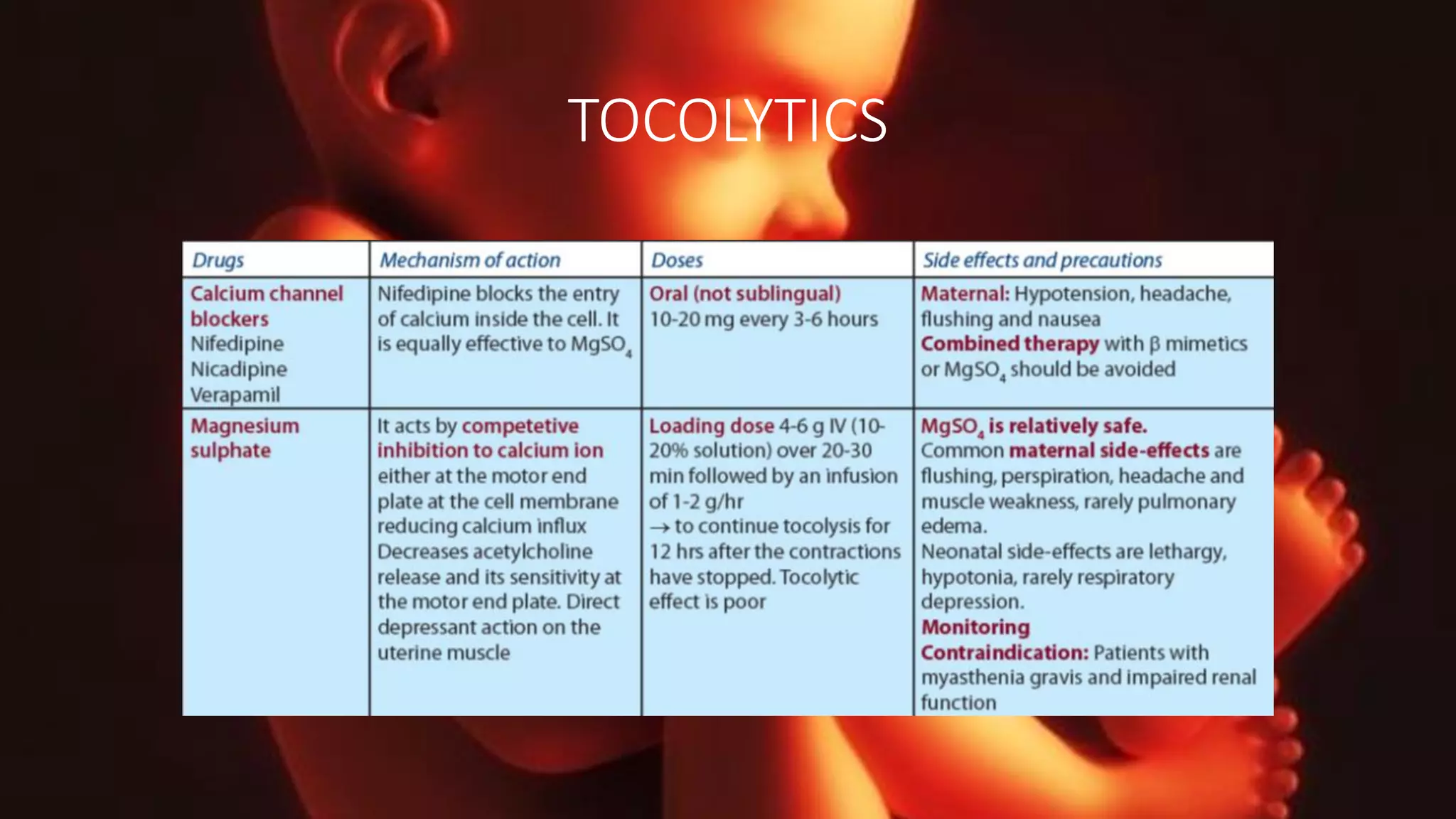
TOCOLYTICS
GLUCOCORTICOIDS
• Maternal administration of glucocorticoids is advocated where the
pregnancy is <34 weeks.
• This helps in fetal lung maturation so that the incidence of RDS, IVH
and NEC are minimized.
• This is beneficial when the delivery is delayed beyond 48 hours of the
first dose. Benefit persists as long as 18 days.
• Either betamethasone 12 mg IM 24 hours apart for 2 doses or
dexamethasone 6 mg IM every 12 hours for 4 doses is given.
• Betamethasone is the steroid of choice (RCOG – 2004).
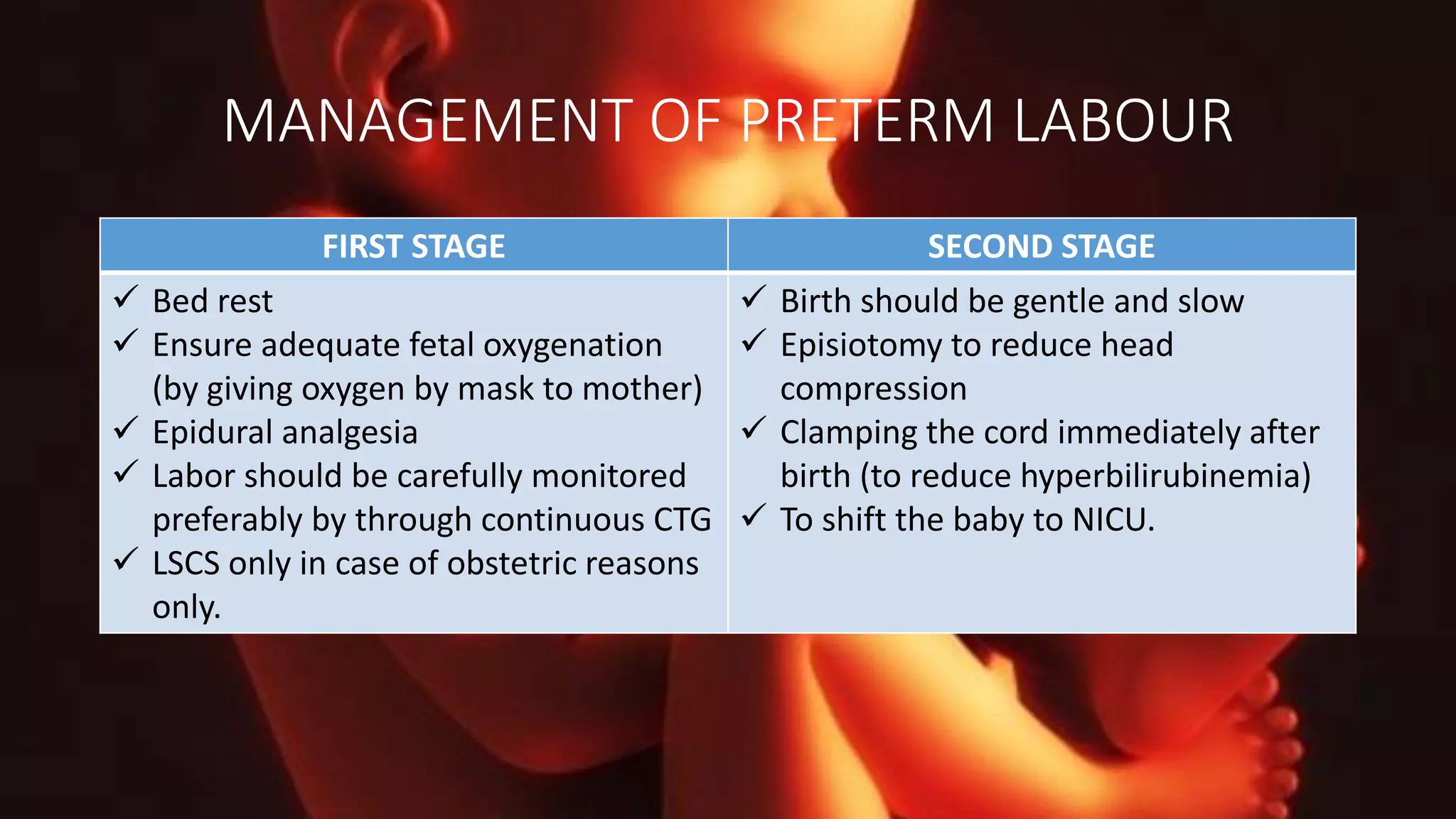
MANAGEMENT OF PRETERM LABOUR
FIRST STAGE SECOND STAGE
 Bed rest
 Ensure adequate fetal oxygenation
(by giving oxygen by mask to mother)
 Epidural analgesia
 Labor should be carefully monitored
preferably by through continuous CTG
 LSCS only in case of obstetric reasons
only.
 Birth should be gentle and slow
 Episiotomy to reduce head
compression
 Clamping the cord immediately after
birth (to reduce hyperbilirubinemia)
 To shift the baby to NICU.
Thank you….
My Email Address: prithwiraj2009@yahoo.in

Preterm labour

  • 2.
    TABLE OF CONTENTS •DEFINITION • RISK FACTORS • ETIOPATHOGENESIS • DIAGNOSIS • TYPES • PREDICTION • ARREST • MANAGEMENT
  • 3.
    DEFINITION  Preterm laboris defined as one where the labor starts before the 37th completed week, counting from the first day of the last menstrual period.
  • 4.
    RISK FACTORS A previousH/O preterm labor: Most consistent risk factor Pre-eclampsia Multiple pregnancy APH PROM Polyhydramnios Genital/ urinary tract infection Low socio-economic status Maternal smoking.
  • 5.
  • 6.
    DIAGNOSIS It is betterto overdiagnose preterm labor than to ignore the possibility of its presence. Diagnostic points are: 1. Regular uterine contractions (at least 1 in every 10 minute) 2. Cervical dilatation (> 2 cm) 3. Cervical effacement (80%) 4. Length of the cervix (measured by TVS) < 2.5 cm and funneling of the internal os.
  • 7.
    TYPES • EARLY pretermlabour: Other diagnostic criteria + cervical dilatation 1- 3 cm • ADVANCED preterm labour: Other diagnostic criteria + cervical dilatation >3 cm • THREATENED preterm labour: Cervical length of <2.5 cm (measured by TVS) + No uterine contractions.
  • 8.
    PREDICTORS OF PRETERMLABOUR • Fetal fibronectin: Fibronectin is a glycoprotein that binds the fetal membranes to the decidua. Normally it is found in the cervicovaginal discharge before 22 weeks and again after 37 weeks of pregnancy. Presence of fibronectin in the cervicovaginal discharge between 24 and 34 weeks is a predictor of preterm labor. When the test is negative it reassures that delivery will not occur within next 7 days. • Cervical length as measured by TVS: <2.5 cm by 24 weeks.
  • 9.
    MEASURES TO ARRESTPRETERM LABOUR • Bed rest in left lateral position • Adequate hydration • Glucocorticoids • Prophylactic cervical circlage (in some cases) • Tocolytics*. * Note: Tocolytics should preferably be avoided as there is no clear benefit (RCOG–2002).
  • 10.
  • 12.
    GLUCOCORTICOIDS • Maternal administrationof glucocorticoids is advocated where the pregnancy is <34 weeks. • This helps in fetal lung maturation so that the incidence of RDS, IVH and NEC are minimized. • This is beneficial when the delivery is delayed beyond 48 hours of the first dose. Benefit persists as long as 18 days. • Either betamethasone 12 mg IM 24 hours apart for 2 doses or dexamethasone 6 mg IM every 12 hours for 4 doses is given. • Betamethasone is the steroid of choice (RCOG – 2004).
  • 13.
    MANAGEMENT OF PRETERMLABOUR FIRST STAGE SECOND STAGE  Bed rest  Ensure adequate fetal oxygenation (by giving oxygen by mask to mother)  Epidural analgesia  Labor should be carefully monitored preferably by through continuous CTG  LSCS only in case of obstetric reasons only.  Birth should be gentle and slow  Episiotomy to reduce head compression  Clamping the cord immediately after birth (to reduce hyperbilirubinemia)  To shift the baby to NICU.
  • 14.
    Thank you…. My EmailAddress: prithwiraj2009@yahoo.in