POLYTRAUMA
&
ITS MANAGEMENT
DR. A. SENGUPTA , Assoc. Prof.
Dr. S. SAHA, Prof.
Department of Orthopedics
R.G.Kar Medical College
KOLKATA
INTRODUCTION
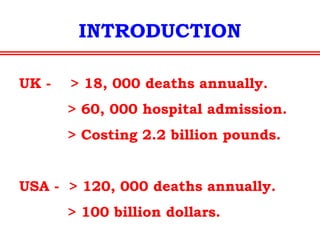
UK - > 18, 000 deaths annually.
> 60, 000 hospital admission.
> Costing 2.2 billion pounds.
USA - > 120, 000 deaths annually.
> 100 billion dollars.
MECHANISMS OF INJURY
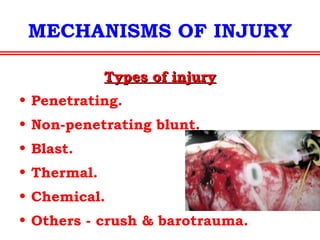
Types of injuryTypes of injury
โ€ข Penetrating.
โ€ข Non-penetrating blunt.
โ€ข Blast.
โ€ข Thermal.
โ€ข Chemical.
โ€ข Others - crush & barotrauma.
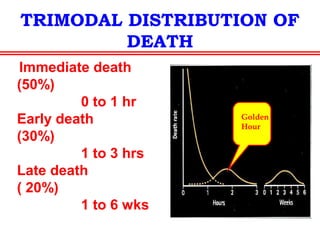
TRIMODAL DISTRIBUTION OF
DEATH
Immediate death
(50%)
0 to 1 hr
Early death
(30%)
1 to 3 hrs
Late death
( 20%)
1 to 6 wks
Golden
Hour
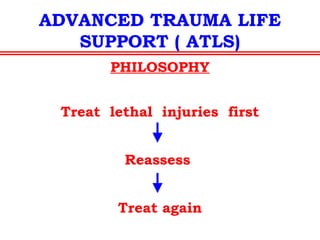
ADVANCED TRAUMA LIFE
SUPPORT ( ATLS)
PHILOSOPHY
Treat lethal injuries first
Reassess
Treat again
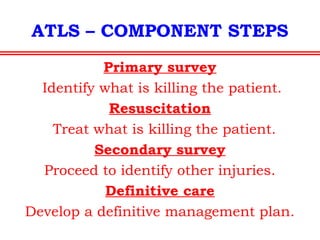
ATLS โ€“ COMPONENT STEPS
Primary survey
Identify what is killing the patient.
Resuscitation
Treat what is killing the patient.
Secondary survey
Proceed to identify other injuries.
Definitive care
Develop a definitive management plan.
PREHOSPITAL RETRIEVAL &
MANAGEMENT
AIMS
Access of the patient
Smooth transfer
APPROACHES
Scoop & Run policy
Stay & Play policy
ORGANISATION OF TRAUMA
CENTRES
LEVEL 1 โ€“ REGIONAL TRAUMA CENTRES
LEVEL 2 โ€“ COMMUNITY TRAUMA CENTRES
LEVEL 3 โ€“ RURAL TRAUMA CENTRES
MANAGEMENT IN HOSPITAL
The
TRAUMA CENTRE
should be adequately equipped
with
ATLS Trained Personnel
MANAGEMENT IN HOSPITAL
THE TRAUMA TEAM
comprises initially of
4 Doctors
At least 1 Anaesthetist
1 Orthopaedician
1 General surgeon
5 Nurses
1 Radiographer
But no more than
6 people should touch the
patient at one time
CAPTAIN OF THE TRAUMA TEAM
Most experienced.
Preferably a general surgeon.
Takes all TRIAGE decisions.
Should be familiar with each
membersโ€™ skills.
Prioritise procedures.
Communicate with consultants
& family members.
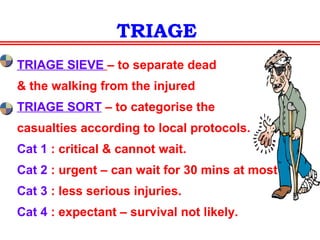
TRIAGE
TRIAGE SIEVE โ€“ to separate dead
& the walking from the injured
TRIAGE SORT โ€“ to categorise the
casualties according to local protocols.
Cat 1 : critical & cannot wait.
Cat 2 : urgent โ€“ can wait for 30 mins at most
Cat 3 : less serious injuries.
Cat 4 : expectant โ€“ survival not likely.
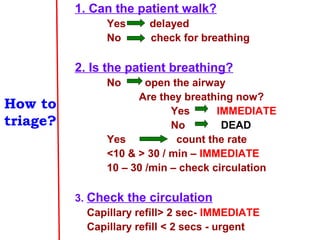
How to
triage?
1. Can the patient walk?
Yes delayed
No check for breathing
2. Is the patient breathing?
No open the airway
Are they breathing now?
Yes IMMEDIATE
No DEAD
Yes count the rate
<10 & > 30 / min โ€“ IMMEDIATE
10 โ€“ 30 /min โ€“ check circulation
3. Check the circulation
Capillary refill> 2 sec- IMMEDIATE
Capillary refill < 2 secs - urgent
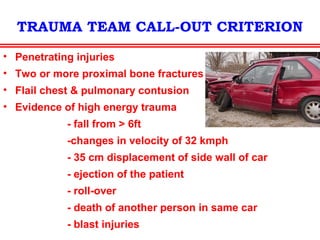
TRAUMA TEAM CALL-OUT CRITERION
โ€ข Penetrating injuries
โ€ข Two or more proximal bone fractures
โ€ข Flail chest & pulmonary contusion
โ€ข Evidence of high energy trauma
- fall from > 6ft
-changes in velocity of 32 kmph
- 35 cm displacement of side wall of car
- ejection of the patient
- roll-over
- death of another person in same car
- blast injuries
ATLS
Primary survey & resuscitation follows
ABCDE sequence
Only radiographs permitted during this
phase are
- cross table lateral C- spine X-ray
- AP supine chest X-ray
- AP plain pelvic film
ATLS- PRIMARY SURVEY
A โ€“ Airway maintenance & control of C.Spine.
B โ€“ Breathing & ventilation.
C โ€“ Circulation & haemorrhage control
D โ€“ Disability limitation
E โ€“ Exposure & environment.
F โ€“ Fracture splintage.
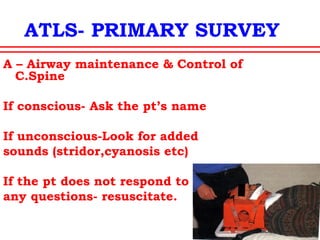
ATLS- PRIMARY SURVEY
A โ€“ Airway maintenance & Control of
C.Spine
If conscious- Ask the ptโ€™s name
If unconscious-Look for added
sounds (stridor,cyanosis etc)
If the pt does not respond to
any questions- resuscitate.
ATLS- PRIMARY SURVEY
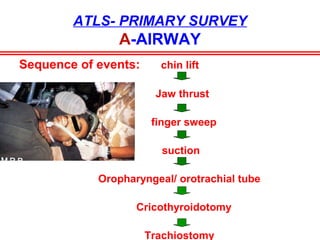
A-AIRWAY
Sequence of events: chin lift
Jaw thrust
finger sweep
suction
Oropharyngeal/ orotrachial tube
Cricothyroidotomy
Trachiostomy
ATLS- Primary Survey
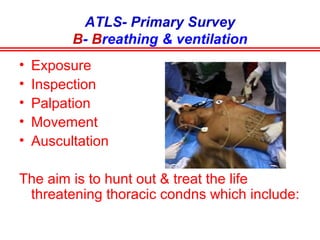
B- Breathing & ventilation
โ€ข Exposure
โ€ข Inspection
โ€ข Palpation
โ€ข Movement
โ€ข Auscultation
The aim is to hunt out & treat the life
threatening thoracic condns which include:
ATLS- Primary Survey
B- Breathing & ventilation
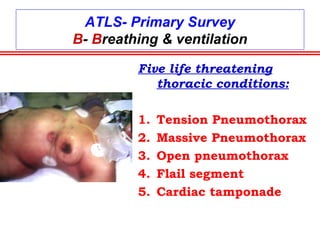
Five life threatening
thoracic conditions:
1. Tension Pneumothorax
2. Massive Pneumothorax
3. Open pneumothorax
4. Flail segment
5. Cardiac tamponade
ATLS- Primary Survey
B- Breathing & ventilation
Tension pneumothorax
C/F Respiratory distress
Tracheal deviation
Diminished breath sounds
Distended neck veins
Immediate needle thoracocentesis throโ€™
2nd
intercostal space in mid clavicular
line reqd.
ATLS- Primary Survey
B- Breathing & ventilation
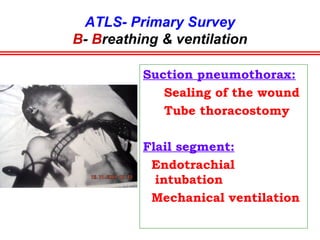
Suction pneumothorax:
Sealing of the wound
Tube thoracostomy
Flail segment:
Endotrachial
intubation
Mechanical ventilation
ATLS- Primary Survey
B- Breathing & ventilation
Cardiac tamponade
(almost always seen with a penetrating wound)
Beckโ€™s triad: Hypotension
distended neck veins
Muffled heart sounds
Pulsus paradoxus
Treatment: needle pericardiocentes
Thoracotomy & repair as def
managemnt
ATLS- Primary Survey
C- Circulation and hge control
Tachycardia in a cold patient indicates shock
Causes of shock following injury:
1. Hypovolemic
2. Cardiogenic
3. Neurogenic
4. Septic
ATLS- Primary Survey
C- Circulation and hge control
Assessment of blood loss
External or obvious
Internal or covert
chest
abdomen
pelvis
limbs
Resuscitation
Arrest bleeding
Obtain vascular access
ATLS- Primary Survey
C- Circulation and hge control
Adults- 2 lit of Ringer lact soln as initial fluid
challenge
Children- 20mg/kg of body wt
Response to initial fluid challenge:
โ€ข Immediate & sustained return of vital
signs.
โ€ข Transient response with later
deterioration
โ€ข No improvement.
ATLS- Primary Survey
C- Circulation and hge control
Immediate responders-<20% blood loss
Bleeding ceases
spontaneously
Transient responders-
bleeding within body
cavities
Surgical intervention reqd.
Non responders-
>40% of blood vol lost
require immediate surgery
Continued IV fluids detrimental
ATLS- Primary Survey
C- Circulation and hge control
Urine output โ€“
0.5ml/kg/hr in adults
1ml/kg/hr in children
2ml/kg/hr in infants
ATLS- Primary Survey
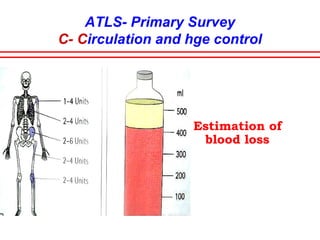
C- Circulation and hge control
Estimation of
blood loss
ATLS- Primary Survey
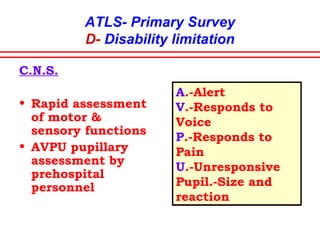
D- Disability limitation
C.N.S.
โ€ข Rapid assessment
of motor &
sensory functions
โ€ข AVPU pupillary
assessment by
prehospital
personnel
A.-Alert
V.-Responds to
Voice
P.-Responds to
Pain
U.-Unresponsive
Pupil.-Size and
reaction
ATLS-Primary survey
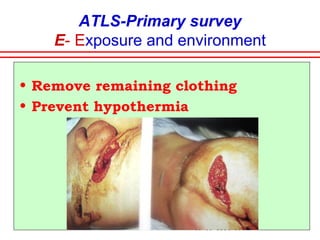
E- Exposure and environment
โ€ข Remove remaining clothing
โ€ข Prevent hypothermia
ATLS-Primary survey
F- Fracture management
1. Minor
2. Moderate open # of digits
undisplaced long bone or pelvis #
3. Serious closed long bone #s
multiple hand/foot #s
4. Severe life threatening
open long bone #
pelvis # with displacement
dislocation of major joints
multiple amputations of digits
amputation of limbs
multiple closed long bone #s
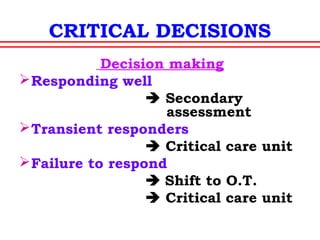
CRITICAL DECISIONS
Decision making
๏ƒ˜Responding well
๏ƒจ Secondary
assessment
๏ƒ˜Transient responders
๏ƒจ Critical care unit
๏ƒ˜Failure to respond
๏ƒจ Shift to O.T.
๏ƒจ Critical care unit
Medication
โ€ข Tetanus prophylaxis
โ€ข Steroids
โ€ข Inotrophic drugs
โ€ข Antiobiotics
โ€ข Calcium gluconate
โ€ข Bicarbonate
Secondary survey (ATLS)
โ€ข Comprises of head to toe examn of the
stable pt
โ€ข Requires
Detailed history
Thorough examination
check the vital signs monitoring devices
-pulse oximeter
-rectal thermometer
โ€ข Detailed radiographic procedures
-C.T., USG, M.R.I.
Secondary survey (ATLS)
HEAD
โ€ข Glasgow coma scale
โ€ข Reaction and size of pupils
โ€ข Plantar response
โ€ข Signs of rhinorrhoea,otorrhoea
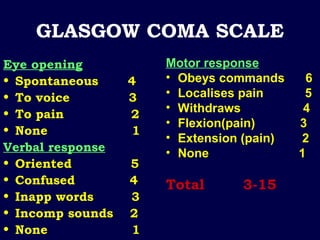
GLASGOW COMA SCALE
Eye opening
โ€ข Spontaneous 4
โ€ข To voice 3
โ€ข To pain 2
โ€ข None 1
Verbal response
โ€ข Oriented 5
โ€ข Confused 4
โ€ข Inapp words 3
โ€ข Incomp sounds 2
โ€ข None 1
Motor response
โ€ข Obeys commands 6
โ€ข Localises pain 5
โ€ข Withdraws 4
โ€ข Flexion(pain) 3
โ€ข Extension (pain) 2
โ€ข None 1
Total 3-15
Secondary survey (ATLS)
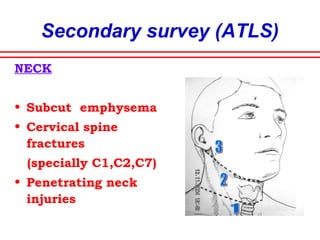
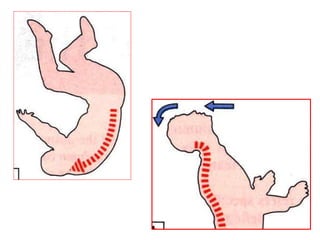
NECK
โ€ข Subcut emphysema
โ€ข Cervical spine
fractures
(specially C1,C2,C7)
โ€ข Penetrating neck
injuries
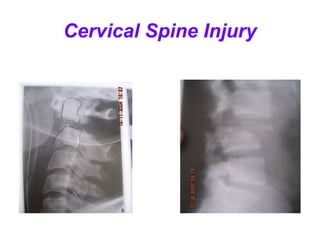
Cervical Spine Injury
Secondary survey (ATLS)
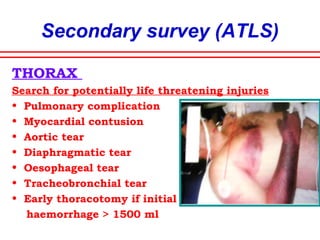
THORAX
Search for potentially life threatening injuries
โ€ข Pulmonary complication
โ€ข Myocardial contusion
โ€ข Aortic tear
โ€ข Diaphragmatic tear
โ€ข Oesophageal tear
โ€ข Tracheobronchial tear
โ€ข Early thoracotomy if initial
haemorrhage > 1500 ml
Secondary survey (ATLS)
ABDOMEN
โ€ข Fingers and tubes in every orifice
โ€ข Nasogastric and Urinary catheter for
diagnosis and treatment
โ€ข Rectal exam
โ€ข Wounds coverage
โ€ข Eviscerated bowels packed by warm
wet mops
Secondary survey (ATLS)
ABDOMEN
For rigid and distended abdomen
โ€ข Four quadrant tap
โ€ข Diagnostic peritoneal lavage
โ€ข Ultrasound
โ€ข Laparoscopic examination
Consider rapid surgical exploration
Any deterioration
Secondary survey (ATLS)
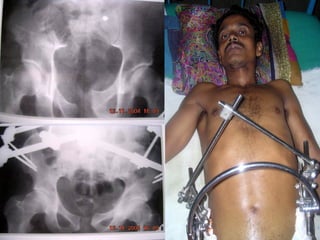
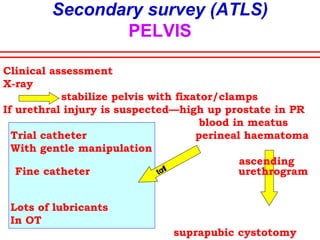
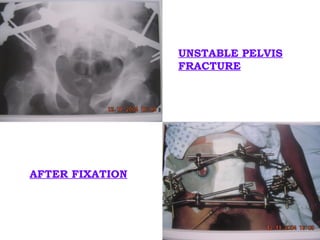
PELVIS
Clinical assessment
X-ray
stabilize pelvis with fixator/clamps
If urethral injury is suspectedโ€”high up prostate in PR
blood in meatus
Trial catheter perineal haematoma
With gentle manipulation
ascending
Fine catheter urethrogram
Lots of lubricants
In OT
suprapubic cystotomy
Ifnot
UNSTABLE PELVIS
FRACTURE
AFTER FIXATION
Secondary survey (ATLS)
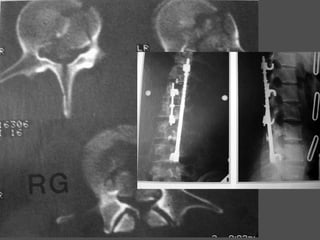
Spinal injury
Thorough sensory and motor examination
โ€ข Prevent further damage in unstable
fractures
โ€ข Log rolling for full neurological
examination-5 people required
โ€ข Use a long spine board for transportation
Secondary survey (ATLS)
EXTREMITIES
โ€ข Full assessment of limbs for
assessment of injury
โ€ข Always look for distal pulse &
neuro-status
โ€ข Carefully look for skin & soft tissue
viability
โ€ข Look out for impending
Compartment syndrome
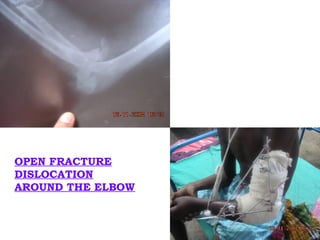
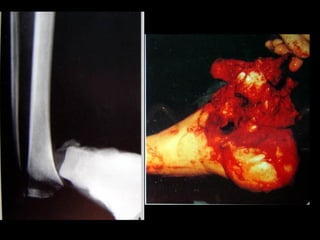
OPEN FRACTURE
DISLOCATION
AROUND THE ELBOW
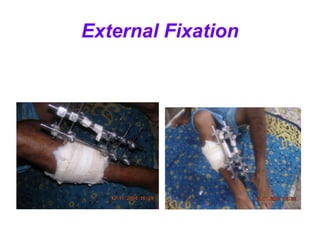
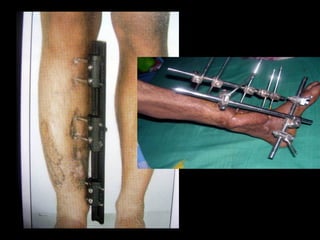
External Fixation
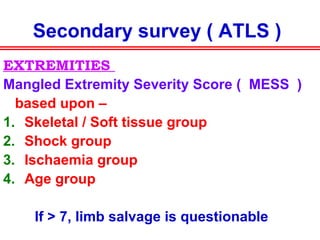
Secondary survey ( ATLS )
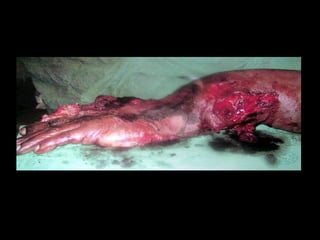
EXTREMITIES
Mangled Extremity Severity Score ( MESS )
based upon โ€“
1. Skeletal / Soft tissue group
2. Shock group
3. Ischaemia group
4. Age group
If > 7, limb salvage is questionable
Definitive care plan(ATLS)
Multi-speciality approach
( Inter-disciplinary
management )
The most appropriate person in-
charge
is the General / Orthopaedic
surgeon.
Current concepts
Permissive hypotension
Maintain systolic B.P. at 85 - 95 mm of Hg
Turn off the tap and do not infuse
too much of fluid and blood products
Complications
โ€ข Tetanus
โ€ข A.R.D.S.
โ€ข Fat embolism
โ€ข D.I.C.
โ€ข Crush syndrome
โ€ข Multisystem organ failure
(M.S.O.F.)
Complications
A.R.D.S.A.R.D.S.
โ€ข Tachypnoea
โ€ข Dyspnoea
โ€ข Bilateral infiltrates in C XR
Treated with mechanical ventilation CPAP
with or without PEEP
Glucocorticoids
Inhaled nitric oxide
Complications
Fat embolismFat embolism
โ€ข Around 72 hours
โ€ข Tachycardia
โ€ข Tachypnoea
โ€ข Dyspnoea
โ€ข Chest pain
โ€ข Petechial haemorrhage
Treated with ----- mechanical ventilation
------anticoagulants
------fixation of fractures
Complications
Disseminated intravascular coagulationDisseminated intravascular coagulation
โ€ข Follows severe blood loss and sepsis
โ€ข Restlessness , confusion,neurological
dysfunction,skin infercation,oligurea
โ€ข Excessive bleeding
โ€ข Prolonged PT,PTT,TT,hypofibrinogenemia
Treatmentโ€“ prevention and early correction and
shock
Complications
Crush syndromeCrush syndrome
โ€ข When a limb remains compressed for many
hours
โ€ข Compartment syndrome and further ischaemia
โ€ข Cardiac arrest due to metabolic changes in
blood
โ€ข Renal failure
Treatment
โ€ข Prevention-ensure high urine flow during
extrication
โ€ข IV Crystalloids,Forced mannitol alkaline
diuresis
โ€ข Fasciotomy and excision of devitalised muscles
โ€ข Amputation
Complications
M.S.O.F.M.S.O.F.
Progressive and sequential dysfunction of physiological
systems
Hypermetabolic state
It is invariably preceded by a condition known as
Systemic Inflammatory Response Syndrome (SIRS)
Characterised by two or more of the following
โ€ข Temperature >38ยบ C or < 36ยบC
โ€ข Tachycardia >90 /min
โ€ข Respiratory rate >20/min
โ€ข WBC count >12,000/cmm or <4,000/cmm
Complications
M.S.O.F.
Treatment : Key word is PREVENTION
โ€ข Prompt stabilisation of fracture
โ€ข Treatment of shock
โ€ข Prevention of hypoxia
โ€ข Excision of all dirty and dead tissue
โ€ข Early diagnosis and treatment of infection
โ€ข Nutritional support
Conclusion
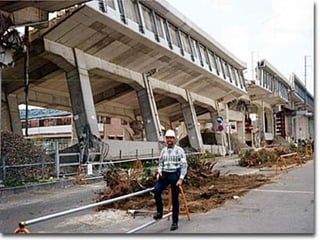
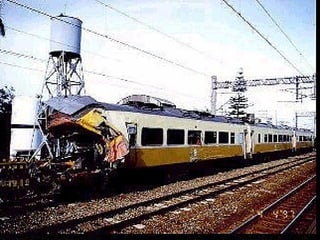
High velocity trauma is aptly called neglected step
child of modern civilisation being the number one
cause of death in 18 to 34 years age group. Despite
the major economic productivity losses due to this
problem injury receives < 2 % of the total health
budget allocation. Adequate funding & legislations
must be passed to reduce the enormous impact on
the society.
Polytrauma Management

Polytrauma Management

  • 1.
    POLYTRAUMA & ITS MANAGEMENT DR. A.SENGUPTA , Assoc. Prof. Dr. S. SAHA, Prof. Department of Orthopedics R.G.Kar Medical College KOLKATA
  • 3.
    INTRODUCTION UK - >18, 000 deaths annually. > 60, 000 hospital admission. > Costing 2.2 billion pounds. USA - > 120, 000 deaths annually. > 100 billion dollars.
  • 4.
    MECHANISMS OF INJURY Typesof injuryTypes of injury โ€ข Penetrating. โ€ข Non-penetrating blunt. โ€ข Blast. โ€ข Thermal. โ€ข Chemical. โ€ข Others - crush & barotrauma.
  • 5.
    TRIMODAL DISTRIBUTION OF DEATH Immediatedeath (50%) 0 to 1 hr Early death (30%) 1 to 3 hrs Late death ( 20%) 1 to 6 wks Golden Hour
  • 6.
    ADVANCED TRAUMA LIFE SUPPORT( ATLS) PHILOSOPHY Treat lethal injuries first Reassess Treat again
  • 7.
    ATLS โ€“ COMPONENTSTEPS Primary survey Identify what is killing the patient. Resuscitation Treat what is killing the patient. Secondary survey Proceed to identify other injuries. Definitive care Develop a definitive management plan.
  • 8.
    PREHOSPITAL RETRIEVAL & MANAGEMENT AIMS Accessof the patient Smooth transfer APPROACHES Scoop & Run policy Stay & Play policy
  • 9.
    ORGANISATION OF TRAUMA CENTRES LEVEL1 โ€“ REGIONAL TRAUMA CENTRES LEVEL 2 โ€“ COMMUNITY TRAUMA CENTRES LEVEL 3 โ€“ RURAL TRAUMA CENTRES
  • 10.
    MANAGEMENT IN HOSPITAL The TRAUMACENTRE should be adequately equipped with ATLS Trained Personnel
  • 11.
    MANAGEMENT IN HOSPITAL THETRAUMA TEAM comprises initially of 4 Doctors At least 1 Anaesthetist 1 Orthopaedician 1 General surgeon 5 Nurses 1 Radiographer
  • 12.
    But no morethan 6 people should touch the patient at one time
  • 13.
    CAPTAIN OF THETRAUMA TEAM Most experienced. Preferably a general surgeon. Takes all TRIAGE decisions. Should be familiar with each membersโ€™ skills. Prioritise procedures. Communicate with consultants & family members.
  • 15.
    TRIAGE TRIAGE SIEVE โ€“to separate dead & the walking from the injured TRIAGE SORT โ€“ to categorise the casualties according to local protocols. Cat 1 : critical & cannot wait. Cat 2 : urgent โ€“ can wait for 30 mins at most Cat 3 : less serious injuries. Cat 4 : expectant โ€“ survival not likely.
  • 16.
    How to triage? 1. Canthe patient walk? Yes delayed No check for breathing 2. Is the patient breathing? No open the airway Are they breathing now? Yes IMMEDIATE No DEAD Yes count the rate <10 & > 30 / min โ€“ IMMEDIATE 10 โ€“ 30 /min โ€“ check circulation 3. Check the circulation Capillary refill> 2 sec- IMMEDIATE Capillary refill < 2 secs - urgent
  • 17.
    TRAUMA TEAM CALL-OUTCRITERION โ€ข Penetrating injuries โ€ข Two or more proximal bone fractures โ€ข Flail chest & pulmonary contusion โ€ข Evidence of high energy trauma - fall from > 6ft -changes in velocity of 32 kmph - 35 cm displacement of side wall of car - ejection of the patient - roll-over - death of another person in same car - blast injuries
  • 19.
    ATLS Primary survey &resuscitation follows ABCDE sequence Only radiographs permitted during this phase are - cross table lateral C- spine X-ray - AP supine chest X-ray - AP plain pelvic film
  • 20.
    ATLS- PRIMARY SURVEY Aโ€“ Airway maintenance & control of C.Spine. B โ€“ Breathing & ventilation. C โ€“ Circulation & haemorrhage control D โ€“ Disability limitation E โ€“ Exposure & environment. F โ€“ Fracture splintage.
  • 21.
    ATLS- PRIMARY SURVEY Aโ€“ Airway maintenance & Control of C.Spine If conscious- Ask the ptโ€™s name If unconscious-Look for added sounds (stridor,cyanosis etc) If the pt does not respond to any questions- resuscitate.
  • 22.
    ATLS- PRIMARY SURVEY A-AIRWAY Sequenceof events: chin lift Jaw thrust finger sweep suction Oropharyngeal/ orotrachial tube Cricothyroidotomy Trachiostomy
  • 23.
    ATLS- Primary Survey B-Breathing & ventilation โ€ข Exposure โ€ข Inspection โ€ข Palpation โ€ข Movement โ€ข Auscultation The aim is to hunt out & treat the life threatening thoracic condns which include:
  • 24.
    ATLS- Primary Survey B-Breathing & ventilation Five life threatening thoracic conditions: 1. Tension Pneumothorax 2. Massive Pneumothorax 3. Open pneumothorax 4. Flail segment 5. Cardiac tamponade
  • 25.
    ATLS- Primary Survey B-Breathing & ventilation Tension pneumothorax C/F Respiratory distress Tracheal deviation Diminished breath sounds Distended neck veins Immediate needle thoracocentesis throโ€™ 2nd intercostal space in mid clavicular line reqd.
  • 26.
    ATLS- Primary Survey B-Breathing & ventilation Suction pneumothorax: Sealing of the wound Tube thoracostomy Flail segment: Endotrachial intubation Mechanical ventilation
  • 27.
    ATLS- Primary Survey B-Breathing & ventilation Cardiac tamponade (almost always seen with a penetrating wound) Beckโ€™s triad: Hypotension distended neck veins Muffled heart sounds Pulsus paradoxus Treatment: needle pericardiocentes Thoracotomy & repair as def managemnt
  • 28.
    ATLS- Primary Survey C-Circulation and hge control Tachycardia in a cold patient indicates shock Causes of shock following injury: 1. Hypovolemic 2. Cardiogenic 3. Neurogenic 4. Septic
  • 29.
    ATLS- Primary Survey C-Circulation and hge control Assessment of blood loss External or obvious Internal or covert chest abdomen pelvis limbs Resuscitation Arrest bleeding Obtain vascular access
  • 30.
    ATLS- Primary Survey C-Circulation and hge control Adults- 2 lit of Ringer lact soln as initial fluid challenge Children- 20mg/kg of body wt Response to initial fluid challenge: โ€ข Immediate & sustained return of vital signs. โ€ข Transient response with later deterioration โ€ข No improvement.
  • 32.
    ATLS- Primary Survey C-Circulation and hge control Immediate responders-<20% blood loss Bleeding ceases spontaneously Transient responders- bleeding within body cavities Surgical intervention reqd. Non responders- >40% of blood vol lost require immediate surgery Continued IV fluids detrimental
  • 33.
    ATLS- Primary Survey C-Circulation and hge control Urine output โ€“ 0.5ml/kg/hr in adults 1ml/kg/hr in children 2ml/kg/hr in infants
  • 34.
    ATLS- Primary Survey C-Circulation and hge control Estimation of blood loss
  • 35.
    ATLS- Primary Survey D-Disability limitation C.N.S. โ€ข Rapid assessment of motor & sensory functions โ€ข AVPU pupillary assessment by prehospital personnel A.-Alert V.-Responds to Voice P.-Responds to Pain U.-Unresponsive Pupil.-Size and reaction
  • 36.
    ATLS-Primary survey E- Exposureand environment โ€ข Remove remaining clothing โ€ข Prevent hypothermia
  • 37.
    ATLS-Primary survey F- Fracturemanagement 1. Minor 2. Moderate open # of digits undisplaced long bone or pelvis # 3. Serious closed long bone #s multiple hand/foot #s 4. Severe life threatening open long bone # pelvis # with displacement dislocation of major joints multiple amputations of digits amputation of limbs multiple closed long bone #s
  • 40.
    CRITICAL DECISIONS Decision making ๏ƒ˜Respondingwell ๏ƒจ Secondary assessment ๏ƒ˜Transient responders ๏ƒจ Critical care unit ๏ƒ˜Failure to respond ๏ƒจ Shift to O.T. ๏ƒจ Critical care unit
  • 41.
    Medication โ€ข Tetanus prophylaxis โ€ขSteroids โ€ข Inotrophic drugs โ€ข Antiobiotics โ€ข Calcium gluconate โ€ข Bicarbonate
  • 43.
    Secondary survey (ATLS) โ€ขComprises of head to toe examn of the stable pt โ€ข Requires Detailed history Thorough examination check the vital signs monitoring devices -pulse oximeter -rectal thermometer โ€ข Detailed radiographic procedures -C.T., USG, M.R.I.
  • 44.
    Secondary survey (ATLS) HEAD โ€ขGlasgow coma scale โ€ข Reaction and size of pupils โ€ข Plantar response โ€ข Signs of rhinorrhoea,otorrhoea
  • 45.
    GLASGOW COMA SCALE Eyeopening โ€ข Spontaneous 4 โ€ข To voice 3 โ€ข To pain 2 โ€ข None 1 Verbal response โ€ข Oriented 5 โ€ข Confused 4 โ€ข Inapp words 3 โ€ข Incomp sounds 2 โ€ข None 1 Motor response โ€ข Obeys commands 6 โ€ข Localises pain 5 โ€ข Withdraws 4 โ€ข Flexion(pain) 3 โ€ข Extension (pain) 2 โ€ข None 1 Total 3-15
  • 46.
    Secondary survey (ATLS) NECK โ€ขSubcut emphysema โ€ข Cervical spine fractures (specially C1,C2,C7) โ€ข Penetrating neck injuries
  • 47.
  • 48.
    Secondary survey (ATLS) THORAX Searchfor potentially life threatening injuries โ€ข Pulmonary complication โ€ข Myocardial contusion โ€ข Aortic tear โ€ข Diaphragmatic tear โ€ข Oesophageal tear โ€ข Tracheobronchial tear โ€ข Early thoracotomy if initial haemorrhage > 1500 ml
  • 49.
    Secondary survey (ATLS) ABDOMEN โ€ขFingers and tubes in every orifice โ€ข Nasogastric and Urinary catheter for diagnosis and treatment โ€ข Rectal exam โ€ข Wounds coverage โ€ข Eviscerated bowels packed by warm wet mops
  • 50.
    Secondary survey (ATLS) ABDOMEN Forrigid and distended abdomen โ€ข Four quadrant tap โ€ข Diagnostic peritoneal lavage โ€ข Ultrasound โ€ข Laparoscopic examination Consider rapid surgical exploration Any deterioration
  • 51.
    Secondary survey (ATLS) PELVIS Clinicalassessment X-ray stabilize pelvis with fixator/clamps If urethral injury is suspectedโ€”high up prostate in PR blood in meatus Trial catheter perineal haematoma With gentle manipulation ascending Fine catheter urethrogram Lots of lubricants In OT suprapubic cystotomy Ifnot
  • 52.
  • 53.
    Secondary survey (ATLS) Spinalinjury Thorough sensory and motor examination โ€ข Prevent further damage in unstable fractures โ€ข Log rolling for full neurological examination-5 people required โ€ข Use a long spine board for transportation
  • 55.
    Secondary survey (ATLS) EXTREMITIES โ€ขFull assessment of limbs for assessment of injury โ€ข Always look for distal pulse & neuro-status โ€ข Carefully look for skin & soft tissue viability โ€ข Look out for impending Compartment syndrome
  • 56.
  • 57.
  • 59.
    Secondary survey (ATLS ) EXTREMITIES Mangled Extremity Severity Score ( MESS ) based upon โ€“ 1. Skeletal / Soft tissue group 2. Shock group 3. Ischaemia group 4. Age group If > 7, limb salvage is questionable
  • 62.
    Definitive care plan(ATLS) Multi-specialityapproach ( Inter-disciplinary management ) The most appropriate person in- charge is the General / Orthopaedic surgeon.
  • 65.
    Current concepts Permissive hypotension Maintainsystolic B.P. at 85 - 95 mm of Hg Turn off the tap and do not infuse too much of fluid and blood products
  • 66.
    Complications โ€ข Tetanus โ€ข A.R.D.S. โ€ขFat embolism โ€ข D.I.C. โ€ข Crush syndrome โ€ข Multisystem organ failure (M.S.O.F.)
  • 67.
    Complications A.R.D.S.A.R.D.S. โ€ข Tachypnoea โ€ข Dyspnoea โ€ขBilateral infiltrates in C XR Treated with mechanical ventilation CPAP with or without PEEP Glucocorticoids Inhaled nitric oxide
  • 68.
    Complications Fat embolismFat embolism โ€ขAround 72 hours โ€ข Tachycardia โ€ข Tachypnoea โ€ข Dyspnoea โ€ข Chest pain โ€ข Petechial haemorrhage Treated with ----- mechanical ventilation ------anticoagulants ------fixation of fractures
  • 69.
    Complications Disseminated intravascular coagulationDisseminatedintravascular coagulation โ€ข Follows severe blood loss and sepsis โ€ข Restlessness , confusion,neurological dysfunction,skin infercation,oligurea โ€ข Excessive bleeding โ€ข Prolonged PT,PTT,TT,hypofibrinogenemia Treatmentโ€“ prevention and early correction and shock
  • 70.
    Complications Crush syndromeCrush syndrome โ€ขWhen a limb remains compressed for many hours โ€ข Compartment syndrome and further ischaemia โ€ข Cardiac arrest due to metabolic changes in blood โ€ข Renal failure Treatment โ€ข Prevention-ensure high urine flow during extrication โ€ข IV Crystalloids,Forced mannitol alkaline diuresis โ€ข Fasciotomy and excision of devitalised muscles โ€ข Amputation
  • 71.
    Complications M.S.O.F.M.S.O.F. Progressive and sequentialdysfunction of physiological systems Hypermetabolic state It is invariably preceded by a condition known as Systemic Inflammatory Response Syndrome (SIRS) Characterised by two or more of the following โ€ข Temperature >38ยบ C or < 36ยบC โ€ข Tachycardia >90 /min โ€ข Respiratory rate >20/min โ€ข WBC count >12,000/cmm or <4,000/cmm
  • 72.
    Complications M.S.O.F. Treatment : Keyword is PREVENTION โ€ข Prompt stabilisation of fracture โ€ข Treatment of shock โ€ข Prevention of hypoxia โ€ข Excision of all dirty and dead tissue โ€ข Early diagnosis and treatment of infection โ€ข Nutritional support
  • 73.
    Conclusion High velocity traumais aptly called neglected step child of modern civilisation being the number one cause of death in 18 to 34 years age group. Despite the major economic productivity losses due to this problem injury receives < 2 % of the total health budget allocation. Adequate funding & legislations must be passed to reduce the enormous impact on the society.