Hypertensiveretinopathy:
AReviewForPGpreparation
Dr.PrithwirajMaiti
Intern,R.G.KarMedicalCollege,Kolkata
FounderofPgblasterIndia
Authorofthefollowingtitles(BothpublishedbyJaypeeBrothers):
APracticalHandbookofPathologySpecimensandSlides&
AnUltimateGuidetoCommunityMedicine
Contents
• Introduction
• Pathogenesis
• Grading
• Clinical types
• Clinical features
• Diagnosis
• Management
Introduction
• Hypertensive retinopathy refers to the changes in the fundus
occurring in a patient of systemic hypertension.
Pathogenesis
3 factors are responsible for pathogenesis of hypertensive retinopathy:
1. Vasoconstriction: It is the primary response of retinal arterioles to
raised blood pressure. It reflects the severity of hypertension.
2. Atherosclerosis: It mainly occurs in older patients. It reflects the
duration of hypertension.
3. Increased vascular permeability: It results from hypoxia and may
result in retinal edema, exudates and hemorrhages.
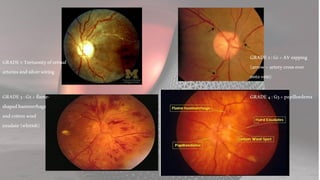
Keith and Wegner Grading (1939)
GRADE 1 : Tortuosity (twisting) of retinal arteries with increased
reflectiveness (silver wiring)
GRADE 2 : Grade 1 + Arteriovenous napping (thickened retinal arteries pass
over retinal veins)
GRADE 3 : Grade 2 + flamed shape haemorrhage and cotton wool exudates
(due to small infarct)
GRADE 4 : Grade 3 + papilloedema (blurry margin of the optic disc due to
swelling).
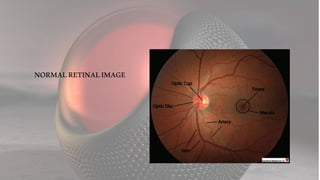
NORMALRETINALIMAGE
GRADE1:Tortuosityofretinal
arteriesandsilverwiring
GRADE2:G1+AVnipping
(arrow–arterycrossover
ontovein)
GRADE3:G2+flame-
shapedhaemorrhage
andcottonwool
exudate(whitish)
GRADE4:G3+papilloedema
Clinical types
4 clinical types are seen:
Hypertension with involutionary (senile) sclerosis: In old age patients
Hypertension without sclerosis: In young patients exposed to raised BP for
a short duration
Hypertension with compensatory arteriolar sclerosis: In young patients
exposed to benign hypertension for a long duration (usually associated
with benign nephrosclerosis; thus called renal retinopathy)
Malignant hypertension: Rapidly progressive and severe changes in fundus
(marked vasoconstriction, papilloedema, flame shaped hemorrhage, cotton
wool spots…. everything is seen; but papilloedema is an essential feature).
Clinical features
• Acute malignant hypertension will cause patients to complain of eye
pain, headaches or reduced visual acuity.
• Chronic arteriosclerotic changes from hypertension will not cause any
symptoms alone.
Diagnosis
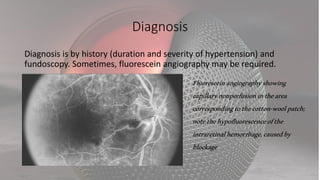
Diagnosis is by history (duration and severity of hypertension) and
fundoscopy. Sometimes, fluorescein angiography may be required.
Fluoresceinangiographyshowing
capillarynonperfusioninthearea
correspondingtothecotton-woolpatch;
notethehypofluorescenceofthe
intraretinalhemorrhage,causedby
blockage
Management
• By itself, chronic hypertensive retinopathy rarely, if ever, results in
significant loss of vision. Treatment of the underlying systemic
condition can halt the progress of the retinal changes, but arteriolar
narrowing and arteriovenous nicking usually are permanent.
• Treatment of malignant hypertensive retinopathy consists of lowering
blood pressure in a slow, deliberate, controlled fashion to prevent
end-organ damage.
• Too rapid a decline can lead to ischemia of the optic nerve head, brain
and other vital organs, resulting in permanent damage.
• Drugs that are commonly used in the outpatient setting to reduce
blood pressure include:
Angiotensin converting enzyme inhibitors,
Calcium channel blockers,
Diuretics, and
β-adrenergic blockers.
• Very rarely, If vision loss occurs, treatment of the retinal edema with
laser or with intravitreal injection of corticosteroids or antivascular
endothelial growth factor drugs (eg, ranibizumab, pegaptanib,
bevacizumab) may be useful.
Thank you….

Hypertensive retinopathy

  • 1.
  • 2.
    Contents • Introduction • Pathogenesis •Grading • Clinical types • Clinical features • Diagnosis • Management
  • 3.
    Introduction • Hypertensive retinopathyrefers to the changes in the fundus occurring in a patient of systemic hypertension.
  • 4.
    Pathogenesis 3 factors areresponsible for pathogenesis of hypertensive retinopathy: 1. Vasoconstriction: It is the primary response of retinal arterioles to raised blood pressure. It reflects the severity of hypertension. 2. Atherosclerosis: It mainly occurs in older patients. It reflects the duration of hypertension. 3. Increased vascular permeability: It results from hypoxia and may result in retinal edema, exudates and hemorrhages.
  • 5.
    Keith and WegnerGrading (1939) GRADE 1 : Tortuosity (twisting) of retinal arteries with increased reflectiveness (silver wiring) GRADE 2 : Grade 1 + Arteriovenous napping (thickened retinal arteries pass over retinal veins) GRADE 3 : Grade 2 + flamed shape haemorrhage and cotton wool exudates (due to small infarct) GRADE 4 : Grade 3 + papilloedema (blurry margin of the optic disc due to swelling).
  • 6.
  • 7.
  • 8.
    Clinical types 4 clinicaltypes are seen: Hypertension with involutionary (senile) sclerosis: In old age patients Hypertension without sclerosis: In young patients exposed to raised BP for a short duration Hypertension with compensatory arteriolar sclerosis: In young patients exposed to benign hypertension for a long duration (usually associated with benign nephrosclerosis; thus called renal retinopathy) Malignant hypertension: Rapidly progressive and severe changes in fundus (marked vasoconstriction, papilloedema, flame shaped hemorrhage, cotton wool spots…. everything is seen; but papilloedema is an essential feature).
  • 9.
    Clinical features • Acutemalignant hypertension will cause patients to complain of eye pain, headaches or reduced visual acuity. • Chronic arteriosclerotic changes from hypertension will not cause any symptoms alone.
  • 10.
    Diagnosis Diagnosis is byhistory (duration and severity of hypertension) and fundoscopy. Sometimes, fluorescein angiography may be required. Fluoresceinangiographyshowing capillarynonperfusioninthearea correspondingtothecotton-woolpatch; notethehypofluorescenceofthe intraretinalhemorrhage,causedby blockage
  • 11.
    Management • By itself,chronic hypertensive retinopathy rarely, if ever, results in significant loss of vision. Treatment of the underlying systemic condition can halt the progress of the retinal changes, but arteriolar narrowing and arteriovenous nicking usually are permanent. • Treatment of malignant hypertensive retinopathy consists of lowering blood pressure in a slow, deliberate, controlled fashion to prevent end-organ damage. • Too rapid a decline can lead to ischemia of the optic nerve head, brain and other vital organs, resulting in permanent damage.
  • 12.
    • Drugs thatare commonly used in the outpatient setting to reduce blood pressure include: Angiotensin converting enzyme inhibitors, Calcium channel blockers, Diuretics, and β-adrenergic blockers. • Very rarely, If vision loss occurs, treatment of the retinal edema with laser or with intravitreal injection of corticosteroids or antivascular endothelial growth factor drugs (eg, ranibizumab, pegaptanib, bevacizumab) may be useful.
  • 13.