DIABETIC RETINOPATHY
Jose M De Jesus, OD, MD, MA
Objectives
• Diabetic retinopathy implications as a public health issue
and a leading cause of blindness in industrialized countries
• Discuss risk factors
• Discuss pathophysiology and the different stages
• Discuss management approach
- Prevention – risk factor control and annual dilated
retinal examinations
- Treatment modalities
Overview
Diabetes Mellitus
Hyperglycemia resulting from body’s inability to produce and/or utilize
insulin
•Type 1
- children and young adults
- immune prone
- no insulin production
- 5% of DM pts
• Type 2
- mostly adult onset (increase incidence at earlier age)
- insulin resistance followed by decreased production
- MC
- obesity
Diabetic Retinopathy (DR)
• Implicated by both types of DM
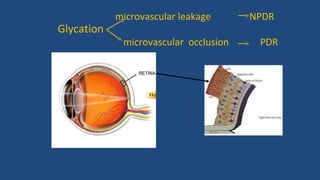
• Progressive glycation on retinal blood vessel wall
• Initially asymptomatic
• Microvascular leakage
• Microvascular occlusion
microvascular leakage NPDR
microvascular occlusion PDR
Glycation
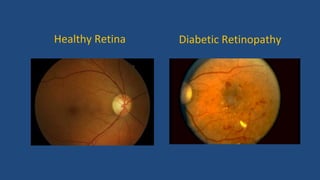
Healthy Retina Diabetic Retinopathy
Epidemiology
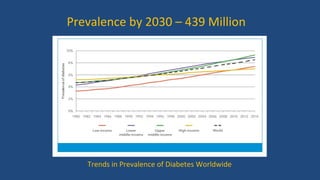
Trends in Prevalence of Diabetes Worldwide
Prevalence by 2030 – 439 Million
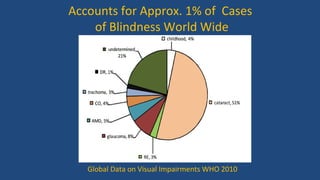
Global Data on Visual Impairments WHO 2010
Accounts for Approx. 1% of Cases
of Blindness World Wide
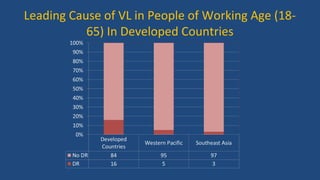
Leading Cause of VL in People of Working Age (18-
65) In Developed Countries
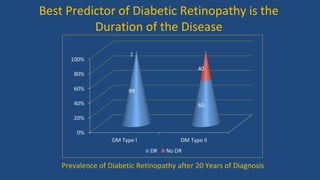
Best Predictor of Diabetic Retinopathy is the
Duration of the Disease
Prevalence of Diabetic Retinopathy after 20 Years of Diagnosis
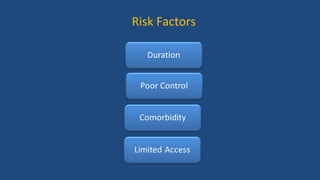
Risk Factors
Pathophysiology
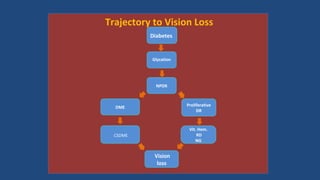
How diabetes cause vision loss
Trajectory to Vision Loss
Glycation
CSDME
Proliferative
DR
Diabetes
NPDR
DME
Vit. Hem.
RD
NG
Vision
loss
Pathophysiology
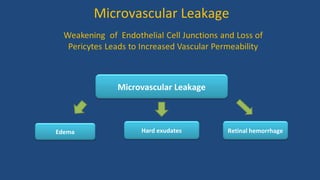
Edema Retinal hemorrhageHard exudates
Microvascular Leakage
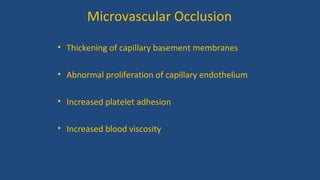
Microvascular Occlusion
• Thickening of capillary basement membranes
• Abnormal proliferation of capillary endothelium
• Increased platelet adhesion
• Increased blood viscosity
Cotton – wool spot
Retinal Neovascularization
Ischemia
Neovascular glaucoma
Microvascular Occlusion
Fibrovascular bands
Vitreous hemorrhageVitreous hemorrhage
Increased VEFG
Tractional retinal detachment
Infarction
Anterior Proliferation
Rubeosis
Clinical Features
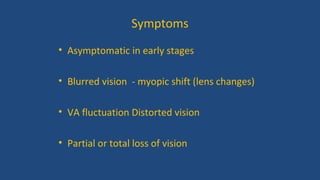
Symptoms
• Asymptomatic in early stages
• Blurred vision - myopic shift (lens changes)
• VA fluctuation Distorted vision
• Partial or total loss of vision
• Microaneurysms
• Dot and Blot hemorrhages
• Hard/lipid Exudates
• Cotton Wool Spots
• Venous Beading
• Intravascular Micro abnormalities (IRMA)
Non-proliferative Diabetic Retinopathy (NPDR)
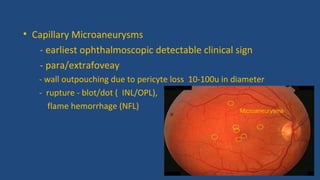
• Capillary Microaneurysms
- earliest ophthalmoscopic detectable clinical sign
- para/extrafoveay
- wall outpouching due to pericyte loss 10-100u in diameter
- rupture - blot/dot ( INL/OPL),
flame hemorrhage (NFL) Microaneurysms
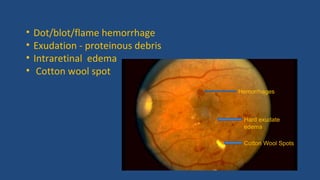
• Dot/blot/flame hemorrhage
• Exudation - proteinous debris
• Intraretinal edema
• Cotton wool spot
Hard exudate
edema
Cotton Wool Spots
Hemorrhages
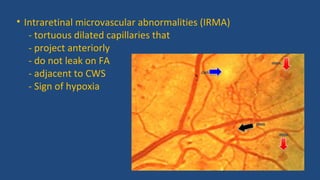
• Intraretinal microvascular abnormalities (IRMA)
- tortuous dilated capillaries that
- project anteriorly
- do not leak on FA
- adjacent to CWS
- Sign of hypoxia
IRMA
IRMA
IRMA
CWS
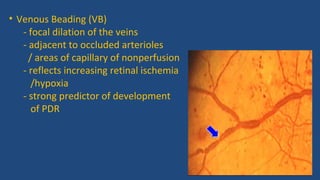
• Venous Beading (VB)
- focal dilation of the veins
- adjacent to occluded arterioles
/ areas of capillary of nonperfusion
- reflects increasing retinal ischemia
/hypoxia
- strong predictor of development
of PDR
• 4/2/1 Rule
- > 20 intraretinal hemorrhages in each of four quadrants
- VB in two or more quadrants
- IRMA in one or more quadrants
Severe NPDR
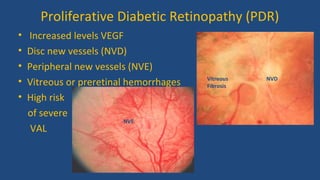
Proliferative Diabetic Retinopathy (PDR)
• Increased levels VEGF
• Disc new vessels (NVD)
• Peripheral new vessels (NVE)
• Vitreous or preretinal hemorrhages
• High risk
of severe
VAL
NVDVitreous
Fibrosis
NVE
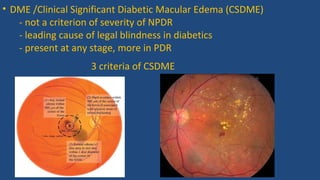
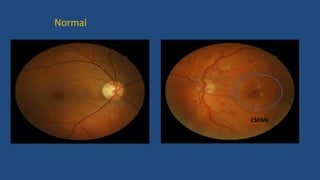
• DME /Clinical Significant Diabetic Macular Edema (CSDME)
- not a criterion of severity of NPDR
- leading cause of legal blindness in diabetics
- present at any stage, more in PDR
3 criteria of CSDME
Normal
CSDME
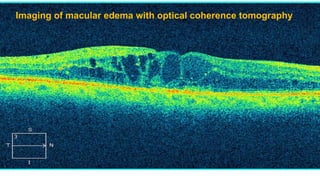
Imaging of macular edema with optical coherence tomography
Management
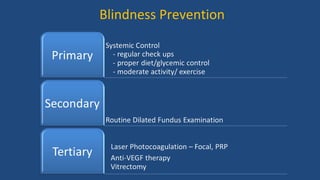
Blindness Prevention
The Best Measure for Prevention of Vision
Loss is Strict Glycemic Control
• Treatments exist but work best before vision
is lost
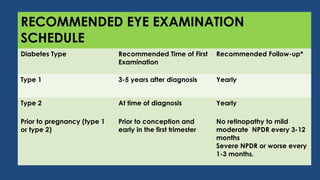
RECOMMENDED EYE EXAMINATION
SCHEDULE
Diabetes Type Recommended Time of First
Examination
Recommended Follow-up*
Type 1 3-5 years after diagnosis Yearly
Type 2 At time of diagnosis Yearly
Prior to pregnancy (type 1
or type 2)
Prior to conception and
early in the first trimester
No retinopathy to mild
moderate NPDR every 3-12
months
Severe NPDR or worse every
1-3 months.
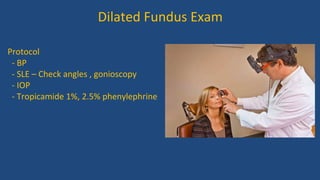
Dilated Fundus Exam
Protocol
- BP
- SLE – Check angles , gonioscopy
- IOP
- Tropicamide 1%, 2.5% phenylephrine
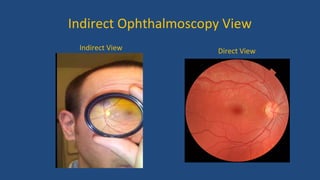
Indirect Ophthalmoscopy View
Indirect View Direct View
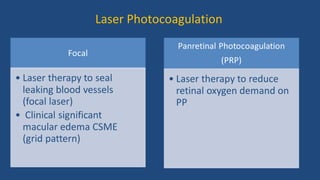
Laser Photocoagulation
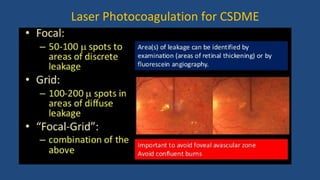
Laser Photocoagulation for CSDME
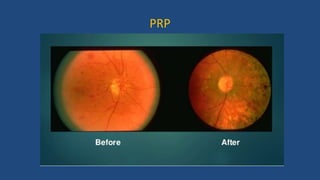
PRP
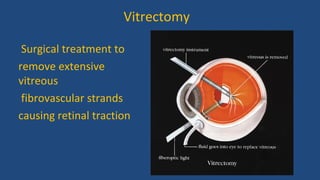
Vitrectomy
Surgical treatment to
remove extensive
vitreous
fibrovascular strands
causing retinal traction
Anti-VEGF Treatment
http://drcrnet.jaeb.org
CONCLUSIONS
References
• Ophthalmology Myron Yanoff MD and Jay S. Duker
• Kanski's Clinical Ophthalmology: A Systematic Approach, 8th Edition, 2015
• Proposed international clinical diabetic retinopathy and diabetic macular edema
disease, Ophthalmology Volume 110, Number 9, September 2003
• http://apps.who.int/iris/bitstream/10665/204871/1/9789241565257_eng.pdf
• http:www.who.int/bulletin/volumens/82/11/en/844.pdf
• WHO/NMH/PBD/12.01.pdf
• http://www.aao.org/newsroom/release/20091030.cfm
• http://one.aao.org/CE/PracticeGuidelines/PPP_Content.aspx?cid=d0c853-219-487b-
a524-326ab3cecd9a
Thank You!!!
????

Diabetic Retinopathy

  • 1.
    DIABETIC RETINOPATHY Jose MDe Jesus, OD, MD, MA
  • 2.
    Objectives • Diabetic retinopathyimplications as a public health issue and a leading cause of blindness in industrialized countries • Discuss risk factors • Discuss pathophysiology and the different stages • Discuss management approach - Prevention – risk factor control and annual dilated retinal examinations - Treatment modalities
  • 3.
  • 4.
    Diabetes Mellitus Hyperglycemia resultingfrom body’s inability to produce and/or utilize insulin •Type 1 - children and young adults - immune prone - no insulin production - 5% of DM pts • Type 2 - mostly adult onset (increase incidence at earlier age) - insulin resistance followed by decreased production - MC - obesity
  • 5.
    Diabetic Retinopathy (DR) •Implicated by both types of DM • Progressive glycation on retinal blood vessel wall • Initially asymptomatic • Microvascular leakage • Microvascular occlusion
  • 6.
  • 7.
  • 8.
  • 9.
    Trends in Prevalenceof Diabetes Worldwide Prevalence by 2030 – 439 Million
  • 10.
    Global Data onVisual Impairments WHO 2010 Accounts for Approx. 1% of Cases of Blindness World Wide
  • 11.
    Leading Cause ofVL in People of Working Age (18- 65) In Developed Countries
  • 12.
    Best Predictor ofDiabetic Retinopathy is the Duration of the Disease Prevalence of Diabetic Retinopathy after 20 Years of Diagnosis
  • 13.
  • 14.
  • 15.
    How diabetes causevision loss Trajectory to Vision Loss Glycation CSDME Proliferative DR Diabetes NPDR DME Vit. Hem. RD NG Vision loss
  • 16.
  • 17.
    Edema Retinal hemorrhageHardexudates Microvascular Leakage Microvascular Leakage
  • 18.
    Microvascular Occlusion • Thickeningof capillary basement membranes • Abnormal proliferation of capillary endothelium • Increased platelet adhesion • Increased blood viscosity
  • 19.
    Cotton – woolspot Retinal Neovascularization Ischemia Neovascular glaucoma Microvascular Occlusion Fibrovascular bands Vitreous hemorrhageVitreous hemorrhage Increased VEFG Tractional retinal detachment Infarction Anterior Proliferation Rubeosis
  • 20.
  • 21.
    Symptoms • Asymptomatic inearly stages • Blurred vision - myopic shift (lens changes) • VA fluctuation Distorted vision • Partial or total loss of vision
  • 22.
    • Microaneurysms • Dotand Blot hemorrhages • Hard/lipid Exudates • Cotton Wool Spots • Venous Beading • Intravascular Micro abnormalities (IRMA) Non-proliferative Diabetic Retinopathy (NPDR)
  • 23.
    • Capillary Microaneurysms -earliest ophthalmoscopic detectable clinical sign - para/extrafoveay - wall outpouching due to pericyte loss 10-100u in diameter - rupture - blot/dot ( INL/OPL), flame hemorrhage (NFL) Microaneurysms
  • 24.
    • Dot/blot/flame hemorrhage •Exudation - proteinous debris • Intraretinal edema • Cotton wool spot Hard exudate edema Cotton Wool Spots Hemorrhages
  • 25.
    • Intraretinal microvascularabnormalities (IRMA) - tortuous dilated capillaries that - project anteriorly - do not leak on FA - adjacent to CWS - Sign of hypoxia IRMA IRMA IRMA CWS
  • 26.
    • Venous Beading(VB) - focal dilation of the veins - adjacent to occluded arterioles / areas of capillary of nonperfusion - reflects increasing retinal ischemia /hypoxia - strong predictor of development of PDR
  • 27.
    • 4/2/1 Rule -> 20 intraretinal hemorrhages in each of four quadrants - VB in two or more quadrants - IRMA in one or more quadrants Severe NPDR
  • 28.
    Proliferative Diabetic Retinopathy(PDR) • Increased levels VEGF • Disc new vessels (NVD) • Peripheral new vessels (NVE) • Vitreous or preretinal hemorrhages • High risk of severe VAL NVDVitreous Fibrosis NVE
  • 29.
    • DME /ClinicalSignificant Diabetic Macular Edema (CSDME) - not a criterion of severity of NPDR - leading cause of legal blindness in diabetics - present at any stage, more in PDR 3 criteria of CSDME
  • 30.
  • 31.
    Imaging of macularedema with optical coherence tomography
  • 32.
  • 33.
  • 34.
    The Best Measurefor Prevention of Vision Loss is Strict Glycemic Control
  • 35.
    • Treatments existbut work best before vision is lost RECOMMENDED EYE EXAMINATION SCHEDULE Diabetes Type Recommended Time of First Examination Recommended Follow-up* Type 1 3-5 years after diagnosis Yearly Type 2 At time of diagnosis Yearly Prior to pregnancy (type 1 or type 2) Prior to conception and early in the first trimester No retinopathy to mild moderate NPDR every 3-12 months Severe NPDR or worse every 1-3 months.
  • 36.
    Dilated Fundus Exam Protocol -BP - SLE – Check angles , gonioscopy - IOP - Tropicamide 1%, 2.5% phenylephrine
  • 37.
  • 38.
  • 39.
  • 40.
  • 41.
    Vitrectomy Surgical treatment to removeextensive vitreous fibrovascular strands causing retinal traction
  • 42.
  • 43.
  • 44.
    References • Ophthalmology MyronYanoff MD and Jay S. Duker • Kanski's Clinical Ophthalmology: A Systematic Approach, 8th Edition, 2015 • Proposed international clinical diabetic retinopathy and diabetic macular edema disease, Ophthalmology Volume 110, Number 9, September 2003 • http://apps.who.int/iris/bitstream/10665/204871/1/9789241565257_eng.pdf • http:www.who.int/bulletin/volumens/82/11/en/844.pdf • WHO/NMH/PBD/12.01.pdf • http://www.aao.org/newsroom/release/20091030.cfm • http://one.aao.org/CE/PracticeGuidelines/PPP_Content.aspx?cid=d0c853-219-487b- a524-326ab3cecd9a
  • 45.

Editor's Notes

  • #5 http://www.diabetes.org/diabetes-basics/?loc=GlobalNavDB
  • #6 http://www.mdconsult.com/das/book/pdf/282715756-3/978-0-323-04332-8/4-u1.0-B978-0-323-04332-8..00092-5..DOCPDF.pdf?isbn=978-0-323-04332-8&eid=4-u1.0-B978-0-323-04332-8..00092-5..DOCPDF
  • #9 http://www.who.int/bulletin/volumes/82/11/en/844.pdf http://www.ncbi.nlm.nih.gov/pubmed/19896746
  • #10 http://www.who.int/bulletin/volumes/82/11/en/844.pdf http://www.ncbi.nlm.nih.gov/pubmed/19896746
  • #12 http://www.who.int/bulletin/volumes/82/11/en/844.pdf
  • #13 Ophthalmology Myron Yanoff MD and Jay S. Duker Basic and Clinical Science Course, Section 12: Retina and Vitreous AAO http://www.aao.org/eyecare/news/upload/Eye-Health-Fact-Sheet.pdf -
  • #14 http://one.aao.org/CE/PracticeGuidelines/PPP_Content.aspx?cid=d0c853d3-219f-487b-a524-326ab3cecd9a
  • #43 http://drcrnet.jaeb.org