1
Dr. T. KRISHNA CHAITANYA
Assistant Professor (Agricultural Entomology)
School of Agricultural Science & Technology, NMIMS, Shirpur
ENTO 131 - Fundamentals of Entomology (3+1)
2
Respiratory system
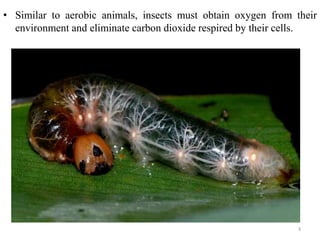
• Similar to aerobic animals, insects must obtain oxygen from their
environment and eliminate carbon dioxide respired by their cells.
3
4
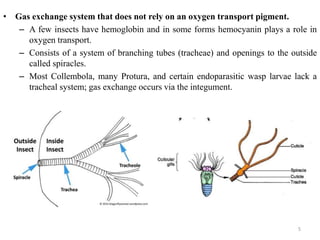
• Gas exchange system that does not rely on an oxygen transport pigment.
– A few insects have hemoglobin and in some forms hemocyanin plays a role in
oxygen transport.
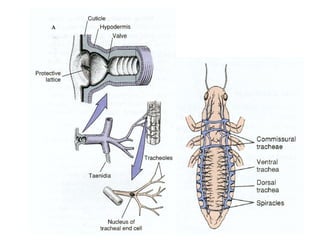
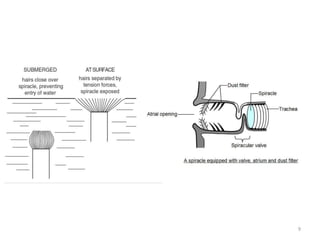
– Consists of a system of branching tubes (tracheae) and openings to the outside
called spiracles.
– Most Collembola, many Protura, and certain endoparasitic wasp larvae lack a
tracheal system; gas exchange occurs via the integument.
5
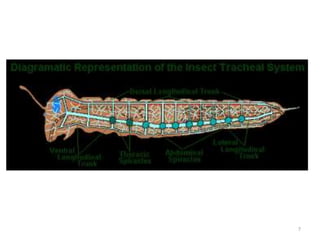
• No insect has more than ten pairs (two thoracic and eight abdominal).
• Based on the number and location of functional spiracles respiratory
system is classified as follows
1. Holopneustic:10 pairs, 2 in thorax and 8 in abdomen. e.g. grasshopper
2. Peripneustic: 9 pairs - 1 in thorax 8 in abdomen e.g. Caterpillar
3. Hemipneustic: 8 pairs, one or two non-functional eg: Mycetophilids
4. Amphipneustic 2 pairs - One anterior, one posterior, e.g. maggot.
5. Propneustic: 1 pair -anterior pair e.g. Puparium
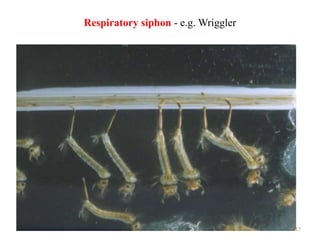
6. Metapneustic: 1 pair - posterior pair e.g. Wriggler
7. Hypopneustic:10 pairs - 7 functional (1 thorax + 6 abdominal), 3 non
functional. e.g. head louse
8. Apneustic: All spiracles closed, closed tracheal system e.g. naiad of
may fly.
6
7
8
9
• Tracheae
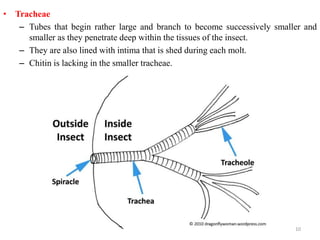
– Tubes that begin rather large and branch to become successively smaller and
smaller as they penetrate deep within the tissues of the insect.
– They are also lined with intima that is shed during each molt.
– Chitin is lacking in the smaller tracheae.
10
• Tracheoles
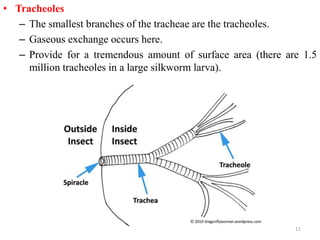
– The smallest branches of the tracheae are the tracheoles.
– Gaseous exchange occurs here.
– Provide for a tremendous amount of surface area (there are 1.5
million tracheoles in a large silkworm larva).
11
• Air sacs
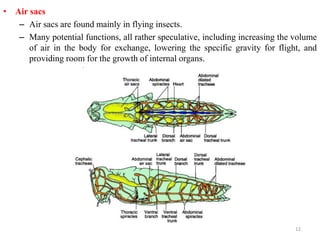
– Air sacs are found mainly in flying insects.
– Many potential functions, all rather speculative, including increasing the volume
of air in the body for exchange, lowering the specific gravity for flight, and
providing room for the growth of internal organs.
12
• Mechanism of respiration
• Oxygen enters the spiracle and passes through the length of the
tracheae to the tracheoles and into the target cells by a combination of
ventilation and diffusion along a concentration gradient, from high in
the external air to low in the tissue.
• Where as the net movement of oxygen molecules in the tracheal
system is inward (Inspiration), the net movement of CO2 and water
vapour molecules is outward (Expiration).
13
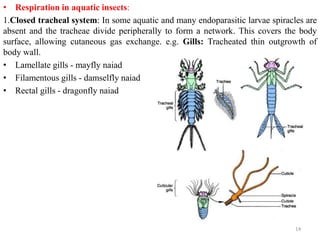
• Respiration in aquatic insects:
1.Closed tracheal system: In some aquatic and many endoparasitic larvae spiracles are
absent and the tracheae divide peripherally to form a network. This covers the body
surface, allowing cutaneous gas exchange. e.g. Gills: Tracheated thin outgrowth of
body wall.
• Lamellate gills - mayfly naiad
• Filamentous gills - damselfly naiad
• Rectal gills - dragonfly naiad
14
2. Open tracheal system:
i. Air store: Air bubble stored beneath wings acts as physical gill, e.g.
water bug.
ii. Respiratory siphon - e.g. Wriggler
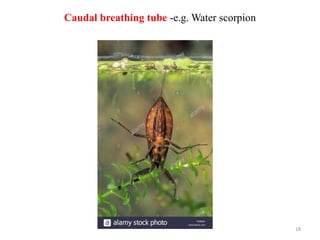
iii. Caudal breathing tube -e.g. Water scorpion
iv. Plastron: Closely set hydrofuge hairs of epicuticle hold a thin film
of air indefinitely.
15
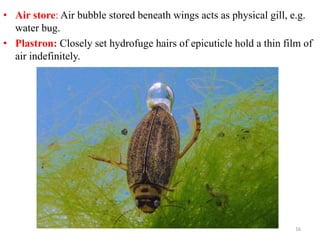
• Air store: Air bubble stored beneath wings acts as physical gill, e.g.
water bug.
• Plastron: Closely set hydrofuge hairs of epicuticle hold a thin film of
air indefinitely.
16
Respiratory siphon - e.g. Wriggler
17
Caudal breathing tube -e.g. Water scorpion
18
19

Respiratory system

  • 1.
    1 Dr. T. KRISHNACHAITANYA Assistant Professor (Agricultural Entomology) School of Agricultural Science & Technology, NMIMS, Shirpur ENTO 131 - Fundamentals of Entomology (3+1)
  • 2.
  • 3.
    • Similar toaerobic animals, insects must obtain oxygen from their environment and eliminate carbon dioxide respired by their cells. 3
  • 4.
  • 5.
    • Gas exchangesystem that does not rely on an oxygen transport pigment. – A few insects have hemoglobin and in some forms hemocyanin plays a role in oxygen transport. – Consists of a system of branching tubes (tracheae) and openings to the outside called spiracles. – Most Collembola, many Protura, and certain endoparasitic wasp larvae lack a tracheal system; gas exchange occurs via the integument. 5
  • 6.
    • No insecthas more than ten pairs (two thoracic and eight abdominal). • Based on the number and location of functional spiracles respiratory system is classified as follows 1. Holopneustic:10 pairs, 2 in thorax and 8 in abdomen. e.g. grasshopper 2. Peripneustic: 9 pairs - 1 in thorax 8 in abdomen e.g. Caterpillar 3. Hemipneustic: 8 pairs, one or two non-functional eg: Mycetophilids 4. Amphipneustic 2 pairs - One anterior, one posterior, e.g. maggot. 5. Propneustic: 1 pair -anterior pair e.g. Puparium 6. Metapneustic: 1 pair - posterior pair e.g. Wriggler 7. Hypopneustic:10 pairs - 7 functional (1 thorax + 6 abdominal), 3 non functional. e.g. head louse 8. Apneustic: All spiracles closed, closed tracheal system e.g. naiad of may fly. 6
  • 7.
  • 8.
  • 9.
  • 10.
    • Tracheae – Tubesthat begin rather large and branch to become successively smaller and smaller as they penetrate deep within the tissues of the insect. – They are also lined with intima that is shed during each molt. – Chitin is lacking in the smaller tracheae. 10
  • 11.
    • Tracheoles – Thesmallest branches of the tracheae are the tracheoles. – Gaseous exchange occurs here. – Provide for a tremendous amount of surface area (there are 1.5 million tracheoles in a large silkworm larva). 11
  • 12.
    • Air sacs –Air sacs are found mainly in flying insects. – Many potential functions, all rather speculative, including increasing the volume of air in the body for exchange, lowering the specific gravity for flight, and providing room for the growth of internal organs. 12
  • 13.
    • Mechanism ofrespiration • Oxygen enters the spiracle and passes through the length of the tracheae to the tracheoles and into the target cells by a combination of ventilation and diffusion along a concentration gradient, from high in the external air to low in the tissue. • Where as the net movement of oxygen molecules in the tracheal system is inward (Inspiration), the net movement of CO2 and water vapour molecules is outward (Expiration). 13
  • 14.
    • Respiration inaquatic insects: 1.Closed tracheal system: In some aquatic and many endoparasitic larvae spiracles are absent and the tracheae divide peripherally to form a network. This covers the body surface, allowing cutaneous gas exchange. e.g. Gills: Tracheated thin outgrowth of body wall. • Lamellate gills - mayfly naiad • Filamentous gills - damselfly naiad • Rectal gills - dragonfly naiad 14
  • 15.
    2. Open trachealsystem: i. Air store: Air bubble stored beneath wings acts as physical gill, e.g. water bug. ii. Respiratory siphon - e.g. Wriggler iii. Caudal breathing tube -e.g. Water scorpion iv. Plastron: Closely set hydrofuge hairs of epicuticle hold a thin film of air indefinitely. 15
  • 16.
    • Air store:Air bubble stored beneath wings acts as physical gill, e.g. water bug. • Plastron: Closely set hydrofuge hairs of epicuticle hold a thin film of air indefinitely. 16
  • 17.
    Respiratory siphon -e.g. Wriggler 17
  • 18.
    Caudal breathing tube-e.g. Water scorpion 18
  • 19.