Suresh R. Jambagi
M.Sc. (Agri) Agril. Entomology
University of Agricultural Sciences
Dharwad, Karnataka-580005
Email: jambagisuru@gmail.com
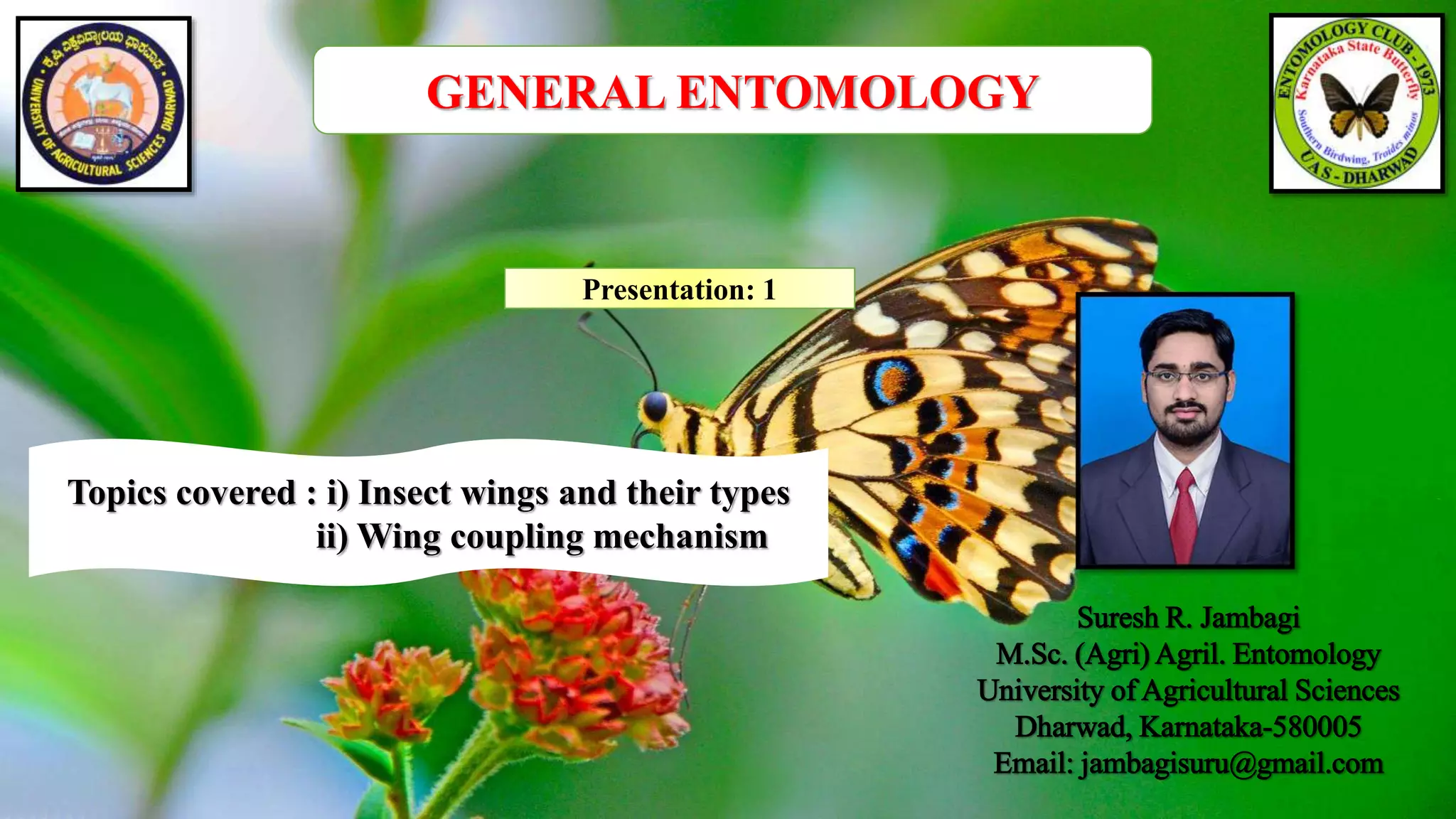
Presentation: 1
GENERAL ENTOMOLOGY
Topics covered : i) Insect wings and their types
ii) Wing coupling mechanism
INSECT WING
 Wings, their modifications and
characters of wings are primary tools
for taxonomic studies.
 Among the invertebrates, only insect
bosses a wings.
 Generally insect have 2 pair of wings.
 One pair on mesothorax and another
pair on metathorax.
 Hence, wing bearing thoracic segments
are called as pterothorax.
Mr. Suresh Jambagi, M.Sc (Agri) Entomology, UAS Dharwad 2
Basically 2 types of wings (Based on absence of wings)
1. Primarily wingless (Apterygota):
Wings are basically absent.
Eg: Sliver flish, Springtail.
2. Secondarily wingless (Pterygota):
Ectoparasites, head louse, poultry louse and fleas.
Basically winged insect but later wings are lacking.
Note:
Wings are deciduous (Ants and termites) : Wings are Shedd out after a
single nuptial flight and before beginning of their life in soil.
Mr. Suresh Jambagi, M.Sc (Agri) Entomology, UAS Dharwad 3
Wings:
Wing is a double layered lateral expansion of the integument which is being
strengthened with a network of highly sclerotized tube called as veins.
Wings are located at dorso-lateral position.
Veins: It is network of highly sclerotised tube/nerve which gives strength to the
wings.
Each wing has a two layers i.e. dorsal lamina and ventral lamina.
Both dorsal and ventral laminar grow, meet and fuse except along certain lines.
Thus series of channel is formed.
These channels serve for the passage of tracheae, nerve and blood. Wing is
nourished by blood circulating through veins.
Later the wall of these channels become thickened to form veins or nerves.
Arrangement of veins systematically in a definite pattern is called as wing
venation.
Mr. Suresh Jambagi, M.Sc (Agri) Entomology, UAS Dharwad 4
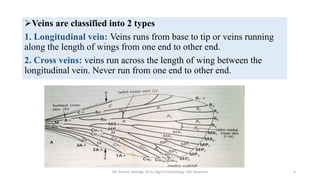
Veins are classified into 2 types
1. Longitudinal vein: Veins runs from base to tip or veins running
along the length of wings from one end to other end.
2. Cross veins: veins run across the length of wing between the
longitudinal vein. Never run from one end to other end.
Mr. Suresh Jambagi, M.Sc (Agri) Entomology, UAS Dharwad 5
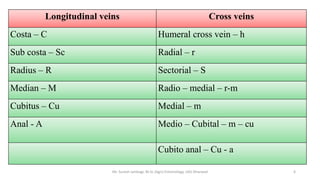
Longitudinal veins Cross veins
Costa – C Humeral cross vein – h
Sub costa – Sc Radial – r
Radius – R Sectorial – S
Median – M Radio – medial – r-m
Cubitus – Cu Medial – m
Anal - A Medio – Cubital – m – cu
Cubito anal – Cu - a
Mr. Suresh Jambagi, M.Sc (Agri) Entomology, UAS Dharwad 6
Based on type of arrangement / network
of veins –
Two types of wings
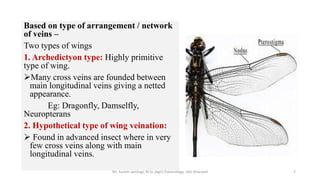
1. Archedictyon type: Highly primitive
type of wing.
Many cross veins are founded between
main longitudinal veins giving a netted
appearance.
Eg: Dragonfly, Damselfly,
Neuropterans
2. Hypothetical type of wing veination:
 Found in advanced insect where in very
few cross veins along with main
longitudinal veins.
Mr. Suresh Jambagi, M.Sc (Agri) Entomology, UAS Dharwad 7
Longitudinal veins
1. Costa (c)
 It is first main vein which run along the anterior margin of the wing.
 It is always unbranched (Convex in nature).
2. Sub costa (Sc)
 It runs immediately below costa.
 It is concave vein runs more or less straight to the margin.
 It branches into Sc1 and Sc2.
3. Radius (R)
 It is next main vein.
It is stout one and connects at base with second axillary sclerites.
The radius typically branches into anteriorly R1 and posteirorly Rs (Radialsector).
Rs further divides into 4 branches (R2, R3, R4, R5).
Mr. Suresh Jambagi, M.Sc (Agri) Entomology, UAS Dharwad 8
4. Median (M)
 It divides into anterior median (MA) and posterior
median (MP).
 MA – It divides into MA1 and MA2 (2 branches).
 MP – further divides into MP1 to MP4 (4 branches).
5. Cubitus (Cu)
 Cubitus divided into 2 branches- Cu1 and Cu2.
 Cu1 (Anterior cubitus) again forked into Cu1A
Cu1B.
 Cu2 (Posterior cubitus) is unbranched.
6. Anal vein
 There are 3 anal veins- 1A, 2A, and 3A.
Mr. Suresh Jambagi, M.Sc (Agri) Entomology, UAS Dharwad 9
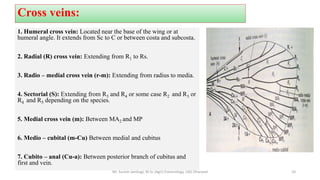
Cross veins:
1. Humeral cross vein: Located near the base of the wing or at
humeral angle. It extends from Sc to C or between costa and subcosta.
2. Radial (R) cross vein: Extending from R1 to Rs.
3. Radio – medial cross vein (r-m): Extending from radius to media.
4. Sectorial (S): Extending from R3 and R4 or some case R2 and R3 or
R4 and R5 depending on the species.
5. Medial cross vein (m): Between MA2 and MP
6. Medio – cubital (m-Cu) Between medial and cubitus
7. Cubito – anal (Cu-a): Between posterior branch of cubitus and
first and vein.
Mr. Suresh Jambagi, M.Sc (Agri) Entomology, UAS Dharwad 10
Wing origin theory:
1. Tracheal gill theory: Proposed by Gigenbhourg.
 According to this theory, the wings are developed from thoracic
tracheal gills, later as a modification these have lasted their original
function of respiration and adopted for flying.
 Earlier this theory was accepted but due to the lack of evidence this
theory was not accepted.
2. Paranotal theory: Proposed by cromptom.
 According to this theory, the wings are being developed from lateral
targal expansion in the thorax.
 This theory was supported by the study of fossils where in such pad
like structures were noticed.
Mr. Suresh Jambagi, M.Sc (Agri) Entomology, UAS Dharwad 11
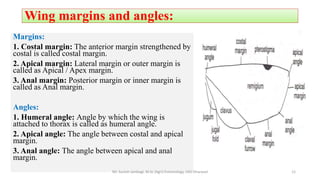
Wing margins and angles:
Margins:
1. Costal margin: The anterior margin strengthened by
costal is called costal margin.
2. Apical margin: Lateral margin or outer margin is
called as Apical / Apex margin.
3. Anal margin: Posterior margin or inner margin is
called as Anal margin.
Angles:
1. Humeral angle: Angle by which the wing is
attached to thorax is called as humeral angle.
2. Apical angle: The angle between costal and apical
margin.
3. Anal angle: The angle between apical and anal
margin.
Mr. Suresh Jambagi, M.Sc (Agri) Entomology, UAS Dharwad 12
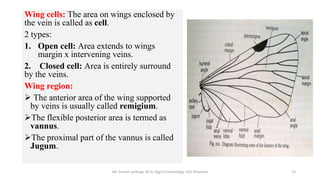
Wing cells: The area on wings enclosed by
the vein is called as cell.
2 types:
1. Open cell: Area extends to wings
margin x intervening veins.
2. Closed cell: Area is entirely surround
by the veins.
Wing region:
 The anterior area of the wing supported
by veins is usually called remigium.
The flexible posterior area is termed as
vannus.
The proximal part of the vannus is called
Jugum.
Mr. Suresh Jambagi, M.Sc (Agri) Entomology, UAS Dharwad 13
Types of wings or wing modification
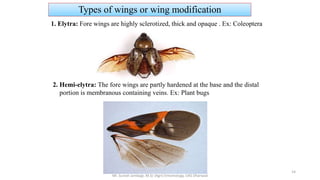
1. Elytra: Fore wings are highly sclerotized, thick and opaque . Ex: Coleoptera
2. Hemi-elytra: The fore wings are partly hardened at the base and the distal
portion is membranous containing veins. Ex: Plant bugs
Mr. Suresh Jambagi, M.Sc (Agri) Entomology, UAS Dharwad
14
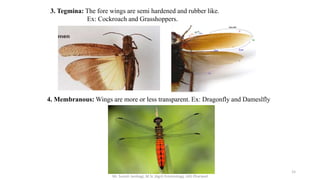
3. Tegmina: The fore wings are semi hardened and rubber like.
Ex: Cockroach and Grasshoppers.
4. Membranous: Wings are more or less transparent. Ex: Dragonfly and Dameslfly
Mr. Suresh Jambagi, M.Sc (Agri) Entomology, UAS Dharwad
15
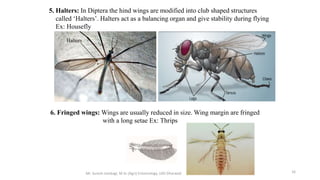
5. Halters: In Diptera the hind wings are modified into club shaped structures
called ‘Halters’. Halters act as a balancing organ and give stability during flying
Ex: Housefly
Halters
6. Fringed wings: Wings are usually reduced in size. Wing margin are fringed
with a long setae Ex: Thrips
Mr. Suresh Jambagi, M.Sc (Agri) Entomology, UAS Dharwad 16
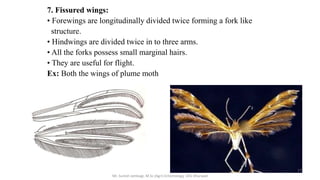
7. Fissured wings:
• Forewings are longitudinally divided twice forming a fork like
structure.
• Hindwings are divided twice in to three arms.
• All the forks possess small marginal hairs.
• They are useful for flight.
Ex: Both the wings of plume moth
Mr. Suresh Jambagi, M.Sc (Agri) Entomology, UAS Dharwad
17
Wing coupling mechanism
• The wings of most insects are moved by distortion of thorax and
because they are so closely associated, hence the movement of each of
the thoracic segments must influence others.
• So, it is impossible for the fore and hind wings to beat independently
of each other. The higher pterygotan insects,wing movement is by
virtue joint movement of both fore and hindwings.
• Wing coupling is mechanism in higher pterygotan insect where both
fore and hindwings are linked anatomically with special structures
during flight is called as wing coupling apperatus/Mechanism.
Mr. Suresh Jambagi, M.Sc (Agri) Entomology, UAS Dharwad 18
• It is there in almost all insect except primitive type of winged insects like
odonata and isopteran, neuroptera where both pair of wings vibrate with
the same frequency and with hindwing beat consistently more advanced
than the forewing beat.
Advantages:
• Helps for easy movement and more speed.
• It reduces the consumption of energy to travel
• Synchronisation between two wings.
Mr. Suresh Jambagi, M.Sc (Agri) Entomology, UAS Dharwad 19
Types of wing coupling:
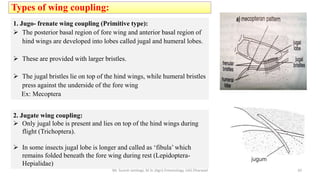
1. Jugo- frenate wing coupling (Primitive type):
 The posterior basal region of fore wing and anterior basal region of
hind wings are developed into lobes called jugal and humeral lobes.
 These are provided with larger bristles.
 The jugal bristles lie on top of the hind wings, while humeral bristles
press against the underside of the fore wing
Ex: Mecoptera
2. Jugate wing coupling:
 Only jugal lobe is present and lies on top of the hind wings during
flight (Trichoptera).
 In some insects jugal lobe is longer and called as ‘fibula’ which
remains folded beneath the fore wing during rest (Lepidoptera-
Hepialidae)
Mr. Suresh Jambagi, M.Sc (Agri) Entomology, UAS Dharwad 20
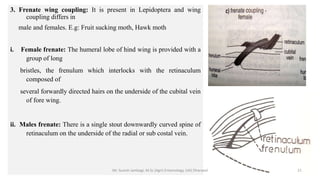
3. Frenate wing coupling: It is present in Lepidoptera and wing
coupling differs in
male and females. E.g: Fruit sucking moth, Hawk moth
i. Female frenate: The humeral lobe of hind wing is provided with a
group of long
bristles, the frenulum which interlocks with the retinaculum
composed of
several forwardly directed hairs on the underside of the cubital vein
of fore wing.
ii. Males frenate: There is a single stout downwardly curved spine of
retinaculum on the underside of the radial or sub costal vein.
Mr. Suresh Jambagi, M.Sc (Agri) Entomology, UAS Dharwad 21
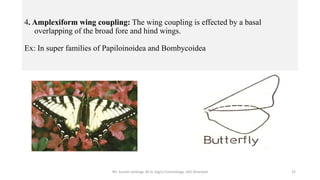
4. Amplexiform wing coupling: The wing coupling is effected by a basal
overlapping of the broad fore and hind wings.
Ex: In super families of Papiloinoidea and Bombycoidea
Mr. Suresh Jambagi, M.Sc (Agri) Entomology, UAS Dharwad 22
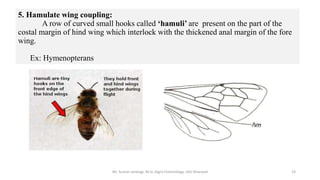
5. Hamulate wing coupling:
A row of curved small hooks called ‘hamuli’ are present on the part of the
costal margin of hind wing which interlock with the thickened anal margin of the fore
wing.
Ex: Hymenopterans
Mr. Suresh Jambagi, M.Sc (Agri) Entomology, UAS Dharwad 23

Insect wing, their modifications and wing coupling mechanism

  • 1.
    Suresh R. Jambagi M.Sc.(Agri) Agril. Entomology University of Agricultural Sciences Dharwad, Karnataka-580005 Email: jambagisuru@gmail.com Presentation: 1 GENERAL ENTOMOLOGY Topics covered : i) Insect wings and their types ii) Wing coupling mechanism
  • 2.
    INSECT WING  Wings,their modifications and characters of wings are primary tools for taxonomic studies.  Among the invertebrates, only insect bosses a wings.  Generally insect have 2 pair of wings.  One pair on mesothorax and another pair on metathorax.  Hence, wing bearing thoracic segments are called as pterothorax. Mr. Suresh Jambagi, M.Sc (Agri) Entomology, UAS Dharwad 2
  • 3.
    Basically 2 typesof wings (Based on absence of wings) 1. Primarily wingless (Apterygota): Wings are basically absent. Eg: Sliver flish, Springtail. 2. Secondarily wingless (Pterygota): Ectoparasites, head louse, poultry louse and fleas. Basically winged insect but later wings are lacking. Note: Wings are deciduous (Ants and termites) : Wings are Shedd out after a single nuptial flight and before beginning of their life in soil. Mr. Suresh Jambagi, M.Sc (Agri) Entomology, UAS Dharwad 3
  • 4.
    Wings: Wing is adouble layered lateral expansion of the integument which is being strengthened with a network of highly sclerotized tube called as veins. Wings are located at dorso-lateral position. Veins: It is network of highly sclerotised tube/nerve which gives strength to the wings. Each wing has a two layers i.e. dorsal lamina and ventral lamina. Both dorsal and ventral laminar grow, meet and fuse except along certain lines. Thus series of channel is formed. These channels serve for the passage of tracheae, nerve and blood. Wing is nourished by blood circulating through veins. Later the wall of these channels become thickened to form veins or nerves. Arrangement of veins systematically in a definite pattern is called as wing venation. Mr. Suresh Jambagi, M.Sc (Agri) Entomology, UAS Dharwad 4
  • 5.
    Veins are classifiedinto 2 types 1. Longitudinal vein: Veins runs from base to tip or veins running along the length of wings from one end to other end. 2. Cross veins: veins run across the length of wing between the longitudinal vein. Never run from one end to other end. Mr. Suresh Jambagi, M.Sc (Agri) Entomology, UAS Dharwad 5
  • 6.
    Longitudinal veins Crossveins Costa – C Humeral cross vein – h Sub costa – Sc Radial – r Radius – R Sectorial – S Median – M Radio – medial – r-m Cubitus – Cu Medial – m Anal - A Medio – Cubital – m – cu Cubito anal – Cu - a Mr. Suresh Jambagi, M.Sc (Agri) Entomology, UAS Dharwad 6
  • 7.
    Based on typeof arrangement / network of veins – Two types of wings 1. Archedictyon type: Highly primitive type of wing. Many cross veins are founded between main longitudinal veins giving a netted appearance. Eg: Dragonfly, Damselfly, Neuropterans 2. Hypothetical type of wing veination:  Found in advanced insect where in very few cross veins along with main longitudinal veins. Mr. Suresh Jambagi, M.Sc (Agri) Entomology, UAS Dharwad 7
  • 8.
    Longitudinal veins 1. Costa(c)  It is first main vein which run along the anterior margin of the wing.  It is always unbranched (Convex in nature). 2. Sub costa (Sc)  It runs immediately below costa.  It is concave vein runs more or less straight to the margin.  It branches into Sc1 and Sc2. 3. Radius (R)  It is next main vein. It is stout one and connects at base with second axillary sclerites. The radius typically branches into anteriorly R1 and posteirorly Rs (Radialsector). Rs further divides into 4 branches (R2, R3, R4, R5). Mr. Suresh Jambagi, M.Sc (Agri) Entomology, UAS Dharwad 8
  • 9.
    4. Median (M) It divides into anterior median (MA) and posterior median (MP).  MA – It divides into MA1 and MA2 (2 branches).  MP – further divides into MP1 to MP4 (4 branches). 5. Cubitus (Cu)  Cubitus divided into 2 branches- Cu1 and Cu2.  Cu1 (Anterior cubitus) again forked into Cu1A Cu1B.  Cu2 (Posterior cubitus) is unbranched. 6. Anal vein  There are 3 anal veins- 1A, 2A, and 3A. Mr. Suresh Jambagi, M.Sc (Agri) Entomology, UAS Dharwad 9
  • 10.
    Cross veins: 1. Humeralcross vein: Located near the base of the wing or at humeral angle. It extends from Sc to C or between costa and subcosta. 2. Radial (R) cross vein: Extending from R1 to Rs. 3. Radio – medial cross vein (r-m): Extending from radius to media. 4. Sectorial (S): Extending from R3 and R4 or some case R2 and R3 or R4 and R5 depending on the species. 5. Medial cross vein (m): Between MA2 and MP 6. Medio – cubital (m-Cu) Between medial and cubitus 7. Cubito – anal (Cu-a): Between posterior branch of cubitus and first and vein. Mr. Suresh Jambagi, M.Sc (Agri) Entomology, UAS Dharwad 10
  • 11.
    Wing origin theory: 1.Tracheal gill theory: Proposed by Gigenbhourg.  According to this theory, the wings are developed from thoracic tracheal gills, later as a modification these have lasted their original function of respiration and adopted for flying.  Earlier this theory was accepted but due to the lack of evidence this theory was not accepted. 2. Paranotal theory: Proposed by cromptom.  According to this theory, the wings are being developed from lateral targal expansion in the thorax.  This theory was supported by the study of fossils where in such pad like structures were noticed. Mr. Suresh Jambagi, M.Sc (Agri) Entomology, UAS Dharwad 11
  • 12.
    Wing margins andangles: Margins: 1. Costal margin: The anterior margin strengthened by costal is called costal margin. 2. Apical margin: Lateral margin or outer margin is called as Apical / Apex margin. 3. Anal margin: Posterior margin or inner margin is called as Anal margin. Angles: 1. Humeral angle: Angle by which the wing is attached to thorax is called as humeral angle. 2. Apical angle: The angle between costal and apical margin. 3. Anal angle: The angle between apical and anal margin. Mr. Suresh Jambagi, M.Sc (Agri) Entomology, UAS Dharwad 12
  • 13.
    Wing cells: Thearea on wings enclosed by the vein is called as cell. 2 types: 1. Open cell: Area extends to wings margin x intervening veins. 2. Closed cell: Area is entirely surround by the veins. Wing region:  The anterior area of the wing supported by veins is usually called remigium. The flexible posterior area is termed as vannus. The proximal part of the vannus is called Jugum. Mr. Suresh Jambagi, M.Sc (Agri) Entomology, UAS Dharwad 13
  • 14.
    Types of wingsor wing modification 1. Elytra: Fore wings are highly sclerotized, thick and opaque . Ex: Coleoptera 2. Hemi-elytra: The fore wings are partly hardened at the base and the distal portion is membranous containing veins. Ex: Plant bugs Mr. Suresh Jambagi, M.Sc (Agri) Entomology, UAS Dharwad 14
  • 15.
    3. Tegmina: Thefore wings are semi hardened and rubber like. Ex: Cockroach and Grasshoppers. 4. Membranous: Wings are more or less transparent. Ex: Dragonfly and Dameslfly Mr. Suresh Jambagi, M.Sc (Agri) Entomology, UAS Dharwad 15
  • 16.
    5. Halters: InDiptera the hind wings are modified into club shaped structures called ‘Halters’. Halters act as a balancing organ and give stability during flying Ex: Housefly Halters 6. Fringed wings: Wings are usually reduced in size. Wing margin are fringed with a long setae Ex: Thrips Mr. Suresh Jambagi, M.Sc (Agri) Entomology, UAS Dharwad 16
  • 17.
    7. Fissured wings: •Forewings are longitudinally divided twice forming a fork like structure. • Hindwings are divided twice in to three arms. • All the forks possess small marginal hairs. • They are useful for flight. Ex: Both the wings of plume moth Mr. Suresh Jambagi, M.Sc (Agri) Entomology, UAS Dharwad 17
  • 18.
    Wing coupling mechanism •The wings of most insects are moved by distortion of thorax and because they are so closely associated, hence the movement of each of the thoracic segments must influence others. • So, it is impossible for the fore and hind wings to beat independently of each other. The higher pterygotan insects,wing movement is by virtue joint movement of both fore and hindwings. • Wing coupling is mechanism in higher pterygotan insect where both fore and hindwings are linked anatomically with special structures during flight is called as wing coupling apperatus/Mechanism. Mr. Suresh Jambagi, M.Sc (Agri) Entomology, UAS Dharwad 18
  • 19.
    • It isthere in almost all insect except primitive type of winged insects like odonata and isopteran, neuroptera where both pair of wings vibrate with the same frequency and with hindwing beat consistently more advanced than the forewing beat. Advantages: • Helps for easy movement and more speed. • It reduces the consumption of energy to travel • Synchronisation between two wings. Mr. Suresh Jambagi, M.Sc (Agri) Entomology, UAS Dharwad 19
  • 20.
    Types of wingcoupling: 1. Jugo- frenate wing coupling (Primitive type):  The posterior basal region of fore wing and anterior basal region of hind wings are developed into lobes called jugal and humeral lobes.  These are provided with larger bristles.  The jugal bristles lie on top of the hind wings, while humeral bristles press against the underside of the fore wing Ex: Mecoptera 2. Jugate wing coupling:  Only jugal lobe is present and lies on top of the hind wings during flight (Trichoptera).  In some insects jugal lobe is longer and called as ‘fibula’ which remains folded beneath the fore wing during rest (Lepidoptera- Hepialidae) Mr. Suresh Jambagi, M.Sc (Agri) Entomology, UAS Dharwad 20
  • 21.
    3. Frenate wingcoupling: It is present in Lepidoptera and wing coupling differs in male and females. E.g: Fruit sucking moth, Hawk moth i. Female frenate: The humeral lobe of hind wing is provided with a group of long bristles, the frenulum which interlocks with the retinaculum composed of several forwardly directed hairs on the underside of the cubital vein of fore wing. ii. Males frenate: There is a single stout downwardly curved spine of retinaculum on the underside of the radial or sub costal vein. Mr. Suresh Jambagi, M.Sc (Agri) Entomology, UAS Dharwad 21
  • 22.
    4. Amplexiform wingcoupling: The wing coupling is effected by a basal overlapping of the broad fore and hind wings. Ex: In super families of Papiloinoidea and Bombycoidea Mr. Suresh Jambagi, M.Sc (Agri) Entomology, UAS Dharwad 22
  • 23.
    5. Hamulate wingcoupling: A row of curved small hooks called ‘hamuli’ are present on the part of the costal margin of hind wing which interlock with the thickened anal margin of the fore wing. Ex: Hymenopterans Mr. Suresh Jambagi, M.Sc (Agri) Entomology, UAS Dharwad 23