Structure and modifications of wing venation,
modifications and wing coupling apparatus
Prepared by
Dr. S. Sumaiya
Insect wings
 Two pairs of wings - in pterothoracic segments (meso-
and metathorax)
 Only one pair of wings -eg. true flies (house fly, horse
fly)
 No wings (apterous) – eg. primitive insects (silverfish,
spring tail)
 Secondarily wingless – eg. Head louse, poultry louse
and flea
 Deciduous wings – eg. Ants and termites
Wing venation
 The principal veins run more-or-less lengthwise on the wing,
thus called longitudinal veins.
 They are connected by cross-veins.
 A closed area bounded by veins is called a cell.
 In insects, like dragonfly, damselfly, there is an opaque spot
near the costal margin of the wing called pterostigma.
 In more primitive insect groups (Odonata), the regions
between principal veins contain irregular networks of veins.
 These networks represent the remains of the archedictyon
described from insect fossils.
 These veins (and their branches) are named according to a
system devised by John Comstock and George Needham
(1898) - the Comstock-Needham System:
Longitudinal veins
• Costa (C) - the leading edge of the wing
• Subcosta (Sc) - 2nd longitudinal vein, typically unbranched
• Radius (R)
- 3rd longitudinal vein, 1-5 branches reach the
wing margin
• Media (M)
- 4th longitudinal vein, 1-4 branches reach the
wing margin
• Cubitus (Cu)
- 5th longitudinal vein, 1-3 branches reach the
wing margin
Anal vein Un branched vein behind the cubitus
Cross veins
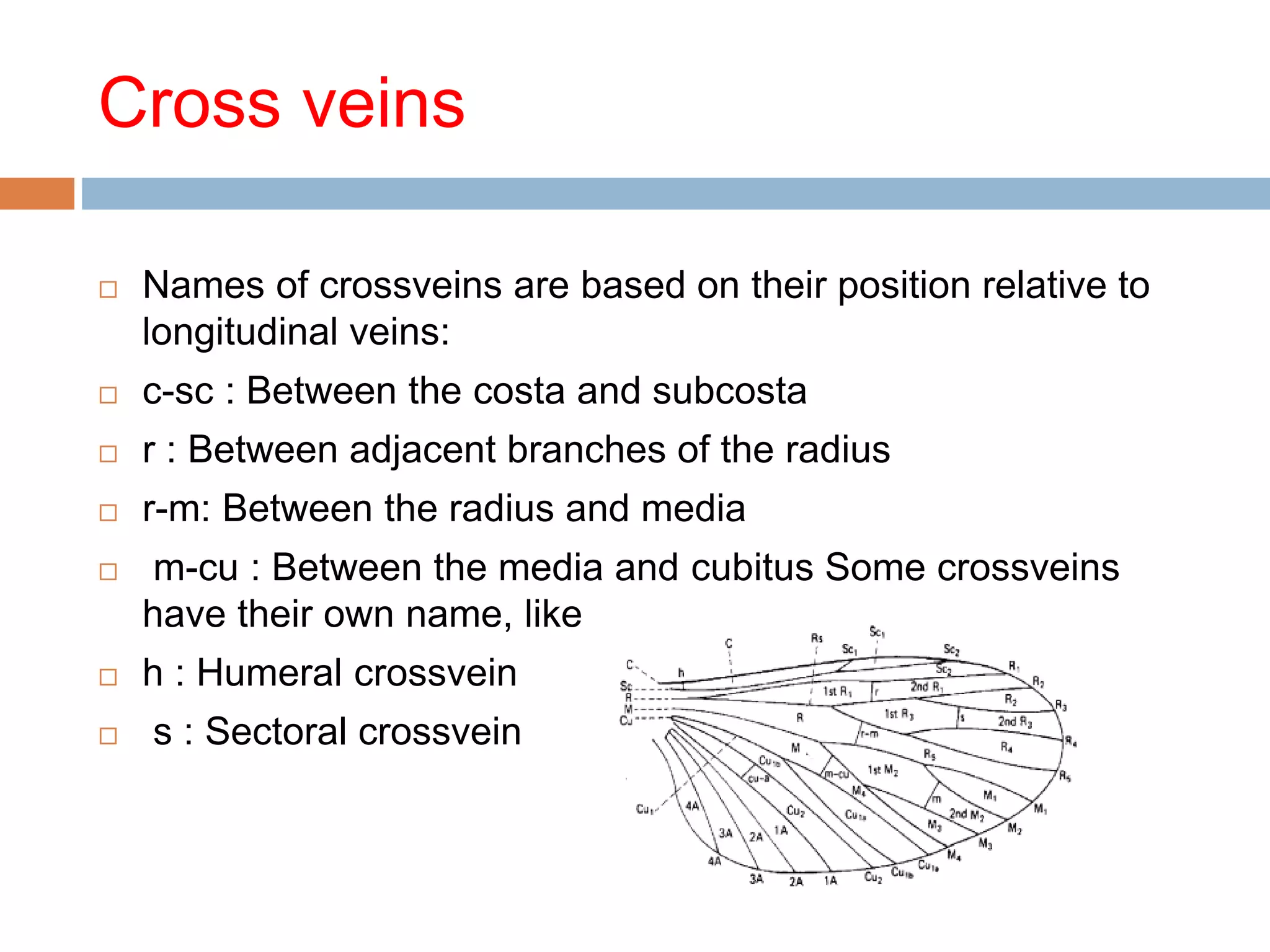
 Names of crossveins are based on their position relative to
longitudinal veins:
 c-sc : Between the costa and subcosta
 r : Between adjacent branches of the radius
 r-m: Between the radius and media
 m-cu : Between the media and cubitus Some crossveins
have their own name, like
 h : Humeral crossvein
 s : Sectoral crossvein
WING MARGINS
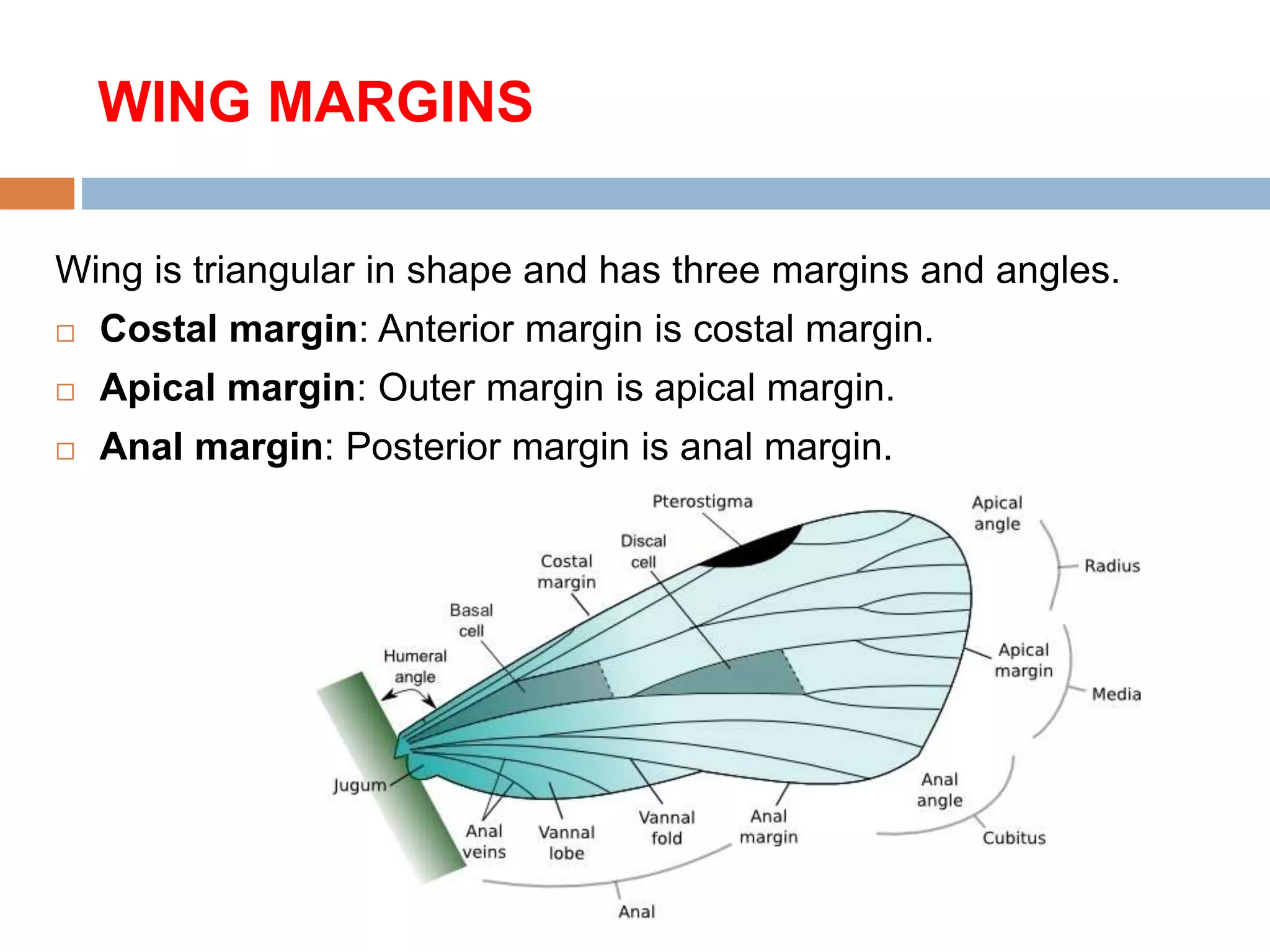
Wing is triangular in shape and has three margins and angles.
 Costal margin: Anterior margin is costal margin.
 Apical margin: Outer margin is apical margin.
 Anal margin: Posterior margin is anal margin.
WING ANGLES
 Humeral angle: Angle at the base of the costal margin of the
wing.
 Apical angle: Angle between the costal margin and the
apical margin.
 Anal angle: Angle between the apical and anal margin.
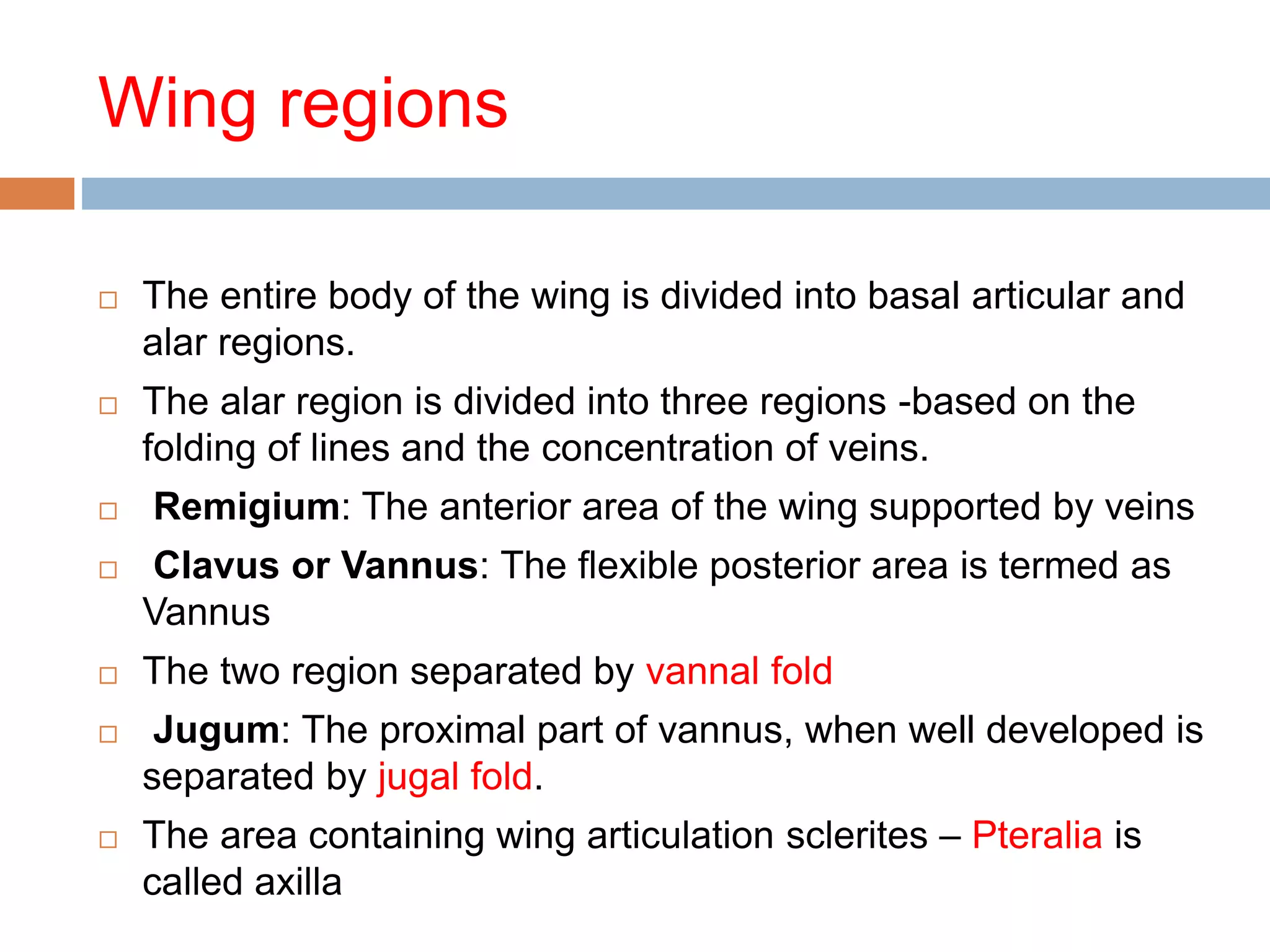
Wing regions
 The entire body of the wing is divided into basal articular and
alar regions.
 The alar region is divided into three regions -based on the
folding of lines and the concentration of veins.
 Remigium: The anterior area of the wing supported by veins
 Clavus or Vannus: The flexible posterior area is termed as
Vannus
 The two region separated by vannal fold
 Jugum: The proximal part of vannus, when well developed is
separated by jugal fold.
 The area containing wing articulation sclerites – Pteralia is
called axilla
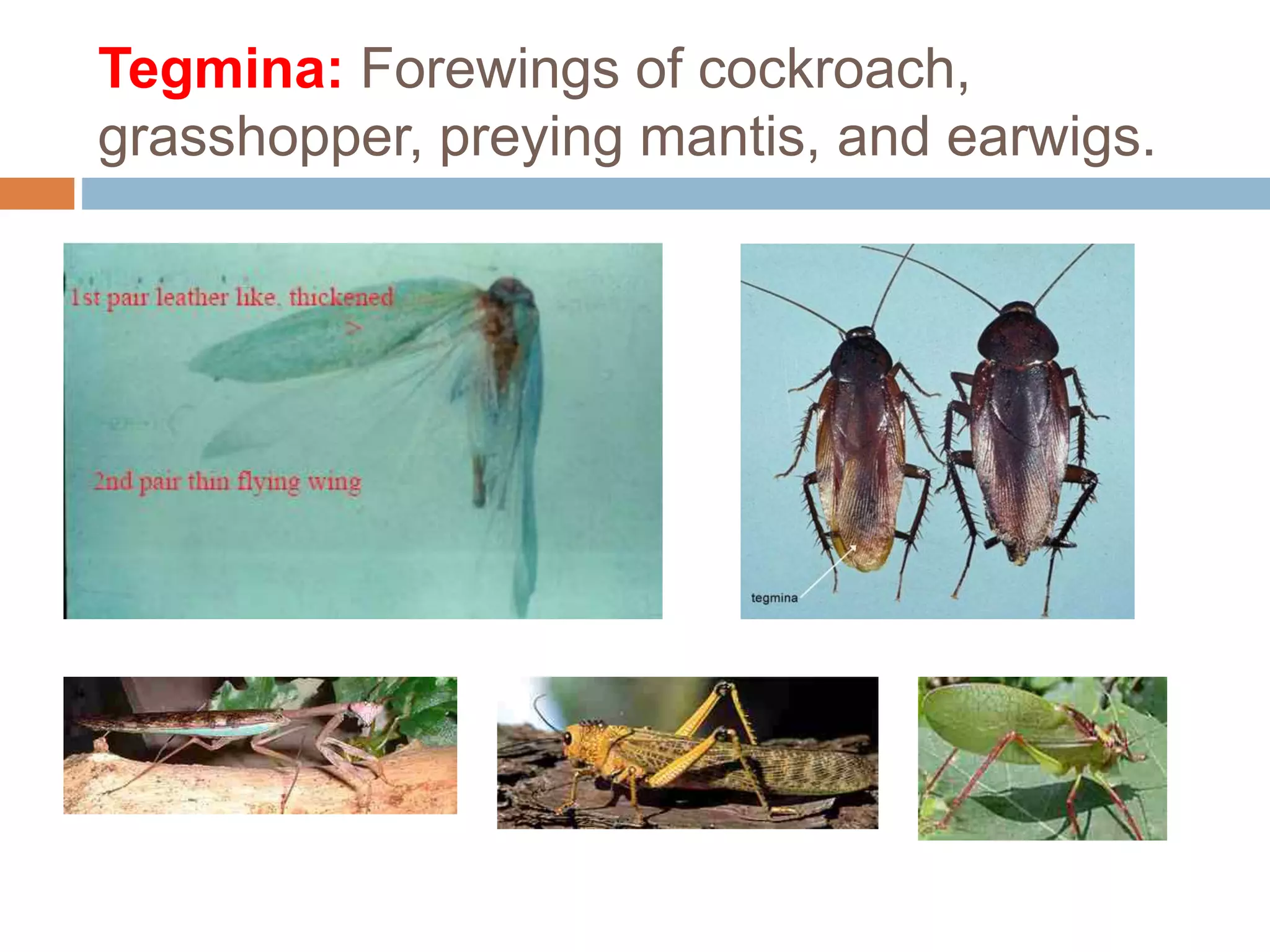
Tegmina: Forewings of cockroach,
grasshopper, preying mantis, and earwigs.
Elytra : Forewings of beetles and
weevils
• Horny, sclerotized, sheath-like
• Devoid of veins
• During flight, they are kept at an angle
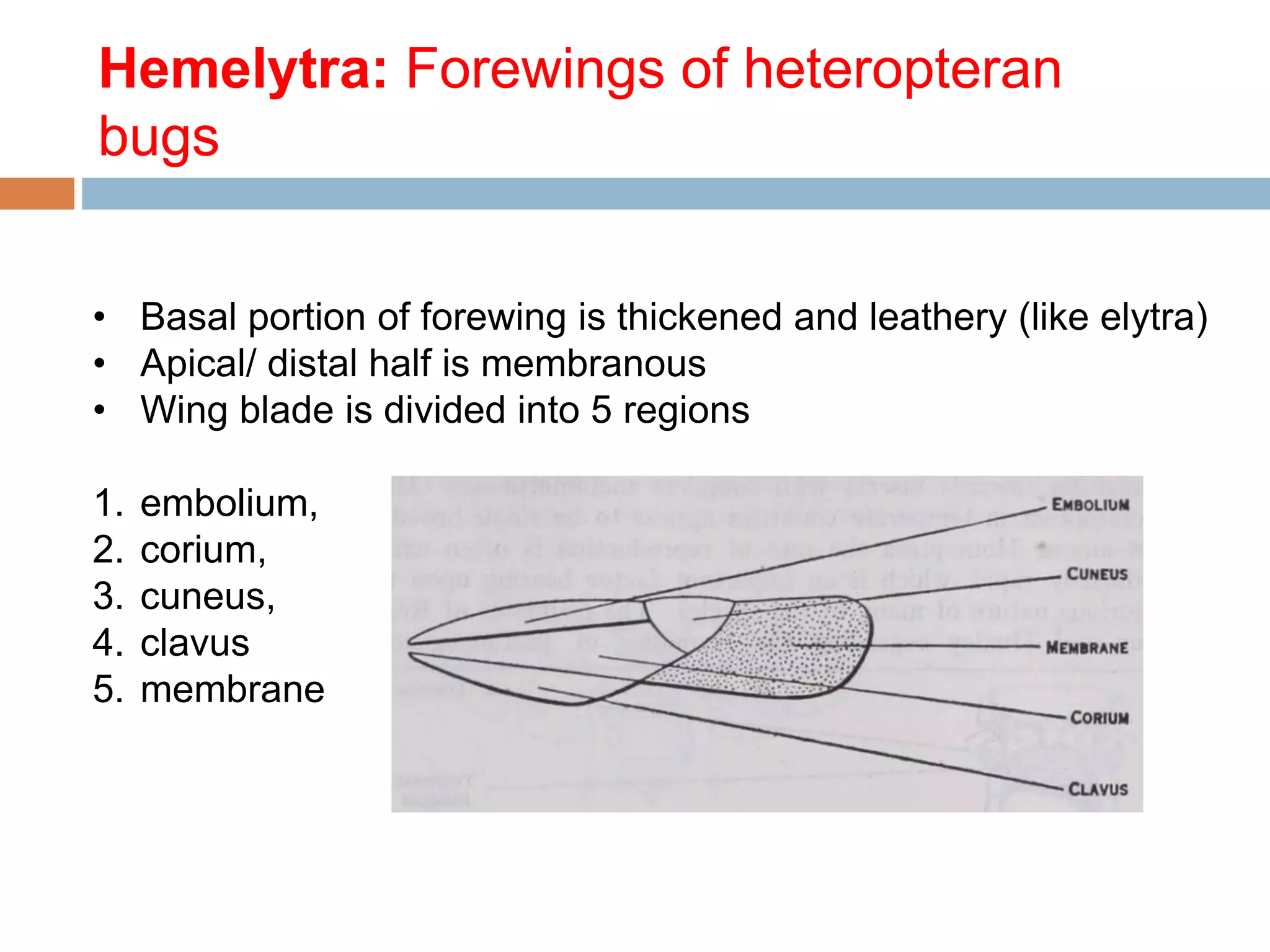
Hemelytra: Forewings of heteropteran
bugs
• Basal portion of forewing is thickened and leathery (like elytra)
• Apical/ distal half is membranous
• Wing blade is divided into 5 regions
1. embolium,
2. corium,
3. cuneus,
4. clavus
5. membrane
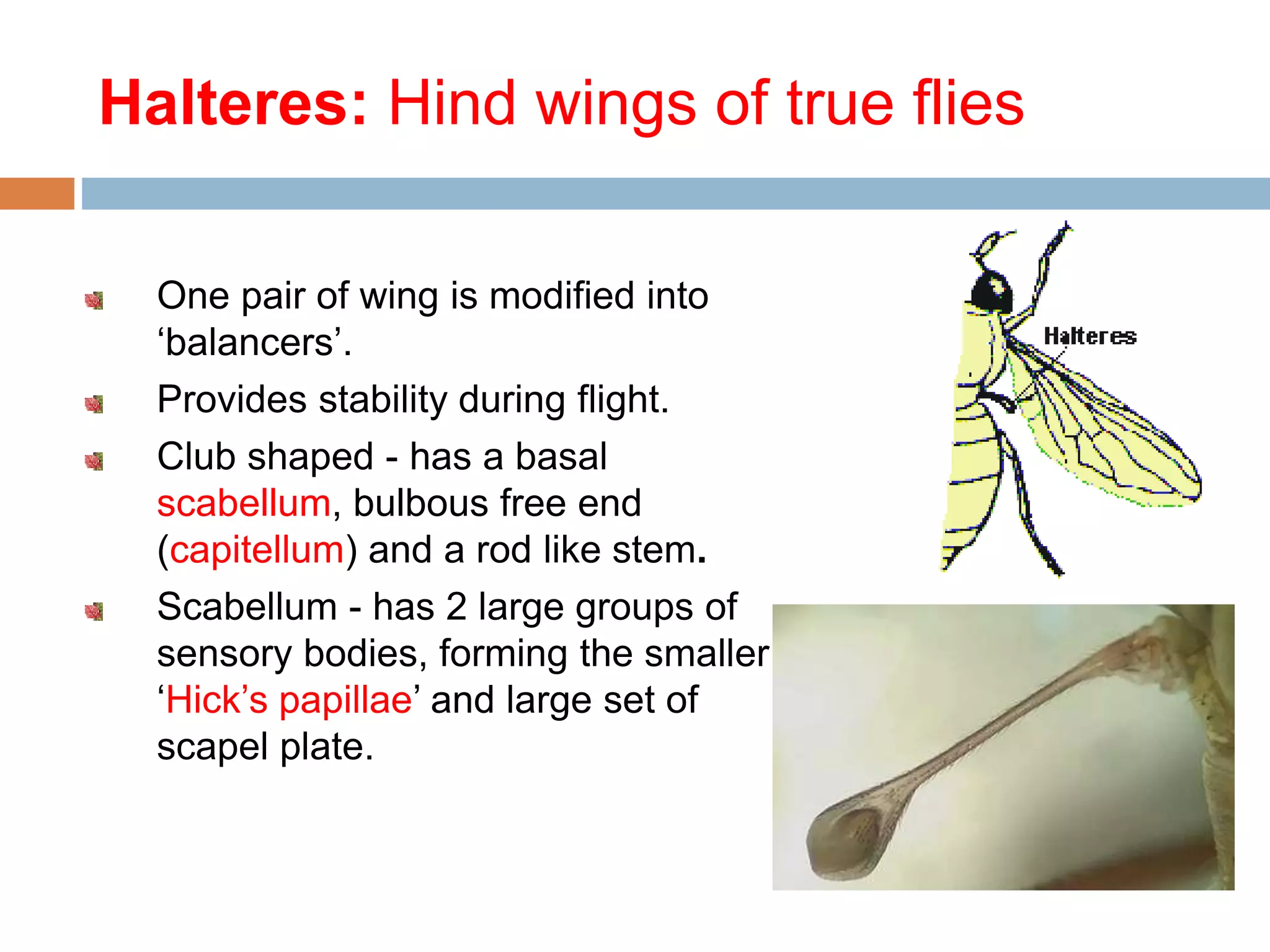
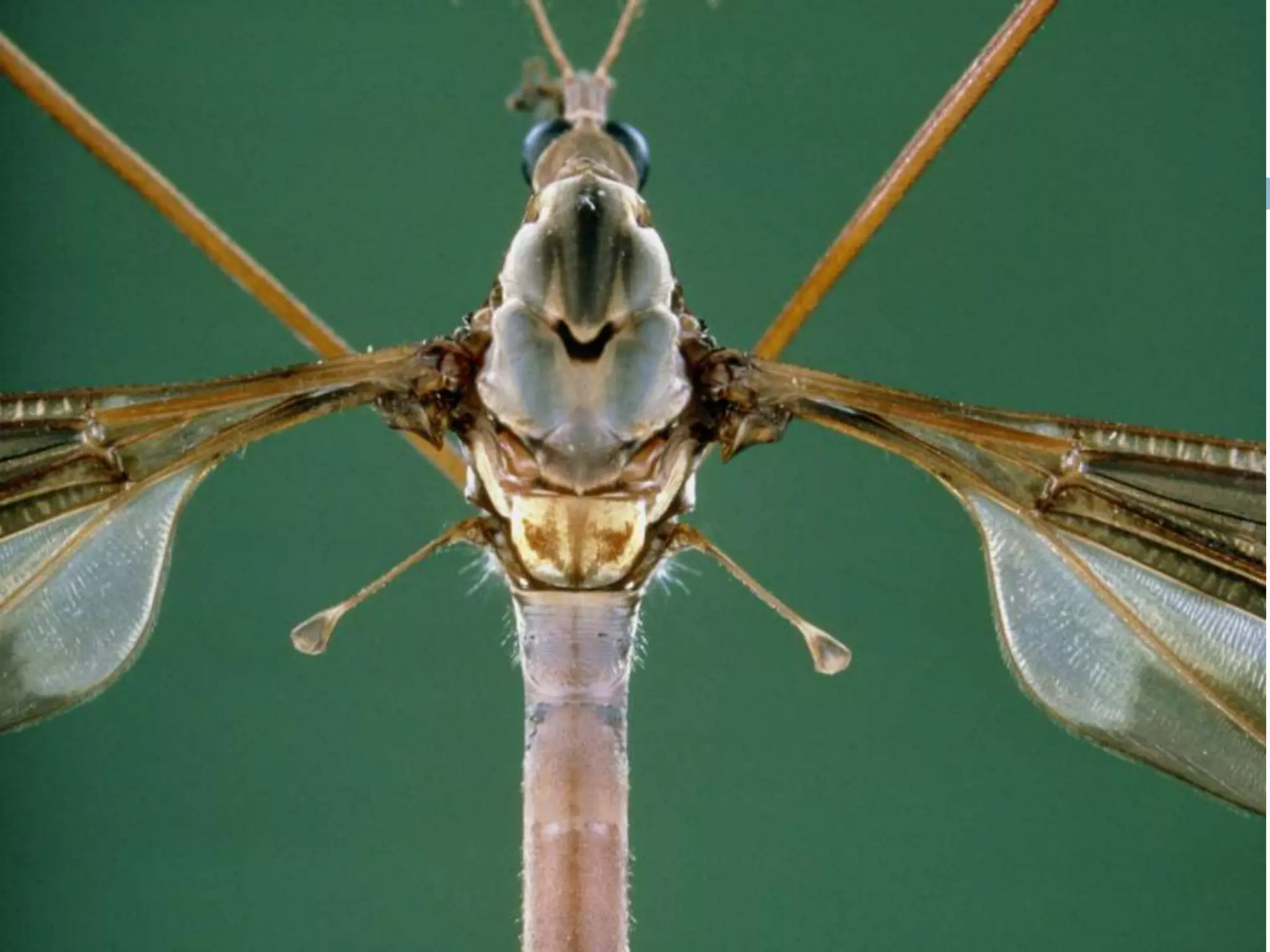
Halteres: Hind wings of true flies
One pair of wing is modified into
‘balancers’.
Provides stability during flight.
Club shaped - has a basal
scabellum, bulbous free end
(capitellum) and a rod like stem.
Scabellum - has 2 large groups of
sensory bodies, forming the smaller
‘Hick’s papillae’ and large set of
scapel plate.
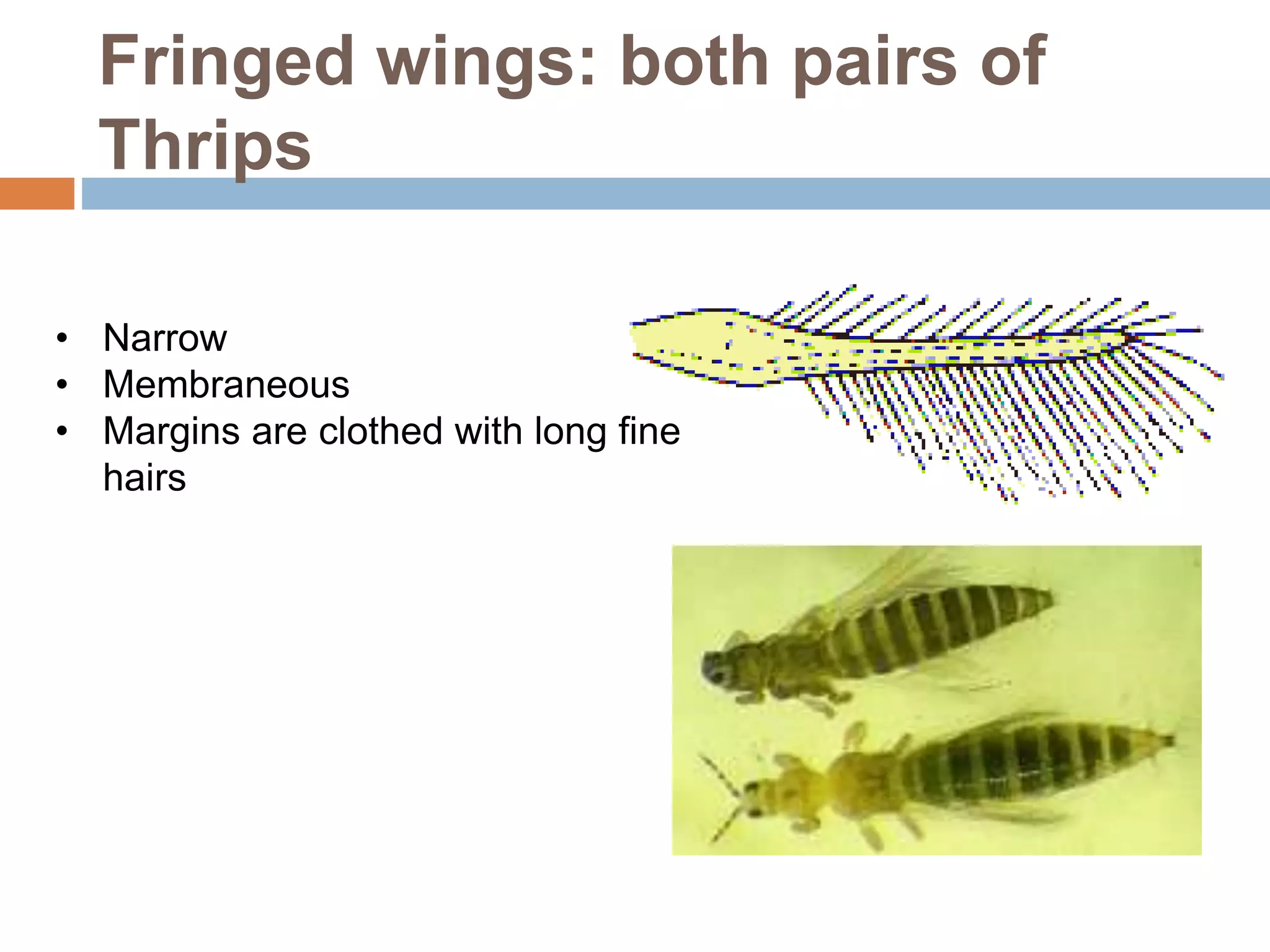
Fringed wings: both pairs of
Thrips
• Narrow
• Membraneous
• Margins are clothed with long fine
hairs
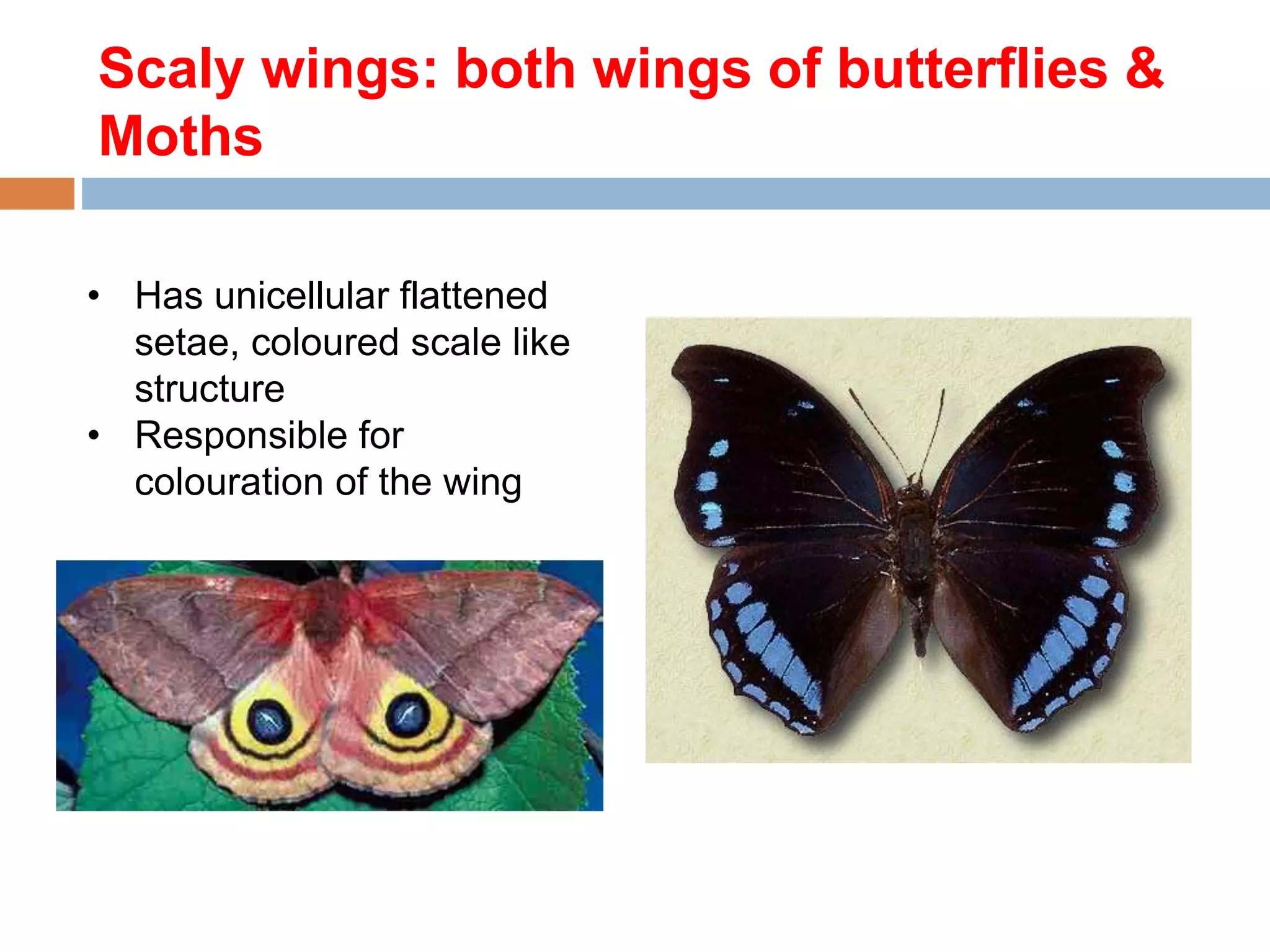
Scaly wings: both wings of butterflies &
Moths
• Has unicellular flattened
setae, coloured scale like
structure
• Responsible for
colouration of the wing
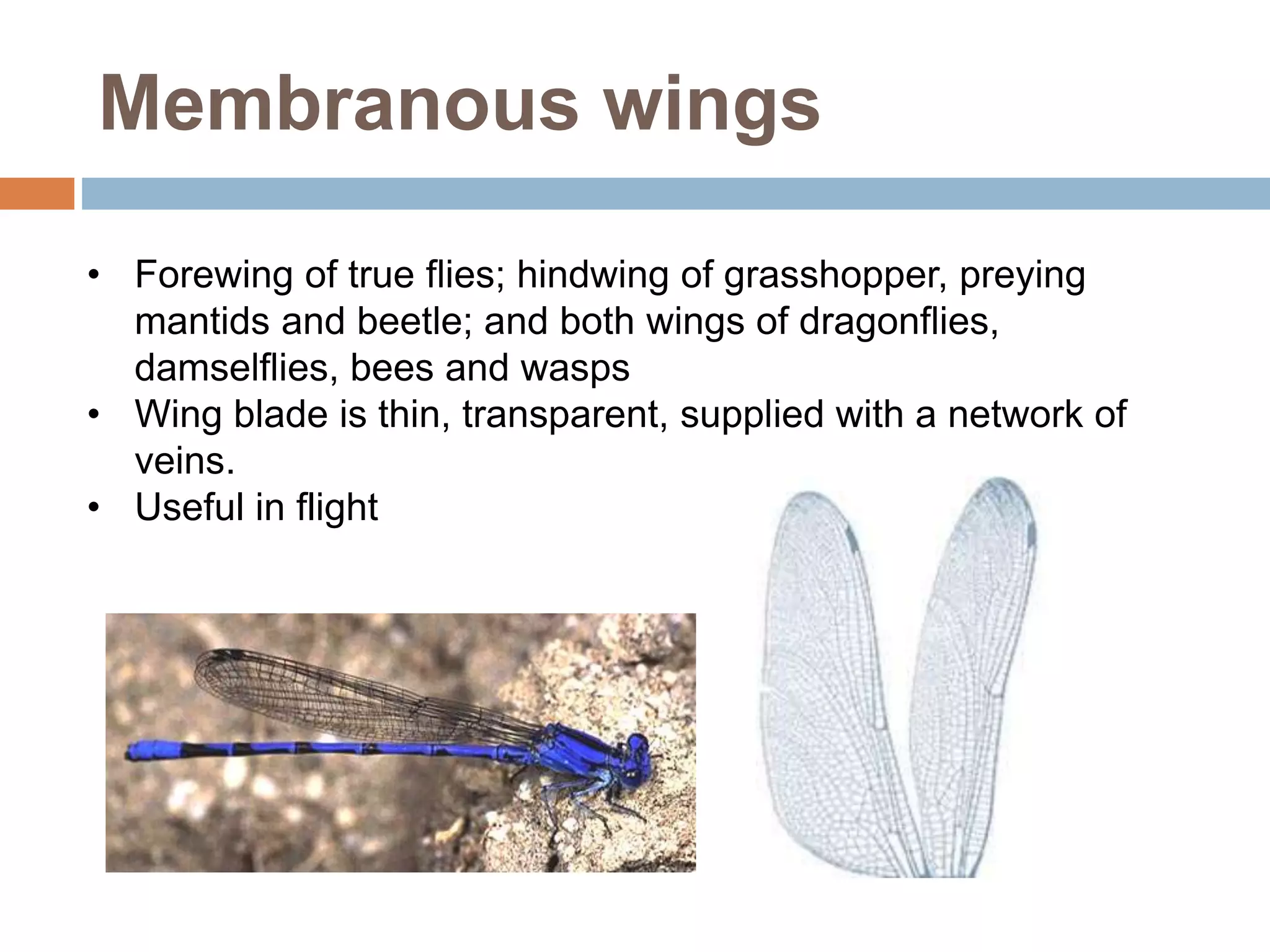
Membranous wings
• Forewing of true flies; hindwing of grasshopper, preying
mantids and beetle; and both wings of dragonflies,
damselflies, bees and wasps
• Wing blade is thin, transparent, supplied with a network of
veins.
• Useful in flight
Hairy wings
TYPES OF WING COUPLING
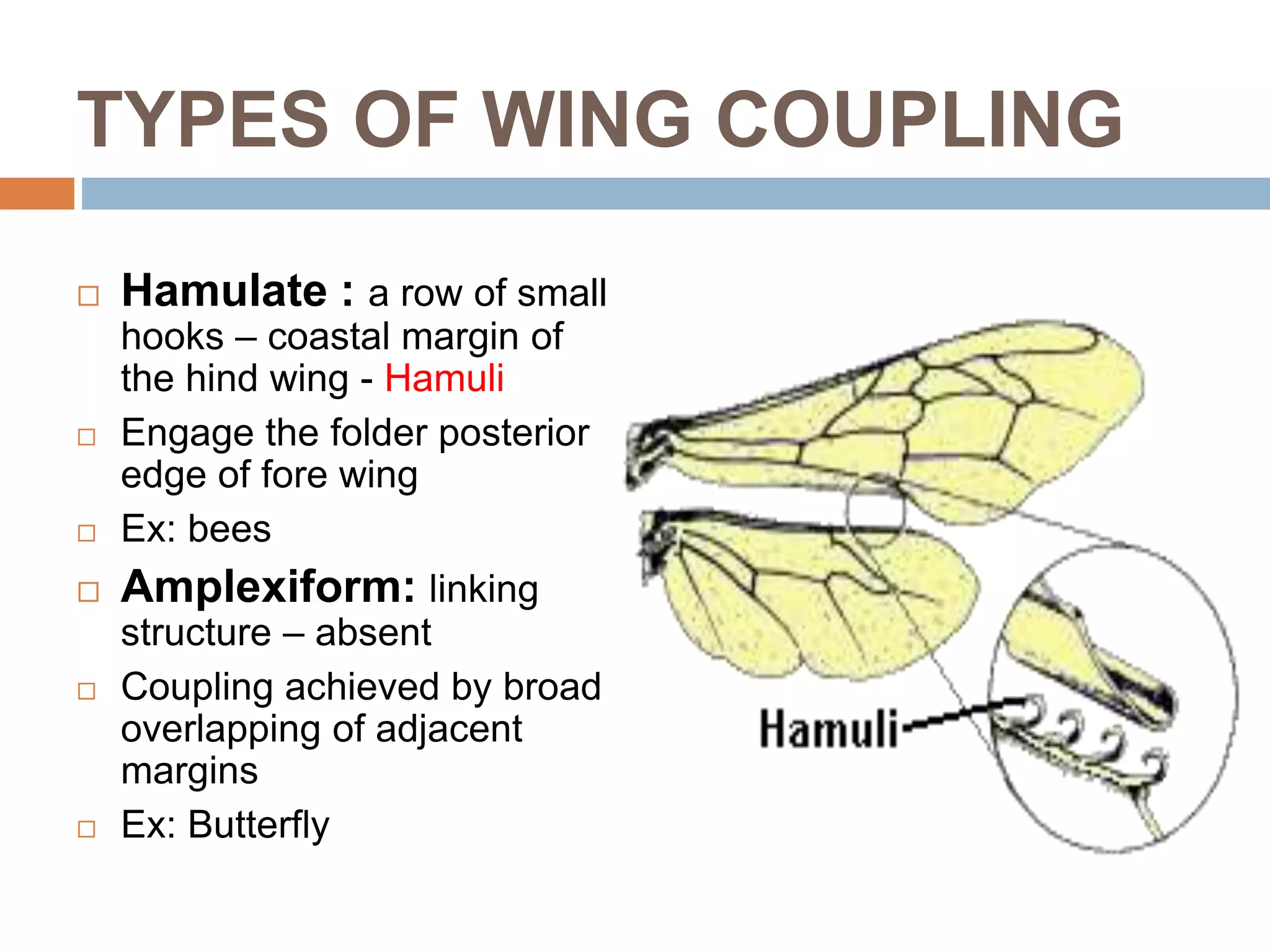
 Hamulate : a row of small
hooks – coastal margin of
the hind wing - Hamuli
 Engage the folder posterior
edge of fore wing
 Ex: bees
 Amplexiform: linking
structure – absent
 Coupling achieved by broad
overlapping of adjacent
margins
 Ex: Butterfly
TYPES OF WING COUPLING
 Frenate: Fruit sucking
moths and Hawk moths
Frenate
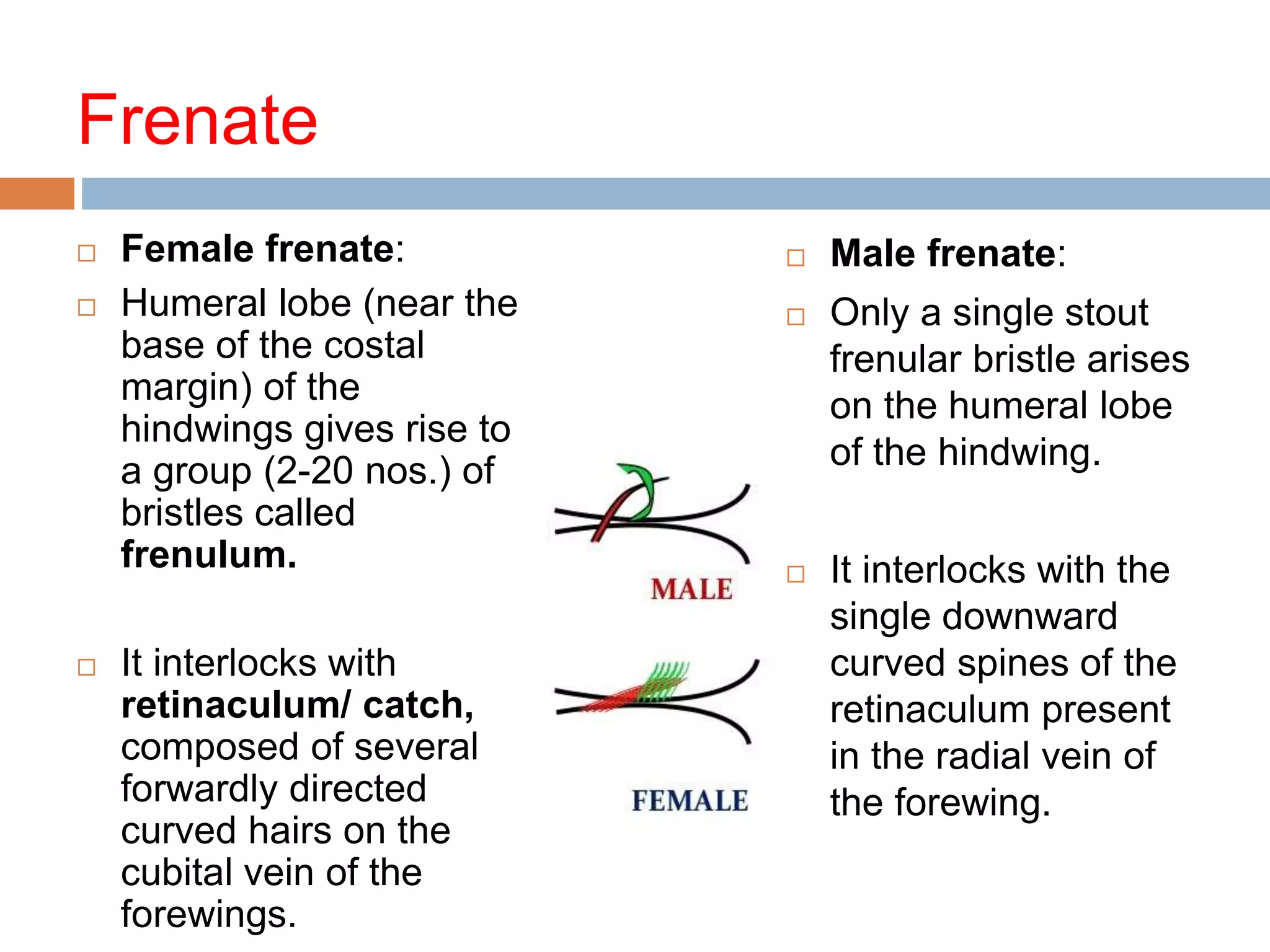
 Female frenate:
 Humeral lobe (near the
base of the costal
margin) of the
hindwings gives rise to
a group (2-20 nos.) of
bristles called
frenulum.
 It interlocks with
retinaculum/ catch,
composed of several
forwardly directed
curved hairs on the
cubital vein of the
forewings.
 Male frenate:
 Only a single stout
frenular bristle arises
on the humeral lobe
of the hindwing.
 It interlocks with the
single downward
curved spines of the
retinaculum present
in the radial vein of
the forewing.
Jugate: Hepialid moths, Sterpsipterans
 Jugam of the forewings
are lobe like
 It is locked to the coastal
margin of the hindwings

Insect wings

  • 1.
    Structure and modificationsof wing venation, modifications and wing coupling apparatus Prepared by Dr. S. Sumaiya
  • 2.
    Insect wings  Twopairs of wings - in pterothoracic segments (meso- and metathorax)  Only one pair of wings -eg. true flies (house fly, horse fly)  No wings (apterous) – eg. primitive insects (silverfish, spring tail)  Secondarily wingless – eg. Head louse, poultry louse and flea  Deciduous wings – eg. Ants and termites
  • 3.
    Wing venation  Theprincipal veins run more-or-less lengthwise on the wing, thus called longitudinal veins.  They are connected by cross-veins.  A closed area bounded by veins is called a cell.  In insects, like dragonfly, damselfly, there is an opaque spot near the costal margin of the wing called pterostigma.  In more primitive insect groups (Odonata), the regions between principal veins contain irregular networks of veins.  These networks represent the remains of the archedictyon described from insect fossils.  These veins (and their branches) are named according to a system devised by John Comstock and George Needham (1898) - the Comstock-Needham System:
  • 4.
    Longitudinal veins • Costa(C) - the leading edge of the wing • Subcosta (Sc) - 2nd longitudinal vein, typically unbranched • Radius (R) - 3rd longitudinal vein, 1-5 branches reach the wing margin • Media (M) - 4th longitudinal vein, 1-4 branches reach the wing margin • Cubitus (Cu) - 5th longitudinal vein, 1-3 branches reach the wing margin Anal vein Un branched vein behind the cubitus
  • 5.
    Cross veins  Namesof crossveins are based on their position relative to longitudinal veins:  c-sc : Between the costa and subcosta  r : Between adjacent branches of the radius  r-m: Between the radius and media  m-cu : Between the media and cubitus Some crossveins have their own name, like  h : Humeral crossvein  s : Sectoral crossvein
  • 6.
    WING MARGINS Wing istriangular in shape and has three margins and angles.  Costal margin: Anterior margin is costal margin.  Apical margin: Outer margin is apical margin.  Anal margin: Posterior margin is anal margin.
  • 7.
    WING ANGLES  Humeralangle: Angle at the base of the costal margin of the wing.  Apical angle: Angle between the costal margin and the apical margin.  Anal angle: Angle between the apical and anal margin.
  • 8.
    Wing regions  Theentire body of the wing is divided into basal articular and alar regions.  The alar region is divided into three regions -based on the folding of lines and the concentration of veins.  Remigium: The anterior area of the wing supported by veins  Clavus or Vannus: The flexible posterior area is termed as Vannus  The two region separated by vannal fold  Jugum: The proximal part of vannus, when well developed is separated by jugal fold.  The area containing wing articulation sclerites – Pteralia is called axilla
  • 9.
    Tegmina: Forewings ofcockroach, grasshopper, preying mantis, and earwigs.
  • 10.
    Elytra : Forewingsof beetles and weevils • Horny, sclerotized, sheath-like • Devoid of veins • During flight, they are kept at an angle
  • 11.
    Hemelytra: Forewings ofheteropteran bugs • Basal portion of forewing is thickened and leathery (like elytra) • Apical/ distal half is membranous • Wing blade is divided into 5 regions 1. embolium, 2. corium, 3. cuneus, 4. clavus 5. membrane
  • 12.
    Halteres: Hind wingsof true flies One pair of wing is modified into ‘balancers’. Provides stability during flight. Club shaped - has a basal scabellum, bulbous free end (capitellum) and a rod like stem. Scabellum - has 2 large groups of sensory bodies, forming the smaller ‘Hick’s papillae’ and large set of scapel plate.
  • 14.
    Fringed wings: bothpairs of Thrips • Narrow • Membraneous • Margins are clothed with long fine hairs
  • 15.
    Scaly wings: bothwings of butterflies & Moths • Has unicellular flattened setae, coloured scale like structure • Responsible for colouration of the wing
  • 16.
    Membranous wings • Forewingof true flies; hindwing of grasshopper, preying mantids and beetle; and both wings of dragonflies, damselflies, bees and wasps • Wing blade is thin, transparent, supplied with a network of veins. • Useful in flight
  • 17.
  • 18.
    TYPES OF WINGCOUPLING  Hamulate : a row of small hooks – coastal margin of the hind wing - Hamuli  Engage the folder posterior edge of fore wing  Ex: bees  Amplexiform: linking structure – absent  Coupling achieved by broad overlapping of adjacent margins  Ex: Butterfly
  • 19.
    TYPES OF WINGCOUPLING  Frenate: Fruit sucking moths and Hawk moths
  • 20.
    Frenate  Female frenate: Humeral lobe (near the base of the costal margin) of the hindwings gives rise to a group (2-20 nos.) of bristles called frenulum.  It interlocks with retinaculum/ catch, composed of several forwardly directed curved hairs on the cubital vein of the forewings.  Male frenate:  Only a single stout frenular bristle arises on the humeral lobe of the hindwing.  It interlocks with the single downward curved spines of the retinaculum present in the radial vein of the forewing.
  • 21.
    Jugate: Hepialid moths,Sterpsipterans  Jugam of the forewings are lobe like  It is locked to the coastal margin of the hindwings