Respiratory System
of Insects
Prepared
By
Dr Hassan Rudayni
1
All insects are aerobic organisms.
They get oxygen directly from environment to convert nutrients into
chemical energy by metabolic reactions.
C6H12O6 + 6O2 6H2O + 6CO2 + energy
Respiratory systems allow organism to move oxygen needed for cellular
respiration into body tissues and remove carbon dioxide from cells.
 Respiratory systems of insect are developed from ectoderm.
2
3
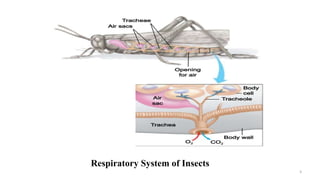
Respiratory System of Insects
4
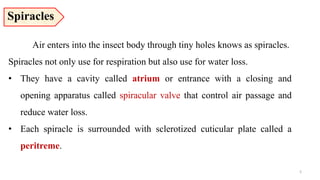
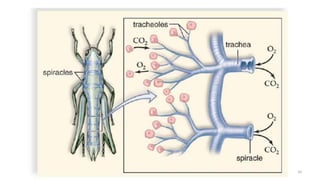
Air enters into the insect body through tiny holes knows as spiracles.
Spiracles not only use for respiration but also use for water loss.
• They have a cavity called atrium or entrance with a closing and
opening apparatus called spiracular valve that control air passage and
reduce water loss.
• Each spiracle is surrounded with sclerotized cuticular plate called a
peritreme.
Spiracles
5
6
peritreme
atrium
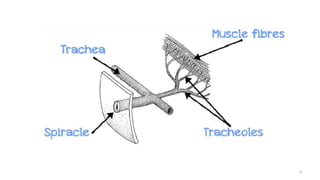
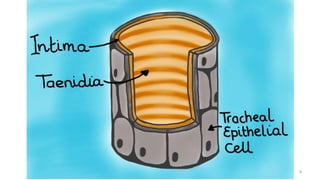
The tracheae are elastic in nature and cuticular pipe like apparatus.
 The circular look of the tracheae is due to the spiral sculpture called
taenidia that permits the tracheae to be flexible but oppose compression.
 It is thick, helical and thread like layer.
 When it filled with air, it shows silvery appearance on dissection.
Tracheae
7
8
Tracheoles
The network of tracheae is called tracheoles with a diameter less
than 1µm (0.2-0.3µm).
 Gaseous will exchange across tracheoles.
 Liquid or air present in it are connected with each other and its
lining not shed down on molting.
 Tracheoles lie within individual cells and diffusion of oxygen and
carbon dioxide in and out of the cells.
9
10
Air-Sacs
In many pterous insects, the tracheae are expanded in many parts of
the body to make thin walled, collapsible structure present called air sacs
that act as air reservoir.
 The air sacs can be seen simply as shiny white vesicle when fill with
air.
 It assist flight by reducing gravity of insects and space for growing
organs. It also proceeds as sound resonator by free vibration of
tympanic membrane and help in heat insulations.
11
12
Number and Arrangement of Spiracles in Insects
In the developed embryo, it is said to be 12 pairs of spiracles are
there on thorax and first nine abdominal segments but mostly spiracles
found on two pairs on thorax and eight pairs on abdomen.
According to number and position of spiracles, respiratory system is
classified as
13
1. Holopneustis Respiratory System
In this system 8 pairs of spiracle are found on first 8 abdominal segments while
remaining 2 pairs found on metathorax and pro or mesothorax.
Example: Dipterans and some Hymenopterans.
2. Hemipneustic Respiratory System:
This system is common of insect larva and in this system, out of 10 pairs of
spiracle; one or two pairs are non-functional.
Number and Arrangement of Spiracles in Insects
14
1 , 2 and
7 only
3. Peripneustic Respiratory System:
Spiracles on abdomen and prothorax are open while on metathorax are close.
Example: Neuroptera, Lepidoptera, Coleoptera, Mecoptera, and Hymenoptera
4. Amphipneustic Respiratory System:
Only 2 pairs of spiracles are open, one of prothorax and other spiracle is of
posterior abdominal segment.
Example : Dipteran’s larva.
5. Propneustic Respiratory System:
Only one pair of prothoracic spiracle is functional.
It is most rare and found in some pupae of Diptera family.
15
6. Metapneustic Respiratory System:
Only last abdominal spiracles pair is functional.
Example: 1st larval instars of aquatic Coleopetra, Family Culicidae, Tipulidae
and Oestridae.
7. Apneustic Respiratory System: ( Closed circular system)
All spiracles are closed. In this respiration takes place by means of diffusion
through gills and general body surface.
Example: Naiad of Mayfly, nymph of Ephemeroptera, Odonata and many
endoparasites (Hymenoptera) that submerged in liquid substances.
16
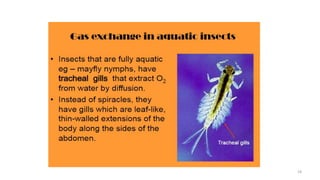
Respiration in Aquatic Insects
17
19
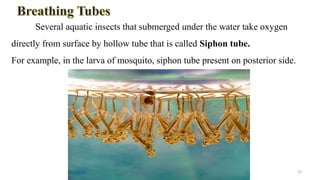
Several aquatic insects that submerged under the water take oxygen
directly from surface by hollow tube that is called Siphon tube.
For example, in the larva of mosquito, siphon tube present on posterior side.
22
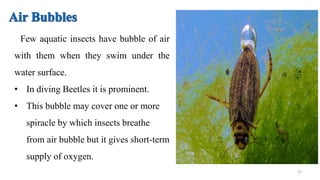
Few aquatic insects have bubble of air
with them when they swim under the
water surface.
• In diving Beetles it is prominent.
• This bubble may cover one or more
spiracle by which insects breathe
from air bubble but it gives short-term
supply of oxygen.
23
24
For thinking:

Insect respiratory system

  • 1.
  • 2.
    All insects areaerobic organisms. They get oxygen directly from environment to convert nutrients into chemical energy by metabolic reactions. C6H12O6 + 6O2 6H2O + 6CO2 + energy Respiratory systems allow organism to move oxygen needed for cellular respiration into body tissues and remove carbon dioxide from cells.  Respiratory systems of insect are developed from ectoderm. 2
  • 3.
  • 4.
  • 5.
    Air enters intothe insect body through tiny holes knows as spiracles. Spiracles not only use for respiration but also use for water loss. • They have a cavity called atrium or entrance with a closing and opening apparatus called spiracular valve that control air passage and reduce water loss. • Each spiracle is surrounded with sclerotized cuticular plate called a peritreme. Spiracles 5
  • 6.
  • 7.
    The tracheae areelastic in nature and cuticular pipe like apparatus.  The circular look of the tracheae is due to the spiral sculpture called taenidia that permits the tracheae to be flexible but oppose compression.  It is thick, helical and thread like layer.  When it filled with air, it shows silvery appearance on dissection. Tracheae 7
  • 8.
  • 9.
    Tracheoles The network oftracheae is called tracheoles with a diameter less than 1µm (0.2-0.3µm).  Gaseous will exchange across tracheoles.  Liquid or air present in it are connected with each other and its lining not shed down on molting.  Tracheoles lie within individual cells and diffusion of oxygen and carbon dioxide in and out of the cells. 9
  • 10.
  • 11.
    Air-Sacs In many pterousinsects, the tracheae are expanded in many parts of the body to make thin walled, collapsible structure present called air sacs that act as air reservoir.  The air sacs can be seen simply as shiny white vesicle when fill with air.  It assist flight by reducing gravity of insects and space for growing organs. It also proceeds as sound resonator by free vibration of tympanic membrane and help in heat insulations. 11
  • 12.
  • 13.
    Number and Arrangementof Spiracles in Insects In the developed embryo, it is said to be 12 pairs of spiracles are there on thorax and first nine abdominal segments but mostly spiracles found on two pairs on thorax and eight pairs on abdomen. According to number and position of spiracles, respiratory system is classified as 13
  • 14.
    1. Holopneustis RespiratorySystem In this system 8 pairs of spiracle are found on first 8 abdominal segments while remaining 2 pairs found on metathorax and pro or mesothorax. Example: Dipterans and some Hymenopterans. 2. Hemipneustic Respiratory System: This system is common of insect larva and in this system, out of 10 pairs of spiracle; one or two pairs are non-functional. Number and Arrangement of Spiracles in Insects 14 1 , 2 and 7 only
  • 15.
    3. Peripneustic RespiratorySystem: Spiracles on abdomen and prothorax are open while on metathorax are close. Example: Neuroptera, Lepidoptera, Coleoptera, Mecoptera, and Hymenoptera 4. Amphipneustic Respiratory System: Only 2 pairs of spiracles are open, one of prothorax and other spiracle is of posterior abdominal segment. Example : Dipteran’s larva. 5. Propneustic Respiratory System: Only one pair of prothoracic spiracle is functional. It is most rare and found in some pupae of Diptera family. 15
  • 16.
    6. Metapneustic RespiratorySystem: Only last abdominal spiracles pair is functional. Example: 1st larval instars of aquatic Coleopetra, Family Culicidae, Tipulidae and Oestridae. 7. Apneustic Respiratory System: ( Closed circular system) All spiracles are closed. In this respiration takes place by means of diffusion through gills and general body surface. Example: Naiad of Mayfly, nymph of Ephemeroptera, Odonata and many endoparasites (Hymenoptera) that submerged in liquid substances. 16
  • 17.
  • 18.
  • 19.
    Several aquatic insectsthat submerged under the water take oxygen directly from surface by hollow tube that is called Siphon tube. For example, in the larva of mosquito, siphon tube present on posterior side. 22
  • 20.
    Few aquatic insectshave bubble of air with them when they swim under the water surface. • In diving Beetles it is prominent. • This bubble may cover one or more spiracle by which insects breathe from air bubble but it gives short-term supply of oxygen. 23
  • 21.

Editor's Notes