DIVISION OF ENTOMOLOGY
ENTO - 501
SUBMITTED TO: DR. DEVINDERSHARMA
CONTENTS
Early Embryonic Development
Post Embryonic Development
INTRODUCTION
• Embryology is the branch of biology which deals with the growth
and development of an embryo of an organism, commencing with
the union of male and female gametes.
• Embryology includes the development of the fertilized egg and
embryo and the growth of the organ system.
• Embryonic Development In Insects:
Development of an insect from egg to adult can be divided into two
parts
• Early embryonic development - takes place inside the egg and
• Post embryonic development – occurring outside the egg.
Early Embryonic Development
FERTILIZATION:
• The production of male (sperm) and female (ovum) gametes is
commonly considered to be The First Phase in insect development.
• The union of gametes (spermatozoon and ovum) is The Second
Phase of development, and creates a diploid zygote with the
potential to form an entire organism and this process occurs
through the fertilization of ovum with sperms.
• The sperm of most of insects remain alive for month to years
within the Spermatheca.
• Fertilization occurs when the eggs are about to be laid and as each
passes down the oviduct.
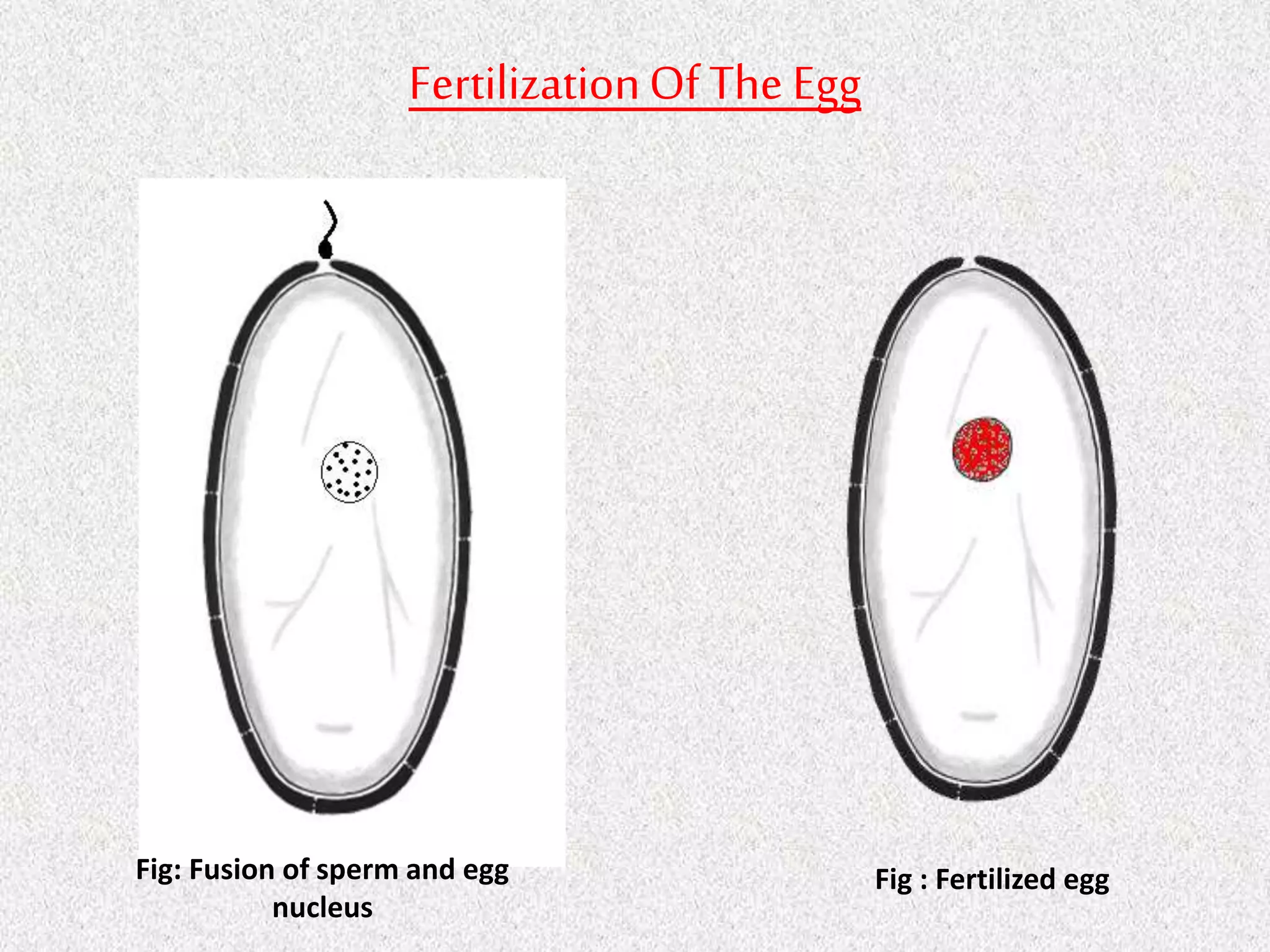
• The sperm enter into the eggs through Micropyle. Several sperms
penetrate into the eggs and fertilization is affected by one of the
sperms to form Zygote while the rest sperms degenerate.
FertilizationOf The Egg
Fig: Fusion of sperm and egg
nucleus
Fig : Fertilized egg
INSECT EGGS
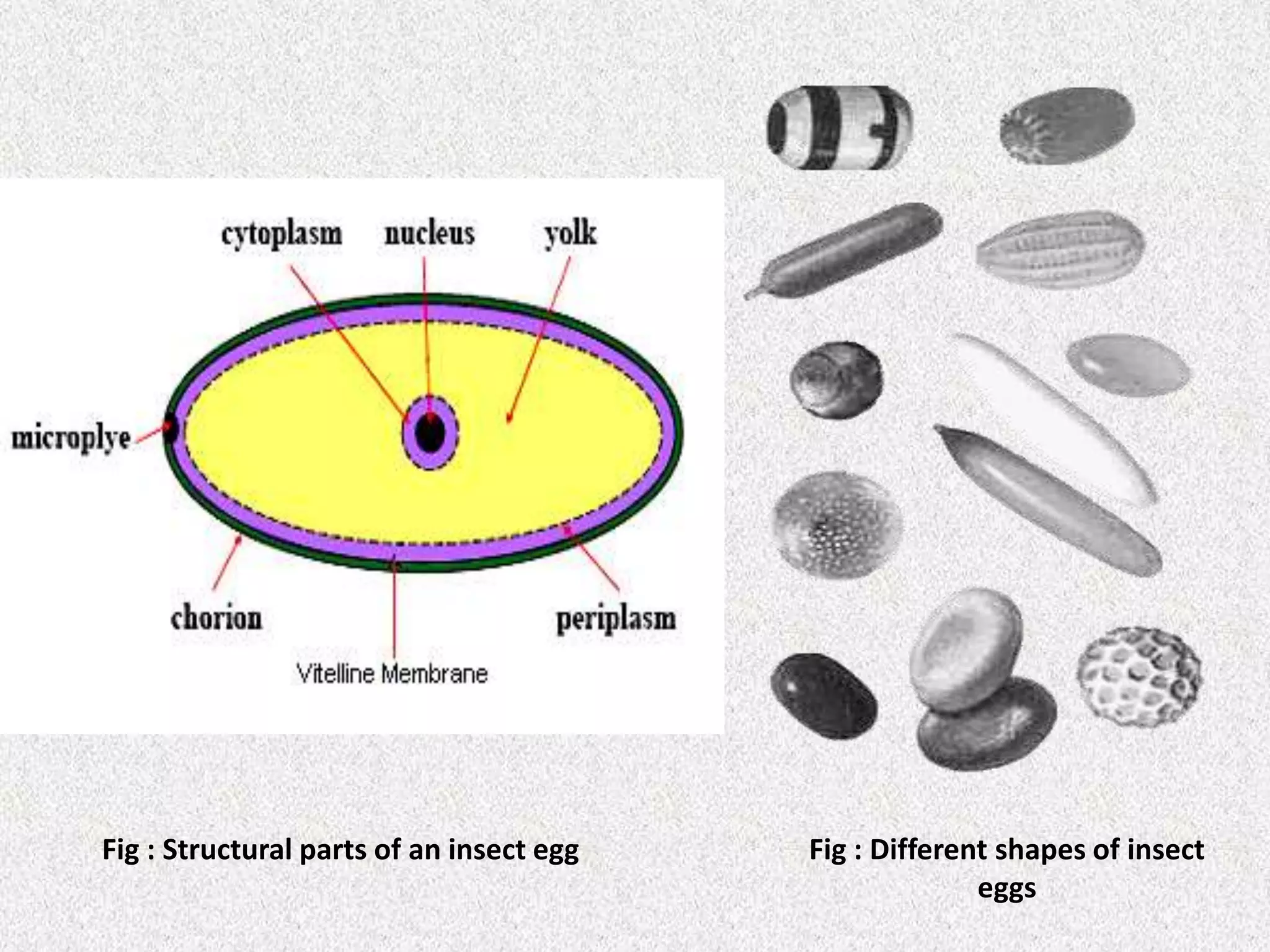
The shapes and structural parts of an insect egg are as follows:
• Mature insect eggs are oval, elongate, may be spherical, disc or
barrel like.
• The eggs are covered by two shells, a tough outer shell called the
Chorion, and a thinner inner shell called The Vitelline Membrane.
• There is an opening called Micropyle at the chorion for the
entrance of sperm.
• The two membranes surround a large nucleus and a mass of
cytoplasm.
• The cytoplasm consists of a large central area of Yolk and a
Peripheral Bounding Layer, the Periplasm, beneath the vitelline
membrane.
• The egg nucleus lies in a central position and embedded in
cytoplasm.
Fig : Different shapes of insect
eggs
Fig : Structural parts of an insect egg
Early Embryonic Development
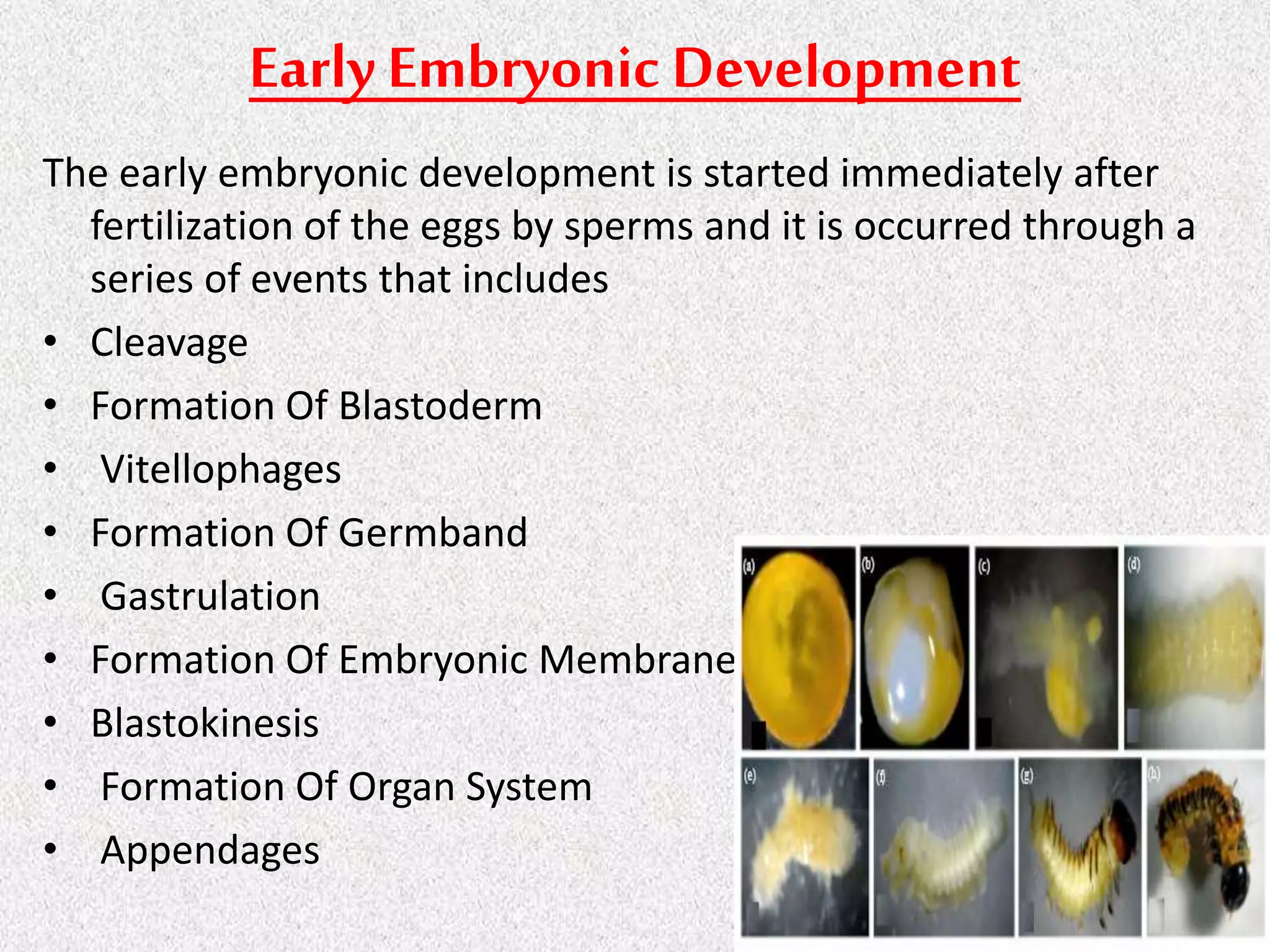
The early embryonic development is started immediately after
fertilization of the eggs by sperms and it is occurred through a
series of events that includes
• Cleavage
• Formation Of Blastoderm
• Vitellophages
• Formation Of Germband
• Gastrulation
• Formation Of Embryonic Membrane
• Blastokinesis
• Formation Of Organ System
• Appendages
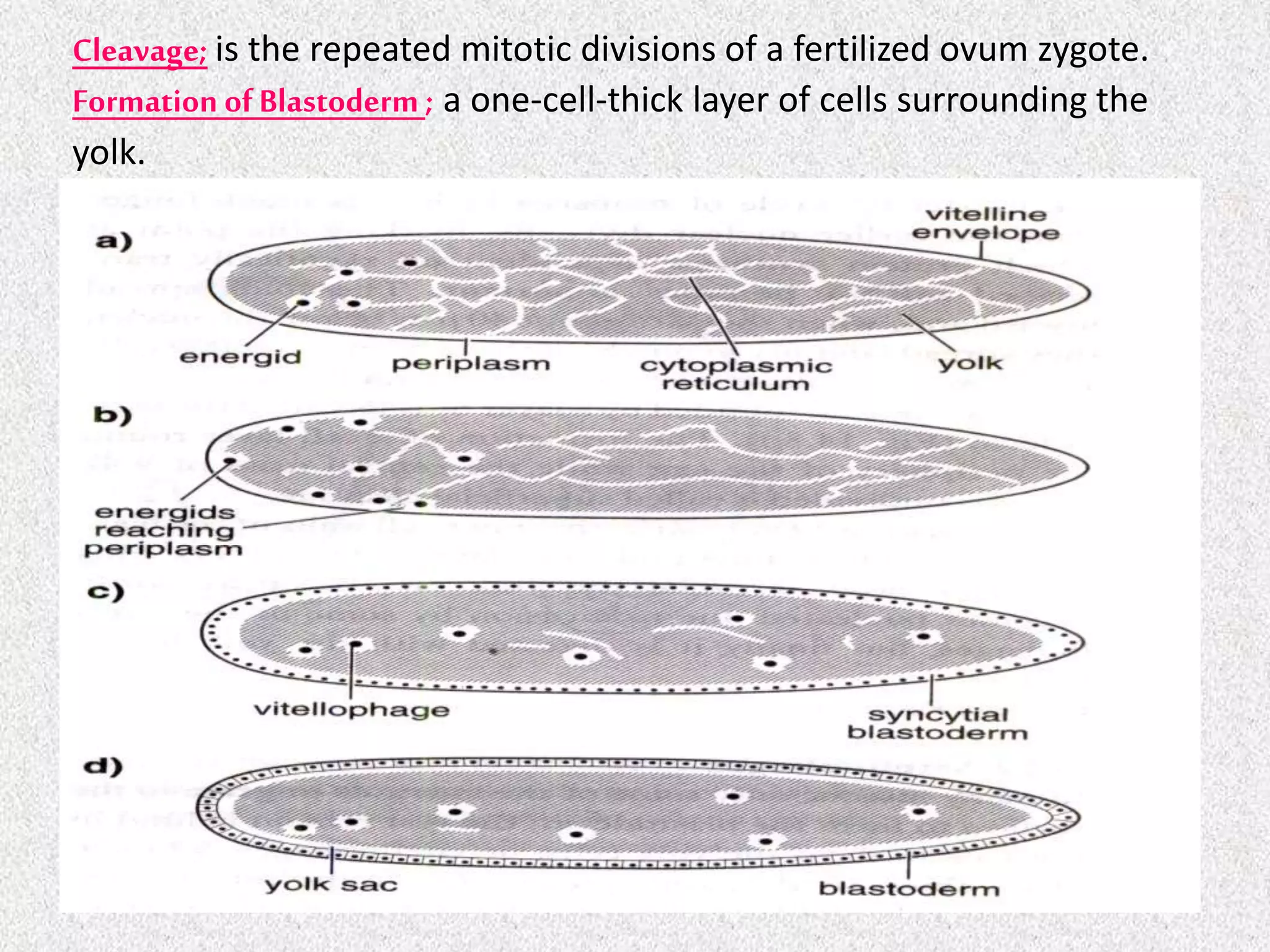
Cleavage; is the repeated mitotic divisions of a fertilized ovum zygote.
Formation ofBlastoderm ; a one-cell-thick layer of cells surrounding the
yolk.
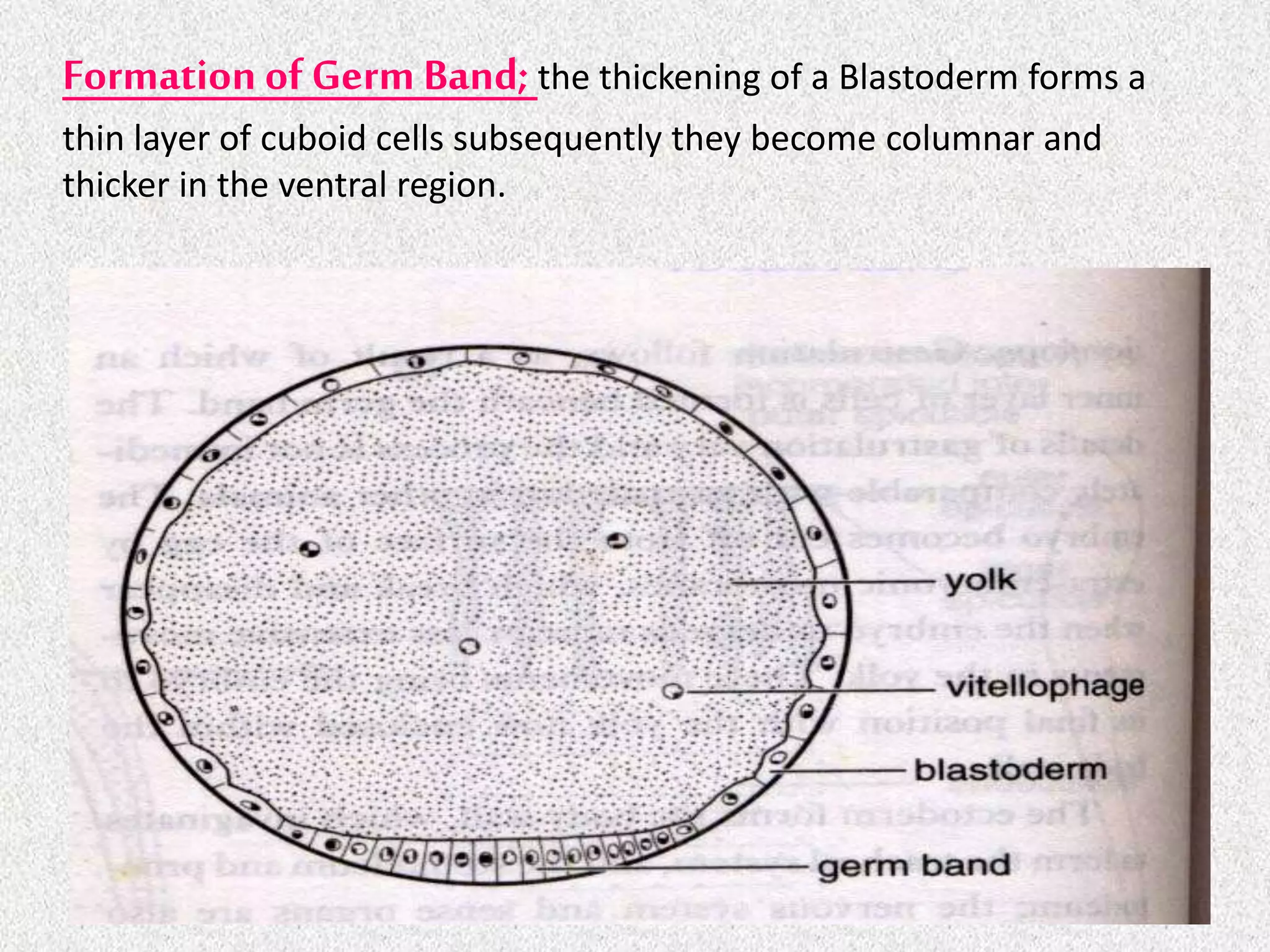
Formation of Germ Band; the thickening of a Blastoderm forms a
thin layer of cuboid cells subsequently they become columnar and
thicker in the ventral region.
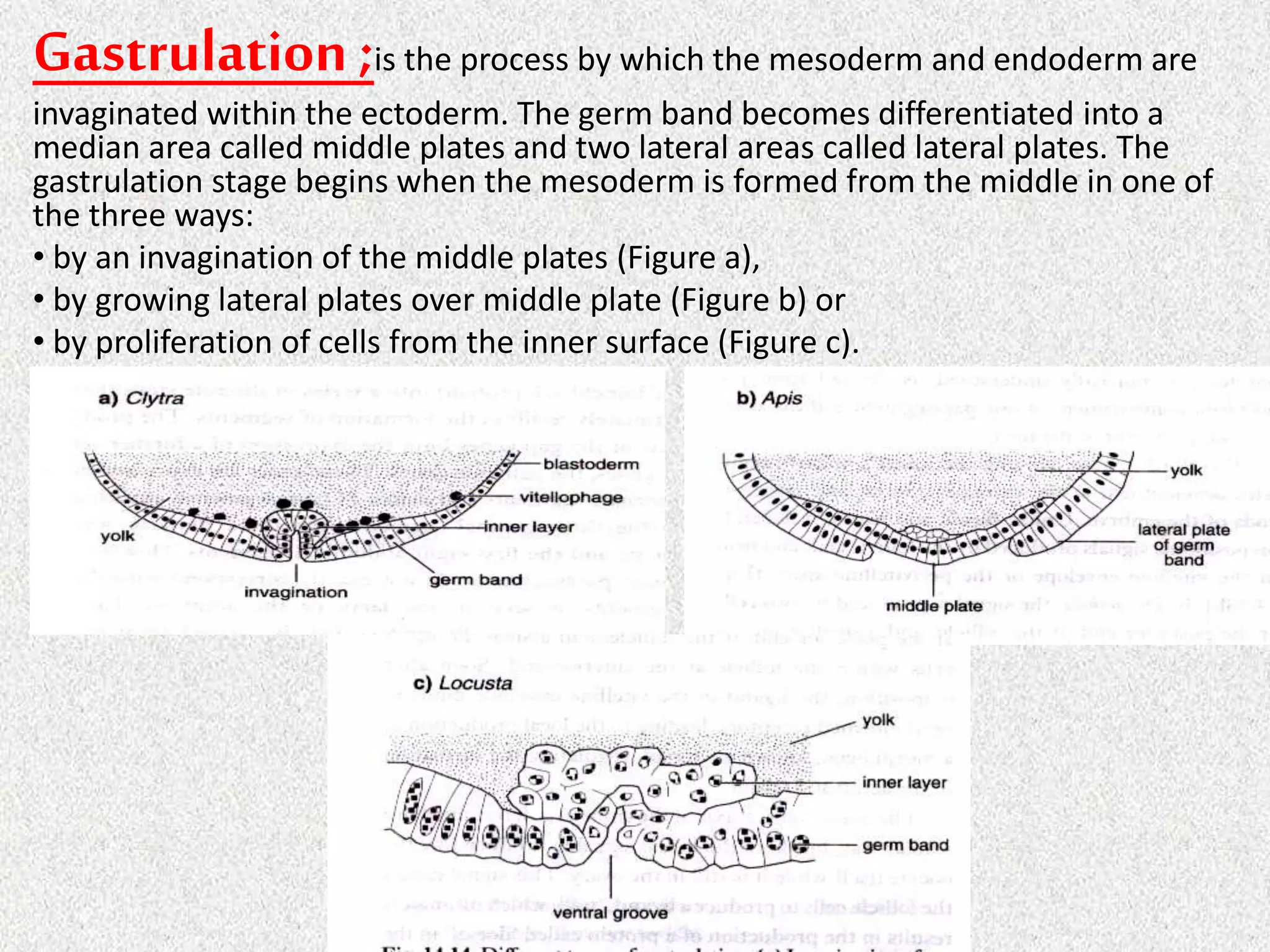
Gastrulation ;is the process by which the mesoderm and endoderm are
invaginated within the ectoderm. The germ band becomes differentiated into a
median area called middle plates and two lateral areas called lateral plates. The
gastrulation stage begins when the mesoderm is formed from the middle in one of
the three ways:
• by an invagination of the middle plates (Figure a),
• by growing lateral plates over middle plate (Figure b) or
• by proliferation of cells from the inner surface (Figure c).
Formation OfThe Embryonic Membrane
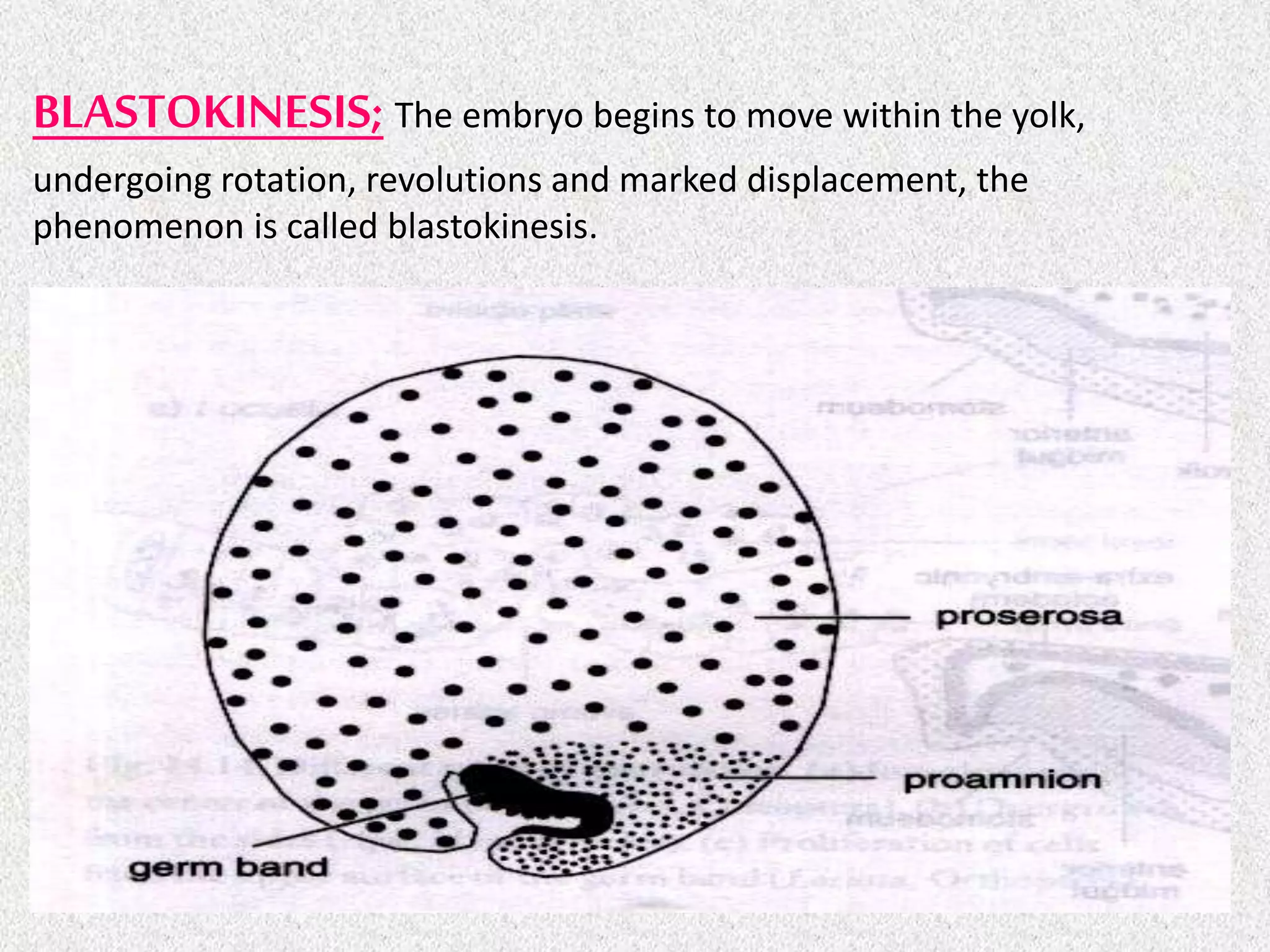
BLASTOKINESIS; The embryo begins to move within the yolk,
undergoing rotation, revolutions and marked displacement, the
phenomenon is called blastokinesis.
DEVELOPMENT OF ORGAN SYSTEM
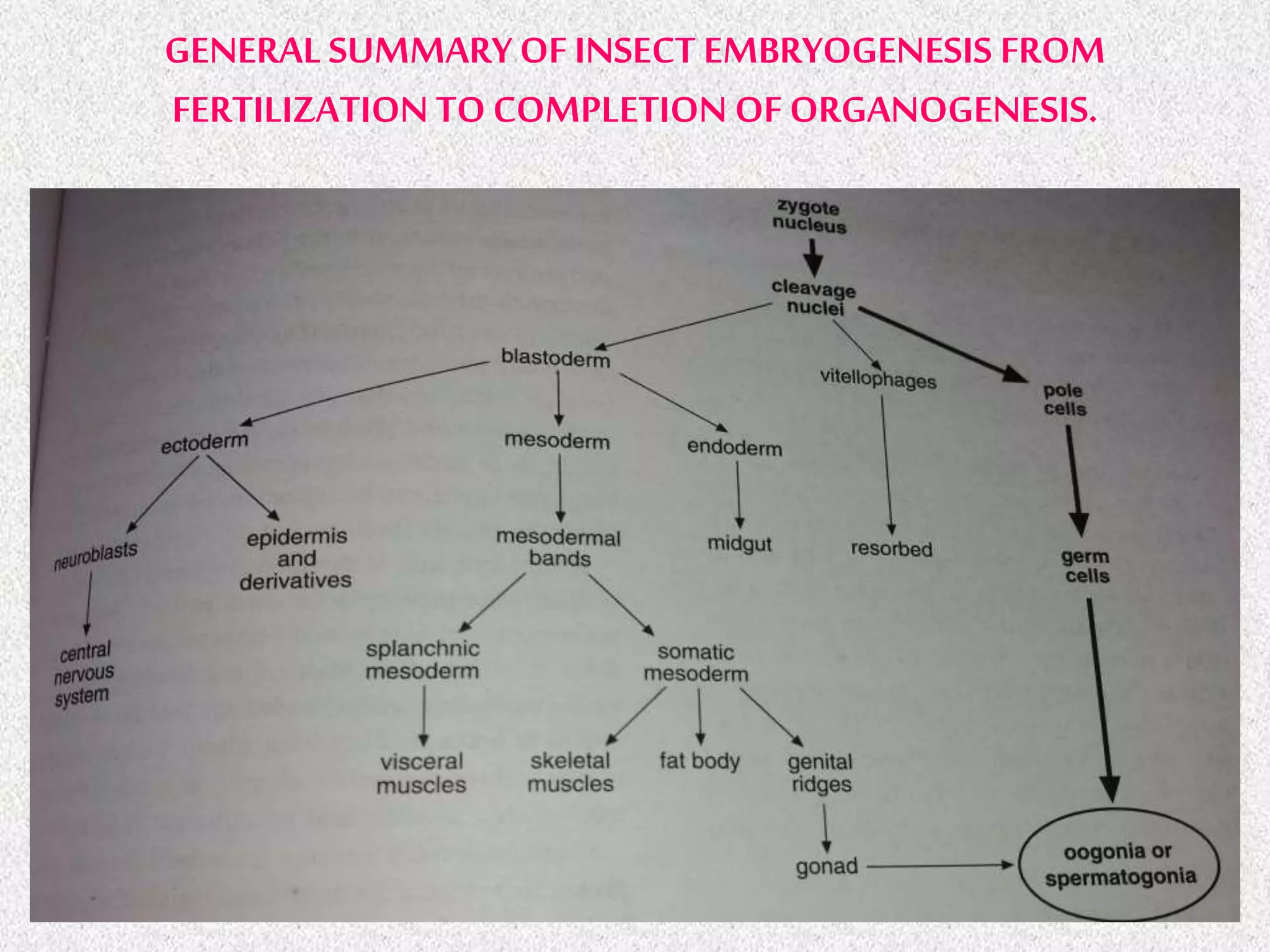
From the three germ layer- ectoderm, mesoderm, and endoderm-
the various organs and tissues of the insect develop.
• The ECTODERM gives rise to the body wall, tracheal system,
nervous system, the malpighian tubles, foregut and hindgut;
• The MESODERM gives rise to the muscular system, heart and
gonads;
• The ENDODERM gives rise to midgut.
DIFFERENT APPENDAGES OF INSECT EMBRYO
GENERAL SUMMARY OF INSECT EMBRYOGENESIS FROM
FERTILIZATION TO COMPLETION OF ORGANOGENESIS.
AlternativeStrategies of AcquiringNutrients
by Embryos
VIVIPARITY
Pseudoplacental Viviparity
Adenotrophic Viviparity
Hemocoelous Viviparity
PARTHENOGENESIS
Thelytoky
Arrhenotoky
POLYEMBRYONY
PEDOGENESIS
Endo Parasitic Hymenoptera Like
Platygaster
Cecidomyids.
Ovoviviparity
Post Embryonic Development
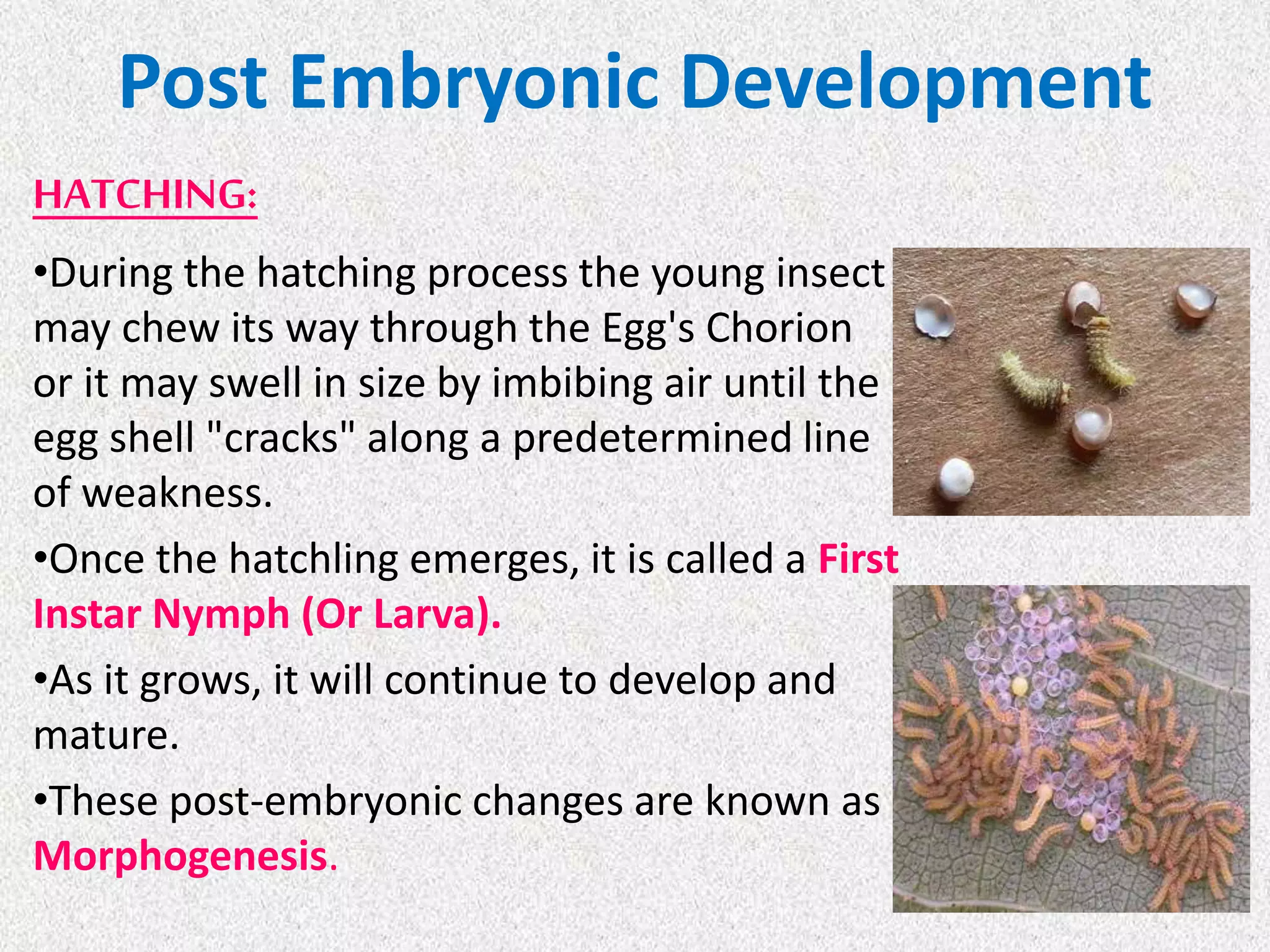
HATCHING:
•During the hatching process the young insect
may chew its way through the Egg's Chorion
or it may swell in size by imbibing air until the
egg shell "cracks" along a predetermined line
of weakness.
•Once the hatchling emerges, it is called a First
Instar Nymph (Or Larva).
•As it grows, it will continue to develop and
mature.
•These post-embryonic changes are known as
Morphogenesis.
MORPHOGENESIS
•Once an insect hatches from the egg it is usually able to
survive on its own, but it is small, wingless, and sexually
immature.
•Its primary role in life is to eat and grow.
• If it survives, it will periodically outgrow and replace its
exoskeleton (a process known as Molting).
•Collectively, all changes that involve growth, molting, and
maturation are known as Morphogenesis.
MOLTING
Step 1: Apolysis -- separation of old exoskeleton from epidermis
Step 2: Secretion of inactive molting fluid by epidermis
Step 3: Production of cuticulin layer for new exoskeleton
Step 4: Activation of molting fluid
Step 5: Digestion and absorption of old endocuticle
Step 6: Epidermis secretes new procuticle
Step 7: Ecdysis -- shedding the old exo- and epicuticle
Step 8: Expansion of new integument
Step 9: Tanning -- sclerotization of new exocuticle
Metamorphosis
Each time an insect molts, it gets a little larger. It may also change
physically in other ways -- depending on its type of metamorphosis:
ametabola, hemimetabola, or holometabola.
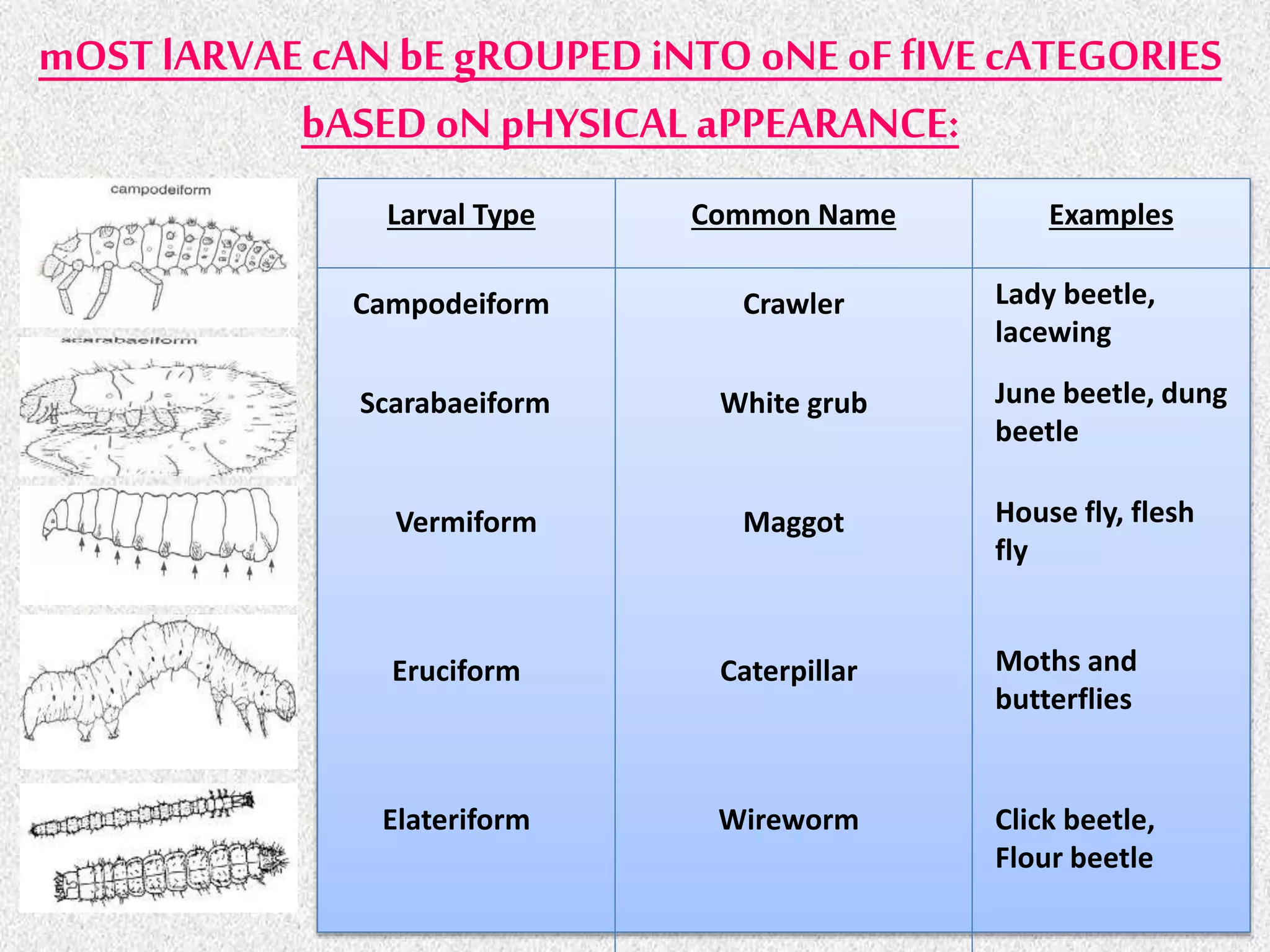
mOST lARVAE cANbE gROUPED iNTO oNE oF fIVEcATEGORIES
bASEDoN pHYSICAL aPPEARANCE:
Larval Type Common Name Examples
Campodeiform
Scarabaeiform
Vermiform
Eruciform
Elateriform
Crawler
White grub
Maggot
Caterpillar
Wireworm
Lady beetle,
lacewing
June beetle, dung
beetle
House fly, flesh
fly
Moths and
butterflies
Click beetle,
Flour beetle
Pupae can be grouped into one of three categories based on
physicalappearance:
Exarate Pupa Obtecta Pupa Coarctate Pupa Chrysalis
Most Of The
Coleoptera I.E.
Beetles
Lepidoptera
(Moths)
Cyclorrhapha
Of Diptera
(Housefly)
Butterflies.
Examples Are:
REFERENCES
 https://projects.ncsu.edu/cals/co.........
 R.F.Chapman, The insect: structure and
function, fourth edition, cambridge university
press, U.K.
 Razzabali.webs.com…….
 https://www.scribd.com......
 Google search……
Embryological development in insect

Embryological development in insect

  • 1.
    DIVISION OF ENTOMOLOGY ENTO- 501 SUBMITTED TO: DR. DEVINDERSHARMA
  • 2.
  • 3.
    INTRODUCTION • Embryology isthe branch of biology which deals with the growth and development of an embryo of an organism, commencing with the union of male and female gametes. • Embryology includes the development of the fertilized egg and embryo and the growth of the organ system. • Embryonic Development In Insects: Development of an insect from egg to adult can be divided into two parts • Early embryonic development - takes place inside the egg and • Post embryonic development – occurring outside the egg.
  • 4.
    Early Embryonic Development FERTILIZATION: •The production of male (sperm) and female (ovum) gametes is commonly considered to be The First Phase in insect development. • The union of gametes (spermatozoon and ovum) is The Second Phase of development, and creates a diploid zygote with the potential to form an entire organism and this process occurs through the fertilization of ovum with sperms. • The sperm of most of insects remain alive for month to years within the Spermatheca. • Fertilization occurs when the eggs are about to be laid and as each passes down the oviduct. • The sperm enter into the eggs through Micropyle. Several sperms penetrate into the eggs and fertilization is affected by one of the sperms to form Zygote while the rest sperms degenerate.
  • 5.
    FertilizationOf The Egg Fig:Fusion of sperm and egg nucleus Fig : Fertilized egg
  • 6.
    INSECT EGGS The shapesand structural parts of an insect egg are as follows: • Mature insect eggs are oval, elongate, may be spherical, disc or barrel like. • The eggs are covered by two shells, a tough outer shell called the Chorion, and a thinner inner shell called The Vitelline Membrane. • There is an opening called Micropyle at the chorion for the entrance of sperm. • The two membranes surround a large nucleus and a mass of cytoplasm. • The cytoplasm consists of a large central area of Yolk and a Peripheral Bounding Layer, the Periplasm, beneath the vitelline membrane. • The egg nucleus lies in a central position and embedded in cytoplasm.
  • 7.
    Fig : Differentshapes of insect eggs Fig : Structural parts of an insect egg
  • 8.
    Early Embryonic Development Theearly embryonic development is started immediately after fertilization of the eggs by sperms and it is occurred through a series of events that includes • Cleavage • Formation Of Blastoderm • Vitellophages • Formation Of Germband • Gastrulation • Formation Of Embryonic Membrane • Blastokinesis • Formation Of Organ System • Appendages
  • 9.
    Cleavage; is therepeated mitotic divisions of a fertilized ovum zygote. Formation ofBlastoderm ; a one-cell-thick layer of cells surrounding the yolk.
  • 10.
    Formation of GermBand; the thickening of a Blastoderm forms a thin layer of cuboid cells subsequently they become columnar and thicker in the ventral region.
  • 11.
    Gastrulation ;is theprocess by which the mesoderm and endoderm are invaginated within the ectoderm. The germ band becomes differentiated into a median area called middle plates and two lateral areas called lateral plates. The gastrulation stage begins when the mesoderm is formed from the middle in one of the three ways: • by an invagination of the middle plates (Figure a), • by growing lateral plates over middle plate (Figure b) or • by proliferation of cells from the inner surface (Figure c).
  • 12.
  • 13.
    BLASTOKINESIS; The embryobegins to move within the yolk, undergoing rotation, revolutions and marked displacement, the phenomenon is called blastokinesis.
  • 14.
    DEVELOPMENT OF ORGANSYSTEM From the three germ layer- ectoderm, mesoderm, and endoderm- the various organs and tissues of the insect develop. • The ECTODERM gives rise to the body wall, tracheal system, nervous system, the malpighian tubles, foregut and hindgut; • The MESODERM gives rise to the muscular system, heart and gonads; • The ENDODERM gives rise to midgut.
  • 15.
  • 16.
    GENERAL SUMMARY OFINSECT EMBRYOGENESIS FROM FERTILIZATION TO COMPLETION OF ORGANOGENESIS.
  • 17.
    AlternativeStrategies of AcquiringNutrients byEmbryos VIVIPARITY Pseudoplacental Viviparity Adenotrophic Viviparity Hemocoelous Viviparity PARTHENOGENESIS Thelytoky Arrhenotoky POLYEMBRYONY PEDOGENESIS Endo Parasitic Hymenoptera Like Platygaster Cecidomyids. Ovoviviparity
  • 18.
    Post Embryonic Development HATCHING: •Duringthe hatching process the young insect may chew its way through the Egg's Chorion or it may swell in size by imbibing air until the egg shell "cracks" along a predetermined line of weakness. •Once the hatchling emerges, it is called a First Instar Nymph (Or Larva). •As it grows, it will continue to develop and mature. •These post-embryonic changes are known as Morphogenesis.
  • 19.
    MORPHOGENESIS •Once an insecthatches from the egg it is usually able to survive on its own, but it is small, wingless, and sexually immature. •Its primary role in life is to eat and grow. • If it survives, it will periodically outgrow and replace its exoskeleton (a process known as Molting). •Collectively, all changes that involve growth, molting, and maturation are known as Morphogenesis.
  • 20.
    MOLTING Step 1: Apolysis-- separation of old exoskeleton from epidermis Step 2: Secretion of inactive molting fluid by epidermis Step 3: Production of cuticulin layer for new exoskeleton Step 4: Activation of molting fluid Step 5: Digestion and absorption of old endocuticle Step 6: Epidermis secretes new procuticle Step 7: Ecdysis -- shedding the old exo- and epicuticle Step 8: Expansion of new integument Step 9: Tanning -- sclerotization of new exocuticle
  • 21.
    Metamorphosis Each time aninsect molts, it gets a little larger. It may also change physically in other ways -- depending on its type of metamorphosis: ametabola, hemimetabola, or holometabola.
  • 22.
    mOST lARVAE cANbEgROUPED iNTO oNE oF fIVEcATEGORIES bASEDoN pHYSICAL aPPEARANCE: Larval Type Common Name Examples Campodeiform Scarabaeiform Vermiform Eruciform Elateriform Crawler White grub Maggot Caterpillar Wireworm Lady beetle, lacewing June beetle, dung beetle House fly, flesh fly Moths and butterflies Click beetle, Flour beetle
  • 23.
    Pupae can begrouped into one of three categories based on physicalappearance: Exarate Pupa Obtecta Pupa Coarctate Pupa Chrysalis Most Of The Coleoptera I.E. Beetles Lepidoptera (Moths) Cyclorrhapha Of Diptera (Housefly) Butterflies. Examples Are:
  • 24.
    REFERENCES  https://projects.ncsu.edu/cals/co.........  R.F.Chapman,The insect: structure and function, fourth edition, cambridge university press, U.K.  Razzabali.webs.com…….  https://www.scribd.com......  Google search……