
Embryonic and Post Embryonic Development
in Insect
ENT-501 Insect Morphology Credit-2(1+1)
Submitted Submitted
to by
Dr. U.S. Kulkarni Devendra Kumar Meena
Department of Entomology
Post Graduation Institute
Dr. Panjabrao Deshmukh Krishi Vidhapeeth,
Akola
EMBRYOLOGY: DEVELOPMENT AND
FORMATION OF EMBRYO IN INSECTS
Embryology
Embryology includes the development of the fertilized egg
and embryo and the growth of the organ system.
Embryonic development in insects
Development of an insect from egg to adult can be divided
into two parts
a. Early embryonic development - takes place inside the
egg and
b. Post embryonic development - occurring outside the egg.
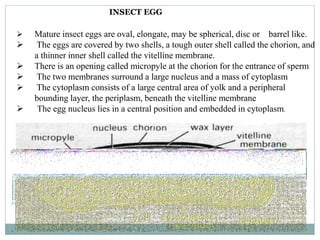
INSECT EGG
 Mature insect eggs are oval, elongate, may be spherical, disc or barrel like.
 The eggs are covered by two shells, a tough outer shell called the chorion, and
a thinner inner shell called the vitelline membrane.
 There is an opening called micropyle at the chorion for the entrance of sperm
 The two membranes surround a large nucleus and a mass of cytoplasm
 The cytoplasm consists of a large central area of yolk and a peripheral
bounding layer, the periplasm, beneath the vitelline membrane
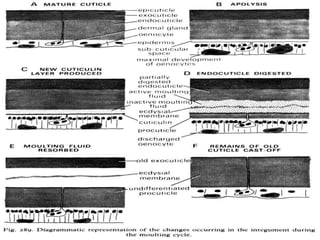
 The egg nucleus lies in a central position and embedded in cytoplasm.
Fertilization of egg
The production of male (sperm) and female (ovum)
gametes is commonly considered to be the first
phase in insect development.
 The union of gametes (spermatozoon and ovum) is the
second phase of development, and creates a diploid
zygote with the potential to form an entire organism.
 This process occurs through the fertilization of ovum
with sperms
Early embryonic development
a. Cleavage
b. Blastoderm formation
c. Vittelophage
d. Formation of gern bandas
e. Gastrulation
f. Formation of embryonic membranes
g. Blastokinesis
h. Formation of organ system
i. Appandeges
Cleavage
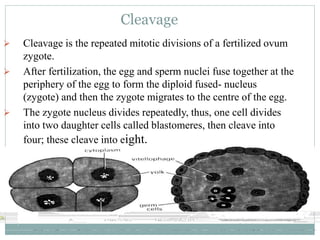
 Cleavage is the repeated mitotic divisions of a fertilized ovum
zygote.
 After fertilization, the egg and sperm nuclei fuse together at the
periphery of the egg to form the diploid fused- nucleus
(zygote) and then the zygote migrates to the centre of the egg.
 The zygote nucleus divides repeatedly, thus, one cell divides
into two daughter cells called blastomeres, then cleave into
four; these cleave into eight.
Blastoderm formation
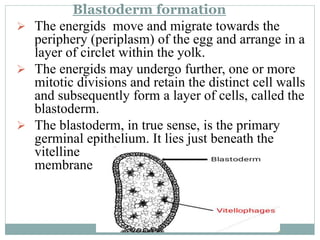
 The energids move and migrate towards the
periphery (periplasm) of the egg and arrange in a
layer of circlet within the yolk.
 The energids may undergo further, one or more
mitotic divisions and retain the distinct cell walls
and subsequently form a layer of cells, called the
blastoderm.
 The blastoderm, in true sense, is the primary
germinal epithelium. It lies just beneath the
vitelline
membrane
Vitellophages
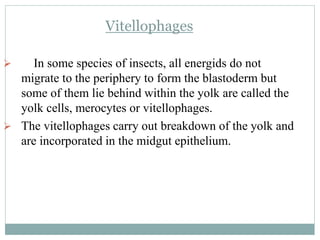
 In some species of insects, all energids do not
migrate to the periphery to form the blastoderm but
some of them lie behind within the yolk are called the
yolk cells, merocytes or vitellophages.
 The vitellophages carry out breakdown of the yolk and
are incorporated in the midgut epithelium.
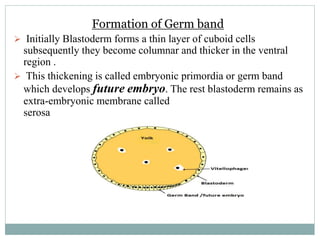
Formation of Germ band
 Initially Blastoderm forms a thin layer of cuboid cells
subsequently they become columnar and thicker in the ventral
region .
 This thickening is called embryonic primordia or germ band
which develops future embryo. The rest blastoderm remains as
extra-embryonic membrane called
serosa
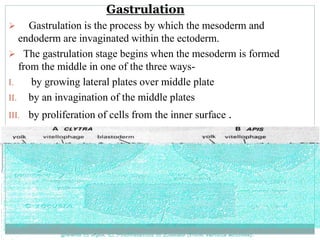
Gastrulation
 Gastrulation is the process by which the mesoderm and
endoderm are invaginated within the ectoderm.
 The gastrulation stage begins when the mesoderm is formed
from the middle in one of the three ways-
I. by growing lateral plates over middle plate
II. by an invagination of the middle plates
III. by proliferation of cells from the inner surface .
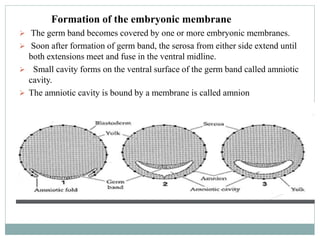
Formation of the embryonic membrane
 The germ band becomes covered by one or more embryonic membranes.
 Soon after formation of germ band, the serosa from either side extend until
both extensions meet and fuse in the ventral midline.
 Small cavity forms on the ventral surface of the germ band called amniotic
cavity.
 The amniotic cavity is bound by a membrane is called amnion
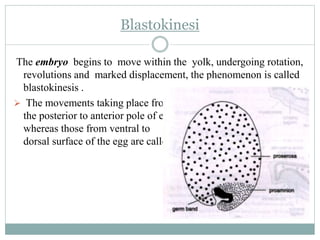
Blastokinesi
The embryo begins to move within the yolk, undergoing rotation,
revolutions and marked displacement, the phenomenon is called
blastokinesis .
 The movements taking place from
the posterior to anterior pole of egg are termed as the anatrepsis,
whereas those from ventral to
dorsal surface of the egg are called katatrepsis.
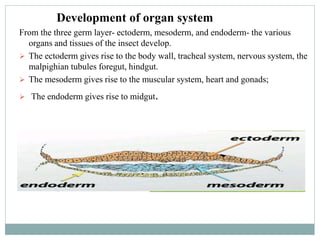
Development of organ system
From the three germ layer- ectoderm, mesoderm, and endoderm- the various
organs and tissues of the insect develop.
 The ectoderm gives rise to the body wall, tracheal system, nervous system, the
malpighian tubules foregut, hindgut.
 The mesoderm gives rise to the muscular system, heart and gonads;
 The endoderm gives rise to midgut.
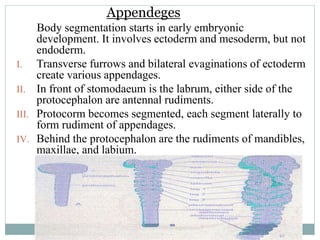
Appendeges
Body segmentation starts in early embryonic
development. It involves ectoderm and mesoderm, but not
endoderm.
I. Transverse furrows and bilateral evaginations of ectoderm
create various appendages.
II. In front of stomodaeum is the labrum, either side of the
protocephalon are antennal rudiments.
III. Protocorm becomes segmented, each segment laterally to
form rudiment of appendages.
IV. Behind the protocephalon are the rudiments of mandibles,
maxillae, and labium.
POST EMBRYONIC DEVELOPMENT
IN INSECTS.
POST EMBRYONIC: Development takes place outside
the egg.
During their post embryonic growth period insect pass
through a series of stages until they become adult.
The time interval occupied by each instar being terminated
by a moult.
METAMORPHOSIS:
It is the change in growth and development an insect
undergoes during its lifecycle from birth to maturity.
FOUR BASIC TYPES OF METAMORPHOSIS IN INSECTS:
•Ametabola
•Hemimetabola
•Paurometabola
•holometabola
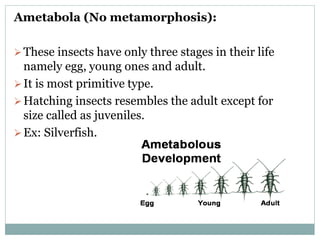
Ametabola (No metamorphosis):
These insects have only three stages in their life
namely egg, young ones and adult.
It is most primitive type.
Hatching insects resembles the adult except for
size called as juveniles.
Ex: Silverfish.
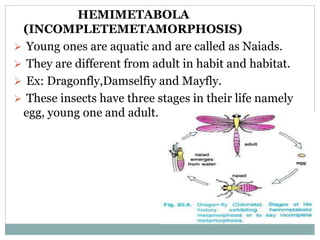
HEMIMETABOLA
(INCOMPLETEMETAMORPHOSIS)
 Young ones are aquatic and are called as Naiads.
 They are different from adult in habit and habitat.
 Ex: Dragonfly,Damselfiy and Mayfly.
 These insects have three stages in their life namely
egg, young one and adult.
PAUROMETABOLA(GRADUAL
METAMORPHOSIS)
The young ones are called Nymphs.
They resembles the adults except the wings and
External genitalia.
Both nymphs and Adults share the same habitat.
Ex: Cockroach,Grasshopper,Bugs.
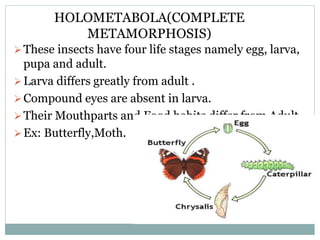
HOLOMETABOLA(COMPLETE
METAMORPHOSIS)
These insects have four life stages namely egg, larva,
pupa and adult.
Larva differs greatly from adult .
Compound eyes are absent in larva.
Their Mouthparts and Food habits differ from Adult.
Ex: Butterfly,Moth.
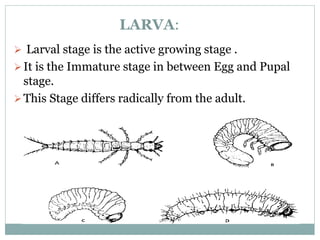
LARVA:
 Larval stage is the active growing stage .
It is the Immature stage in between Egg and Pupal
stage.
This Stage differs radically from the adult.
TYPES OF LARVA
1.Oligopod larva:
 Thoracic legs are well developed and Abdominal legs
are absent.There are two Subtypes :
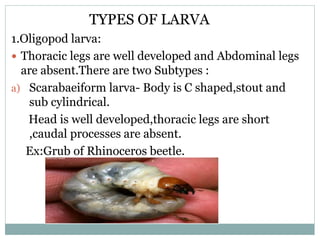
a) Scarabaeiform larva- Body is C shaped,stout and
sub cylindrical.
Head is well developed,thoracic legs are short
,caudal processes are absent.
Ex:Grub of Rhinoceros beetle.
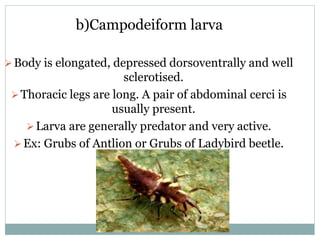
b)Campodeiform larva
Body is elongated, depressed dorsoventrally and well
sclerotised.
Thoracic legs are long. A pair of abdominal cerci is
usually present.
Larva are generally predator and very active.
Ex: Grubs of Antlion or Grubs of Ladybird beetle.
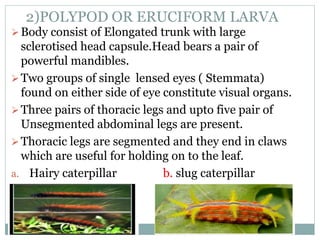
2)POLYPOD OR ERUCIFORM LARVA
Body consist of Elongated trunk with large
sclerotised head capsule.Head bears a pair of
powerful mandibles.
Two groups of single lensed eyes ( Stemmata)
found on either side of eye constitute visual organs.
Three pairs of thoracic legs and upto five pair of
Unsegmented abdominal legs are present.
Thoracic legs are segmented and they end in claws
which are useful for holding on to the leaf.
a. Hairy caterpillar b. slug caterpillar
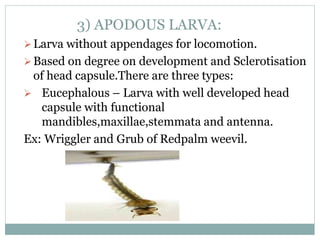
3) APODOUS LARVA:
Larva without appendages for locomotion.
Based on degree on development and Sclerotisation
of head capsule.There are three types:
 Eucephalous – Larva with well developed head
capsule with functional
mandibles,maxillae,stemmata and antenna.
Ex: Wriggler and Grub of Redpalm weevil.
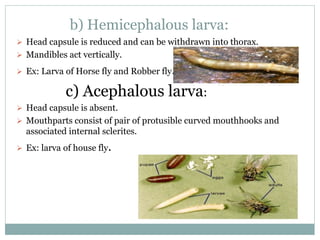
b) Hemicephalous larva:
 Head capsule is reduced and can be withdrawn into thorax.
 Mandibles act vertically.
 Ex: Larva of Horse fly and Robber fly.
c) Acephalous larva:
 Head capsule is absent.
 Mouthparts consist of pair of protusible curved mouthhooks and
associated internal sclerites.
 Ex: larva of house fly.
PUPA
 It is the distinct and inactive stage in all Holometabolous
insects.
 During this stage, the insect is incapable of feeding and is
quiescent.
 In this stage, the larval characters are destroyed and new
adult characters are created.
TYPES OF PUPA:
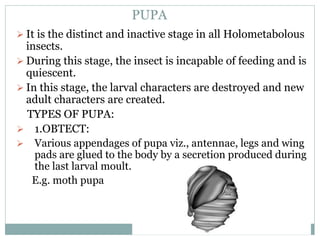
 1.OBTECT:
 Various appendages of pupa viz., antennae, legs and wing
pads are glued to the body by a secretion produced during
the last larval moult.
E.g. moth pupa
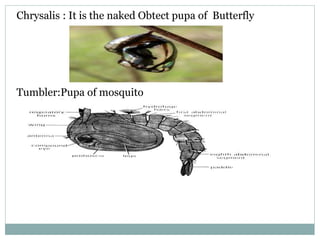
Chrysalis : It is the naked Obtect pupa of Butterfly
Tumbler:Pupa of mosquito
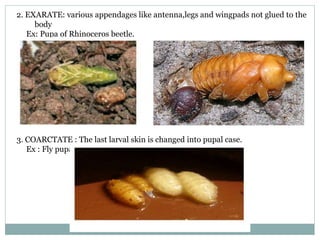
2. EXARATE: various appendages like antenna,legs and wingpads not glued to the
body
Ex: Pupa of Rhinoceros beetle.
3. COARCTATE : The last larval skin is changed into pupal case.
Ex : Fly pupa
MOULTING.
Periodical process of shedding the old cuticle
accompanied by the formation of new cuticle is
called moulting.
The Cuticular part discarded during moulting is
known as EXUVIA.
The time interval between the two subsequent
moulting is called as STADIUM.
The form assumed by the insect in any stadium as
INSTAR.
STEPS IN MOULTING
Apolysis: Detachment of cuticle from Epidermis.
Digestion of old cuticle.
Ecdysis.
Formation of epicuticle.
Production of old cuticle.
Hardening of cuticle
I. Tyrosine
II. Dopa dihydroxy phenylalamine
III. N-acetyle dopamine
IV. N-acetyl dopamine quinone
V. Tanning
Embryonic and post embryonic development in insect

Embryonic and post embryonic development in insect

  • 1.
    Embryonic and PostEmbryonic Development in Insect ENT-501 Insect Morphology Credit-2(1+1) Submitted Submitted to by Dr. U.S. Kulkarni Devendra Kumar Meena Department of Entomology Post Graduation Institute Dr. Panjabrao Deshmukh Krishi Vidhapeeth, Akola
  • 2.
    EMBRYOLOGY: DEVELOPMENT AND FORMATIONOF EMBRYO IN INSECTS Embryology Embryology includes the development of the fertilized egg and embryo and the growth of the organ system. Embryonic development in insects Development of an insect from egg to adult can be divided into two parts a. Early embryonic development - takes place inside the egg and b. Post embryonic development - occurring outside the egg.
  • 3.
    INSECT EGG  Matureinsect eggs are oval, elongate, may be spherical, disc or barrel like.  The eggs are covered by two shells, a tough outer shell called the chorion, and a thinner inner shell called the vitelline membrane.  There is an opening called micropyle at the chorion for the entrance of sperm  The two membranes surround a large nucleus and a mass of cytoplasm  The cytoplasm consists of a large central area of yolk and a peripheral bounding layer, the periplasm, beneath the vitelline membrane  The egg nucleus lies in a central position and embedded in cytoplasm.
  • 4.
    Fertilization of egg Theproduction of male (sperm) and female (ovum) gametes is commonly considered to be the first phase in insect development.  The union of gametes (spermatozoon and ovum) is the second phase of development, and creates a diploid zygote with the potential to form an entire organism.  This process occurs through the fertilization of ovum with sperms
  • 5.
    Early embryonic development a.Cleavage b. Blastoderm formation c. Vittelophage d. Formation of gern bandas e. Gastrulation f. Formation of embryonic membranes g. Blastokinesis h. Formation of organ system i. Appandeges
  • 6.
    Cleavage  Cleavage isthe repeated mitotic divisions of a fertilized ovum zygote.  After fertilization, the egg and sperm nuclei fuse together at the periphery of the egg to form the diploid fused- nucleus (zygote) and then the zygote migrates to the centre of the egg.  The zygote nucleus divides repeatedly, thus, one cell divides into two daughter cells called blastomeres, then cleave into four; these cleave into eight.
  • 7.
    Blastoderm formation  Theenergids move and migrate towards the periphery (periplasm) of the egg and arrange in a layer of circlet within the yolk.  The energids may undergo further, one or more mitotic divisions and retain the distinct cell walls and subsequently form a layer of cells, called the blastoderm.  The blastoderm, in true sense, is the primary germinal epithelium. It lies just beneath the vitelline membrane
  • 8.
    Vitellophages  In somespecies of insects, all energids do not migrate to the periphery to form the blastoderm but some of them lie behind within the yolk are called the yolk cells, merocytes or vitellophages.  The vitellophages carry out breakdown of the yolk and are incorporated in the midgut epithelium.
  • 9.
    Formation of Germband  Initially Blastoderm forms a thin layer of cuboid cells subsequently they become columnar and thicker in the ventral region .  This thickening is called embryonic primordia or germ band which develops future embryo. The rest blastoderm remains as extra-embryonic membrane called serosa
  • 10.
    Gastrulation  Gastrulation isthe process by which the mesoderm and endoderm are invaginated within the ectoderm.  The gastrulation stage begins when the mesoderm is formed from the middle in one of the three ways- I. by growing lateral plates over middle plate II. by an invagination of the middle plates III. by proliferation of cells from the inner surface .
  • 11.
    Formation of theembryonic membrane  The germ band becomes covered by one or more embryonic membranes.  Soon after formation of germ band, the serosa from either side extend until both extensions meet and fuse in the ventral midline.  Small cavity forms on the ventral surface of the germ band called amniotic cavity.  The amniotic cavity is bound by a membrane is called amnion
  • 12.
    Blastokinesi The embryo beginsto move within the yolk, undergoing rotation, revolutions and marked displacement, the phenomenon is called blastokinesis .  The movements taking place from the posterior to anterior pole of egg are termed as the anatrepsis, whereas those from ventral to dorsal surface of the egg are called katatrepsis.
  • 13.
    Development of organsystem From the three germ layer- ectoderm, mesoderm, and endoderm- the various organs and tissues of the insect develop.  The ectoderm gives rise to the body wall, tracheal system, nervous system, the malpighian tubules foregut, hindgut.  The mesoderm gives rise to the muscular system, heart and gonads;  The endoderm gives rise to midgut.
  • 14.
    Appendeges Body segmentation startsin early embryonic development. It involves ectoderm and mesoderm, but not endoderm. I. Transverse furrows and bilateral evaginations of ectoderm create various appendages. II. In front of stomodaeum is the labrum, either side of the protocephalon are antennal rudiments. III. Protocorm becomes segmented, each segment laterally to form rudiment of appendages. IV. Behind the protocephalon are the rudiments of mandibles, maxillae, and labium.
  • 15.
    POST EMBRYONIC DEVELOPMENT ININSECTS. POST EMBRYONIC: Development takes place outside the egg. During their post embryonic growth period insect pass through a series of stages until they become adult. The time interval occupied by each instar being terminated by a moult. METAMORPHOSIS: It is the change in growth and development an insect undergoes during its lifecycle from birth to maturity. FOUR BASIC TYPES OF METAMORPHOSIS IN INSECTS: •Ametabola •Hemimetabola •Paurometabola •holometabola
  • 16.
    Ametabola (No metamorphosis): Theseinsects have only three stages in their life namely egg, young ones and adult. It is most primitive type. Hatching insects resembles the adult except for size called as juveniles. Ex: Silverfish.
  • 17.
    HEMIMETABOLA (INCOMPLETEMETAMORPHOSIS)  Young onesare aquatic and are called as Naiads.  They are different from adult in habit and habitat.  Ex: Dragonfly,Damselfiy and Mayfly.  These insects have three stages in their life namely egg, young one and adult.
  • 18.
    PAUROMETABOLA(GRADUAL METAMORPHOSIS) The young onesare called Nymphs. They resembles the adults except the wings and External genitalia. Both nymphs and Adults share the same habitat. Ex: Cockroach,Grasshopper,Bugs.
  • 19.
    HOLOMETABOLA(COMPLETE METAMORPHOSIS) These insects havefour life stages namely egg, larva, pupa and adult. Larva differs greatly from adult . Compound eyes are absent in larva. Their Mouthparts and Food habits differ from Adult. Ex: Butterfly,Moth.
  • 20.
    LARVA:  Larval stageis the active growing stage . It is the Immature stage in between Egg and Pupal stage. This Stage differs radically from the adult.
  • 21.
    TYPES OF LARVA 1.Oligopodlarva:  Thoracic legs are well developed and Abdominal legs are absent.There are two Subtypes : a) Scarabaeiform larva- Body is C shaped,stout and sub cylindrical. Head is well developed,thoracic legs are short ,caudal processes are absent. Ex:Grub of Rhinoceros beetle.
  • 22.
    b)Campodeiform larva Body iselongated, depressed dorsoventrally and well sclerotised. Thoracic legs are long. A pair of abdominal cerci is usually present. Larva are generally predator and very active. Ex: Grubs of Antlion or Grubs of Ladybird beetle.
  • 23.
    2)POLYPOD OR ERUCIFORMLARVA Body consist of Elongated trunk with large sclerotised head capsule.Head bears a pair of powerful mandibles. Two groups of single lensed eyes ( Stemmata) found on either side of eye constitute visual organs. Three pairs of thoracic legs and upto five pair of Unsegmented abdominal legs are present. Thoracic legs are segmented and they end in claws which are useful for holding on to the leaf. a. Hairy caterpillar b. slug caterpillar
  • 24.
    3) APODOUS LARVA: Larvawithout appendages for locomotion. Based on degree on development and Sclerotisation of head capsule.There are three types:  Eucephalous – Larva with well developed head capsule with functional mandibles,maxillae,stemmata and antenna. Ex: Wriggler and Grub of Redpalm weevil.
  • 25.
    b) Hemicephalous larva: Head capsule is reduced and can be withdrawn into thorax.  Mandibles act vertically.  Ex: Larva of Horse fly and Robber fly. c) Acephalous larva:  Head capsule is absent.  Mouthparts consist of pair of protusible curved mouthhooks and associated internal sclerites.  Ex: larva of house fly.
  • 26.
    PUPA  It isthe distinct and inactive stage in all Holometabolous insects.  During this stage, the insect is incapable of feeding and is quiescent.  In this stage, the larval characters are destroyed and new adult characters are created. TYPES OF PUPA:  1.OBTECT:  Various appendages of pupa viz., antennae, legs and wing pads are glued to the body by a secretion produced during the last larval moult. E.g. moth pupa
  • 27.
    Chrysalis : Itis the naked Obtect pupa of Butterfly Tumbler:Pupa of mosquito
  • 28.
    2. EXARATE: variousappendages like antenna,legs and wingpads not glued to the body Ex: Pupa of Rhinoceros beetle. 3. COARCTATE : The last larval skin is changed into pupal case. Ex : Fly pupa
  • 29.
    MOULTING. Periodical process ofshedding the old cuticle accompanied by the formation of new cuticle is called moulting. The Cuticular part discarded during moulting is known as EXUVIA. The time interval between the two subsequent moulting is called as STADIUM. The form assumed by the insect in any stadium as INSTAR.
  • 30.
    STEPS IN MOULTING Apolysis:Detachment of cuticle from Epidermis. Digestion of old cuticle. Ecdysis. Formation of epicuticle. Production of old cuticle. Hardening of cuticle I. Tyrosine II. Dopa dihydroxy phenylalamine III. N-acetyle dopamine IV. N-acetyl dopamine quinone V. Tanning