Gaseous exchange : uptake of O2 from the environment and the discharge of CO2 to the environment. Takes place in respiratory structures. Movement of the respiratory gases between the  respiratory surface  and the external environment is by  diffusion . Characteristics of respiratory structures: The respiratory surface is moist Cells lining the respiratory surface are thin The respiratory structure has a large surface area.
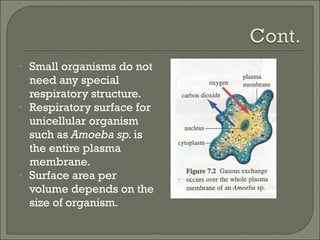
Small organisms do not need any special respiratory structure. Respiratory surface for unicellular organism such as  Amoeba sp.  is the entire plasma membrane. Surface area per volume depends on the size of organism.
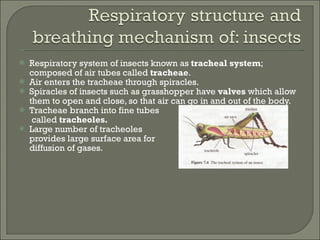
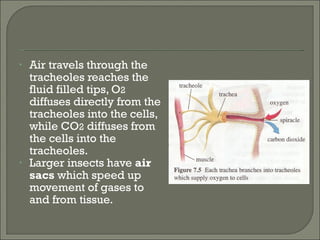
Respiratory system of insects known as  tracheal system ; composed of air tubes called  tracheae . Air enters the tracheae through spiracles. Spiracles of insects such as grasshopper have  valves  which allow them to open and close, so that air can go in and out of the body. Tracheae branch into fine tubes   called  tracheoles. Large number of tracheoles  provides large surface area for diffusion of gases.
Air travels through the tracheoles reaches the fluid filled tips, O 2  diffuses directly from the tracheoles into the cells, while CO 2  diffuses from the cells into the tracheoles. Larger insects have  air sacs  which speed up movement of gases to and from tissue.
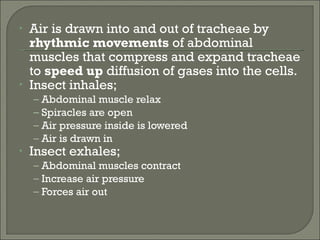
Air is drawn into and out of tracheae by  rhythmic movements  of abdominal muscles that compress and expand tracheae to  speed up  diffusion of gases into the cells. Insect inhales; Abdominal muscle relax Spiracles are open Air pressure inside is lowered Air is drawn in Insect exhales; Abdominal muscles contract Increase air pressure Forces air out
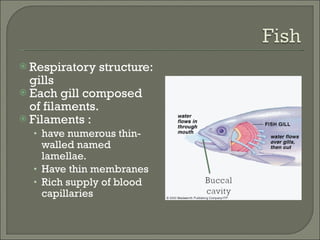
Respiratory structure: gills Each gill composed of filaments. Filaments : have numerous thin-walled named lamellae. Have thin membranes Rich supply of blood capillaries
 
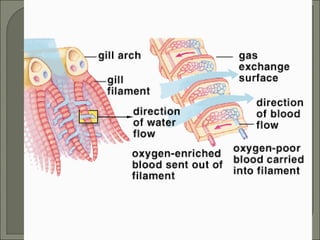
Gaseous exchange enhanced by  countercurrent exchange  mechanism. The blood in the capillaries flow in the opposite direction to the flow of water. ensures maximum intake of O 2  (80%) by the blood. Deoxygenated blood enters the capillaries, it encounters water with higher O 2  content  Thus, along the capillaries, the diffusion gradient allows the transfer of O 2  into the blood. Ventilation increases the flow of water over respiratory surface by swimming and opening and closing the operculum.
Gaseous exchange occurs through  skin  and  lungs . Skin: Thin Highly permeable to respiratory gases. Kept moist by secreting mucus Beneath skin, large number of blood capillaries Facilitate rapid and efficient exchange of gases between skin and environment.
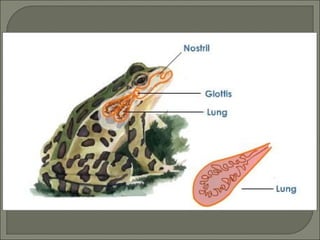
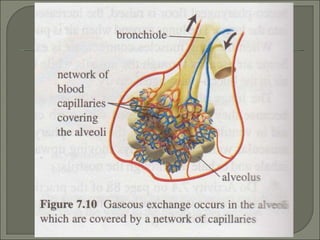
Lung: Consists of a pair of thin walled sacs Thin Moist Covered by network of capillaries. Breathing mechanisms Filling buccal cavity with air Bucco-pharyngeal floor  lowered    glottis closes    nostril open to suck air    air is drawn into bucco-pharyngeal cavity. Forcing air into the lungs Glottis open    nostrils closed    bucco-pharyngeal floor raised    air pressure increased    air is forced into the lungs Frog repeat steps (a) and (b) to take in more air, pumping up itself to a considerable size Expiration the frog opens its nostrils and glottis    air flows out of its lungs.


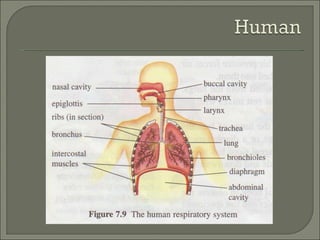
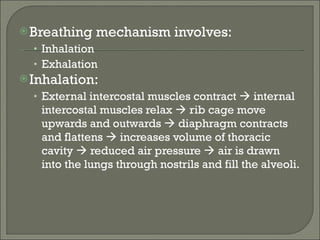
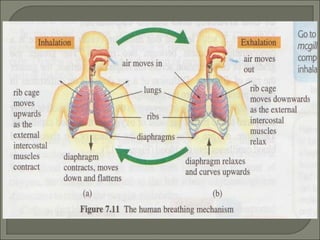
Breathing mechanism involves: Inhalation Exhalation Inhalation: External intercostal muscles contract    internal intercostal muscles relax    rib cage move upwards and outwards    diaphragm contracts and flattens    increases volume of thoracic cavity    reduced air pressure    air is drawn into the lungs through nostrils and fill the alveoli.
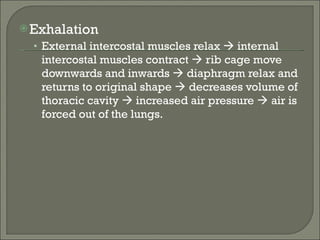
Exhalation External intercostal muscles relax    internal intercostal muscles contract    rib cage move downwards and inwards    diaphragm relax and returns to original shape    decreases volume of thoracic cavity    increased air pressure    air is forced out of the lungs.
 

7.2

  • 1.
  • 2.
    Gaseous exchange :uptake of O2 from the environment and the discharge of CO2 to the environment. Takes place in respiratory structures. Movement of the respiratory gases between the respiratory surface and the external environment is by diffusion . Characteristics of respiratory structures: The respiratory surface is moist Cells lining the respiratory surface are thin The respiratory structure has a large surface area.
  • 3.
    Small organisms donot need any special respiratory structure. Respiratory surface for unicellular organism such as Amoeba sp. is the entire plasma membrane. Surface area per volume depends on the size of organism.
  • 4.
    Respiratory system ofinsects known as tracheal system ; composed of air tubes called tracheae . Air enters the tracheae through spiracles. Spiracles of insects such as grasshopper have valves which allow them to open and close, so that air can go in and out of the body. Tracheae branch into fine tubes called tracheoles. Large number of tracheoles provides large surface area for diffusion of gases.
  • 5.
    Air travels throughthe tracheoles reaches the fluid filled tips, O 2 diffuses directly from the tracheoles into the cells, while CO 2 diffuses from the cells into the tracheoles. Larger insects have air sacs which speed up movement of gases to and from tissue.
  • 6.
    Air is drawninto and out of tracheae by rhythmic movements of abdominal muscles that compress and expand tracheae to speed up diffusion of gases into the cells. Insect inhales; Abdominal muscle relax Spiracles are open Air pressure inside is lowered Air is drawn in Insect exhales; Abdominal muscles contract Increase air pressure Forces air out
  • 7.
    Respiratory structure: gillsEach gill composed of filaments. Filaments : have numerous thin-walled named lamellae. Have thin membranes Rich supply of blood capillaries
  • 8.
  • 9.
    Gaseous exchange enhancedby countercurrent exchange mechanism. The blood in the capillaries flow in the opposite direction to the flow of water. ensures maximum intake of O 2 (80%) by the blood. Deoxygenated blood enters the capillaries, it encounters water with higher O 2 content Thus, along the capillaries, the diffusion gradient allows the transfer of O 2 into the blood. Ventilation increases the flow of water over respiratory surface by swimming and opening and closing the operculum.
  • 10.
    Gaseous exchange occursthrough skin and lungs . Skin: Thin Highly permeable to respiratory gases. Kept moist by secreting mucus Beneath skin, large number of blood capillaries Facilitate rapid and efficient exchange of gases between skin and environment.
  • 11.
    Lung: Consists ofa pair of thin walled sacs Thin Moist Covered by network of capillaries. Breathing mechanisms Filling buccal cavity with air Bucco-pharyngeal floor lowered  glottis closes  nostril open to suck air  air is drawn into bucco-pharyngeal cavity. Forcing air into the lungs Glottis open  nostrils closed  bucco-pharyngeal floor raised  air pressure increased  air is forced into the lungs Frog repeat steps (a) and (b) to take in more air, pumping up itself to a considerable size Expiration the frog opens its nostrils and glottis  air flows out of its lungs.
  • 12.
  • 13.
  • 14.
  • 15.
    Breathing mechanism involves:Inhalation Exhalation Inhalation: External intercostal muscles contract  internal intercostal muscles relax  rib cage move upwards and outwards  diaphragm contracts and flattens  increases volume of thoracic cavity  reduced air pressure  air is drawn into the lungs through nostrils and fill the alveoli.
  • 16.
    Exhalation External intercostalmuscles relax  internal intercostal muscles contract  rib cage move downwards and inwards  diaphragm relax and returns to original shape  decreases volume of thoracic cavity  increased air pressure  air is forced out of the lungs.
  • 17.