EXCRETORY ORGANS IN
INSECTS
SYNOPSIS
1.EXCRETION SYSTEM
2.EXCRETORY ORGANS
3.TYPES OF EXCRETORY ORGANS
 MALPIGHIAN TUBE
 Histology
 Function
 LABIAL GLAND
 NEHROCYTES
 URATE CELLS
 OENOCYTES
 RECTUM/GUT
4.NITROGEN EXCRETION
5.CRYPTONEHRY
6.STORAGE EXCRETION
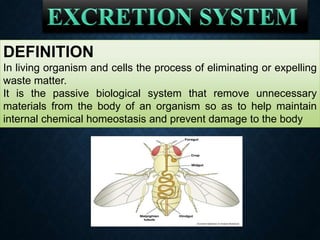
DEFINITION
In living organism and cells the process of eliminating or expelling
waste matter.
It is the passive biological system that remove unnecessary
materials from the body of an organism so as to help maintain
internal chemical homeostasis and prevent damage to the body
Internal body organ and group of tissues and cells which perform
excretion known by the excretory organ they are
Kidney (human)
Flame cells (flatworms)
Urinary bladder
In insects the function of excretion is chiefly concerned with the
elimination of several types of substances such as mineral salts and
water and products of the metabolism of nitrogenous substances ,
sulphur and phosphorus certain complex compounds that are produced
incidentally as a result of certain accidents or as a by product in case of
certain chemical changes and the acids and alkalis
It is a process by which the internal environment of the insects is
regulated at a constant level by removing surplus and injurious materials
TYPES OF EXCRETORY ORGANS
1.MALPIGHIAN TUBE
2.LABIAL GLAND
3.NEPHROCYTES
4.URATE CELLS
5.OENOCYTES
6.RECTUM AND GUT
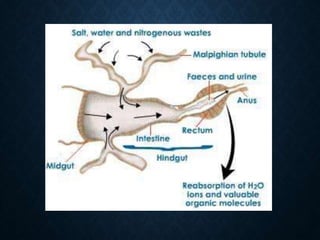
THE MALPIGHIAN TUBE
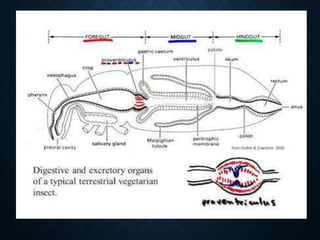
The main organ of excretion and osmoregulation in insects are
the malpighian tubules .acting in association with rectum or
ileum
ORIGIN = they are outgrowth of the alimentary canal and consist of
long thin tubules
STRUCTURE = they are long, slender, blind tubules which are
often convoluted
NUMBERS = varies from group to group
Anoplura – 4
Thysanoptera , hemiptera , diptera, siphonoptera – 4 to 6
Psocoptera and coleoptera – 2 to 8
Isoptera and lepidoptera ,trichoptera – 6
Odonata-50 to 100
COLOUR = white , yellow , cream coloured , smooth or beaded
structure
ABSENCE = they are absent in collembola and the family of
aphididae of the order HOMOPTERA
Histology of Malpighian Tube
The malpighian tubules are composed of two or eight cells
and are of various shapes and sizes . They are either
produced with distinct cell boundaries or are syncitial the
cells are either smooth or have a brush or honey comb
border towards the lumen the cells rest on a thin basement
membrane covered by a peritonial membrane occasionally
containing five muscle fibers which bring about the
peristaltic movement of the tubules the movement caused
by the muscles of the tubules assures the mixing of the
contents .the tubules carries the contents towards the hind
gut for find disposal
Function of Malpighian Tube
1. This is chiefly excrete uric acid which is usually accompanied by
water . The process of excretion takes place as follows
The uric acid collected in the body cells diffuse into the blood
which finally circulates round the malpighian tubules in the blood uric
acid combines with sodium and potassium carbonates to form
sodium and potassium urates .
 These two salts are soluble in water and are easily absorbed by
the distal part of malpighian tubules in this way the urate salts are
secreted into the lower of the malpighian tubules within the proximal
part of tubule in alkaline pH by the action of carbonic anhydrates .
 The urate salts are broken down to regenerate water bicarbonates
and uric acid the water and bicarbonates are reabsorbed and free
uric acid is precipitated from here the uric acid solution loosely
termed as ‘urine ‘ is passed into the proctodaeum and is finally
excreted through the anus
It may be mentioned that this method of excretion involves a constant
supply of water and in the majority of the insects .water is a very
impotent constituent and can not be lost so easily
In aquatic insects which are not compelled to conserve water excretion
of uric acid accompanies a good deal of water . However in these to
deprive the insects of essential ions such as chlorides sodium
potassium . in order to eliminate this deficiency some aquatic larvae
have a body covering which is highly impermeable to salts . The anal
papillae can absorb the substances present in the fresh water
OTHER ASCCESSORY FUNCTION
1. Spittle secretion in spittle bug
2. Light production in Bolitophila
3. Silk production in larval neuroptera
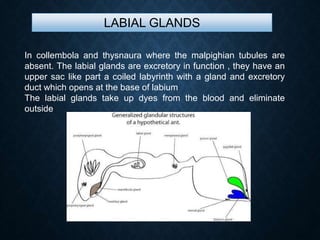
LABIAL GLANDS
In collembola and thysnaura where the malpighian tubules are
absent. The labial glands are excretory in function , they have an
upper sac like part a coiled labyrinth with a gland and excretory
duct which opens at the base of labium
The labial glands take up dyes from the blood and eliminate
outside
NEPHROCYTES
In some insects special cells . The nephrocytes perform the function of
excretion . These cells are either pericardial cells distributed along the
dorsal heart or garland like string of cells
They also known by pericardial cells they are large and are often
binucleate they are always found to have an acid reaction mesodermal in
origin
HOLLANDE (1922) give description about the pericardial cells.
They are agents for breaking down complex colloids which are
transformed by ferments produced in the cells into crystalloids
Urate cells
Certain insects are provided with special cells in the body which become
loader with crystalline spheres of uric acid .these cells are termed as urate
cells
They serve the function of excretion of uric acid and often of pigments also
these urate cells are regarded as “storage” kidneys and are scattered
throughout the insect body . These cells collect the uric acid in solid form
through out the larval life and the excretory products are finally transferred to
the malpighian tubules in the pupal stage for elimination e. g social
hymenoptera
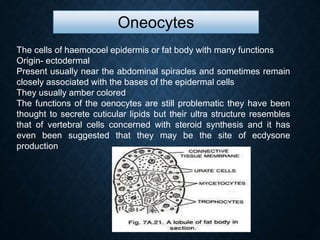
Oneocytes
The cells of haemocoel epidermis or fat body with many functions
Origin- ectodermal
Present usually near the abdominal spiracles and sometimes remain
closely associated with the bases of the epidermal cells
They usually amber colored
The functions of the oenocytes are still problematic they have been
thought to secrete cuticular lipids but their ultra structure resembles
that of vertebral cells concerned with steroid synthesis and it has
even been suggested that they may be the site of ecdysone
production
Excretion by Gut and Rectum
According to WATERHOUSE and DAY tn collembola the mid gut
performs the functions of excretion in case of aphids the excretory
materials and the pigments are eliminated by the digestive tract in
Periplaeta the uric acid is present in the form of crystals and not in liquid
form in the wall of hind gut accordingly the hind gut does the functions of
excretion to some extent in this insect some insects excrete ammonia
which appears to pass directly into the digestive tract with out going to
the malpighian tubules e.g. in blourflty larvae the ammonia is produced in
the mid gut and is then reabsorbed and passed via blood to the hind gut.
In aquatic insects the ammonia may be secreted directly into the rectum .
NITROGEN EXCRETION
Terrestrial insects excrete waste products as uric acid or certain of
its salts called urates which were water insoluble and requires
less amount of water for waste product removal this type of
excretion is known as “URICOTELISM”
In aquatic insects ammonia is the excretory products which is
poly soluble in water and requires more amount of water for waste
product removal
This type of excretion is known as “AMMONOTELISM”
CRYPTONEPHRY
The distal ends of the malpighian tubules are held in contact with the
rectal by the perinehric membrane . Which is concerned either with
efficient dehydration of faeces before their elimination or ionic regulation
example larval symphyta
STORAGE EXCRETION
The excretory waste materials are retained with in the body in
different sites
Uric acid is stored as urates in the cells of fat body e.g. –
American cockroach
Uric acid is stored in the body wall giving white color e.g.:-
Red cotton bug
Uric acid is stored in the male accessory glands to produced
the outer coat of spermatophore which is excreted during
copulation
Uric acid is stored in the wing scales giving white color
example butterfly
Excretory organs in insects

Excretory organs in insects

  • 1.
  • 2.
    SYNOPSIS 1.EXCRETION SYSTEM 2.EXCRETORY ORGANS 3.TYPESOF EXCRETORY ORGANS  MALPIGHIAN TUBE  Histology  Function  LABIAL GLAND  NEHROCYTES  URATE CELLS  OENOCYTES  RECTUM/GUT 4.NITROGEN EXCRETION 5.CRYPTONEHRY 6.STORAGE EXCRETION
  • 3.
    DEFINITION In living organismand cells the process of eliminating or expelling waste matter. It is the passive biological system that remove unnecessary materials from the body of an organism so as to help maintain internal chemical homeostasis and prevent damage to the body
  • 5.
    Internal body organand group of tissues and cells which perform excretion known by the excretory organ they are Kidney (human) Flame cells (flatworms) Urinary bladder In insects the function of excretion is chiefly concerned with the elimination of several types of substances such as mineral salts and water and products of the metabolism of nitrogenous substances , sulphur and phosphorus certain complex compounds that are produced incidentally as a result of certain accidents or as a by product in case of certain chemical changes and the acids and alkalis It is a process by which the internal environment of the insects is regulated at a constant level by removing surplus and injurious materials
  • 6.
    TYPES OF EXCRETORYORGANS 1.MALPIGHIAN TUBE 2.LABIAL GLAND 3.NEPHROCYTES 4.URATE CELLS 5.OENOCYTES 6.RECTUM AND GUT
  • 7.
    THE MALPIGHIAN TUBE Themain organ of excretion and osmoregulation in insects are the malpighian tubules .acting in association with rectum or ileum ORIGIN = they are outgrowth of the alimentary canal and consist of long thin tubules STRUCTURE = they are long, slender, blind tubules which are often convoluted NUMBERS = varies from group to group Anoplura – 4 Thysanoptera , hemiptera , diptera, siphonoptera – 4 to 6 Psocoptera and coleoptera – 2 to 8 Isoptera and lepidoptera ,trichoptera – 6 Odonata-50 to 100
  • 8.
    COLOUR = white, yellow , cream coloured , smooth or beaded structure ABSENCE = they are absent in collembola and the family of aphididae of the order HOMOPTERA
  • 9.
    Histology of MalpighianTube The malpighian tubules are composed of two or eight cells and are of various shapes and sizes . They are either produced with distinct cell boundaries or are syncitial the cells are either smooth or have a brush or honey comb border towards the lumen the cells rest on a thin basement membrane covered by a peritonial membrane occasionally containing five muscle fibers which bring about the peristaltic movement of the tubules the movement caused by the muscles of the tubules assures the mixing of the contents .the tubules carries the contents towards the hind gut for find disposal
  • 11.
    Function of MalpighianTube 1. This is chiefly excrete uric acid which is usually accompanied by water . The process of excretion takes place as follows The uric acid collected in the body cells diffuse into the blood which finally circulates round the malpighian tubules in the blood uric acid combines with sodium and potassium carbonates to form sodium and potassium urates .  These two salts are soluble in water and are easily absorbed by the distal part of malpighian tubules in this way the urate salts are secreted into the lower of the malpighian tubules within the proximal part of tubule in alkaline pH by the action of carbonic anhydrates .  The urate salts are broken down to regenerate water bicarbonates and uric acid the water and bicarbonates are reabsorbed and free uric acid is precipitated from here the uric acid solution loosely termed as ‘urine ‘ is passed into the proctodaeum and is finally excreted through the anus
  • 12.
    It may bementioned that this method of excretion involves a constant supply of water and in the majority of the insects .water is a very impotent constituent and can not be lost so easily In aquatic insects which are not compelled to conserve water excretion of uric acid accompanies a good deal of water . However in these to deprive the insects of essential ions such as chlorides sodium potassium . in order to eliminate this deficiency some aquatic larvae have a body covering which is highly impermeable to salts . The anal papillae can absorb the substances present in the fresh water OTHER ASCCESSORY FUNCTION 1. Spittle secretion in spittle bug 2. Light production in Bolitophila 3. Silk production in larval neuroptera
  • 13.
    LABIAL GLANDS In collembolaand thysnaura where the malpighian tubules are absent. The labial glands are excretory in function , they have an upper sac like part a coiled labyrinth with a gland and excretory duct which opens at the base of labium The labial glands take up dyes from the blood and eliminate outside
  • 14.
    NEPHROCYTES In some insectsspecial cells . The nephrocytes perform the function of excretion . These cells are either pericardial cells distributed along the dorsal heart or garland like string of cells They also known by pericardial cells they are large and are often binucleate they are always found to have an acid reaction mesodermal in origin HOLLANDE (1922) give description about the pericardial cells. They are agents for breaking down complex colloids which are transformed by ferments produced in the cells into crystalloids
  • 15.
    Urate cells Certain insectsare provided with special cells in the body which become loader with crystalline spheres of uric acid .these cells are termed as urate cells They serve the function of excretion of uric acid and often of pigments also these urate cells are regarded as “storage” kidneys and are scattered throughout the insect body . These cells collect the uric acid in solid form through out the larval life and the excretory products are finally transferred to the malpighian tubules in the pupal stage for elimination e. g social hymenoptera
  • 16.
    Oneocytes The cells ofhaemocoel epidermis or fat body with many functions Origin- ectodermal Present usually near the abdominal spiracles and sometimes remain closely associated with the bases of the epidermal cells They usually amber colored The functions of the oenocytes are still problematic they have been thought to secrete cuticular lipids but their ultra structure resembles that of vertebral cells concerned with steroid synthesis and it has even been suggested that they may be the site of ecdysone production
  • 17.
    Excretion by Gutand Rectum According to WATERHOUSE and DAY tn collembola the mid gut performs the functions of excretion in case of aphids the excretory materials and the pigments are eliminated by the digestive tract in Periplaeta the uric acid is present in the form of crystals and not in liquid form in the wall of hind gut accordingly the hind gut does the functions of excretion to some extent in this insect some insects excrete ammonia which appears to pass directly into the digestive tract with out going to the malpighian tubules e.g. in blourflty larvae the ammonia is produced in the mid gut and is then reabsorbed and passed via blood to the hind gut. In aquatic insects the ammonia may be secreted directly into the rectum .
  • 18.
    NITROGEN EXCRETION Terrestrial insectsexcrete waste products as uric acid or certain of its salts called urates which were water insoluble and requires less amount of water for waste product removal this type of excretion is known as “URICOTELISM” In aquatic insects ammonia is the excretory products which is poly soluble in water and requires more amount of water for waste product removal This type of excretion is known as “AMMONOTELISM”
  • 19.
    CRYPTONEPHRY The distal endsof the malpighian tubules are held in contact with the rectal by the perinehric membrane . Which is concerned either with efficient dehydration of faeces before their elimination or ionic regulation example larval symphyta
  • 20.
    STORAGE EXCRETION The excretorywaste materials are retained with in the body in different sites Uric acid is stored as urates in the cells of fat body e.g. – American cockroach Uric acid is stored in the body wall giving white color e.g.:- Red cotton bug Uric acid is stored in the male accessory glands to produced the outer coat of spermatophore which is excreted during copulation Uric acid is stored in the wing scales giving white color example butterfly