1
Dr. T. KRISHNA CHAITANYA
Assistant Professor (Agricultural Entomology)
School of Agricultural Science & Technology, NMIMS, Shirpur
ENTO 131 - Fundamentals of Entomology (3+1)
2
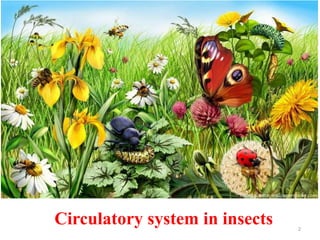
Circulatory system in insects
3
4
5
6
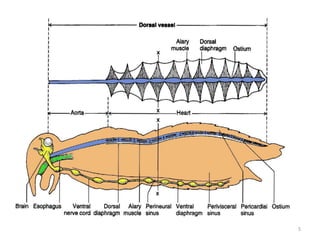
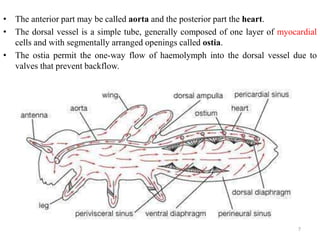
• The anterior part may be called aorta and the posterior part the heart.
• The dorsal vessel is a simple tube, generally composed of one layer of myocardial
cells and with segmentally arranged openings called ostia.
• The ostia permit the one-way flow of haemolymph into the dorsal vessel due to
valves that prevent backflow.
7
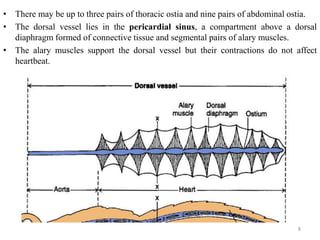
• There may be up to three pairs of thoracic ostia and nine pairs of abdominal ostia.
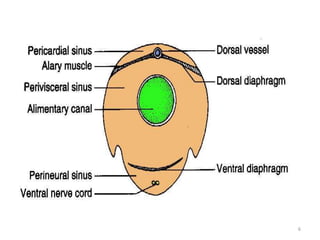
• The dorsal vessel lies in the pericardial sinus, a compartment above a dorsal
diaphragm formed of connective tissue and segmental pairs of alary muscles.
• The alary muscles support the dorsal vessel but their contractions do not affect
heartbeat.
8
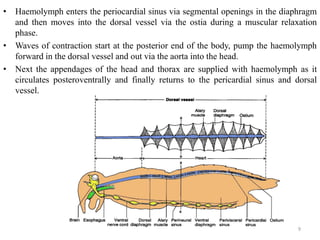
• Haemolymph enters the periocardial sinus via segmental openings in the diaphragm
and then moves into the dorsal vessel via the ostia during a muscular relaxation
phase.
• Waves of contraction start at the posterior end of the body, pump the haemolymph
forward in the dorsal vessel and out via the aorta into the head.
• Next the appendages of the head and thorax are supplied with haemolymph as it
circulates posteroventrally and finally returns to the pericardial sinus and dorsal
vessel.
9
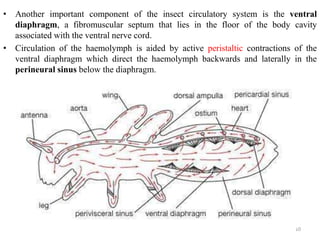
• Another important component of the insect circulatory system is the ventral
diaphragm, a fibromuscular septum that lies in the floor of the body cavity
associated with the ventral nerve cord.
• Circulation of the haemolymph is aided by active peristaltic contractions of the
ventral diaphragm which direct the haemolymph backwards and laterally in the
perineural sinus below the diaphragm.
10
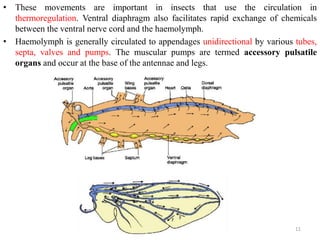
• These movements are important in insects that use the circulation in
thermoregulation. Ventral diaphragm also facilitates rapid exchange of chemicals
between the ventral nerve cord and the haemolymph.
• Haemolymph is generally circulated to appendages unidirectional by various tubes,
septa, valves and pumps. The muscular pumps are termed accessory pulsatile
organs and occur at the base of the antennae and legs.
11
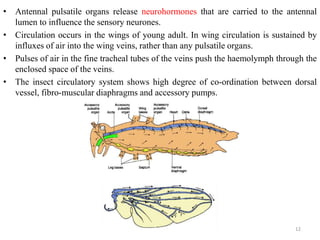
• Antennal pulsatile organs release neurohormones that are carried to the antennal
lumen to influence the sensory neurones.
• Circulation occurs in the wings of young adult. In wing circulation is sustained by
influxes of air into the wing veins, rather than any pulsatile organs.
• Pulses of air in the fine tracheal tubes of the veins push the haemolymph through the
enclosed space of the veins.
• The insect circulatory system shows high degree of co-ordination between dorsal
vessel, fibro-muscular diaphragms and accessory pumps.
12
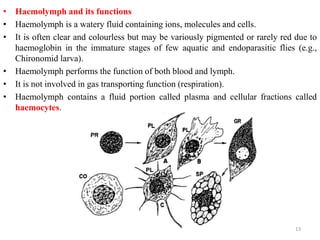
• Haemolymph and its functions
• Haemolymph is a watery fluid containing ions, molecules and cells.
• It is often clear and colourless but may be variously pigmented or rarely red due to
haemoglobin in the immature stages of few aquatic and endoparasitic flies (e.g.,
Chironomid larva).
• Haemolymph performs the function of both blood and lymph.
• It is not involved in gas transporting function (respiration).
• Haemolymph contains a fluid portion called plasma and cellular fractions called
haemocytes.
13
• 1.Plasma: Plasma is an aqueous solution of inorganic ions, lipids,
sugars (mainly trehalose), amino acids, proteins, organic acids and
other compounds.
• pH is usually acidic (6.7).
• Density is 1.01 to 1.06.
• Water content is 84-92 per cent.
14
• Inorganic ions present are `Na' in predators and parasites, `Mg' and
`K‘ in phytophagous insects.
• Carbohydrate is in the form of trehalose sugar.
• Major proteins are lipoproteins, glycoproteins and enzymes.
• Lipids in form of fat particles or lipoproteins.
• Higher concentration of amino acids leads to a condition called
aminoacidemia which effects the osmosis process.
• In high altitude insect’s glycerol is present which acts as a anti
freezing compound.
• Nitrogenous waste is present in the form of uric acid.
15
16
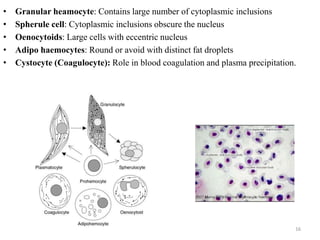
• Granular heamocyte: Contains large number of cytoplasmic inclusions
• Spherule cell: Cytoplasmic inclusions obscure the nucleus
• Oenocytoids: Large cells with eccentric nucleus
• Adipo haemocytes: Round or avoid with distinct fat droplets
• Cystocyte (Coagulocyte): Role in blood coagulation and plasma precipitation.
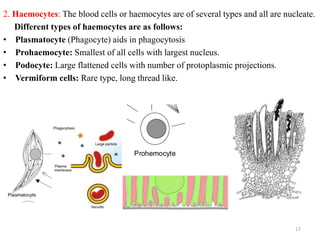
2. Haemocytes: The blood cells or haemocytes are of several types and all are nucleate.
Different types of haemocytes are as follows:
• Plasmatocyte (Phagocyte) aids in phagocytosis
• Prohaemocyte: Smallest of all cells with largest nucleus.
• Podocyte: Large flattened cells with number of protoplasmic projections.
• Vermiform cells: Rare type, long thread like.
17
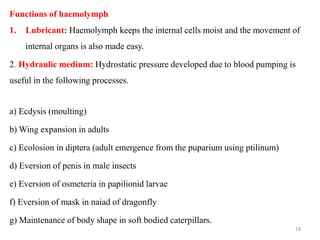
Functions of haemolymph
1. Lubricant: Haemolymph keeps the internal cells moist and the movement of
internal organs is also made easy.
2. Hydraulic medium: Hydrostatic pressure developed due to blood pumping is
useful in the following processes.
a) Ecdysis (moulting)
b) Wing expansion in adults
c) Ecolosion in diptera (adult emergence from the puparium using ptilinum)
d) Eversion of penis in male insects
e) Eversion of osmeteria in papilionid larvae
f) Eversion of mask in naiad of dragonfly
g) Maintenance of body shape in soft bodied caterpillars.
18
3.Transport and storage: Digested nutrients, hormones and gases
(chironomid larva) were transported with the help of haemolymph.
• It also removes the waste materials to the excretory organs.
• Water and raw materials required for histogenesis (the differentiation
of cells into specialized tissues and organs during growth) is stored in
haemolymph.
4.Protection: It helps in phagocytocis, encapsulation, detoxification,
coagulation, and wound healing.
• Non celluar component like lysozymes also kill the invading bacteria.
5. Heat transfer: Haemolymph through its movement in the circulatory
system regulate the body heat (Thermoregulation).
19
6. Maintenance of osmotic pressure: Ions, amino acids and organic
acids present in the haemolymph helps in maintaining osmotic pressure
required for normal physiological functions.
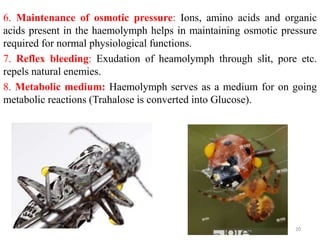
7. Reflex bleeding: Exudation of heamolymph through slit, pore etc.
repels natural enemies.
8. Metabolic medium: Haemolymph serves as a medium for on going
metabolic reactions (Trahalose is converted into Glucose).
20
21

Circulatory system in insects

  • 1.
    1 Dr. T. KRISHNACHAITANYA Assistant Professor (Agricultural Entomology) School of Agricultural Science & Technology, NMIMS, Shirpur ENTO 131 - Fundamentals of Entomology (3+1)
  • 2.
  • 3.
  • 4.
  • 5.
  • 6.
  • 7.
    • The anteriorpart may be called aorta and the posterior part the heart. • The dorsal vessel is a simple tube, generally composed of one layer of myocardial cells and with segmentally arranged openings called ostia. • The ostia permit the one-way flow of haemolymph into the dorsal vessel due to valves that prevent backflow. 7
  • 8.
    • There maybe up to three pairs of thoracic ostia and nine pairs of abdominal ostia. • The dorsal vessel lies in the pericardial sinus, a compartment above a dorsal diaphragm formed of connective tissue and segmental pairs of alary muscles. • The alary muscles support the dorsal vessel but their contractions do not affect heartbeat. 8
  • 9.
    • Haemolymph entersthe periocardial sinus via segmental openings in the diaphragm and then moves into the dorsal vessel via the ostia during a muscular relaxation phase. • Waves of contraction start at the posterior end of the body, pump the haemolymph forward in the dorsal vessel and out via the aorta into the head. • Next the appendages of the head and thorax are supplied with haemolymph as it circulates posteroventrally and finally returns to the pericardial sinus and dorsal vessel. 9
  • 10.
    • Another importantcomponent of the insect circulatory system is the ventral diaphragm, a fibromuscular septum that lies in the floor of the body cavity associated with the ventral nerve cord. • Circulation of the haemolymph is aided by active peristaltic contractions of the ventral diaphragm which direct the haemolymph backwards and laterally in the perineural sinus below the diaphragm. 10
  • 11.
    • These movementsare important in insects that use the circulation in thermoregulation. Ventral diaphragm also facilitates rapid exchange of chemicals between the ventral nerve cord and the haemolymph. • Haemolymph is generally circulated to appendages unidirectional by various tubes, septa, valves and pumps. The muscular pumps are termed accessory pulsatile organs and occur at the base of the antennae and legs. 11
  • 12.
    • Antennal pulsatileorgans release neurohormones that are carried to the antennal lumen to influence the sensory neurones. • Circulation occurs in the wings of young adult. In wing circulation is sustained by influxes of air into the wing veins, rather than any pulsatile organs. • Pulses of air in the fine tracheal tubes of the veins push the haemolymph through the enclosed space of the veins. • The insect circulatory system shows high degree of co-ordination between dorsal vessel, fibro-muscular diaphragms and accessory pumps. 12
  • 13.
    • Haemolymph andits functions • Haemolymph is a watery fluid containing ions, molecules and cells. • It is often clear and colourless but may be variously pigmented or rarely red due to haemoglobin in the immature stages of few aquatic and endoparasitic flies (e.g., Chironomid larva). • Haemolymph performs the function of both blood and lymph. • It is not involved in gas transporting function (respiration). • Haemolymph contains a fluid portion called plasma and cellular fractions called haemocytes. 13
  • 14.
    • 1.Plasma: Plasmais an aqueous solution of inorganic ions, lipids, sugars (mainly trehalose), amino acids, proteins, organic acids and other compounds. • pH is usually acidic (6.7). • Density is 1.01 to 1.06. • Water content is 84-92 per cent. 14
  • 15.
    • Inorganic ionspresent are `Na' in predators and parasites, `Mg' and `K‘ in phytophagous insects. • Carbohydrate is in the form of trehalose sugar. • Major proteins are lipoproteins, glycoproteins and enzymes. • Lipids in form of fat particles or lipoproteins. • Higher concentration of amino acids leads to a condition called aminoacidemia which effects the osmosis process. • In high altitude insect’s glycerol is present which acts as a anti freezing compound. • Nitrogenous waste is present in the form of uric acid. 15
  • 16.
    16 • Granular heamocyte:Contains large number of cytoplasmic inclusions • Spherule cell: Cytoplasmic inclusions obscure the nucleus • Oenocytoids: Large cells with eccentric nucleus • Adipo haemocytes: Round or avoid with distinct fat droplets • Cystocyte (Coagulocyte): Role in blood coagulation and plasma precipitation.
  • 17.
    2. Haemocytes: Theblood cells or haemocytes are of several types and all are nucleate. Different types of haemocytes are as follows: • Plasmatocyte (Phagocyte) aids in phagocytosis • Prohaemocyte: Smallest of all cells with largest nucleus. • Podocyte: Large flattened cells with number of protoplasmic projections. • Vermiform cells: Rare type, long thread like. 17
  • 18.
    Functions of haemolymph 1.Lubricant: Haemolymph keeps the internal cells moist and the movement of internal organs is also made easy. 2. Hydraulic medium: Hydrostatic pressure developed due to blood pumping is useful in the following processes. a) Ecdysis (moulting) b) Wing expansion in adults c) Ecolosion in diptera (adult emergence from the puparium using ptilinum) d) Eversion of penis in male insects e) Eversion of osmeteria in papilionid larvae f) Eversion of mask in naiad of dragonfly g) Maintenance of body shape in soft bodied caterpillars. 18
  • 19.
    3.Transport and storage:Digested nutrients, hormones and gases (chironomid larva) were transported with the help of haemolymph. • It also removes the waste materials to the excretory organs. • Water and raw materials required for histogenesis (the differentiation of cells into specialized tissues and organs during growth) is stored in haemolymph. 4.Protection: It helps in phagocytocis, encapsulation, detoxification, coagulation, and wound healing. • Non celluar component like lysozymes also kill the invading bacteria. 5. Heat transfer: Haemolymph through its movement in the circulatory system regulate the body heat (Thermoregulation). 19
  • 20.
    6. Maintenance ofosmotic pressure: Ions, amino acids and organic acids present in the haemolymph helps in maintaining osmotic pressure required for normal physiological functions. 7. Reflex bleeding: Exudation of heamolymph through slit, pore etc. repels natural enemies. 8. Metabolic medium: Haemolymph serves as a medium for on going metabolic reactions (Trahalose is converted into Glucose). 20
  • 21.