1
Dr. T. KRISHNA CHAITANYA
Assistant Professor (Agricultural Entomology)
School of Agricultural Science & Technology, NMIMS, Shirpur
ENTO 131 - Fundamentals of Entomology (3+1)
2
Reproductive system &
Types of reproduction
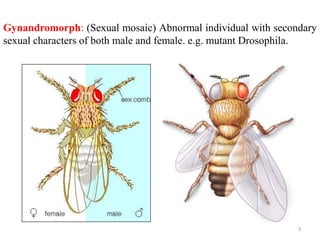
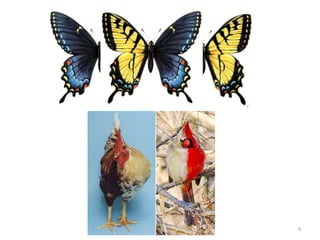
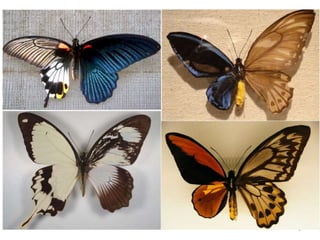
Gynandromorph: (Sexual mosaic) Abnormal individual with secondary
sexual characters of both male and female. e.g. mutant Drosophila.
3
4
5
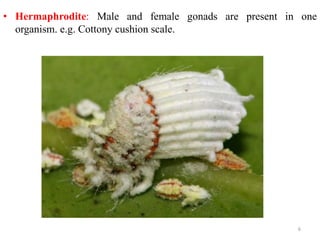
• Hermaphrodite: Male and female gonads are present in one
organism. e.g. Cottony cushion scale.
6
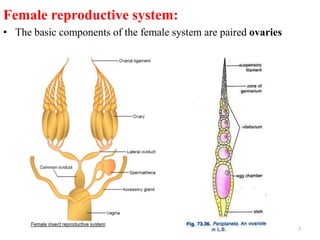
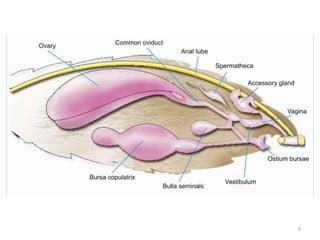
Female reproductive system:
• The basic components of the female system are paired ovaries
7
8
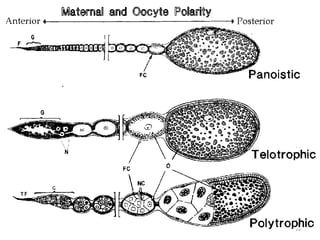
• There are different types of ovarioless based on the presence or
absence of specialized nutritive cells called trophocytes / nurse cells
for nourishment of oocytes.
Paniostic ovariole: Lacks specialized nutritive cells so that it contains
only a string of follicles, with the oocytes obtaining nutrients from the
haemolymph via the follicular epithelium. e.g. Cockroach.
Telotrophic ovariole: (Acrotrophic) The trophocyte is present and its
location is confined to the germarium and remain connected to the
oocytes by cytoplasmic strands as the oocytes move down the ovariole.
eg. bugs.
Polytrophic ovariole: A number of trophocytes are connected to each
oocyte and trophocytes moves down along with the ovariole, providing
nutrients until depleted. Thus individual oocytes are alternated with
groups of smaller trophocytes in the ovarioles. e.g. moths and flies.
9
10
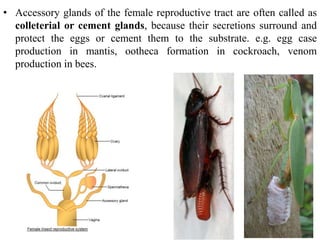
• Accessory glands of the female reproductive tract are often called as
colleterial or cement glands, because their secretions surround and
protect the eggs or cement them to the substrate. e.g. egg case
production in mantis, ootheca formation in cockroach, venom
production in bees.
11
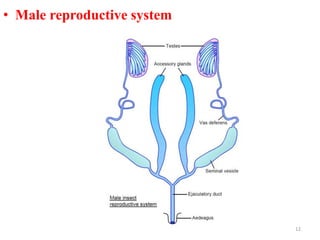
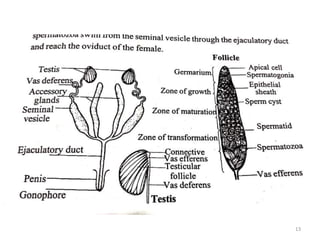
• Male reproductive system
12
13
14
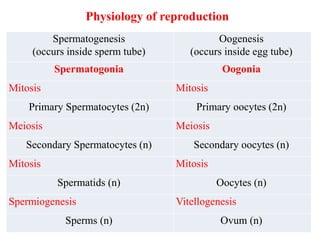
Spermatogenesis
(occurs inside sperm tube)
Oogenesis
(occurs inside egg tube)
Spermatogonia Oogonia
Mitosis Mitosis
Primary Spermatocytes (2n) Primary oocytes (2n)
Meiosis Meiosis
Secondary Spermatocytes (n) Secondary oocytes (n)
Mitosis Mitosis
Spermatids (n) Oocytes (n)
Spermiogenesis Vitellogenesis
Sperms (n) Ovum (n)
Physiology of reproduction
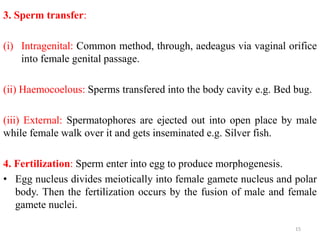
3. Sperm transfer:
(i) Intragenital: Common method, through, aedeagus via vaginal orifice
into female genital passage.
(ii) Haemocoelous: Sperms transfered into the body cavity e.g. Bed bug.
(iii) External: Spermatophores are ejected out into open place by male
while female walk over it and gets inseminated e.g. Silver fish.
4. Fertilization: Sperm enter into egg to produce morphogenesis.
• Egg nucleus divides meiotically into female gamete nucleus and polar
body. Then the fertilization occurs by the fusion of male and female
gamete nuclei.
15
Types of Reproduction
16
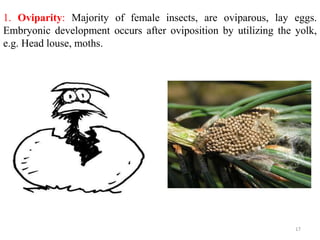
1. Oviparity: Majority of female insects, are oviparous, lay eggs.
Embryonic development occurs after oviposition by utilizing the yolk,
e.g. Head louse, moths.
17
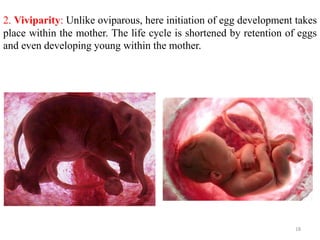
2. Viviparity: Unlike oviparous, here initiation of egg development takes
place within the mother. The life cycle is shortened by retention of eggs
and even developing young within the mother.
18
• Four main types of viviparity are observed in different insect groups.
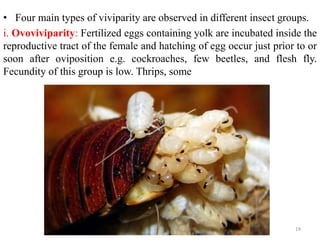
i. Ovoviviparity: Fertilized eggs containing yolk are incubated inside the
reproductive tract of the female and hatching of egg occur just prior to or
soon after oviposition e.g. cockroaches, few beetles, and flesh fly.
Fecundity of this group is low. Thrips, some
19
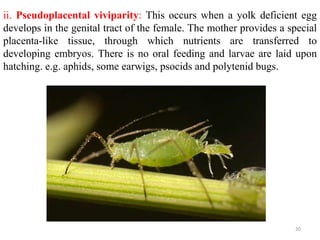
ii. Pseudoplacental viviparity: This occurs when a yolk deficient egg
develops in the genital tract of the female. The mother provides a special
placenta-like tissue, through which nutrients are transferred to
developing embryos. There is no oral feeding and larvae are laid upon
hatching. e.g. aphids, some earwigs, psocids and polytenid bugs.
20
iii. Haemocoelous viviparity: This involves embryos developing free in
the female's haemolymph with nutrients taken up by osmosis. This form
of internal parasitism occurs only in sterpsiptera and some gall midges.
21
A, diagrammatic representation of neotenic
female with brood canal and genital ducts (lateral
view). B, neotenic female Xenos vesparum,
cephalothorax (arrow) (ventral view). C, planidia
larva emerging from genital duct of paternal
female Stichotrema dallatorreanum [scanning
electron micrograph (SEM)]. D, cephalothorax of
female Xenos vesparum (SEM) with first-instar
planidia larvae emerging from brood canal
opening. Scale bars: (A, B) 1 mm; (C) 10 μm;
(D) 400 μm.
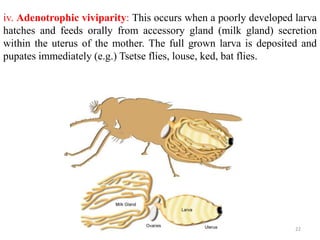
iv. Adenotrophic viviparity: This occurs when a poorly developed larva
hatches and feeds orally from accessory gland (milk gland) secretion
within the uterus of the mother. The full grown larva is deposited and
pupates immediately (e.g.) Tsetse flies, louse, ked, bat flies.
22
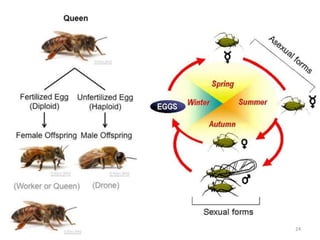
3.Parthenogenesis: Reproduction without fertilization is
parthenogenesis.
Different types of parthenogenesis are as follows:
a. Based on occurrence
i. Facultative (not compulsory) e.g. bee.
ii. Obligatory or constant (compulsory) e.g. stick insect
iii. Cyclic/ sporadic: alternation of gamic and agamic population. e.g.
aphid.
23
24
25
b. Based on sex produced:
i. Arrhenotoky: Produce male e.g. bee
ii. Thelytoky: produce female e.g. aphids
iii. Amphitoky / deuterotoky: produce both male and female e.g.
Cynipid wasp.
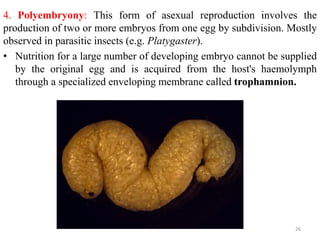
4. Polyembryony: This form of asexual reproduction involves the
production of two or more embryos from one egg by subdivision. Mostly
observed in parasitic insects (e.g. Platygaster).
• Nutrition for a large number of developing embryo cannot be supplied
by the original egg and is acquired from the host's haemolymph
through a specialized enveloping membrane called trophamnion.
26
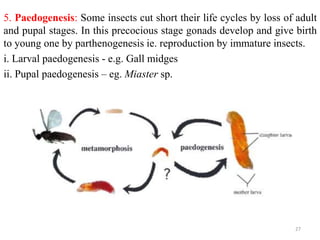
5. Paedogenesis: Some insects cut short their life cycles by loss of adult
and pupal stages. In this precocious stage gonads develop and give birth
to young one by parthenogenesis ie. reproduction by immature insects.
i. Larval paedogenesis - e.g. Gall midges
ii. Pupal paedogenesis – eg. Miaster sp.
27
28

Reproductive system

  • 1.
    1 Dr. T. KRISHNACHAITANYA Assistant Professor (Agricultural Entomology) School of Agricultural Science & Technology, NMIMS, Shirpur ENTO 131 - Fundamentals of Entomology (3+1)
  • 2.
  • 3.
    Gynandromorph: (Sexual mosaic)Abnormal individual with secondary sexual characters of both male and female. e.g. mutant Drosophila. 3
  • 4.
  • 5.
  • 6.
    • Hermaphrodite: Maleand female gonads are present in one organism. e.g. Cottony cushion scale. 6
  • 7.
    Female reproductive system: •The basic components of the female system are paired ovaries 7
  • 8.
  • 9.
    • There aredifferent types of ovarioless based on the presence or absence of specialized nutritive cells called trophocytes / nurse cells for nourishment of oocytes. Paniostic ovariole: Lacks specialized nutritive cells so that it contains only a string of follicles, with the oocytes obtaining nutrients from the haemolymph via the follicular epithelium. e.g. Cockroach. Telotrophic ovariole: (Acrotrophic) The trophocyte is present and its location is confined to the germarium and remain connected to the oocytes by cytoplasmic strands as the oocytes move down the ovariole. eg. bugs. Polytrophic ovariole: A number of trophocytes are connected to each oocyte and trophocytes moves down along with the ovariole, providing nutrients until depleted. Thus individual oocytes are alternated with groups of smaller trophocytes in the ovarioles. e.g. moths and flies. 9
  • 10.
  • 11.
    • Accessory glandsof the female reproductive tract are often called as colleterial or cement glands, because their secretions surround and protect the eggs or cement them to the substrate. e.g. egg case production in mantis, ootheca formation in cockroach, venom production in bees. 11
  • 12.
  • 13.
  • 14.
    14 Spermatogenesis (occurs inside spermtube) Oogenesis (occurs inside egg tube) Spermatogonia Oogonia Mitosis Mitosis Primary Spermatocytes (2n) Primary oocytes (2n) Meiosis Meiosis Secondary Spermatocytes (n) Secondary oocytes (n) Mitosis Mitosis Spermatids (n) Oocytes (n) Spermiogenesis Vitellogenesis Sperms (n) Ovum (n) Physiology of reproduction
  • 15.
    3. Sperm transfer: (i)Intragenital: Common method, through, aedeagus via vaginal orifice into female genital passage. (ii) Haemocoelous: Sperms transfered into the body cavity e.g. Bed bug. (iii) External: Spermatophores are ejected out into open place by male while female walk over it and gets inseminated e.g. Silver fish. 4. Fertilization: Sperm enter into egg to produce morphogenesis. • Egg nucleus divides meiotically into female gamete nucleus and polar body. Then the fertilization occurs by the fusion of male and female gamete nuclei. 15
  • 16.
  • 17.
    1. Oviparity: Majorityof female insects, are oviparous, lay eggs. Embryonic development occurs after oviposition by utilizing the yolk, e.g. Head louse, moths. 17
  • 18.
    2. Viviparity: Unlikeoviparous, here initiation of egg development takes place within the mother. The life cycle is shortened by retention of eggs and even developing young within the mother. 18
  • 19.
    • Four maintypes of viviparity are observed in different insect groups. i. Ovoviviparity: Fertilized eggs containing yolk are incubated inside the reproductive tract of the female and hatching of egg occur just prior to or soon after oviposition e.g. cockroaches, few beetles, and flesh fly. Fecundity of this group is low. Thrips, some 19
  • 20.
    ii. Pseudoplacental viviparity:This occurs when a yolk deficient egg develops in the genital tract of the female. The mother provides a special placenta-like tissue, through which nutrients are transferred to developing embryos. There is no oral feeding and larvae are laid upon hatching. e.g. aphids, some earwigs, psocids and polytenid bugs. 20
  • 21.
    iii. Haemocoelous viviparity:This involves embryos developing free in the female's haemolymph with nutrients taken up by osmosis. This form of internal parasitism occurs only in sterpsiptera and some gall midges. 21 A, diagrammatic representation of neotenic female with brood canal and genital ducts (lateral view). B, neotenic female Xenos vesparum, cephalothorax (arrow) (ventral view). C, planidia larva emerging from genital duct of paternal female Stichotrema dallatorreanum [scanning electron micrograph (SEM)]. D, cephalothorax of female Xenos vesparum (SEM) with first-instar planidia larvae emerging from brood canal opening. Scale bars: (A, B) 1 mm; (C) 10 μm; (D) 400 μm.
  • 22.
    iv. Adenotrophic viviparity:This occurs when a poorly developed larva hatches and feeds orally from accessory gland (milk gland) secretion within the uterus of the mother. The full grown larva is deposited and pupates immediately (e.g.) Tsetse flies, louse, ked, bat flies. 22
  • 23.
    3.Parthenogenesis: Reproduction withoutfertilization is parthenogenesis. Different types of parthenogenesis are as follows: a. Based on occurrence i. Facultative (not compulsory) e.g. bee. ii. Obligatory or constant (compulsory) e.g. stick insect iii. Cyclic/ sporadic: alternation of gamic and agamic population. e.g. aphid. 23
  • 24.
  • 25.
    25 b. Based onsex produced: i. Arrhenotoky: Produce male e.g. bee ii. Thelytoky: produce female e.g. aphids iii. Amphitoky / deuterotoky: produce both male and female e.g. Cynipid wasp.
  • 26.
    4. Polyembryony: Thisform of asexual reproduction involves the production of two or more embryos from one egg by subdivision. Mostly observed in parasitic insects (e.g. Platygaster). • Nutrition for a large number of developing embryo cannot be supplied by the original egg and is acquired from the host's haemolymph through a specialized enveloping membrane called trophamnion. 26
  • 27.
    5. Paedogenesis: Someinsects cut short their life cycles by loss of adult and pupal stages. In this precocious stage gonads develop and give birth to young one by parthenogenesis ie. reproduction by immature insects. i. Larval paedogenesis - e.g. Gall midges ii. Pupal paedogenesis – eg. Miaster sp. 27
  • 28.