1
Dr. T. KRISHNA CHAITANYA
Assistant Professor (Agricultural Entomology)
School of Agricultural Science & Technology, NMIMS, Shirpur
ENTO 131 - Fundamentals of Entomology (3+1)
2
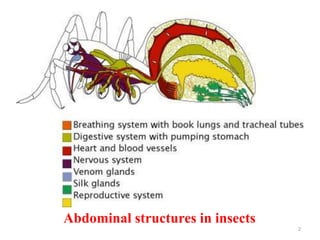
Abdominal structures in insects
3
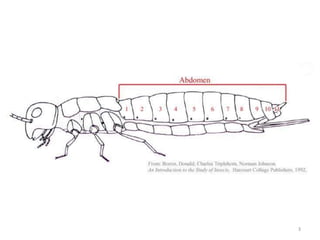
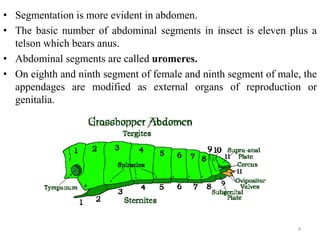
• Segmentation is more evident in abdomen.
• The basic number of abdominal segments in insect is eleven plus a
telson which bears anus.
• Abdominal segments are called uromeres.
• On eighth and ninth segment of female and ninth segment of male, the
appendages are modified as external organs of reproduction or
genitalia.
4
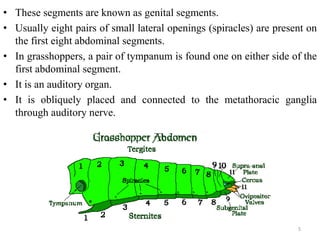
• These segments are known as genital segments.
• Usually eight pairs of small lateral openings (spiracles) are present on
the first eight abdominal segments.
• In grasshoppers, a pair of tympanum is found one on either side of the
first abdominal segment.
• It is an auditory organ.
• It is obliquely placed and connected to the metathoracic ganglia
through auditory nerve.
5
• Modifications:
• Reduction in number of abdominal segments has taken place in many insects. In
spring tail only six segments are present. In house fly only segments 2 to 5 are
visible and segments 6 to 9 are telescoped within others.
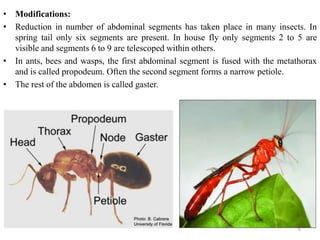
• In ants, bees and wasps, the first abdominal segment is fused with the metathorax
and is called propodeum. Often the second segment forms a narrow petiole.
• The rest of the abdomen is called gaster.
6
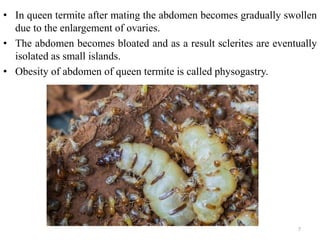
• In queen termite after mating the abdomen becomes gradually swollen
due to the enlargement of ovaries.
• The abdomen becomes bloated and as a result sclerites are eventually
isolated as small islands.
• Obesity of abdomen of queen termite is called physogastry.
7
• Abdominal appendages
• i. Pregenital abdominal appendages in wingless insects:
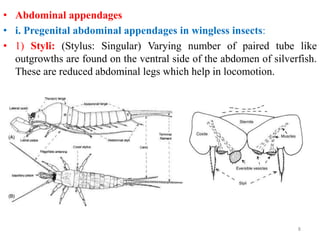
• 1) Styli: (Stylus: Singular) Varying number of paired tube like
outgrowths are found on the ventral side of the abdomen of silverfish.
These are reduced abdominal legs which help in locomotion.
8
2). Collophore or ventral tube or glue peg:
• It is located on the ventral side of the first abdominal segment of
spring tail. It is cylindrical. It is protruded out by the hydrostatic
pressure of haemolymph. It might serve as an organ of adhesion. It
aids in water absorption from the substratum and also in respiration.
9
A-C. Seira domestica: A, collophore chaetotaxy (lateral view); B, manubrium ventral
chaetotaxy; C, manubrial plate and subapical chaetae (dorsal view).
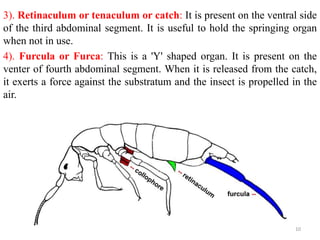
3). Retinaculum or tenaculum or catch: It is present on the ventral side
of the third abdominal segment. It is useful to hold the springing organ
when not in use.
4). Furcula or Furca: This is a 'Y' shaped organ. It is present on the
venter of fourth abdominal segment. When it is released from the catch,
it exerts a force against the substratum and the insect is propelled in the
air.
10
Abdominal appendages in immature insects:
1) Anal papillae: A group of four papillae surrounds the anus in
mosquito larvae. These papillae are concerned with salt regulation.
11
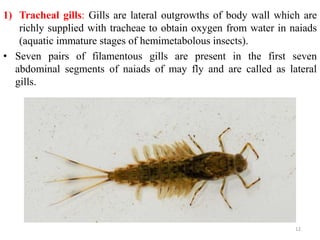
1) Tracheal gills: Gills are lateral outgrowths of body wall which are
richly supplied with tracheae to obtain oxygen from water in naiads
(aquatic immature stages of hemimetabolous insects).
• Seven pairs of filamentous gills are present in the first seven
abdominal segments of naiads of may fly and are called as lateral
gills.
12
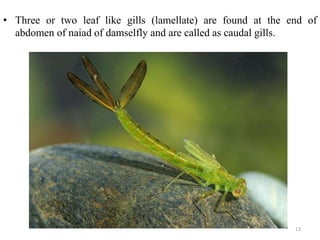
• Three or two leaf like gills (lamellate) are found at the end of
abdomen of naiad of damselfly and are called as caudal gills.
13
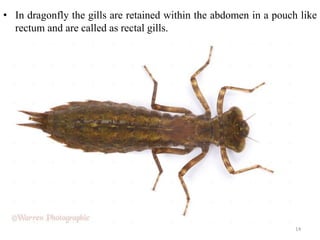
• In dragonfly the gills are retained within the abdomen in a pouch like
rectum and are called as rectal gills.
14
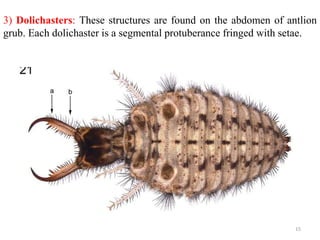
3) Dolichasters: These structures are found on the abdomen of antlion
grub. Each dolichaster is a segmental protuberance fringed with setae.
15
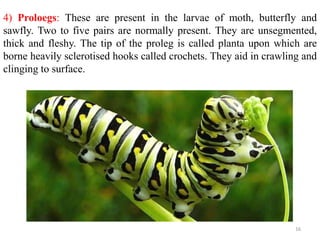
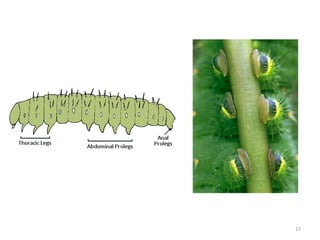
4) Proloegs: These are present in the larvae of moth, butterfly and
sawfly. Two to five pairs are normally present. They are unsegmented,
thick and fleshy. The tip of the proleg is called planta upon which are
borne heavily sclerotised hooks called crochets. They aid in crawling and
clinging to surface.
16
17
iii) Abdominal appendages in winged adults:
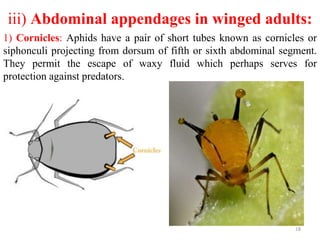
1) Cornicles: Aphids have a pair of short tubes known as cornicles or
siphonculi projecting from dorsum of fifth or sixth abdominal segment.
They permit the escape of waxy fluid which perhaps serves for
protection against predators.
18
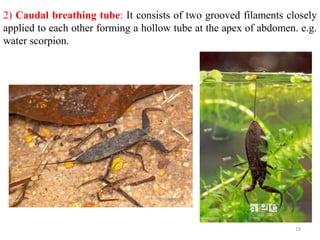
2) Caudal breathing tube: It consists of two grooved filaments closely
applied to each other forming a hollow tube at the apex of abdomen. e.g.
water scorpion.
19
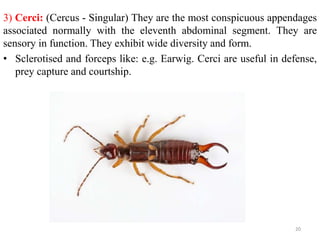
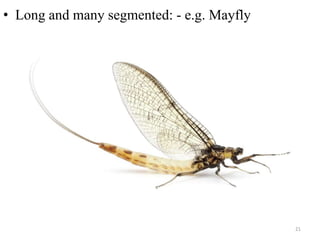
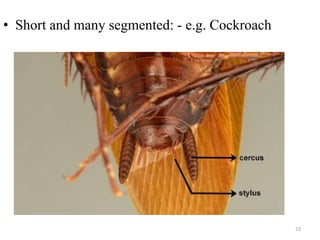
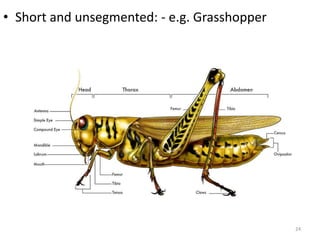
3) Cerci: (Cercus - Singular) They are the most conspicuous appendages
associated normally with the eleventh abdominal segment. They are
sensory in function. They exhibit wide diversity and form.
• Sclerotised and forceps like: e.g. Earwig. Cerci are useful in defense,
prey capture and courtship.
20
• Long and many segmented: - e.g. Mayfly
21
• Long and unsegmented: - e.g. Cricket
22
• Short and many segmented: - e.g. Cockroach
23
• Short and unsegmented: - e.g. Grasshopper
24
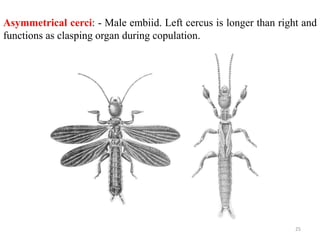
Asymmetrical cerci: - Male embiid. Left cercus is longer than right and
functions as clasping organ during copulation.
25
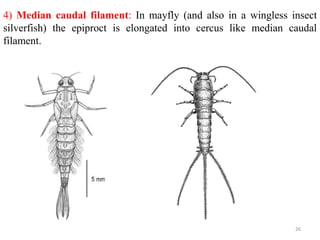
4) Median caudal filament: In mayfly (and also in a wingless insect
silverfish) the epiproct is elongated into cercus like median caudal
filament.
26
5) Pygostyles: A pair of unsegmented cerci like structures are found in
the last abdominal segment of scoliid wasp.
27
6) Anal styli: A pair of short unsegmented structure found at the end of
the abdomen of male cockroach. They are used to hold the female during
copulation.
28
7) Ovipositor: The egg laying organ found in female insect is called
ovipositor. It is suited to lay eggs in precise microhabitats. It exhibits
wide diversity and form. Short and horny: e.g. Short horned grasshopper
29
• Long and sword like: e.g. Katydid, long horned grasshopper
30
• Needle like: e.g. Cricket
31
• Ovipositor modified into sting: e.g. Worker honey bee.
32
• Pseudoovipositor: An appendicular ovipositor is lacking in fruit flies
and house flies.
• In fruit flies, the elongated abdomen terminates into a sharp point with
which the fly pierces the rind of the fruit before depositing the eggs.
33
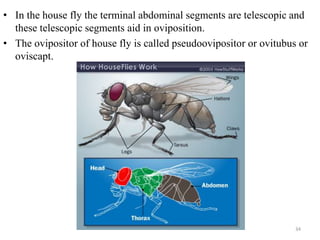
• In the house fly the terminal abdominal segments are telescopic and
these telescopic segments aid in oviposition.
• The ovipositor of house fly is called pseudoovipositor or ovitubus or
oviscapt.
34
• Male genitalia: External sexual organs of male insects are confined to
ninth abdominal segment. In damselfly, the functional copulatory
organ is present on the venter of second abdominal segment
35
36

Abdominal structures in insects

  • 1.
    1 Dr. T. KRISHNACHAITANYA Assistant Professor (Agricultural Entomology) School of Agricultural Science & Technology, NMIMS, Shirpur ENTO 131 - Fundamentals of Entomology (3+1)
  • 2.
  • 3.
  • 4.
    • Segmentation ismore evident in abdomen. • The basic number of abdominal segments in insect is eleven plus a telson which bears anus. • Abdominal segments are called uromeres. • On eighth and ninth segment of female and ninth segment of male, the appendages are modified as external organs of reproduction or genitalia. 4
  • 5.
    • These segmentsare known as genital segments. • Usually eight pairs of small lateral openings (spiracles) are present on the first eight abdominal segments. • In grasshoppers, a pair of tympanum is found one on either side of the first abdominal segment. • It is an auditory organ. • It is obliquely placed and connected to the metathoracic ganglia through auditory nerve. 5
  • 6.
    • Modifications: • Reductionin number of abdominal segments has taken place in many insects. In spring tail only six segments are present. In house fly only segments 2 to 5 are visible and segments 6 to 9 are telescoped within others. • In ants, bees and wasps, the first abdominal segment is fused with the metathorax and is called propodeum. Often the second segment forms a narrow petiole. • The rest of the abdomen is called gaster. 6
  • 7.
    • In queentermite after mating the abdomen becomes gradually swollen due to the enlargement of ovaries. • The abdomen becomes bloated and as a result sclerites are eventually isolated as small islands. • Obesity of abdomen of queen termite is called physogastry. 7
  • 8.
    • Abdominal appendages •i. Pregenital abdominal appendages in wingless insects: • 1) Styli: (Stylus: Singular) Varying number of paired tube like outgrowths are found on the ventral side of the abdomen of silverfish. These are reduced abdominal legs which help in locomotion. 8
  • 9.
    2). Collophore orventral tube or glue peg: • It is located on the ventral side of the first abdominal segment of spring tail. It is cylindrical. It is protruded out by the hydrostatic pressure of haemolymph. It might serve as an organ of adhesion. It aids in water absorption from the substratum and also in respiration. 9 A-C. Seira domestica: A, collophore chaetotaxy (lateral view); B, manubrium ventral chaetotaxy; C, manubrial plate and subapical chaetae (dorsal view).
  • 10.
    3). Retinaculum ortenaculum or catch: It is present on the ventral side of the third abdominal segment. It is useful to hold the springing organ when not in use. 4). Furcula or Furca: This is a 'Y' shaped organ. It is present on the venter of fourth abdominal segment. When it is released from the catch, it exerts a force against the substratum and the insect is propelled in the air. 10
  • 11.
    Abdominal appendages inimmature insects: 1) Anal papillae: A group of four papillae surrounds the anus in mosquito larvae. These papillae are concerned with salt regulation. 11
  • 12.
    1) Tracheal gills:Gills are lateral outgrowths of body wall which are richly supplied with tracheae to obtain oxygen from water in naiads (aquatic immature stages of hemimetabolous insects). • Seven pairs of filamentous gills are present in the first seven abdominal segments of naiads of may fly and are called as lateral gills. 12
  • 13.
    • Three ortwo leaf like gills (lamellate) are found at the end of abdomen of naiad of damselfly and are called as caudal gills. 13
  • 14.
    • In dragonflythe gills are retained within the abdomen in a pouch like rectum and are called as rectal gills. 14
  • 15.
    3) Dolichasters: Thesestructures are found on the abdomen of antlion grub. Each dolichaster is a segmental protuberance fringed with setae. 15
  • 16.
    4) Proloegs: Theseare present in the larvae of moth, butterfly and sawfly. Two to five pairs are normally present. They are unsegmented, thick and fleshy. The tip of the proleg is called planta upon which are borne heavily sclerotised hooks called crochets. They aid in crawling and clinging to surface. 16
  • 17.
  • 18.
    iii) Abdominal appendagesin winged adults: 1) Cornicles: Aphids have a pair of short tubes known as cornicles or siphonculi projecting from dorsum of fifth or sixth abdominal segment. They permit the escape of waxy fluid which perhaps serves for protection against predators. 18
  • 19.
    2) Caudal breathingtube: It consists of two grooved filaments closely applied to each other forming a hollow tube at the apex of abdomen. e.g. water scorpion. 19
  • 20.
    3) Cerci: (Cercus- Singular) They are the most conspicuous appendages associated normally with the eleventh abdominal segment. They are sensory in function. They exhibit wide diversity and form. • Sclerotised and forceps like: e.g. Earwig. Cerci are useful in defense, prey capture and courtship. 20
  • 21.
    • Long andmany segmented: - e.g. Mayfly 21
  • 22.
    • Long andunsegmented: - e.g. Cricket 22
  • 23.
    • Short andmany segmented: - e.g. Cockroach 23
  • 24.
    • Short andunsegmented: - e.g. Grasshopper 24
  • 25.
    Asymmetrical cerci: -Male embiid. Left cercus is longer than right and functions as clasping organ during copulation. 25
  • 26.
    4) Median caudalfilament: In mayfly (and also in a wingless insect silverfish) the epiproct is elongated into cercus like median caudal filament. 26
  • 27.
    5) Pygostyles: Apair of unsegmented cerci like structures are found in the last abdominal segment of scoliid wasp. 27
  • 28.
    6) Anal styli:A pair of short unsegmented structure found at the end of the abdomen of male cockroach. They are used to hold the female during copulation. 28
  • 29.
    7) Ovipositor: Theegg laying organ found in female insect is called ovipositor. It is suited to lay eggs in precise microhabitats. It exhibits wide diversity and form. Short and horny: e.g. Short horned grasshopper 29
  • 30.
    • Long andsword like: e.g. Katydid, long horned grasshopper 30
  • 31.
    • Needle like:e.g. Cricket 31
  • 32.
    • Ovipositor modifiedinto sting: e.g. Worker honey bee. 32
  • 33.
    • Pseudoovipositor: Anappendicular ovipositor is lacking in fruit flies and house flies. • In fruit flies, the elongated abdomen terminates into a sharp point with which the fly pierces the rind of the fruit before depositing the eggs. 33
  • 34.
    • In thehouse fly the terminal abdominal segments are telescopic and these telescopic segments aid in oviposition. • The ovipositor of house fly is called pseudoovipositor or ovitubus or oviscapt. 34
  • 35.
    • Male genitalia:External sexual organs of male insects are confined to ninth abdominal segment. In damselfly, the functional copulatory organ is present on the venter of second abdominal segment 35
  • 36.