Shri Shivaji Education Society, Amravati's
Shri Pundlik Maharaj Mahavidyalaya, Nandura Rly. Dist. Buldana
Topic: Respiratory System of Cockroach
Class: B.Sc-I, Sem-I
Shantaram Bhoye
Assistant Professor & Head
Department of Zoology
M.Sc., NET-JRF, SET, M.A.(Eng.)
Mr. Shantaram Bhoye, Assistant Professor, Shri Pundlik Maharaj Mahavidyalaya, Nandura Rly., Dist. Buldana
Respiratory System in Cockroach:
 The respiratory system of cockroach is well developed and elaborate like those of the other
terrestrial insects to compensate the absence of respiratory pigment in the blood.
 It consists of a system of air tubes or tracheae through which every tissue of their body
remains in direct contact with the environmental air for gaseous exchange.
 The environmental air enters into and escapes from the tracheae through the spiracles or
stigmata.
Spiracles:
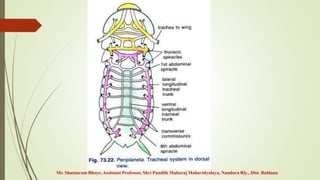
 There are ten pairs of spiracles or stigmata arranged segmentally; 2 pairs in the thorax and 8 pairs
in the abdomen.
 Each spiracle is slit-like aperture in an oval sclerotized area guarded by bristles or hairs to
prevent the passage of dirt.
 The spiracles are opened and closed by valves regulated by sphincter or spiracular muscles.
 This mechanism prevents undue loss of water through the spiracles and also regulates the flow of
the air through them.
 The aperture of each spiracle leads internally into a short chamber called atrium from which
arises the main tracheal trunk.
Mr. Shantaram Bhoye, Assistant Professor, Shri Pundlik Maharaj Mahavidyalaya, Nandura Rly., Dist. Buldana
Tracheae:
 The haemocoel of terrestrial insects including cockroach contains a system of network of elastic, closed,
branching and silvery white tubes called tracheae.
 The tracheae are formed by the in pushing of the ectoderm, hence, its wall consists of three layers
taenidia or intima, basement membrane and epithelium.
 The intima is the cuticular lining in the form of spiral or ring-like thickenings which prevents the
tracheae from collapsing.
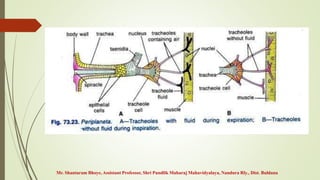
 The ultimate branches of tracheae end in tracheole cells from which arise very fine tubes called
tracheoles.
 The tracheoles have thinned cuticle lining and they end blindly in the tissue cells.
 In a resting insect when respiratory activity is not high, the tracheoles are filled, not with air but with a
tissue fluid of cells in which oxygen dissolves.
 By means of this system of tracheae the cells of the body or their fluids are in direct communication with
the environmental air.
Mr. Shantaram Bhoye, Assistant Professor, Shri Pundlik Maharaj Mahavidyalaya, Nandura Rly., Dist. Buldana
Mechanism of Respiration Cockroach :
 Inspiration and expiration take place through the spiracles; expiration is an active process but
inspiration is passive.
 In cockroach the first thoracic and first abdominal spiracles remain open all the time, but the second
thoracic and last seven abdominal spiracles open during inspiration and close during expiration.
 Air enters the spiracles during inspiration and comes to the tracheae, then it comes to the tracheoles
which contain fluids, the O2 gets dissolved in these fluids and reaches the tissue cells.
 Opening of spiracles and subsequent diffusion of air occur due to the stimulation of spiracles by carbon
dioxide.
 In expiration some carbon dioxide may pass out through the spiracles but the major part of it diffuses
out through the cuticular covering of the body.
 Carbon dioxide also dissolves in the plasma and reaches the body surface which is permeable to gases
and allows carbon dioxide to pass out.
Mr. Shantaram Bhoye, Assistant Professor, Shri Pundlik Maharaj Mahavidyalaya, Nandura Rly., Dist. Buldana
 When active movement takes place, as in running or flying, the metabolic rate is high and the osmotic
pressure of the tissues increases, as a result of these the fluid is withdrawn from the tracheoles into the
body cells.
 In active movement the abdominal segments expand and relax, these movements are termed
respiratory movements and they cause more air to be taken in through the spiracles.
 Respiratory movements are coordinated by nerves in each segment, but these nerves receive impulses
from thoracic ganglia which exercise a controlling influence over all respiratory activities.
 The coordinating centers in thoracic ganglia are stimulated and respond lack of oxygen and also to an
excess of carbon dioxide.

Respiratory system of Cockroach.pptx

  • 1.
    Shri Shivaji EducationSociety, Amravati's Shri Pundlik Maharaj Mahavidyalaya, Nandura Rly. Dist. Buldana Topic: Respiratory System of Cockroach Class: B.Sc-I, Sem-I Shantaram Bhoye Assistant Professor & Head Department of Zoology M.Sc., NET-JRF, SET, M.A.(Eng.)
  • 2.
    Mr. Shantaram Bhoye,Assistant Professor, Shri Pundlik Maharaj Mahavidyalaya, Nandura Rly., Dist. Buldana Respiratory System in Cockroach:  The respiratory system of cockroach is well developed and elaborate like those of the other terrestrial insects to compensate the absence of respiratory pigment in the blood.  It consists of a system of air tubes or tracheae through which every tissue of their body remains in direct contact with the environmental air for gaseous exchange.  The environmental air enters into and escapes from the tracheae through the spiracles or stigmata.
  • 3.
    Spiracles:  There areten pairs of spiracles or stigmata arranged segmentally; 2 pairs in the thorax and 8 pairs in the abdomen.  Each spiracle is slit-like aperture in an oval sclerotized area guarded by bristles or hairs to prevent the passage of dirt.  The spiracles are opened and closed by valves regulated by sphincter or spiracular muscles.  This mechanism prevents undue loss of water through the spiracles and also regulates the flow of the air through them.  The aperture of each spiracle leads internally into a short chamber called atrium from which arises the main tracheal trunk. Mr. Shantaram Bhoye, Assistant Professor, Shri Pundlik Maharaj Mahavidyalaya, Nandura Rly., Dist. Buldana
  • 4.
    Tracheae:  The haemocoelof terrestrial insects including cockroach contains a system of network of elastic, closed, branching and silvery white tubes called tracheae.  The tracheae are formed by the in pushing of the ectoderm, hence, its wall consists of three layers taenidia or intima, basement membrane and epithelium.  The intima is the cuticular lining in the form of spiral or ring-like thickenings which prevents the tracheae from collapsing.  The ultimate branches of tracheae end in tracheole cells from which arise very fine tubes called tracheoles.  The tracheoles have thinned cuticle lining and they end blindly in the tissue cells.  In a resting insect when respiratory activity is not high, the tracheoles are filled, not with air but with a tissue fluid of cells in which oxygen dissolves.  By means of this system of tracheae the cells of the body or their fluids are in direct communication with the environmental air. Mr. Shantaram Bhoye, Assistant Professor, Shri Pundlik Maharaj Mahavidyalaya, Nandura Rly., Dist. Buldana
  • 5.
    Mr. Shantaram Bhoye,Assistant Professor, Shri Pundlik Maharaj Mahavidyalaya, Nandura Rly., Dist. Buldana
  • 6.
    Mr. Shantaram Bhoye,Assistant Professor, Shri Pundlik Maharaj Mahavidyalaya, Nandura Rly., Dist. Buldana
  • 7.
    Mechanism of RespirationCockroach :  Inspiration and expiration take place through the spiracles; expiration is an active process but inspiration is passive.  In cockroach the first thoracic and first abdominal spiracles remain open all the time, but the second thoracic and last seven abdominal spiracles open during inspiration and close during expiration.  Air enters the spiracles during inspiration and comes to the tracheae, then it comes to the tracheoles which contain fluids, the O2 gets dissolved in these fluids and reaches the tissue cells.  Opening of spiracles and subsequent diffusion of air occur due to the stimulation of spiracles by carbon dioxide.  In expiration some carbon dioxide may pass out through the spiracles but the major part of it diffuses out through the cuticular covering of the body.  Carbon dioxide also dissolves in the plasma and reaches the body surface which is permeable to gases and allows carbon dioxide to pass out. Mr. Shantaram Bhoye, Assistant Professor, Shri Pundlik Maharaj Mahavidyalaya, Nandura Rly., Dist. Buldana
  • 8.
    Mr. Shantaram Bhoye,Assistant Professor, Shri Pundlik Maharaj Mahavidyalaya, Nandura Rly., Dist. Buldana  When active movement takes place, as in running or flying, the metabolic rate is high and the osmotic pressure of the tissues increases, as a result of these the fluid is withdrawn from the tracheoles into the body cells.  In active movement the abdominal segments expand and relax, these movements are termed respiratory movements and they cause more air to be taken in through the spiracles.  Respiratory movements are coordinated by nerves in each segment, but these nerves receive impulses from thoracic ganglia which exercise a controlling influence over all respiratory activities.  The coordinating centers in thoracic ganglia are stimulated and respond lack of oxygen and also to an excess of carbon dioxide.