ISHFAQ SHAH
( SKUAST-K WADURA , 193201)
RESPIRATION: Process Of Interchange Of Gases Between The
Environment And The Blood Or Cellular Tissue Of An Organism.
It includes both chemical and physical phases.
CHEMICAL PHASE: Concerned with oxidation in the body tissues
resulting in the formation of carbon-dioxide and water.
PHYSICAL PHASE : Involves transportation of air to tissues and
elimination of carbon-dioxide.
The special mechanical devices that are developed to facilitate the
respiration in animals constitute the respiratory system.
The main respiratory organs in insects are trachea.
RESPIRATORY SYSTEM
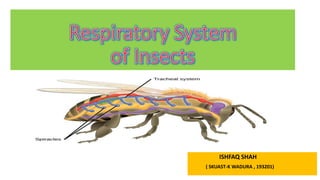
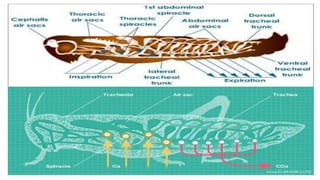
An insect's respiratory system is the biological system .
Air enters the respiratory systems of insects through a series of
external openings called spiracles.
 A densely networked array of tubes called tracheae ( This
network of transverse and longitudinal tracheae equalizes
pressure throughout the system).
It is responsible for delivering sufficient oxygen (O2) to all cells
of the body and for removing carbon dioxide (CO2).
INSECTS RESPIRATORY SYSTEM
CONSISTS OF :
1) SPIRACLES
2) TRACHAE
3) TRACHEOLES
4) TRACHEOBLAST
5) AIR-SACS
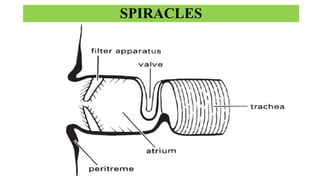
SPIRACLES
Air enters into body through tiny holes spiracles
 Use to avoid water loss
 A cavity atrium or entrance is present
 Air passage is controlled by Valves
Surrounded by peritreme
SPIRACLES
TRACHAE
 Elastic in nature, & are ectodermal in origin.
Cuticular pipe like apparatus.
Thick, helical and thread like layer taenidia.
give flexibility.
Filled with air shows silvery appearance.
TRACHAE
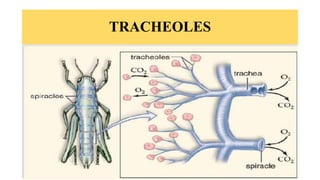
TRACHEOLES
• The network of tracheae
• Diameter less than 1μm (0.2-0.3μm)
• Gaseous exchange
• Lie within each cell
• Its lining not shed down on molting
TRACHEOLES
Air-Sacs
• Balloon-like structures acts as oxygen reservoir.
• Allow growth of the body.
• Assist flight by reducing gravity of insects.
• In case of Aquatic insects, air sacs have a hydro-static
function.
• Heat insulations & to maintain body temperature.
Air-Sacs
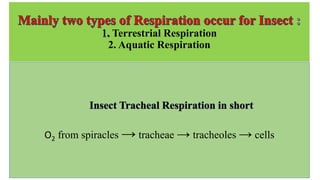
Terrestrial Respiration
2. Aquatic Respiration
•O2 from spiracles --> tracheae --> tracheoles --> cells
O2 from spiracles → tracheae → tracheoles → cells
THE TRACHEAL SYSTEM
VENTILATION
ROLE AND FUNCTION OF THE
RESPIRATORY SYSTEM :
Provide the cells and tissues with oxygen.
 To eliminate carbon dioxide a product of cellular respiration.
 To work in conjunction with the circulatory system in
providing oxygen to the flight muscle.
 Haemolymph circulation .
Gives some degree of buoyancy in aquatic insects e.g. phantom
midge (diptera).
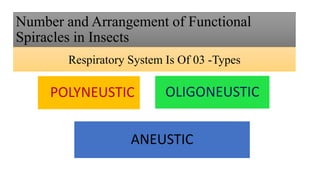
Number and Arrangement of Functional
Spiracles in Insects
POLYNEUSTIC OLIGONEUSTIC
ANEUSTIC
Respiratory System Is Of 03 -Types
POLYNEUSTIC : At Least 8 Functional Spiracles On Each
Side Of The Body . It Is Further Divided Into:
 Holopneustic Respiratory System:
 8 pairs of spiracle on first 8 abdominal segments
 2 pairs found on meso-thorax and meta-thorax
Example: Dipterans and some Hymenopterans
 Peripneustic Respiratory System:
 9 pairs of spiracles,1 meso-thoracic & 8 abdominal spiracles are
functional.
Example: Cecidomyid larvae
 Hemipneustic Respiratory System:
 8 pairs of spiracles present; 1 meso-thoracic and 7 abdominal
spiracles are functional
Example: Neuroptera & Lepidoptera
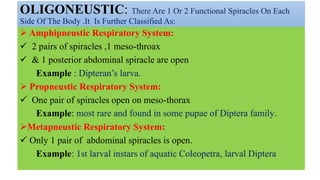
OLIGONEUSTIC: There Are 1 Or 2 Functional Spiracles On Each
Side Of The Body .It Is Further Classified As:
 Amphipneustic Respiratory System:
 2 pairs of spiracles ,1 meso-throax
 & 1 posterior abdominal spiracle are open
Example : Dipteran’s larva.
 Propneustic Respiratory System:
 One pair of spiracles open on meso-thorax
Example: most rare and found in some pupae of Diptera family.
Metapneustic Respiratory System:
 Only 1 pair of abdominal spiracles is open.
Example: 1st larval instars of aquatic Coleopetra, larval Diptera
APNEUSTIC : None Of The Spiracles Are Open
 All spiracles are closed
 Respiration takes place through gills and general body surface
Example: Naiad of Mayfly, nymph of Ephemeroptera , Odonata and
many endoparasites (Hymenoptera).
PHYSIOLOGY OF RESPIRATION : The opening and closing of spiracle is
controlled by nervous system. There are three phases in the process of respiration.
 INSPIRATION PHASE: To take the oxygen in the body is called
inspiration. In this phase the main trunk and air sacs are filled with oxygen
. Relaxation of muscles and reduction of pressure due to the muscular
expansion of the abdomen leads to this phase.
 COMPRESSION PHASE: In this phase air flow is increased due to
dorsoventral flattening of abdomen. The abdomen starts to contract while
the spiracles are still closed , so that the air in the trachea is under
pressure.
 EXPIRATION PHASE: Diffusion of carbon dioxide out side the body is
called expiration. Compresssion of system by the tergum and sternal
muscles leads to the decrease in volume , various organs present in the
body press the air due to the increase in blood pressure and causes the air
to move out.
MECHANISM OF RESPIRATION
•Oxygen enters the spiracle and passes through the
length of the tracheae to the tracheoles and into the
target cells by a combination of ventilation and diffusion
along a concentration gradient, from high in the external
air to low in the tissue. Where as the net movement of
oxygen molecules in the tracheal system is inward
(Inspiration), the net movement of CO2 and water
vapour molecules is outward (Expiration).
Insect respiratory system

Insect respiratory system

  • 1.
    ISHFAQ SHAH ( SKUAST-KWADURA , 193201)
  • 2.
    RESPIRATION: Process OfInterchange Of Gases Between The Environment And The Blood Or Cellular Tissue Of An Organism. It includes both chemical and physical phases. CHEMICAL PHASE: Concerned with oxidation in the body tissues resulting in the formation of carbon-dioxide and water. PHYSICAL PHASE : Involves transportation of air to tissues and elimination of carbon-dioxide. The special mechanical devices that are developed to facilitate the respiration in animals constitute the respiratory system. The main respiratory organs in insects are trachea.
  • 3.
    RESPIRATORY SYSTEM An insect'srespiratory system is the biological system . Air enters the respiratory systems of insects through a series of external openings called spiracles.  A densely networked array of tubes called tracheae ( This network of transverse and longitudinal tracheae equalizes pressure throughout the system). It is responsible for delivering sufficient oxygen (O2) to all cells of the body and for removing carbon dioxide (CO2).
  • 4.
    INSECTS RESPIRATORY SYSTEM CONSISTSOF : 1) SPIRACLES 2) TRACHAE 3) TRACHEOLES 4) TRACHEOBLAST 5) AIR-SACS
  • 5.
    SPIRACLES Air enters intobody through tiny holes spiracles  Use to avoid water loss  A cavity atrium or entrance is present  Air passage is controlled by Valves Surrounded by peritreme
  • 6.
  • 7.
    TRACHAE  Elastic innature, & are ectodermal in origin. Cuticular pipe like apparatus. Thick, helical and thread like layer taenidia. give flexibility. Filled with air shows silvery appearance.
  • 8.
  • 9.
    TRACHEOLES • The networkof tracheae • Diameter less than 1μm (0.2-0.3μm) • Gaseous exchange • Lie within each cell • Its lining not shed down on molting
  • 10.
  • 11.
    Air-Sacs • Balloon-like structuresacts as oxygen reservoir. • Allow growth of the body. • Assist flight by reducing gravity of insects. • In case of Aquatic insects, air sacs have a hydro-static function. • Heat insulations & to maintain body temperature.
  • 12.
  • 14.
    Terrestrial Respiration 2. AquaticRespiration •O2 from spiracles --> tracheae --> tracheoles --> cells O2 from spiracles → tracheae → tracheoles → cells
  • 15.
  • 16.
  • 17.
    ROLE AND FUNCTIONOF THE RESPIRATORY SYSTEM : Provide the cells and tissues with oxygen.  To eliminate carbon dioxide a product of cellular respiration.  To work in conjunction with the circulatory system in providing oxygen to the flight muscle.  Haemolymph circulation . Gives some degree of buoyancy in aquatic insects e.g. phantom midge (diptera).
  • 18.
    Number and Arrangementof Functional Spiracles in Insects POLYNEUSTIC OLIGONEUSTIC ANEUSTIC Respiratory System Is Of 03 -Types
  • 19.
    POLYNEUSTIC : AtLeast 8 Functional Spiracles On Each Side Of The Body . It Is Further Divided Into:  Holopneustic Respiratory System:  8 pairs of spiracle on first 8 abdominal segments  2 pairs found on meso-thorax and meta-thorax Example: Dipterans and some Hymenopterans  Peripneustic Respiratory System:  9 pairs of spiracles,1 meso-thoracic & 8 abdominal spiracles are functional. Example: Cecidomyid larvae  Hemipneustic Respiratory System:  8 pairs of spiracles present; 1 meso-thoracic and 7 abdominal spiracles are functional Example: Neuroptera & Lepidoptera
  • 20.
    OLIGONEUSTIC: There Are1 Or 2 Functional Spiracles On Each Side Of The Body .It Is Further Classified As:  Amphipneustic Respiratory System:  2 pairs of spiracles ,1 meso-throax  & 1 posterior abdominal spiracle are open Example : Dipteran’s larva.  Propneustic Respiratory System:  One pair of spiracles open on meso-thorax Example: most rare and found in some pupae of Diptera family. Metapneustic Respiratory System:  Only 1 pair of abdominal spiracles is open. Example: 1st larval instars of aquatic Coleopetra, larval Diptera
  • 21.
    APNEUSTIC : NoneOf The Spiracles Are Open  All spiracles are closed  Respiration takes place through gills and general body surface Example: Naiad of Mayfly, nymph of Ephemeroptera , Odonata and many endoparasites (Hymenoptera).
  • 22.
    PHYSIOLOGY OF RESPIRATION: The opening and closing of spiracle is controlled by nervous system. There are three phases in the process of respiration.  INSPIRATION PHASE: To take the oxygen in the body is called inspiration. In this phase the main trunk and air sacs are filled with oxygen . Relaxation of muscles and reduction of pressure due to the muscular expansion of the abdomen leads to this phase.  COMPRESSION PHASE: In this phase air flow is increased due to dorsoventral flattening of abdomen. The abdomen starts to contract while the spiracles are still closed , so that the air in the trachea is under pressure.  EXPIRATION PHASE: Diffusion of carbon dioxide out side the body is called expiration. Compresssion of system by the tergum and sternal muscles leads to the decrease in volume , various organs present in the body press the air due to the increase in blood pressure and causes the air to move out.
  • 24.
    MECHANISM OF RESPIRATION •Oxygenenters the spiracle and passes through the length of the tracheae to the tracheoles and into the target cells by a combination of ventilation and diffusion along a concentration gradient, from high in the external air to low in the tissue. Where as the net movement of oxygen molecules in the tracheal system is inward (Inspiration), the net movement of CO2 and water vapour molecules is outward (Expiration).