Resistance Spot Welding
LEVEL 2 BODY AND PAINT
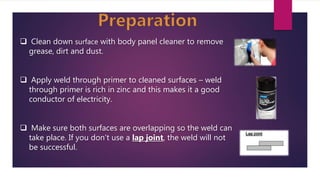
 Clean down surface with body panel cleaner to remove
grease, dirt and dust.
 Apply weld through primer to cleaned surfaces – weld
through primer is rich in zinc and this makes it a good
conductor of electricity.
 Make sure both surfaces are overlapping so the weld can
take place. If you don’t use a lap joint, the weld will not
be successful.
 Squeeze time
The time given for the movable electrode to come into contact with the work piece and build up
needed to make a good weld. Squeeze time is programmable in cycles. (1 Cycle = 1/60 of a second)
 Weld time
Weld time is the time it takes to actually make the weld. So this is when the electrical current passes from
the electrode, through the mild steel, which resists the current and produces the heat to melt the steel.
 Hold time
This is the time it takes for the metal to cool down and harden. The metal has to be held between the
electrodes until the metal has cooled and hardened.
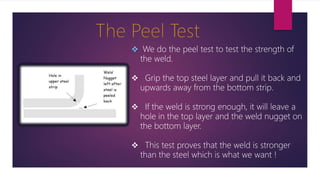
 We do the peel test to test the strength of
the weld.
 Grip the top steel layer and pull it back and
upwards away from the bottom strip.
 If the weld is strong enough, it will leave a
hole in the top layer and the weld nugget on
the bottom layer.
 This test proves that the weld is stronger
than the steel which is what we want !
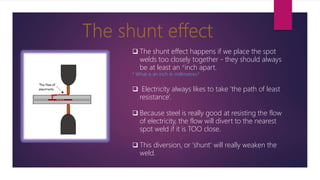
 The shunt effect happens if we place the spot
welds too closely together - they should always
be at least an *inch apart.
* What is an inch in millimetres?
 Electricity always likes to take 'the path of least
resistance'.
 Because steel is really good at resisting the flow
of electricity, the flow will divert to the nearest
spot weld if it is TOO close.
 This diversion, or 'shunt' will really weaken the
weld.

Resistance spot welding

  • 1.
  • 3.
     Clean downsurface with body panel cleaner to remove grease, dirt and dust.  Apply weld through primer to cleaned surfaces – weld through primer is rich in zinc and this makes it a good conductor of electricity.  Make sure both surfaces are overlapping so the weld can take place. If you don’t use a lap joint, the weld will not be successful.
  • 5.
     Squeeze time Thetime given for the movable electrode to come into contact with the work piece and build up needed to make a good weld. Squeeze time is programmable in cycles. (1 Cycle = 1/60 of a second)  Weld time Weld time is the time it takes to actually make the weld. So this is when the electrical current passes from the electrode, through the mild steel, which resists the current and produces the heat to melt the steel.  Hold time This is the time it takes for the metal to cool down and harden. The metal has to be held between the electrodes until the metal has cooled and hardened.
  • 6.
     We dothe peel test to test the strength of the weld.  Grip the top steel layer and pull it back and upwards away from the bottom strip.  If the weld is strong enough, it will leave a hole in the top layer and the weld nugget on the bottom layer.  This test proves that the weld is stronger than the steel which is what we want !
  • 7.
     The shunteffect happens if we place the spot welds too closely together - they should always be at least an *inch apart. * What is an inch in millimetres?  Electricity always likes to take 'the path of least resistance'.  Because steel is really good at resisting the flow of electricity, the flow will divert to the nearest spot weld if it is TOO close.  This diversion, or 'shunt' will really weaken the weld.