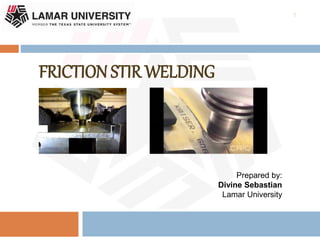
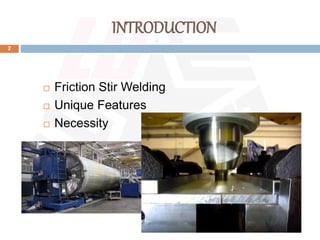
FRICTION STIR WELDING
1
Prepared by:
Divine Sebastian
Lamar University
INTRODUCTION
2
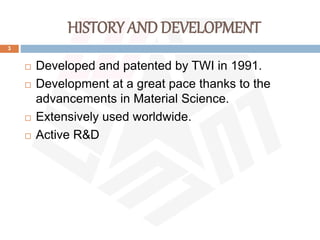
 Friction Stir Welding
 Unique Features
 Necessity
HISTORY AND DEVELOPMENT
3
 Developed and patented by TWI in 1991.
 Development at a great pace thanks to the
advancements in Material Science.
 Extensively used worldwide.
 Active R&D
WORKING
4
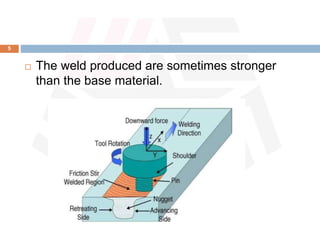
 Workpieces to be joined are rigidly fixed.
 Wear resistant tool of different material rotating
at high speed.
 Material becomes plastic due to friction heat.
 Rotation of tool leads to stirring and subsequent
mixing of material at the joining region below
their melting points.
 Good mechanical properties and low distortion
due to low heat input.
5
 The weld produced are sometimes stronger
than the base material.
TOOL GEOMETRY
6
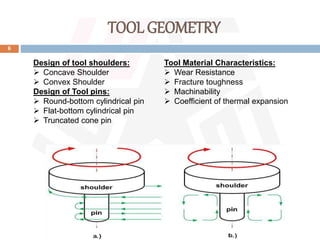
Design of tool shoulders:
 Concave Shoulder
 Convex Shoulder
Design of Tool pins:
 Round-bottom cylindrical pin
 Flat-bottom cylindrical pin
 Truncated cone pin
Tool Material Characteristics:
 Wear Resistance
 Fracture toughness
 Machinability
 Coefficient of thermal expansion
MATERIALS
7
 Materials which can be welded:
 Aluminum and its alloys
 High strength materials like steel
 Copper
 Magnesium and Zinc
 Titanium
 Tool Materials:
 Polycrystalline Cubic Boron Nitride(PCBN)
 High speed steels(When used along with milling machines)
 Hot work tool steels
 Nickel and cobalt base alloys
 Refractory metals(W, Mo)
 Tungsten based alloys
ADVANTAGES & DISADVANTAGES
 ADVANTAGES
 No fumes or toxic gas.
 Excellent mechanical
properties.
 Can be used to weld
materials that cannot be
welded by fusion welding..
 Dissimilar materials and
alloys can be welded.
 Excellent weld quality
 Low distortion
 Low shrinkage
 Absence of porosity
 Absence of lack of fusion
 DISADVANTAGES
 Very large forces are required
 Very rigid clamping system.
 High initial investment.
 Exit hole remains after the
tool is removed
 Low traverse rate
8
APPLICATIONS
9
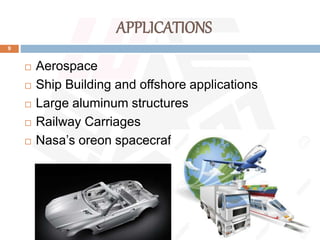
 Aerospace
 Ship Building and offshore applications
 Large aluminum structures
 Railway Carriages
 Nasa’s oreon spacecraft
RECENT DEVELOPMENTS & CURRENT STATUS
10
 Automation
 Robot Systems
 Introduction of new tool materials
 Ship building(Aluminum extensively used)
 Aerospace applications(fuel tanks)
CONCLUSION
11
 Significance of FSW process
 Possible improvements
 Establishment in small scale industries
REFERENCES
12
 Experimental study on the effect of welding speed and tool pin profiles on
AA6082-O aluminum friction stir welded butt joints, ‖ vol. 2, no. 5, pp.
268–275, 2010. (Patil H. S)
 Effect of tool pin profile on mechanical properties of single and double
sided FSW AA19000 (Ram Niwas Bishnoi et. al.)
 Influence of Tool Design On the Mechanical Properties and Microstructure
in Friction Stir Welding of AA6351 Aluminium Alloy (M. Karthikeyan.,
Dr.A.K.Shaik Dawood)
 Effect of tool pin profile on aluminum alloy using FSW for optimum
results by finding optimum parameters (V. Patel Chandresh)
 Friction stir joining of aluminium alloys. Bulletin, November/December
1995, (Dawes C J, Thomas W M)

Friction stir welding

  • 1.
    FRICTION STIR WELDING 1 Preparedby: Divine Sebastian Lamar University
  • 2.
    INTRODUCTION 2  Friction StirWelding  Unique Features  Necessity
  • 3.
    HISTORY AND DEVELOPMENT 3 Developed and patented by TWI in 1991.  Development at a great pace thanks to the advancements in Material Science.  Extensively used worldwide.  Active R&D
  • 4.
    WORKING 4  Workpieces tobe joined are rigidly fixed.  Wear resistant tool of different material rotating at high speed.  Material becomes plastic due to friction heat.  Rotation of tool leads to stirring and subsequent mixing of material at the joining region below their melting points.  Good mechanical properties and low distortion due to low heat input.
  • 5.
    5  The weldproduced are sometimes stronger than the base material.
  • 6.
    TOOL GEOMETRY 6 Design oftool shoulders:  Concave Shoulder  Convex Shoulder Design of Tool pins:  Round-bottom cylindrical pin  Flat-bottom cylindrical pin  Truncated cone pin Tool Material Characteristics:  Wear Resistance  Fracture toughness  Machinability  Coefficient of thermal expansion
  • 7.
    MATERIALS 7  Materials whichcan be welded:  Aluminum and its alloys  High strength materials like steel  Copper  Magnesium and Zinc  Titanium  Tool Materials:  Polycrystalline Cubic Boron Nitride(PCBN)  High speed steels(When used along with milling machines)  Hot work tool steels  Nickel and cobalt base alloys  Refractory metals(W, Mo)  Tungsten based alloys
  • 8.
    ADVANTAGES & DISADVANTAGES ADVANTAGES  No fumes or toxic gas.  Excellent mechanical properties.  Can be used to weld materials that cannot be welded by fusion welding..  Dissimilar materials and alloys can be welded.  Excellent weld quality  Low distortion  Low shrinkage  Absence of porosity  Absence of lack of fusion  DISADVANTAGES  Very large forces are required  Very rigid clamping system.  High initial investment.  Exit hole remains after the tool is removed  Low traverse rate 8
  • 9.
    APPLICATIONS 9  Aerospace  ShipBuilding and offshore applications  Large aluminum structures  Railway Carriages  Nasa’s oreon spacecraft
  • 10.
    RECENT DEVELOPMENTS &CURRENT STATUS 10  Automation  Robot Systems  Introduction of new tool materials  Ship building(Aluminum extensively used)  Aerospace applications(fuel tanks)
  • 11.
    CONCLUSION 11  Significance ofFSW process  Possible improvements  Establishment in small scale industries
  • 12.
    REFERENCES 12  Experimental studyon the effect of welding speed and tool pin profiles on AA6082-O aluminum friction stir welded butt joints, ‖ vol. 2, no. 5, pp. 268–275, 2010. (Patil H. S)  Effect of tool pin profile on mechanical properties of single and double sided FSW AA19000 (Ram Niwas Bishnoi et. al.)  Influence of Tool Design On the Mechanical Properties and Microstructure in Friction Stir Welding of AA6351 Aluminium Alloy (M. Karthikeyan., Dr.A.K.Shaik Dawood)  Effect of tool pin profile on aluminum alloy using FSW for optimum results by finding optimum parameters (V. Patel Chandresh)  Friction stir joining of aluminium alloys. Bulletin, November/December 1995, (Dawes C J, Thomas W M)