DR. B. C. ROY ENGINEERING
COLLEGE
SEMINAR ON
FRICTION STIR WELDING
GUIDED BY:
PROF. S. C. MOI
PRESENTED BY:
RAVI RANJAN KUMAR (12000714144)
SLIDE PLAN
 WELDING
 DIFFERENT TYPES OF WELDING PROCESSES
 SOLID STATE WELDING PROCESSES
 FRICTION WELDING
 INTRODUCATION
 FRICTION STIR WELDING
 FRICTION STIR WELDING PROCESS
 TOOLS USED FOR FSW
 ADVANTAGES AND DISADVANTAGES
 APPLICATIONS
 LIMITATIONS
WELDING
Welding is a process for joining two similar or
dissimilar material by fusion.
Classification of welding
The welding processes are divided into three
main sub-classes: Plastic (forge) , Fusion
and Solid State
DIFFERENT TYPES OF
WELDING PROCESSES
1. Arc Welding
2. Oxy Fuel Gas Welding
3. Resistance Welding
4. Thermit Welding
5. Radiant Energy Welding
6. Solid State Welding
SOLID STATE
WELDING PROCESSES
This group of welding processes uses
pressure and heat (below the melting
temperature) to produce coalescence
between the pieces to be joined without
the use of filler metal.
FRICTION WELDING
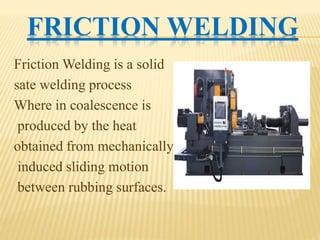
Friction Welding is a solid
sate welding process
Where in coalescence is
produced by the heat
obtained from mechanically
induced sliding motion
between rubbing surfaces.
INTRODUCATION
Friction stir welding is a relatively new solid-
state joining process.
This joining technique is energy efficient,
environment friendly, and versatile. In
particular, it can be used to join high-strength
aerospace aluminum alloys and other metallic
alloys.
FRICTION STIR
WELDING
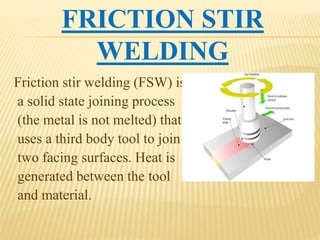
Friction stir welding (FSW) is
a solid state joining process
(the metal is not melted) that
uses a third body tool to join
two facing surfaces. Heat is
generated between the tool
and material.
FRICTION STIR
WELDING PROCESS
 Friction stir welding is a new solid state joining process.
 Here a cylindrical shouldered tool along with a profiled
probe is rotated and fed at a constant traverse rate in to
the joint.
 Frictional heat generated between the wear resistant
welding tool and the work piece along with mechanical
mixing heat causes the stirred material to soften without
reaching.
TOOLS USED FOR
FRICTION STIR WELDING
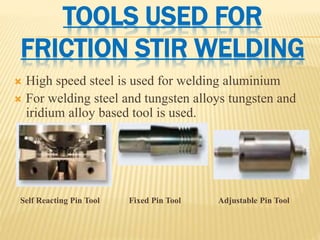
 High speed steel is used for welding aluminium
 For welding steel and tungsten alloys tungsten and
iridium alloy based tool is used.
Self Reacting Pin Tool Fixed Pin Tool Adjustable Pin Tool
ADVANTAGES AND
DISADVANTAGES
ADVANTAGES
 Low distortion and shrinkage
 No arc and no porosity
 Can operate in all position
 Energy efficient
 Good mechanical properties fatigue, tensile and
bend test
DISADVANTAGES
Work pieces must be rigidly clamped
Keyhole at the end of each weld
Cannot make joints which required
metal deposition
Initial cost of the machine is very high
compared by fusion welding
APPLICATIONS
1. Ship building and marine
industries
2. Aerospace industry
3. Railway and land transport.
LIMITATIONS
Work pieces must be rigidly clamped
Key holes at the end of each weld
Less flexible than manual and arc
processes
BIBLIOGRAPHY
Welding Science and Technology by
Md. Ibrahim Khan
Welding Technology by O. P. Khanna
Production Technology by R.K. Jain
Friction stir welding

Friction stir welding

  • 1.
    DR. B. C.ROY ENGINEERING COLLEGE SEMINAR ON FRICTION STIR WELDING GUIDED BY: PROF. S. C. MOI PRESENTED BY: RAVI RANJAN KUMAR (12000714144)
  • 2.
    SLIDE PLAN  WELDING DIFFERENT TYPES OF WELDING PROCESSES  SOLID STATE WELDING PROCESSES  FRICTION WELDING  INTRODUCATION  FRICTION STIR WELDING  FRICTION STIR WELDING PROCESS  TOOLS USED FOR FSW  ADVANTAGES AND DISADVANTAGES  APPLICATIONS  LIMITATIONS
  • 3.
    WELDING Welding is aprocess for joining two similar or dissimilar material by fusion. Classification of welding The welding processes are divided into three main sub-classes: Plastic (forge) , Fusion and Solid State
  • 4.
    DIFFERENT TYPES OF WELDINGPROCESSES 1. Arc Welding 2. Oxy Fuel Gas Welding 3. Resistance Welding 4. Thermit Welding 5. Radiant Energy Welding 6. Solid State Welding
  • 5.
    SOLID STATE WELDING PROCESSES Thisgroup of welding processes uses pressure and heat (below the melting temperature) to produce coalescence between the pieces to be joined without the use of filler metal.
  • 6.
    FRICTION WELDING Friction Weldingis a solid sate welding process Where in coalescence is produced by the heat obtained from mechanically induced sliding motion between rubbing surfaces.
  • 7.
    INTRODUCATION Friction stir weldingis a relatively new solid- state joining process. This joining technique is energy efficient, environment friendly, and versatile. In particular, it can be used to join high-strength aerospace aluminum alloys and other metallic alloys.
  • 8.
    FRICTION STIR WELDING Friction stirwelding (FSW) is a solid state joining process (the metal is not melted) that uses a third body tool to join two facing surfaces. Heat is generated between the tool and material.
  • 9.
    FRICTION STIR WELDING PROCESS Friction stir welding is a new solid state joining process.  Here a cylindrical shouldered tool along with a profiled probe is rotated and fed at a constant traverse rate in to the joint.  Frictional heat generated between the wear resistant welding tool and the work piece along with mechanical mixing heat causes the stirred material to soften without reaching.
  • 10.
    TOOLS USED FOR FRICTIONSTIR WELDING  High speed steel is used for welding aluminium  For welding steel and tungsten alloys tungsten and iridium alloy based tool is used. Self Reacting Pin Tool Fixed Pin Tool Adjustable Pin Tool
  • 11.
    ADVANTAGES AND DISADVANTAGES ADVANTAGES  Lowdistortion and shrinkage  No arc and no porosity  Can operate in all position  Energy efficient  Good mechanical properties fatigue, tensile and bend test
  • 12.
    DISADVANTAGES Work pieces mustbe rigidly clamped Keyhole at the end of each weld Cannot make joints which required metal deposition Initial cost of the machine is very high compared by fusion welding
  • 13.
    APPLICATIONS 1. Ship buildingand marine industries 2. Aerospace industry 3. Railway and land transport.
  • 14.
    LIMITATIONS Work pieces mustbe rigidly clamped Key holes at the end of each weld Less flexible than manual and arc processes
  • 15.
    BIBLIOGRAPHY Welding Science andTechnology by Md. Ibrahim Khan Welding Technology by O. P. Khanna Production Technology by R.K. Jain