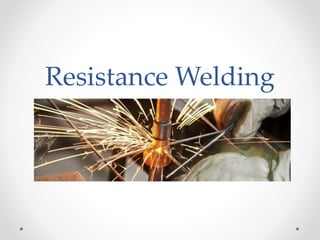
Resistance Welding
Resistance Welding
• A liquid state welding process
• Is a thermo-electric process
o Uses electric resistance to generate heat
Working Principal
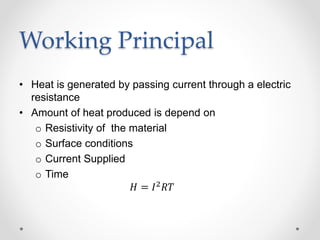
• Heat is generated by passing current through a electric
resistance
• Amount of heat produced is depend on
o Resistivity of the material
o Surface conditions
o Current Supplied
o Time
𝐻 = 𝐼2
𝑅𝑇
Types of RW
• Spot Welding
• Seam Welding
• Projection Welding
• Flash Butt Welding
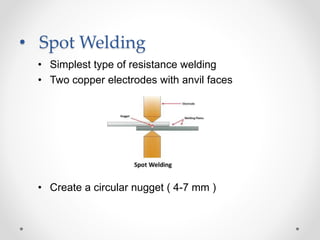
• Spot Welding
• Simplest type of resistance welding
• Two copper electrodes with anvil faces
• Create a circular nugget ( 4-7 mm )
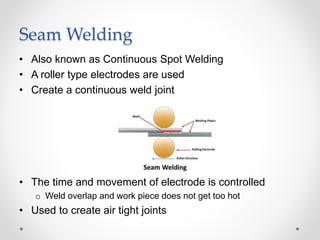
Seam Welding
• Also known as Continuous Spot Welding
• A roller type electrodes are used
• Create a continuous weld joint
• The time and movement of electrode is controlled
o Weld overlap and work piece does not get too hot
• Used to create air tight joints
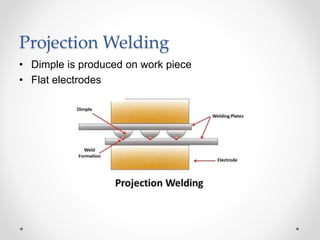
Projection Welding
• Dimple is produced on work piece
• Flat electrodes
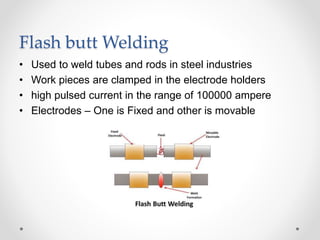
Flash butt Welding
• Used to weld tubes and rods in steel industries
• Work pieces are clamped in the electrode holders
• high pulsed current in the range of 100000 ampere
• Electrodes – One is Fixed and other is movable
Applications
• Resistance welding - automotive industries
• Projection welding - production of nut and bolt
• Seam welding - produce leak prove joint
required in small tanks,
boilers etc.
• Flash welding -welding pipes and tubes
Advantages
• It can weld thin (0.1 mm) as well as thick (20mm) metals.
• High welding speed.
• Easily automated.
• Both similar and dissimilar metals can be weld.
• The process is simple and fully automated so does not
required high skilled labor.
• High production rate.
• It is environment friendly process.
• It does not require any filler metal, flux and shielding
gases.
Disadvantages
• High equipment cost.
• The thickness of work piece is limited due to current
requirement.
• It is less efficient for high conductive materials.
• High electric power required.
• Weld joints have low tensile and fatigue strength.
Thank You!

Resistance welding

  • 1.
  • 2.
    Resistance Welding • Aliquid state welding process • Is a thermo-electric process o Uses electric resistance to generate heat
  • 3.
    Working Principal • Heatis generated by passing current through a electric resistance • Amount of heat produced is depend on o Resistivity of the material o Surface conditions o Current Supplied o Time 𝐻 = 𝐼2 𝑅𝑇
  • 4.
    Types of RW •Spot Welding • Seam Welding • Projection Welding • Flash Butt Welding
  • 5.
    • Spot Welding •Simplest type of resistance welding • Two copper electrodes with anvil faces • Create a circular nugget ( 4-7 mm )
  • 6.
    Seam Welding • Alsoknown as Continuous Spot Welding • A roller type electrodes are used • Create a continuous weld joint • The time and movement of electrode is controlled o Weld overlap and work piece does not get too hot • Used to create air tight joints
  • 7.
    Projection Welding • Dimpleis produced on work piece • Flat electrodes
  • 8.
    Flash butt Welding •Used to weld tubes and rods in steel industries • Work pieces are clamped in the electrode holders • high pulsed current in the range of 100000 ampere • Electrodes – One is Fixed and other is movable
  • 9.
    Applications • Resistance welding- automotive industries • Projection welding - production of nut and bolt • Seam welding - produce leak prove joint required in small tanks, boilers etc. • Flash welding -welding pipes and tubes
  • 10.
    Advantages • It canweld thin (0.1 mm) as well as thick (20mm) metals. • High welding speed. • Easily automated. • Both similar and dissimilar metals can be weld. • The process is simple and fully automated so does not required high skilled labor. • High production rate. • It is environment friendly process. • It does not require any filler metal, flux and shielding gases.
  • 11.
    Disadvantages • High equipmentcost. • The thickness of work piece is limited due to current requirement. • It is less efficient for high conductive materials. • High electric power required. • Weld joints have low tensile and fatigue strength.
  • 12.