PRESENTATION 
ON 
LASER BEAM WELDING 
SUBMITTED TO: SUBMITTED BY: 
DR. N. M. SURI SHIV J I GOSWAMI 
MECHANICAL DEPARTMENT ROLL NO. 1 3 2222
WHAT IS LASER BEAM? 
 The term laser is an acronym for Light 
Amplification by Stimulated Emission of 
Radiation. 
 A laser beam is a powerful, narrow, 
monochromatic and directional beam of 
electromagnetic radiation. 
 Often, these beams are within the visible 
spectrum of light. 
 A laser device excites the atoms in a losing 
medium. The electrons of these atoms move to a 
higher orbit, then release photons, creating a 
laser beam.
Properties of Laser Beam 
 A LASER beam is highly intense in nature. 
 LASER beam is having strictly monochromatic. 
 LASER light is highly powerful and capable of 
propagating over long distance & are not easily 
absorbed by water. 
 LASER beam is also said to be highly directional. 
 This beam is coherent with the wave train in phase 
with each other.
Types of laser Beam 
Types of lasers include gas, liquid and solid. 
1. Gas lasers excite the electrons in gases, such as 
helium, neon, cadmium, carbon dioxide and 
nitrogen. 
2. Liquid lasers include the dye laser, which uses 
organic dye molecules in liquid form to produce a 
wavelength of radiation that can be tuned. 
3. Solid lasers include the ruby laser, which uses a 
precious stone to produce a beam of red light.
Laser beam welding process 
 In general cases heat is required to fuse the metals 
for any types of welding, in laser beam welding 
process the heat is obtained from the application of a 
concentrated coherent light beam which striking 
upon the weld metal and melt the metal, such this 
weld joint is obtained, this welding process is called 
laser welding.
Principle of LBW 
 A laser beam is produced inside of the Ruby 
Crystal. The Ruby Crystal is made of aluminium 
oxide with chromium dispersed throughout it. 
Which is forming about 1/2000 of crystal, this less 
than natural ruby. Silver coated mirrors are fitted 
internally in the both side of crystal. The one side 
of mirror has a tiny hole, a beam is come out 
through this hole. 
 A flash tube is placed around the Ruby Crystal, 
which is filled with xenon inert gas. The flash is 
specially designed such as which is made flash rate 
about thousands flashes per seconds.
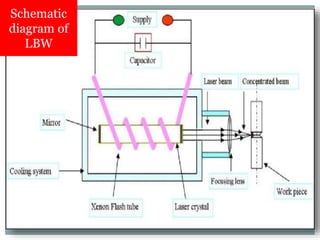
Schematic 
diagram of 
LBW
 The electrical energy is converted into light energy, 
this is worked by flash tube. 
 The capacitor is provided for storage the electrical 
energy and supply the high voltage to flash tube for 
performed appropriately. 
 The electrical energy discharged from capacitor 
and xenon transform the high energy into white 
flash light rate of 1/1000 per second.
 The chromium atoms of Ruby Crystal are excited 
and pumped into high energy. Due to heat 
generating the some of this energy is lost. But some 
light energy reflected mirror to mirror and again 
chromium atoms are excited until loss their extra 
energy simultaneously to form a narrow beam of 
coherent light. Which is come out through the one 
end tiny hole of crystal’s mirror. 
 This narrow beam is focused by a optical focusing 
lens to produce a small intense of laser on the job.
MECHANICS OF LBW 
 Laser beam welding (LBW) is a welding process 
which produces coalescence of materials with the 
heat obtained from the application of a concentrate 
coherent light beam impinging upon the surfaces to 
be joined. 
 It is achieved through following phases:
1. Interaction of laser beam with work material. 
2. Heat conduction and temperature rise. 
3. Melting vaporization and joining : When using 
the laser beam for welding, the electromagnetic 
radiation impinges on the surface of the base 
metal with such a concentration of energy that 
the temperature of the surface is melted vapor 
and melts the metal below.
Parameters of LBW 
1. Medium Normal atmosphere 
2. Tool High power laser beam 
3. Critical parameters Beam intensity ,beam dia, 
melting temperature. 
4. Materials application All material
LBW Process Advantages: 
Works with high alloy metals without difficulty 
 Can be used in open air 
 Can be transmitted over long distances with a 
minimal loss of power 
Narrow heat affected zone 
 Low total thermal input 
Welds dissimilar metals 
 No filler metals necessary
Advantages contd.. 
No secondary finishing necessary 
Extremely accurate 
 Produces deep and narrow welds 
Low distortion in welds 
High quality welds 
 Can weld small, thin components 
 No contact with materials
LIMITATIONS 
 Rapid cooling rate may cause cracking in some 
metals 
 High capital cost for equipment 
 Optical surfaces of the laser are easily damaged 
 High maintenance costs 
 The maximum joint thickness that can be welded 
by laser beam is somewhat limited. Thus weld 
penetrations of larger than 19 mms are difficult to 
weld.
Thanking you

Laser beam welding

  • 1.
    PRESENTATION ON LASERBEAM WELDING SUBMITTED TO: SUBMITTED BY: DR. N. M. SURI SHIV J I GOSWAMI MECHANICAL DEPARTMENT ROLL NO. 1 3 2222
  • 2.
    WHAT IS LASERBEAM?  The term laser is an acronym for Light Amplification by Stimulated Emission of Radiation.  A laser beam is a powerful, narrow, monochromatic and directional beam of electromagnetic radiation.  Often, these beams are within the visible spectrum of light.  A laser device excites the atoms in a losing medium. The electrons of these atoms move to a higher orbit, then release photons, creating a laser beam.
  • 3.
    Properties of LaserBeam  A LASER beam is highly intense in nature.  LASER beam is having strictly monochromatic.  LASER light is highly powerful and capable of propagating over long distance & are not easily absorbed by water.  LASER beam is also said to be highly directional.  This beam is coherent with the wave train in phase with each other.
  • 4.
    Types of laserBeam Types of lasers include gas, liquid and solid. 1. Gas lasers excite the electrons in gases, such as helium, neon, cadmium, carbon dioxide and nitrogen. 2. Liquid lasers include the dye laser, which uses organic dye molecules in liquid form to produce a wavelength of radiation that can be tuned. 3. Solid lasers include the ruby laser, which uses a precious stone to produce a beam of red light.
  • 5.
    Laser beam weldingprocess  In general cases heat is required to fuse the metals for any types of welding, in laser beam welding process the heat is obtained from the application of a concentrated coherent light beam which striking upon the weld metal and melt the metal, such this weld joint is obtained, this welding process is called laser welding.
  • 6.
    Principle of LBW  A laser beam is produced inside of the Ruby Crystal. The Ruby Crystal is made of aluminium oxide with chromium dispersed throughout it. Which is forming about 1/2000 of crystal, this less than natural ruby. Silver coated mirrors are fitted internally in the both side of crystal. The one side of mirror has a tiny hole, a beam is come out through this hole.  A flash tube is placed around the Ruby Crystal, which is filled with xenon inert gas. The flash is specially designed such as which is made flash rate about thousands flashes per seconds.
  • 7.
  • 8.
     The electricalenergy is converted into light energy, this is worked by flash tube.  The capacitor is provided for storage the electrical energy and supply the high voltage to flash tube for performed appropriately.  The electrical energy discharged from capacitor and xenon transform the high energy into white flash light rate of 1/1000 per second.
  • 9.
     The chromiumatoms of Ruby Crystal are excited and pumped into high energy. Due to heat generating the some of this energy is lost. But some light energy reflected mirror to mirror and again chromium atoms are excited until loss their extra energy simultaneously to form a narrow beam of coherent light. Which is come out through the one end tiny hole of crystal’s mirror.  This narrow beam is focused by a optical focusing lens to produce a small intense of laser on the job.
  • 10.
    MECHANICS OF LBW  Laser beam welding (LBW) is a welding process which produces coalescence of materials with the heat obtained from the application of a concentrate coherent light beam impinging upon the surfaces to be joined.  It is achieved through following phases:
  • 11.
    1. Interaction oflaser beam with work material. 2. Heat conduction and temperature rise. 3. Melting vaporization and joining : When using the laser beam for welding, the electromagnetic radiation impinges on the surface of the base metal with such a concentration of energy that the temperature of the surface is melted vapor and melts the metal below.
  • 12.
    Parameters of LBW 1. Medium Normal atmosphere 2. Tool High power laser beam 3. Critical parameters Beam intensity ,beam dia, melting temperature. 4. Materials application All material
  • 13.
    LBW Process Advantages: Works with high alloy metals without difficulty  Can be used in open air  Can be transmitted over long distances with a minimal loss of power Narrow heat affected zone  Low total thermal input Welds dissimilar metals  No filler metals necessary
  • 14.
    Advantages contd.. Nosecondary finishing necessary Extremely accurate  Produces deep and narrow welds Low distortion in welds High quality welds  Can weld small, thin components  No contact with materials
  • 15.
    LIMITATIONS  Rapidcooling rate may cause cracking in some metals  High capital cost for equipment  Optical surfaces of the laser are easily damaged  High maintenance costs  The maximum joint thickness that can be welded by laser beam is somewhat limited. Thus weld penetrations of larger than 19 mms are difficult to weld.
  • 16.