 Front Cover
RESISTANCE SPOT
WELDING
REPORT
TEAM MEMBERS:
1) MUHAMMAD HAFIZIEBINROSELAMAT
2) MUHAMMAD SAFWANBINHASHIMI
3) MUHAMMAD SYAFIQ IKHWANBIN MUSTAFA FADZIL
4) MUHAMMAD NADZRI BINHAMZAH
TTO : SIRFAHMI
 Table of Content
Definition (What is Resistance Spot Welding?)
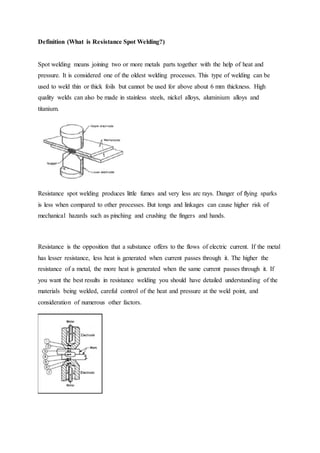
Spot welding means joining two or more metals parts together with the help of heat and
pressure. It is considered one of the oldest welding processes. This type of welding can be
used to weld thin or thick foils but cannot be used for above about 6 mm thickness. High
quality welds can also be made in stainless steels, nickel alloys, aluminium alloys and
titanium.
Resistance spot welding produces little fumes and very less arc rays. Danger of flying sparks
is less when compared to other processes. But tongs and linkages can cause higher risk of
mechanical hazards such as pinching and crushing the fingers and hands.
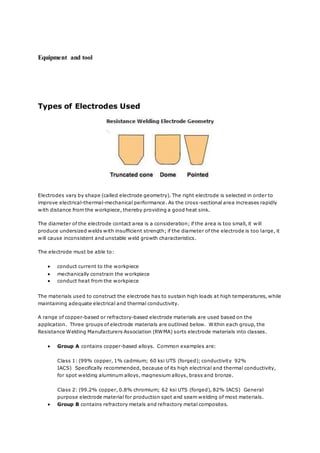
Resistance is the opposition that a substance offers to the flows of electric current. If the metal
has lesser resistance, less heat is generated when current passes through it. The higher the
resistance of a metal, the more heat is generated when the same current passes through it. If
you want the best results in resistance welding you should have detailed understanding of the
materials being welded, careful control of the heat and pressure at the weld point, and
consideration of numerous other factors.
Equipment and tool
Types of Electrodes Used
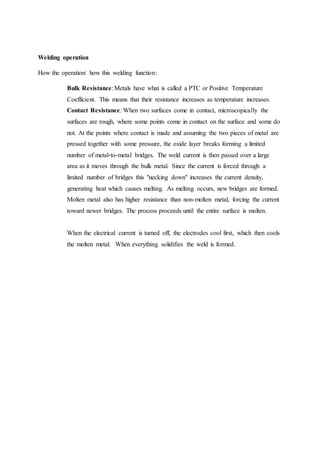
Electrodes vary by shape (called electrode geometry). The right electrode is selected in order to
improve electrical-thermal-mechanical performance. As the cross-sectional area increases rapidly
with distance from the workpiece, thereby providing a good heat sink.
The diameter of the electrode contact area is a consideration; if the area is too small, it will
produce undersized welds with insufficient strength; if the diameter of the electrode is too large, it
will cause inconsistent and unstable weld growth characteristics.
The electrode must be able to:
 conduct current to the workpiece
 mechanically constrain the workpiece
 conduct heat from the workpiece
The materials used to construct the electrode has to sustain high loads at high temperatures, while
maintaining adequate electrical and thermal conductivity.
A range of copper-based or refractory-based electrode materials are used based on the
application. Three groups of electrode materials are outlined below. Within each group, the
Resistance Welding Manufacturers Association (RWMA) sorts electrode materials into classes.
 Group A contains copper-based alloys. Common examples are:
Class 1: (99% copper, 1% cadmium; 60 ksi UTS (forged); conductivity 92%
IACS) Specifically recommended, because of its high electrical and thermal conductivity,
for spot welding aluminum alloys, magnesium alloys, brass and bronze.
Class 2: (99.2% copper, 0.8% chromium; 62 ksi UTS (forged), 82% IACS) General
purpose electrode material for production spot and seam welding of most materials.
 Group B contains refractory metals and refractory metal composites.
 Group C contains specialty materials such as dispersion-strengthened copper.
In general, higher levels of resistance occurs when the power supply overcomes the level of
resistance. To produce higher levels of resistance dissimilar parts are used.
 Conductive electrodes such as copper are used to weld resistive materials like nickel or
stainless steel
 Resistive electrodes such as those made from molybdenum are used for welding conductive
metals such as gold or copper
Welding operation
How the operation/ how this welding function:
Bulk Resistance:Metals have what is called a PTC or Positive Temperature
Coefficient. This means that their resistance increases as temperature increases.
Contact Resistance: When two surfaces come in contact, microscopically the
surfaces are rough, where some points come in contact on the surface and some do
not. At the points where contact is made and assuming the two pieces of metal are
pressed together with some pressure, the oxide layer breaks forming a limited
number of metal-to-metal bridges. The weld current is then passed over a large
area as it moves through the bulk metal. Since the current is forced through a
limited number of bridges this "necking down" increases the current density,
generating heat which causes melting. As melting occurs, new bridges are formed.
Molten metal also has higher resistance than non-molten metal, forcing the current
toward newer bridges. The process proceeds until the entire surface is molten.
When the electrical current is turned off, the electrodes cool first, which then cools
the molten metal. When everything solidifies the weld is formed.
When to use
Why use this welding compare to others
Advantages and disadvantages
Advantages
 Comparatively low cost
 Resistance Spot Welding (RSW) method doesn't need highly skilled worker.
 Distortion or warping of parts is eliminated though it leaves some depressions or
indentation
 The joint made is highly uniform.
 Automatic or semi-automatic operation both can be done
 There is no need for edge preparation.
 Welding can be done in quick succession. It just needs a few seconds to make the
joint.
Disadvantages
 The equipment cost is high so it can has an effect on the initial cost.
 Skilled welders or technicians are needed for the maintenance and controlling.
 Some metals need special surface preparation for making the RSW a success.
 The thick jobs are not easy to weld.
Example of welding application in industry ( Min 2 Video)
Application of Resistance Spot Welding
 Spot welding of thick steel plates has been done and it has replaced the need for
riveting.
 The welding of two or more sheet metals can be joined by mechanical means more
economically by using the spot welding methods. We don't need gas tight joints.
 Spot welding can be used for attaching braces, pads or clips with cases, bases and
covers which are mainly product of sheet metal forming.
 Automobile and aircraft industries relies greatly of spot welding these days.

resistance spot welding

  • 1.
  • 2.
    RESISTANCE SPOT WELDING REPORT TEAM MEMBERS: 1)MUHAMMAD HAFIZIEBINROSELAMAT 2) MUHAMMAD SAFWANBINHASHIMI 3) MUHAMMAD SYAFIQ IKHWANBIN MUSTAFA FADZIL 4) MUHAMMAD NADZRI BINHAMZAH TTO : SIRFAHMI
  • 3.
     Table ofContent
  • 4.
    Definition (What isResistance Spot Welding?) Spot welding means joining two or more metals parts together with the help of heat and pressure. It is considered one of the oldest welding processes. This type of welding can be used to weld thin or thick foils but cannot be used for above about 6 mm thickness. High quality welds can also be made in stainless steels, nickel alloys, aluminium alloys and titanium. Resistance spot welding produces little fumes and very less arc rays. Danger of flying sparks is less when compared to other processes. But tongs and linkages can cause higher risk of mechanical hazards such as pinching and crushing the fingers and hands. Resistance is the opposition that a substance offers to the flows of electric current. If the metal has lesser resistance, less heat is generated when current passes through it. The higher the resistance of a metal, the more heat is generated when the same current passes through it. If you want the best results in resistance welding you should have detailed understanding of the materials being welded, careful control of the heat and pressure at the weld point, and consideration of numerous other factors.
  • 5.
    Equipment and tool Typesof Electrodes Used Electrodes vary by shape (called electrode geometry). The right electrode is selected in order to improve electrical-thermal-mechanical performance. As the cross-sectional area increases rapidly with distance from the workpiece, thereby providing a good heat sink. The diameter of the electrode contact area is a consideration; if the area is too small, it will produce undersized welds with insufficient strength; if the diameter of the electrode is too large, it will cause inconsistent and unstable weld growth characteristics. The electrode must be able to:  conduct current to the workpiece  mechanically constrain the workpiece  conduct heat from the workpiece The materials used to construct the electrode has to sustain high loads at high temperatures, while maintaining adequate electrical and thermal conductivity. A range of copper-based or refractory-based electrode materials are used based on the application. Three groups of electrode materials are outlined below. Within each group, the Resistance Welding Manufacturers Association (RWMA) sorts electrode materials into classes.  Group A contains copper-based alloys. Common examples are: Class 1: (99% copper, 1% cadmium; 60 ksi UTS (forged); conductivity 92% IACS) Specifically recommended, because of its high electrical and thermal conductivity, for spot welding aluminum alloys, magnesium alloys, brass and bronze. Class 2: (99.2% copper, 0.8% chromium; 62 ksi UTS (forged), 82% IACS) General purpose electrode material for production spot and seam welding of most materials.  Group B contains refractory metals and refractory metal composites.
  • 6.
     Group Ccontains specialty materials such as dispersion-strengthened copper. In general, higher levels of resistance occurs when the power supply overcomes the level of resistance. To produce higher levels of resistance dissimilar parts are used.  Conductive electrodes such as copper are used to weld resistive materials like nickel or stainless steel  Resistive electrodes such as those made from molybdenum are used for welding conductive metals such as gold or copper
  • 7.
    Welding operation How theoperation/ how this welding function: Bulk Resistance:Metals have what is called a PTC or Positive Temperature Coefficient. This means that their resistance increases as temperature increases. Contact Resistance: When two surfaces come in contact, microscopically the surfaces are rough, where some points come in contact on the surface and some do not. At the points where contact is made and assuming the two pieces of metal are pressed together with some pressure, the oxide layer breaks forming a limited number of metal-to-metal bridges. The weld current is then passed over a large area as it moves through the bulk metal. Since the current is forced through a limited number of bridges this "necking down" increases the current density, generating heat which causes melting. As melting occurs, new bridges are formed. Molten metal also has higher resistance than non-molten metal, forcing the current toward newer bridges. The process proceeds until the entire surface is molten. When the electrical current is turned off, the electrodes cool first, which then cools the molten metal. When everything solidifies the weld is formed.
  • 8.
    When to use Whyuse this welding compare to others
  • 9.
    Advantages and disadvantages Advantages Comparatively low cost  Resistance Spot Welding (RSW) method doesn't need highly skilled worker.  Distortion or warping of parts is eliminated though it leaves some depressions or indentation  The joint made is highly uniform.  Automatic or semi-automatic operation both can be done  There is no need for edge preparation.  Welding can be done in quick succession. It just needs a few seconds to make the joint. Disadvantages  The equipment cost is high so it can has an effect on the initial cost.  Skilled welders or technicians are needed for the maintenance and controlling.  Some metals need special surface preparation for making the RSW a success.  The thick jobs are not easy to weld.
  • 10.
    Example of weldingapplication in industry ( Min 2 Video) Application of Resistance Spot Welding  Spot welding of thick steel plates has been done and it has replaced the need for riveting.  The welding of two or more sheet metals can be joined by mechanical means more economically by using the spot welding methods. We don't need gas tight joints.  Spot welding can be used for attaching braces, pads or clips with cases, bases and covers which are mainly product of sheet metal forming.  Automobile and aircraft industries relies greatly of spot welding these days.