Foundry:
” Foundry or casting is the process of
producing metal/alloy component parts of desired
shapes by pouring the molten metal/alloy into a
prepared mould (of that shape) and then allowing
the metal/alloy to cool and solidify. The solidified
piece of metal/alloy is known as a CASTING”.
Casting Terms:
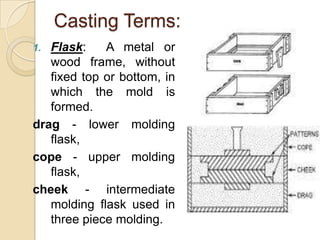
Flask:
A metal or
wood frame, without
fixed top or bottom, in
which the mold is
formed.
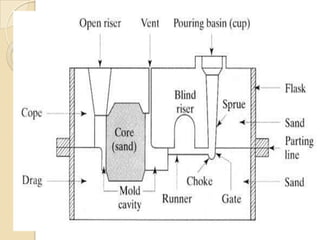
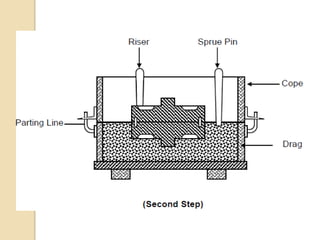
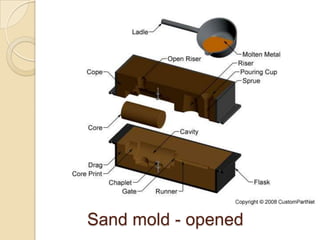
drag - lower molding
flask,
cope - upper molding
flask,
cheek - intermediate
molding flask used in
three piece molding.
1.
Casting Terms:
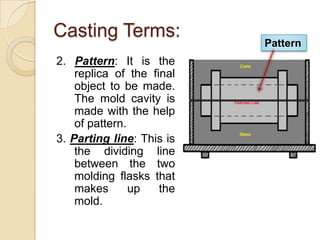
2. Pattern: It is the
replica of the final
object to be made.
The mold cavity is
made with the help
of pattern.
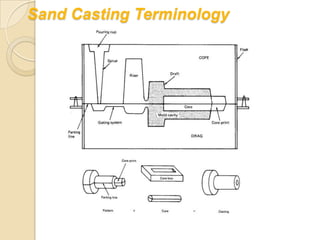
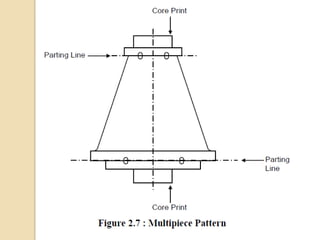
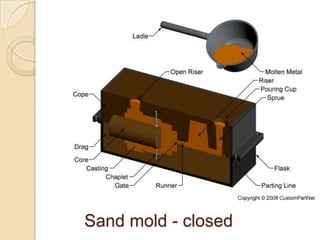
3. Parting line: This is
the dividing line
between the two
molding flasks that
makes
up
the
mold.

Pattern
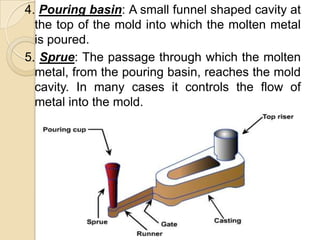
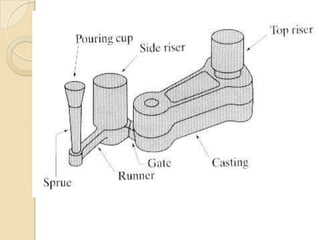
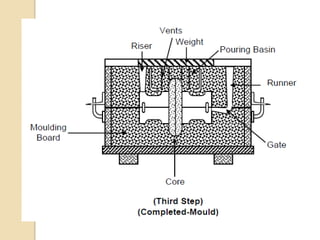
4. Pouring basin: A small funnel shaped cavity at
the top of the mold into which the molten metal
is poured.
5. Sprue: The passage through which the molten
metal, from the pouring basin, reaches the mold
cavity. In many cases it controls the flow of
metal into the mold.
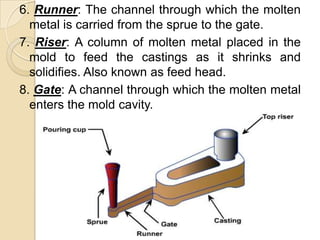
6. Runner: The channel through which the molten
metal is carried from the sprue to the gate.
7. Riser: A column of molten metal placed in the
mold to feed the castings as it shrinks and
solidifies. Also known as feed head.
8. Gate: A channel through which the molten metal
enters the mold cavity.
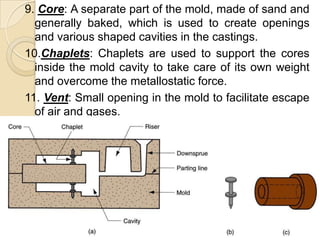
9. Core: A separate part of the mold, made of sand and
generally baked, which is used to create openings
and various shaped cavities in the castings.
10.Chaplets: Chaplets are used to support the cores
inside the mold cavity to take care of its own weight
and overcome the metallostatic force.
11. Vent: Small opening in the mold to facilitate escape
of air and gases.
Basic Features:
Pattern and Mould
◦ A pattern is made of wood or
metal, is a replica of the final
product and is used for preparing
mould cavity.
◦ Mould material should posses
refractory characteristics and with
stand the pouring temperature.
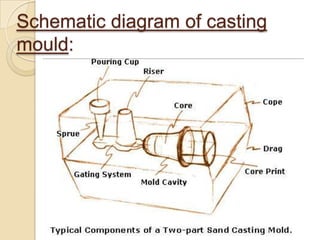
Schematic diagram of casting
mould:
Sand Casting Terminology
Steps involved in making a casting:
Make the pattern out of Wood , Metal or Plastic.
2. Prepare the necessary sand mixtures for mould
and core making.
3. Prepare the Mould and necessary Cores.
4. Melt the metal/alloy to be cast.
5. Pour the molten metal/alloy into mould and
remove the casting from the mould after the
metal solidifies.
6. Clean and finish the casting.
7. Test and inspect the casting.
8. Remove the defects, if any.
9. Relieve the casting stresses by Heat Treatment.
10. Again inspect the casting.
11. The casting is ready for shipping.
1.
Applications of Casting:
 Transportation
 Turbine

vehicles

vanes
 Power generators
 Railway crossings
 Agricultural parts
 Aircraft jet engine parts
 Sanitary fittings
 Communication, Construction and
Atomic Energy applications, etc..
Raw Materials for Foundry:
Metals and alloys

Fuels (For melting metals)
Fluxes
Metals and alloys commonly
used in Foundries:
1. Ferrous
2. Non-Ferrous
FERROUS:
a. Cast irons
b. Steels

NON-FERROUS:
a.
b.
c.
d.
e.

Copper alloys
Aluminium alloys
Magnesium alloys
Zinc alloys
Nickel alloys
Pattern Making:
A

Pattern is a model or the replica of the
object to be cast.

 Except

for the various allowances a
pattern exactly resembles the casting to
be made.

A

pattern is required even if one object
has to be cast.
Functions of Patterns:







A Pattern prepares a mould cavity for the
purpose of making a casting.
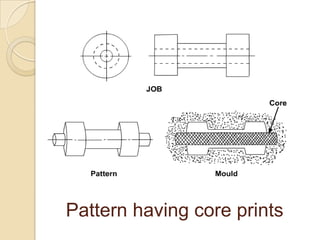
A Pattern may contain projections known
as core prints if the casting requires a
core and need to be made hollow.
Patterns properly made and having
finished and smooth surfaces reduce
casting defects.
Properly constructed patterns minimize
overall cost of the casting.
Pattern having core prints
Selection of Pattern Materials:
The following factors assist in selecting
proper pattern material:
No. of castings to be produced.
Dimensional accuracy & surface finish.
Shape, complexity and size of casting.
Casting design parameters.
Type of molding materials.
The chance of repeat orders.
Nature of molding process.
The pattern material should be:
1.
2.

3.
4.
5.
6.
7.

Easily worked, shaped and joined.
Light in weight.
Strong, hard and durable.
Resistant to wear and abrasion .
Resistant to corrosion, and to chemical
reactions.
Dimensionally stable and unaffected by
variations in temperature and humidity.
Available at low cost.
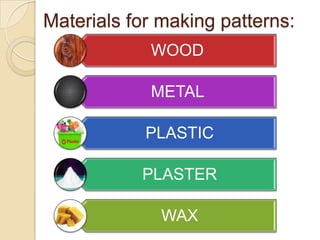
Materials for making patterns:
WOOD

METAL
PLASTIC
PLASTER
WAX
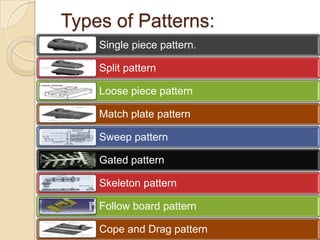
Types of Patterns:
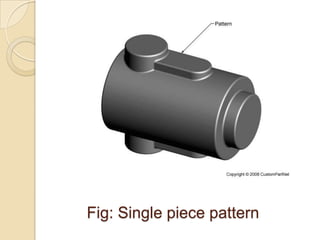
Single piece pattern.
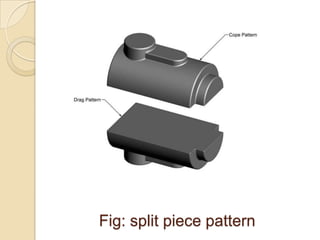
Split pattern
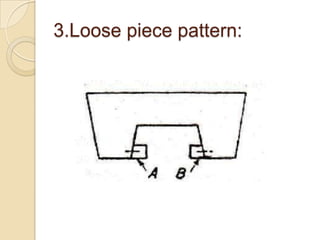
Loose piece pattern
Match plate pattern

Sweep pattern
Gated pattern
Skeleton pattern
Follow board pattern
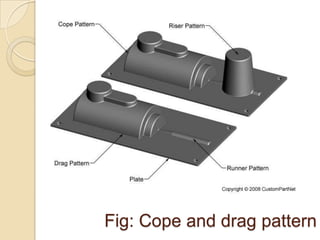
Cope and Drag pattern
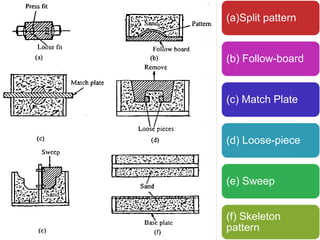
(a)Split pattern

(b) Follow-board

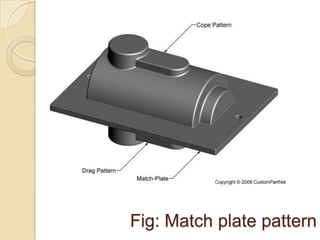
(c) Match Plate

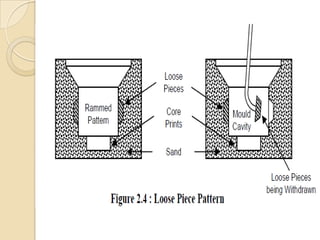
(d) Loose-piece

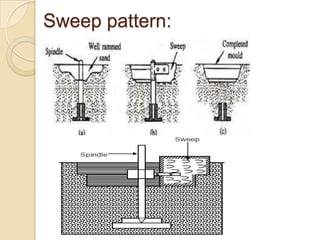
(e) Sweep
(f) Skeleton
pattern
Fig: Single piece pattern
Fig: split piece pattern
3.Loose piece pattern:
Fig: Match plate pattern
Sweep pattern:
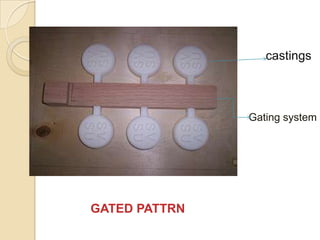
castings

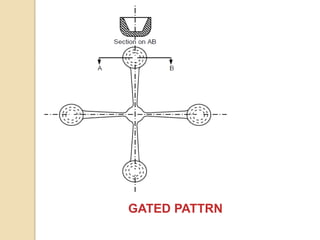
Gating system

GATED PATTRN
GATED PATTRN
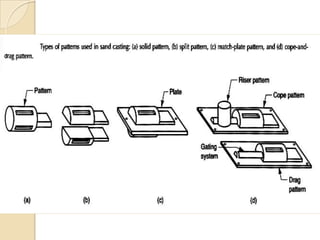
Fig: Cope and drag pattern
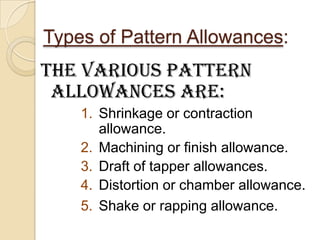
Types of Pattern Allowances:

The various pattern
allowances are:
1. Shrinkage or contraction
allowance.
2. Machining or finish allowance.
3. Draft of tapper allowances.
4. Distortion or chamber allowance.
5. Shake or rapping allowance.
1.Shrinkage Allowance:
All most all cast metals shrink or contract
volumetrically on cooling.

The metal
shrinkage is of two
types:
1. Liquid Shrinkage:
2. Solid Shrinkage:
2. Machining Allowance:
A Casting is given an allowance for
machining, because:
Castings get oxidized in the mold and during
heat treatment; scales etc., thus formed need
to be removed.
ii. It is the intended to remove surface
roughness and other imperfections from the
castings.
iii. It is required to achieve exact casting
dimensions.
iv. Surface finish is required on the casting.
i.
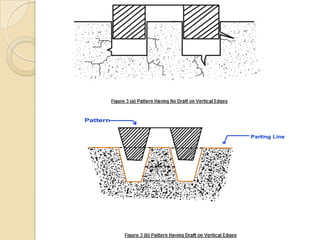
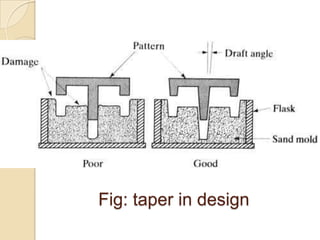
3. Draft or Taper Allowance:




It is given to all surfaces perpendicular
to parting line.
Draft allowance is given so that the
pattern can be easily removed from the
molding material tightly packed around
it with out damaging the mould cavity.
Fig: taper in design
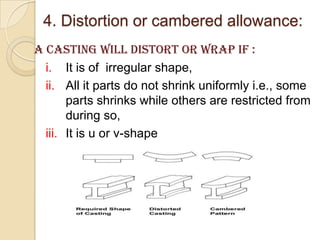
4. Distortion or cambered allowance:
A casting will distort or wrap if :
i. It is of irregular shape,
ii. All it parts do not shrink uniformly i.e., some
parts shrinks while others are restricted from
during so,
iii. It is u or v-shape
5. Shake allowance:
A

pattern is shaken or rapped by striking the
same with a wooden piece from side to side.
This is done so that the pattern a little is
loosened in the mold cavity and can be easily
removed.

 In

turn, therefore, rapping enlarges the mould
cavity which results in a bigger sized casting.
a –ve allowance is provided on the
pattern i.e., the pattern dimensions are kept
smaller in order to compensate the
enlargement of mould cavity due to rapping.

 Hence,
Pattern Layout:
Steps involved:


Get the working drawing of the part for which the
pattern is to be made.



Make two views of the part drawing on a sheet,
using a shrink rule. A shrink rule is modified form
of an ordinary scale which has already taken
care of shrinkage allowance for a particular metal
to be cast.



Add machining
requirements.



Depending upon the method of molding, provide
the draft allowance.

allowances

as

per

the
Pattern Construction:
 Study








the pattern layout carefully and establish,
a. Location of parting surface.
b. No. of parts in which the pattern will be made.
Using the various hand tools and pattern making
machines fabricate the different parts of the pattern.
Inspect the pattern as regards the alignment of
different portions of the pattern and its dimensional
accuracy.
Fill wax in all the fillets in order to remove sharp
corners.
Give a shellac coatings(3 coats) to pattern.
impart suitable colors to the pattern for identification
purposes and for other informations.
Moulding Materials
Major part of Moulding material in sand casting are
1. 70-85% silica sand (SiO2)
2. 10-12% bonding material e.g., clay cereal etc.
3. 3-6% water
Properties of molding sand are:
(a) Refractoriness
(b) Cohesiveness
(c) Strength/Adhesiveness
(d) Permeability
(e) Collapsibility
(f) Flowability
(g) Chemical Inactiveness
Molding Sand Composition:
The main ingredients of any molding
sand are:
 Base sand,
 Binder, and
 Moisture
 Additives
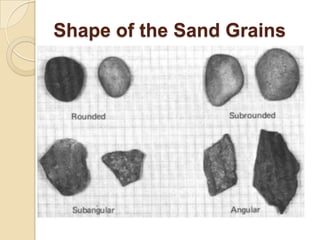
Shape of the Sand Grains
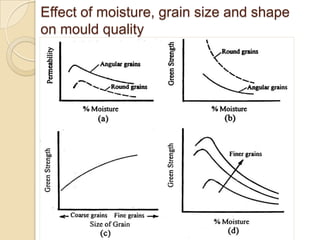
Effect of moisture, grain size and shape
on mould quality
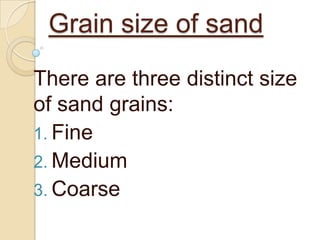
Grain size of sand
There are three distinct size
of sand grains:
1. Fine
2. Medium
3. Coarse
Types of Moulding Sand
1.
2.
3.
4.

5.
6.
7.

Green Sand
Dry Sand
Facing Sand
Loam Sand
Backing Sand
Parting Sand
Core Sand
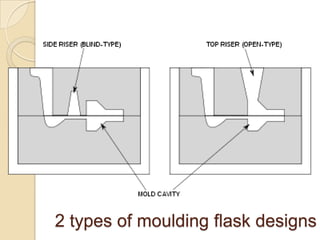
2 types of moulding flask designs
SAND MOULDING
PROCESS
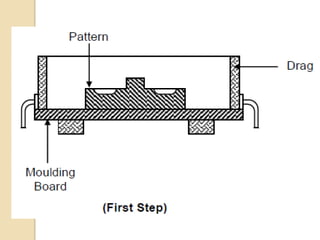
Sand mold - opened
Sand mold - closed
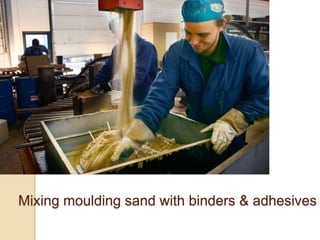
Mixing moulding sand with binders & adhesives
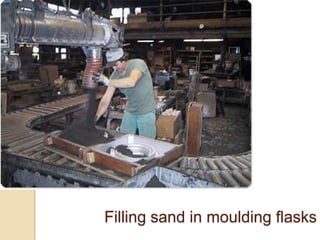
Filling sand in moulding flasks
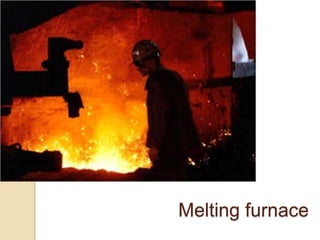
Melting furnace
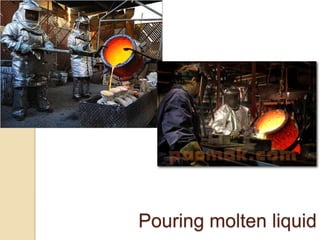
Pouring molten liquid
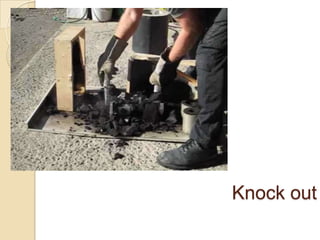
Knock out
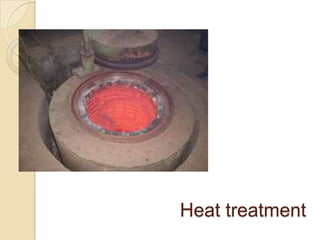
Heat treatment
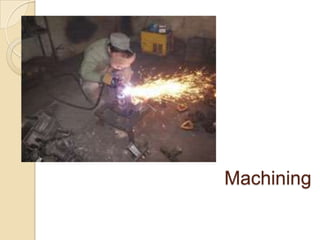
Machining
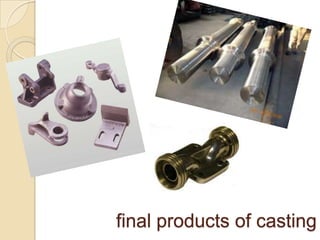
final products of casting
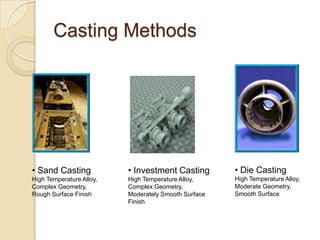
Casting Methods

• Sand Casting

• Investment Casting

• Die Casting

High Temperature Alloy,
Complex Geometry,
Rough Surface Finish

High Temperature Alloy,
Complex Geometry,
Moderately Smooth Surface
Finish

High Temperature Alloy,
Moderate Geometry,
Smooth Surface

Casting

  • 2.
    Foundry: ” Foundry orcasting is the process of producing metal/alloy component parts of desired shapes by pouring the molten metal/alloy into a prepared mould (of that shape) and then allowing the metal/alloy to cool and solidify. The solidified piece of metal/alloy is known as a CASTING”.
  • 3.
    Casting Terms: Flask: A metalor wood frame, without fixed top or bottom, in which the mold is formed. drag - lower molding flask, cope - upper molding flask, cheek - intermediate molding flask used in three piece molding. 1.
  • 4.
    Casting Terms: 2. Pattern:It is the replica of the final object to be made. The mold cavity is made with the help of pattern. 3. Parting line: This is the dividing line between the two molding flasks that makes up the mold. Pattern
  • 5.
    4. Pouring basin:A small funnel shaped cavity at the top of the mold into which the molten metal is poured. 5. Sprue: The passage through which the molten metal, from the pouring basin, reaches the mold cavity. In many cases it controls the flow of metal into the mold.
  • 6.
    6. Runner: Thechannel through which the molten metal is carried from the sprue to the gate. 7. Riser: A column of molten metal placed in the mold to feed the castings as it shrinks and solidifies. Also known as feed head. 8. Gate: A channel through which the molten metal enters the mold cavity.
  • 7.
    9. Core: Aseparate part of the mold, made of sand and generally baked, which is used to create openings and various shaped cavities in the castings. 10.Chaplets: Chaplets are used to support the cores inside the mold cavity to take care of its own weight and overcome the metallostatic force. 11. Vent: Small opening in the mold to facilitate escape of air and gases.
  • 8.
    Basic Features: Pattern andMould ◦ A pattern is made of wood or metal, is a replica of the final product and is used for preparing mould cavity. ◦ Mould material should posses refractory characteristics and with stand the pouring temperature.
  • 9.
    Schematic diagram ofcasting mould:
  • 12.
  • 13.
    Steps involved inmaking a casting: Make the pattern out of Wood , Metal or Plastic. 2. Prepare the necessary sand mixtures for mould and core making. 3. Prepare the Mould and necessary Cores. 4. Melt the metal/alloy to be cast. 5. Pour the molten metal/alloy into mould and remove the casting from the mould after the metal solidifies. 6. Clean and finish the casting. 7. Test and inspect the casting. 8. Remove the defects, if any. 9. Relieve the casting stresses by Heat Treatment. 10. Again inspect the casting. 11. The casting is ready for shipping. 1.
  • 14.
    Applications of Casting: Transportation  Turbine vehicles vanes  Power generators  Railway crossings  Agricultural parts  Aircraft jet engine parts  Sanitary fittings  Communication, Construction and Atomic Energy applications, etc..
  • 15.
    Raw Materials forFoundry: Metals and alloys Fuels (For melting metals) Fluxes
  • 16.
    Metals and alloyscommonly used in Foundries: 1. Ferrous 2. Non-Ferrous FERROUS: a. Cast irons b. Steels NON-FERROUS: a. b. c. d. e. Copper alloys Aluminium alloys Magnesium alloys Zinc alloys Nickel alloys
  • 17.
    Pattern Making: A Pattern isa model or the replica of the object to be cast.  Except for the various allowances a pattern exactly resembles the casting to be made. A pattern is required even if one object has to be cast.
  • 18.
    Functions of Patterns:     APattern prepares a mould cavity for the purpose of making a casting. A Pattern may contain projections known as core prints if the casting requires a core and need to be made hollow. Patterns properly made and having finished and smooth surfaces reduce casting defects. Properly constructed patterns minimize overall cost of the casting.
  • 19.
  • 20.
    Selection of PatternMaterials: The following factors assist in selecting proper pattern material: No. of castings to be produced. Dimensional accuracy & surface finish. Shape, complexity and size of casting. Casting design parameters. Type of molding materials. The chance of repeat orders. Nature of molding process.
  • 21.
    The pattern materialshould be: 1. 2. 3. 4. 5. 6. 7. Easily worked, shaped and joined. Light in weight. Strong, hard and durable. Resistant to wear and abrasion . Resistant to corrosion, and to chemical reactions. Dimensionally stable and unaffected by variations in temperature and humidity. Available at low cost.
  • 22.
    Materials for makingpatterns: WOOD METAL PLASTIC PLASTER WAX
  • 23.
    Types of Patterns: Singlepiece pattern. Split pattern Loose piece pattern Match plate pattern Sweep pattern Gated pattern Skeleton pattern Follow board pattern Cope and Drag pattern
  • 24.
    (a)Split pattern (b) Follow-board (c)Match Plate (d) Loose-piece (e) Sweep (f) Skeleton pattern
  • 26.
  • 27.
  • 29.
  • 31.
  • 32.
  • 33.
  • 34.
  • 35.
    Fig: Cope anddrag pattern
  • 36.
    Types of PatternAllowances: The various pattern allowances are: 1. Shrinkage or contraction allowance. 2. Machining or finish allowance. 3. Draft of tapper allowances. 4. Distortion or chamber allowance. 5. Shake or rapping allowance.
  • 37.
    1.Shrinkage Allowance: All mostall cast metals shrink or contract volumetrically on cooling. The metal shrinkage is of two types: 1. Liquid Shrinkage: 2. Solid Shrinkage:
  • 38.
    2. Machining Allowance: ACasting is given an allowance for machining, because: Castings get oxidized in the mold and during heat treatment; scales etc., thus formed need to be removed. ii. It is the intended to remove surface roughness and other imperfections from the castings. iii. It is required to achieve exact casting dimensions. iv. Surface finish is required on the casting. i.
  • 39.
    3. Draft orTaper Allowance:   It is given to all surfaces perpendicular to parting line. Draft allowance is given so that the pattern can be easily removed from the molding material tightly packed around it with out damaging the mould cavity.
  • 41.
  • 42.
    4. Distortion orcambered allowance: A casting will distort or wrap if : i. It is of irregular shape, ii. All it parts do not shrink uniformly i.e., some parts shrinks while others are restricted from during so, iii. It is u or v-shape
  • 43.
    5. Shake allowance: A patternis shaken or rapped by striking the same with a wooden piece from side to side. This is done so that the pattern a little is loosened in the mold cavity and can be easily removed.  In turn, therefore, rapping enlarges the mould cavity which results in a bigger sized casting. a –ve allowance is provided on the pattern i.e., the pattern dimensions are kept smaller in order to compensate the enlargement of mould cavity due to rapping.  Hence,
  • 44.
    Pattern Layout: Steps involved:  Getthe working drawing of the part for which the pattern is to be made.  Make two views of the part drawing on a sheet, using a shrink rule. A shrink rule is modified form of an ordinary scale which has already taken care of shrinkage allowance for a particular metal to be cast.  Add machining requirements.  Depending upon the method of molding, provide the draft allowance. allowances as per the
  • 45.
    Pattern Construction:  Study      thepattern layout carefully and establish, a. Location of parting surface. b. No. of parts in which the pattern will be made. Using the various hand tools and pattern making machines fabricate the different parts of the pattern. Inspect the pattern as regards the alignment of different portions of the pattern and its dimensional accuracy. Fill wax in all the fillets in order to remove sharp corners. Give a shellac coatings(3 coats) to pattern. impart suitable colors to the pattern for identification purposes and for other informations.
  • 46.
    Moulding Materials Major partof Moulding material in sand casting are 1. 70-85% silica sand (SiO2) 2. 10-12% bonding material e.g., clay cereal etc. 3. 3-6% water Properties of molding sand are: (a) Refractoriness (b) Cohesiveness (c) Strength/Adhesiveness (d) Permeability (e) Collapsibility (f) Flowability (g) Chemical Inactiveness
  • 47.
    Molding Sand Composition: Themain ingredients of any molding sand are:  Base sand,  Binder, and  Moisture  Additives
  • 48.
    Shape of theSand Grains
  • 49.
    Effect of moisture,grain size and shape on mould quality
  • 50.
    Grain size ofsand There are three distinct size of sand grains: 1. Fine 2. Medium 3. Coarse
  • 51.
    Types of MouldingSand 1. 2. 3. 4. 5. 6. 7. Green Sand Dry Sand Facing Sand Loam Sand Backing Sand Parting Sand Core Sand
  • 52.
    2 types ofmoulding flask designs
  • 53.
  • 57.
  • 58.
  • 59.
    Mixing moulding sandwith binders & adhesives
  • 60.
    Filling sand inmoulding flasks
  • 61.
  • 62.
  • 63.
  • 64.
  • 65.
  • 66.
  • 67.
    Casting Methods • SandCasting • Investment Casting • Die Casting High Temperature Alloy, Complex Geometry, Rough Surface Finish High Temperature Alloy, Complex Geometry, Moderately Smooth Surface Finish High Temperature Alloy, Moderate Geometry, Smooth Surface