RESISTANCE WELDING
KELAS CM5
Bambang Suryadi
Jalu Prasetyo Sugiantoro
Aditya Darma M
Trihardika Biantoro
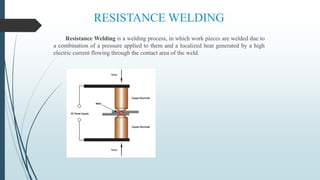
Resistance Welding is a welding process, in which work pieces are welded due to
a combination of a pressure applied to them and a localized heat generated by a high
electric current flowing through the contact area of the weld.
RESISTANCE WELDING
 Low carbon steels - the widest application of Resistance Welding
 Aluminum alloys
 Medium carbon steels, high carbon steels and Alloy steels (may be
welded, but the weld is brittle)
The following metals may be welded by
Resistance Welding
 High welding rates;
 Low fumes;
 Cost effectiveness;
 Easy automation;
 No filler materials are required;
 Low distortions.
Advantages of Resistance Welding:
 High equipment cost;
 Low strength of discontinuous welds;
 Thickness of welded sheets is limited - up to 1/4” (6 mm);
Disadvantages of Resistance Welding:
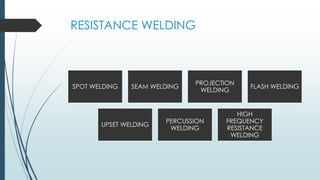
RESISTANCE WELDING
SPOT WELDING SEAM WELDING
PROJECTION
WELDING
FLASH WELDING
UPSET WELDING
PERCUSSION
WELDING
HIGH
FREQUENCY
RESISTANCE
WELDING
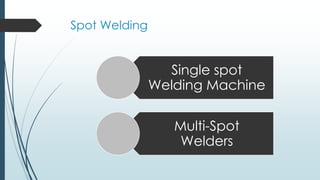
Spot Welding
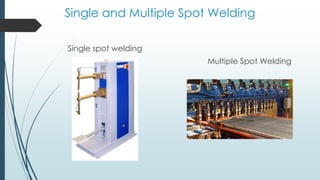
Single spot
Welding Machine
Multi-Spot
Welders
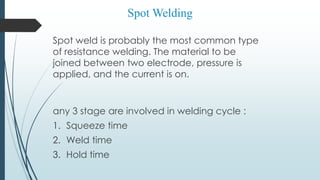
Spot weld is probably the most common type
of resistance welding. The material to be
joined between two electrode, pressure is
applied, and the current is on.
any 3 stage are involved in welding cycle :
1. Squeeze time
2. Weld time
3. Hold time
Spot Welding
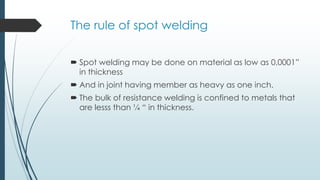
The rule of spot welding
 Spot welding may be done on material as low as 0,0001”
in thickness
 And in joint having member as heavy as one inch.
 The bulk of resistance welding is confined to metals that
are lesss than ¼ “ in thickness.
Single spot welding
Single and Multiple Spot Welding
Multiple Spot Welding
Single Spot Welding
 Two type of single-spot welding machines :
Rocker arm
Press-type
spot welders
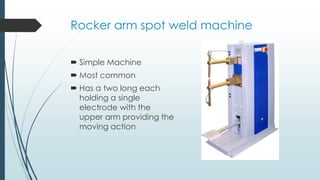
Rocker arm spot weld machine
 Simple Machine
 Most common
 Has a two long each
holding a single
electrode with the
upper arm providing the
moving action
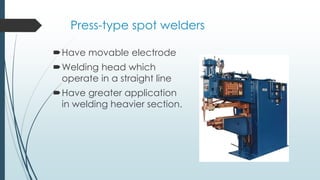
Press-type spot welders
Have movable electrode
Welding head which
operate in a straight line
Have greater application
in welding heavier section.
Heat application
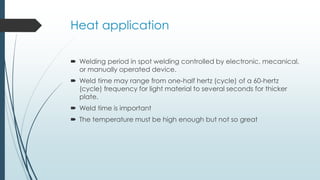
 Welding period in spot welding controlled by electronic, mecanical,
or manually operated device.
 Weld time may range from one-half hertz (cycle) of a 60-hertz
(cycle) frequency for light material to several seconds for thicker
plate.
 Weld time is important
 The temperature must be high enough but not so great
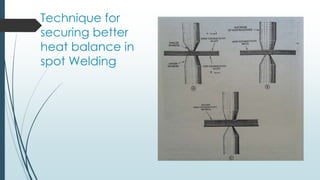
Technique for
securing better
heat balance in
spot Welding
A Condition
Smaller
electrode
On High
conductivity
metals
Larger
electrode
On Low
conductivity
metals
B condition
Using a high
thermal
resistance
electrode
On High
conductivity
metals
Using a high
thermal
resistance
electrode
Tungsten and
molybdenum
C condition
Increase the
thickness of the
higher conductivity
metals
Better secure heat
balance
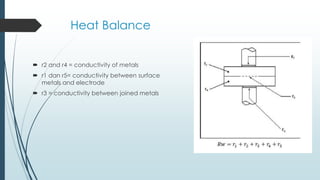
Heat Balance
 r2 and r4 = conductivity of metals
 r1 dan r5= conductivity between surface
metals and electrode
 r3 = conductivity between joined metals
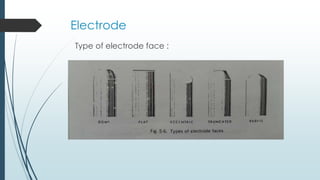
Electrode
Type of electrode face :
Primary functions of Electrode
 Conduct the required heat to the weld zone
 Transmit the necessary force to the weld area
 Help the dissipate the heat from the weld zone
Most electrodes for spot welding are made of low
resistance copper alloy
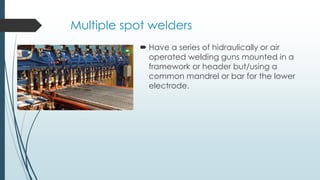
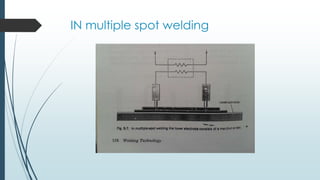
Multiple spot welders
 Have a series of hidraulically or air
operated welding guns mounted in a
framework or header but/using a
common mandrel or bar for the lower
electrode.
IN multiple spot welding
Spot welding is widely used in automotive industry
for joining vehicle body parts.
SEAM WELDING
Electrodes
Current
Welding speed and Forces
Types of weld seams
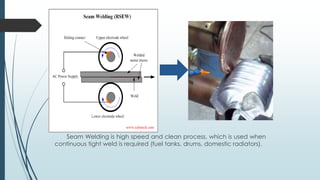
Seam welding is similar to spot welding. Equipment is very similar
both in terms of welding current production, control and pressing force.
however, differs from spot welding mainly because of the rolling welding
wheel. In most applications, wheels on both sides of the workpiece
produce the weld.
Seam Welding
Seam Welding is high speed and clean process, which is used when
continuous tight weld is required (fuel tanks, drums, domestic radiators).
Electrodes
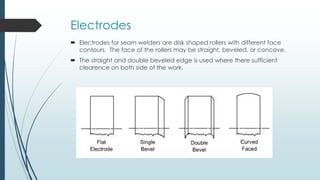
 Electrodes for seam welders are disk shaped rollers with different face
contours. The face of the rollers may be straight, beveled, or concave.
 The straight and double beveled edge is used where there sufficient
clearence on both side of the work.
Current
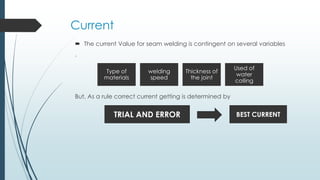
 The current Value for seam welding is contingent on several variables
,
But, As a rule correct current getting is determined by
Type of
materials
welding
speed
Thickness of
the joint
Used of
water
colling
TRIAL AND ERROR BEST CURRENT
Welding speed and Forces
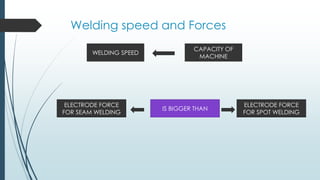
WELDING SPEED
CAPACITY OF
MACHINE
ELECTRODE FORCE
FOR SEAM WELDING
ELECTRODE FORCE
FOR SPOT WELDING
IS BIGGER THAN
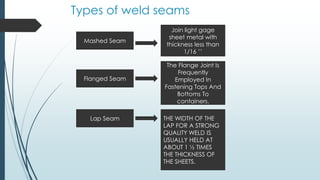
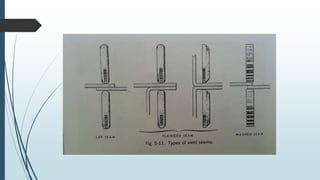
Types of weld seams
Mashed Seam
Join light gage
sheet metal with
thickness less than
1/16 ’’
Flanged Seam
The Flange Joint Is
Frequently
Employed In
Fastening Tops And
Bottoms To
containers.
Lap Seam THE WIDTH OF THE
LAP FOR A STRONG
QUALITY WELD IS
USUALLY HELD AT
ABOUT 1 ½ TIMES
THE THICKNESS OF
THE SHEETS.
Projection Welding
Electodes
Metals adaptable for Projection
Welding
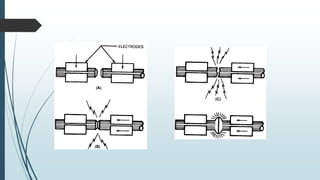
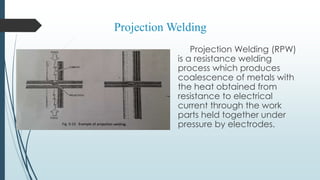
Projection Welding (RPW)
is a resistance welding
process which produces
coalescence of metals with
the heat obtained from
resistance to electrical
current through the work
parts held together under
pressure by electrodes.
Projection Welding
The resulting welds are localized at predetermined points by projections,
embossments, or intersections. Localization of heating is obtained by a
projection or embossment on one or both of the parts being welded.
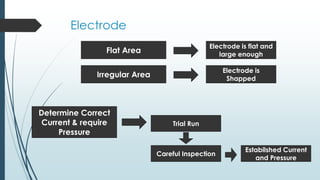
Electrode
Flat Area
Electrode is flat and
large enough
Irregular Area
Electrode is
Shapped
Determine Correct
Current & require
Pressure
Trial Run
Careful Inspection
Estabilshed Current
and Pressure
Metals adaptable for Projection Welding
 Not all metals can be projection welded. Brass and copper as a rule
do not lend themselves to projection welding because the
projections collapse too easily under pressure. Aluminium projection
welding is generally limited to extruded parts. Galvanized sheet-
steel, tin plate, and stainless steel as well as most other thin gage
steel can be successfully projection welded.
The Advantage of projection welding is that
electrode life is increased because larger contact
surfaces are used. A very common use of projection
welding is the use of special nuts that have projections
on the portion of the part to be welded to the
assembly.
The Advantage
FLASH WELDING
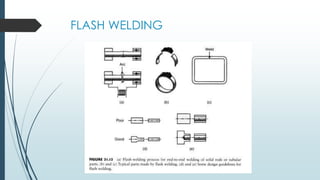
Flash Welding
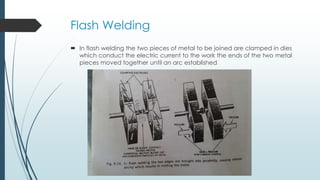
 In flash welding the two pieces of metal to be joined are clamped in dies
which conduct the electric current to the work the ends of the two metal
pieces moved together until an arc established
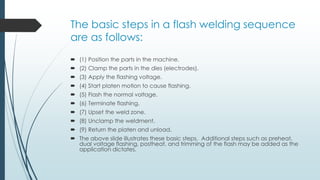
The basic steps in a flash welding sequence
are as follows:
 (1) Position the parts in the machine.
 (2) Clamp the parts in the dies (electrodes).
 (3) Apply the flashing voltage.
 (4) Start platen motion to cause flashing.
 (5) Flash the normal voltage.
 (6) Terminate flashing.
 (7) Upset the weld zone.
 (8) Unclamp the weldment.
 (9) Return the platen and unload.
 The above slide illustrates these basic steps. Additional steps such as preheat,
dual voltage flashing, postheat, and trimming of the flash may be added as the
application dictates.
advantages
 Flexible cross sectioned shapes
 Flexible positioning for similar cross section parts
 Impurities can be removed during upset acts
 Faying surface preparation is not critical except for large parts
 Can weld rings of various cross sections
 Narrower heat-affected zones than those of upset welds
Limitations
 Produce unbalance on three-phase primary power lines
 The ejected molten metal particles present a fire hazard
 Require special equipment for removal of flash metal
 Difficult alignment for workpieces with small cross sections
 Require almost identical cross section parts
Applications
 Wheel Truck Rims
 Ball Bearing Raceways
 Bar Welding
 Strip Welding During Continuous Processing
 Pipelines
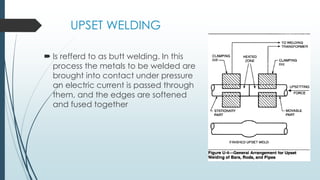
UPSET WELDING
 Is refferd to as butt welding. In this
process the metals to be welded are
brought into contact under pressure
an electric current is passed through
them, and the edges are softened
and fused together
Upset Welding
 Upset welding (UW) is a resistance welding process that produces
coalescence over the entire area of faying surfaces, or progressively along
a butt joint, by the heat obtained from the resistance to the flow of welding
current through the area where those surfaces are in contact. Pressure is
used to complete the weld.
 With this process, welding is essentially done in the solid state. The metal at
the joint is resistance heated to a temperature where recrystallization can
rapidly take place across the faying surfaces. A force is applied to the joint
to being the faying surfaces into intimate contact and then upset the
metal. Upset hastens recrystallization at the interface and, at the same
time, some metal is forced outward from this location. This tends to purge
the joint of oxidized metal.
Two variations
 Upset welding has two variations:
 (1) Joining two sections of the same cross section end-to-end (butt joint).
 (2) Continuous welding of butt joint seams in roll-formed products such as
pipe and tubing.
 The first variation can also be accomplished by flash welding and friction
welding. The second variation is also done with high frequency welding.
 The general arrangement for upset welding is shown in the above slide.
One clamping die is stationary and the other is movable to accomplish
upset. Upset force is applied through the movable clamping die or a
mechanical backup, or both.
Method of achieving heat balance
Upset velocity
 Higher Velocity Helps extrude Centerline Oxides Out
 1. Oxides Are Present Because Melting Points are high
 2. Oxides Tend to Solidify or Harden and Get entrapped at the Interface
 3. Rapid Velocity Helps Get Them Moving
Advantages
• Keeps Heat at Center Line During Upset
• Keeps Oxides Fluid
• Aids In Forcing Oxides Out
Disadvantages
• Excess Heating Can Produce Excess Upset
• More HAZ Fiber Turn Up
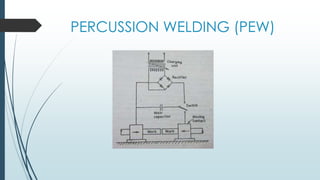
PERCUSSION WELDING (PEW)
DEFINITION
Percussion welding is a process in which
heat is produced from an arc that is
generated by the rapid discharge of
electrical energi between the workpieces
and followed immediately by an
impacting force which weld the pieces
together.
PRINCIPLE OF OPERATION
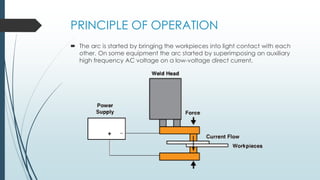
 The arc is started by bringing the workpieces into light contact with each
other. On some equipment the arc started by superimposing an auxiliary
high frequency AC voltage on a low-voltage direct current.
ADVANTAGES
The percussion procces is that heat penetration
is shallow around 0.010 inch
The process possible to weld stellite tips to
bronze or stainless steel valve stems or an
aluminum fixture to stainless steel or cooper
without affecting their metallurgical properties.
The process is often used in welding wire, bar,
and tubing
DISADVANTAGES
The process has somewhat restriced
applications
The process generally confined to butt
welded
If used on larger section the arc fails to
distribute itself evenly over the entire surface
and unwelded spots result in the joint
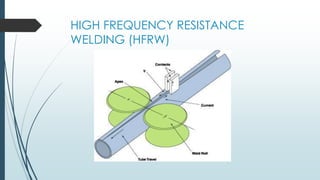
HIGH FREQUENCY RESISTANCE
WELDING (HFRW)
DEFINITION
HFRW employs a high frequency current
to generate the required heat for bonding
edges of metal
PRINCIPLE OF OPERATION
 The process is based on the use of current that reverses at a high
rate- 450,000 Hertz (cycles) as compared with the line frequency of
60 Hertz (cycles).
 Power supply for HFRW consist of a 60 to 560 kw radio frequency
transmitter. The transmitter equipped with a rectifier.
APPLICATION
 The process has wide application in fabricating tubes, pipes, structural
shapes, heat exchanger, cable sheathing, and other parts where high
speed is required
 The procees can welded ferrous and nonferrous materials in thicknesses
ranging from 0.004 inch to ½ inch in thickness.
Resistance welding

Resistance welding

  • 1.
    RESISTANCE WELDING KELAS CM5 BambangSuryadi Jalu Prasetyo Sugiantoro Aditya Darma M Trihardika Biantoro
  • 2.
    Resistance Welding isa welding process, in which work pieces are welded due to a combination of a pressure applied to them and a localized heat generated by a high electric current flowing through the contact area of the weld. RESISTANCE WELDING
  • 3.
     Low carbonsteels - the widest application of Resistance Welding  Aluminum alloys  Medium carbon steels, high carbon steels and Alloy steels (may be welded, but the weld is brittle) The following metals may be welded by Resistance Welding
  • 4.
     High weldingrates;  Low fumes;  Cost effectiveness;  Easy automation;  No filler materials are required;  Low distortions. Advantages of Resistance Welding:
  • 5.
     High equipmentcost;  Low strength of discontinuous welds;  Thickness of welded sheets is limited - up to 1/4” (6 mm); Disadvantages of Resistance Welding:
  • 6.
    RESISTANCE WELDING SPOT WELDINGSEAM WELDING PROJECTION WELDING FLASH WELDING UPSET WELDING PERCUSSION WELDING HIGH FREQUENCY RESISTANCE WELDING
  • 7.
    Spot Welding Single spot WeldingMachine Multi-Spot Welders
  • 8.
    Spot weld isprobably the most common type of resistance welding. The material to be joined between two electrode, pressure is applied, and the current is on. any 3 stage are involved in welding cycle : 1. Squeeze time 2. Weld time 3. Hold time Spot Welding
  • 9.
    The rule ofspot welding  Spot welding may be done on material as low as 0,0001” in thickness  And in joint having member as heavy as one inch.  The bulk of resistance welding is confined to metals that are lesss than ¼ “ in thickness.
  • 10.
    Single spot welding Singleand Multiple Spot Welding Multiple Spot Welding
  • 11.
    Single Spot Welding Two type of single-spot welding machines : Rocker arm Press-type spot welders
  • 12.
    Rocker arm spotweld machine  Simple Machine  Most common  Has a two long each holding a single electrode with the upper arm providing the moving action
  • 13.
    Press-type spot welders Havemovable electrode Welding head which operate in a straight line Have greater application in welding heavier section.
  • 14.
    Heat application  Weldingperiod in spot welding controlled by electronic, mecanical, or manually operated device.  Weld time may range from one-half hertz (cycle) of a 60-hertz (cycle) frequency for light material to several seconds for thicker plate.  Weld time is important  The temperature must be high enough but not so great
  • 15.
    Technique for securing better heatbalance in spot Welding
  • 16.
  • 17.
    B condition Using ahigh thermal resistance electrode On High conductivity metals Using a high thermal resistance electrode Tungsten and molybdenum
  • 18.
    C condition Increase the thicknessof the higher conductivity metals Better secure heat balance
  • 19.
    Heat Balance  r2and r4 = conductivity of metals  r1 dan r5= conductivity between surface metals and electrode  r3 = conductivity between joined metals
  • 20.
  • 21.
    Primary functions ofElectrode  Conduct the required heat to the weld zone  Transmit the necessary force to the weld area  Help the dissipate the heat from the weld zone Most electrodes for spot welding are made of low resistance copper alloy
  • 22.
    Multiple spot welders Have a series of hidraulically or air operated welding guns mounted in a framework or header but/using a common mandrel or bar for the lower electrode.
  • 23.
  • 24.
    Spot welding iswidely used in automotive industry for joining vehicle body parts.
  • 25.
    SEAM WELDING Electrodes Current Welding speedand Forces Types of weld seams
  • 26.
    Seam welding issimilar to spot welding. Equipment is very similar both in terms of welding current production, control and pressing force. however, differs from spot welding mainly because of the rolling welding wheel. In most applications, wheels on both sides of the workpiece produce the weld. Seam Welding
  • 27.
    Seam Welding ishigh speed and clean process, which is used when continuous tight weld is required (fuel tanks, drums, domestic radiators).
  • 28.
    Electrodes  Electrodes forseam welders are disk shaped rollers with different face contours. The face of the rollers may be straight, beveled, or concave.  The straight and double beveled edge is used where there sufficient clearence on both side of the work.
  • 29.
    Current  The currentValue for seam welding is contingent on several variables , But, As a rule correct current getting is determined by Type of materials welding speed Thickness of the joint Used of water colling TRIAL AND ERROR BEST CURRENT
  • 30.
    Welding speed andForces WELDING SPEED CAPACITY OF MACHINE ELECTRODE FORCE FOR SEAM WELDING ELECTRODE FORCE FOR SPOT WELDING IS BIGGER THAN
  • 31.
    Types of weldseams Mashed Seam Join light gage sheet metal with thickness less than 1/16 ’’ Flanged Seam The Flange Joint Is Frequently Employed In Fastening Tops And Bottoms To containers. Lap Seam THE WIDTH OF THE LAP FOR A STRONG QUALITY WELD IS USUALLY HELD AT ABOUT 1 ½ TIMES THE THICKNESS OF THE SHEETS.
  • 33.
  • 34.
    Projection Welding (RPW) isa resistance welding process which produces coalescence of metals with the heat obtained from resistance to electrical current through the work parts held together under pressure by electrodes. Projection Welding
  • 35.
    The resulting weldsare localized at predetermined points by projections, embossments, or intersections. Localization of heating is obtained by a projection or embossment on one or both of the parts being welded.
  • 36.
    Electrode Flat Area Electrode isflat and large enough Irregular Area Electrode is Shapped Determine Correct Current & require Pressure Trial Run Careful Inspection Estabilshed Current and Pressure
  • 37.
    Metals adaptable forProjection Welding  Not all metals can be projection welded. Brass and copper as a rule do not lend themselves to projection welding because the projections collapse too easily under pressure. Aluminium projection welding is generally limited to extruded parts. Galvanized sheet- steel, tin plate, and stainless steel as well as most other thin gage steel can be successfully projection welded.
  • 38.
    The Advantage ofprojection welding is that electrode life is increased because larger contact surfaces are used. A very common use of projection welding is the use of special nuts that have projections on the portion of the part to be welded to the assembly. The Advantage
  • 39.
  • 41.
    Flash Welding  Inflash welding the two pieces of metal to be joined are clamped in dies which conduct the electric current to the work the ends of the two metal pieces moved together until an arc established
  • 42.
    The basic stepsin a flash welding sequence are as follows:  (1) Position the parts in the machine.  (2) Clamp the parts in the dies (electrodes).  (3) Apply the flashing voltage.  (4) Start platen motion to cause flashing.  (5) Flash the normal voltage.  (6) Terminate flashing.  (7) Upset the weld zone.  (8) Unclamp the weldment.  (9) Return the platen and unload.  The above slide illustrates these basic steps. Additional steps such as preheat, dual voltage flashing, postheat, and trimming of the flash may be added as the application dictates.
  • 43.
    advantages  Flexible crosssectioned shapes  Flexible positioning for similar cross section parts  Impurities can be removed during upset acts  Faying surface preparation is not critical except for large parts  Can weld rings of various cross sections  Narrower heat-affected zones than those of upset welds
  • 44.
    Limitations  Produce unbalanceon three-phase primary power lines  The ejected molten metal particles present a fire hazard  Require special equipment for removal of flash metal  Difficult alignment for workpieces with small cross sections  Require almost identical cross section parts
  • 45.
    Applications  Wheel TruckRims  Ball Bearing Raceways  Bar Welding  Strip Welding During Continuous Processing  Pipelines
  • 46.
    UPSET WELDING  Isrefferd to as butt welding. In this process the metals to be welded are brought into contact under pressure an electric current is passed through them, and the edges are softened and fused together
  • 47.
    Upset Welding  Upsetwelding (UW) is a resistance welding process that produces coalescence over the entire area of faying surfaces, or progressively along a butt joint, by the heat obtained from the resistance to the flow of welding current through the area where those surfaces are in contact. Pressure is used to complete the weld.  With this process, welding is essentially done in the solid state. The metal at the joint is resistance heated to a temperature where recrystallization can rapidly take place across the faying surfaces. A force is applied to the joint to being the faying surfaces into intimate contact and then upset the metal. Upset hastens recrystallization at the interface and, at the same time, some metal is forced outward from this location. This tends to purge the joint of oxidized metal.
  • 48.
    Two variations  Upsetwelding has two variations:  (1) Joining two sections of the same cross section end-to-end (butt joint).  (2) Continuous welding of butt joint seams in roll-formed products such as pipe and tubing.  The first variation can also be accomplished by flash welding and friction welding. The second variation is also done with high frequency welding.  The general arrangement for upset welding is shown in the above slide. One clamping die is stationary and the other is movable to accomplish upset. Upset force is applied through the movable clamping die or a mechanical backup, or both.
  • 49.
    Method of achievingheat balance
  • 50.
    Upset velocity  HigherVelocity Helps extrude Centerline Oxides Out  1. Oxides Are Present Because Melting Points are high  2. Oxides Tend to Solidify or Harden and Get entrapped at the Interface  3. Rapid Velocity Helps Get Them Moving
  • 51.
    Advantages • Keeps Heatat Center Line During Upset • Keeps Oxides Fluid • Aids In Forcing Oxides Out Disadvantages • Excess Heating Can Produce Excess Upset • More HAZ Fiber Turn Up
  • 52.
  • 53.
    DEFINITION Percussion welding isa process in which heat is produced from an arc that is generated by the rapid discharge of electrical energi between the workpieces and followed immediately by an impacting force which weld the pieces together.
  • 54.
    PRINCIPLE OF OPERATION The arc is started by bringing the workpieces into light contact with each other. On some equipment the arc started by superimposing an auxiliary high frequency AC voltage on a low-voltage direct current.
  • 55.
    ADVANTAGES The percussion proccesis that heat penetration is shallow around 0.010 inch The process possible to weld stellite tips to bronze or stainless steel valve stems or an aluminum fixture to stainless steel or cooper without affecting their metallurgical properties. The process is often used in welding wire, bar, and tubing
  • 56.
    DISADVANTAGES The process hassomewhat restriced applications The process generally confined to butt welded If used on larger section the arc fails to distribute itself evenly over the entire surface and unwelded spots result in the joint
  • 57.
  • 58.
    DEFINITION HFRW employs ahigh frequency current to generate the required heat for bonding edges of metal
  • 59.
    PRINCIPLE OF OPERATION The process is based on the use of current that reverses at a high rate- 450,000 Hertz (cycles) as compared with the line frequency of 60 Hertz (cycles).  Power supply for HFRW consist of a 60 to 560 kw radio frequency transmitter. The transmitter equipped with a rectifier.
  • 60.
    APPLICATION  The processhas wide application in fabricating tubes, pipes, structural shapes, heat exchanger, cable sheathing, and other parts where high speed is required  The procees can welded ferrous and nonferrous materials in thicknesses ranging from 0.004 inch to ½ inch in thickness.

Editor's Notes

  • #3 Resistance Welding adalah proses pengelasan, dimana benda kerja dilas berdasarkan kombinasi dari tekanan yang diterapkan kepada benda kerja dan panas lokal yang dihasilkan oleh arus listrik yang tinggi mengalir melalui bidang kontak las.
  • #4 Baja karbon rendah - aplikasi terluas Resistance Welding paduan aluminium Baja karbon menengah, baja karbon tinggi dan baja Alloy (dapat dilas, tapi las rapuh)
  • #5 Rata2 pengelasan tinggi; Rendah asap; Efektivitas biaya; Otomatisasi mudah; Tidak ada bahan pengisi yang diperlukan; Rendah distorsi.
  • #6 Biaya peralatan yang tinggi; Kekuatan rendah lasan terputus; Ketebalan lembar dilas terbatas - sampai 1/4 "(6 mm);
  • #9 Spot Welding adalah proses Resistance Welding, di mana dua atau lebih lembaran logam tumpang tindih disambung dengan Spot welding. Metode ini menggunakan elektroda tembaga runcing yang mengalirkan aliran arus listrik. Elektroda juga tekanan transmitt diperlukan untuk pembentukan las yang kuat.? Diameter tempat las di kisaran 1/8 "- 1/2" (3 - 12 mm).
  • #10 Spot las dapat dilakukan pada bahan serendah 0,0001 "ketebalan Dan di sendi memiliki anggota seberat satu inci. Sebagian besar pengelasan resistansi terbatas pada logam yang lesss dari ¼ "ketebalan.
  • #13 sederhana Mesin paling umum Memiliki dua panjang masing-masing memegang elektroda tunggal dengan lengan atas memberikan tindakan bergerak
  • #14 Memiliki elektroda bergerak Welding kepala yang beroperasi dalam garis lurus Memiliki aplikasi yang lebih besar dalam pengelasan bagian berat.
  • #15 Periode las di tempat pengelasan dikendalikan oleh elektronik, mecanical, atau dioperasikan secara manual perangkat. Waktu las dapat berkisar dari satu-setengah hertz (siklus) dari 60-hertz (siklus) frekuensi untuk bahan ringan untuk beberapa detik untuk piring tebal. Waktu Weld penting Suhu harus cukup tinggi tapi tidak begitu besar
  • #18 Mol
  • #22 Mengalirkan panas yang dibutuhkan untuk zona las Mengirimkan kekuatan yang diperlukan untuk daerah las Membantu menghilangkan panas dari zona las
  • #23 Memiliki serangkaian hidraulically atau udara yang dioperasikan senjata dipasang dalam kerangka atau sundulan tapi / menggunakan mandrel umum atau bar untuk elektroda las rendah.
  • #24 In multiple spot welding the lower electrode consist of a mander bar.
  • #25 Spot pengelasan banyak digunakan dalam industri otomotif untuk bergabung bagian tubuh kendaraan.
  • #27 Seam welding mirip dengan spot welding. Peralatan sangat mirip baik dari segi produksi arus pengelasan , kontrol dan gaya tekan. Seam Welding, Namun, perbedaan dari spot welding adalah terutama karena adanya roda pengelasan bergulir. Dalam sebagian besar aplikasi, roda di kedua sisi benda kerja menghasilkan las. Pada seam welding elektrodanya menggunakan roda yg bisa berjalan (berputar)
  • #28 Seam Welding memiliki kecepatan tinggi dan proses yang bersih, yang digunakan ketika mengelas kencang terus menerus diperlukan (tangki bahan bakar, drum, radiator domestik).
  • #29 1. The straight and double beveled edge is used where there sufficient clearence on both side of the work. 2. A single bevered edge electrode is often required where the weld must be made close to an obstruction such as flange. 3. The radius or concave face frequently will produce the best weld appearance. 4. Diameter of electrode may vary 2’’ to 2’ 5. The material is usually a copper alloy of the heat-treated, precipitation-hardening kind. 6. Normally the width of a seam weld will range from 1 ½ to 3 times the thickness of the thinner piece to be welded.
  • #30 UNTIL THE DESIRED QUALITY WELD OBTAINED. IMPROPER CURRENT SETTING WILL OFTEN RESULT IN CRACKED AND ....
  • #32 Beberapa Jenis Jahitan Digunakan Dalam Seam Welding. Paling sederhana dan paling umum Apakah Seam lap Dimana Dua Ujung Apakah tersusun Cukup untuk Ijin Sound Weld. The Flange Joint Apakah Sering Bekerja Dalam Pengikatan atas Dan bawah Untuk kontainer. The Mash Seam Apakah Adaptable Untuk Bergabung Cahaya Gage Lembar Logam Dengan ketebalan kurang dari 1/16 ". The Mash Seam Apakah terbentuk dari Memaksa Tumpang Ujung Bersama. Sebuah Elektroda Dengan Cukup Luas Wajah Cover Tumpang tindih The Apakah Diperlukan. Elektroda yang Dioperasikan Pada Sebuah Kecepatan lambat Dan Dengan Tekanan Tinggi. Lebar Dari Lap untuk Kuat Kualitas Weld Apakah Biasanya Dimiliki Pada Tentang 1 ½ kali Ketebalan Dari Lembar tersebut3
  • #35 Proyeksi Pengelasan (RPW) adalah proses pengelasan resistansi yang menghasilkan perpaduan logam dengan panas yang diperoleh dari perlawanan terhadap arus listrik melalui bagian pekerjaan yang diselenggarakan bersama-sama di bawah tekanan oleh elektroda.
  • #36 Hasil pengelasan dihasilkan terlokalisasi pada titik-titik yang telah ditentukan berdasarkan proyeksi, embossments, atau persimpangan. Lokalisasi pemanasan diperoleh dengan proyeksi atau embos segitiga pada salah satu atau kedua bagian yang dilas.
  • #38 Tidak semua logam dapat proyeksi dilas. Kuningan dan tembaga sebagai aturan tidak meminjamkan diri untuk proyeksi pengelasan karena runtuhnya proyeksi terlalu mudah di bawah tekanan. Proyeksi Aluminium pengelasan umumnya terbatas pada bagian diekstrusi. Galvanis lembaran baja, pelat timah, dan stainless steel serta sebagian lainnya baja pengukur tipis dapat berhasil proyeksi dilas.
  • #39 Keuntungan dari proyeksi proyeksi adalah bahwa nyala elektroda meningkat karena permukaan kontak yang lebih besar digunakan. Sebuah penggunaan yang sangat umum dari proyeksi pengelasan adalah penggunaan (nuts) khusus yang memiliki proyeksi pada bagian bagian yang akan dilas untuk perakitan.
  • #42 Pada pengelasan flash dua logam yang akan bergabung dijepit di pada dies yang mengalirkan arus listrik untuk pekerjaan ujung dua potong logam yang bergerak bersama-sama sampai busur stabil
  • #43 Langkah-langkah dasar dalam urutan flashdisk las adalah sebagai berikut: (1) Posisikan bagian dalam mesin. (2) Jepit bagian dalam dies (elektroda). (3) Menerapkan tegangan flashing. (4) Mulai gerak pelat menyebabkan flashing. (5) Jalankan Flashing tegangan normal. (6) Hentikan flashing. (7) Merusak zona las. (8) buka lasan tersebut. (9) Kembalikan pelat dan membongkar. Slide atas menggambarkan langkah-langkah dasar. Langkah tambahan seperti pemanasan awal, berkedip tegangan ganda, postheat, dan pemangkasan flash yang dapat ditambahkan sebagai perintah aplikasi.
  • #44  Fleksibel untuk bentuk menyilang Posisi yang fleksibel untuk bagian yang mirip dengan bagian melintang Kotoran dapat dihapus selama tindakan upset Faying persiapan permukaan tidak penting kecuali untuk sebagian besar Dapat mengelas cincin berbagai penampang Zona terkena panas sempit dibandingkan lasan upset
  • #45 Menghasilkan ketidakseimbangan pada tiga fase jaringan listrik utama Partikel logam cair yang dikeluarkan menimbulkan bahaya kebakaran Memerlukan peralatan khusus untuk menghilangkan flash logam Keselarasan sulit untuk benda kerja dengan penampang kecil Membutuhkan hampir identik bagian penampang
  • #47 Ini yang kami sebut sebagai butt pengelasan. Dalam proses ini logam yang akan dilas dibawa ke dalam kontak di bawah tekanan arus listrik dilewatkan melalui mereka, dan ujung-ujungnya melunak dan menyatu bersama-sama
  • #48 1. Merusak las (UW) adalah proses pengelasan resistansi yang menghasilkan perpaduan di seluruh wilayah faying permukaan, atau progresif bersama bersama butt, dengan panas yang diperoleh dari perlawanan terhadap aliran arus pengelasan melalui daerah di mana mereka permukaan yang dalam kontak. Tekanan digunakan untuk menyelesaikan melas. 2. Dengan proses ini, pengelasan pada dasarnya dilakukan dalam keadaan padat. Logam pada sambungan adalah resistensi yang dipanaskan sampai suhu di mana rekristalisasi cepat dapat terjadi di seluruh permukaan faying. Sebuah gaya diterapkan untuk sambungan menjadi permukaan faying ke dalam kontak intim dan kemudian marah logam. Merusak mempercepat rekristalisasi di antarmuka dan, pada saat yang sama, beberapa logam dipaksa keluar dari lokasi ini. Hal ini cenderung untuk membersihkan sendi logam teroksidasi.
  • #49 Merusak las memiliki dua variasi: (1) Bergabung dua bagian yang sama penampang end-to-end (butt sendi). (2) pengelasan berkelanjutan dari butt jahitan bersama di produk roll-dibentuk seperti pipa dan tabung. Variasi pertama juga dapat dicapai dengan pengelasan flash dan gesekan pengelasan. Variasi kedua juga dilakukan dengan frekuensi tinggi pengelasan. Pengaturan umum untuk marah pengelasan ditunjukkan pada slide di atas. Satu menjepit mati diam dan yang lainnya adalah bergerak untuk mencapai marah. Gaya Merusak diterapkan melalui menjepit mati bergerak atau cadangan mekanis, atau keduanya.
  • #51 Velocity lebih tinggi Membantu mengusir Centerline Oksida Out 1. Oksidasi ditampilkan Karena titik lebur yang tinggi 2. Oksidasi Cenderung Memperkuat atau Harden dan Dapatkan terperangkap di Interface 3. kecepatan yang Cepat Membantunya untuk bergerak
  • #52  keuntungan   Terus Panas di Center Line Selama Merusak   Terus Oksida Fluid   Aids Dalam Memaksa Oksida Out kekurangan   Pemanasan berlebih Bisa Menghasilkan Merusak Kelebihan
  • #54 Perkusi pengelasan adalah proses di mana panas yang dihasilkan dari busur yang dihasilkan oleh debit cepat dari energi listrik antara benda kerja dan segera diikuti oleh suatu kekuatan berdampak yang mengelas potongan.
  • #55 Busur dimulai dengan membawa benda kerja ke dalam kontak cahaya dengan satu sama lain. Pada beberapa peralatan busur dimulai dengan melapiskan tegangan AC frekuensi tinggi tambahan pada tegangan rendah arus searah.
  • #56 The procces perkusi adalah bahwa penetrasi panas dangkal sekitar 0.010 inch Proses mungkin untuk mengelas kiat stellite untuk perunggu atau katup stainless steel batang atau perlengkapan aluminium untuk stainless steel atau tembaga tanpa mempengaruhi sifat metalurgi mereka. Proses ini sering digunakan dalam kawat las, bar, dan tubing
  • #57 Proses ini agak restriced aplikasi Proses umumnya terbatas pada butt dilas Jika digunakan pada bagian yang lebih besar busur gagal untuk mendistribusikan sendiri secara merata di seluruh permukaan dan tempat unwelded mengakibatkan sendi
  • #59 HFRW mempekerjakan arus frekuensi tinggi untuk menghasilkan panas yang dibutuhkan untuk ikatan tepi logam
  • #60 Proses ini didasarkan pada penggunaan arus yang membalikkan pada tingkat-tinggi 450.000 Hertz (siklus) dibandingkan dengan frekuensi garis 60 Hertz (siklus). Power supply untuk HFRW terdiri dari 60-560 kw frekuensi radio pemancar. Pemancar dilengkapi dengan penyearah.
  • #61 Proses ini memiliki aplikasi yang luas dalam fabrikasi tabung, pipa, bentuk struktural, penukar panas, kabel selubung, dan bagian lain di mana kecepatan tinggi diperlukan Proses dapat dilas pada bahan besi dan nonferrous di ketebalan mulai dari 0,004 inci ½ inci di ketebalan.