1
2
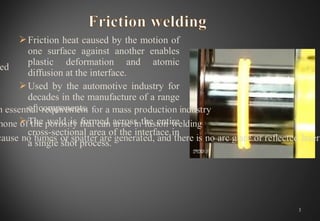
Friction heat caused by the motion of
one surface against another enables
plastic deformation and atomic
diffusion at the interface.
Used by the automotive industry for
decades in the manufacture of a range
of components.
The weld is formed across the entire
cross-sectional area of the interface in
a single shot process.
3
• Dissimilar metals can be joined
• No fusion zone
• Can be used under water
• Very high reproducibility - an essential requirement for a mass
production industry
• Excellent weld quality, with none of the porosity that can arise in
fusion welding
• environmentally friendly, because no fumes or spatter are generated,
and there is no arc glare or reflected laser beams with which to contend
4
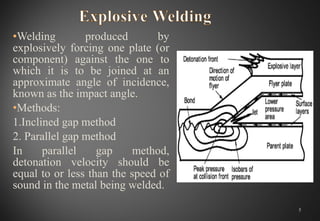
•Welding produced by
explosively forcing one plate (or
component) against the one to
which it is to be joined at an
approximate angle of incidence,
known as the impact angle.
•Methods:
1.Inclined gap method
2. Parallel gap method
In parallel gap method,
detonation velocity should be
equal to or less than the speed of
sound in the metal being welded.
5
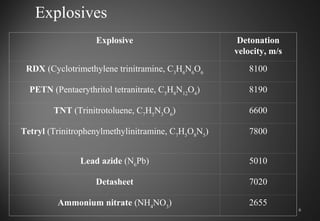
Explosive Detonation
velocity, m/s
RDX (Cyclotrimethylene trinitramine, C3
H6
N6
O6
8100
PETN (Pentaerythritol tetranitrate, C5
H8
N12
O4
) 8190
TNT (Trinitrotoluene, C7
H5
N3
O6
) 6600
Tetryl (Trinitrophenylmethylinitramine, C7
H5
O8
N5
) 7800
Lead azide (N6
Pb) 5010
Detasheet 7020
Ammonium nitrate (NH4
NO3
) 2655
Explosives
6
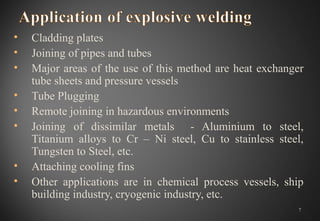
• Cladding plates
• Joining of pipes and tubes
• Major areas of the use of this method are heat exchanger
tube sheets and pressure vessels
• Tube Plugging
• Remote joining in hazardous environments
• Joining of dissimilar metals - Aluminium to steel,
Titanium alloys to Cr – Ni steel, Cu to stainless steel,
Tungsten to Steel, etc.
• Attaching cooling fins
• Other applications are in chemical process vessels, ship
building industry, cryogenic industry, etc.
7
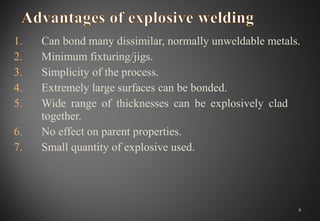
1. Can bond many dissimilar, normally unweldable metals.
2. Minimum fixturing/jigs.
3. Simplicity of the process.
4. Extremely large surfaces can be bonded.
5. Wide range of thicknesses can be explosively clad
together.
6. No effect on parent properties.
7. Small quantity of explosive used.
8
1. The metals must have high enough impact resistance,
and ductility.
2. Noise and blast can require operator protection,
vacuum chambers, buried in sand/water.
3. The use of explosives in industrial areas will be
restricted by the noise and ground vibrations caused
by the explosion.
4. The geometries welded must be simple – flat,
cylindrical, conical.
5. Area should be cleaned and sound grounded for
explosion.
6. Licences are necessary to hold and use explosives.
9
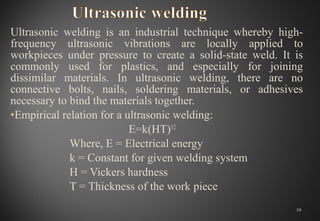
Ultrasonic welding is an industrial technique whereby high-
frequency ultrasonic vibrations are locally applied to
workpieces under pressure to create a solid-state weld. It is
commonly used for plastics, and especially for joining
dissimilar materials. In ultrasonic welding, there are no
connective bolts, nails, soldering materials, or adhesives
necessary to bind the materials together.
•Empirical relation for a ultrasonic welding:
E=k(HT)3/2
Where, E = Electrical energy
k = Constant for given welding system
H = Vickers hardness
T = Thickness of the work piece
10
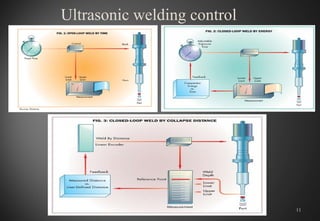
Ultrasonic welding control
11
Advantages:
•Energy efficiency
•High productivity with low costs and ease of automated
assembly line production
Disadvantages:
The maximum component length that can be welded by a single
horn is approximately 250 mm. This is due to limitations in the
power output capability of a single transducer, the inability of the
horns to transmit very high power, and amplitude control
difficulties.
12
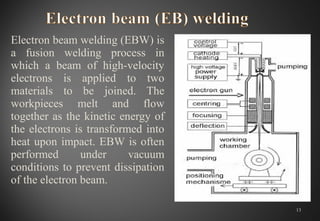
Electron beam welding (EBW) is
a fusion welding process in
which a beam of high-velocity
electrons is applied to two
materials to be joined. The
workpieces melt and flow
together as the kinetic energy of
the electrons is transformed into
heat upon impact. EBW is often
performed under vacuum
conditions to prevent dissipation
of the electron beam.
13
• Advantage: Very deep penetration can be achieved. For
example, joining of 200 mm aluminium plates requires 600
passes when conventional gas metal arc process requires
over 100 passes even using specially developed narrow-
grove process. By using the EB process, the same plate can
be welded in only 2 passes.
• Disadvantage: Dealing with the vacuum needed for the
process
14
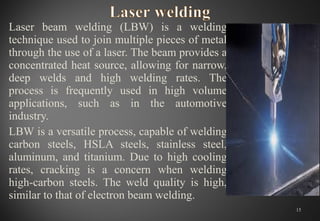
Laser beam welding (LBW) is a welding
technique used to join multiple pieces of metal
through the use of a laser. The beam provides a
concentrated heat source, allowing for narrow,
deep welds and high welding rates. The
process is frequently used in high volume
applications, such as in the automotive
industry.
LBW is a versatile process, capable of welding
carbon steels, HSLA steels, stainless steel,
aluminum, and titanium. Due to high cooling
rates, cracking is a concern when welding
high-carbon steels. The weld quality is high,
similar to that of electron beam welding.
15
• The laser beam can be transmitted through air rather than
requiring a vacuum
• The process is easily automated with robotic machinery
• x-rays are not generated
• LBW results in higher quality welds
16
• The LaserStar® Workstation is an Nd:YAG laser. The
host material is a cylindrical crystal of yttrium-
aluminum -garnet (Y3Al5O12), YAG doped by weight
with neodymium (Nd3+) ions. Laser emission takes
place at 1.064 μm (infrared).
LASERPOWER
• Joules: The “hot light” energy output is measured in
joules. This industry term by definition is “ the
capacity for doing work”. Hot light energy output is
determined by the amount of voltage and pulse-
length selected by the operator
17
18
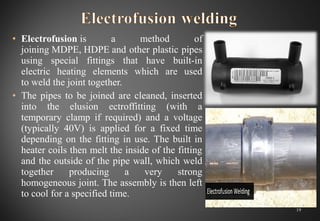
• Electrofusion is  a  method  of 
joining MDPE, HDPE and other plastic pipes 
using  special  fittings  that  have  built-in 
electric  heating  elements  which  are  used 
to weld the joint together.
• The pipes to be joined are cleaned, inserted 
into  the  elusion  ectroffitting  (with  a 
temporary  clamp  if  required)  and  a  voltage 
(typically  40V)  is  applied  for  a  fixed  time 
depending on the fitting in use. The built in 
heater coils then melt the inside of the fitting 
and the outside of the pipe wall, which weld 
together  producing  a  very  strong 
homogeneous joint. The assembly is then left 
to cool for a specified time.
19
Plasma arc welding is an arc welding process wherein coalescence is 
produced by the heat obtained from a constricted arc setup between a 
tungsten/alloy  tungsten  electrode  and  the  water-cooled  (constricting) 
nozzle  (non-transferred  arc)  or  between  a  tungsten/alloy  tungsten 
electrode and the job (transferred arc). The process employs two inert 
gases, one forms the arc plasma and the second shields the arc plasma. 
Filler metal may or may not be added.
At least two separate (and possibly three) flows of gas are
used in PAW:
Plasma gas – flows through the orifice and becomes ionized.
Shielding gas – flows through the outer nozzle and shields the molten 
weld from the atmosphere
Back-purge  and  trailing  gas  –  required  for  certain  materials  and 
applications.
20
21
Plasma arc welding is an advancement over the GTAW process. PAW 
can be used to join all metals that are weldable with GTAW. Difficult-
to-weld  in  metals  by  PAW  include  bronze,  cast  iron,  lead  and 
magnesium.  Several  basic  PAW  process  variations  are  possible  by 
varying  the  current,  plasma  gas  flow  rate,  and  the  orifice  diameter, 
including:
Micro-plasma (< 15 Amperes)
Melt-in mode (15–100 Amperes)
Keyhole mode (>100 Amperes)
Plasma arc welding has a greater energy concentration as compared to 
GTAW.
PAW requires relatively expensive and complex equipment as compared 
to GTAW.
Welding  procedures  tend  to  be  more  complex  and  less  tolerant  to 
variations in fit-up, etc.
Operator skill required is slightly greater than for GTAW.
22

Advanced welding ppt by Shivank

  • 1.
  • 2.
  • 3.
    Friction heat causedby the motion of one surface against another enables plastic deformation and atomic diffusion at the interface. Used by the automotive industry for decades in the manufacture of a range of components. The weld is formed across the entire cross-sectional area of the interface in a single shot process. 3
  • 4.
    • Dissimilar metalscan be joined • No fusion zone • Can be used under water • Very high reproducibility - an essential requirement for a mass production industry • Excellent weld quality, with none of the porosity that can arise in fusion welding • environmentally friendly, because no fumes or spatter are generated, and there is no arc glare or reflected laser beams with which to contend 4
  • 5.
    •Welding produced by explosivelyforcing one plate (or component) against the one to which it is to be joined at an approximate angle of incidence, known as the impact angle. •Methods: 1.Inclined gap method 2. Parallel gap method In parallel gap method, detonation velocity should be equal to or less than the speed of sound in the metal being welded. 5
  • 6.
    Explosive Detonation velocity, m/s RDX(Cyclotrimethylene trinitramine, C3 H6 N6 O6 8100 PETN (Pentaerythritol tetranitrate, C5 H8 N12 O4 ) 8190 TNT (Trinitrotoluene, C7 H5 N3 O6 ) 6600 Tetryl (Trinitrophenylmethylinitramine, C7 H5 O8 N5 ) 7800 Lead azide (N6 Pb) 5010 Detasheet 7020 Ammonium nitrate (NH4 NO3 ) 2655 Explosives 6
  • 7.
    • Cladding plates •Joining of pipes and tubes • Major areas of the use of this method are heat exchanger tube sheets and pressure vessels • Tube Plugging • Remote joining in hazardous environments • Joining of dissimilar metals - Aluminium to steel, Titanium alloys to Cr – Ni steel, Cu to stainless steel, Tungsten to Steel, etc. • Attaching cooling fins • Other applications are in chemical process vessels, ship building industry, cryogenic industry, etc. 7
  • 8.
    1. Can bondmany dissimilar, normally unweldable metals. 2. Minimum fixturing/jigs. 3. Simplicity of the process. 4. Extremely large surfaces can be bonded. 5. Wide range of thicknesses can be explosively clad together. 6. No effect on parent properties. 7. Small quantity of explosive used. 8
  • 9.
    1. The metalsmust have high enough impact resistance, and ductility. 2. Noise and blast can require operator protection, vacuum chambers, buried in sand/water. 3. The use of explosives in industrial areas will be restricted by the noise and ground vibrations caused by the explosion. 4. The geometries welded must be simple – flat, cylindrical, conical. 5. Area should be cleaned and sound grounded for explosion. 6. Licences are necessary to hold and use explosives. 9
  • 10.
    Ultrasonic welding isan industrial technique whereby high- frequency ultrasonic vibrations are locally applied to workpieces under pressure to create a solid-state weld. It is commonly used for plastics, and especially for joining dissimilar materials. In ultrasonic welding, there are no connective bolts, nails, soldering materials, or adhesives necessary to bind the materials together. •Empirical relation for a ultrasonic welding: E=k(HT)3/2 Where, E = Electrical energy k = Constant for given welding system H = Vickers hardness T = Thickness of the work piece 10
  • 11.
  • 12.
    Advantages: •Energy efficiency •High productivitywith low costs and ease of automated assembly line production Disadvantages: The maximum component length that can be welded by a single horn is approximately 250 mm. This is due to limitations in the power output capability of a single transducer, the inability of the horns to transmit very high power, and amplitude control difficulties. 12
  • 13.
    Electron beam welding(EBW) is a fusion welding process in which a beam of high-velocity electrons is applied to two materials to be joined. The workpieces melt and flow together as the kinetic energy of the electrons is transformed into heat upon impact. EBW is often performed under vacuum conditions to prevent dissipation of the electron beam. 13
  • 14.
    • Advantage: Verydeep penetration can be achieved. For example, joining of 200 mm aluminium plates requires 600 passes when conventional gas metal arc process requires over 100 passes even using specially developed narrow- grove process. By using the EB process, the same plate can be welded in only 2 passes. • Disadvantage: Dealing with the vacuum needed for the process 14
  • 15.
    Laser beam welding(LBW) is a welding technique used to join multiple pieces of metal through the use of a laser. The beam provides a concentrated heat source, allowing for narrow, deep welds and high welding rates. The process is frequently used in high volume applications, such as in the automotive industry. LBW is a versatile process, capable of welding carbon steels, HSLA steels, stainless steel, aluminum, and titanium. Due to high cooling rates, cracking is a concern when welding high-carbon steels. The weld quality is high, similar to that of electron beam welding. 15
  • 16.
    • The laserbeam can be transmitted through air rather than requiring a vacuum • The process is easily automated with robotic machinery • x-rays are not generated • LBW results in higher quality welds 16
  • 17.
    • The LaserStar®Workstation is an Nd:YAG laser. The host material is a cylindrical crystal of yttrium- aluminum -garnet (Y3Al5O12), YAG doped by weight with neodymium (Nd3+) ions. Laser emission takes place at 1.064 μm (infrared). LASERPOWER • Joules: The “hot light” energy output is measured in joules. This industry term by definition is “ the capacity for doing work”. Hot light energy output is determined by the amount of voltage and pulse- length selected by the operator 17
  • 18.
  • 19.
    • Electrofusion is  a method  of  joining MDPE, HDPE and other plastic pipes  using  special  fittings  that  have  built-in  electric  heating  elements  which  are  used  to weld the joint together. • The pipes to be joined are cleaned, inserted  into  the  elusion  ectroffitting  (with  a  temporary  clamp  if  required)  and  a  voltage  (typically  40V)  is  applied  for  a  fixed  time  depending on the fitting in use. The built in  heater coils then melt the inside of the fitting  and the outside of the pipe wall, which weld  together  producing  a  very  strong  homogeneous joint. The assembly is then left  to cool for a specified time. 19
  • 20.
    Plasma arc welding is an arc welding process wherein coalescence is  produced by the heat obtained from a constricted arc setup between a  tungsten/alloy  tungsten  electrode and  the  water-cooled  (constricting)  nozzle  (non-transferred  arc)  or  between  a  tungsten/alloy  tungsten  electrode and the job (transferred arc). The process employs two inert  gases, one forms the arc plasma and the second shields the arc plasma.  Filler metal may or may not be added. At least two separate (and possibly three) flows of gas are used in PAW: Plasma gas – flows through the orifice and becomes ionized. Shielding gas – flows through the outer nozzle and shields the molten  weld from the atmosphere Back-purge  and  trailing  gas  –  required  for  certain  materials  and  applications. 20
  • 21.
    21 Plasma arc welding is an advancement over the GTAW process. PAW  can be used to join all metals that are weldable with GTAW. Difficult- to-weld  in  metals by  PAW  include  bronze,  cast  iron,  lead  and  magnesium.  Several  basic  PAW  process  variations  are  possible  by  varying  the  current,  plasma  gas  flow  rate,  and  the  orifice  diameter,  including: Micro-plasma (< 15 Amperes) Melt-in mode (15–100 Amperes) Keyhole mode (>100 Amperes) Plasma arc welding has a greater energy concentration as compared to  GTAW. PAW requires relatively expensive and complex equipment as compared  to GTAW. Welding  procedures  tend  to  be  more  complex  and  less  tolerant  to  variations in fit-up, etc. Operator skill required is slightly greater than for GTAW.
  • 22.