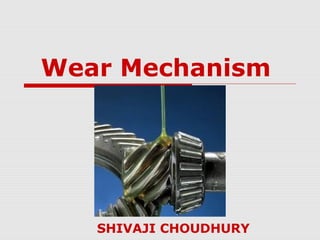
Wear Mechanism 
SHIVAJI CHOUDHURY
Wear 
 Wear is the undesirable removal of 
solids from a sliding or rolling 
component.
Wear analysis 
 In analyzing a wear problem in a machine, 
it is necessary to determine the kind of 
wear that occurred. 
 Analysis requires microscopic examination 
of the worn area and a close look at the 
used lubricant. 
 Wear is generally proportional to the 
applied load and the amount of sliding.
Types of wear : 
 1.Adhesive Wear 
 2.Abrasive Wear 
 3.Erosion Wear 
 4.Polishing Wear 
 5.Contact fatigue 
 6.Corrosive wear 
 7.Electro-Corrosive 
wear 
 8.Fretting wear 
 9.Electrical 
discharge wear 
 10.Cavitation 
damage 
 11.False brinelling
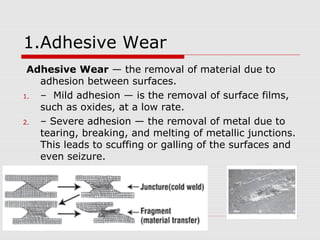
1.Adhesive Wear 
Adhesive Wear — the removal of material due to 
adhesion between surfaces. 
1. – Mild adhesion — is the removal of surface films, 
such as oxides, at a low rate. 
2. – Severe adhesion — the removal of metal due to 
tearing, breaking, and melting of metallic junctions. 
This leads to scuffing or galling of the surfaces and 
even seizure.
1.1.Adhesive Wear -Prevention 
 MECHANICAL 
1. Reduce load, speed 
and temperature 
2. Improve oil cooling 
3. Use compatible 
metals 
4. Apply surface 
coatings such as 
phosphating 
LUBRICANT 
1. Use more viscous 
oil to separate 
surfaces 
2. Use "extreme 
pressure" (anti-scuff) 
additives 
such as a sulfur-phosphorous 
or 
borate compounds
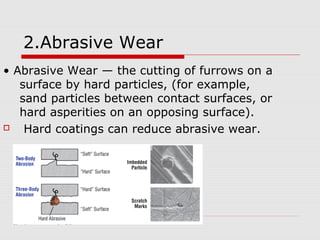
2.Abrasive Wear 
• Abrasive Wear — the cutting of furrows on a 
surface by hard particles, (for example, 
sand particles between contact surfaces, or 
hard asperities on an opposing surface). 
 Hard coatings can reduce abrasive wear.
2.1.Abrasive Wear-Prevention 
 MECHANICAL 
1. Remove abrasive by 
improved air and oil 
filtering, clean oil 
handling practices, 
improved seals, flushing 
and frequent oil changes 
2. Minimize shot peening, 
beading, or sand blasting 
of surfaces because 
abrasives cannot be 
completely removed 
3. Increase hardness of 
metal surfaces 
 LUBRICANT 
1. Use oil free of 
abrasive particles 
2. Use more viscous 
oil
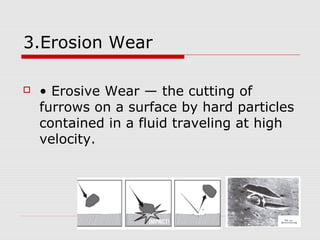
3.Erosion Wear 
 • Erosive Wear — the cutting of 
furrows on a surface by hard particles 
contained in a fluid traveling at high 
velocity.
3.1.Erosion Wear -Prevention 
 MECHANICAL 
1. Remove abrasive by 
improved air and oil 
filtering, clean oil 
handling practices, 
improved seals, flushing 
and frequent oil changes 
2. Reduce impact angle to 
less than 15 degrees 
3. Increase hardness of 
metal surfaces 
 LUBRICANT 
1. Use oil free of abrasive 
Particles 
2. Use more viscous oil
4.Polishing Wear 
 • Polishing Wear — the continuous removal 
of surface films, laid down via a chemical 
reaction from an additive in oil or by very 
fine hard particles in the lubricant, and so 
on. 
 Polishing wear is characterized by very 
shiny, very smooth, mirror like metal 
surfaces. Fine abrasives wear away the 
surface films as they form and reform.
4.1.Polishing Wear -Prevention 
 MECHANICAL 
1. none 
 LUBRICANT 
1. Choose less 
chemically active 
additive 
2. Remove corrosive 
contaminant 
3. Remove abrasive
5.Contact fatigue 
 • Contact Fatigue — the cracking, 
pitting, and spalling of a surface in 
sequence due to cyclic stresses in a 
contact. 
 Contact fatigue is most common in 
rolling element bearings, gear teeth, 
and cams.
5.1.Contact fatigue- Prevention 
 MECHANICAL 
1. Reduce contact 
pressures and 
frequency of cyclic 
stress. 
2. Use high quality 
vacuum melted 
steels. 
3. Use less abusive 
surface finish 
 LUBRICANT 
1. Use clean, dry oil. 
2. Use more viscous 
oil 
3. Use oil with 
higher-pressure 
viscosity coefficient
6.Corrosive wear 
 • Corrosive Wear — the removal of 
corrosion products from a surface by 
motion, such as the rubbing off of 
rust.
6.1.Corrosive wear-Prevention 
 MECHANICAL 
1. Use more corrosion 
resistant metal 
(not stainless) 
2. Reduce operating 
temperature 
3. Eliminate corrosive 
material 
 LUBRICANT 
1. Remove corrosive 
material such as 
too chemically 
active additive and 
contaminates 
2. Use improved 
corrosion inhibitor 
3. Use fresh oil
7.Electro-Corrosive wear 
 • Electro-Corrosive Wear — the 
removal of metal by dissolution in a 
corrosive liquid with the aid of electric 
currents. 
 One source of currents is streaming 
potential from high velocity fluids. 
 The oil serves as the electrolyte.
7.1.Electro-Corrosive wear-prevention 
 MECHANICAL 
1. Decrease liquid 
velocity and 
velocity gradients 
2. Use corrosion-resistant 
metals 
3. Eliminate stray 
currents 
 LUBRICANT 
1. Decrease or 
increase electrical 
conductivity of 
lubricants or 
hydraulic fluids
8.Fretting wear 
 • Fretting Wear — localized wear of 
lubricated surfaces due to 
reciprocating sliding of extremely low 
amplitude because of vibration.
8.1.Fretting wear -Prevention 
 MECHANICAL 
1. Reduce or stop 
vibration by tighter 
fit or higher load . 
2. Improve lubrication 
between surfaces by 
rougher (then 
honed) surface finish 
 LUBRICANT 
1. Use oil of lower 
viscosity 
2. Relubricate 
frequently 
3. Use oxidation 
inhibitors in oil
9.Electrical discharge wear 
 • Electrical Discharge Wear — the 
removal of molten metal from 
surfaces due to electrical sparks 
between them. 
 High static voltages are sometimes 
generated by large rotating 
machinery and these are relieved by 
sparking to regions of lower potential.
9.1.Electrical discharge wear- 
Prevention 
 MECHANICAL 
1. Improve electrical 
insulation of bearings 
2. Degauss magnetic 
rotating parts 
3. Install brushes on 
shaft 
4. Improve machine 
grounding 
 LUBRICANT 
1. Use of oil of higher 
electrical conductivity
10.Cavitation damage 
 • Cavitation Damage — the removal of 
material due to cracking and pitting caused 
by high energy implosions of vacuous 
cavities in a cavitating liquid. 
 Liquids cavitate when suddenly subjected 
to low pressures. 
 Removal of metal by vapor cavity implosion 
in a cavitating liquid.
10.1.Cavitation damage-Prevention 
 MECHANICAL 
1. Use hard, tough 
metals, such as tool 
steel 
2. Reduce vibration, flow 
velocities and 
pressures 
3. Avoid restriction and 
obstructions to liquid 
flow 
 LUBRICANT 
1. Avoid low vapor 
pressure, aerated, wet 
oils 
2. Use noncorrosive oils
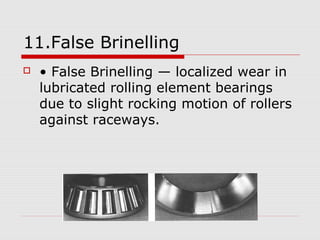
11.False Brinelling 
 • False Brinelling — localized wear in 
lubricated rolling element bearings 
due to slight rocking motion of rollers 
against raceways.
11.1.False Brinelling- Prevention 
 MECHANICAL 
1. Reduce or 
eliminate impact 
2. Rotate bearings 
occasionally 
 LUBRICANT 
1. Change viscosity
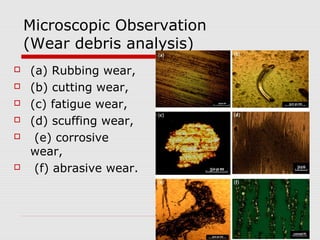
Microscopic Observation 
(Wear debris analysis) 
 (a) Rubbing wear, 
 (b) cutting wear, 
 (c) fatigue wear, 
 (d) scuffing wear, 
 (e) corrosive 
wear, 
 (f) abrasive wear.
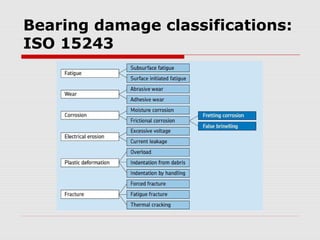
Bearing damage classifications: 
ISO 15243
Thanking you

Wear mechanism

  • 1.
  • 2.
    Wear  Wearis the undesirable removal of solids from a sliding or rolling component.
  • 3.
    Wear analysis In analyzing a wear problem in a machine, it is necessary to determine the kind of wear that occurred.  Analysis requires microscopic examination of the worn area and a close look at the used lubricant.  Wear is generally proportional to the applied load and the amount of sliding.
  • 4.
    Types of wear:  1.Adhesive Wear  2.Abrasive Wear  3.Erosion Wear  4.Polishing Wear  5.Contact fatigue  6.Corrosive wear  7.Electro-Corrosive wear  8.Fretting wear  9.Electrical discharge wear  10.Cavitation damage  11.False brinelling
  • 5.
    1.Adhesive Wear AdhesiveWear — the removal of material due to adhesion between surfaces. 1. – Mild adhesion — is the removal of surface films, such as oxides, at a low rate. 2. – Severe adhesion — the removal of metal due to tearing, breaking, and melting of metallic junctions. This leads to scuffing or galling of the surfaces and even seizure.
  • 6.
    1.1.Adhesive Wear -Prevention  MECHANICAL 1. Reduce load, speed and temperature 2. Improve oil cooling 3. Use compatible metals 4. Apply surface coatings such as phosphating LUBRICANT 1. Use more viscous oil to separate surfaces 2. Use "extreme pressure" (anti-scuff) additives such as a sulfur-phosphorous or borate compounds
  • 7.
    2.Abrasive Wear •Abrasive Wear — the cutting of furrows on a surface by hard particles, (for example, sand particles between contact surfaces, or hard asperities on an opposing surface).  Hard coatings can reduce abrasive wear.
  • 8.
    2.1.Abrasive Wear-Prevention MECHANICAL 1. Remove abrasive by improved air and oil filtering, clean oil handling practices, improved seals, flushing and frequent oil changes 2. Minimize shot peening, beading, or sand blasting of surfaces because abrasives cannot be completely removed 3. Increase hardness of metal surfaces  LUBRICANT 1. Use oil free of abrasive particles 2. Use more viscous oil
  • 9.
    3.Erosion Wear • Erosive Wear — the cutting of furrows on a surface by hard particles contained in a fluid traveling at high velocity.
  • 10.
    3.1.Erosion Wear -Prevention  MECHANICAL 1. Remove abrasive by improved air and oil filtering, clean oil handling practices, improved seals, flushing and frequent oil changes 2. Reduce impact angle to less than 15 degrees 3. Increase hardness of metal surfaces  LUBRICANT 1. Use oil free of abrasive Particles 2. Use more viscous oil
  • 11.
    4.Polishing Wear • Polishing Wear — the continuous removal of surface films, laid down via a chemical reaction from an additive in oil or by very fine hard particles in the lubricant, and so on.  Polishing wear is characterized by very shiny, very smooth, mirror like metal surfaces. Fine abrasives wear away the surface films as they form and reform.
  • 12.
    4.1.Polishing Wear -Prevention  MECHANICAL 1. none  LUBRICANT 1. Choose less chemically active additive 2. Remove corrosive contaminant 3. Remove abrasive
  • 13.
    5.Contact fatigue • Contact Fatigue — the cracking, pitting, and spalling of a surface in sequence due to cyclic stresses in a contact.  Contact fatigue is most common in rolling element bearings, gear teeth, and cams.
  • 14.
    5.1.Contact fatigue- Prevention  MECHANICAL 1. Reduce contact pressures and frequency of cyclic stress. 2. Use high quality vacuum melted steels. 3. Use less abusive surface finish  LUBRICANT 1. Use clean, dry oil. 2. Use more viscous oil 3. Use oil with higher-pressure viscosity coefficient
  • 15.
    6.Corrosive wear • Corrosive Wear — the removal of corrosion products from a surface by motion, such as the rubbing off of rust.
  • 16.
    6.1.Corrosive wear-Prevention MECHANICAL 1. Use more corrosion resistant metal (not stainless) 2. Reduce operating temperature 3. Eliminate corrosive material  LUBRICANT 1. Remove corrosive material such as too chemically active additive and contaminates 2. Use improved corrosion inhibitor 3. Use fresh oil
  • 17.
    7.Electro-Corrosive wear • Electro-Corrosive Wear — the removal of metal by dissolution in a corrosive liquid with the aid of electric currents.  One source of currents is streaming potential from high velocity fluids.  The oil serves as the electrolyte.
  • 18.
    7.1.Electro-Corrosive wear-prevention MECHANICAL 1. Decrease liquid velocity and velocity gradients 2. Use corrosion-resistant metals 3. Eliminate stray currents  LUBRICANT 1. Decrease or increase electrical conductivity of lubricants or hydraulic fluids
  • 19.
    8.Fretting wear • Fretting Wear — localized wear of lubricated surfaces due to reciprocating sliding of extremely low amplitude because of vibration.
  • 20.
    8.1.Fretting wear -Prevention  MECHANICAL 1. Reduce or stop vibration by tighter fit or higher load . 2. Improve lubrication between surfaces by rougher (then honed) surface finish  LUBRICANT 1. Use oil of lower viscosity 2. Relubricate frequently 3. Use oxidation inhibitors in oil
  • 21.
    9.Electrical discharge wear  • Electrical Discharge Wear — the removal of molten metal from surfaces due to electrical sparks between them.  High static voltages are sometimes generated by large rotating machinery and these are relieved by sparking to regions of lower potential.
  • 22.
    9.1.Electrical discharge wear- Prevention  MECHANICAL 1. Improve electrical insulation of bearings 2. Degauss magnetic rotating parts 3. Install brushes on shaft 4. Improve machine grounding  LUBRICANT 1. Use of oil of higher electrical conductivity
  • 23.
    10.Cavitation damage • Cavitation Damage — the removal of material due to cracking and pitting caused by high energy implosions of vacuous cavities in a cavitating liquid.  Liquids cavitate when suddenly subjected to low pressures.  Removal of metal by vapor cavity implosion in a cavitating liquid.
  • 24.
    10.1.Cavitation damage-Prevention MECHANICAL 1. Use hard, tough metals, such as tool steel 2. Reduce vibration, flow velocities and pressures 3. Avoid restriction and obstructions to liquid flow  LUBRICANT 1. Avoid low vapor pressure, aerated, wet oils 2. Use noncorrosive oils
  • 25.
    11.False Brinelling • False Brinelling — localized wear in lubricated rolling element bearings due to slight rocking motion of rollers against raceways.
  • 26.
    11.1.False Brinelling- Prevention  MECHANICAL 1. Reduce or eliminate impact 2. Rotate bearings occasionally  LUBRICANT 1. Change viscosity
  • 27.
    Microscopic Observation (Weardebris analysis)  (a) Rubbing wear,  (b) cutting wear,  (c) fatigue wear,  (d) scuffing wear,  (e) corrosive wear,  (f) abrasive wear.
  • 28.
  • 29.