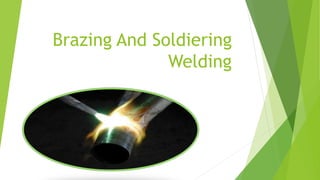
Brazing And Soldiering
Welding
Overview of Brazing and Soldiering
 Both use filler metals to permanently join metal parts, but there is no melting
of base metals
 When to use brazing or soldiering instead of fusion welding:
 Metals have poor weld ability
 Dissimilar metals are to be joined
 Intense heat of welding may damage components being joined
 Geometry of joint not suitable for welding
 High strength is not required
Brazing
 Joining process in which a filler metal is melted and distributed by capillary
action between faying surface of metal parts being joined
 No melting of base metals occurs
 Only the filler melts
 Filler metal Tm greater than 4500C (8400F) but less than Tm of base metal(s)
to be joined.
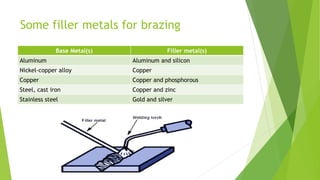
Some filler metals for brazing
Base Metal(s) Filler metal(s)
Aluminum Aluminum and silicon
Nickel-copper alloy Copper
Copper Copper and phosphorous
Steel, cast iron Copper and zinc
Stainless steel Gold and silver
Brazing Compared to Welding
 Any metals can be joined, including dissimilar metals
 Can be performed quickly and consistently, permitting high production rates
 Multiple joints can be braze simultaneously
 Less heat and power Required than Fusion welding
 Joint areas that are inaccessible by many welding processes can be brazed;
capillary action draws molten filler metal into joint
Disadvantages and Limitations of Brazing
 Joint strength is generally less than a welded joint
 Joint strength is likely to be less than the base metals
 High service temperatures may weaken a brazed joint
 Color of brazing metal may not match color of base metal parts, a possible
aesthetic disadvantage
Brazing Applications
 Automotive (e.g. Joining tubes and pipes)
 Electrical equipment (e.g. joining wires and cables)
 Cutting tools (e.g. brazing cemented carbide inserts to shanks)
 Jewelry
 Chemical process industry
 Plumbing and heating contractors join metal pipes and tubes by brazing
 Repair and maintenance work
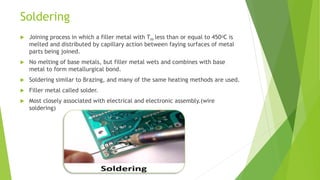
Soldering
 Joining process in which a filler metal with Tm less than or equal to 450ᵒC is
melted and distributed by capillary action between faying surfaces of metal
parts being joined.
 No melting of base metals, but filler metal wets and combines with base
metal to form metallurgical bond.
 Soldering similar to Brazing, and many of the same heating methods are used.
 Filler metal called solder.
 Most closely associated with electrical and electronic assembly.(wire
soldering)
Soldering Advantages and Disadvantages
Advantages :
• Lower energy than brazing or fusion welding
• Variety of heating methods available.
• Good electrical and thermal conductivity in joint.
• Easy repair and rework.
Disadvantages :
• Low joint strength unless reinforced by mechanically means.
• Possible weak or melting of joint in elevated temperature service.
Filler metals in soldering
 Usually alloys of tin(Sn) and lead(Pb).Both metals have low melting
temperature.
 In soldering copper, copper and tin form intermetallic compounds that
strengthen bond.
 Silver and antimony also used in soldering alloys.
Summary
 Brazing and soldering are process that have many great advantages that are
often overlooked.
 They are an excellent process for portable applications and the versatility
makes them great choices for many jobs.
 Their ability to join may different materials with a limited variety of fluxes
and filler metals reduces the need for a large inventory of materials.
Brazing and soldering welding

Brazing and soldering welding

  • 1.
  • 2.
    Overview of Brazingand Soldiering  Both use filler metals to permanently join metal parts, but there is no melting of base metals  When to use brazing or soldiering instead of fusion welding:  Metals have poor weld ability  Dissimilar metals are to be joined  Intense heat of welding may damage components being joined  Geometry of joint not suitable for welding  High strength is not required
  • 3.
    Brazing  Joining processin which a filler metal is melted and distributed by capillary action between faying surface of metal parts being joined  No melting of base metals occurs  Only the filler melts  Filler metal Tm greater than 4500C (8400F) but less than Tm of base metal(s) to be joined.
  • 4.
    Some filler metalsfor brazing Base Metal(s) Filler metal(s) Aluminum Aluminum and silicon Nickel-copper alloy Copper Copper Copper and phosphorous Steel, cast iron Copper and zinc Stainless steel Gold and silver
  • 5.
    Brazing Compared toWelding  Any metals can be joined, including dissimilar metals  Can be performed quickly and consistently, permitting high production rates  Multiple joints can be braze simultaneously  Less heat and power Required than Fusion welding  Joint areas that are inaccessible by many welding processes can be brazed; capillary action draws molten filler metal into joint
  • 6.
    Disadvantages and Limitationsof Brazing  Joint strength is generally less than a welded joint  Joint strength is likely to be less than the base metals  High service temperatures may weaken a brazed joint  Color of brazing metal may not match color of base metal parts, a possible aesthetic disadvantage
  • 7.
    Brazing Applications  Automotive(e.g. Joining tubes and pipes)  Electrical equipment (e.g. joining wires and cables)  Cutting tools (e.g. brazing cemented carbide inserts to shanks)  Jewelry  Chemical process industry  Plumbing and heating contractors join metal pipes and tubes by brazing  Repair and maintenance work
  • 8.
    Soldering  Joining processin which a filler metal with Tm less than or equal to 450ᵒC is melted and distributed by capillary action between faying surfaces of metal parts being joined.  No melting of base metals, but filler metal wets and combines with base metal to form metallurgical bond.  Soldering similar to Brazing, and many of the same heating methods are used.  Filler metal called solder.  Most closely associated with electrical and electronic assembly.(wire soldering)
  • 9.
    Soldering Advantages andDisadvantages Advantages : • Lower energy than brazing or fusion welding • Variety of heating methods available. • Good electrical and thermal conductivity in joint. • Easy repair and rework. Disadvantages : • Low joint strength unless reinforced by mechanically means. • Possible weak or melting of joint in elevated temperature service.
  • 10.
    Filler metals insoldering  Usually alloys of tin(Sn) and lead(Pb).Both metals have low melting temperature.  In soldering copper, copper and tin form intermetallic compounds that strengthen bond.  Silver and antimony also used in soldering alloys.
  • 11.
    Summary  Brazing andsoldering are process that have many great advantages that are often overlooked.  They are an excellent process for portable applications and the versatility makes them great choices for many jobs.  Their ability to join may different materials with a limited variety of fluxes and filler metals reduces the need for a large inventory of materials.