The industrial training report details the author's experience at Bhagwan Dass Jagan Nath Casting, an OEM supplier in India known for producing high-quality ductile and grey iron castings. The report includes an overview of the foundry industry, casting processes, and various testing methods, as well as the company's mission, vision, and quality policy. Additionally, it acknowledges the guidance received from faculty and the company during the training period.
![[1]
CHAPTER - 01
ABOUT COMPANY](https://image.slidesharecdn.com/pawansixmonthsindustrialtraining-191006165828/85/TRAINING-REPORT-ON-CASTING-7-320.jpg)
![[2]
1. INTRODUCTION
BHAGWAN DASS JAGAN NATH CASTING is an OEM supplier engaged in
manufacturing and exports of Quality Castings (Ductile Iron and Grey Iron).
Founded in 2014, Bhagwan Dass Jagan Nath Casting, rapidly became the leader of
high-quality Ductile and Grey Iron castings. Its foundry unit has a capacity of 200
Ton/month. It is an ISO 9001: 2008 certified company by TUV.
The company distinguishes itself by its high-level performances in the precision
Ductile and Grey iron casting industry because of teamwork, meticulous quality
control, the capacity of production, the skills of technicians and specialized engineers
and also state of the art equipment.
The company specializes in Engine components, Axle Parts, Gearbox Housings,
Critical Housings, Brackets, Oil Pumps for the OEM’s like Balaji, Emmbros Auto,
United Gears, Engineers Auto, Technomech, Sarveswari, Samarth, AB Tools,
Millenium. The company seeks to identify, develop, and more importantly, apply
new and improved technologies in order to produce the evolving specifications of
our clients in India and abroad.
It has good setup foundry facilities like Automatic high-pressure molding line,
Induction furnace with the dual track(500 kg with 550 KW), Shell core shooter,](https://image.slidesharecdn.com/pawansixmonthsindustrialtraining-191006165828/85/TRAINING-REPORT-ON-CASTING-8-320.jpg)
![[3]
automatic sand plant 10 ton/hr & Tumbler shot blast, Chemical test, Mechanical test
lab.
2. VALUES
Customer Priority
Consistency & Cost Effectiveness
Passion for Excellence
Integrity & Openness
Client Satisfaction
Deliver on Promises
Business Partner not another supplier
3. MISSION
Bhagwan Dass Jagan Nath Casting is always committed to producing high-quality
casting components. We are consistent in our dedication to manufacturing
excellence, on-time delivery, and client-driven customer service. Our goal is to
achieve 100% quality at all levels and in every organizational function: quoting,
purchasing, manufacturing, testing, and shipping.
4. VISION
We shall strive to be leaders in this business by offering products of a world-class
quality, and through constant technological innovation. We understand the needs of
our customers and shall stay focused on them by offering them products, service, and
solutions of the highest quality.
Our vision is to manufacture castings by an Environment-Friendly Process.
To establish the most modern manufacturing facility to cater to widest
industrial segments with cost-effective pricing and best quality.
To be recognized by all new and existing customers as a solution provider of
choice in the manufacturing of high integrity products and services.](https://image.slidesharecdn.com/pawansixmonthsindustrialtraining-191006165828/85/TRAINING-REPORT-ON-CASTING-9-320.jpg)
![[4]
5. QUALITY POLICY
We at Bhagwan Dass Jagan Nath Casting strive to continually improve quality
management system process and provide quality goods products and aiming for high
customer satisfaction.
6. PLANTS AND LABS
I. SAND PLANT
In the sand plant, sand casting is prepared using silica sand, clay, and water,
additives (like coal powder).
In sand, a suitable bonding agent (usually clay) is mixed or occurs with the sand. The
mixture is moistened, typically with water, but sometimes with other substances, to
develop the strength and plasticity of the clay and to make the aggregate suitable for
molding. The sand is typically contained in a system of frames or mold boxes known
as a flask. The mold cavities and gate system are created by compacting the sand
around models called patterns, by carving directly into the sand.
The molding sand after it is prepared should be properly tested to see that require
properties are achieved. Tests are conducted on a sample of the standard sand. The
molding sand should be prepared exactly as it is done in the shop on the standard
equipment and then carefully enclosed in a container to safeguard its moisture
content.](https://image.slidesharecdn.com/pawansixmonthsindustrialtraining-191006165828/85/TRAINING-REPORT-ON-CASTING-10-320.jpg)
![[5]
The following are the various types of sand control tests:
i. Moisture content test: Moisture is the property of the molding sand it is
defined as the amount of water present in the molding sand. Low moisture
content in the molding sand does not develop strength properties. High
moisture content decreases permeability.
ii. Clay content test: Clay influences strength, permeability, and other molding
properties. It is responsible for bonding sand particles together.
iii. Grain fitness test: The grain size, distribution, grain fitness are determined
with the help of the fitness testing of molding sands. The apparatus consists
of a number of standard sieves mounted one above the other, on a power-
driven shaker.
iv. Permeability test: The quantity of air that will pass through a standard
specimen of the sand at a particular pressure condition is called the
permeability of the sand.
v. Strength test: Measurements of the strength of molding sands can be carried
out on the universal sand strength testing machine. The strength can be
measured in compression, shear, and tension.
vi. Mold hardness test: Hardness of the mold surface can be tested with the
help of an ―indentation hardness tester‖. It consists of indicator, spring-loaded
spherical indenter.
Machine:
Horizontal Parting Flaskless Molding Machine: A Moulding Machine may be
defined as a device which has a large number of correlated parts and mechanisms,
transmits and directs various forces and motions in required directions so as to help
the preparation of a sand mold.
First, the drag is filled with sand and then rammed by the jolting action of the table.
Then the cope is filled up with sand and the latter rammed by squeezing between the
overhead plate and the machine table. The overhead plate is then swung aside and
sand on the top leveled off, cope removed and the drag vibrated by air vibrator. This
is followed by removal of match plate and closing of two halves of the mold for
pouring.](https://image.slidesharecdn.com/pawansixmonthsindustrialtraining-191006165828/85/TRAINING-REPORT-ON-CASTING-11-320.jpg)
![[6]
II. PHYSICAL LAB
In the physical lab, mechanical properties, metallurgical structure and chemical
composition of casting are observed with help of some equipment.
Mechanical testing gives an evaluation of the metal and the casting to determine
whether the properties are in compliance with the specified mechanical requirements.
Following are common mechanical tests used in metal casting facilities.
Hardness testing: - the most commonly used procedure for mechanical
property testing, it provides a numerical value and is nondestructive.](https://image.slidesharecdn.com/pawansixmonthsindustrialtraining-191006165828/85/TRAINING-REPORT-ON-CASTING-12-320.jpg)
![[7]
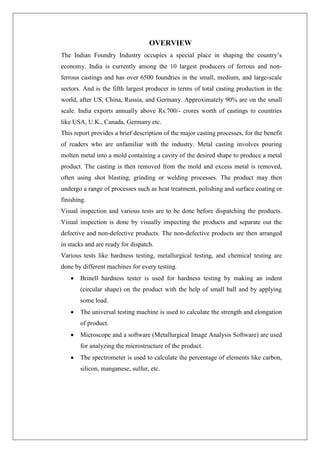
Hardness values generally relate to an alloy’s machinability and wear
resistance. The Brinell hardness test uses a 5 mm diameter carbide ball and
750 kg load to make an indent on the casting. The impressions are large
enough to provide a dependable average hardness.
Tensile testing: - conducted on test specimens of standardized dimensions.
Tensile testing provides ultimate tensile strength, yield strength, elongation
and reduction of area data. Universal Testing Machine is used for this testing.
Metallurgical structure: - microstructure of the casting is observed with the
help of a microscope and a Metallurgical Image Analysis Software.](https://image.slidesharecdn.com/pawansixmonthsindustrialtraining-191006165828/85/TRAINING-REPORT-ON-CASTING-13-320.jpg)
![[8]
Chemical composition: - chemical composition of the casting material like
percentage of carbon, manganese, silicon, sulfur, is being observed on the
spectrometer.](https://image.slidesharecdn.com/pawansixmonthsindustrialtraining-191006165828/85/TRAINING-REPORT-ON-CASTING-14-320.jpg)
![[9]
III. PATTERN SHOP
A pattern is a full-size model of the part you are trying to cast; patterns can be made
from various materials such as mahogany, metal, plastic or Styrofoam. It is very
important to have suitable patterns, for the quality of the casting is influenced by the
quality of the pattern.
The engineers of the pattern shop work closely with the foundry to ensure that the
proper patterns are built and maintained in order to meet their customers’
requirements. They do the research and development for different casting patterns
with the help of CAD software.](https://image.slidesharecdn.com/pawansixmonthsindustrialtraining-191006165828/85/TRAINING-REPORT-ON-CASTING-15-320.jpg)
![[10]
IV. CHEMICAL LAB
In chemical lab, engineers do various chemical analyses and testing of sand. They
are:
i. Moisture content Test
ii. Clay content Test
iii. Chemical composition of sand
iv. Wet Analysis
V. CORE MAKING AREA
A core is a device used in casting and molding processes to produce internal cavities.
The core is normally a disposable item that is destroyed to get it out of the
piece. They are most commonly used in sand casting.
Materials required to make cores are Core sand, Bentonite clay, Pulverized coal,
Resin oil.
Usually sand-molded, cores are inserted into the casting box after removal of the
pattern. Whenever possible, designs are made that avoid the use of cores, due to the
additional set-up time and thus greater cost.](https://image.slidesharecdn.com/pawansixmonthsindustrialtraining-191006165828/85/TRAINING-REPORT-ON-CASTING-16-320.jpg)
![[11]
After casting, the cores are broken up by rods or shot and removed from the casting.
Core Shooting Machine:
The mold material fed in after the machine bunker has been prepared. It is then shot
into the core box. The core box is clamped hydraulically which prevents the core box
from moving during shooting and gassing. The clamping and separating devices can](https://image.slidesharecdn.com/pawansixmonthsindustrialtraining-191006165828/85/TRAINING-REPORT-ON-CASTING-17-320.jpg)
![[12]
be changed so that it is possible to work with vertically and horizontally coreboxes.
After the mold material has been shot via the shooting unit which is pressed on
the core box, the hardening device is brought in and the hardening process is carried
out. The separating process then begins. The movable part of the core box is turned
and the core is pushed out of the solid core box part onto the transport belt (Film).
The molding tools can be made of wood, plastic or metal.
VI. FURNACE
An electric arc furnace (EAF) is a furnace that heats charged material by means of an
electric arc.
Industrial arc furnaces range in size from small units of approximately one-ton
capacity (used in foundries for producing cast iron products) up to about 400-ton
units used for secondary steelmaking.
TEMPERATURE RANGE:-Arc furnaces used in research laboratories and by
dentists may have a capacity of only a few dozen grams. Industrial electric arc
furnace temperatures can be up to 1,800 °C (3,272 °F), while laboratory units can
exceed 3,000 °C (5,432 °F).
Arc furnaces differ from induction furnaces in that the charge material is directly
exposed to an electric arc, and the current in the furnace terminals passes through the
charged material.](https://image.slidesharecdn.com/pawansixmonthsindustrialtraining-191006165828/85/TRAINING-REPORT-ON-CASTING-18-320.jpg)
![[13]
VII. INSPECTION AREA
Finished castings are inspected before being shipped. In this area, defective and non-
defective items are separated from the pile of casting. The non-defective product is
stacked for dispatch and the defective products are rejected and melted in the
furnace.
7. PRODUCTS
The company engages in manufacturing products of cast iron of two types.
a) Ductile cast iron also called Spheroidal Graphite (SG) cast iron
b) Grey cast iron also called Flakes Graphite (FG) cast iron
Different grades of SG cast iron is used like
i. SG 400/12
ii. SG 420/12
iii. SG 450/12
iv. SG 500/7
v. SG 600/3
vi. SG 700/2](https://image.slidesharecdn.com/pawansixmonthsindustrialtraining-191006165828/85/TRAINING-REPORT-ON-CASTING-19-320.jpg)
![[14]
Different grades of FG cast iron is used like
i. FG 200
ii. FG 260
iii. FG 300
Some Ductile Cast Iron Products
NUT – 29 NUT – 31
SG – 420/12
WHEEL HUB RE HSG – 107
SG – 450/12](https://image.slidesharecdn.com/pawansixmonthsindustrialtraining-191006165828/85/TRAINING-REPORT-ON-CASTING-20-320.jpg)
![[15]
BONUT FLANGE
SG – 400/12
KOLBEN BRAKE DISC – 63
SG – 500/7 SG – 600/3](https://image.slidesharecdn.com/pawansixmonthsindustrialtraining-191006165828/85/TRAINING-REPORT-ON-CASTING-21-320.jpg)
![[16]
Some Grey Cast Iron Products
COVER LAY SHAFT TURRET HSG
FG – 260
FORNT COVER BRAKE DISC – 151
FG – 200 FG – 300](https://image.slidesharecdn.com/pawansixmonthsindustrialtraining-191006165828/85/TRAINING-REPORT-ON-CASTING-22-320.jpg)
![[17]
8. CUSTOMERS](https://image.slidesharecdn.com/pawansixmonthsindustrialtraining-191006165828/85/TRAINING-REPORT-ON-CASTING-23-320.jpg)
![[18]
CHAPTER - 02
FOUNDRY](https://image.slidesharecdn.com/pawansixmonthsindustrialtraining-191006165828/85/TRAINING-REPORT-ON-CASTING-24-320.jpg)
![[19]
1. INTRODUCTION
A foundry is a factory that produces metal castings. Metals are cast into shapes by
melting them into a liquid, pouring the metal into a mold, and removing the mold
material or casting after the metal has solidified as it cools. The most common metals
processed are aluminum and cast iron. However, other metals, such as bronze, brass,
steel, magnesium, and zinc, are also used to produce castings in foundries. In this
process, parts of desired shapes and sizes can be formed.
2. PROCESS
In metalworking, casting involves pouring liquid metal into a mold, which contains a
hollow cavity of the desired shape and then allowing it to cool and solidify. The
solidified part is also known as a casting, which is ejected or broken out of the mold
to complete the process. Casting is most often used for making complex shapes that
would be difficult or uneconomical to make by other methods.
I. PATTERN MAKING
In casting, a pattern is a replica of the object to be cast, used to prepare the cavity
into which molten material will be poured during the casting process.
Patterns used in sand casting may be made of wood, metal, plastics or other
materials. Patterns are made to exacting standards of construction, so that they can
last for a reasonable length of time, according to the quality grade of the pattern
being built, and so that they will repeatably provide a dimensionally acceptable
casting.
Material Used:
Typically, materials used for pattern making are wood, metal or plastics. Wax and
Plaster of Paris are also used, but only for specialized applications. Mahogany is the
most commonly used material for patterns, primarily because it is soft, light, and
easy to work, but also once properly cured it is about as stable as any wood available,
not subject to warping or curling. Once the pattern is built the foundry does not want
it changing shape. The downside is that it wears out fast, and is prone to moisture](https://image.slidesharecdn.com/pawansixmonthsindustrialtraining-191006165828/85/TRAINING-REPORT-ON-CASTING-25-320.jpg)
![[20]
attack. Metal patterns are more long-lasting and do not succumb to moisture, but they
are heavier and difficult to repair once damaged.
Design:
The patternmaker or foundry engineer decides where the sprues, gating systems,
and risers are placed with respect to the pattern. Where a hole is desired in a casting,
a core may be used which defines a volume or location in a casting where metal will
not flow into. Sometimes chills may be placed on a pattern surface prior to molding,
which is then formed into the sand mold. Chills are heat sinks which enable localized
rapid cooling. The rapid cooling may be desired to refine the grain structure or
determine the freezing sequence of the molten metal which is poured into the mold.
Because they are at a much cooler temperature, and often a different metal than what
is being poured, they do not attach to the casting when the casting cools. The chills
can then be reclaimed and reused.
The design of the feeding and gating system is usually referred to
as methoding or methods design. It can be carried out manually or interactively using
general-purpose CAD software or semi-automatically using special-purpose software
(such as AutoCAST).
Types of Pattern:
i. Single Piece Pattern: -
These are inexpensive and the simplest type of pattern. As the name indicates, they
are made of a single piece. This type of pattern used in the case where the job is very
simple and does not create any withdrawal problems. It is also used for applications
in very small-scale production or in prototype development.](https://image.slidesharecdn.com/pawansixmonthsindustrialtraining-191006165828/85/TRAINING-REPORT-ON-CASTING-26-320.jpg)
![[21]
ii. Split Pattern or Two Piece Pattern: -
This is the most widely used type of pattern for intricate castings. When the contour
of casting makes its withdrawal from the mold difficult, or when the depth of the
casting is too high, then the pattern is split into two parts so that one part is in the
drag and the other in the cope.
iii. Gated Pattern: -
This is an improvement over the simple pattern where the gating and runner system
is integral to the pattern. This would eliminate the hand cutting off the runner and
gates and help in improving the productivity of the molder.
iv. Cope and Drag Pattern: -
These are similar to split patterns. In addition to splitting the pattern, the cope and
drag halves of the pattern along with the gating and risering system are attached
separately to the metal or wooden plate along with the alignment pins. They are
called the cope and drag pattern. These types of patterns are used for castings which
are heavy and inconvenient for handling as also for continuous production.](https://image.slidesharecdn.com/pawansixmonthsindustrialtraining-191006165828/85/TRAINING-REPORT-ON-CASTING-27-320.jpg)
![[22]
v. Match Plate Pattern
These are extensions of the previous type. Here, the cope and drag pattern the
risering are mounted on a single matching metal or wooden plate on either side. On
one side of the match plate or cope flask is prepared and on the other, the drag flask.
After molding when the match plate is removed, a complete mold with gating is
obtained by joining the cope and the drag together.
II. MOLDING
Sand casting, also known as sand molded casting, is a metal casting process
characterized by using sand as the mold material. In addition to the sand, a suitable
bonding agent (usually clay) is mixed or occurs with the sand. The mixture is
moistened, typically with water, but sometimes with other substances, to develop
strength and plasticity of the clay and to make the aggregate suitable for molding.](https://image.slidesharecdn.com/pawansixmonthsindustrialtraining-191006165828/85/TRAINING-REPORT-ON-CASTING-28-320.jpg)
![[23]
The sand is typically contained in a system of frames or mold boxes known as a
flask. The mold cavities and gate system are created by compacting the sand around
models, or patterns, or carved directly into the sand.
Sand casting is one of the most popular and simplest types of casting and has been
used for centuries. Sand casting allows for smaller batches than permanent mold
casting and at a very reasonable cost. Not only does this method allow manufacturers
to create products at a low cost, but there are other benefits to sand casting, such as
very small-size operations. From castings that fit in the palm of your hand to train
beds (one casting can create the entire bed for one rail car), it can all be done with
sand casting. Sand casting also allows most metals to be cast depending on the type
of sand used for the molds.
Basic Process:-
There are six steps in this process:
i. Place a pattern in the sand to create a mold.
ii. Incorporate the pattern and sand in a gating system.
iii. Remove the pattern.
iv. Fill the mold cavity with molten metal
v. Allow the metal to cool.
vi. Breakaway the sand mold and remove the casting](https://image.slidesharecdn.com/pawansixmonthsindustrialtraining-191006165828/85/TRAINING-REPORT-ON-CASTING-29-320.jpg)
![[24]
Mould Material:
There are four main components for making a sand casting mold: base sand,
a binder, additives, and a parting compound.
i. Types of base sands
Base sand is the type used to make the mold or core without any binder. Because it
does not have a binder it will not bond together and is not usable in this state.
a) Silica Sand
Silica (SiO2) sand is the sand found on a beach and is also the most commonly used
sand. It is made by either crushing sandstone or taken from natural occurring
locations, such as beaches and river beds.
Silica sand is the most commonly used sand because of its great abundance, and,
thus, low cost. Its disadvantages are high thermal expansion, which can cause casting
defects with high melting point metals, and low thermal conductivity, which can lead
to unsound casting. It also cannot be used with certain basic metals because it will
chemically interact with the metal, forming surface defects. Finally, it releases silica
particulates during the pour, risking silicosis in foundry workers.
b) Olivine sand
Olivine is a mixture of orthosilicates of iron and magnesium from the mineral dunite.
Its main advantage is that it is free from silica, therefore it can be used with basic
metals, such as manganese steels. Other advantages include a low thermal expansion,
high thermal conductivity, and high fusion point. Finally, it is safer to use than silica,
therefore it is popular in Europe.
c) Chromite sand
Chromite sand is a solid solution of spinels. Its advantages are a low percentage of
silica, a very high fusion point (1,850 °C (3,360 °F)), and a very high thermal
conductivity. Its disadvantage is its costliness, therefore it's only used with
expensive alloy steel casting and to make cores.
d) Zircon sand
Zircon sand is a compound of approximately two-thirds zircon oxide (Zr2O) and one-
third silica. It has the highest fusion point of all the base sands at 2,600 °C
(4,710 °F), a very low thermal expansion, and a high thermal conductivity. Because](https://image.slidesharecdn.com/pawansixmonthsindustrialtraining-191006165828/85/TRAINING-REPORT-ON-CASTING-30-320.jpg)
![[25]
of these good properties, it is commonly used when casting alloy steels and other
expensive alloys. It is also used as a mold wash (a coating applied to the molding
cavity) to improve surface finish. However, it is expensive and not readily available.
e) Chamotte sand
Chamotte is made by calcining fire clay (Al2O3-SiO2) above 1,100 °C (2,010 °F). Its
fusion point is 1,750 °C (3,180 °F) and has low thermal expansion. It is the second
cheapest sand, however, it is still twice as expensive as silica. Its disadvantages are
very coarse grains, which result in a poor surface finish, and it is limited to dry sand
molding. Mold washes are used to overcome the surface finish problem. This sand is
usually used when casting large steel workpieces.
ii. Binders
Binders are added to a base sand to bond the sand particles together (i.e. it is the glue
that holds the mold together).
a) Clay and water
A mixture of clay and water is the most commonly used binder. There are two types
of clay commonly used: bentonite and kaolinite, with the former being the most
common.
b) Oil
Oils, such as linseed oil, other vegetable oils, and marine oils, used to be used as a
binder, however, due to their increasing cost, they have been mostly phased out. The
oil also required careful baking at 100 to 200 °C (212 to 392 °F) to cure (if
overheated, the oil becomes brittle, wasting the mold).
c) Resin
Resin binders are natural or synthetic high melting point gums. The two common
types used are urea formaldehyde (UF) and phenol formaldehyde (PF) resins. PF
resins have a higher heat resistance than UF resins and cost less. There are also cold-
set resins, which use a catalyst instead of a heat to cure the binder. Resin binders are
quite popular because different properties can be achieved by mixing with various
additives. Other advantages include good collapsibility, low gassing, and they leave a
good surface finish on the casting.[19]](https://image.slidesharecdn.com/pawansixmonthsindustrialtraining-191006165828/85/TRAINING-REPORT-ON-CASTING-31-320.jpg)
![[26]
MDI (methylene diphenyl diisocyanate) is also a commonly used binder resin in the
foundry core process.
d) Sodium silicate
Sodium silicate [Na2SiO3 or (Na2O)(SiO2)] is a high strength binder used with silica
molding sand. To cure the binder, carbon dioxide gas is used.
The advantage to this binder is that it can be used at room temperature and is fast.
The disadvantage is that its high strength leads to shakeout difficulties and possibly
hot tears in the casting.
iii. Additives
Additives are added to the molding components to improve: surface finish, dry
strength, refractoriness, and "cushioning properties".
Up to 5% of reducing agents, such as coal powder, pitch, creosote, and fuel oil, may
be added to the molding material to prevent wetting (prevention of liquid metal
sticking to sand particles, thus leaving them on the casting surface), improve surface
finish, decrease metal penetration, and burn-on defects. These additives achieve this
by creating gases at the surface of the mold cavity, which prevents the liquid metal
from adhering to the sand. Reducing agents are not used with steel casting, because
they can carburize the metal during casting.
Up to 3% of "cushioning material", such as wood flour, sawdust,
powdered husks, peat, and straw, can be added to reduce scabbing, hot tear, and hot
crack casting defects when casting high-temperature metals. These materials are
beneficial because burn-off, when the metal is poured, creates tiny voids in the mold,
allowing the sand particles to expand. They also increase collapsibility and reduce
shakeout time.
Up to 2% of cereal binders, such as dextrin, starch, sulfite lye, and molasses, can be
used to increase dry strength (the strength of the mold after curing) and improve
surface finish. Cereal binders also improve collapsibility and reduce shakeout time
because they burn off when the metal is poured. The disadvantage to cereal binders is
that they are expensive.
Up to 2% of iron oxide powder can be used to prevent mold cracking and metal
penetration, essentially improving refractoriness. Silica flour (fine silica) and zircon](https://image.slidesharecdn.com/pawansixmonthsindustrialtraining-191006165828/85/TRAINING-REPORT-ON-CASTING-32-320.jpg)
![[27]
flour also improve refractoriness, especially in ferrous castings. The disadvantages of
these additives are that they greatly reduce permeability.
iv. Parting compounds
To get the pattern out of the mold, prior to casting, a parting compound is applied to
the pattern to ease removal. They can be a liquid or a fine powder (particle diameters
between 75 and 150 micrometers (0.0030 and 0.0059 in)). Common powders
include talc, graphite, and dry silica; common liquids include mineral oil and water-
based silicon solutions. The latter is more commonly used with metal and large
wooden patterns.
III. MELTING
Melting is performed in a furnace. Virgin material, external scrap, internal scrap, and
alloying elements are used to charge the furnace. Virgin material refers to
commercially pure forms of the primary metal used to form a particular alloy.
Alloying elements are either pure forms of an alloying element, like
electrolytic nickel, or alloys of limited composition, such as ferroalloys or master
alloys. External scrap is material from other forming processes such
as punching, forging, or machining. Internal scrap consists of gates, risers, defective
castings, and other extraneous metal oddments produced within the facility.
The process includes melting the charge, refining the melt, adjusting the melt
chemistry and tapping into a transport vessel. Refining is done to remove deleterious
gases and elements from the molten metal to avoid casting defects. The material is
added during the melting process to bring the final chemistry within a specific range
specified by industry and/or internal standards. Certain fluxes may be used to
separate the metal from slag and/or dross and degassers are used to remove dissolved
gas from metals that readily dissolve certain gasses. During the tap, final chemistry
adjustments are made.
Furnace
Several specialized furnaces are used to heat the metal. Furnaces are refractory-lined
vessels that contain the material to be melted and provide the energy to melt it.
Modern furnace types include electric arc furnaces (EAF), induction furnaces,](https://image.slidesharecdn.com/pawansixmonthsindustrialtraining-191006165828/85/TRAINING-REPORT-ON-CASTING-33-320.jpg)
![[28]
cupolas, reverberatory, and crucible furnaces. Furnace choice is dependent on the
alloy system quantities produced. For ferrous materials, EAFs, cupolas, and
induction furnaces are commonly used. Reverberatory and crucible furnaces are
common for producing aluminum, bronze, and brass castings.
IV. POURING
In a foundry, molten metal is poured into molds. Pouring can be accomplished with
gravity, or it may be assisted with a vacuum or pressurized gas. Many modern
foundries use robots or automatic pouring machines to pour molten metal.
Traditionally, molds were poured by hand using ladles. Ladles are used to transport
molten metal from the melting furnace to the mold and vice versa. These ladles
consist of steel shell lined with a suitable refractory material like fireclay.](https://image.slidesharecdn.com/pawansixmonthsindustrialtraining-191006165828/85/TRAINING-REPORT-ON-CASTING-34-320.jpg)
![[29]
Gating system:
A good gating design should ensure proper distribution of molten metal without
excessive temperature loss, turbulence, gas entrapping and slags. If the molten metal
is poured very slowly since the time taken to fill the mold cavity will become longer,
solidification will start even before the mold is completely filled. This can be](https://image.slidesharecdn.com/pawansixmonthsindustrialtraining-191006165828/85/TRAINING-REPORT-ON-CASTING-35-320.jpg)
![[30]
restricted by using superheated metal, but in this case, solubility will be a problem. If
the molten metal is poured very faster, it can erode the mold cavity. So gating design
is important and it depends on the metal and molten metal composition. For example,
aluminum can get oxidized easily.
Gating Elements:
i. Sprue: It is a circular cross-section minimizing turbulence and heat loss and
its area is quantified from choke area and gating ratio. Ideally, it should be
large at the top and small at the bottom.
ii. Sprue well: It is designed to restrict the free fall of molten metal by directing
it at a right angle towards the runner. It aids in reducing turbulence and air
aspiration. Ideally, it should be shaped cylindrically having a diameter twice
as that of sprue exit and depth twice of runner.
iii. Runner: Mainly slows down the molten metal that speeds during the free fall
from the sprue to the ingate. The cross-section is of a runner should be greater
than the sprue exit. It should also be able to fill completely before allowing
the metal to enter the ingates. In systems where more than one ingate is
present, it is recommended that the runner cross section area must be lowered
after each ingate connection to ensure smooth flow.
iv. Ingate: It directs the molten metal from the gating system to the mold cavity.
It is recommended that ingate should be designed to reduce the metal
velocity; they must be easy to fettle, must not lead to a hot spot and the flow
of molten metal from the ingate should be proportional to the volume of
casting region.
v. Riser: A riser, also known as a feeder, is a reservoir built into a metal
casting mold to prevent cavities due to shrinkage. Most metals are less dense
as a liquid than as a solid so castings shrink upon cooling, which can leave a
void at the last point to solidify. Risers prevent this by providing molten
metal to the casting as it solidifies so that the cavity forms in the riser and not
the casting
Gating design is classified mainly into three types:
i. Vertical gating
ii. Bottom gating
iii. Horizontal gating.](https://image.slidesharecdn.com/pawansixmonthsindustrialtraining-191006165828/85/TRAINING-REPORT-ON-CASTING-36-320.jpg)
![[31]
Vertical gating:
The liquid metal is poured vertically, directly to fill the mold with atmospheric
pressure at the base end.
Bottom gating:
Molten metal is poured from the top, but filled from bottom to top. This minimizes
oxidation and splashing while pouring.
Horizontal gating:
It is a modification of bottom gating, in which some horizontal portions are added for
good distribution of molten metal and to avoid turbulence.](https://image.slidesharecdn.com/pawansixmonthsindustrialtraining-191006165828/85/TRAINING-REPORT-ON-CASTING-37-320.jpg)
![[32]
V. SHAKEOUT
The solidified metal component is then removed from its mold. Where the mold is
sand based, this can be done by shaking or tumbling. This frees the casting from the
sand, which is still attached to the metal runners and gates — which are the channels
through which the molten metal traveled to reach the component itself.
VI. DEGATING
Degating is the removal of the heads, runners, gates, and risers from the casting.
Runners, gates, and risers may be removed using cutting torches, bandsaws, or
ceramic cutoff blades. For some metal types, and with some gating system designs,
the sprue, runners, and gates can be removed by breaking them away from the
casting with a sledge hammer or specially designed knockout machinery.
The gating system required to produce castings in a mold yields leftover metal -
including heads, risers, and sprue that can exceed 50% of the metal required to pour a
full mold. Since this metal must be remelted as salvage, the yield of a particular
gating configuration becomes an important economic consideration when designing](https://image.slidesharecdn.com/pawansixmonthsindustrialtraining-191006165828/85/TRAINING-REPORT-ON-CASTING-38-320.jpg)
![[33]
various gating schemes, to minimize the cost of excess sprue, and thus overall
melting costs.
VII. SURFACE CLEANING
After degating, sand or other molding media may remain adhered to the casting. To
remove any mold remnants, the surface is cleaned using a blasting process. This
means a granular media will be propelled against the surface of the casting to
mechanically knock away the adhering sand. The media may be blown with
compressed air, or may be hurled using a shot wheel. The cleaning media strikes the
casting surface at high velocity to dislodge the mold remnants (for example, sand,
slag) from the casting surface. Numerous materials may be used to clean cast
surfaces, including steel, iron, other metal alloys, aluminum oxides, glass beads,
walnut shells, baking powder, and many others. The blasting media is selected to
develop the color and reflectance of the cast surface. Terms used to describe this
process include cleaning, bead blasting, and sand blasting. Shot peening may be used
to further work-harden and finish the surface.](https://image.slidesharecdn.com/pawansixmonthsindustrialtraining-191006165828/85/TRAINING-REPORT-ON-CASTING-39-320.jpg)
![[34]
VIII. FINISHING
The final step in the process of casting usually involves grinding, sanding,
or machining the component in order to achieve the desired dimensional accuracies,
physical shape, and surface finish.
Removing the remaining gate material, called a gate stub, is usually done using
a grinder or sander. These processes are used because their material removal rates are
slow enough to control the amount of material being removed. These steps are done
prior to any final machining.](https://image.slidesharecdn.com/pawansixmonthsindustrialtraining-191006165828/85/TRAINING-REPORT-ON-CASTING-40-320.jpg)
![[35]
Flow diagram of a typical Sand Casting Process](https://image.slidesharecdn.com/pawansixmonthsindustrialtraining-191006165828/85/TRAINING-REPORT-ON-CASTING-41-320.jpg)
![[36]
. CHAPTER - 03
TRAINING](https://image.slidesharecdn.com/pawansixmonthsindustrialtraining-191006165828/85/TRAINING-REPORT-ON-CASTING-42-320.jpg)
![[37]
a. OBJECTIVE
The main objective of this training is:
i. To know the real work environment of the industry.
ii. To develop skills in the application of theory to the practical work situation.
iii. To build the strength, teamwork spirit, and self – confidence.
iv. To instill moral values such as responsibility, commitment and trustworthy.
b. ROLES AND RESPONSIBILITIES
I was assigned to a Quality Control Department. There, my roles and responsibilities
are:
i. To visually inspect the finished product and separate out defective and non –
defective one before dispatching.
ii. To check the hardness of the product of each heat that it is under the standard
or not.
iii. To check the microstructure of the ball, of the last mold when pouring is
done, of every heat.
iv. To check the microstructure of the products before dispatching.
I. VISUAL INSPECTION
Visual inspection is a common method of quality control. Visual Inspection, used in
the maintenance of facilities, mean inspection of products using either or all of raw
human senses such as vision, hearing, touch.
Common defects such as surface roughness, obvious shifts, the omission of cores and
surface cracks can be detected by a visual inspection of the casting. Cracks may also
be detected by hitting the casting with a mallet and listening to the quality of the tone
produced.
A properly designed casting, a properly prepared mold, and correctly melted metal
should result in a defect-free casting. However, if proper control is not exercised in
the foundry a variety of defects may result in a casting.
These defects may be the result of:
a) improper pattern design
b) improper mold and core construction
c) improper melting practice](https://image.slidesharecdn.com/pawansixmonthsindustrialtraining-191006165828/85/TRAINING-REPORT-ON-CASTING-43-320.jpg)
![[38]
d) improper pouring practice
e) Because of molding and core making materials
f) Improper gating system
g) Improper metal composition
h) Inadequate melting temp and rate of pouring
Some common defects found in casting
a) Shift and Mismatch
The defect caused due to misalignment of upper and lower part of the casting and
misplacement of the core at the parting line.
Cause:
i. Improper alignment of upper and lower part during mold preparation.
ii. Misalignment of the flask (a flask is the type of tool which is used to contain
a mold in metal casting. it may be square, round, rectangular or of any
convenient shape.)
Remedies
i. Proper alignment of the pattern or die part, molding boxes.
ii. Correct mountings of the pattern on pattern plates.
iii. Check the alignment of the flask.
b) Swell
It is the enlargement of the mold cavity because of the molten metal pressure, which
results in localized or overall enlargement of the casting.](https://image.slidesharecdn.com/pawansixmonthsindustrialtraining-191006165828/85/TRAINING-REPORT-ON-CASTING-44-320.jpg)
![[39]
Causes
i. Defective or improper ramming of the mold.
Remedies
i. The sand should be rammed properly and evenly.
c) Blowholes
When gases entrapped on the surface of the casting due to solidifying metal, a
rounded or oval cavity is formed called as blowholes. These defects are always
present in the cope part of the mold.
Causes:
i. Excessive moisture in the sand.
ii. Low Permeability of the sand
iii. Sand grains are too fine.
iv. Too hard rammed sand.
v. Insufficient venting is provided.
Remedies:
i. The moisture content in the sand must be controlled and kept at the desired
level.
ii. High permeability sand should be used.
iii. Sand of appropriate grain size should be used.
iv. Sufficient ramming should be done.
v. Adequate venting facility should be provided.
d) Drop](https://image.slidesharecdn.com/pawansixmonthsindustrialtraining-191006165828/85/TRAINING-REPORT-ON-CASTING-45-320.jpg)
![[40]
Drop defect occurs when there is cracking on the upper surface of the sand and sand
pieces fall into the molten metal.
Causes:
i. Soft ramming and low strength of sand.
ii. Insufficient fluxing of molten metal. Fluxing means the addition of a
substance in molten metal to remove impurities. After fluxing the impurities
from the molten metal can be easily removed.
iii. Insufficient reinforcement of sand projections in the cope.
Remedies
i. Sand of high strength should be used with proper ramming (neither too hard
nor soft).
ii. There should be proper fluxing of molten metal, so the impurities present in
molten metal is removed easily before pouring it into the mold.
iii. Sufficient reinforcement of the sand projections in the cope.
e) Metal Penetration
These casting defects appear as an uneven and rough surface of the casting. When the
size of sand grains is larges, the molten fuses into the sand and solidifies giving us metal
penetration defect.](https://image.slidesharecdn.com/pawansixmonthsindustrialtraining-191006165828/85/TRAINING-REPORT-ON-CASTING-46-320.jpg)
![[41]
Causes:
i. It is caused due to low strength, large grain size, high permeability and soft
ramming of sand. Because of this the molten metal penetrates in the molding
sand and we get rough or uneven casting surface.
Remedies:
i. This defect can be eliminated by using high strength, small grain size, low
permeability and soft ramming of sand.
f) Pinholes
They are very small holes of about 2 mm in size which appears on the surface of the
casting. This defect happens because of the dissolution of the hydrogen gases in the
molten metal. When the molten metal is poured in the mold cavity and as it starts to
solidify, the solubility of the hydrogen gas decreases and it starts escaping out the
molten metal leaves behind a small number of holes called as pinholes.
Causes
i. Use of high moisture content sand.
ii. Absorption of hydrogen or carbon monoxide gas by molten metal.
iii. Pouring of steel from wet ladles or not sufficiently gasified.
Remedies
i. By reducing the moisture content of the molding sand.
ii. Good fluxing and melting practices should be used.
iii. Increasing permeability of the sand.
iv. By doing rapid rate of solidification.](https://image.slidesharecdn.com/pawansixmonthsindustrialtraining-191006165828/85/TRAINING-REPORT-ON-CASTING-47-320.jpg)
![[42]
g) Shrinkage
The formation of a cavity in the casting due to volumetric contraction is called as
shrinkage cavity.
Causes
i. Uneven or uncontrolled solidification of molten metal.
ii. Pouring temperature is too high.
Remedies
i. This defect can be removed by applying the principle of directional
solidification in mold design.
ii. Wise use of chills (a chill is an object which is used to promote solidification
in a specific portion of a metal casting) and padding.
h) Cold Shut
It is a type of surface defects and a line on the surface can be seen. When the molten
metal enters into the mold from two gates and when these two streams of molten
metal meet at a junction with low temperatures than they do not fuse with each other
and solidify creating a cold shut (appear as a line on the casting). It looks like a crack
with round edge.](https://image.slidesharecdn.com/pawansixmonthsindustrialtraining-191006165828/85/TRAINING-REPORT-ON-CASTING-48-320.jpg)
![[43]
Causes
i. Poor gating system
ii. Low melting temperature
iii. Lack of fluidity
Remedies
i. Improved gating system.
ii. Proper pouring temperature.
i) Misrun
When the molten metal solidifies before completely filling the mold cavity and
leaves a space in the mold called as misrun.
Causes
i. Low fluidity of the molten metal.
ii. Low temperature of the molten metal which decreases its fluidity.
iii. Too thin section and improper gating system.
Remedies
i. Increasing the pouring temperature of the molten metal increases the fluidity.
ii. Proper gating system
iii. Too thin section is avoided.
j) Slag Inclusion
This defect is caused when the molten metal containing slag particles is poured into
the mold cavity and it gets solidifies.](https://image.slidesharecdn.com/pawansixmonthsindustrialtraining-191006165828/85/TRAINING-REPORT-ON-CASTING-49-320.jpg)
![[44]
Causes
i. The presence of slag in the molten metal
Remedies
i. Remove slag particles from the molten metal before pouring it into the mold
cavity.
k) Hot Tears
When the metal is hot it is weak and the residual stress (tensile) in the material cause
the casting fails as the molten metal cools down. The failure of casting, in this case,
looks like cracks and called as hot tears or hot cracking.
Causes
i. Improper mold design.
Remedies
i. Proper mold design can easily eliminate these types of casting defects.
ii. Elimination of residual stress from the material of the casting.
l) Distortion or warp
It is an accidental and unwanted deformation in the casting that happens during or
after solidification. Due to this defect, the dimension of the final product changes.](https://image.slidesharecdn.com/pawansixmonthsindustrialtraining-191006165828/85/TRAINING-REPORT-ON-CASTING-50-320.jpg)
![[45]
Causes:
i. Due to different rates of solidification of different sections. This induces
stresses in adjoining walls and results in warpage.
ii. Large and flat sections or intersecting section such as ribs are more prone to
these casting defects.
Remedies
i. It can be prevented by producing large areas with wavy, corrugated
construction, or add sufficient rib-like shape, to provide equal cooling rates in
all areas.
ii. Proper casting designs can reduce these defects more efficiently.
Some Casting defects](https://image.slidesharecdn.com/pawansixmonthsindustrialtraining-191006165828/85/TRAINING-REPORT-ON-CASTING-51-320.jpg)
![[46]
II. HARDNESS TESTING
Hardness is a measure of the resistance to localized plastic deformation induced by
either mechanical indentation or abrasion. Some materials (e.g. metals) are harder
than others (e.g. plastics). There are different measurements of hardness: scratch
hardness, indentation hardness, and rebound hardness.
Hardness is dependent on ductility, elastic stiffness, plasticity, strain, strength,
toughness, viscoelasticity, and viscosity.
Indentation hardness:
Indentation hardness measures the resistance of a sample to material deformation due
to a constant compression load from a sharp object; they are primarily used
in engineering and metallurgy fields. The tests work on the basic premise of
measuring the critical dimensions of an indentation left by a specifically dimensioned
and loaded indenter.
Common indentation hardness scales are Rockwell, Vickers, Shore, and Brinell.
Machine:
Brinell hardness testing machine is used for the measurement of hardness of castings.
Most commonly it is used to test materials that have a structure that is too coarse or
that have a surface that is too rough to be tested using another test method, e.g.,
castings and forgings. Brinell testing often uses a very high test load (3000 kgf) and a](https://image.slidesharecdn.com/pawansixmonthsindustrialtraining-191006165828/85/TRAINING-REPORT-ON-CASTING-52-320.jpg)
![[47]
10mm diameter indenter so that the resulting indentation averages out the most
surface and sub-surface inconsistencies.
The Brinell method applies a predetermined test load (F) to
a carbide ball of fixed diameter (D) which is held for a
predetermined time period and then removed. The resulting
impression is measured with a specially designed Brinell
microscope or optical system across at least two diameters
– usually, at right angles to each other and these results are
averaged (d). Although the calculation below can be used
to generate the Brinell number, most often a chart is then
used to convert the averaged diameter measurement to a
Brinell hardness number.
According to the standard (ISO 6506), the test load should
be increased to its final value within a minimum of two to a
maximum of eight seconds.
Indent made by Brinell Hardness Testing Machine](https://image.slidesharecdn.com/pawansixmonthsindustrialtraining-191006165828/85/TRAINING-REPORT-ON-CASTING-53-320.jpg)
![[48]
Hardness as per IS Standard
S. No. Grade Hardness
01. FG 200 160 - 220
02. FG 260 180 – 230
03. FG 300 180 – 230
04. SG 400/12 143 – 193
05. SG 420/12 143 – 193
06. SG 450/12 156 – 217
07. SG 500/7 160 – 240
08. SG 600/3 190 – 270
09. SG 700/2 225 – 305](https://image.slidesharecdn.com/pawansixmonthsindustrialtraining-191006165828/85/TRAINING-REPORT-ON-CASTING-54-320.jpg)
![[49]
III. METALLURGICAL TESTING
Metallurgical Testing typically uses microscopy to provide important information
about the structure and properties of metal and alloy samples. These services are also
called Metallography Evaluation, Metallographic Examination, and Metallurgical
Analysis.
As metals are subjected to melting, cooling and working processes, the grains and
crystalline structure change. So the study of the materials’ microstructure and
macrostructure to evaluate the effects on material properties is necessary.
a. CAST IRON
Cast iron is a group of iron-carbon alloys with a carbon content greater than 2%. Its
usefulness derives from its relatively low melting temperature. Carbon (C) ranging
from 1.8–4 wt%, and silicon (Si) 1–3 wt% are the main alloying elements of cast
iron.
Cast iron tends to be brittle, except for malleable cast irons. With its relatively low
melting point, good fluidity, castability, excellent machinability, resistance to
deformation and wear resistance, cast irons have become an engineering material
with a wide range of applications and are used in pipes, machines and automotive
industry parts, such as cylinder heads, cylinder blocksand gearbox cases. It is
resistant to destruction and weakening by oxidation.
Graphite structure in Cast Iron
There are six forms of Graphite in Cast Iron:
i. Flake graphite
ii. Crab-form graphite
iii. Quasi-flake graphite
iv. Aggregate or tempered carbon
v. Nodular graphite, imperfectly formed
vi. Nodular graphite](https://image.slidesharecdn.com/pawansixmonthsindustrialtraining-191006165828/85/TRAINING-REPORT-ON-CASTING-55-320.jpg)
![[50]
Metal matrix of Cast Iron
Metal matrix of a cast iron alloy depends on the composition of the alloy and the
solidification conditions.
Control and formation of the matrix is based on the uniqueness of the dual iron-
carbon system (Iron-carbon phase diagram), which has made ferrous metals the most
important metal materials
Characteristics are:
Transformation of the face-centered cubic austenite lattice into the body-
centered cubic ferrite lattice, and
Insolubility of carbon in ferrite, resulting in carbon precipitation and thus
enabling precipitation of carbon both in the form of graphite and in the form
of iron carbide (cementite).](https://image.slidesharecdn.com/pawansixmonthsindustrialtraining-191006165828/85/TRAINING-REPORT-ON-CASTING-56-320.jpg)
![[51]
Therefore, it is generally possible to obtain five different transformation products and
the corresponding matrices for cast iron:
i. Ferrite, with the transformation of austenite taking place in the stable system.
In the microscopic scale of the structure, this represents long-term diffusion.
It takes relatively long and/or requires comparatively high-temperature levels.
With a ferritic matrix maximum toughness, thermal resistance and good
machining properties can be obtained.
ii. Pearlite, in which carbon is precipitated as cementite in the form lamellae
along with ferrite. The transformation to pearlite in the meta-stable system
corresponds to medium-term diffusion of carbon. The distance between the
lamellae decreases as the temperature falls.
iii. Ausferrite, below a temperature of 400 to 500°C, the type of transformation
mentioned above is no longer possible; instead, short-term diffusion takes
place which initially only generates ferrite. The carbon displaced from
the ferrite accumulates in the austenite, whose carbon content may increase
up to 2 % due to this process. This stabilizes the austenite down to low
temperatures and the resulting structure comprises a mixture of finely
acicular ferrite and austenite.
iv. Bainite, forming upon longer hold times in the temperature range between
400 and 240°C since the carbon-rich austenite in ausferrite segregates to
form ferrite and acicular carbide so that bainite is obtained.
v. Martensite, formed by diffusion-free transformation of austenite. The
precipitation of carbides is suppressed and the α-solid solution supersaturated
with carbon is distorted tetragonally. Below a temperature level of approx.
240 °C carbon diffusion is no longer possible; the austenite lattice collapses
without diffusion. These transformation processes of austenite can be
strategically influenced by heat treatment and/or alloying elements.](https://image.slidesharecdn.com/pawansixmonthsindustrialtraining-191006165828/85/TRAINING-REPORT-ON-CASTING-57-320.jpg)
![[52]
Ferrite Pearlite
cementite Ausferrite
Bainite Martensite
b. GREY CAST IRON
Grey cast iron is characterized by its graphitic microstructure, which causes fractures
of the material to have a grey appearance. It is the most commonly used cast iron and
the most widely used cast material based on weight. Most cast irons have a chemical
composition of 2.5–4.0% carbon, 1–3% silicon, and the remainder iron. Grey cast](https://image.slidesharecdn.com/pawansixmonthsindustrialtraining-191006165828/85/TRAINING-REPORT-ON-CASTING-58-320.jpg)
![[53]
iron has less tensile strength and shock resistance than steel, but its compressive
strength is comparable to low- and medium-carbon steel. These mechanical
properties are controlled by the size and shape of the graphite flakes present in the
microstructure.
Structure:
A typical chemical composition to obtain a graphitic microstructure is 2.5 to
4.0% carbon and 1 to 3% silicon by weight. Graphite may occupy 6 to 10% of the
volume of grey iron. Silicon is important for making grey iron as opposed to white
cast iron because silicon is a graphite stabilizing element in cast iron, which means it
helps the alloy produce graphite instead of iron carbides; at 3% silicon, almost no
carbon is held in chemical form as iron carbide. Another factor affecting
graphitization is the solidification rate; the slower the rate, the greater the time for the
carbon to diffuse and accumulate into graphite. A moderate cooling rate forms a
more pearlitic matrix, while a fast cooling rate forms a more ferritic matrix. To
achieve a fully ferritic matrix the alloy must be annealed. Rapid cooling partly or
completely suppresses graphitization and leads to the formation of cementite, which
is called white iron.
The graphite takes on the shape of a three-dimensional flake. In two dimensions, as a
polished surface, the graphite flakes appear as fine lines. The graphite has no
appreciable strength, so they can be treated as voids. The tips of the flakes act as
preexisting notches at which stresses concentrate and it, therefore, behaves in
a brittle manner. The presence of graphite flakes makes the Grey Iron easily
machinable as they tend to crack easily across the graphite flakes. Grey iron also has
very good damping capacity and hence it is often used as the base for machine tool
mountings.](https://image.slidesharecdn.com/pawansixmonthsindustrialtraining-191006165828/85/TRAINING-REPORT-ON-CASTING-59-320.jpg)
![[54]
Chemical Composition of Grey Cast Iron
Sr,
No.
Grade
Chemical Composition
Hardness
in BHN
Pouring
Temp.
(ºC)
Microstructure
C% Si% Mn% S% P%
01.
FG
200
3.20-
3.45
1.80-
2.0
0.60-
0.85
0.1
Max
0.12
Max
160-220
1380-
1330
Predominantly A
type (Min. 85%)
microstructure
with graphite
flakes size 4-6.
Matrix Pearlite
(Min.85%) with
Max. 10% Ferrite
02.
FG
260
3.30-
3.55
1.80-
2.0
0.60-
0.85
0.1
Max
0.12
Max
180-230
1420-
1380
03.
FG
300
3.35-
3.55
1.80-
2.0
0.60-
0.85
0.1
Max
0.12
Max
180-230
1360-
1330
Graphite Distribution in Grey Cast Iron
i. Type A: Random orientation, uniform distribution
The preferred type for engineering applications. This type of graphite structure forms
when a high degree of nucleation exists in the liquid iron, promoting solidification
close to the equilibrium graphite eutectic.
ii. Type B: Rosette grouping
The eutectic cell size is large because of the low degree of nucleation. Fine flakes
form at the center of the rosette because of undercooling, these coarsen as the
structure grows.
iii. Type C: Superimposed flake sizes, random orientation
Structures occur in hypereutectic irons, where the first graphite to form is primary
kish graphite. It may reduce tensile properties and cause pitting on machined
surfaces.
iv. Type D: Interdendritic segregation, random orientation
v. Type E: Interdendritic segregation, preferred orientation
Both are fine, undercooled graphites which form in rapidly cooled irons having
insufficient graphite nuclei. Although the fine flakes increase the strength of the](https://image.slidesharecdn.com/pawansixmonthsindustrialtraining-191006165828/85/TRAINING-REPORT-ON-CASTING-60-320.jpg)
![[55]
eutectic, this morphology is undesirable because it prevents the formation of a fully
pearlitic matrix. Occurs in hypoeutectic alloys.](https://image.slidesharecdn.com/pawansixmonthsindustrialtraining-191006165828/85/TRAINING-REPORT-ON-CASTING-61-320.jpg)
![[56]
Graphite Size in Grey Cast Iron
Pearlitic and Ferritic Matrix of Grey Cast Iron](https://image.slidesharecdn.com/pawansixmonthsindustrialtraining-191006165828/85/TRAINING-REPORT-ON-CASTING-62-320.jpg)
![[57]
Common Metallurgical Defects in Grey Iron
i. Hydrogen Blowhole
Possible Causes:
High moisture content in charge or alloy materials (including rust)
High content of aluminum or titanium
High moisture content in molding sand
Build-up of dead clay in greensand
Wet mold or core coating
Use of damp refractories or patched linings
Cores have become old and have picked up moisture
ii. Nitrogen Fissure
Possible causes:
Use of high steel scrap content in cupola melted iron with high coke
charges
Use of recarburiser with a high nitrogen content
Use of high nitrogen containing resins or build-up of nitrogen in the
sand. Insufficient Ti or Zr contents to neutralize free nitrogen
iii. Compaction of Graphite Flakes
Normally found in medium to heavy sections, often in association with nitrogen
fissures.
Possible causes:
Use of high steel scrap content in cupola melted iron with high coke
charges
Use of recarburiser with a high nitrogen content
Use of high nitrogen containing resins or build-up of nitrogen in the
sand
Insufficient Ti or Zr contents to neutralize free nitrogen](https://image.slidesharecdn.com/pawansixmonthsindustrialtraining-191006165828/85/TRAINING-REPORT-ON-CASTING-63-320.jpg)
![[58]
iv. Shrinkage
Possible causes:
Soft molds or not properly cured binder
Insufficient clamping or weighting
Incorrect carbon content or carbon equivalent
Hot spots resulting from poorly designed gates and risering systems
Casting design causing large changes in casting section size or sharp
radii
Incorrect inoculation
v. Slag Entrapment
Possible causes:
Inadequate slag removal during melting and pouring
Cold metal heels in ladles and receivers
Lack of slag traps or filters
Low pouring temperature
Excess addition of slag forming materials
Turbulent mold filling
vi. Carbon Monoxide Blowhole
Carbon monoxide blowhole is also known as the manganese sulphide blowhole.
Possible causes:
High sulphur in combination with a high manganese content
Low pouring temperature
Improper slag separation
Slag contaminated ladles and improper draining leaving a metal heel
in the ladle
vii. Intercellular Carbide
Possible causes:
Excessive levels of strong carbide promoting elements such as Cr, V,
Ti and Mo](https://image.slidesharecdn.com/pawansixmonthsindustrialtraining-191006165828/85/TRAINING-REPORT-ON-CASTING-64-320.jpg)
![[59]
Low levels of graphite promoting elements such as Si and Ni in base
iron
Low solidification rate
Insufficient inoculation
Superheating and long holding of base iron
Too high amount of steel scrap in the charge
viii. Steadite
Possible causes:
Excessive or high phosphorous content
Slow cooling in thicker section castings
ix. Undercooled Graphite
Possible causes:
Insufficient inoculation
Rapid solidification
Superheating or long holding of metal prior to pouring
High content of titanium
Low carbon equivalent
x. C Type Graphite
Also called Kish-graphite, is mainly found in iron with hypereutectic composition.
Possible causes:
Often found in the condition of very slow cooling rate and near
eutectic compositions
Under inoculation
xi. Widmanstätten Graphite
Often seen in thicker sections subject to slower cooling rate and segregation.
Possible causes:
Excessive or high content of trace elements such as Pb, Bi, and Sb](https://image.slidesharecdn.com/pawansixmonthsindustrialtraining-191006165828/85/TRAINING-REPORT-ON-CASTING-65-320.jpg)
![[60]
xii. Ferritic Rim
Possible causes:
Too low content of volatiles in greensand molds.
Under inoculation
Slow pouring rate
Low pouring temperature.](https://image.slidesharecdn.com/pawansixmonthsindustrialtraining-191006165828/85/TRAINING-REPORT-ON-CASTING-66-320.jpg)
![[61]
c. DUCTILE CAST IRON
Nodular or ductile cast iron has its graphite in the form of very tiny nodules with the
graphite in the form of concentric layers forming the nodules. As a result, the
properties of ductile cast iron are that of spongy steel without the stress concentration
effects that flakes of graphite would produce. Tiny amounts of 0.02 to
0.1% magnesium, and only 0.02 to 0.04% cerium added to these alloys slow the
growth of graphite precipitates by bonding to the edges of the graphite planes. Along
with careful control of other elements and timing, this allows the carbon to separate
as spheroidal particles as the material solidifies.
Chemical Composition of Ductile Cast Iron
Sr, No. Grade
Chemical Composition Hardness
in BHN
Pouring
Temp. (ºC)C% Si% Mn% S% P%
01.
SG
400/12
3.35-
3.85
1.80-
2.8
0.3
Max
0.02
Max
0.03
Max
143-193 1400 - 1360
02.
SG
420/12
3.35-
3.85
1.80-
2.8
0.3
Max
0.02
Max
0.03
Max
143-193 1400 - 1360
03.
SG
450/12
3.6-
3.8
1.80-
2.8
0.4
Max
0.02
Max
0.03
Max
156 - 217 1380-1340
04.
SG
500/7
3.35-
3.85
1.80-
2.8
0.6
Max
0.02
Max
0.03
Max
160 - 240 1400 - 1360](https://image.slidesharecdn.com/pawansixmonthsindustrialtraining-191006165828/85/TRAINING-REPORT-ON-CASTING-67-320.jpg)
![[62]
05.
SG
600/3
2.8-
3.6
1.80-
2.8
0.7
Max
0.02
Max
0.03
Max
190 - 270 1380 - 1340
06.
SG
700/2
2.8-
3.6
1.80-
2.8
0.7
Max
0.02
Max
0.03
Max
225 - 305 1380 - 1340
Pearlitic and Ferritic Matrix of Ductile Cast Iron
Sr. No. Grade Microstructure
01. SG 400/12 80% Min nodularity, Nodule count 150 – 250. Min 80%
Ferrite and rest Pearlite02. SG 420/12
03. SG 450/12
80% Min nodularity, Nodule count 150 – 250. Min 70%
Ferrite and rest Pearlite
04. SG 500/7
80% Min nodularity, Nodule count 150 – 250. Min 50%
Pearlite and rest Ferrite
05. SG 600/3 80% Min nodularity, Nodule count 150 – 250. Min 80%
Pearlite and rest Ferrite06. SG 700/2
SG 400/12 & SG 420/12 SG 450/7](https://image.slidesharecdn.com/pawansixmonthsindustrialtraining-191006165828/85/TRAINING-REPORT-ON-CASTING-68-320.jpg)
![[63]
SG 500/7 SG 600/3 & SG 700/2
Graphite Sizes in Ductile Iron
Common Metallurgical Defects In Ductile Iron
i. Compacted Graphite
Potential Causes:
Low residual magnesium and/or rare earth from poor nodularisation
practice, high temperatures or long holding time.
Excess sulphur in the base iron not balanced by sufficient magnesium](https://image.slidesharecdn.com/pawansixmonthsindustrialtraining-191006165828/85/TRAINING-REPORT-ON-CASTING-69-320.jpg)
![[64]
ii. Exploded Graphite
Potential Causes:
Excess rare earth additions, particularly when high purity charges are
used. Normally found in thick section castings or at higher carbon
equivalents.
iii. Chunky Graphite
Potential Causes:
Excess rare earth additions, particularly when high purity charges are
used. Normally found in thick section castings or at higher carbon
equivalents.
iv. Spiky Graphite
Potential Causes:
Very small amounts of lead which have not been neutralized by rare earth
result in spiky graphite. This has a catastrophic effect on mechanical
properties.
v. Graphite Flotation
Potential causes:
High carbon equivalent.
Excess pouring temperature.
Slow cooling rate in thicker sections.
Insufficient inoculation
vi. Flake Graphite Surface Structure
Potential causes:
Excess sulphur build-up in molding sand. This causes reversion to flake
as the magnesium in the iron reacts with the sulphur. The use of higher
magnesium / rare earth in the nodulariser or a cerium-containing
inoculant can overcome this.](https://image.slidesharecdn.com/pawansixmonthsindustrialtraining-191006165828/85/TRAINING-REPORT-ON-CASTING-70-320.jpg)
![[65]
vii. Nodule Alignment
Potential causes:
Low carbon equivalent·
Under inoculation causing the growth of large dendrites with nodules
aligned between arms of the dendrite.
High pouring temperature.
viii. Carbides
Potential causes:
Low carbon equivalent.
Excess magnesium and/or rare earth.
Carbide promoting elements such as Mn, Cr, V, Mo.
Insufficient inoculation.
Rapid cooling rate.
ix. Irregular Graphite
Potential causes:
High holding temperature.
Long holding time which can result in "dead" irons.
Poor inoculation or excessive fading of inoculation.
Graphite shape may be improved by a late addition of a powerful
speciality inoculant
x. Slag Inclusions
Potential causes:
Inadequate slag control from pouring system.
Lack of slag traps or filter.
Low pouring temperature.
Excess additions of slag forming materials.
Turbulent mold filling.](https://image.slidesharecdn.com/pawansixmonthsindustrialtraining-191006165828/85/TRAINING-REPORT-ON-CASTING-71-320.jpg)
![[66]
xi. Shrinkage
Potential causes:
Insufficient mold strength causing dilation.
Inadequate feed metal available.
Poor gating design.
Excess magnesium.
Low carbon equivalent.
Under inoculation or over inoculation.](https://image.slidesharecdn.com/pawansixmonthsindustrialtraining-191006165828/85/TRAINING-REPORT-ON-CASTING-72-320.jpg)
![[67]
Apparatus
i. Microscope
A microscope is an instrument used to see objects that are too small to be seen by the
naked eye. One way is to describe the way the instruments interact with a sample to
create images, either by sending a beam of light or electrons to a sample in its optical
path, or by scanning across, and a short distance from, the surface of a sample using
a probe. The most common microscope is the optical microscope, which uses light to
pass through a sample to produce an image.
The microscope is used to produce an image of the microstructure of the sample. The
image captured by software named Metallurgical Image Analysis Software.](https://image.slidesharecdn.com/pawansixmonthsindustrialtraining-191006165828/85/TRAINING-REPORT-ON-CASTING-73-320.jpg)
![[68]
It is a powerful integration of hardware and software that enables metallurgists to
automatically capture images. It is a tool that provides enhancement, measurement,
visualization, analysis and processing of image data.
Measurements:
Count and Classification
Particle Measurements
Phase Volume Fraction
Nodules
Porosity
Coating Thickness
Decarburization
Grain Size
Non-Metallic Inclusion
Graphite Flakes](https://image.slidesharecdn.com/pawansixmonthsindustrialtraining-191006165828/85/TRAINING-REPORT-ON-CASTING-74-320.jpg)
![[69]
d. PREPARATION FOR MICROEXAMINATION
Specimen Preparation
The metallographic specimen preparation process for microstructural investigations
of cast iron specimens usually consists of five stages: sampling, grinding, polishing,
and etching with a suitable etchant to reveal the microstructure.
i. Sampling: - It is the first step in which selecting the test location to be
evaluated metallographically. Samples can be obtained by cutting them out
from either a large or small casting. Hand cutter is used for dividing the
sample from the casting. Overheating should be avoided.
ii. Grinding: - The sample is then ground on the grinding wheel to flatten the
surface.
iii. Paper Polishing: - After grinding, paper polishing is done using SiC grit
papers P150, P220, P320 and P600 one by one.](https://image.slidesharecdn.com/pawansixmonthsindustrialtraining-191006165828/85/TRAINING-REPORT-ON-CASTING-75-320.jpg)
![[70]
iv. Cloth Polishing: - Then cloth polishing is done on napped synthetic
polyurethane pad using diamond paste as abrasive and lubricant. Polishing is
done for 3 – 5 mins for SG Cast Iron and 7 – 9 mins for FG Cast Iron.
Polishing Machine
Diamond Paste Lubricant
Chemical etching
The examination of the microstructure of the sample is done with a light optical
microscope.
i. To see the microstructure of the polished sample, first, wipe the polished
surface with methanol to avoid oxidation and also to clean the surface.](https://image.slidesharecdn.com/pawansixmonthsindustrialtraining-191006165828/85/TRAINING-REPORT-ON-CASTING-76-320.jpg)
![[71]
ii. Then the sample is kept on the microscope to see the microstructure and to
capture it for further measurement like for SG, nodularity and nodule count is
measured and for FG, the percentage of various types of graphite flakes is
measured.
iii. After then etching is done on the polished surface to see the matrix structure
(pearlite and ferrite) and also to capture it for measuring the percentage of
pearlite and ferrite. Nital is used as an etchant. It is a composition of 97%
methanol and 3% nitric acid.](https://image.slidesharecdn.com/pawansixmonthsindustrialtraining-191006165828/85/TRAINING-REPORT-ON-CASTING-77-320.jpg)
![[72]
e. SAMPLE OF REPORT OF THE COMPANY
Hardness Report
.](https://image.slidesharecdn.com/pawansixmonthsindustrialtraining-191006165828/85/TRAINING-REPORT-ON-CASTING-78-320.jpg)
![[73]
Microstructure report](https://image.slidesharecdn.com/pawansixmonthsindustrialtraining-191006165828/85/TRAINING-REPORT-ON-CASTING-79-320.jpg)
![[74]
CHAPTER - 04
CONCLUSION](https://image.slidesharecdn.com/pawansixmonthsindustrialtraining-191006165828/85/TRAINING-REPORT-ON-CASTING-80-320.jpg)
![[75]
1. CONCLUSION
As an undergraduate, I would like to say that this training program is an excellent
opportunity for me to get to the ground level and experience the things that I would
have never gained through going straight into a job.
In this report, various works of the company are described. No. of plants, shops, and
labs are there into which engineers do their research continuously to improve the
quality of the product so that the company gets benefits and ultimately is influenced
to them also.
Various casting processes are described in the report like molding, melting, pouring,
shake out, fettling and machining. These processes will give you a brief overview of
how the casting product is formed, what are the challenges come across during the
processes and what action should be taken either to eliminate or reduce the problem.
The major problem of the foundry is the casting defects. Because casting defects
result in increased unit cost and lower morale of shop floor personnel. So defects
need to be diagnosed correctly for appropriate remedial measures.
Various casting defects are also described in this report like blowholes, porosity, cold
shut, mis run, shrinkage, etc. and what are the causes due to which these defects arise
and there remedies also.
Various testing is also described in the report like hardness testing, metallurgical
testing. Brinell Hardness Testing Machine is used for the measurement of hardness
of the material. The microstructure is observed using microscope and measurement is
done by Metallurgical Image Analysis Software. A measurement like nodularity,
graphite flakes, pearlite, ferrite, etc. Various metallurgical defects of grey and ductile
cast iron are described also.
This training provides me to observe and practice how engineering is applicable in
the real industry. I had a taste of how the real atmosphere in the workplace, as well as
a good relationship of mutual help - help, and cooperation during my industrial
training.](https://image.slidesharecdn.com/pawansixmonthsindustrialtraining-191006165828/85/TRAINING-REPORT-ON-CASTING-81-320.jpg)
![[76]
2. BIBLIOGRAPHY
i. https://en.wikipedia.org/wiki/Casting_defect
ii. https://en.wikipedia.org/wiki/Foundry
iii. http://ferro-casting-ductile.blogspot.in/2011/07/common-metallurgical-
defects-in-grey.html
iv. https://bdjncasting.com/
v. http://www.reliance-foundry.com/blog/what-is-a-foundry#gref
vi. https://en.wikipedia.org/wiki/Pattern_(casting)
vii. https://en.wikipedia.org/wiki/Sand_casting
viii. https://www.giessereilexikon.com/en/foundry-
lexicon/Encyclopedia/show/core-shooting-machine-3221/
ix. http://www.themetalcasting.com/gating-system-types.html
x. http://www.themetalcasting.com/gating-design-analysis.html
xi. https://en.wikipedia.org/wiki/Riser_(casting)
xii. https://en.wikipedia.org/wiki/Visual_inspection
xiii. http://www.mechanicalbooster.com/2017/11/casting-defects.html
xiv. https://en.wikipedia.org/wiki/Hardness
xv. https://www.emcotest.com/en/the-world-of-hardness-testing/hardness-
know-how/theory-of-hardness-testing/brinell/brinell-test-procedure/
xvi. http://www.qs-hardnesstester.com/brinell-hardness-chart.html
xvii. https://www.labtesting.com/services/materials-testing/metallurgical-
testing/
xviii. https://en.wikipedia.org/wiki/Cast_iron
xix. https://en.wikipedia.org/wiki/Gray_iron
xx. https://en.wikipedia.org/wiki/Ductile_iron
xxi. https://www.giessereilexikon.com/en/foundry-
lexicon/Encyclopedia/show/metal-matrix-of-cast-iron-3526/
xxii. https://en.wikipedia.org/wiki/Microscope
xxiii. http://www.qsmetrology.com/metallurgical-image-analyzer.html
xxiv. www.foundry.elkem.com](https://image.slidesharecdn.com/pawansixmonthsindustrialtraining-191006165828/85/TRAINING-REPORT-ON-CASTING-82-320.jpg)
![VTU Internship Report.[Peekay Steel Castings]](https://cdn.slidesharecdn.com/ss_thumbnails/internshipreport-1hk15me076-200402094020-thumbnail.jpg?width=640&height=640&fit=bounds)


