Level 3 Diploma in Electrical Installations (Buildings and Structures)
© 2015 City and Guilds of London Institute. All rights reserved. 1 of 11
PowerPointpresentation
Solar thermal (hot water)
Unit 301: Understand the fundamental principles
and requirements of environmental technology
systems
Level 3 Diploma in Electrical Installations (Buildings and Structures)
© 2015 City and Guilds of London Institute. All rights reserved. 2 of 11
What is renewable energy?
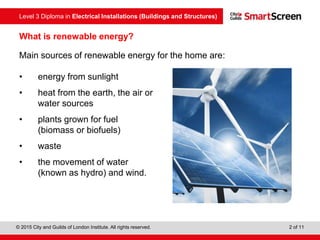
Main sources of renewable energy for the home are:
• energy from sunlight
• heat from the earth, the air or
water sources
• plants grown for fuel
(biomass or biofuels)
• waste
• the movement of water
(known as hydro) and wind.
Level 3 Diploma in Electrical Installations (Buildings and Structures)
© 2015 City and Guilds of London Institute. All rights reserved. 3 of 11
Why use renewables?
• making use of secure, local
resources
• reducing the dependence on
non-renewable energy
• helping to keep the air clean
• helping to reduce the production
of carbon dioxide and other
greenhouse gases
• creating new jobs in renewable
energy industries
• saving and even earning money.
Level 3 Diploma in Electrical Installations (Buildings and Structures)
© 2015 City and Guilds of London Institute. All rights reserved. 4 of 11
Solar thermal (hot water)
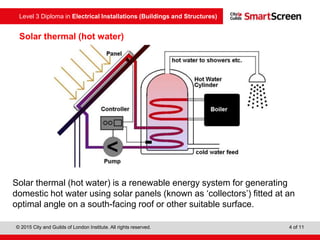
Solar thermal (hot water) is a renewable energy system for generating
domestic hot water using solar panels (known as ‘collectors’) fitted at an
optimal angle on a south-facing roof or other suitable surface.
Level 3 Diploma in Electrical Installations (Buildings and Structures)
© 2015 City and Guilds of London Institute. All rights reserved. 5 of 11
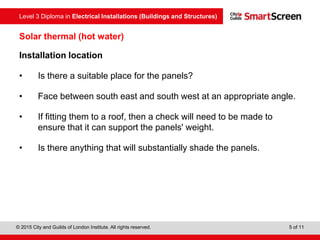
Solar thermal (hot water)
Installation location
• Is there a suitable place for the panels?
• Face between south east and south west at an appropriate angle.
• If fitting them to a roof, then a check will need to be made to
ensure that it can support the panels' weight.
• Is there anything that will substantially shade the panels.
Level 3 Diploma in Electrical Installations (Buildings and Structures)
© 2015 City and Guilds of London Institute. All rights reserved. 6 of 11
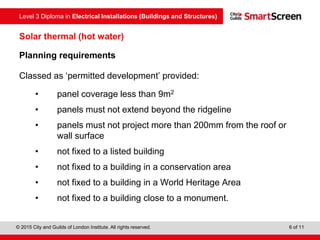
Solar thermal (hot water)
Planning requirements
Classed as ‘permitted development’ provided:
• panel coverage less than 9m2
• panels must not extend beyond the ridgeline
• panels must not project more than 200mm from the roof or
wall surface
• not fixed to a listed building
• not fixed to a building in a conservation area
• not fixed to a building in a World Heritage Area
• not fixed to a building close to a monument.
Level 3 Diploma in Electrical Installations (Buildings and Structures)
© 2015 City and Guilds of London Institute. All rights reserved. 7 of 11
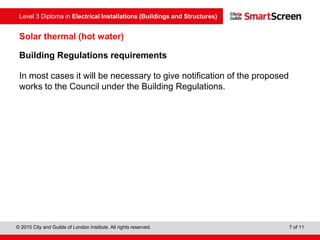
Solar thermal (hot water)
Building Regulations requirements
In most cases it will be necessary to give notification of the proposed
works to the Council under the Building Regulations.
Level 3 Diploma in Electrical Installations (Buildings and Structures)
© 2015 City and Guilds of London Institute. All rights reserved. 8 of 11
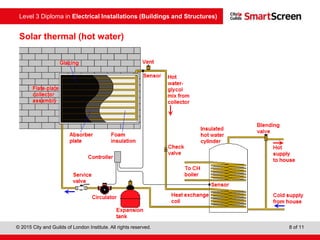
Solar thermal (hot water)
Level 3 Diploma in Electrical Installations (Buildings and Structures)
© 2015 City and Guilds of London Institute. All rights reserved. 9 of 11
Solar thermal (hot water)
Advantages of solar thermal (hot water)
• Cut carbon footprint
• Cut bills
• Hot water all year round.
Level 3 Diploma in Electrical Installations (Buildings and Structures)
© 2015 City and Guilds of London Institute. All rights reserved. 10 of 11
Solar thermal (hot water)
Disadvantages of solar thermal (hot water)
• Only available during daytime
• Subject to the effects of climatic changes
• Dependant on geographical location
• Energy conversion rates or efficiencies are low compared to other
energy sources
• High capital cost.
Level 3 Diploma in Electrical Installations (Buildings and Structures)
© 2015 City and Guilds of London Institute. All rights reserved. 11 of 11
Any questions?

Solar thermal

  • 1.
    Level 3 Diplomain Electrical Installations (Buildings and Structures) © 2015 City and Guilds of London Institute. All rights reserved. 1 of 11 PowerPointpresentation Solar thermal (hot water) Unit 301: Understand the fundamental principles and requirements of environmental technology systems
  • 2.
    Level 3 Diplomain Electrical Installations (Buildings and Structures) © 2015 City and Guilds of London Institute. All rights reserved. 2 of 11 What is renewable energy? Main sources of renewable energy for the home are: • energy from sunlight • heat from the earth, the air or water sources • plants grown for fuel (biomass or biofuels) • waste • the movement of water (known as hydro) and wind.
  • 3.
    Level 3 Diplomain Electrical Installations (Buildings and Structures) © 2015 City and Guilds of London Institute. All rights reserved. 3 of 11 Why use renewables? • making use of secure, local resources • reducing the dependence on non-renewable energy • helping to keep the air clean • helping to reduce the production of carbon dioxide and other greenhouse gases • creating new jobs in renewable energy industries • saving and even earning money.
  • 4.
    Level 3 Diplomain Electrical Installations (Buildings and Structures) © 2015 City and Guilds of London Institute. All rights reserved. 4 of 11 Solar thermal (hot water) Solar thermal (hot water) is a renewable energy system for generating domestic hot water using solar panels (known as ‘collectors’) fitted at an optimal angle on a south-facing roof or other suitable surface.
  • 5.
    Level 3 Diplomain Electrical Installations (Buildings and Structures) © 2015 City and Guilds of London Institute. All rights reserved. 5 of 11 Solar thermal (hot water) Installation location • Is there a suitable place for the panels? • Face between south east and south west at an appropriate angle. • If fitting them to a roof, then a check will need to be made to ensure that it can support the panels' weight. • Is there anything that will substantially shade the panels.
  • 6.
    Level 3 Diplomain Electrical Installations (Buildings and Structures) © 2015 City and Guilds of London Institute. All rights reserved. 6 of 11 Solar thermal (hot water) Planning requirements Classed as ‘permitted development’ provided: • panel coverage less than 9m2 • panels must not extend beyond the ridgeline • panels must not project more than 200mm from the roof or wall surface • not fixed to a listed building • not fixed to a building in a conservation area • not fixed to a building in a World Heritage Area • not fixed to a building close to a monument.
  • 7.
    Level 3 Diplomain Electrical Installations (Buildings and Structures) © 2015 City and Guilds of London Institute. All rights reserved. 7 of 11 Solar thermal (hot water) Building Regulations requirements In most cases it will be necessary to give notification of the proposed works to the Council under the Building Regulations.
  • 8.
    Level 3 Diplomain Electrical Installations (Buildings and Structures) © 2015 City and Guilds of London Institute. All rights reserved. 8 of 11 Solar thermal (hot water)
  • 9.
    Level 3 Diplomain Electrical Installations (Buildings and Structures) © 2015 City and Guilds of London Institute. All rights reserved. 9 of 11 Solar thermal (hot water) Advantages of solar thermal (hot water) • Cut carbon footprint • Cut bills • Hot water all year round.
  • 10.
    Level 3 Diplomain Electrical Installations (Buildings and Structures) © 2015 City and Guilds of London Institute. All rights reserved. 10 of 11 Solar thermal (hot water) Disadvantages of solar thermal (hot water) • Only available during daytime • Subject to the effects of climatic changes • Dependant on geographical location • Energy conversion rates or efficiencies are low compared to other energy sources • High capital cost.
  • 11.
    Level 3 Diplomain Electrical Installations (Buildings and Structures) © 2015 City and Guilds of London Institute. All rights reserved. 11 of 11 Any questions?