




In the name of Allah Kareem,
Most Beneficent, Most Gracious,
the Most Merciful !
RESEARCH PARADIGMS/ WORLD VIEWS


   Positivism           Interpretivism         Pragmatism
Determination         Understanding           Consequences of
Reductionism          Multiple participant    actions
Empirical             meanings                Problem centered
observation and       Social and historical   Pluralistic
measurement           construction            Real-world
Theory verification   Theory generation       practice oriented
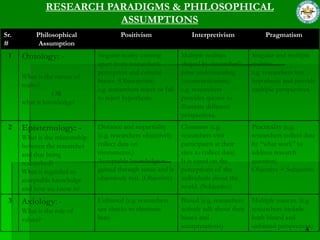
RESEARCH PARADIGMS & PHILOSOPHICAL
                         ASSUMPTIONS
Sr.        Philosophical                  Positivism                   Interpretivism               Pragmatism
#           Assumption
 1    Ontology: -                Singular reality existing         Multiple realities          Singular and multiple
                                 apart from researcher’s           shaped by researcher’s      realities.
                                 perception and cultural           prior understanding         e.g. researchers test
      What is the nature of
                                 biases. (Objectivism)             (constructionism).          hypothesis and provide
      reality?
                                 e.g. researchers reject or fail   e.g. researchers            multiple perspectives.
                 OR
                                 to reject hypothesis.             provides quotes to
      what is knowledge?
                                                                   illustrate different
                                                                   perspectives.
 2    Epistemology: -            Distance and impartiality         Closeness (e.g.             Practicality (e.g.
      What is the relationship   (e.g. researchers objectively     researchers visit           researchers collect data
      between the researcher     collect data on                   participants at their       by “what work” to
      and that being             instruments.)                     sites to collect data)      address research
      researched?                Acceptable knowledge is           It is cased on the          question).
      What is regarded as        gained through sense and is       perceptions of the          Objective + Subjective
      acceptable knowledge       objectively real. (Objective)     individuals about the
      and how we know it?                                          world. (Subjective)
 3    Axiology: -                Unbiased (e.g. researchers        Biased (e.g. researchers    Multiple stances. (e.g.
      What is the role of        use checks to eliminate           actively talk about their   researchers include
      values?                    bias)                             biases and                  both biased and
                                                                   interpretations)            unbiased perspectives)
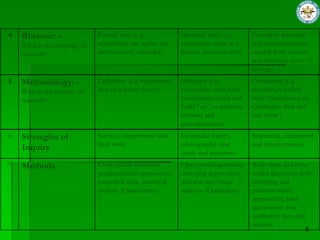
4   Rhetoric: -               Formal style (e.g.            Informal style. (e.g.       Formal or informal
    What is the language of   researchers use agrees on     researchers write in s      (e.g. researchers may
    research?                 definitions of variables)     literary, informal style)   employ both formal
                                                                                        and informal styles of
                                                                                        writing).
5   Methodology: -            Deductive (e.g. researchers   Inductive (e.g.             Combining (e.g.
    What is the process of    that an a priori theory)      researchers start with      researchers collect
    research?                                               participants views and      both Quantitative an
                                                            build “up” to patterns,     Qualitative data and
                                                            theories and                mix them )
                                                            generalizations)
6   Strategies of             Surveys, experiments and      Grounded theory,            Sequential, concurrent
                              field work                    ethnography, case           and transformative.
    Inquiry
                                                            study and narratives
7   Methods                   Close ended questions,        Open ended questions,       Both open and close
                              predetermined approaches      emerging approaches,        ended questions; both
                              numerical data, statistical   and text and image          emerging and
                              analysis (Quantitative)       analysis. (Qualitative)     predetermined
                                                                                        approaches; both
                                                                                        quantitative and
                                                                                        qualitative data and
                                                                                        analysis.
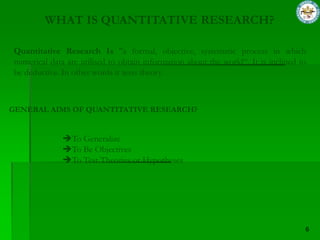
WHAT IS QUANTITATIVE RESEARCH?

Quantitative Research Is "a formal, objective, systematic process in which
numerical data are utilised to obtain information about the world“. It is inclined to
be deductive. In other words it tests theory.


GENERAL AIMS OF QUANTITATIVE RESEARCH?


              To Generalize
              To Be Objectives
              To Test Theories or Hypotheses
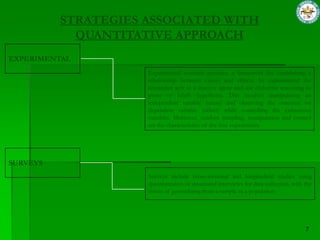
STRATEGIES ASSOCIATED WITH
            QUANTITATIVE APPROACH
EXPERIMENTAL
                     Experimental research provides a framework for establishing a
                     relationship between causes and effects. In experimental the
                     researcher acts as a inactive agent and use deductive reasoning to
                     prove or falsify hypothesis. This involves manipulating an
                     independent variable (cause) and observing the outcome on
                     dependent variable (effect) while controlling the extraneous
                     variables. Moreover, random sampling, manipulation and control
                     are the characteristics of the true experiments.


SURVEYS
                     Surveys include cross-sectional and longitudinal studies using
                     questionnaires or structured interviews for data collection, with the
                     intent of generalizing from a sample to a population
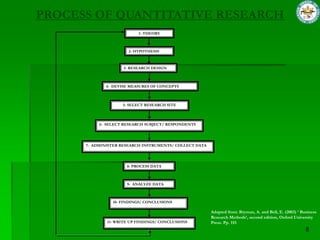
PROCESS OF QUANTITATIVE RESEARCH
                           1- THEORY


                       2- HYPOTHESIS


                     3- RESEARCH DESIGN


              4- DEVISE MEASURES OF CONCEPTS


                    5- SELECT RESEARCH SITE


           6- SELECT RESEARCH SUBJECT/ RESPONDENTS


      7- ADMINISTER RESEARCH INSTRUMENTS/ COLLECT DATA


                      8- PROCESS DATA


                      9- ANALYZE DATA


                10- FINDINGS/ CONCLUSIONS

                                                         Adapted from: Bryman, A. and Bell, E. (2003) ‘ Business
                                                         Research Methods’, second edition, Oxford University
              11- WRITE UP FINDINGS/ CONCLUSIONS         Press. Pp. 155
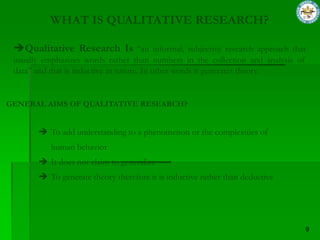
WHAT IS QUALITATIVE RESEARCH?

 Qualitative Research Is “an informal, subjective research approach that
 usually emphasizes words rather than numbers in the collection and analysis of
 data” and that is inductive in nature. In other words it generates theory.


GENERAL AIMS OF QUALITATIVE RESEARCH?


        To add understanding to a phenomenon or the complexities of
           human behavior
        It does not claim to generalize
        To generate theory therefore it is inductive rather than deductive
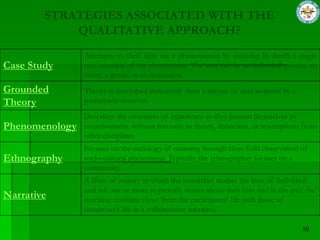
STRATEGIES ASSOCIATED WITH THE
            QUALITATIVE APPROACH?
                Attempts to shed light on a phenomenon by studying in depth a single
Case Study      case example of the phenomena. The case can be an individual person, an
                event, a group, or an institution.
Grounded        Theory is developed inductively from a corpus of data acquired by a
Theory          participant-observer.

                Describes the structures of experience as they present themselves to
Phenomenology   consciousness, without recourse to theory, deduction, or assumptions from
                other disciplines
                Focuses on the sociology of meaning through close field observation of
Ethnography     socio-cultural phenomena. Typically, the ethnographer focuses on a
                community.
                A from of inquiry in which the researcher studies the lives of individual
                and ask one or more to provide stories about their lives and in the end, the
Narrative       narrative combine views from the participants’ life with those of
                researcher’s life in a collaborative narrative.
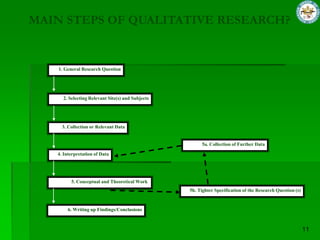
MAIN STEPS OF QUALITATIVE RESEARCH?


   1. General Research Question


     2. Selecting Relevant Site(s) and Subjects


     3. Collection or Relevant Data


                                                        5a. Collection of Further Data
   4. Interpretation of Data


         5. Conceptual and Theoretical Work
                                                  5b. Tighter Specification of the Research Question (s)


       6. Writing up Findings/Conclusions
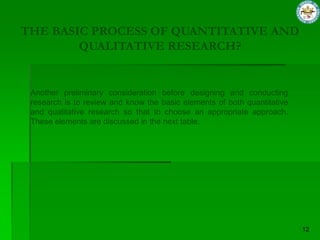
THE BASIC PROCESS OF QUANTITATIVE AND
        QUALITATIVE RESEARCH?


 Another preliminary consideration before designing and conducting
 research is to review and know the basic elements of both quantitative
 and qualitative research so that to choose an appropriate approach.
 These elements are discussed in the next table.
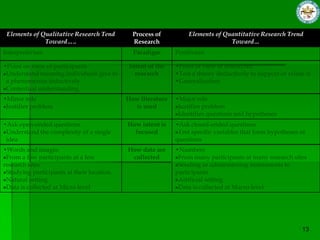
Elements of Qualitative Research Tend        Process of          Elements of Quantitative Research Trend
              Toward…..                       Research                          Toward…
Interpretivism                                Paradigm       Positivism

•Point on view of participants               Intent of the   •Point of view of researcher
 Understand meaning individuals give to        research      •Test a theory deductively to support or refute it
 a phenomenon inductively                                    •Generalization
 Contextual understanding
•Minor role                                 How literature   •Major role
 Justifies problem                            is used         Justifies problem
                                                              Identifies questions and hypotheses
•Ask open-ended questions                   How intent is    •Ask closed-ended questions
 Understand the complexity of a single        focused         Test specific variables that form hypotheses or
 idea                                                        questions
•Words and images                           How data are     •Numbers
 From a few participants at a few            collected        From many participants at many research sites
research sites                                                Sending or administering instruments to
 Studying participants at their location.                    participants
 Natural setting                                              Artificial setting
 Data is collected at Micro level                             Data is collected at Macro level
•Text or image analysis                     How data are   •Numerical statistical analysis
 Themes                                      analyzed       Rejecting hypotheses or determining effect sizes
 Larger patterns or generalizations.
•Using validity procedures that rely on     How data are   •Using validity procedures based on external
 the participants, the researcher, or the    validated      standards, such as judges, past research, statistics
 reader
•Researcher is close                         Role of the   •Researcher is distant
 Identifies personal stance                  researcher     Remains in background
 Reports bias                                               Take steps to remove bias
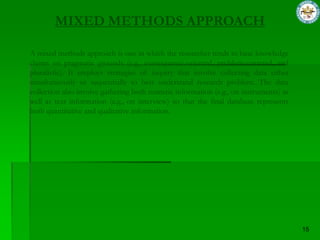
MIXED METHODS APPROACH

A mixed methods approach is one in which the researcher tends to base knowledge
claims on pragmatic grounds (e.g., consequence-oriented, problem-centered, and
pluralistic). It employs strategies of inquiry that involve collecting data either
simultaneously or sequentially to best understand research problem. The data
collection also involve gathering both numeric information (e.g., on instruments) as
well as text information (e.g., on interview) so that the final database represents
both quantitative and qualitative information.
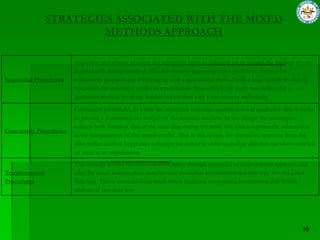
STRATEGIES ASSOCIATED WITH THE MIXED
                          METHODS APPROACH

                        Sequential procedures, in which the researcher seeks to elaborate on or expand the findings of one
                        method with another method. This may involve beginning with a qualitative method for
Sequential Procedures   exploratory purposes and following up with a quantitative method with a large sample so that the
                        researcher can generalize results to a population. Alternatively, the study may begin with a
                        qualitative method involving detailed exploration with a few cases or individuals.

                        Concurrent procedures, in which the researcher converges quantitative and qualitative data in order
                        to provide a comprehensive analysis of the research problem. In this design, the investigator
                        collects both forms of data at the same time during the study and then integrates the information
Concurrent Procedures
                        in the interpretation of the overall results. Also, in this design, the researcher nests one from the
                        data within another, larger data collection procedure in order to analyze different questions or levels
                        of units in an organization.
                        This strategy involve the data collection either through sequential or a con-current approach, but
Transformative          after the initial analysis, there searcher uses procedure to transform one data type into the other
Procedures              data type. This is accomplishing result which facilitates comparison, interrelation and further
                        analysis of two data sets.
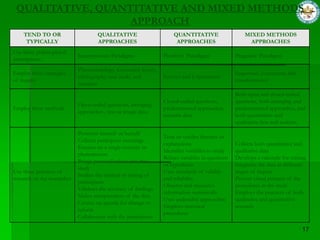
QUALITATIVE, QUANTITATIVE AND MIXED METHODS
                   APPROACH
    TEND TO OR                        QUALITATIVE                      QUANTITATIVE                     MIXED METHODS
     TYPICALLY                        APPROACHES                        APPROACHES                        APPROACHES
Use these philosophical
                              Interpretatism Paradigms             Positivist Paradigms             Pragmatic Paradigms
assumptions
                              Phenomenology. Grounded theory,
Employ these strategies                                                                             Sequential, concurrent, and
                              ethnography, case study, and         Surveys and Experiments
of inquiry                                                                                          transformative
                              narrative
                                                                                                    Both open and closed-ended
                                                                   Closed-ended questions,          questions, both emerging and
                              Open-ended questions, emerging
Employ these methods                                               predetermined approaches,        predetermined approaches, and
                              approaches , text or image data
                                                                   numeric data                     both quantitative and
                                                                                                    qualitative data and analysis.
                              Positions himself or herself
                                                                   Tests or verifies theories or
                              Collects participant meanings
                                                                   explanations                     Collects both quantitative and
                              Focuses on a single concept or
                                                                   Identifies variables to study    qualitative data
                              phenomenon
                                                                   Relates variables in questions   Develops a rationale for mixing
                              Brings personal values into this
                                                                   or hypothesis                    integrates the data at different
                              study
Use these practices of                                             Uses standards of validity       stages of inquiry
                              Studies the context or setting of
research, as the researcher                                        and reliability                  Present visual pictures of the
                              participants
                                                                   Observe and measures             procedures in the study
                              Validates the accuracy of findings
                                                                   information numerically          Employs the practices of both
                              Makes interpretation of the data
                                                                   Uses undecided approaches        qualitative and quantitative
                              Creates on agenda for change or
                                                                   Employs statistical              research
                              reform
                                                                   procedures
                              Collaborates with the participants
SUPERIOR GROUP OF COLLEGES   18

RESEARCH PARADIGMS WORLD VIEWS

  • 1.
    In the nameof Allah Kareem, Most Beneficent, Most Gracious, the Most Merciful !
  • 3.
    RESEARCH PARADIGMS/ WORLDVIEWS Positivism Interpretivism Pragmatism Determination Understanding Consequences of Reductionism Multiple participant actions Empirical meanings Problem centered observation and Social and historical Pluralistic measurement construction Real-world Theory verification Theory generation practice oriented
  • 4.
    RESEARCH PARADIGMS &PHILOSOPHICAL ASSUMPTIONS Sr. Philosophical Positivism Interpretivism Pragmatism # Assumption 1 Ontology: - Singular reality existing Multiple realities Singular and multiple apart from researcher’s shaped by researcher’s realities. perception and cultural prior understanding e.g. researchers test What is the nature of biases. (Objectivism) (constructionism). hypothesis and provide reality? e.g. researchers reject or fail e.g. researchers multiple perspectives. OR to reject hypothesis. provides quotes to what is knowledge? illustrate different perspectives. 2 Epistemology: - Distance and impartiality Closeness (e.g. Practicality (e.g. What is the relationship (e.g. researchers objectively researchers visit researchers collect data between the researcher collect data on participants at their by “what work” to and that being instruments.) sites to collect data) address research researched? Acceptable knowledge is It is cased on the question). What is regarded as gained through sense and is perceptions of the Objective + Subjective acceptable knowledge objectively real. (Objective) individuals about the and how we know it? world. (Subjective) 3 Axiology: - Unbiased (e.g. researchers Biased (e.g. researchers Multiple stances. (e.g. What is the role of use checks to eliminate actively talk about their researchers include values? bias) biases and both biased and interpretations) unbiased perspectives)
  • 5.
    4 Rhetoric: - Formal style (e.g. Informal style. (e.g. Formal or informal What is the language of researchers use agrees on researchers write in s (e.g. researchers may research? definitions of variables) literary, informal style) employ both formal and informal styles of writing). 5 Methodology: - Deductive (e.g. researchers Inductive (e.g. Combining (e.g. What is the process of that an a priori theory) researchers start with researchers collect research? participants views and both Quantitative an build “up” to patterns, Qualitative data and theories and mix them ) generalizations) 6 Strategies of Surveys, experiments and Grounded theory, Sequential, concurrent field work ethnography, case and transformative. Inquiry study and narratives 7 Methods Close ended questions, Open ended questions, Both open and close predetermined approaches emerging approaches, ended questions; both numerical data, statistical and text and image emerging and analysis (Quantitative) analysis. (Qualitative) predetermined approaches; both quantitative and qualitative data and analysis.
  • 6.
    WHAT IS QUANTITATIVERESEARCH? Quantitative Research Is "a formal, objective, systematic process in which numerical data are utilised to obtain information about the world“. It is inclined to be deductive. In other words it tests theory. GENERAL AIMS OF QUANTITATIVE RESEARCH? To Generalize To Be Objectives To Test Theories or Hypotheses
  • 7.
    STRATEGIES ASSOCIATED WITH QUANTITATIVE APPROACH EXPERIMENTAL Experimental research provides a framework for establishing a relationship between causes and effects. In experimental the researcher acts as a inactive agent and use deductive reasoning to prove or falsify hypothesis. This involves manipulating an independent variable (cause) and observing the outcome on dependent variable (effect) while controlling the extraneous variables. Moreover, random sampling, manipulation and control are the characteristics of the true experiments. SURVEYS Surveys include cross-sectional and longitudinal studies using questionnaires or structured interviews for data collection, with the intent of generalizing from a sample to a population
  • 8.
    PROCESS OF QUANTITATIVERESEARCH 1- THEORY 2- HYPOTHESIS 3- RESEARCH DESIGN 4- DEVISE MEASURES OF CONCEPTS 5- SELECT RESEARCH SITE 6- SELECT RESEARCH SUBJECT/ RESPONDENTS 7- ADMINISTER RESEARCH INSTRUMENTS/ COLLECT DATA 8- PROCESS DATA 9- ANALYZE DATA 10- FINDINGS/ CONCLUSIONS Adapted from: Bryman, A. and Bell, E. (2003) ‘ Business Research Methods’, second edition, Oxford University 11- WRITE UP FINDINGS/ CONCLUSIONS Press. Pp. 155
  • 9.
    WHAT IS QUALITATIVERESEARCH? Qualitative Research Is “an informal, subjective research approach that usually emphasizes words rather than numbers in the collection and analysis of data” and that is inductive in nature. In other words it generates theory. GENERAL AIMS OF QUALITATIVE RESEARCH?  To add understanding to a phenomenon or the complexities of human behavior  It does not claim to generalize  To generate theory therefore it is inductive rather than deductive
  • 10.
    STRATEGIES ASSOCIATED WITHTHE QUALITATIVE APPROACH? Attempts to shed light on a phenomenon by studying in depth a single Case Study case example of the phenomena. The case can be an individual person, an event, a group, or an institution. Grounded Theory is developed inductively from a corpus of data acquired by a Theory participant-observer. Describes the structures of experience as they present themselves to Phenomenology consciousness, without recourse to theory, deduction, or assumptions from other disciplines Focuses on the sociology of meaning through close field observation of Ethnography socio-cultural phenomena. Typically, the ethnographer focuses on a community. A from of inquiry in which the researcher studies the lives of individual and ask one or more to provide stories about their lives and in the end, the Narrative narrative combine views from the participants’ life with those of researcher’s life in a collaborative narrative.
  • 11.
    MAIN STEPS OFQUALITATIVE RESEARCH? 1. General Research Question 2. Selecting Relevant Site(s) and Subjects 3. Collection or Relevant Data 5a. Collection of Further Data 4. Interpretation of Data 5. Conceptual and Theoretical Work 5b. Tighter Specification of the Research Question (s) 6. Writing up Findings/Conclusions
  • 12.
    THE BASIC PROCESSOF QUANTITATIVE AND QUALITATIVE RESEARCH? Another preliminary consideration before designing and conducting research is to review and know the basic elements of both quantitative and qualitative research so that to choose an appropriate approach. These elements are discussed in the next table.
  • 13.
    Elements of QualitativeResearch Tend Process of Elements of Quantitative Research Trend Toward….. Research Toward… Interpretivism Paradigm Positivism •Point on view of participants Intent of the •Point of view of researcher Understand meaning individuals give to research •Test a theory deductively to support or refute it a phenomenon inductively •Generalization Contextual understanding •Minor role How literature •Major role Justifies problem is used Justifies problem Identifies questions and hypotheses •Ask open-ended questions How intent is •Ask closed-ended questions Understand the complexity of a single focused Test specific variables that form hypotheses or idea questions •Words and images How data are •Numbers From a few participants at a few collected From many participants at many research sites research sites Sending or administering instruments to Studying participants at their location. participants Natural setting Artificial setting Data is collected at Micro level Data is collected at Macro level
  • 14.
    •Text or imageanalysis How data are •Numerical statistical analysis Themes analyzed Rejecting hypotheses or determining effect sizes Larger patterns or generalizations. •Using validity procedures that rely on How data are •Using validity procedures based on external the participants, the researcher, or the validated standards, such as judges, past research, statistics reader •Researcher is close Role of the •Researcher is distant Identifies personal stance researcher Remains in background Reports bias Take steps to remove bias
  • 15.
    MIXED METHODS APPROACH Amixed methods approach is one in which the researcher tends to base knowledge claims on pragmatic grounds (e.g., consequence-oriented, problem-centered, and pluralistic). It employs strategies of inquiry that involve collecting data either simultaneously or sequentially to best understand research problem. The data collection also involve gathering both numeric information (e.g., on instruments) as well as text information (e.g., on interview) so that the final database represents both quantitative and qualitative information.
  • 16.
    STRATEGIES ASSOCIATED WITHTHE MIXED METHODS APPROACH Sequential procedures, in which the researcher seeks to elaborate on or expand the findings of one method with another method. This may involve beginning with a qualitative method for Sequential Procedures exploratory purposes and following up with a quantitative method with a large sample so that the researcher can generalize results to a population. Alternatively, the study may begin with a qualitative method involving detailed exploration with a few cases or individuals. Concurrent procedures, in which the researcher converges quantitative and qualitative data in order to provide a comprehensive analysis of the research problem. In this design, the investigator collects both forms of data at the same time during the study and then integrates the information Concurrent Procedures in the interpretation of the overall results. Also, in this design, the researcher nests one from the data within another, larger data collection procedure in order to analyze different questions or levels of units in an organization. This strategy involve the data collection either through sequential or a con-current approach, but Transformative after the initial analysis, there searcher uses procedure to transform one data type into the other Procedures data type. This is accomplishing result which facilitates comparison, interrelation and further analysis of two data sets.
  • 17.
    QUALITATIVE, QUANTITATIVE ANDMIXED METHODS APPROACH TEND TO OR QUALITATIVE QUANTITATIVE MIXED METHODS TYPICALLY APPROACHES APPROACHES APPROACHES Use these philosophical Interpretatism Paradigms Positivist Paradigms Pragmatic Paradigms assumptions Phenomenology. Grounded theory, Employ these strategies Sequential, concurrent, and ethnography, case study, and Surveys and Experiments of inquiry transformative narrative Both open and closed-ended Closed-ended questions, questions, both emerging and Open-ended questions, emerging Employ these methods predetermined approaches, predetermined approaches, and approaches , text or image data numeric data both quantitative and qualitative data and analysis. Positions himself or herself Tests or verifies theories or Collects participant meanings explanations Collects both quantitative and Focuses on a single concept or Identifies variables to study qualitative data phenomenon Relates variables in questions Develops a rationale for mixing Brings personal values into this or hypothesis integrates the data at different study Use these practices of Uses standards of validity stages of inquiry Studies the context or setting of research, as the researcher and reliability Present visual pictures of the participants Observe and measures procedures in the study Validates the accuracy of findings information numerically Employs the practices of both Makes interpretation of the data Uses undecided approaches qualitative and quantitative Creates on agenda for change or Employs statistical research reform procedures Collaborates with the participants
  • 18.
    SUPERIOR GROUP OFCOLLEGES 18