The document outlines different research paradigms including positivism, which uses scientific methods and quantitative data, interpretivism/constructivism, which relies on participants' views and qualitative data, and pragmatism, which
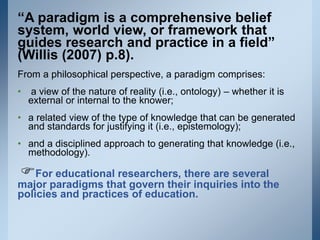
“A paradigm isa comprehensive belief
system, world view, or framework that
guides research and practice in a field”
(Willis (2007) p.8).
From a philosophical perspective, a paradigm comprises:
• a view of the nature of reality (i.e., ontology) – whether it is
external or internal to the knower;
• a related view of the type of knowledge that can be generated
and standards for justifying it (i.e., epistemology);
• and a disciplined approach to generating that knowledge (i.e.,
methodology).
For educational researchers, there are several
major paradigms that govern their inquiries into the
policies and practices of education.
Positivism is sometimesreferred to as 'scientific method'
or 'science research', is "based on the rationalistic,
empiricist philosophy that originated with Aristotle,
Francis Bacon, John Locke, August Comte, and Emmanuel
Kant" (Mertens, 2005, p.8) and "reflects a deterministic
philosophy in which causes probably determine effects or
outcomes“
Example: Walking helps decrease sugar levels in diabetic
patients.
Cause: Walking
Effect: Decrease in sugar level in diabetic patients.
Positivism
7.
• This ‘scientific’research paradigm strives to investigate,
confirm and predict law-like patterns of behaviour, and is
commonly used in graduate research to test theories or
hypotheses.
• This is particularly useful in natural science, physical science
and, to some extent, in the social sciences, especially where
very large sample sizes are involved.
• Generally its focus is on the objectivity of the research process
(Creswell, 2008).
• The positivist paradigm mostly involves quantitative
methodology, utilizing experimental methods involving
experimental (or treatment) and control groups and
administration of pre- and post-tests to measure gain scores.
Here, the researcher is external to the research site and is the
controller of the research process.
Some features:
8.
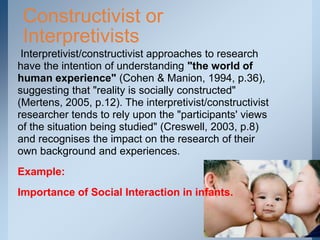
Interpretivist/constructivist approaches toresearch
have the intention of understanding "the world of
human experience" (Cohen & Manion, 1994, p.36),
suggesting that "reality is socially constructed"
(Mertens, 2005, p.12). The interpretivist/constructivist
researcher tends to rely upon the "participants' views
of the situation being studied" (Creswell, 2003, p.8)
and recognises the impact on the research of their
own background and experiences.
Example:
Importance of Social Interaction in infants.
Constructivist or
Interpretivists
9.
• Constructivists donot generally begin with a theory
(as with positivists) rather they "generate or
inductively develop a theory or pattern of meanings"
(Creswell, 2003, p.9) throughout the research
process.
• The constructivist researcher is most likely to rely on
qualitative data collection methods and analysis or a
combination of both qualitative and quantitative
methods (mixed methods).
• Quantitative data may be utilised in a way, which
supports or expands upon qualitative data and
effectively deepens the description.
Some features:
10.
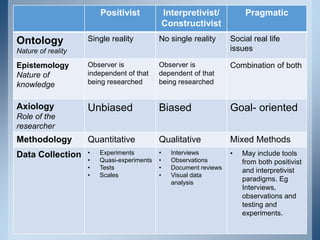
Positivist Interpretivist/
Constructivist
Pragmatic
Ontology
Nature ofreality
Single reality No single reality Social real life
issues
Epistemology
Nature of
knowledge
Observer is
independent of that
being researched
Observer is
dependent of that
being researched
Combination of both
Axiology
Role of the
researcher
Unbiased Biased Goal- oriented
Methodology Quantitative Qualitative Mixed Methods
Data Collection • Experiments
• Quasi-experiments
• Tests
• Scales
• Interviews
• Observations
• Document reviews
• Visual data
analysis
• May include tools
from both positivist
and interpretivist
paradigms. Eg
Interviews,
observations and
testing and
experiments.
11.
• Pragmatism isnot committed to any one system of
philosophy or reality. Pragmatist researchers focus
on the 'what' and 'how' of the research problem
(Creswell, 2003, p.11).
• Early pragmatists "rejected the scientific notion that
social inquiry was able to access the 'truth' about
the real world solely by virtue of a single scientific
method" (Mertens, 2005, p.26).
• Example:
Lowering infant mortality rates.
Pragmatism
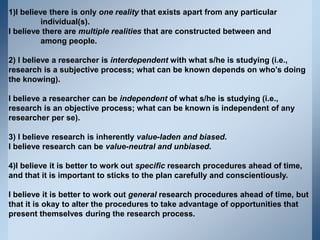
1)I believe thereis only one reality that exists apart from any particular
individual(s).
I believe there are multiple realities that are constructed between and
among people.
2) I believe a researcher is interdependent with what s/he is studying (i.e.,
research is a subjective process; what can be known depends on who’s doing
the knowing).
I believe a researcher can be independent of what s/he is studying (i.e.,
research is an objective process; what can be known is independent of any
researcher per se).
3) I believe research is inherently value-laden and biased.
I believe research can be value-neutral and unbiased.
4)I believe it is better to work out specific research procedures ahead of time,
and that it is important to sticks to the plan carefully and conscientiously.
I believe it is better to work out general research procedures ahead of time, but
that it is okay to alter the procedures to take advantage of opportunities that
present themselves during the research process.
14.
5. I believeit is important to draw more general conclusions that are applicable
to people, situations, and time periods other than the one studied.
I believe it is important to draw more specific conclusions that apply only to
the particular people, situation, or time period actually studied.
6. I believe it is easier to read/write research reports that have an informal
structure and include the personal (first-person) voice of the researcher.
I believe it is easier to read/write research reports that have a formal structure
and are written in an impersonal (third-person) voice.
15.
The Relationship BetweenResearch
Questions and Methodologies
Quantitative methods
• Does? Is (are)? Can? Should? What effect
does ..?
Qualitative methods
• What factors?
• Why?
Quantitative, qualitative, or mixed
methods
• How?
• Being ‘ethical’means that your project
does not bring harm or disadvantage to
anyone who takes part, including
yourself.
-Lambert, Mike (2012-09-05). A Beginner's Guide to
Doing Your Education Research Project (p. 21). SAGE
Publications. Kindle Edition.
Meaning of ethics
18.
• Disturbance: Yourinvestigation could interfere with the
proper running of a class, or your wish to do interviews
may disrupt a teacher’s busy timetable.
• Intrusion: If you withdraw students for research work,
they may miss an important lesson which will adversely
affect their learning.
• Secrecy: If you keep secret from your participants what
you are investigating, those participants may not realize
the implications of what they do or say. If they
understood better, they may have preferred not to take
part.
• Embarrassment: You may ask questions or make
comments which cause embarrassment to your
participants or to the organization where you are doing
your research.
Here are some examples of the harm or disadvantage
which your research could cause:
19.
• Lowering self-esteem:Your research may highlight
deficiencies or personal difficulties in your
participants and lessen their status in front of
colleagues, friends or you, the researcher.
Here too is one way in which your research may harm
yourself:
Resentment: In doing your research, you may ask too
many personal questions, causing resentment
amongst colleagues and adversely affecting your
professional relationships.
20.
• There arevarious codes and guidelines which will
help you to recognize ethical standards in your
research.
• BERA (British Educational Research
Association) BERA’s ethical guidelines
(www.bera.ac.uk) are the most important for UK
researchers. They stress participants’ right to
privacy, to be informed about the research to which
they are being asked to contribute and to withdraw
from the investigation if they so wish. From
researchers, they call for openness and attention to
cultural and other differences.
Codes
Show respect foreveryone who is helping you, as
well as for those who decide that they do not wish to
be involved.
23.
Be ready toexplain and discuss your
research, and respond constructively to
criticism about it.
24.
• Take responsibilityfor
what you do and for its
consequences.
• Respect confidentiality
of data and the anonymity
of those taking part
25.
• Take steps
alsoto avoid
situations
which may
cause harm
to yourself.
Pursue truth in your
investigation, but be
aware of the
implications of this for
others and be
‘tentative and modest’
(Pring, 2004: 149)
about what you claim
to have discovered.
26.
Below are somekey ethical principles, informed by Pring
(2004).
• Show respect for everyone who is helping you, as well as
for those who decide that they do not wish to be involved.
• Be ready to explain and discuss your research, and
respond constructively to criticism about it.
• Respect confidentiality of data and the anonymity of those
taking part.
• Take responsibility for what you do and for its
consequences.
• Take steps also to avoid situations which may cause
harm to yourself.
• Pursue truth in your investigation, but be aware of the
implications of this for others and be ‘tentative and modest’
(Pring, 2004: 149) about what you claim to have discovered.
• What typeof research is it? How do you know?
• What paradigms must have guided these
researches?
• What methods the researcher must have adopted?
How do you know?
• What methodology is best suited for this kind of
research?
• Can you imagine some of the difficulties that the
researcher must have faced? What kind of
difficulties?
• Do you think it benefitted us in anyway? Discuss.
Read the passages and
discuss these with your
partner:
Editor's Notes
#6 Fill in table for your paradigm and give an example of a SoTL RQ that fits within your paradigm
#16 Explain how research questions imply specific methods. Ask what kind of questions were they generating at their tables. Were they Why questions? How questions? What questions?
Then ask how congruent were the questions that they were posing with the research paradigm that they identified as being most true to their own assumptions about the nature of reality, values, methods, and the goal of scholarly inquiry. If they were not congruent, then the type of research design that you are most comfortable with (qualitative or quantitative) may not be the best suited to answer the question you have asked. Explain why qualitative methods are often used when the goal is to understand in classroom research; not always possible to have control group, not always possible to have a large N.