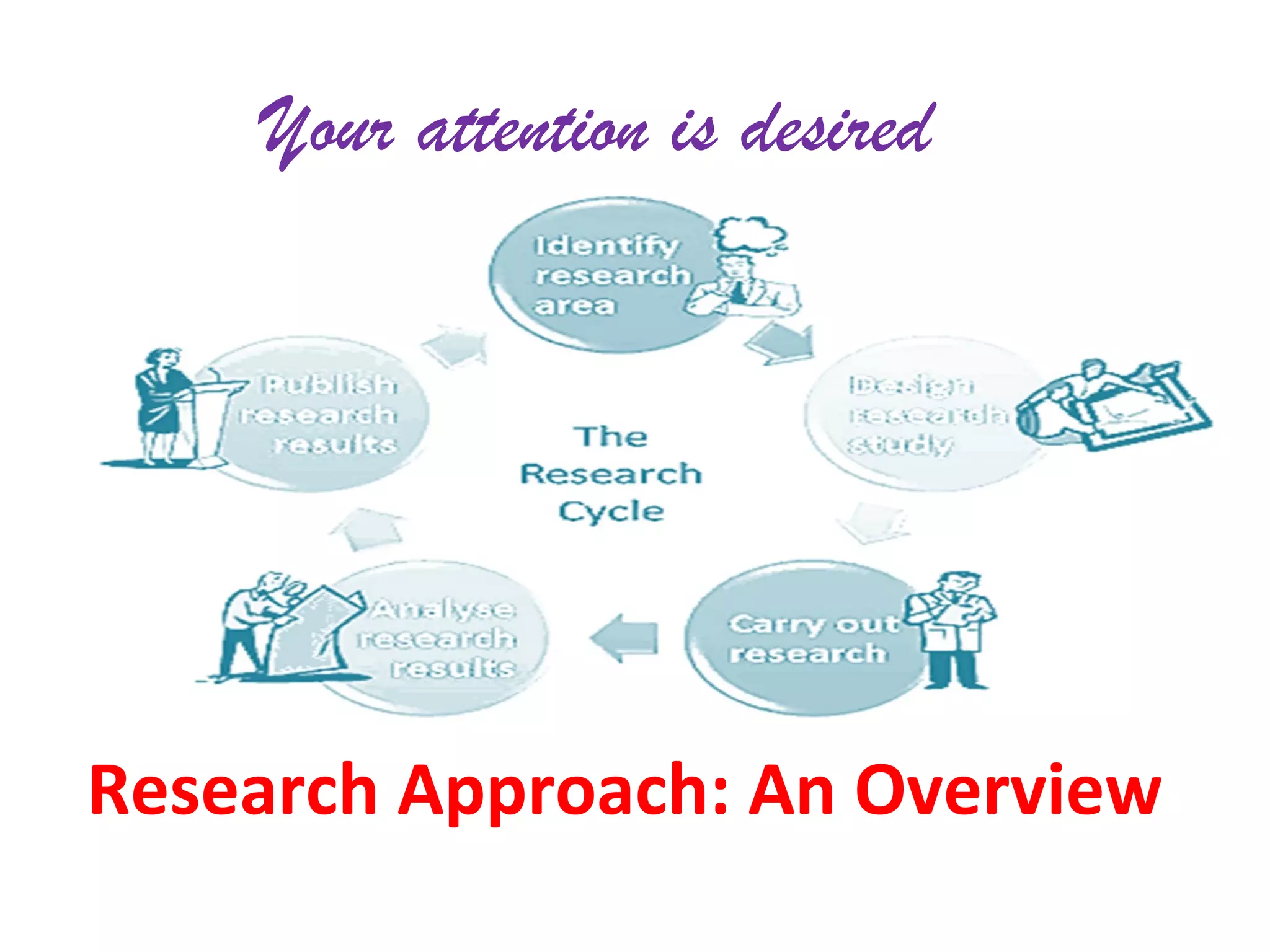
Your attention is desired
Research Approach: An Overview
Research Approach: Concept
Plans and the procedure for research that span the steps
from broad assumptions to detailed methods of data
collection, analysis, and interpretation.
The overall decision involves which approach should be
used to study a topic. Informing this decision should be
the philosophical assumptions the researcher brings to
the study; procedures of inquiry (called research
designs); and specific research methods of data
collection, analysis, and interpretation.
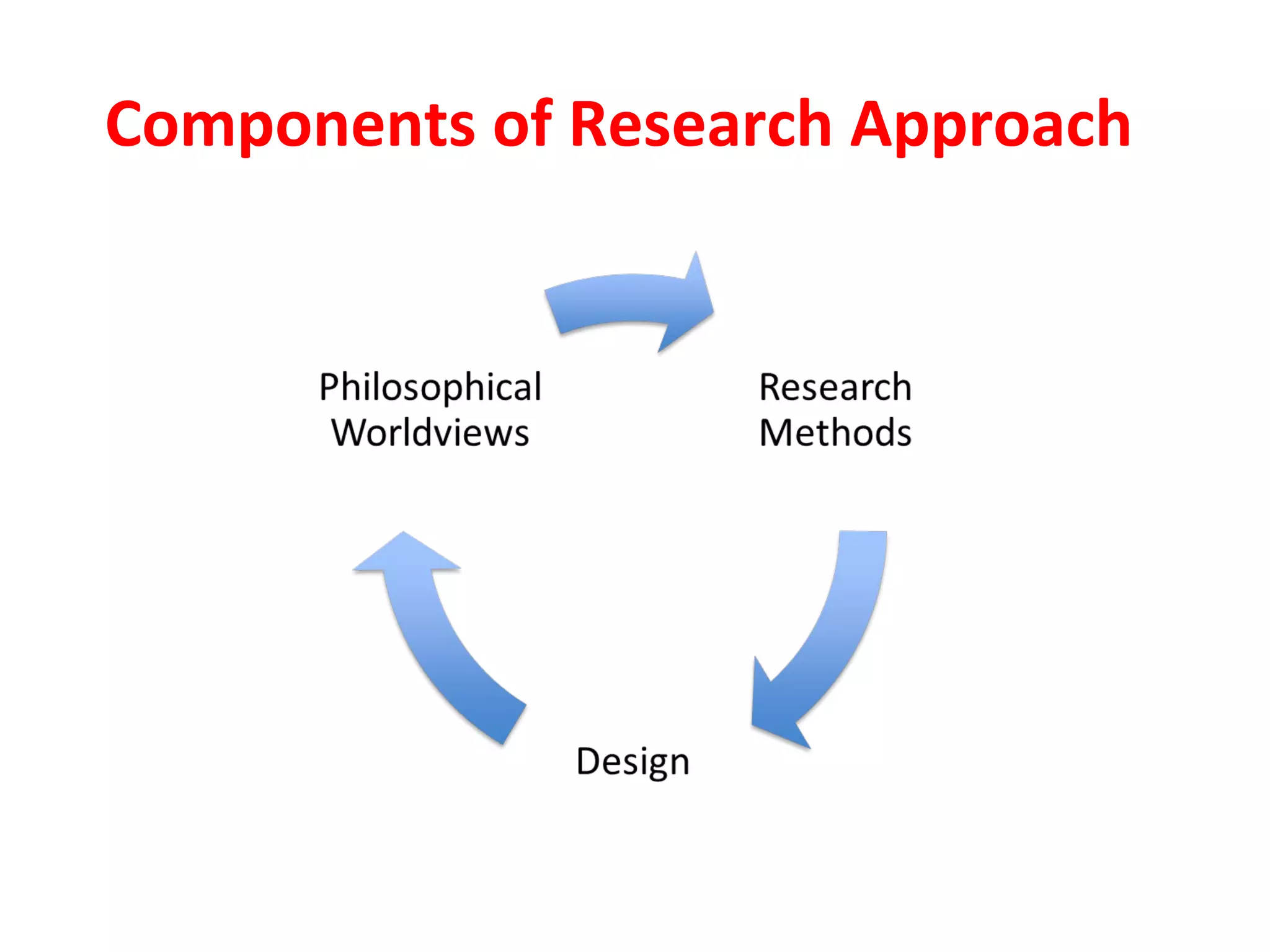
Components of Research Approach
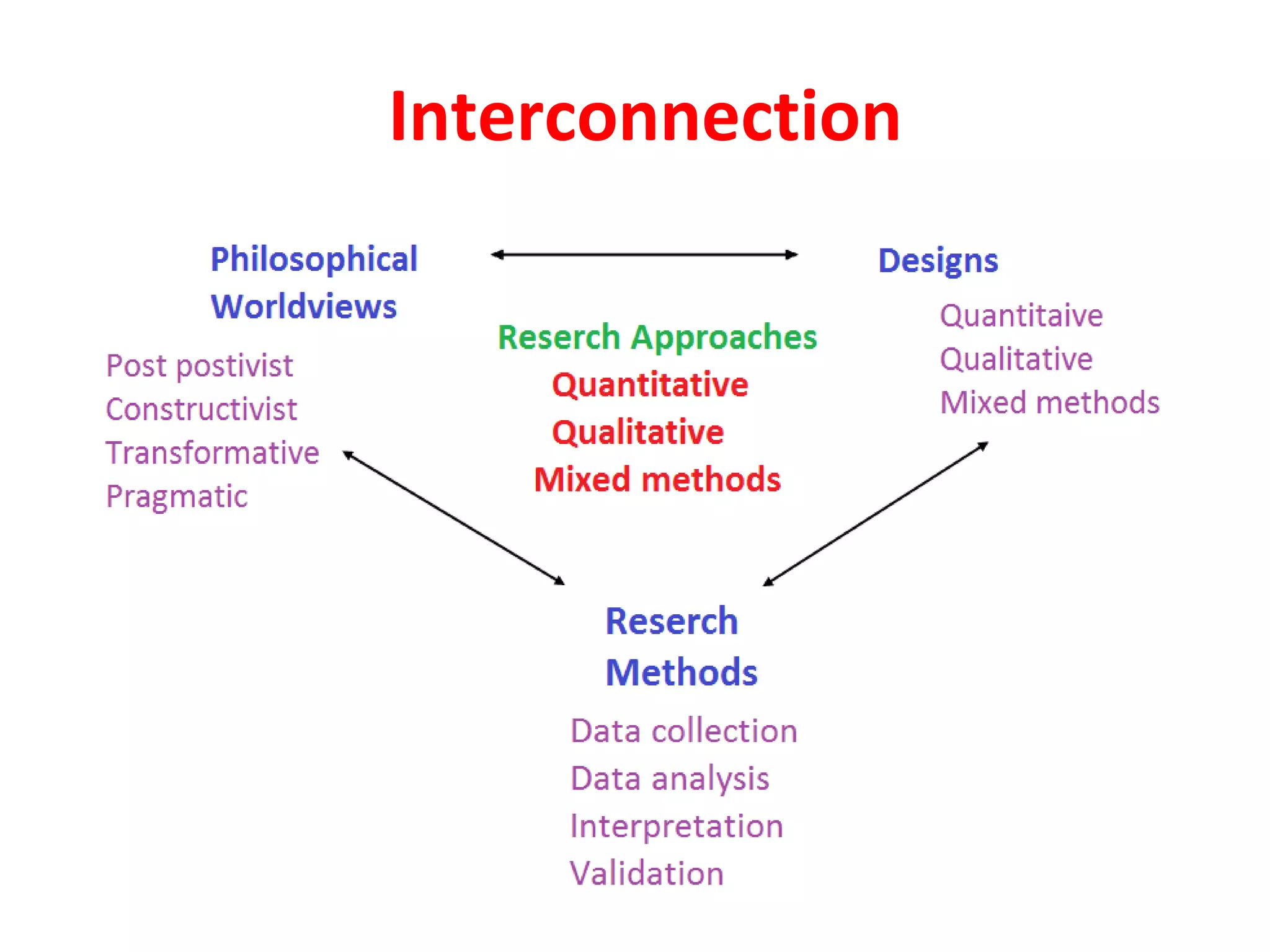
Interconnection
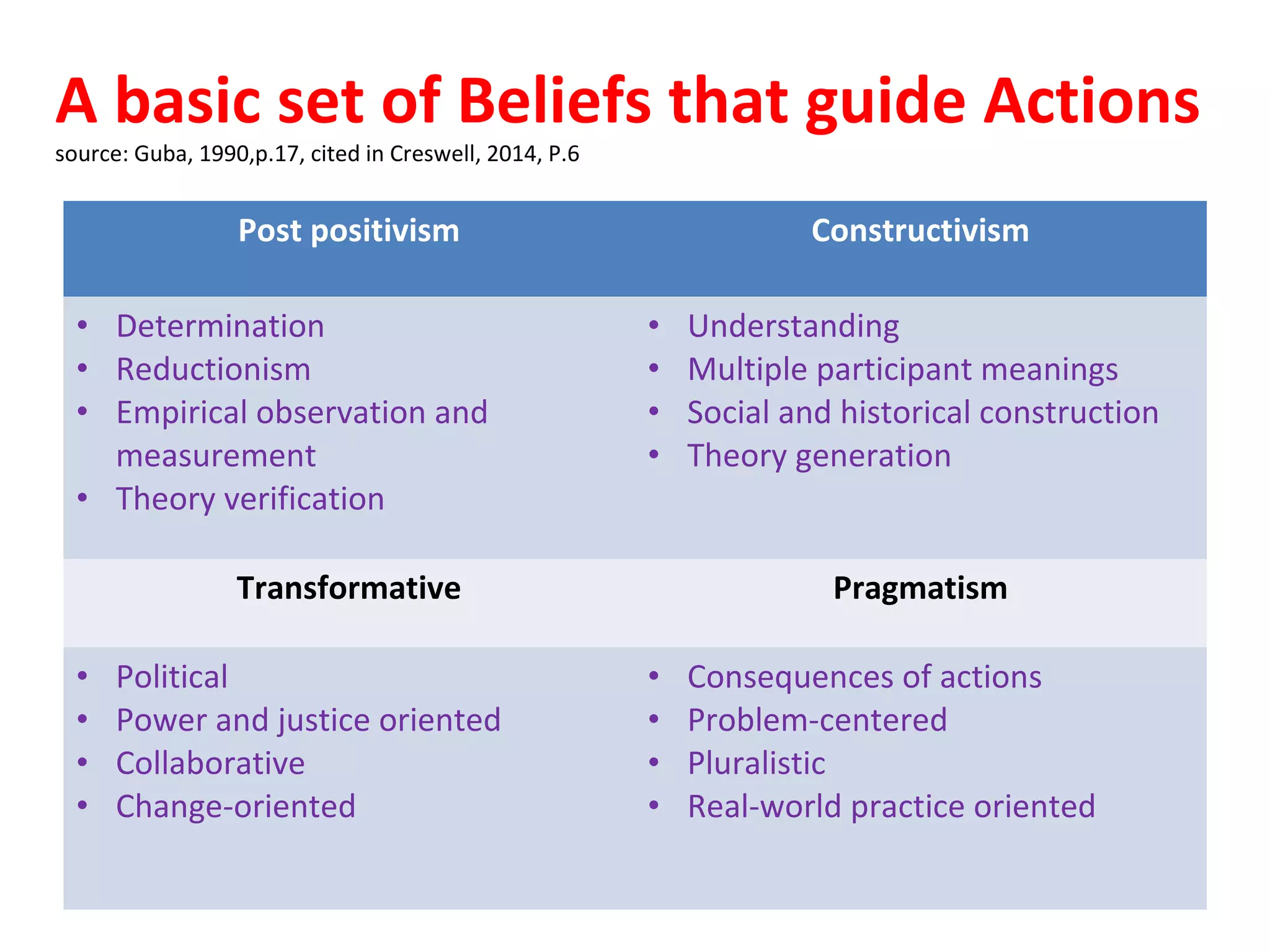
Post positivism Constructivism
• Determination
• Reductionism
• Empirical observation and
measurement
• Theory verification
• Understanding
• Multiple participant meanings
• Social and historical construction
• Theory generation
Transformative Pragmatism
• Political
• Power and justice oriented
• Collaborative
• Change-oriented
• Consequences of actions
• Problem-centered
• Pluralistic
• Real-world practice oriented
A basic set of Beliefs that guide Actions
source: Guba, 1990,p.17, cited in Creswell, 2014, P.6
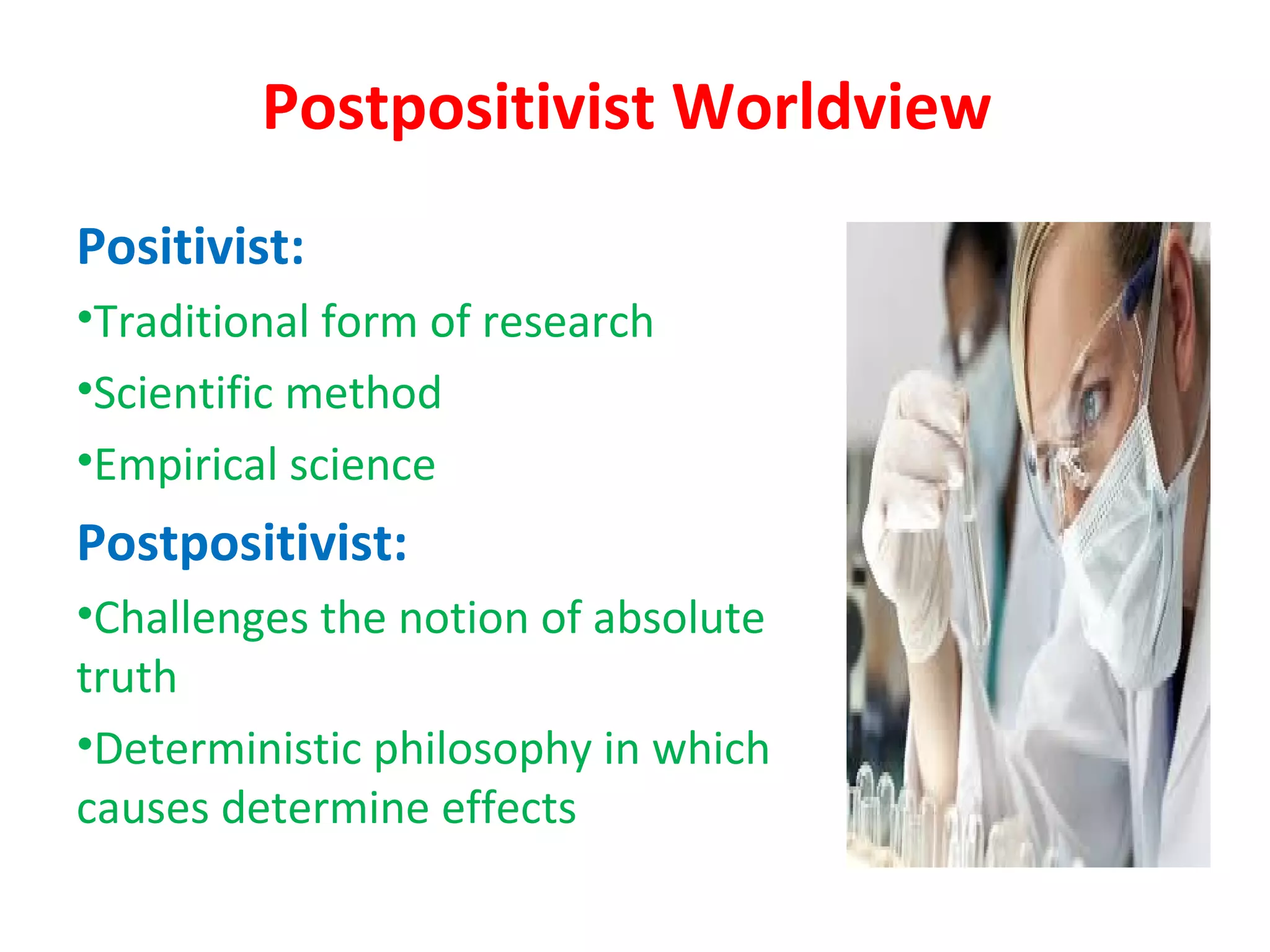
Postpositivist Worldview
Positivist:
•Traditional form of research
•Scientific method
•Empirical science
Postpositivist:
•Challenges the notion of absolute
truth
•Deterministic philosophy in which
causes determine effects
Postpositivist Worldview
• Assesses causes that influence
outcomes
• Reduce ideas to a small set of
ideas to test out as variables
• Research is governed by research
questions or hypothesis
• Careful observation and
measurement of observations
• Testing a theory
5 Principals of Post positivism WV
1. Knowledge is conjectural…
– Cannot prove a hypothesis; we
state failure to reject the
hypothesis or “accept it”
1. Research is the process of making
claims…
– Start with deductively testing a
theory
1. Data, evidence, and rational
considerations shape knowledge
- Collecting information through the
use of instruments
5 Principals of Post positivism WV (Contd.)
4. Research seeks to develop
relevant, true statements…
– Advances the understanding of
relationship among variables
4. Being objective is essential…
– Validity and reliability are
critical
Constructivist Worldview
• Belief that individuals seek
understanding of the world
• Belief that people develop subjective
meanings of their experiences
• Researchers look for the complexity of
views, not the reduction of variables
that explain maximal variance
• Interview questions are often very
open ended to allow participants to
construct their own knowledge of
situations
Constructivist Worldview (contd.)
• Researchers focus on the processes
and interactions
• Recognition that researcher’s personal
background shape interpretation and
meaning (interpretivism)
• Develops inductively a theory or
pattern of meaning instead of testing
from theory (grounded approach)
3 Principals of Constructivism WV
1. Construct meaning through
interacting with the world we
interpret
– Researches use open ended questions
1. Make sense of the world based on
personal historical and societal
perspectives
– Interpretation is also tied to researcher
1. Generation of meaning is social from
and within community
– Meaning generated from data collected
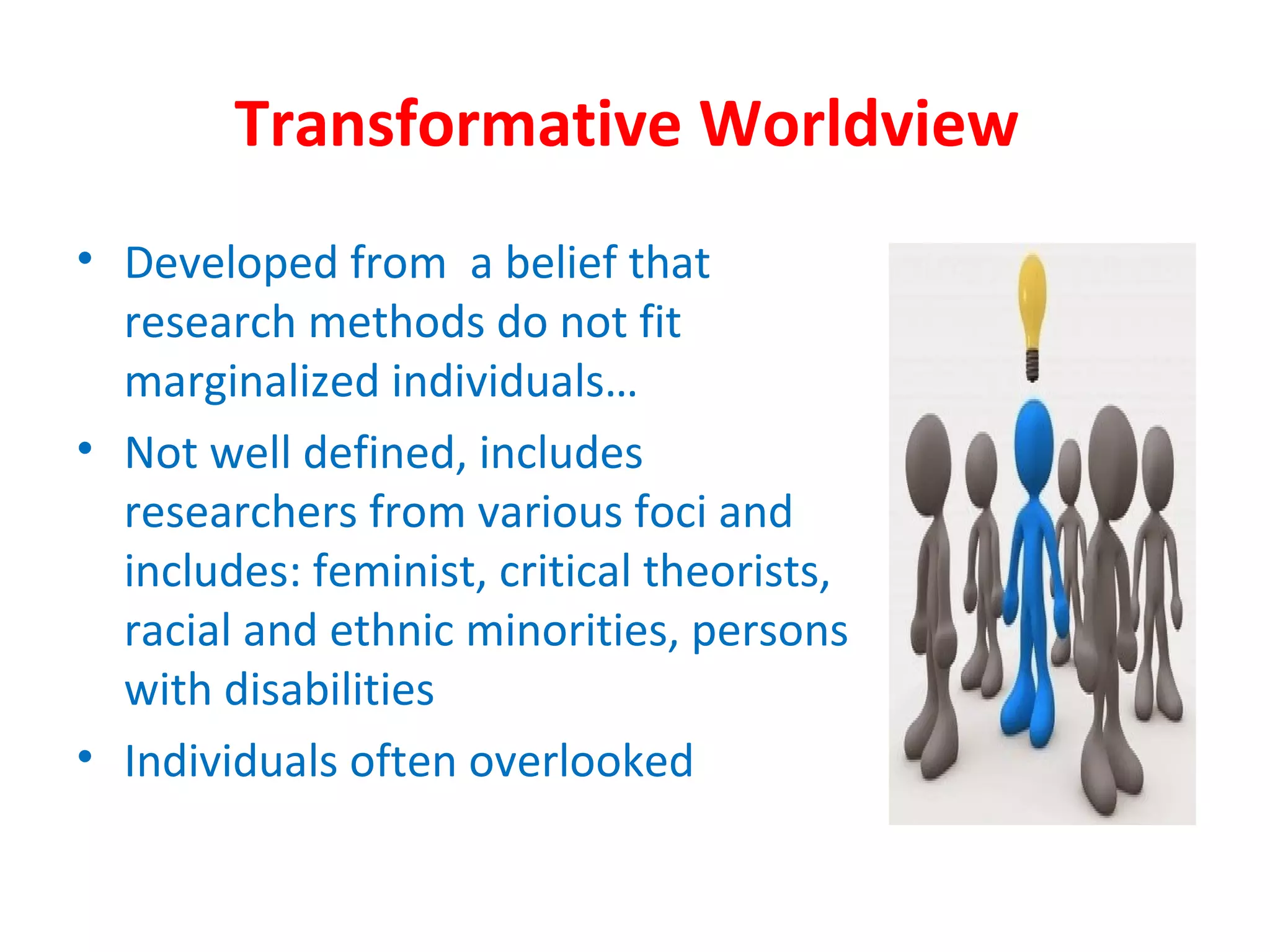
Transformative Worldview
• Developed from a belief that
research methods do not fit
marginalized individuals…
• Not well defined, includes
researchers from various foci and
includes: feminist, critical theorists,
racial and ethnic minorities, persons
with disabilities
• Individuals often overlooked
Transformative Worldview (Contd.)
• Element of advocacy in research; the
research is directional towards a
cause
• Research contains an action agenda
that may change the lives of those
involved (differs from action
research)
• Issues address important aspects:
empowerment, inequality, and
oppression…
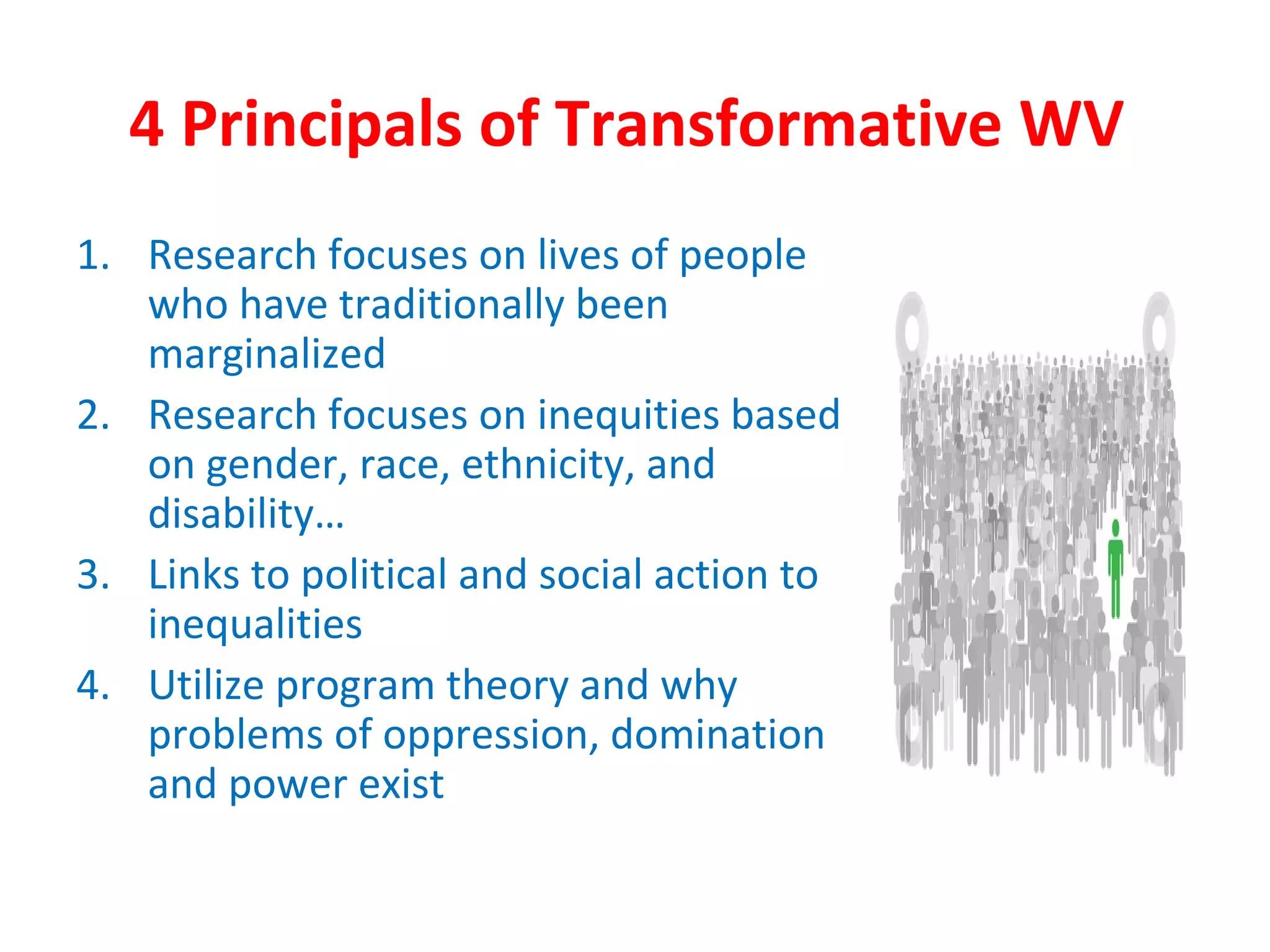
4 Principals of Transformative WV
1. Research focuses on lives of people
who have traditionally been
marginalized
2. Research focuses on inequities based
on gender, race, ethnicity, and
disability…
3. Links to political and social action to
inequalities
4. Utilize program theory and why
problems of oppression, domination
and power exist
Pragmatism
• Arises from actions, situation
and consequences
• Focus on “what works”
• Focus on problem more than
methods
• Practical more than focus on
methods
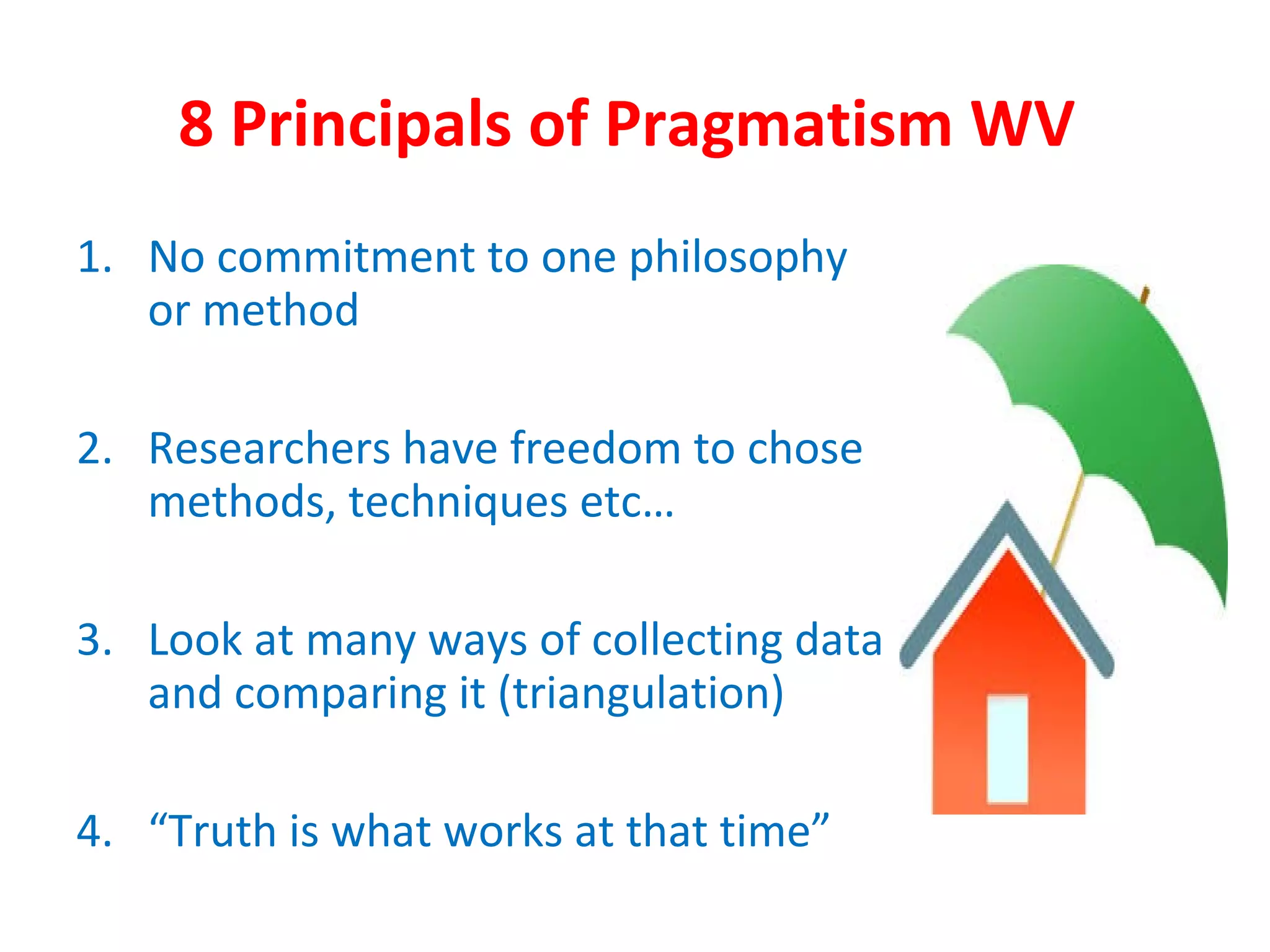
8 Principals of Pragmatism WV
1. No commitment to one philosophy
or method
2. Researchers have freedom to chose
methods, techniques etc…
3. Look at many ways of collecting data
and comparing it (triangulation)
4. “Truth is what works at that time”
8 Principals of Pragmatism WV (Contd.)
5. There is an intended purpose for the
research and an examination of
consequences
6. Research is situated in context
(social, historical, etc.)
7. Practical purpose for research; no
need to focus on the nature of the
world
8. Very open approach to collecting,
analyzing and looking at data
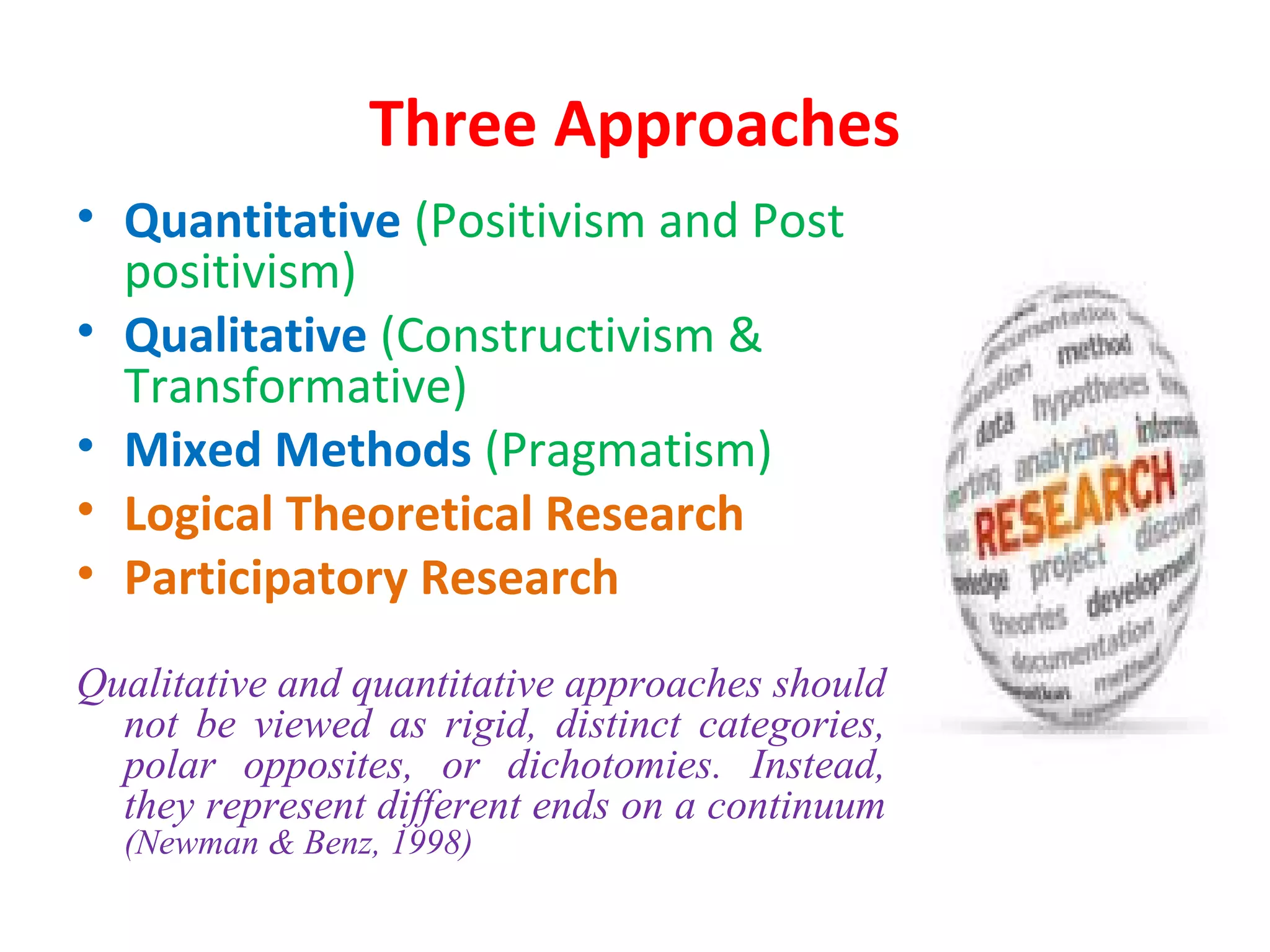
Three Approaches
• Quantitative (Positivism and Post
positivism)
• Qualitative (Constructivism &
Transformative)
• Mixed Methods (Pragmatism)
• Logical Theoretical Research
• Participatory Research
Qualitative and quantitative approaches should
not be viewed as rigid, distinct categories,
polar opposites, or dichotomies. Instead,
they represent different ends on a continuum
(Newman & Benz, 1998)
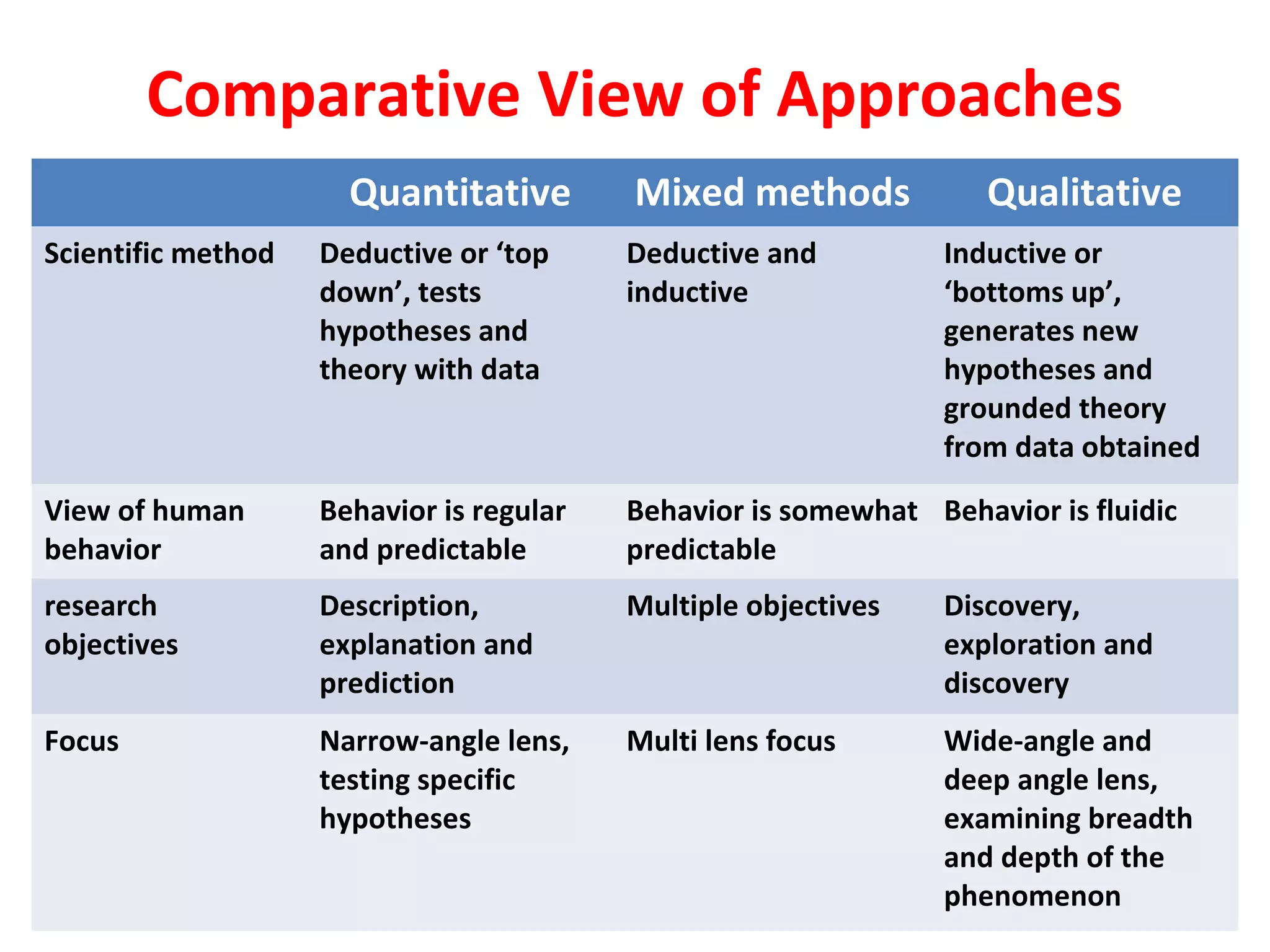
Comparative View of Approaches
Quantitative Mixed methods Qualitative
Scientific method Deductive or ‘top
down’, tests
hypotheses and
theory with data
Deductive and
inductive
Inductive or
‘bottoms up’,
generates new
hypotheses and
grounded theory
from data obtained
View of human
behavior
Behavior is regular
and predictable
Behavior is somewhat
predictable
Behavior is fluidic
research
objectives
Description,
explanation and
prediction
Multiple objectives Discovery,
exploration and
discovery
Focus Narrow-angle lens,
testing specific
hypotheses
Multi lens focus Wide-angle and
deep angle lens,
examining breadth
and depth of the
phenomenon
Comparative View of Approaches
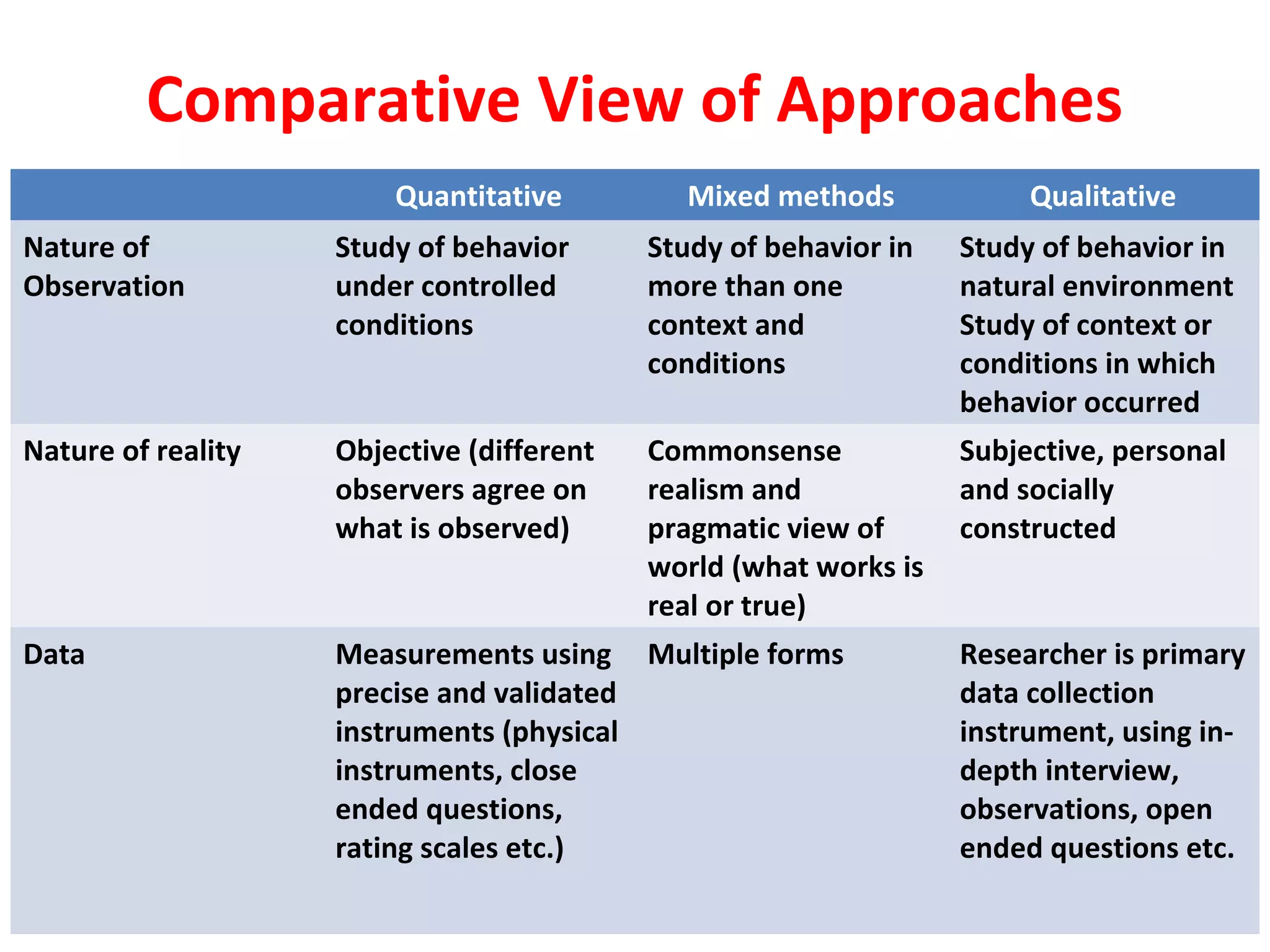
Quantitative Mixed methods Qualitative
Nature of
Observation
Study of behavior
under controlled
conditions
Study of behavior in
more than one
context and
conditions
Study of behavior in
natural environment
Study of context or
conditions in which
behavior occurred
Nature of reality Objective (different
observers agree on
what is observed)
Commonsense
realism and
pragmatic view of
world (what works is
real or true)
Subjective, personal
and socially
constructed
Data Measurements using
precise and validated
instruments (physical
instruments, close
ended questions,
rating scales etc.)
Multiple forms Researcher is primary
data collection
instrument, using in-
depth interview,
observations, open
ended questions etc.
Comparative View of Approaches
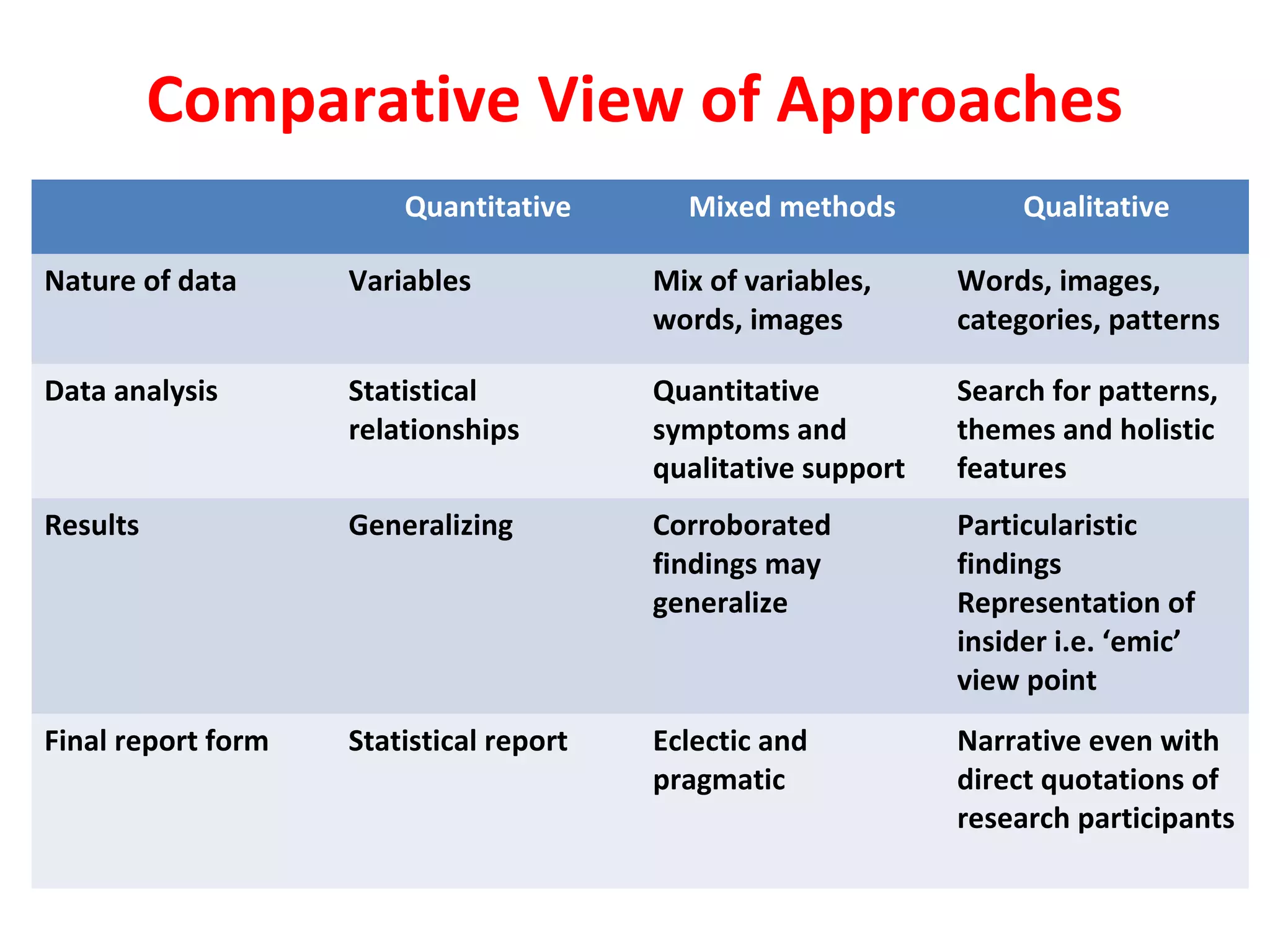
Quantitative Mixed methods Qualitative
Nature of data Variables Mix of variables,
words, images
Words, images,
categories, patterns
Data analysis Statistical
relationships
Quantitative
symptoms and
qualitative support
Search for patterns,
themes and holistic
features
Results Generalizing Corroborated
findings may
generalize
Particularistic
findings
Representation of
insider i.e. ‘emic’
view point
Final report form Statistical report Eclectic and
pragmatic
Narrative even with
direct quotations of
research participants
Comparative View of Approaches
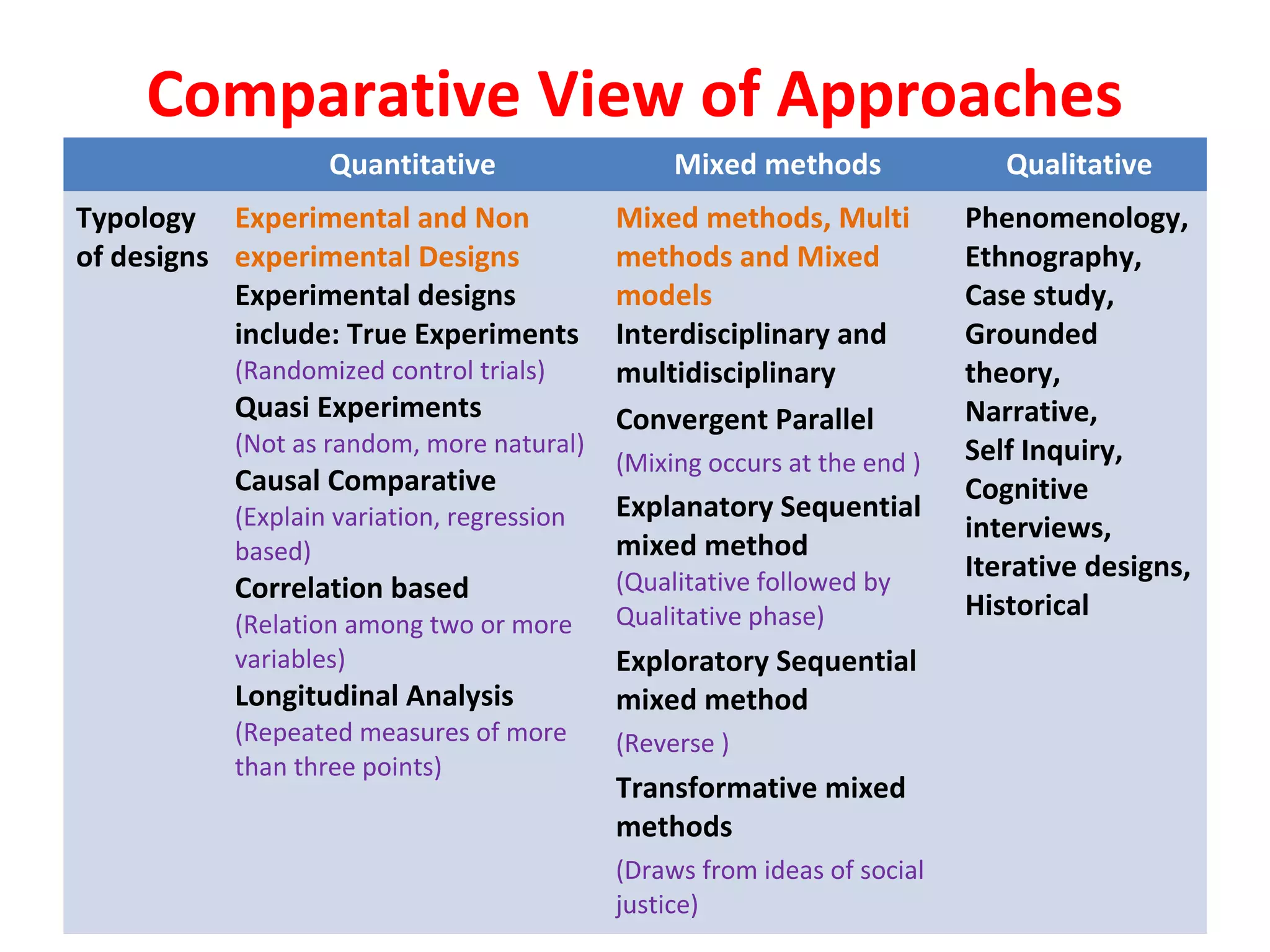
Quantitative Mixed methods Qualitative
Typology
of designs
Experimental and Non
experimental Designs
Experimental designs
include: True Experiments
(Randomized control trials)
Quasi Experiments
(Not as random, more natural)
Causal Comparative
(Explain variation, regression
based)
Correlation based
(Relation among two or more
variables)
Longitudinal Analysis
(Repeated measures of more
than three points)
Mixed methods, Multi
methods and Mixed
models
Interdisciplinary and
multidisciplinary
Convergent Parallel
(Mixing occurs at the end )
Explanatory Sequential
mixed method
(Qualitative followed by
Qualitative phase)
Exploratory Sequential
mixed method
(Reverse )
Transformative mixed
methods
(Draws from ideas of social
justice)
Phenomenology,
Ethnography,
Case study,
Grounded
theory,
Narrative,
Self Inquiry,
Cognitive
interviews,
Iterative designs,
Historical
Comparative View of Approaches
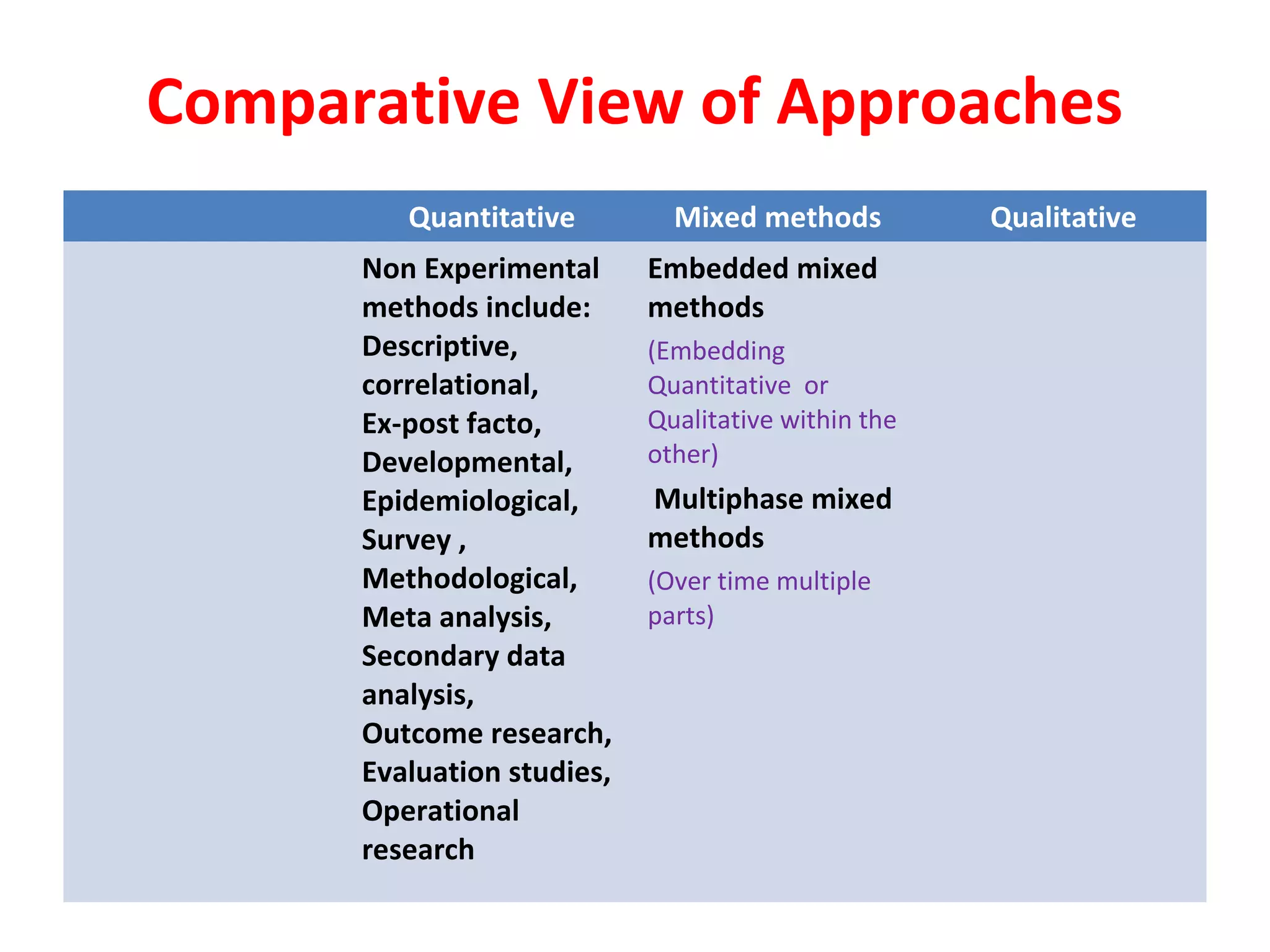
Quantitative Mixed methods Qualitative
Non Experimental
methods include:
Descriptive,
correlational,
Ex-post facto,
Developmental,
Epidemiological,
Survey ,
Methodological,
Meta analysis,
Secondary data
analysis,
Outcome research,
Evaluation studies,
Operational
research
Embedded mixed
methods
(Embedding
Quantitative or
Qualitative within the
other)
Multiphase mixed
methods
(Over time multiple
parts)
Logical, theoretical research
By a logical theoretical research approach is meant formal
deduction of logical consequences from a set of initial
assumptions (axioms). If the axioms are true and the rules are
logically sound, the consequences are true as well.
According to Hirschheim et al. (1995),
"data modeling is first and foremost a social and organizational activity and
very little, if anything (except consulting folklore) is known how data modeling
is exercised in practice and what its impacts are on organizations, their
information systems management, and business operations."
Participatory action research
Reason, 1994; van Meel, 1993 refer participatory research as a
set of methods to research on social systems in which the
researcher actively engage in the process under investigation
(the actors of the social system being studied can be considered
as co-researchers). Meel exemplifies this approach to research:
First, an initial case study is performed for identification of
problems, followed by theory development and implementation
of a prototype. Then Prototype is employed to full-scale project,
researcher participates and reflects upon the use of the
prototype with the actors.
Walsham (1995) points out the problems of being perceived to
have a personal stake in the researched project, and reporting on
one's own role within the project as challenging problems of
participatory action research.
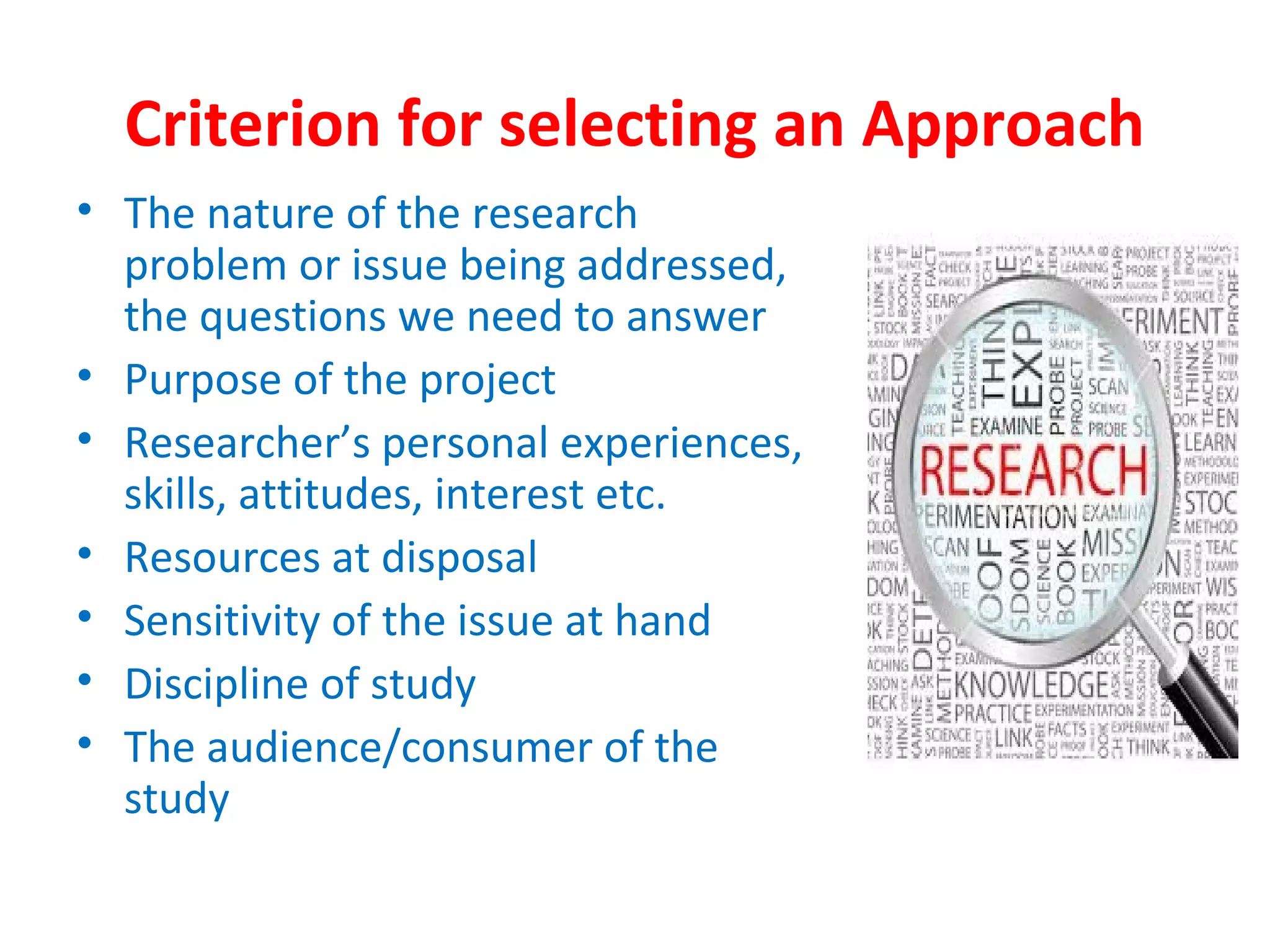
Criterion for selecting an Approach
• The nature of the research
problem or issue being addressed,
the questions we need to answer
• Purpose of the project
• Researcher’s personal experiences,
skills, attitudes, interest etc.
• Resources at disposal
• Sensitivity of the issue at hand
• Discipline of study
• The audience/consumer of the
study
Thanks For Your Kind Attention
Dr. Vijay Grover
DAV College of Education, Abohar
Email: grovervijayk@gmail.com

Research approach

  • 1.
    Your attention isdesired Research Approach: An Overview
  • 2.
    Research Approach: Concept Plansand the procedure for research that span the steps from broad assumptions to detailed methods of data collection, analysis, and interpretation. The overall decision involves which approach should be used to study a topic. Informing this decision should be the philosophical assumptions the researcher brings to the study; procedures of inquiry (called research designs); and specific research methods of data collection, analysis, and interpretation.
  • 3.
  • 4.
  • 5.
    Post positivism Constructivism •Determination • Reductionism • Empirical observation and measurement • Theory verification • Understanding • Multiple participant meanings • Social and historical construction • Theory generation Transformative Pragmatism • Political • Power and justice oriented • Collaborative • Change-oriented • Consequences of actions • Problem-centered • Pluralistic • Real-world practice oriented A basic set of Beliefs that guide Actions source: Guba, 1990,p.17, cited in Creswell, 2014, P.6
  • 6.
    Postpositivist Worldview Positivist: •Traditional formof research •Scientific method •Empirical science Postpositivist: •Challenges the notion of absolute truth •Deterministic philosophy in which causes determine effects
  • 7.
    Postpositivist Worldview • Assessescauses that influence outcomes • Reduce ideas to a small set of ideas to test out as variables • Research is governed by research questions or hypothesis • Careful observation and measurement of observations • Testing a theory
  • 8.
    5 Principals ofPost positivism WV 1. Knowledge is conjectural… – Cannot prove a hypothesis; we state failure to reject the hypothesis or “accept it” 1. Research is the process of making claims… – Start with deductively testing a theory 1. Data, evidence, and rational considerations shape knowledge - Collecting information through the use of instruments
  • 9.
    5 Principals ofPost positivism WV (Contd.) 4. Research seeks to develop relevant, true statements… – Advances the understanding of relationship among variables 4. Being objective is essential… – Validity and reliability are critical
  • 10.
    Constructivist Worldview • Beliefthat individuals seek understanding of the world • Belief that people develop subjective meanings of their experiences • Researchers look for the complexity of views, not the reduction of variables that explain maximal variance • Interview questions are often very open ended to allow participants to construct their own knowledge of situations
  • 11.
    Constructivist Worldview (contd.) •Researchers focus on the processes and interactions • Recognition that researcher’s personal background shape interpretation and meaning (interpretivism) • Develops inductively a theory or pattern of meaning instead of testing from theory (grounded approach)
  • 12.
    3 Principals ofConstructivism WV 1. Construct meaning through interacting with the world we interpret – Researches use open ended questions 1. Make sense of the world based on personal historical and societal perspectives – Interpretation is also tied to researcher 1. Generation of meaning is social from and within community – Meaning generated from data collected
  • 13.
    Transformative Worldview • Developedfrom a belief that research methods do not fit marginalized individuals… • Not well defined, includes researchers from various foci and includes: feminist, critical theorists, racial and ethnic minorities, persons with disabilities • Individuals often overlooked
  • 14.
    Transformative Worldview (Contd.) •Element of advocacy in research; the research is directional towards a cause • Research contains an action agenda that may change the lives of those involved (differs from action research) • Issues address important aspects: empowerment, inequality, and oppression…
  • 15.
    4 Principals ofTransformative WV 1. Research focuses on lives of people who have traditionally been marginalized 2. Research focuses on inequities based on gender, race, ethnicity, and disability… 3. Links to political and social action to inequalities 4. Utilize program theory and why problems of oppression, domination and power exist
  • 16.
    Pragmatism • Arises fromactions, situation and consequences • Focus on “what works” • Focus on problem more than methods • Practical more than focus on methods
  • 17.
    8 Principals ofPragmatism WV 1. No commitment to one philosophy or method 2. Researchers have freedom to chose methods, techniques etc… 3. Look at many ways of collecting data and comparing it (triangulation) 4. “Truth is what works at that time”
  • 18.
    8 Principals ofPragmatism WV (Contd.) 5. There is an intended purpose for the research and an examination of consequences 6. Research is situated in context (social, historical, etc.) 7. Practical purpose for research; no need to focus on the nature of the world 8. Very open approach to collecting, analyzing and looking at data
  • 19.
    Three Approaches • Quantitative(Positivism and Post positivism) • Qualitative (Constructivism & Transformative) • Mixed Methods (Pragmatism) • Logical Theoretical Research • Participatory Research Qualitative and quantitative approaches should not be viewed as rigid, distinct categories, polar opposites, or dichotomies. Instead, they represent different ends on a continuum (Newman & Benz, 1998)
  • 20.
    Comparative View ofApproaches Quantitative Mixed methods Qualitative Scientific method Deductive or ‘top down’, tests hypotheses and theory with data Deductive and inductive Inductive or ‘bottoms up’, generates new hypotheses and grounded theory from data obtained View of human behavior Behavior is regular and predictable Behavior is somewhat predictable Behavior is fluidic research objectives Description, explanation and prediction Multiple objectives Discovery, exploration and discovery Focus Narrow-angle lens, testing specific hypotheses Multi lens focus Wide-angle and deep angle lens, examining breadth and depth of the phenomenon
  • 21.
    Comparative View ofApproaches Quantitative Mixed methods Qualitative Nature of Observation Study of behavior under controlled conditions Study of behavior in more than one context and conditions Study of behavior in natural environment Study of context or conditions in which behavior occurred Nature of reality Objective (different observers agree on what is observed) Commonsense realism and pragmatic view of world (what works is real or true) Subjective, personal and socially constructed Data Measurements using precise and validated instruments (physical instruments, close ended questions, rating scales etc.) Multiple forms Researcher is primary data collection instrument, using in- depth interview, observations, open ended questions etc.
  • 22.
    Comparative View ofApproaches Quantitative Mixed methods Qualitative Nature of data Variables Mix of variables, words, images Words, images, categories, patterns Data analysis Statistical relationships Quantitative symptoms and qualitative support Search for patterns, themes and holistic features Results Generalizing Corroborated findings may generalize Particularistic findings Representation of insider i.e. ‘emic’ view point Final report form Statistical report Eclectic and pragmatic Narrative even with direct quotations of research participants
  • 23.
    Comparative View ofApproaches Quantitative Mixed methods Qualitative Typology of designs Experimental and Non experimental Designs Experimental designs include: True Experiments (Randomized control trials) Quasi Experiments (Not as random, more natural) Causal Comparative (Explain variation, regression based) Correlation based (Relation among two or more variables) Longitudinal Analysis (Repeated measures of more than three points) Mixed methods, Multi methods and Mixed models Interdisciplinary and multidisciplinary Convergent Parallel (Mixing occurs at the end ) Explanatory Sequential mixed method (Qualitative followed by Qualitative phase) Exploratory Sequential mixed method (Reverse ) Transformative mixed methods (Draws from ideas of social justice) Phenomenology, Ethnography, Case study, Grounded theory, Narrative, Self Inquiry, Cognitive interviews, Iterative designs, Historical
  • 24.
    Comparative View ofApproaches Quantitative Mixed methods Qualitative Non Experimental methods include: Descriptive, correlational, Ex-post facto, Developmental, Epidemiological, Survey , Methodological, Meta analysis, Secondary data analysis, Outcome research, Evaluation studies, Operational research Embedded mixed methods (Embedding Quantitative or Qualitative within the other) Multiphase mixed methods (Over time multiple parts)
  • 25.
    Logical, theoretical research Bya logical theoretical research approach is meant formal deduction of logical consequences from a set of initial assumptions (axioms). If the axioms are true and the rules are logically sound, the consequences are true as well. According to Hirschheim et al. (1995), "data modeling is first and foremost a social and organizational activity and very little, if anything (except consulting folklore) is known how data modeling is exercised in practice and what its impacts are on organizations, their information systems management, and business operations."
  • 26.
    Participatory action research Reason,1994; van Meel, 1993 refer participatory research as a set of methods to research on social systems in which the researcher actively engage in the process under investigation (the actors of the social system being studied can be considered as co-researchers). Meel exemplifies this approach to research: First, an initial case study is performed for identification of problems, followed by theory development and implementation of a prototype. Then Prototype is employed to full-scale project, researcher participates and reflects upon the use of the prototype with the actors. Walsham (1995) points out the problems of being perceived to have a personal stake in the researched project, and reporting on one's own role within the project as challenging problems of participatory action research.
  • 27.
    Criterion for selectingan Approach • The nature of the research problem or issue being addressed, the questions we need to answer • Purpose of the project • Researcher’s personal experiences, skills, attitudes, interest etc. • Resources at disposal • Sensitivity of the issue at hand • Discipline of study • The audience/consumer of the study
  • 28.
    Thanks For YourKind Attention Dr. Vijay Grover DAV College of Education, Abohar Email: grovervijayk@gmail.com