An Introduction to
Qualitative Research
Dr. Ranadip Chowdhury M.D.
Study Co-ordinator
CHRD-SAS
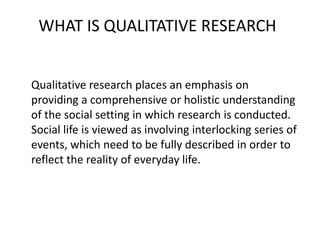
WHAT IS QUALITATIVE RESEARCH
Qualitative research places an emphasis on
providing a comprehensive or holistic understanding
of the social setting in which research is conducted.
Social life is viewed as involving interlocking series of
events, which need to be fully described in order to
reflect the reality of everyday life.
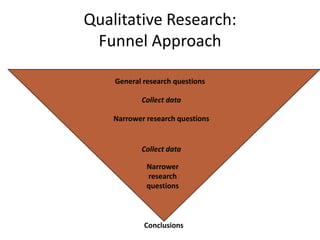
Qualitative Research:
Funnel Approach
General research questions
Collect data
Narrower research questions
Collect data
Narrower
research
questions
Conclusions
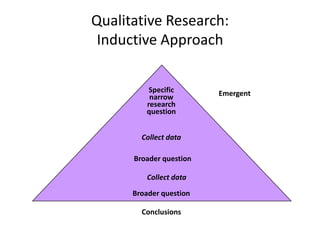
Qualitative Research:
Inductive Approach
Conclusions
Specific
narrow
research
question
Collect data
Broader question
Collect data
Broader question
Emergent Data
The process of
qualitative research
The steps in designing a qualitative study
1. Establish the general problem to be
investigated
โ€“ Of interest to the researcher
2. Stating the purpose of the study
โ€“ Based on problem analysis
โ€“ Arises from previous studies
โ€“ Guided by literature review
โ€“ Determined by who will use the research
results
3. Develop a conceptual/theoretical framework for
the study
4. Formulate general and specific research
questions (aims and objectives)
5. Select a qualitative research design
6. Select a sampling strategy
โ€“ Establish site of the research
โ€“ Selection of participants
7. Ensure trustworthiness of the study
8. Determine data collection methods and develop
data collection tools
9. Establish how data will be managed and
analyzed.
10. Interpretation and discussion of findings
11. Prepare research report
Qualitative research designs
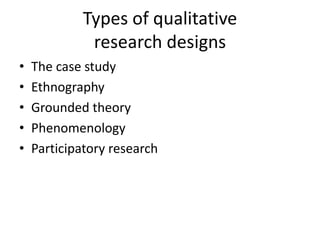
Types of qualitative
research designs
โ€ข The case study
โ€ข Ethnography
โ€ข Grounded theory
โ€ข Phenomenology
โ€ข Participatory research
The case study
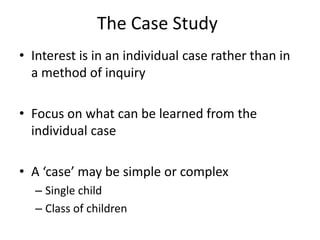
The Case Study
โ€ข Interest is in an individual case rather than in
a method of inquiry
โ€ข Focus on what can be learned from the
individual case
โ€ข A โ€˜caseโ€™ may be simple or complex
โ€“ Single child
โ€“ Class of children
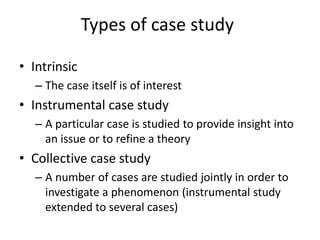
Types of case study
โ€ข Intrinsic
โ€“ The case itself is of interest
โ€ข Instrumental case study
โ€“ A particular case is studied to provide insight into
an issue or to refine a theory
โ€ข Collective case study
โ€“ A number of cases are studied jointly in order to
investigate a phenomenon (instrumental study
extended to several cases)
Ethnography
Ethnography
โ€ข Rooted in anthropology
โ€ข Also called participant observation/
naturalistic enquiry
โ€ข Ethno = people Graphy = describing
something
โ€ข Characterized by immersion
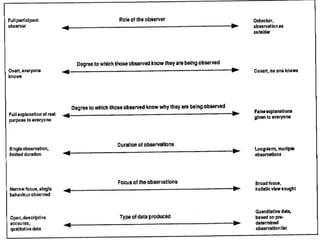
Role of the observer
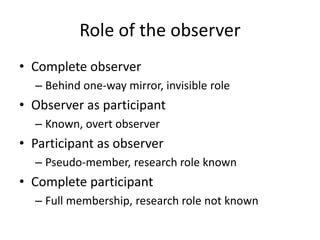
โ€ข Complete observer
โ€“ Behind one-way mirror, invisible role
โ€ข Observer as participant
โ€“ Known, overt observer
โ€ข Participant as observer
โ€“ Pseudo-member, research role known
โ€ข Complete participant
โ€“ Full membership, research role not known
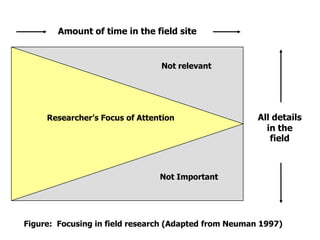
Amount of time in the field site
Researcherโ€™s Focus of Attention
Not relevant
Not Important
All details
in the
field
Amount of time in the field site
Figure: Focusing in field research (Adapted from Neuman 1997)
Grounded Theory
Grounded Theory
โ€ข Rooted in social sciences
โ€ข Emphasises the development of theory
โ€ข Which is grounded in data systematically collected and
analyzed (constant comparative analysis to produce
substantive theory)
โ€ข Theory must be faithful to the evidence
โ€ข Looks for generalisable theory - by making comparisons
across situations
โ€ข Focus is on patterns of action and interaction
Phenomenology
Features of Phenomenology
โ€ข Rooted in philosophy
โ€ข Central question: what is the meaning,
structure, and essence of the lived experience
of this phenomenon for this person/group of
people?
โ€ข How is each individualโ€™s subjective reality
applied to make experiences meaningful?
โ€ข Analysis of the language used
Approaches to Participatory
Research
Participatory Action Research (PAR)
โ€ข Emphasises the political aspects of knowledge
production
โ€ข Concerned about power and powerlessness โ€“
empowerment through conscientisation
(building self-awareness and constructing
knowledge)
โ€ข Importance of peopleโ€™s lived experience โ€“
โ€˜honour the wisdom of the peopleโ€™
โ€ข Concerned with genuine collaboration
โ€ข Democratic values
Action Research
โ€ข Build action theories - action science
โ€ข Aim is to develop effective action, improve
practice, and implement change
โ€ข Cyclical process, alternating between action
and reflection
Sampling in qualitative research
Considerations in sampling
โ€ข Purpose of qualitative research
โ€“ Produce information-rich data
โ€“ Depth rather than breadth
โ€“ Insight rather than generalisation
โ€ข Conceptual rather than numerical
considerations
โ€“ Choose information-rich sites and respondents
Common sampling approach
โ€ข Purposive sampling
โ€“ Not haphzard
โ€“ Select information-rich cases
โ€“ Not the same as convenience sampling
Purposive Sampling Strategies
โ€ข Deviant case sampling
โ€“ Information rich cases that are unusual (e.g. In
Search of Excellence)
โ€ข Intensity sampling
โ€“ Excellent examples of the phenomenon of
interest but not highly unusual cases
โ€ข Heterogenous sampling
โ€“ Sample people with diverse characteristics to see
whether there are common patterns
โ€ข Homogenous samples
โ€“ Describe a particular sub-group in depth
โ€ข Typical case sampling
โ€“ To describe and illustrate what is typical to a
particular setting
โ€ข Snowball sampling
โ€“ Through informants identify others who know a
lot about the issue
โ€ข Opportunistic sampling
โ€“ Taking advantage of on-the-spot opportunities
Considerations in sample size
โ€ข Saturation
โ€ข Redundancy
โ€ข Minimum samples based on expected
reasonable coverage, given the purpose of the
study and constraints
Criteria for judging the quality and credibility of
qualitative research
โ€ข Criteria for judging the quality of qualitative
research specific to the research design
selected
โ€ข General criteria inlcude:
โ€“ Clear exposition of data collection and analysis
methods
โ€“ Generating and assessing rival conclusions
โ€ข Alternative themes, divergent patterns, rival
explanations
โ€ข Attention to negative cases
Triangulation
โ€ข Methods โ€“ interviews, observations, document
analysis
โ€ข Sources โ€“ public/private, over time, different
perspectives
โ€ข Analysts โ€“ multiple analysts, independent
analysis and compare findings
โ€ข Theories โ€“ to understand how diferent
assumptions affect findings, illuminate
inconsistencies
โ€“Respondent validation
โ€“Reflexivity
โ€ข The researcher as research instrument
โ€“Relevance
โ€ข Adds to/affirms existing knowledge
โ€ข Generalisable to similar settings
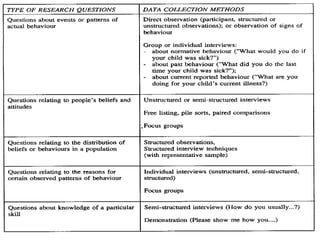
Data Collection Methods
Unstructured Interview
โ€ข Topic List
โ€ข Effective Probing
โ€ข Good Response to individual differences &
situational characteristics.
โ€ข Good for initial rapport building.
โ€ข Difficult to systemize and analyze data.
Semi-structured Interview
โ€ข Depth/focused interview (Extensive
descriptive information, in the form of
narratives, actions, events, that can give
verbal pictures of systemic behavior)
โ€ข Case Study (Comprehensive, systemic, and in-
depth information about a particular cases of
interest)
โ€ข Life-histories
โ€ข Helpful for clarity of the researcher and
flexible to follow new leads
โ€ข Development of interviewer guide
Structured/Systemic Interview
โ€ข Free Listing.
โ€“ The purpose is to isolate and define relevant
domain.
โ€ข Pile-sorting.
โ€“ Helps to study the relations among items within
domain.
โ€ข Rating Scale.
โ€“ Items can be rated on a single conceptual scale.
โ€ข Rank order
โ€“ Complete rank Ordering
โ€“ Partial Rank Ordering
Group Interview
โ€ข Focus Group
โ€“ Get a variety of perspectives/reactions to a
certain issue but not they are not appropriate for
trying to get actual behaviors.
โ€“ In a short time
โ€“ Mainly for eliciting opinions, values, feelings
โ€“ Homogenous, Strangers
โ€“ 6-10 people, 1-2 hours
โ€“ At least 2 groups should be conducted for each
type of respondent to be interviewed.
โ€ข Non-focus group interviews
โ€“ Un-structured/semi-structured technique
โ€“ Useful for action oriented research
โ€ข Mapping & Modelling
โ€“ Health service catchment area/village residential area/
social map etc.
โ€ข Seasonal Calendars
โ€“ Particular health problem common/rainfall/farming
activities.
โ€ข Time lines
โ€“ Local events & development of community history
Observation
โ€ข Purpose of observation
โ€“ Describe the setting
โ€“ First-hand experience โ€“ assists with analysis
โ€“ See what is normally taken for granted or not
easily spoken about
โ€“ Confirm perceptions of respondents
โ€ข Requires training, preparation and discipline
โ€ข Develop an observation checklist
Types of observation
โ€ข Participant Observation
โ€ข Un-structured Observation
โ€ข Structured Observation
โ€“ Continuous monitoring
โ€“ Spot checks
โ€“ Rating Checks
Qualitative data analysis
Stages in qualitative data analysis
โ€ข Qualitative data analysis is a non-linear /
iterative process (interim analysis).
โ€“ Numerous rounds of questioning, reflecting,
rephrasing, analysing, theorising, verifying
after each observation, interview, or Focus
Group Discussion
โ€ข During data collection
โ€“Reading โ€“ data immersion โ€“ reading
and re-reading (Memos: Reflective
notes)
โ€“Coding โ€“ listen to the data for
emerging themes and begin to attach
labels or codes to the texts that
represent the themes
โ€ข After data collection
โ€“Displaying โ€“ the themes (all information)
โ€“Developing hypotheses, questioning and
verification
โ€“Reducing โ€“ from the displayed data
identify the main points
โ€ข Interpretation (Content Analysis)
โ€“At all stages โ€“ searching for core
meanings of thoughts, feelings, and
behaviours described
โ€“Overall interpretation
โ€ข Identify how themes relate to each
other
โ€ข Explain how study questions are
answered
โ€ข Explain what the findings mean
beyond the context of your study
Content Analysis
3 distinct approaches:
โ€ข Conventional,
โ€ข Directed
โ€ข Summative.
(The major differences among the approaches
are coding schemes, origins of codes, and
threats to trustworthiness.)
Steps
โ€ข Step1: Transcription
โ€ข Step 2: Deciding the unit of analysis
โ€ข Step 3: From units to categories
โ€ข Step 4: Test coding on sample test
โ€ข Step 5: Code all text data
โ€ข Step 6: Assess the coding consistency
โ€ข Step 7: Drawing conclusions from the coded
data
โ€ข Step 8: Reporting
Software
โ€ข NUDIST
โ€ข ATLAS-ti
โ€ข Ethnograph
โ€ข NVivo 2.0
โ€ข ANTHROPAC
Thank you...

Qualitative research

  • 1.
    An Introduction to QualitativeResearch Dr. Ranadip Chowdhury M.D. Study Co-ordinator CHRD-SAS
  • 2.
    WHAT IS QUALITATIVERESEARCH Qualitative research places an emphasis on providing a comprehensive or holistic understanding of the social setting in which research is conducted. Social life is viewed as involving interlocking series of events, which need to be fully described in order to reflect the reality of everyday life.
  • 3.
    Qualitative Research: Funnel Approach Generalresearch questions Collect data Narrower research questions Collect data Narrower research questions Conclusions
  • 4.
    Qualitative Research: Inductive Approach Conclusions Specific narrow research question Collectdata Broader question Collect data Broader question Emergent Data
  • 5.
  • 6.
    The steps indesigning a qualitative study 1. Establish the general problem to be investigated โ€“ Of interest to the researcher 2. Stating the purpose of the study โ€“ Based on problem analysis โ€“ Arises from previous studies โ€“ Guided by literature review โ€“ Determined by who will use the research results
  • 7.
    3. Develop aconceptual/theoretical framework for the study 4. Formulate general and specific research questions (aims and objectives) 5. Select a qualitative research design 6. Select a sampling strategy โ€“ Establish site of the research โ€“ Selection of participants
  • 8.
    7. Ensure trustworthinessof the study 8. Determine data collection methods and develop data collection tools 9. Establish how data will be managed and analyzed. 10. Interpretation and discussion of findings 11. Prepare research report
  • 9.
  • 10.
    Types of qualitative researchdesigns โ€ข The case study โ€ข Ethnography โ€ข Grounded theory โ€ข Phenomenology โ€ข Participatory research
  • 11.
  • 12.
    The Case Study โ€ขInterest is in an individual case rather than in a method of inquiry โ€ข Focus on what can be learned from the individual case โ€ข A โ€˜caseโ€™ may be simple or complex โ€“ Single child โ€“ Class of children
  • 13.
    Types of casestudy โ€ข Intrinsic โ€“ The case itself is of interest โ€ข Instrumental case study โ€“ A particular case is studied to provide insight into an issue or to refine a theory โ€ข Collective case study โ€“ A number of cases are studied jointly in order to investigate a phenomenon (instrumental study extended to several cases)
  • 14.
  • 15.
    Ethnography โ€ข Rooted inanthropology โ€ข Also called participant observation/ naturalistic enquiry โ€ข Ethno = people Graphy = describing something โ€ข Characterized by immersion
  • 16.
    Role of theobserver โ€ข Complete observer โ€“ Behind one-way mirror, invisible role โ€ข Observer as participant โ€“ Known, overt observer โ€ข Participant as observer โ€“ Pseudo-member, research role known โ€ข Complete participant โ€“ Full membership, research role not known
  • 17.
    Amount of timein the field site Researcherโ€™s Focus of Attention Not relevant Not Important All details in the field Amount of time in the field site Figure: Focusing in field research (Adapted from Neuman 1997)
  • 18.
  • 19.
    Grounded Theory โ€ข Rootedin social sciences โ€ข Emphasises the development of theory โ€ข Which is grounded in data systematically collected and analyzed (constant comparative analysis to produce substantive theory) โ€ข Theory must be faithful to the evidence โ€ข Looks for generalisable theory - by making comparisons across situations โ€ข Focus is on patterns of action and interaction
  • 20.
  • 21.
    Features of Phenomenology โ€ขRooted in philosophy โ€ข Central question: what is the meaning, structure, and essence of the lived experience of this phenomenon for this person/group of people? โ€ข How is each individualโ€™s subjective reality applied to make experiences meaningful? โ€ข Analysis of the language used
  • 22.
  • 23.
    Participatory Action Research(PAR) โ€ข Emphasises the political aspects of knowledge production โ€ข Concerned about power and powerlessness โ€“ empowerment through conscientisation (building self-awareness and constructing knowledge) โ€ข Importance of peopleโ€™s lived experience โ€“ โ€˜honour the wisdom of the peopleโ€™ โ€ข Concerned with genuine collaboration โ€ข Democratic values
  • 24.
    Action Research โ€ข Buildaction theories - action science โ€ข Aim is to develop effective action, improve practice, and implement change โ€ข Cyclical process, alternating between action and reflection
  • 25.
  • 26.
    Considerations in sampling โ€ขPurpose of qualitative research โ€“ Produce information-rich data โ€“ Depth rather than breadth โ€“ Insight rather than generalisation โ€ข Conceptual rather than numerical considerations โ€“ Choose information-rich sites and respondents
  • 27.
    Common sampling approach โ€ขPurposive sampling โ€“ Not haphzard โ€“ Select information-rich cases โ€“ Not the same as convenience sampling
  • 28.
    Purposive Sampling Strategies โ€ขDeviant case sampling โ€“ Information rich cases that are unusual (e.g. In Search of Excellence) โ€ข Intensity sampling โ€“ Excellent examples of the phenomenon of interest but not highly unusual cases โ€ข Heterogenous sampling โ€“ Sample people with diverse characteristics to see whether there are common patterns
  • 29.
    โ€ข Homogenous samples โ€“Describe a particular sub-group in depth โ€ข Typical case sampling โ€“ To describe and illustrate what is typical to a particular setting โ€ข Snowball sampling โ€“ Through informants identify others who know a lot about the issue โ€ข Opportunistic sampling โ€“ Taking advantage of on-the-spot opportunities
  • 30.
    Considerations in samplesize โ€ข Saturation โ€ข Redundancy โ€ข Minimum samples based on expected reasonable coverage, given the purpose of the study and constraints
  • 31.
    Criteria for judgingthe quality and credibility of qualitative research โ€ข Criteria for judging the quality of qualitative research specific to the research design selected โ€ข General criteria inlcude: โ€“ Clear exposition of data collection and analysis methods โ€“ Generating and assessing rival conclusions โ€ข Alternative themes, divergent patterns, rival explanations โ€ข Attention to negative cases
  • 32.
    Triangulation โ€ข Methods โ€“interviews, observations, document analysis โ€ข Sources โ€“ public/private, over time, different perspectives โ€ข Analysts โ€“ multiple analysts, independent analysis and compare findings โ€ข Theories โ€“ to understand how diferent assumptions affect findings, illuminate inconsistencies
  • 33.
    โ€“Respondent validation โ€“Reflexivity โ€ข Theresearcher as research instrument โ€“Relevance โ€ข Adds to/affirms existing knowledge โ€ข Generalisable to similar settings
  • 34.
  • 35.
    Unstructured Interview โ€ข TopicList โ€ข Effective Probing โ€ข Good Response to individual differences & situational characteristics. โ€ข Good for initial rapport building. โ€ข Difficult to systemize and analyze data.
  • 36.
    Semi-structured Interview โ€ข Depth/focusedinterview (Extensive descriptive information, in the form of narratives, actions, events, that can give verbal pictures of systemic behavior) โ€ข Case Study (Comprehensive, systemic, and in- depth information about a particular cases of interest) โ€ข Life-histories
  • 37.
    โ€ข Helpful forclarity of the researcher and flexible to follow new leads โ€ข Development of interviewer guide
  • 38.
    Structured/Systemic Interview โ€ข FreeListing. โ€“ The purpose is to isolate and define relevant domain. โ€ข Pile-sorting. โ€“ Helps to study the relations among items within domain. โ€ข Rating Scale. โ€“ Items can be rated on a single conceptual scale. โ€ข Rank order โ€“ Complete rank Ordering โ€“ Partial Rank Ordering
  • 39.
    Group Interview โ€ข FocusGroup โ€“ Get a variety of perspectives/reactions to a certain issue but not they are not appropriate for trying to get actual behaviors. โ€“ In a short time โ€“ Mainly for eliciting opinions, values, feelings โ€“ Homogenous, Strangers โ€“ 6-10 people, 1-2 hours โ€“ At least 2 groups should be conducted for each type of respondent to be interviewed.
  • 40.
    โ€ข Non-focus groupinterviews โ€“ Un-structured/semi-structured technique โ€“ Useful for action oriented research โ€ข Mapping & Modelling โ€“ Health service catchment area/village residential area/ social map etc. โ€ข Seasonal Calendars โ€“ Particular health problem common/rainfall/farming activities. โ€ข Time lines โ€“ Local events & development of community history
  • 41.
    Observation โ€ข Purpose ofobservation โ€“ Describe the setting โ€“ First-hand experience โ€“ assists with analysis โ€“ See what is normally taken for granted or not easily spoken about โ€“ Confirm perceptions of respondents โ€ข Requires training, preparation and discipline โ€ข Develop an observation checklist
  • 42.
    Types of observation โ€ขParticipant Observation โ€ข Un-structured Observation โ€ข Structured Observation โ€“ Continuous monitoring โ€“ Spot checks โ€“ Rating Checks
  • 45.
  • 46.
    Stages in qualitativedata analysis โ€ข Qualitative data analysis is a non-linear / iterative process (interim analysis). โ€“ Numerous rounds of questioning, reflecting, rephrasing, analysing, theorising, verifying after each observation, interview, or Focus Group Discussion
  • 47.
    โ€ข During datacollection โ€“Reading โ€“ data immersion โ€“ reading and re-reading (Memos: Reflective notes) โ€“Coding โ€“ listen to the data for emerging themes and begin to attach labels or codes to the texts that represent the themes
  • 48.
    โ€ข After datacollection โ€“Displaying โ€“ the themes (all information) โ€“Developing hypotheses, questioning and verification โ€“Reducing โ€“ from the displayed data identify the main points
  • 49.
    โ€ข Interpretation (ContentAnalysis) โ€“At all stages โ€“ searching for core meanings of thoughts, feelings, and behaviours described โ€“Overall interpretation โ€ข Identify how themes relate to each other โ€ข Explain how study questions are answered โ€ข Explain what the findings mean beyond the context of your study
  • 50.
    Content Analysis 3 distinctapproaches: โ€ข Conventional, โ€ข Directed โ€ข Summative. (The major differences among the approaches are coding schemes, origins of codes, and threats to trustworthiness.)
  • 51.
    Steps โ€ข Step1: Transcription โ€ขStep 2: Deciding the unit of analysis โ€ข Step 3: From units to categories โ€ข Step 4: Test coding on sample test โ€ข Step 5: Code all text data โ€ข Step 6: Assess the coding consistency โ€ข Step 7: Drawing conclusions from the coded data โ€ข Step 8: Reporting
  • 52.
    Software โ€ข NUDIST โ€ข ATLAS-ti โ€ขEthnograph โ€ข NVivo 2.0 โ€ข ANTHROPAC
  • 53.