Introduction

•Selects of the area
•Identifies and defines
•Reviews the literature
•States hypotheses
•Defines the objectives
•Finalizes the research plan
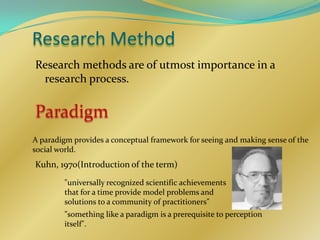
Research Method
Research methods are of utmost importance in a
 research process.

Paradigm
A paradigm provides a conceptual framework for seeing and making sense of the
social world.
Kuhn, 1970(Introduction of the term)

        "universally recognized scientific achievements
        that for a time provide model problems and
        solutions to a community of practitioners"
        "something like a paradigm is a prerequisite to perception
        itself".
Burrell and Morgan (1979)

          "To be located in a particular paradigm is to view the world
in a particular way

Patton (1990)

          He terms it as "world view”


The Two Paradigms
 •Quantitative Paradigm

 •Qualitative Paradigm
Quantitative Paradigm
 Quantitative research is termed the traditional,
  positivists, the experimental or empirical tradition by
  some of the authorities like Comte, Mill, Durkheim,
  Newton, etc
 Quantitative approach uses ‘measurement’ as the most
  precise and universally accepted method for assigning
  quantitative values
 Measurement is defined as the assignment of numbers
  to objects and events according to logically accepted
  rules
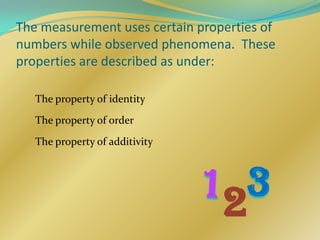
The measurement uses certain properties of
numbers while observed phenomena. These
properties are described as under:

   The property of identity

   The property of order

   The property of additivity


                                 2
Qualitative Research
 Qualitative approach is used in phenomenological
 inquiry for the verification of proposition, which takes
 into consideration the totality of phenomenon and
 does not attempt at analyzing it into quantifiable
 components.
  Qualitative research in contrast to quantitative
 approach is by some regarded as less ‘scientific’ and
 ‘softer.’
  Detailed perspectives of the participants in the
 ‘naturalistic’ settings.
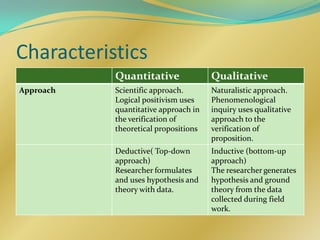
Characteristics
           Quantitative               Qualitative
Approach   Scientific approach.       Naturalistic approach.
           Logical positivism uses    Phenomenological
           quantitative approach in   inquiry uses qualitative
           the verification of        approach to the
           theoretical propositions   verification of
                                      proposition.
           Deductive( Top-down        Inductive (bottom-up
           approach)                  approach)
           Researcher formulates      The researcher generates
           and uses hypothesis and    hypothesis and ground
           theory with data.          the0ry from the data
                                      collected during field
                                      work.
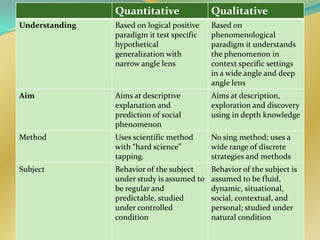
Quantitative                Qualitative
Understanding   Based on logical positive   Based on
                paradigm it test specific   phenomenological
                hypothetical                paradigm it understands
                generalization with         the phenomenon in
                narrow angle lens           context specific settings
                                            in a wide angle and deep
                                            angle lens
Aim             Aims at descriptive         Aims at description,
                explanation and             exploration and discovery
                prediction of social        using in depth knowledge
                phenomenon
Method          Uses scientific method      No sing method; uses a
                with “hard science”         wide range of discrete
                tapping.                    strategies and methods
Subject         Behavior of the subject     Behavior of the subject is
                under study is assumed to   assumed to be fluid,
                be regular and              dynamic, situational,
                predictable, studied        social, contextual, and
                under controlled            personal; studied under
                condition                   natural condition
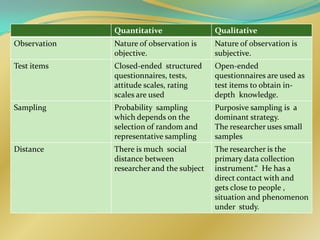
Quantitative                 Qualitative
Observation   Nature of observation is     Nature of observation is
              objective.                   subjective.
Test items    Closed-ended structured      Open-ended
              questionnaires, tests,       questionnaires are used as
              attitude scales, rating      test items to obtain in-
              scales are used              depth knowledge.
Sampling      Probability sampling         Purposive sampling is a
              which depends on the         dominant strategy.
              selection of random and      The researcher uses small
              representative sampling      samples
Distance      There is much social         The researcher is the
              distance between             primary data collection
              researcher and the subject   instrument.“ He has a
                                           direct contact with and
                                           gets close to people ,
                                           situation and phenomenon
                                           under study.
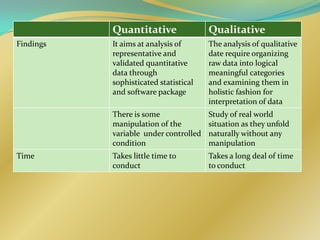
Quantitative                Qualitative
Findings   It aims at analysis of      The analysis of qualitative
           representative and          date require organizing
           validated quantitative      raw data into logical
           data through                meaningful categories
           sophisticated statistical   and examining them in
           and software package        holistic fashion for
                                       interpretation of data
           There is some               Study of real world
           manipulation of the         situation as they unfold
           variable under controlled   naturally without any
           condition                   manipulation
Time       Takes little time to        Takes a long deal of time
           conduct                     to conduct
Major Types of Researches
Quantitative Paradigm

   1.   Descriptive survey research
   2.   Correlation research
   3.   Causal-comparative research
   4.   Experimental research.


Qualitative Paradigm
   1.   Phenomenology.
   2.   Ethnography.
   3.   Case studies.
   4.   Grounded theory
Merits and Demerits of Quantitative Paradigm

 Merits
  1. The research has statistical reliability

  2. Quantitative research involves quantifications based on numbers.

  3. The results of the quantitative research can be generalized.

  4. The use of multivariate methods and analysis is helpful in measuring and
     controlling the variable or variables which intervene between independent
     and dependent variables.
Demerits
 1.   Quantitative research uses quantitative data.

 2. It is not always possible to formulate specific hypothetical
    generalizations.

 3. Involve researcher ‘bias.’

 4. The primary disadvantage of quantitative research is that issues are
    measured if they are known prior to beginning of the study, especially in
    survey research.

 5. The selection and use of large samples for drawing reliable statistics
    involves a lot of efforts in terms of money and man-power.
Merits and Demerits of Qualitative Paradigm
   Merits
    1. Qualitative research is not a unitary approach. It utilizes a variety
       of alternative approaches to the traditional, positivistic research.

    2. It utilizes qualitative data which are detailed and descriptive.

    3. Qualitative research is most suitable in the study of human
       behavior which is fluid, dynamic, situational, social, contextual,
       and personal

    4. It does not start with advanced formulation of specific deductive
       hypothesis .

    5. Qualitative research utilizes flexible design and “avoids getting
       locked into rigid designs.

    6. The researcher has direct and close contact with the people,
       situation, and phenomenon under study.

    7. The final report of the qualitative research studies are detailed and
       interesting narrations about the phenomenon
Demerits
  1. Subjective bias is a constant threat to objective data gathering tools
     and analysis of techniques.

  2. The findings lack generalization because of the nature and size of
     the samples used for data collection.

  3. Qualitative research utilizes a variety of methodologies in studying
     a phenomenon in holistic perspective. In certain cases, it is
     difficult to focus on complex interdependencies of its parts and
     understand the meaning of the phenomenon as a whole.

  4. It is cost effective and takes a long deal of time.
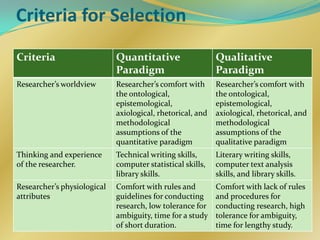
Criteria for Selection
Criteria                     Quantitative                   Qualitative
                             Paradigm                       Paradigm
Researcher’s worldview       Researcher’s comfort with      Researcher’s comfort with
                             the ontological,               the ontological,
                             epistemological,               epistemological,
                             axiological, rhetorical, and   axiological, rhetorical, and
                             methodological                 methodological
                             assumptions of the             assumptions of the
                             quantitative paradigm          qualitative paradigm
Thinking and experience      Technical writing skills,      Literary writing skills,
of the researcher.           computer statistical skills,   computer text analysis
                             library skills.                skills, and library skills.
Researcher’s physiological   Comfort with rules and         Comfort with lack of rules
attributes                   guidelines for conducting      and procedures for
                             research, low tolerance for    conducting research, high
                             ambiguity, time for a study    tolerance for ambiguity,
                             of short duration.             time for lengthy study.
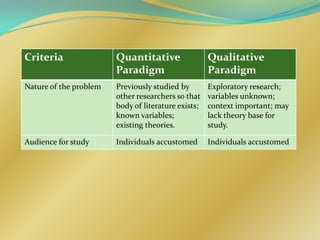
Criteria                Quantitative                 Qualitative
                        Paradigm                     Paradigm
Nature of the problem   Previously studied by        Exploratory research;
                        other researchers so that    variables unknown;
                        body of literature exists;   context important; may
                        known variables;             lack theory base for
                        existing theories.           study.

Audience for study      Individuals accustomed       Individuals accustomed
?? Q & A ??

Thank You

Research paradigms in education

  • 1.
    Introduction •Selects of thearea •Identifies and defines •Reviews the literature •States hypotheses •Defines the objectives •Finalizes the research plan
  • 2.
    Research Method Research methodsare of utmost importance in a research process. Paradigm A paradigm provides a conceptual framework for seeing and making sense of the social world. Kuhn, 1970(Introduction of the term) "universally recognized scientific achievements that for a time provide model problems and solutions to a community of practitioners" "something like a paradigm is a prerequisite to perception itself".
  • 3.
    Burrell and Morgan(1979) "To be located in a particular paradigm is to view the world in a particular way Patton (1990) He terms it as "world view” The Two Paradigms •Quantitative Paradigm •Qualitative Paradigm
  • 4.
    Quantitative Paradigm  Quantitativeresearch is termed the traditional, positivists, the experimental or empirical tradition by some of the authorities like Comte, Mill, Durkheim, Newton, etc  Quantitative approach uses ‘measurement’ as the most precise and universally accepted method for assigning quantitative values  Measurement is defined as the assignment of numbers to objects and events according to logically accepted rules
  • 5.
    The measurement usescertain properties of numbers while observed phenomena. These properties are described as under: The property of identity The property of order The property of additivity 2
  • 6.
    Qualitative Research Qualitativeapproach is used in phenomenological inquiry for the verification of proposition, which takes into consideration the totality of phenomenon and does not attempt at analyzing it into quantifiable components. Qualitative research in contrast to quantitative approach is by some regarded as less ‘scientific’ and ‘softer.’ Detailed perspectives of the participants in the ‘naturalistic’ settings.
  • 7.
    Characteristics Quantitative Qualitative Approach Scientific approach. Naturalistic approach. Logical positivism uses Phenomenological quantitative approach in inquiry uses qualitative the verification of approach to the theoretical propositions verification of proposition. Deductive( Top-down Inductive (bottom-up approach) approach) Researcher formulates The researcher generates and uses hypothesis and hypothesis and ground theory with data. the0ry from the data collected during field work.
  • 8.
    Quantitative Qualitative Understanding Based on logical positive Based on paradigm it test specific phenomenological hypothetical paradigm it understands generalization with the phenomenon in narrow angle lens context specific settings in a wide angle and deep angle lens Aim Aims at descriptive Aims at description, explanation and exploration and discovery prediction of social using in depth knowledge phenomenon Method Uses scientific method No sing method; uses a with “hard science” wide range of discrete tapping. strategies and methods Subject Behavior of the subject Behavior of the subject is under study is assumed to assumed to be fluid, be regular and dynamic, situational, predictable, studied social, contextual, and under controlled personal; studied under condition natural condition
  • 9.
    Quantitative Qualitative Observation Nature of observation is Nature of observation is objective. subjective. Test items Closed-ended structured Open-ended questionnaires, tests, questionnaires are used as attitude scales, rating test items to obtain in- scales are used depth knowledge. Sampling Probability sampling Purposive sampling is a which depends on the dominant strategy. selection of random and The researcher uses small representative sampling samples Distance There is much social The researcher is the distance between primary data collection researcher and the subject instrument.“ He has a direct contact with and gets close to people , situation and phenomenon under study.
  • 10.
    Quantitative Qualitative Findings It aims at analysis of The analysis of qualitative representative and date require organizing validated quantitative raw data into logical data through meaningful categories sophisticated statistical and examining them in and software package holistic fashion for interpretation of data There is some Study of real world manipulation of the situation as they unfold variable under controlled naturally without any condition manipulation Time Takes little time to Takes a long deal of time conduct to conduct
  • 11.
    Major Types ofResearches Quantitative Paradigm 1. Descriptive survey research 2. Correlation research 3. Causal-comparative research 4. Experimental research. Qualitative Paradigm 1. Phenomenology. 2. Ethnography. 3. Case studies. 4. Grounded theory
  • 12.
    Merits and Demeritsof Quantitative Paradigm Merits 1. The research has statistical reliability 2. Quantitative research involves quantifications based on numbers. 3. The results of the quantitative research can be generalized. 4. The use of multivariate methods and analysis is helpful in measuring and controlling the variable or variables which intervene between independent and dependent variables.
  • 13.
    Demerits 1. Quantitative research uses quantitative data. 2. It is not always possible to formulate specific hypothetical generalizations. 3. Involve researcher ‘bias.’ 4. The primary disadvantage of quantitative research is that issues are measured if they are known prior to beginning of the study, especially in survey research. 5. The selection and use of large samples for drawing reliable statistics involves a lot of efforts in terms of money and man-power.
  • 14.
    Merits and Demeritsof Qualitative Paradigm Merits 1. Qualitative research is not a unitary approach. It utilizes a variety of alternative approaches to the traditional, positivistic research. 2. It utilizes qualitative data which are detailed and descriptive. 3. Qualitative research is most suitable in the study of human behavior which is fluid, dynamic, situational, social, contextual, and personal 4. It does not start with advanced formulation of specific deductive hypothesis . 5. Qualitative research utilizes flexible design and “avoids getting locked into rigid designs. 6. The researcher has direct and close contact with the people, situation, and phenomenon under study. 7. The final report of the qualitative research studies are detailed and interesting narrations about the phenomenon
  • 15.
    Demerits 1.Subjective bias is a constant threat to objective data gathering tools and analysis of techniques. 2. The findings lack generalization because of the nature and size of the samples used for data collection. 3. Qualitative research utilizes a variety of methodologies in studying a phenomenon in holistic perspective. In certain cases, it is difficult to focus on complex interdependencies of its parts and understand the meaning of the phenomenon as a whole. 4. It is cost effective and takes a long deal of time.
  • 16.
    Criteria for Selection Criteria Quantitative Qualitative Paradigm Paradigm Researcher’s worldview Researcher’s comfort with Researcher’s comfort with the ontological, the ontological, epistemological, epistemological, axiological, rhetorical, and axiological, rhetorical, and methodological methodological assumptions of the assumptions of the quantitative paradigm qualitative paradigm Thinking and experience Technical writing skills, Literary writing skills, of the researcher. computer statistical skills, computer text analysis library skills. skills, and library skills. Researcher’s physiological Comfort with rules and Comfort with lack of rules attributes guidelines for conducting and procedures for research, low tolerance for conducting research, high ambiguity, time for a study tolerance for ambiguity, of short duration. time for lengthy study.
  • 17.
    Criteria Quantitative Qualitative Paradigm Paradigm Nature of the problem Previously studied by Exploratory research; other researchers so that variables unknown; body of literature exists; context important; may known variables; lack theory base for existing theories. study. Audience for study Individuals accustomed Individuals accustomed
  • 18.
    ?? Q &A ?? Thank You