Research Method

       EDHE6530
Dr. Pu-Shih Daniel Chen
Overview
• Review our progress
• Introduction of Research Methods
• Qualitative Research Methods
A Quick Review
Chapter One
• Introduction/problem statement
• Purpose of the study
• Conceptual framework or theoretical
  orientation
• Research questions and hypotheses
• Definition of terms
• Significance of the study
• Limitations and delimitations
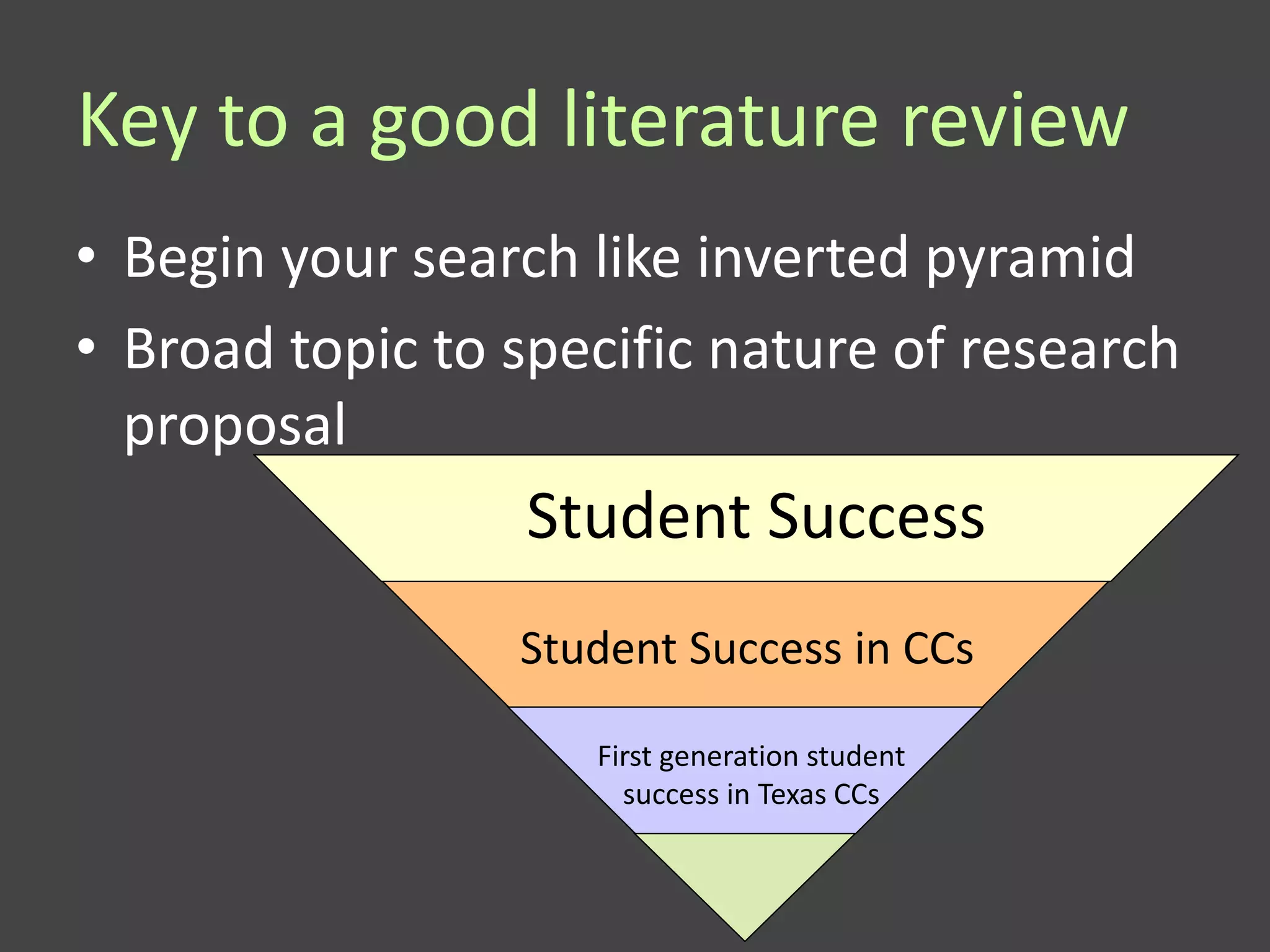
Key to a good literature review
• Begin your search like inverted pyramid
• Broad topic to specific nature of research
  proposal
                 Student Success
                 Student Success in CCs

                    First generation student
                      success in Texas CCs
Key to a good literature review
• Always keep your research questions in
  mind
• Critically analyze the literature
• Integrate instead of summarize
• Use primary sources
• Distinguish between assertion and
  evidence
Other tips
• Don’t ignore studies that differ from
  majority or personal bias
• Read most recent ones first, oldest last
• Read important landmark works
• Use data-based, empirical studies
• Opinion pieces and descriptive research
  helpful in introduction – set stage
• Not a literary production- be clear and
  concise
Research Methods
Types of Research
• Basic vs. Applied Research
• Four research paradigms:
  – Quantitative (positivist)
  – Qualitative (interpretive)
  – Ideological
  – Mixed-method (pragmatic)
Basic Research
• Theory Driven
• Discovery of knowledge
Applied Research
• IMMEDIATE practical problem
• ACTUAL problems in the field
• Limited generalizability
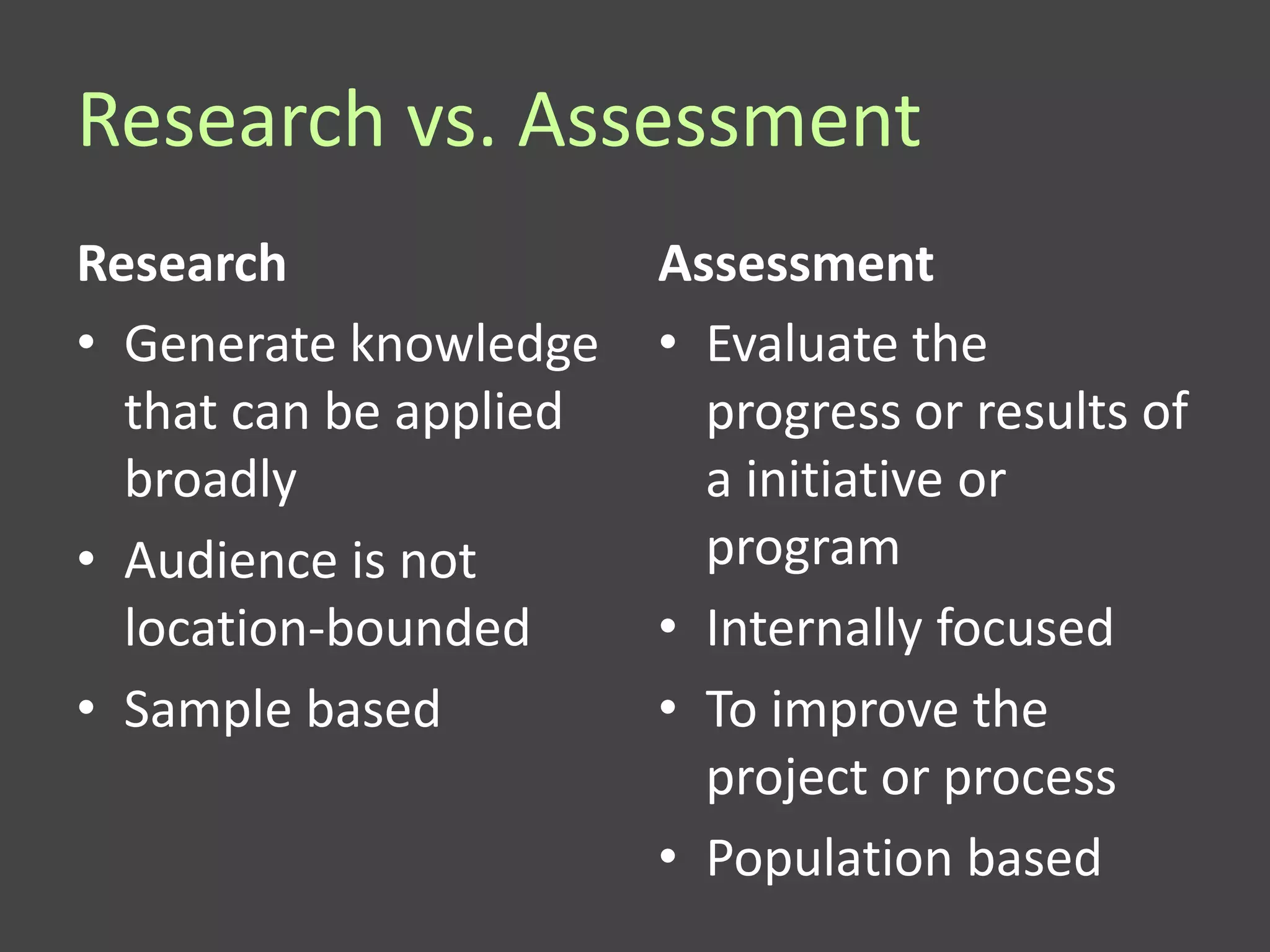
Research vs. Assessment
Research                Assessment
• Generate knowledge    • Evaluate the
  that can be applied     progress or results of
  broadly                 a initiative or
• Audience is not         program
  location-bounded      • Internally focused
• Sample based          • To improve the
                          project or process
                        • Population based
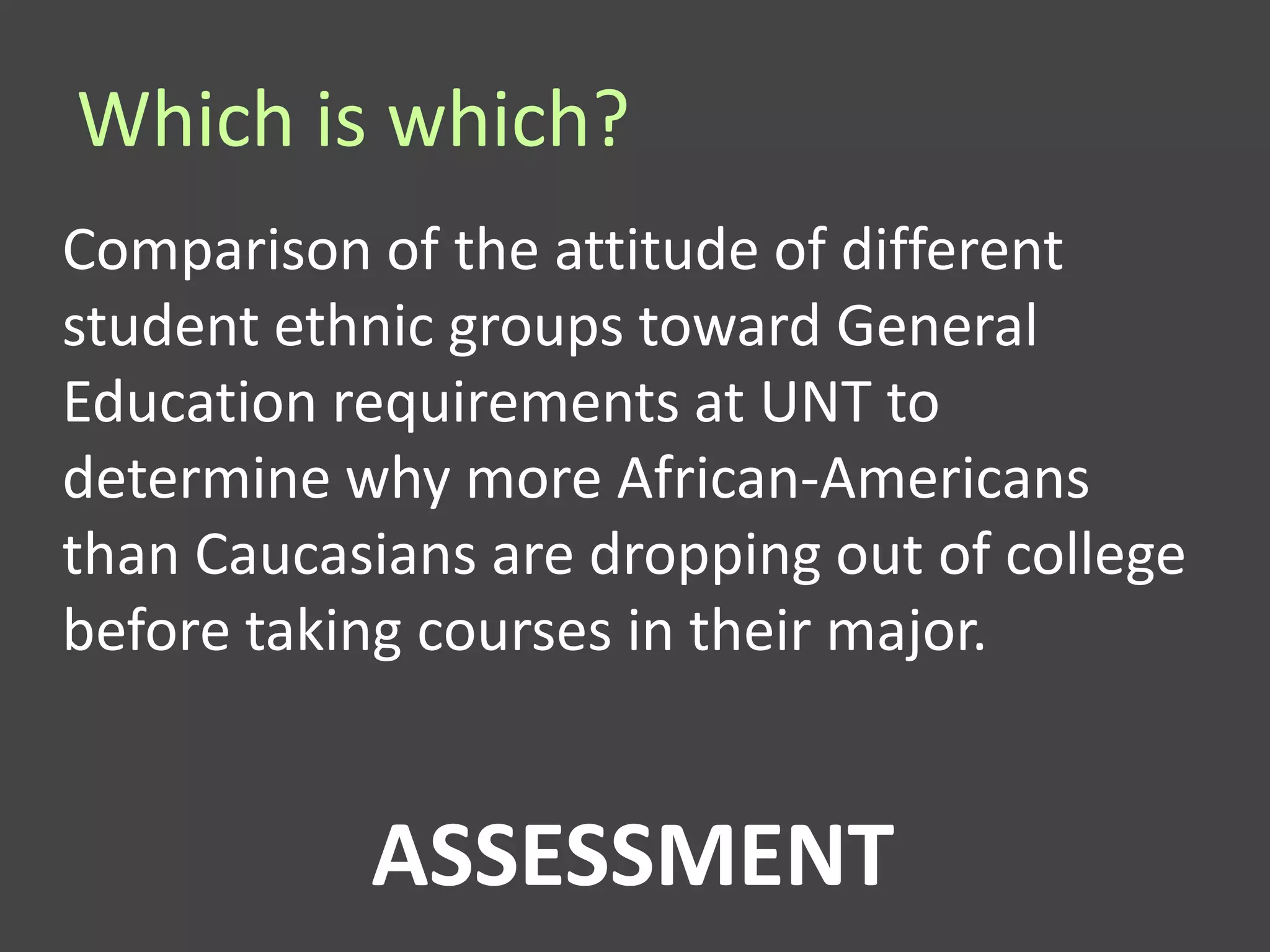
Which is which?
Comparison of the attitude of different
student ethnic groups toward General
Education requirements at UNT to
determine why more African-Americans
than Caucasians are dropping out of college
before taking courses in their major.


           ASSESSMENT
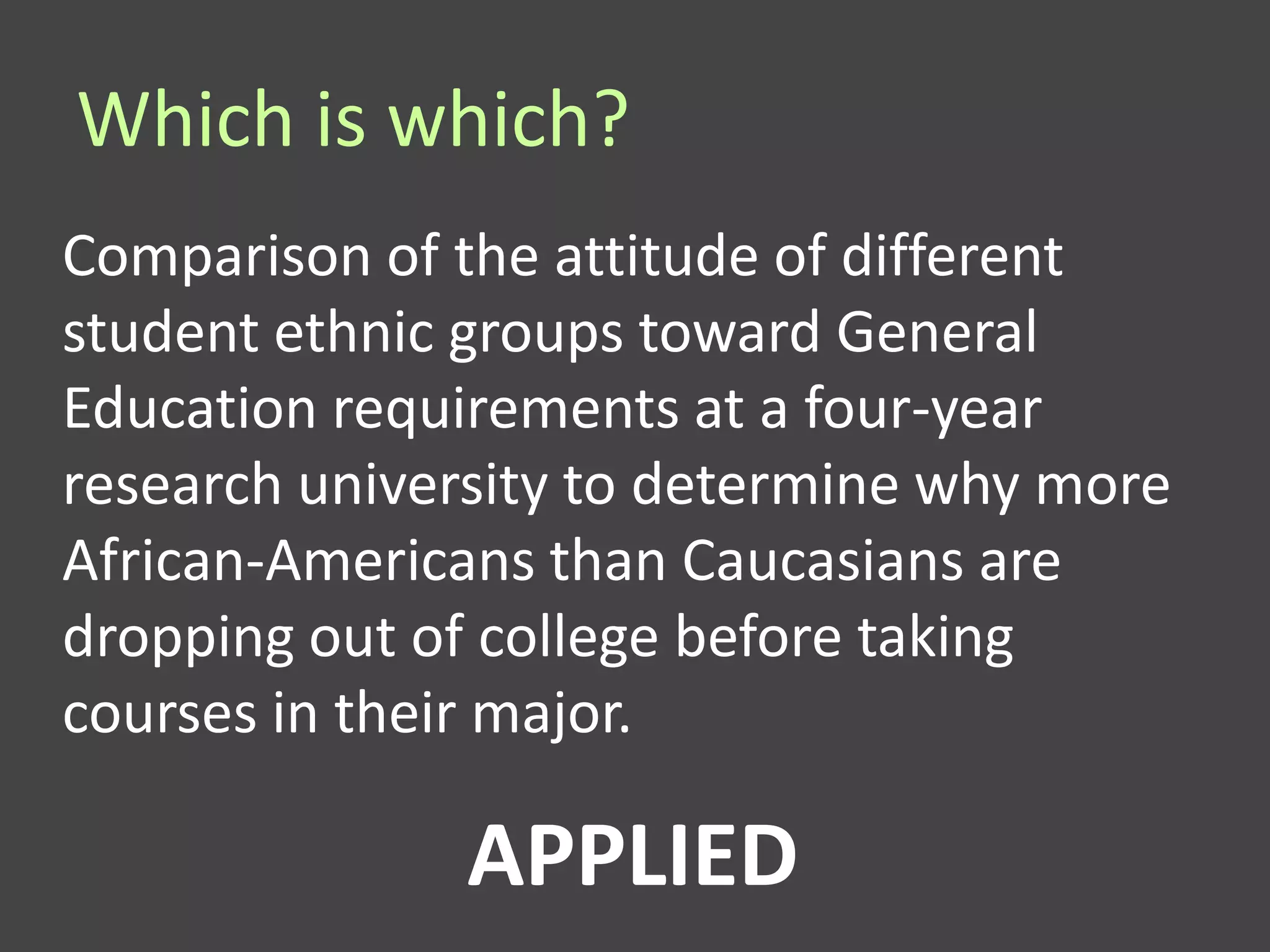
Which is which?
Comparison of the attitude of different
student ethnic groups toward General
Education requirements at a four-year
research university to determine why more
African-Americans than Caucasians are
dropping out of college before taking
courses in their major.

              APPLIED
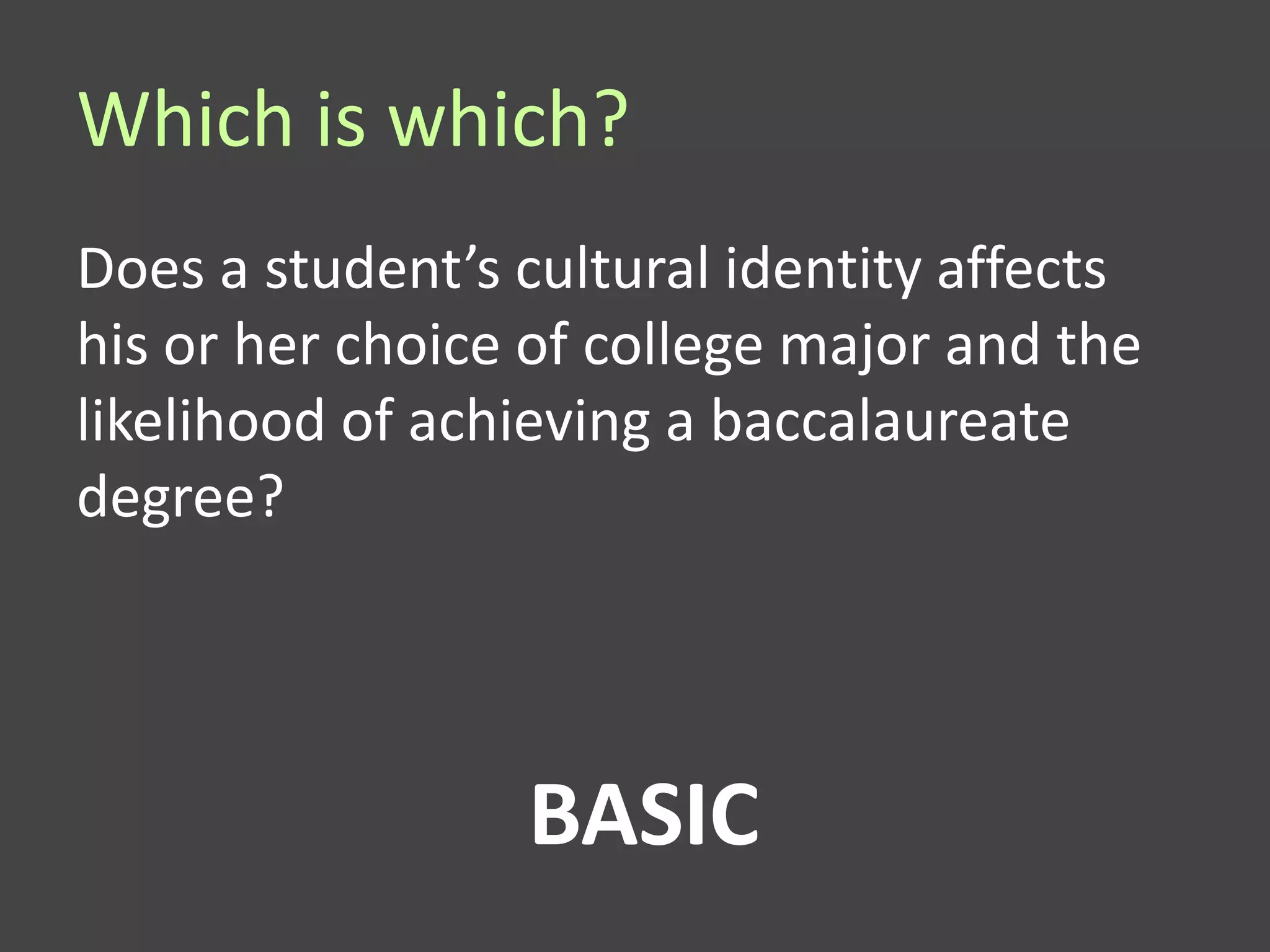
Which is which?
Does a student’s cultural identity affects
his or her choice of college major and the
likelihood of achieving a baccalaureate
degree?


                 BASIC
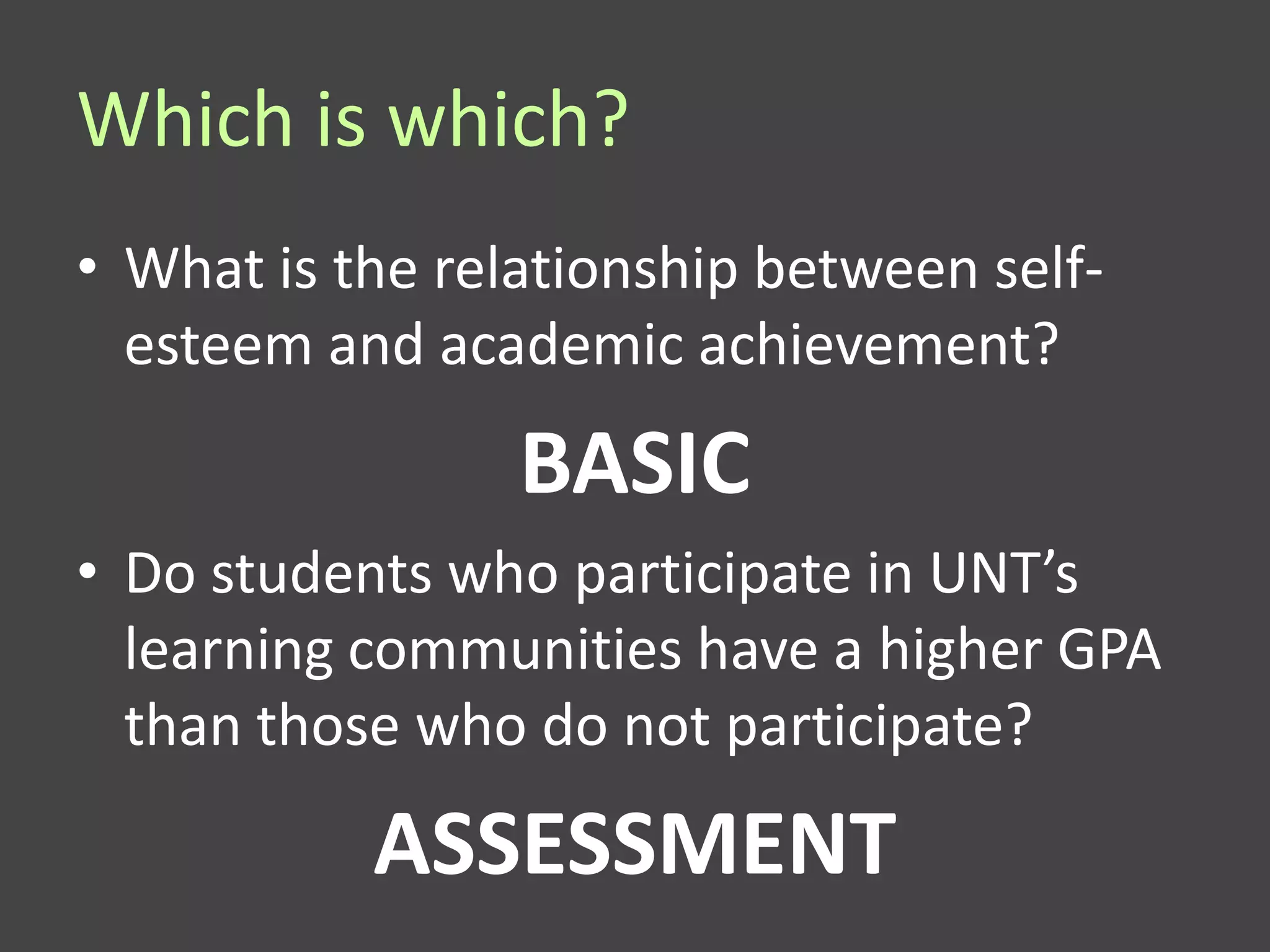
Which is which?
• What is the relationship between self-
  esteem and academic achievement?

                 BASIC
• Do students who participate in UNT’s
  learning communities have a higher GPA
  than those who do not participate?

           ASSESSMENT
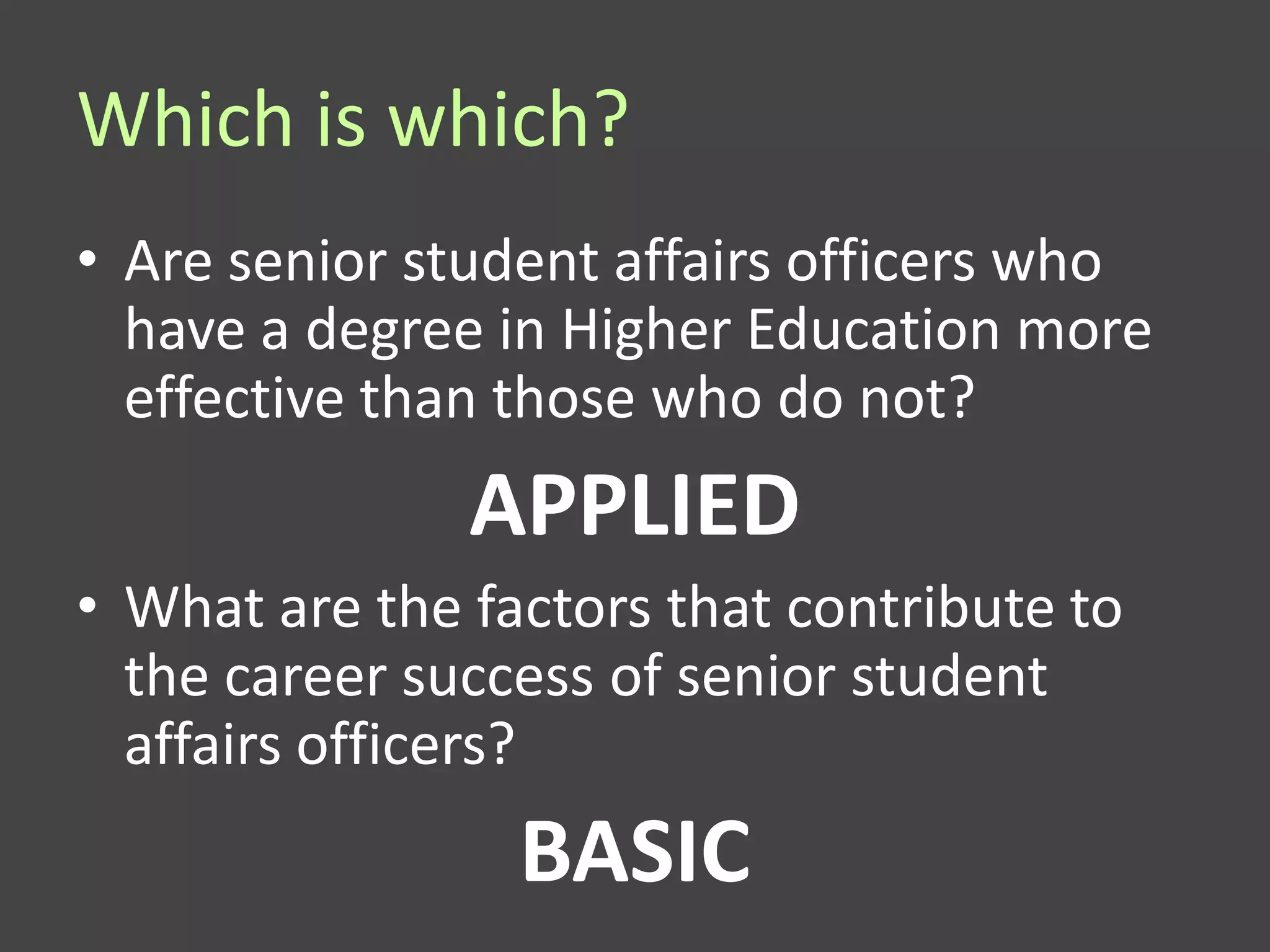
Which is which?
• Are senior student affairs officers who
  have a degree in Higher Education more
  effective than those who do not?
               APPLIED
• What are the factors that contribute to
  the career success of senior student
  affairs officers?
                 BASIC
Which is which?
• What is the effects of student
  engagement on college student’s identity
  development?
                BASIC
• What is the effect of the No Child Left
  Behind Act of 2001 on student readiness
  in Texas community colleges?
              APPLIED
Fundamental Questions
1.   What constitutes knowledge?
2.   Where is knowledge located?
3.   How do we attain knowledge?
4.   How do we describe knowledge?
5.   How do we study knowledge?
Quantitative vs. Qualitative
•   Epistemology
•   Treatment of Theory
•   Role of the researcher(s)
•   Data collection and analysis
•   Quality controls
•   Report of findings
•   Types of studies
•   How to choose between the two methods
Epistemology
Quantitative                       Qualitative
• Positivism                       • Phenomenology
   – An objective reality exist      – The world exists and different
     that is subject to natural        people construct it in
     law such as cause and             different ways. Reality cannot
     effect and there are              be understood without the
     universal truth that can be       consciousness of a person.
     discovered through inquiry.       Therefore, study of objective
   – Example: A physicist              truth is meaningless without
     studies the movement of           the context.
     stars and interpreted it        – Example: A study of
     with Quantum                      homophobia in 19th century
     Chromodynamics                    American society
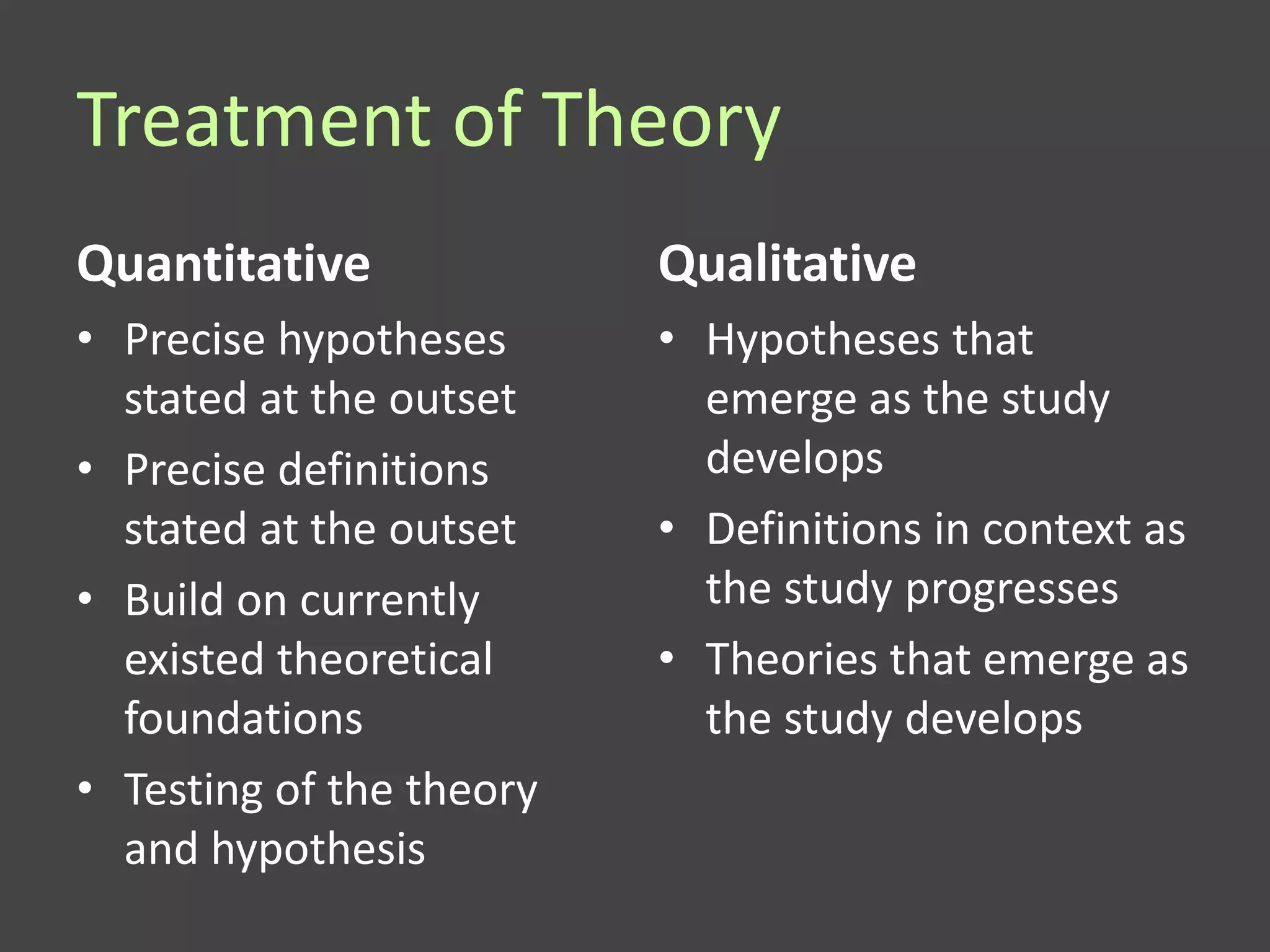
Treatment of Theory
Quantitative              Qualitative
• Precise hypotheses      • Hypotheses that
  stated at the outset      emerge as the study
• Precise definitions       develops
  stated at the outset    • Definitions in context as
• Build on currently        the study progresses
  existed theoretical     • Theories that emerge as
  foundations               the study develops
• Testing of the theory
  and hypothesis
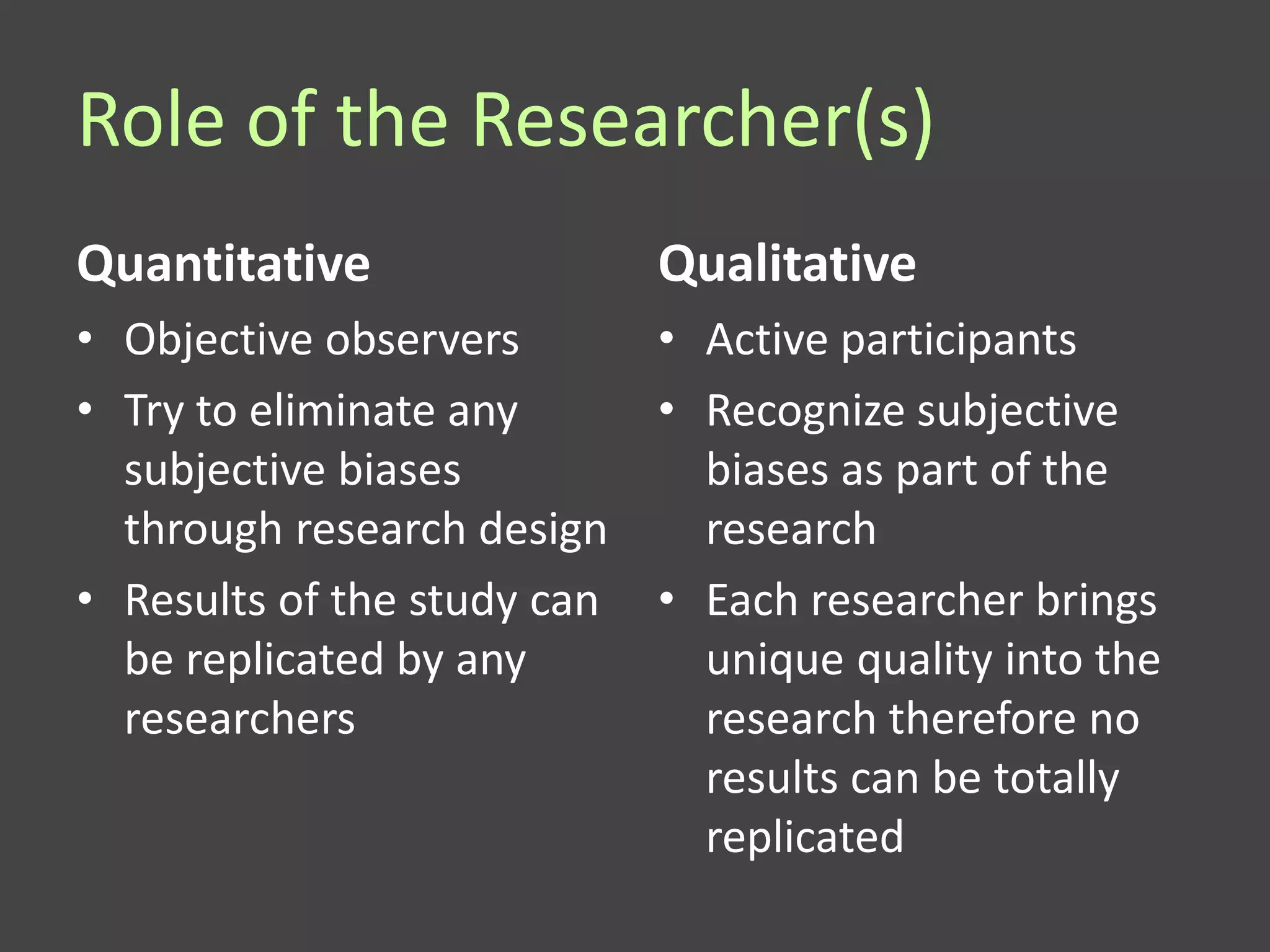
Role of the Researcher(s)
Quantitative                 Qualitative
• Objective observers        • Active participants
• Try to eliminate any       • Recognize subjective
  subjective biases            biases as part of the
  through research design      research
• Results of the study can   • Each researcher brings
  be replicated by any         unique quality into the
  researchers                  research therefore no
                               results can be totally
                               replicated
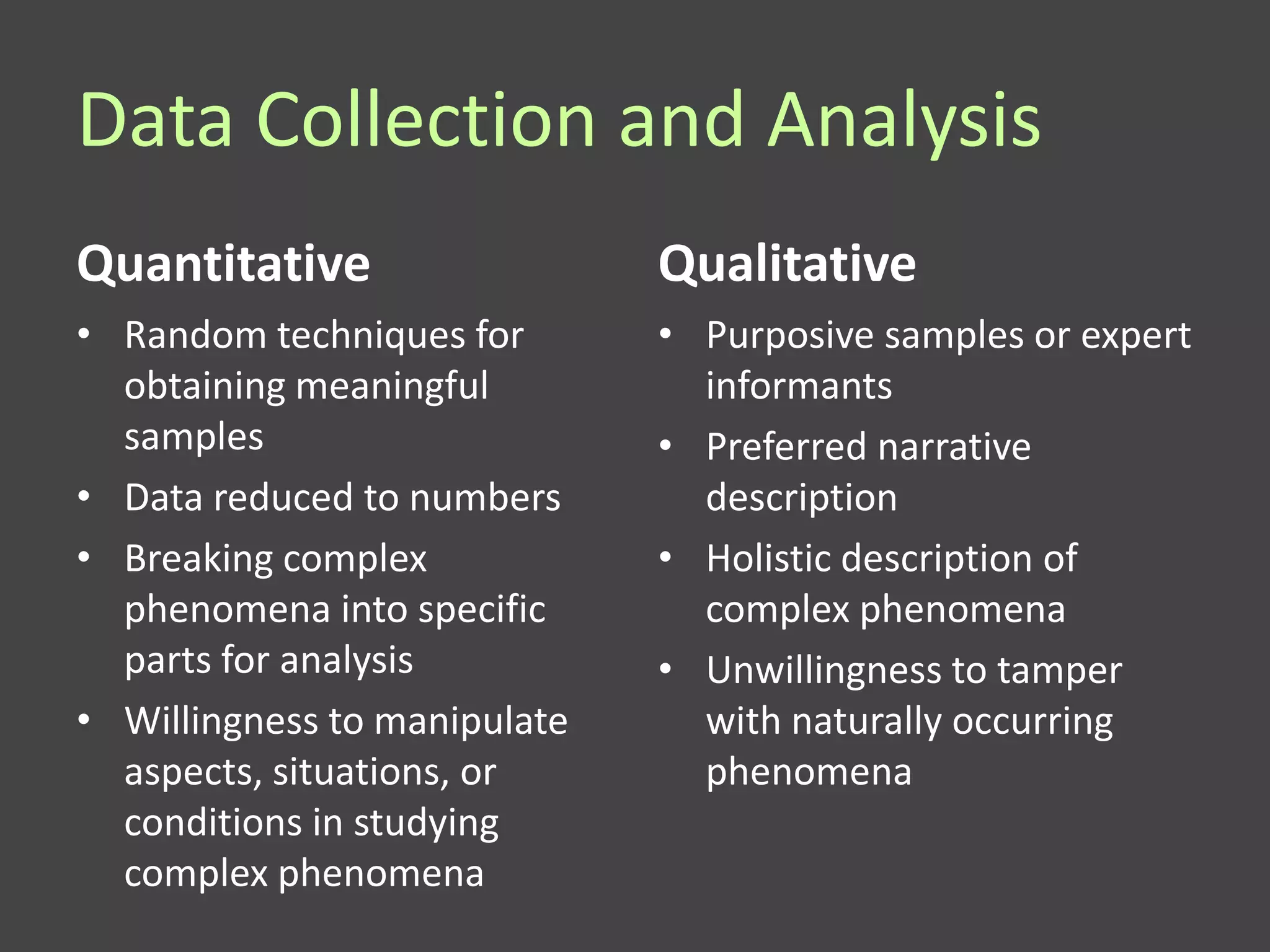
Data Collection and Analysis
Quantitative                  Qualitative
• Random techniques for       • Purposive samples or expert
  obtaining meaningful          informants
  samples                     • Preferred narrative
• Data reduced to numbers       description
• Breaking complex            • Holistic description of
  phenomena into specific       complex phenomena
  parts for analysis          • Unwillingness to tamper
• Willingness to manipulate     with naturally occurring
  aspects, situations, or       phenomena
  conditions in studying
  complex phenomena
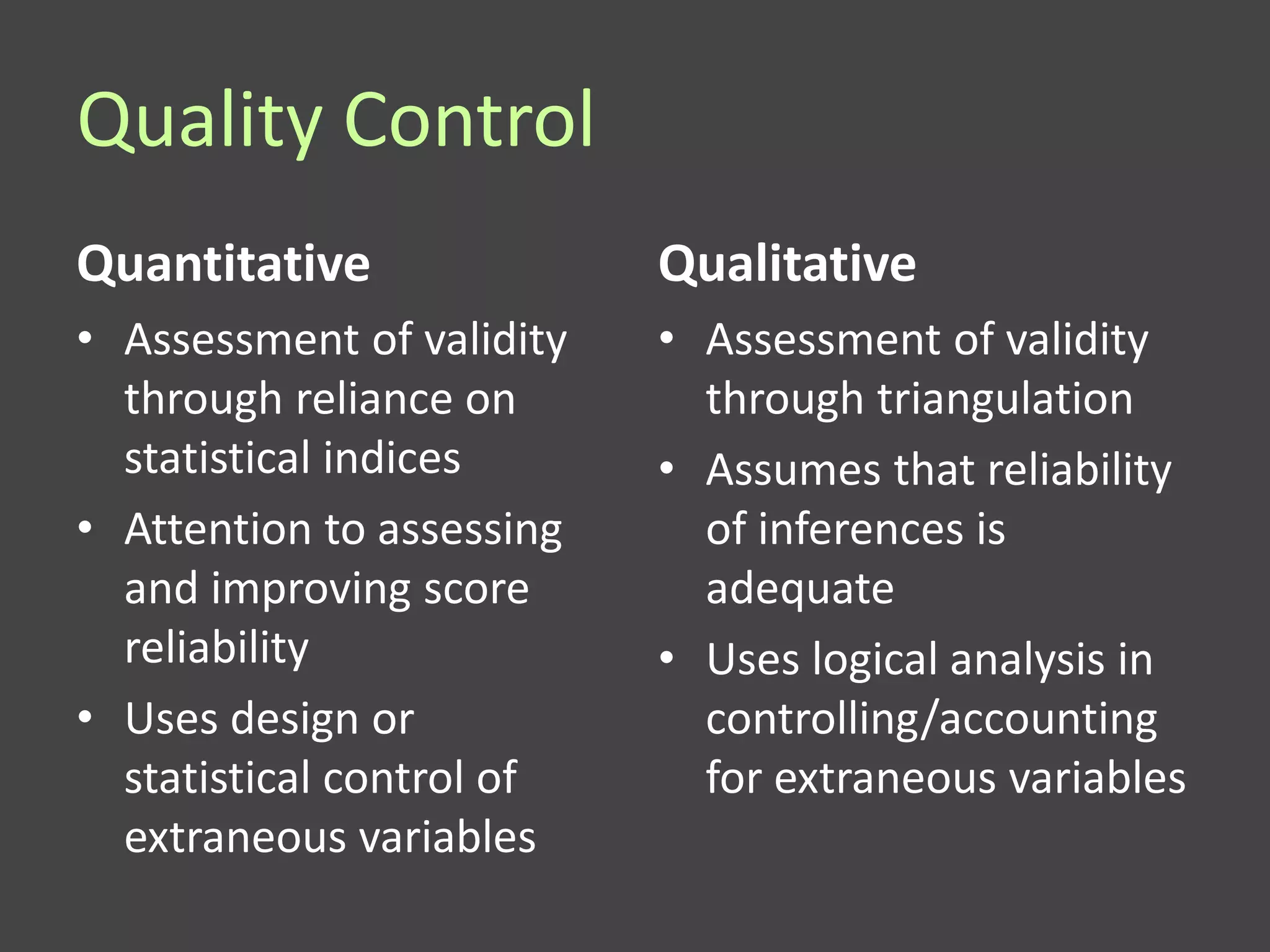
Quality Control
Quantitative               Qualitative
• Assessment of validity   • Assessment of validity
  through reliance on        through triangulation
  statistical indices      • Assumes that reliability
• Attention to assessing     of inferences is
  and improving score        adequate
  reliability              • Uses logical analysis in
• Uses design or             controlling/accounting
  statistical control of     for extraneous variables
  extraneous variables
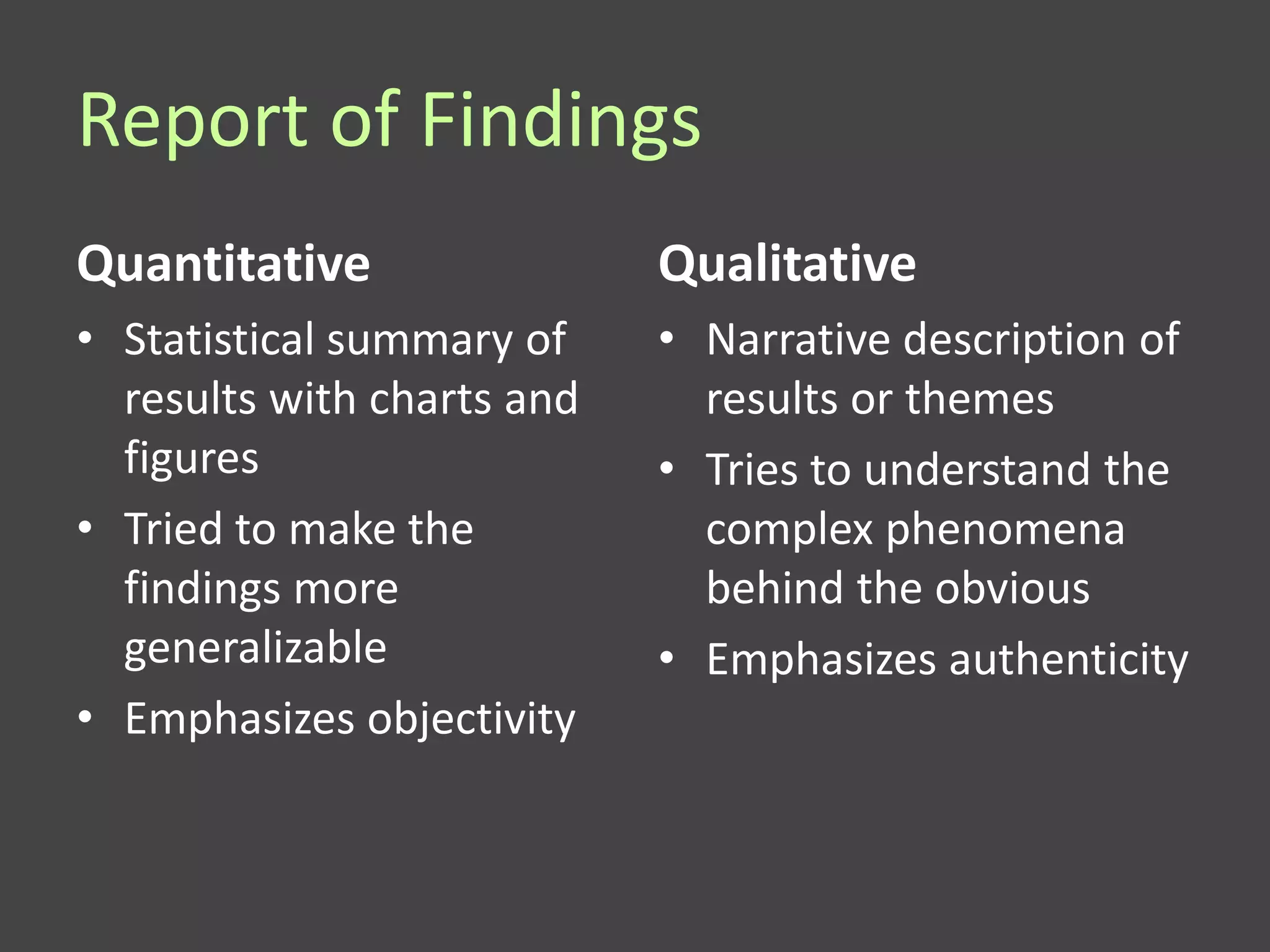
Report of Findings
Quantitative                Qualitative
• Statistical summary of    • Narrative description of
  results with charts and     results or themes
  figures                   • Tries to understand the
• Tried to make the           complex phenomena
  findings more               behind the obvious
  generalizable             • Emphasizes authenticity
• Emphasizes objectivity
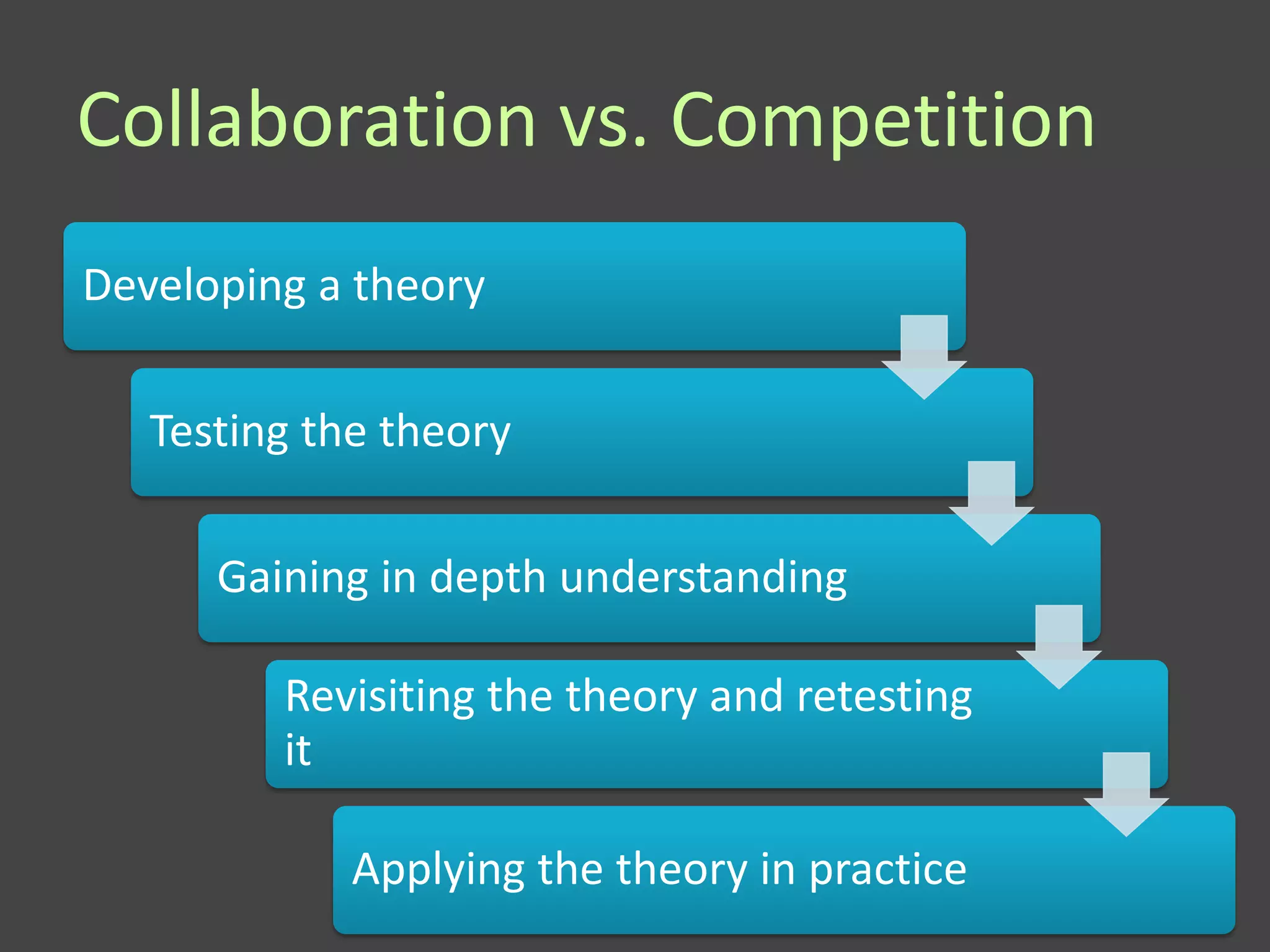
Collaboration vs. Competition
Developing a theory

   Testing the theory

      Gaining in depth understanding

         Revisiting the theory and retesting
         it

             Applying the theory in practice
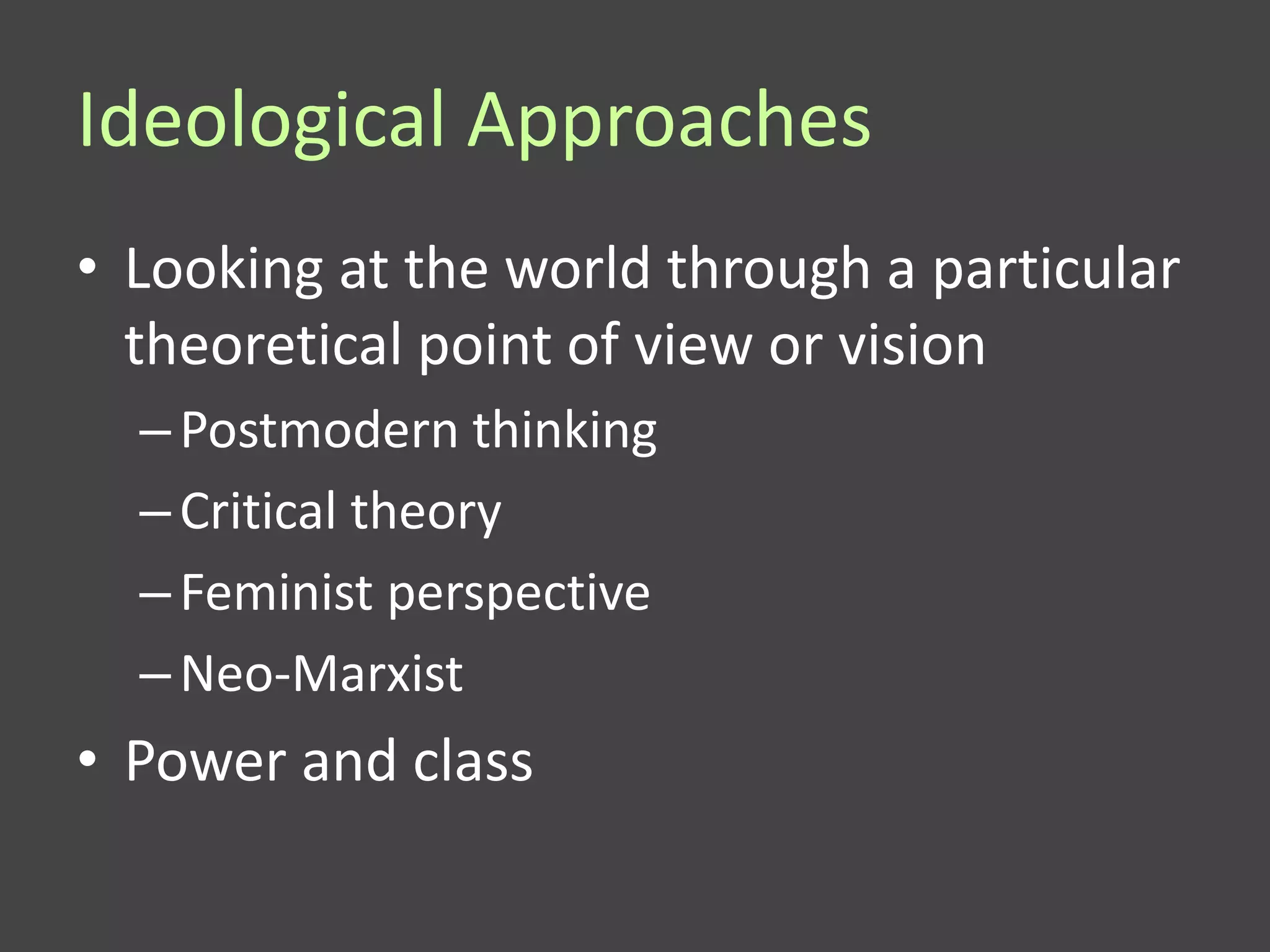
Ideological Approaches
• Looking at the world through a particular
  theoretical point of view or vision
  – Postmodern thinking
  – Critical theory
  – Feminist perspective
  – Neo-Marxist
• Power and class
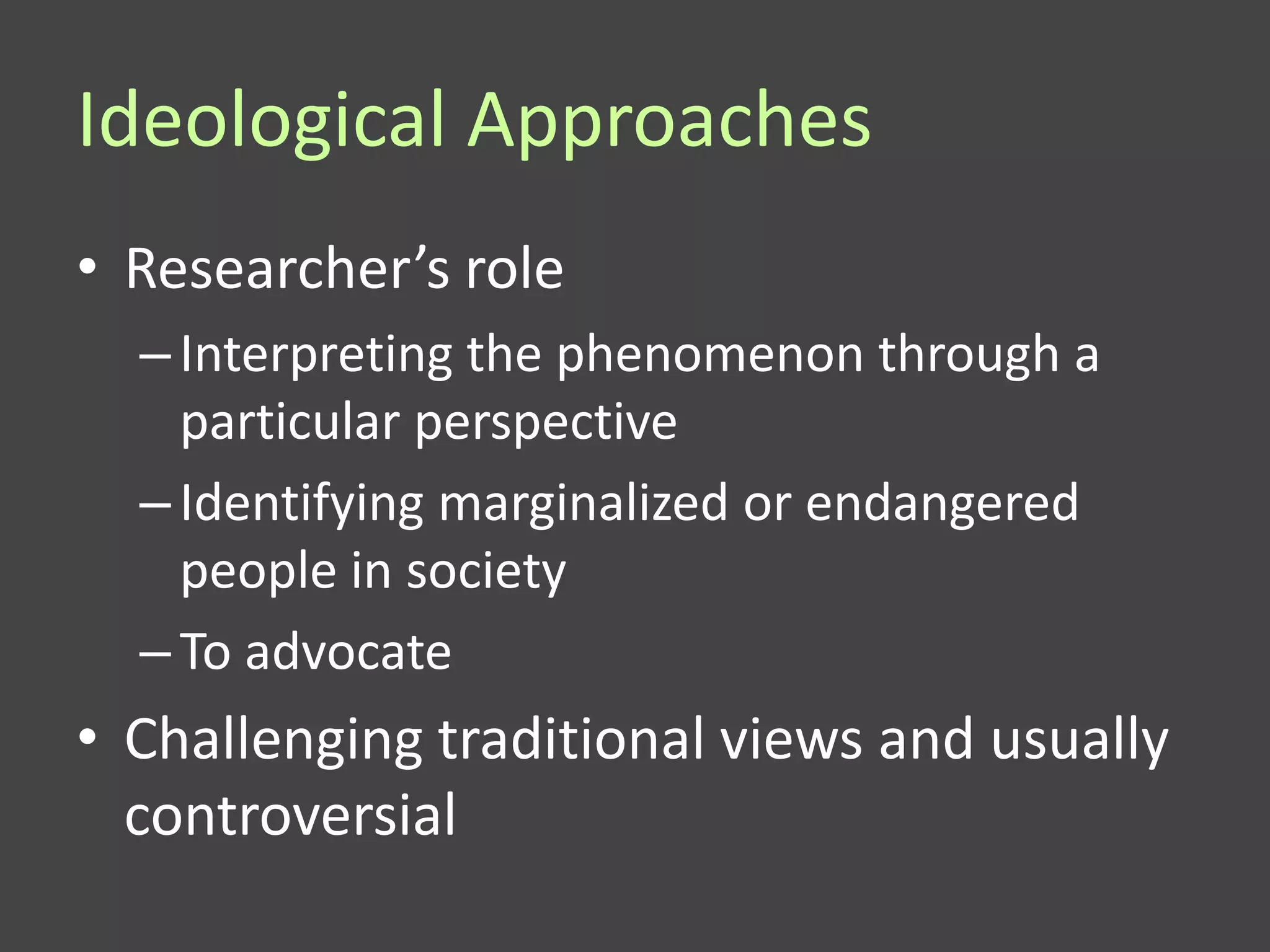
Ideological Approaches
• Researcher’s role
  – Interpreting the phenomenon through a
    particular perspective
  – Identifying marginalized or endangered
    people in society
  – To advocate
• Challenging traditional views and usually
  controversial
Mixed-Method
• Philosophically torn between positivist
  and Phenomenology
• Pragmatism comes to save the day
• Focusing on “solving the problems”
  instead of philosophical arguments
• Mixed-method is NOT half quantitative
  and half qualitative
How to Choose?
•   Type of questions you are interested
•   Type of data that are available to you
•   Personality and world view
•   Your ability to conduct the research


    Purpose must always precede method or
                    format
Ask yourself…
• Am I predisposed as a researcher toward
  achieving some sort of closure, toward
  seeking knowledge that can be replicated
  and reconfirmed and therefore held with
  considerable certainty?
• Is it important that my data enable me to
  explain, predict, or even control the
  outcomes of similar future events?
Ask yourself…
• Do I feel the need to eliminate plausible
  competing explanations for findings that
  I obtain through my research?
• Am I uncomfortable with uncertainty?
Ask yourself…
• Am I more inclined toward uncovering
  multiple or even conflicting
  interpretations of the phenomenon or
  experience I am investigating?
• Am I comfortable with the prospect of
  furnishing more than a single meaning to
  features of an experience?
Ask yourself…
• Am I predisposed toward the generation
  of questions that invite rather than
  reduce complexity?
• Am I comfortable with uncertainty?
Ask yourself…
• Do I feel a strong desire to advocate for a
  underprivileged social class through a
  particular theoretical vision?
• Will incorporate both quantitative and
  qualitative methods make my research
  more complete?
Type of Studies
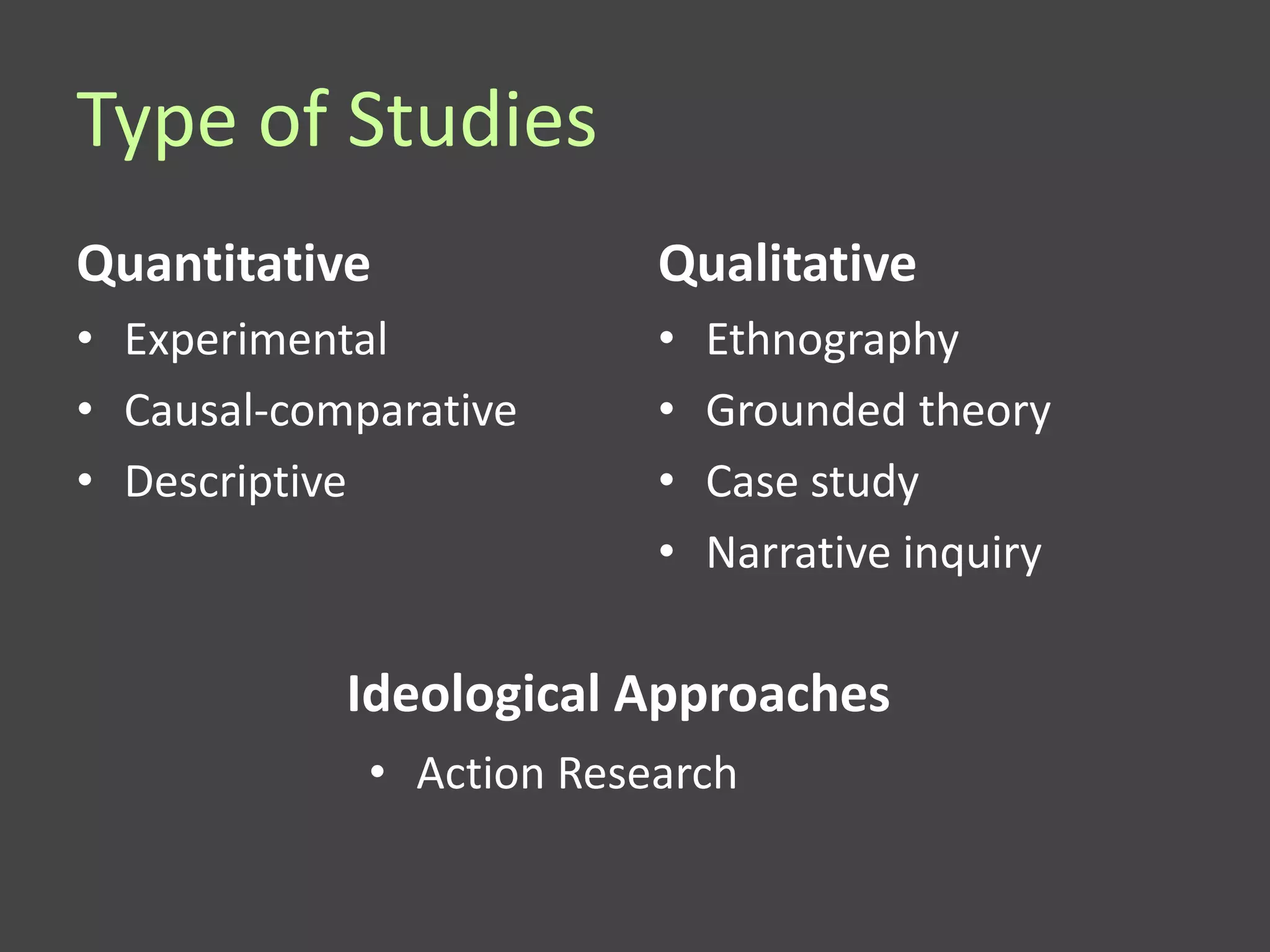
Quantitative              Qualitative
• Experimental            •   Ethnography
• Causal-comparative      •   Grounded theory
• Descriptive             •   Case study
                          •   Narrative inquiry

            Ideological Approaches
             • Action Research
Experimental Design
• Independent Variable (IV) manipulated
  by researcher
• Dependent Variable (DV) measured
• CONTROLLED setting
• Simple and powerful
• Cause and effect relationships
Causal-Comparative Design
•   Ex Post Facto research
•   IV cannot be manipulated ethically
•   Changes in IV have already occurred
•   Groups may be different before IV
•   Produce cause-effect relationship
Descriptive Design
• Tells what is
• Describes present state of affairs
• NO manipulation of variables
Case Study
• Detailed study of a person/group
• Person or group – atypical
• Entire range behaviors – relationships to
  person’s history and environment
• Reactions to naturally occurring events
Ethnography
• A study of culture
• To develop a holistic and comprehensive
  understanding of a culture
• Emic perspective – the meaning from the
  actor’s point of view
• Ethic perspective – observer’s point of
  view
• Find the meaning
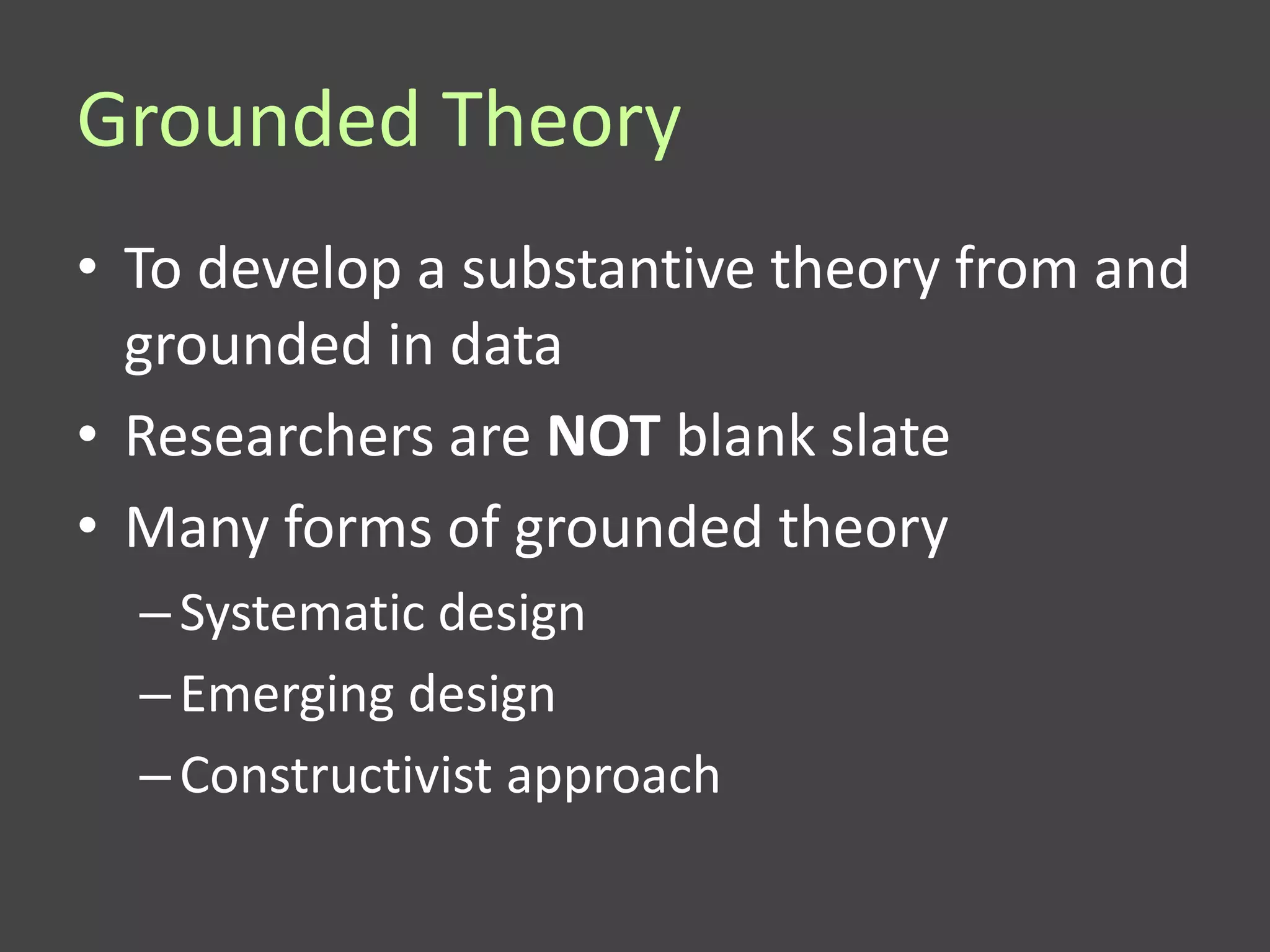
Grounded Theory
• To develop a substantive theory from and
  grounded in data
• Researchers are NOT blank slate
• Many forms of grounded theory
  – Systematic design
  – Emerging design
  – Constructivist approach
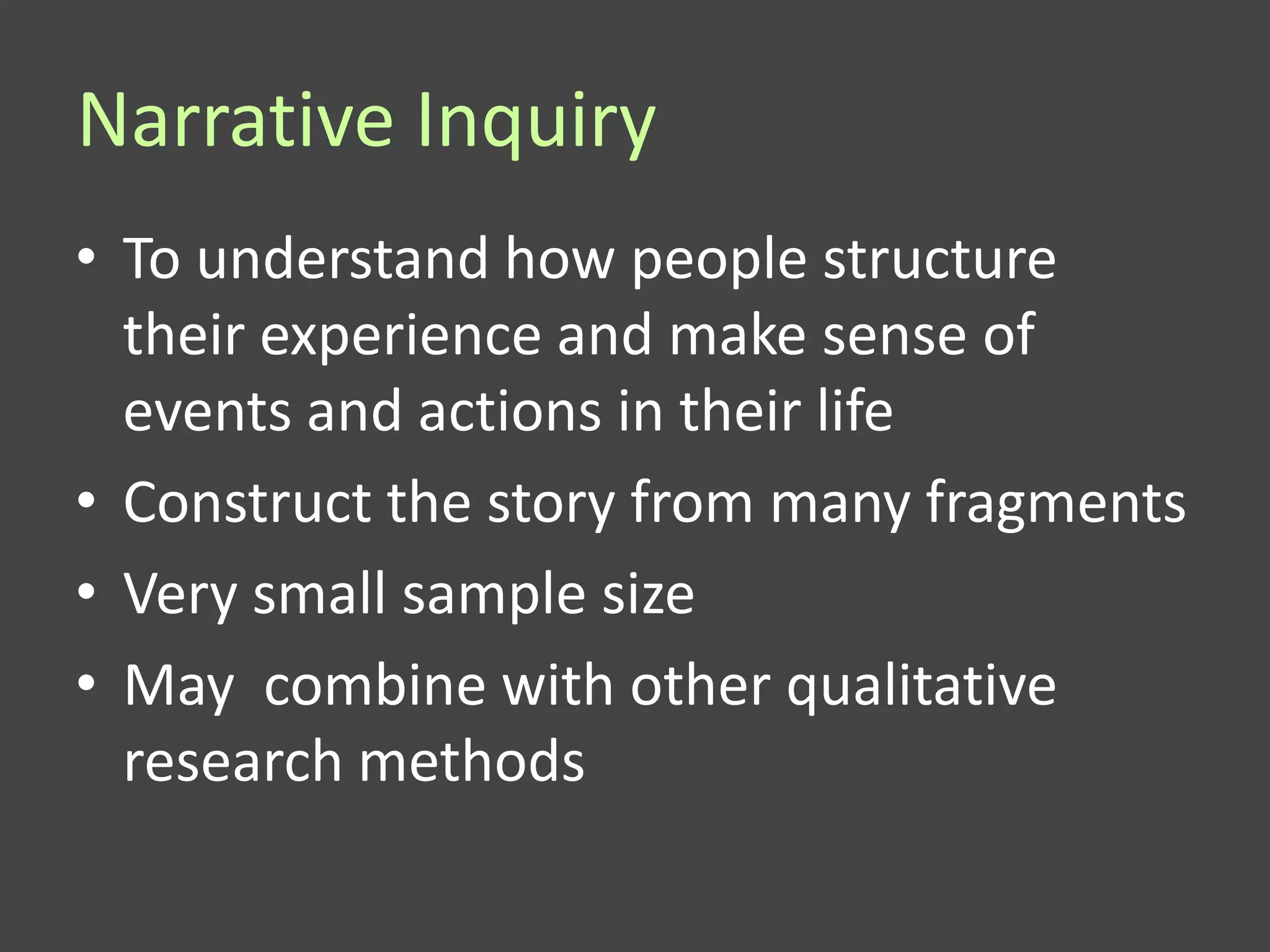
Narrative Inquiry
• To understand how people structure
  their experience and make sense of
  events and actions in their life
• Construct the story from many fragments
• Very small sample size
• May combine with other qualitative
  research methods
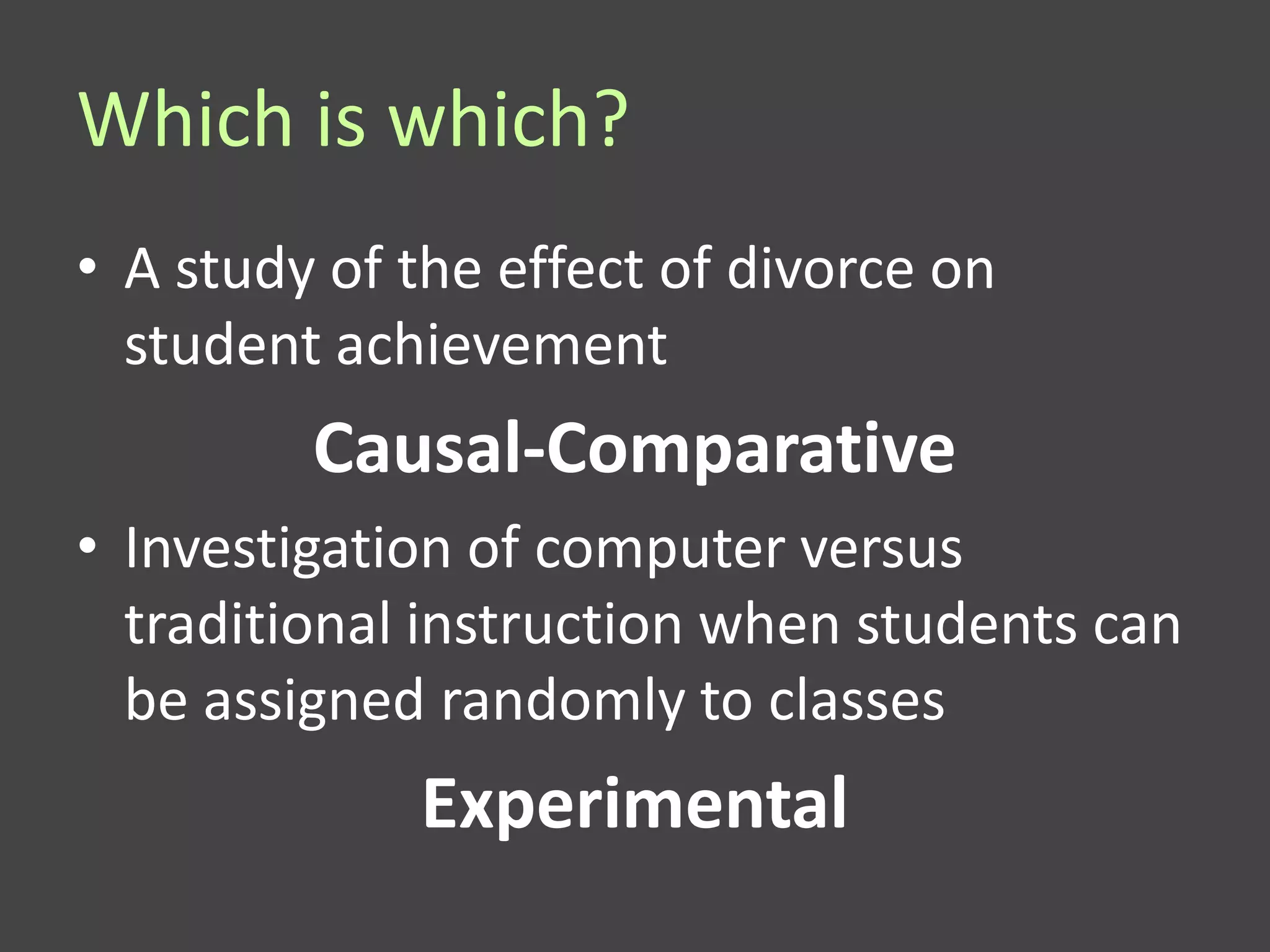
Which is which?
• A study of the effect of divorce on
  student achievement
         Causal-Comparative
• Investigation of computer versus
  traditional instruction when students can
  be assigned randomly to classes
             Experimental
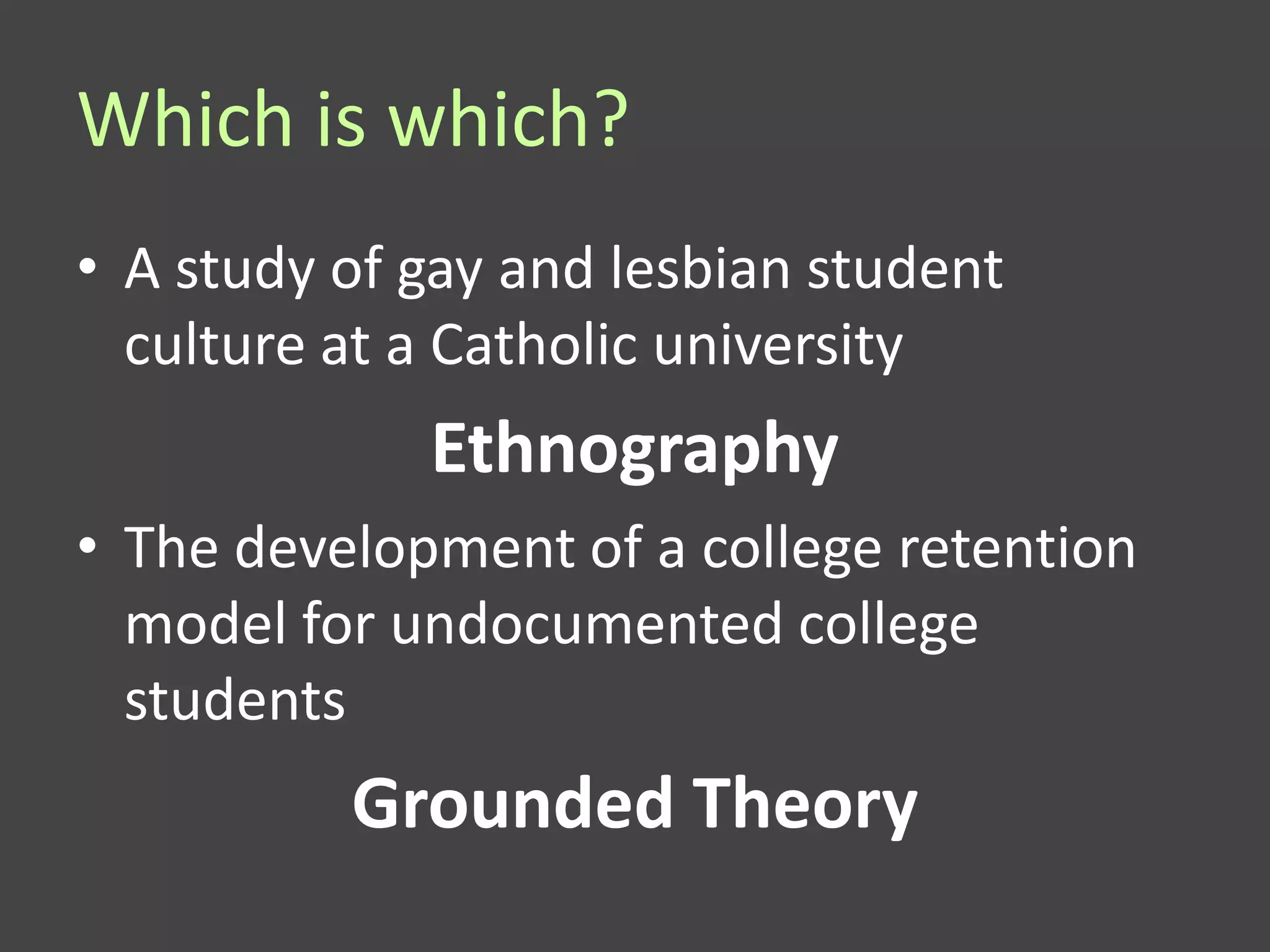
Which is which?
• A study of gay and lesbian student
  culture at a Catholic university
             Ethnography
• The development of a college retention
  model for undocumented college
  students
          Grounded Theory
Which is which?
• A survey of graduate students’ attitudes
  toward the increase in tuition
               Descriptive
• A study of the presidency of Gretchen
  Bataille at the University of North Texas
               Case Study

Lecture 10.5.10

  • 1.
    Research Method EDHE6530 Dr. Pu-Shih Daniel Chen
  • 2.
    Overview • Review ourprogress • Introduction of Research Methods • Qualitative Research Methods
  • 3.
  • 4.
    Chapter One • Introduction/problemstatement • Purpose of the study • Conceptual framework or theoretical orientation • Research questions and hypotheses • Definition of terms • Significance of the study • Limitations and delimitations
  • 5.
    Key to agood literature review • Begin your search like inverted pyramid • Broad topic to specific nature of research proposal Student Success Student Success in CCs First generation student success in Texas CCs
  • 6.
    Key to agood literature review • Always keep your research questions in mind • Critically analyze the literature • Integrate instead of summarize • Use primary sources • Distinguish between assertion and evidence
  • 7.
    Other tips • Don’tignore studies that differ from majority or personal bias • Read most recent ones first, oldest last • Read important landmark works • Use data-based, empirical studies • Opinion pieces and descriptive research helpful in introduction – set stage • Not a literary production- be clear and concise
  • 8.
  • 9.
    Types of Research •Basic vs. Applied Research • Four research paradigms: – Quantitative (positivist) – Qualitative (interpretive) – Ideological – Mixed-method (pragmatic)
  • 10.
    Basic Research • TheoryDriven • Discovery of knowledge
  • 11.
    Applied Research • IMMEDIATEpractical problem • ACTUAL problems in the field • Limited generalizability
  • 12.
    Research vs. Assessment Research Assessment • Generate knowledge • Evaluate the that can be applied progress or results of broadly a initiative or • Audience is not program location-bounded • Internally focused • Sample based • To improve the project or process • Population based
  • 13.
    Which is which? Comparisonof the attitude of different student ethnic groups toward General Education requirements at UNT to determine why more African-Americans than Caucasians are dropping out of college before taking courses in their major. ASSESSMENT
  • 14.
    Which is which? Comparisonof the attitude of different student ethnic groups toward General Education requirements at a four-year research university to determine why more African-Americans than Caucasians are dropping out of college before taking courses in their major. APPLIED
  • 15.
    Which is which? Doesa student’s cultural identity affects his or her choice of college major and the likelihood of achieving a baccalaureate degree? BASIC
  • 16.
    Which is which? •What is the relationship between self- esteem and academic achievement? BASIC • Do students who participate in UNT’s learning communities have a higher GPA than those who do not participate? ASSESSMENT
  • 17.
    Which is which? •Are senior student affairs officers who have a degree in Higher Education more effective than those who do not? APPLIED • What are the factors that contribute to the career success of senior student affairs officers? BASIC
  • 18.
    Which is which? •What is the effects of student engagement on college student’s identity development? BASIC • What is the effect of the No Child Left Behind Act of 2001 on student readiness in Texas community colleges? APPLIED
  • 19.
    Fundamental Questions 1. What constitutes knowledge? 2. Where is knowledge located? 3. How do we attain knowledge? 4. How do we describe knowledge? 5. How do we study knowledge?
  • 20.
    Quantitative vs. Qualitative • Epistemology • Treatment of Theory • Role of the researcher(s) • Data collection and analysis • Quality controls • Report of findings • Types of studies • How to choose between the two methods
  • 21.
    Epistemology Quantitative Qualitative • Positivism • Phenomenology – An objective reality exist – The world exists and different that is subject to natural people construct it in law such as cause and different ways. Reality cannot effect and there are be understood without the universal truth that can be consciousness of a person. discovered through inquiry. Therefore, study of objective – Example: A physicist truth is meaningless without studies the movement of the context. stars and interpreted it – Example: A study of with Quantum homophobia in 19th century Chromodynamics American society
  • 22.
    Treatment of Theory Quantitative Qualitative • Precise hypotheses • Hypotheses that stated at the outset emerge as the study • Precise definitions develops stated at the outset • Definitions in context as • Build on currently the study progresses existed theoretical • Theories that emerge as foundations the study develops • Testing of the theory and hypothesis
  • 23.
    Role of theResearcher(s) Quantitative Qualitative • Objective observers • Active participants • Try to eliminate any • Recognize subjective subjective biases biases as part of the through research design research • Results of the study can • Each researcher brings be replicated by any unique quality into the researchers research therefore no results can be totally replicated
  • 24.
    Data Collection andAnalysis Quantitative Qualitative • Random techniques for • Purposive samples or expert obtaining meaningful informants samples • Preferred narrative • Data reduced to numbers description • Breaking complex • Holistic description of phenomena into specific complex phenomena parts for analysis • Unwillingness to tamper • Willingness to manipulate with naturally occurring aspects, situations, or phenomena conditions in studying complex phenomena
  • 25.
    Quality Control Quantitative Qualitative • Assessment of validity • Assessment of validity through reliance on through triangulation statistical indices • Assumes that reliability • Attention to assessing of inferences is and improving score adequate reliability • Uses logical analysis in • Uses design or controlling/accounting statistical control of for extraneous variables extraneous variables
  • 26.
    Report of Findings Quantitative Qualitative • Statistical summary of • Narrative description of results with charts and results or themes figures • Tries to understand the • Tried to make the complex phenomena findings more behind the obvious generalizable • Emphasizes authenticity • Emphasizes objectivity
  • 27.
    Collaboration vs. Competition Developinga theory Testing the theory Gaining in depth understanding Revisiting the theory and retesting it Applying the theory in practice
  • 28.
    Ideological Approaches • Lookingat the world through a particular theoretical point of view or vision – Postmodern thinking – Critical theory – Feminist perspective – Neo-Marxist • Power and class
  • 29.
    Ideological Approaches • Researcher’srole – Interpreting the phenomenon through a particular perspective – Identifying marginalized or endangered people in society – To advocate • Challenging traditional views and usually controversial
  • 30.
    Mixed-Method • Philosophically tornbetween positivist and Phenomenology • Pragmatism comes to save the day • Focusing on “solving the problems” instead of philosophical arguments • Mixed-method is NOT half quantitative and half qualitative
  • 31.
    How to Choose? • Type of questions you are interested • Type of data that are available to you • Personality and world view • Your ability to conduct the research Purpose must always precede method or format
  • 32.
    Ask yourself… • AmI predisposed as a researcher toward achieving some sort of closure, toward seeking knowledge that can be replicated and reconfirmed and therefore held with considerable certainty? • Is it important that my data enable me to explain, predict, or even control the outcomes of similar future events?
  • 33.
    Ask yourself… • DoI feel the need to eliminate plausible competing explanations for findings that I obtain through my research? • Am I uncomfortable with uncertainty?
  • 34.
    Ask yourself… • AmI more inclined toward uncovering multiple or even conflicting interpretations of the phenomenon or experience I am investigating? • Am I comfortable with the prospect of furnishing more than a single meaning to features of an experience?
  • 35.
    Ask yourself… • AmI predisposed toward the generation of questions that invite rather than reduce complexity? • Am I comfortable with uncertainty?
  • 36.
    Ask yourself… • DoI feel a strong desire to advocate for a underprivileged social class through a particular theoretical vision? • Will incorporate both quantitative and qualitative methods make my research more complete?
  • 37.
    Type of Studies Quantitative Qualitative • Experimental • Ethnography • Causal-comparative • Grounded theory • Descriptive • Case study • Narrative inquiry Ideological Approaches • Action Research
  • 38.
    Experimental Design • IndependentVariable (IV) manipulated by researcher • Dependent Variable (DV) measured • CONTROLLED setting • Simple and powerful • Cause and effect relationships
  • 39.
    Causal-Comparative Design • Ex Post Facto research • IV cannot be manipulated ethically • Changes in IV have already occurred • Groups may be different before IV • Produce cause-effect relationship
  • 40.
    Descriptive Design • Tellswhat is • Describes present state of affairs • NO manipulation of variables
  • 41.
    Case Study • Detailedstudy of a person/group • Person or group – atypical • Entire range behaviors – relationships to person’s history and environment • Reactions to naturally occurring events
  • 42.
    Ethnography • A studyof culture • To develop a holistic and comprehensive understanding of a culture • Emic perspective – the meaning from the actor’s point of view • Ethic perspective – observer’s point of view • Find the meaning
  • 43.
    Grounded Theory • Todevelop a substantive theory from and grounded in data • Researchers are NOT blank slate • Many forms of grounded theory – Systematic design – Emerging design – Constructivist approach
  • 44.
    Narrative Inquiry • Tounderstand how people structure their experience and make sense of events and actions in their life • Construct the story from many fragments • Very small sample size • May combine with other qualitative research methods
  • 45.
    Which is which? •A study of the effect of divorce on student achievement Causal-Comparative • Investigation of computer versus traditional instruction when students can be assigned randomly to classes Experimental
  • 46.
    Which is which? •A study of gay and lesbian student culture at a Catholic university Ethnography • The development of a college retention model for undocumented college students Grounded Theory
  • 47.
    Which is which? •A survey of graduate students’ attitudes toward the increase in tuition Descriptive • A study of the presidency of Gretchen Bataille at the University of North Texas Case Study