NATURALISTIC QUALITATIVE
        INQUIRY

           DR.R.KRISHNARAJ
       PROFESSOR OF EDUCATION
              AND HEAD,
   DEPARTMENT OF LIFELONG LEARNING
         ALAGAPPA UNIVERSITY,
             KARAIKUDI.
NATURALISTIC
     QUALITATIVE INQUIRY
•It express one view as to the nature of “reality”. It
is the view that the real world is a dynamic system
all of whose parts are so interrelated that one part
inevitably influences the other parts.
•To understand to real world, the parts cannot be
separated bit by bit, but the parts must be
examined in the context of the whole.
•It is essentially a phenomenological view – as
differentiated from a logical – positivistic view – of
the reality of the world.
Phenomenological research
Describes the meaning for several
individuals of their lived experience of a
certain phenomena.
Can center around basic broad questions:
“what have you experienced in terms of the
phenomena” and “what contexts have
influenced your experience of the
phenomena”
Grounded theory research
Employed in situations where it is perceived
as necessary to go beyond description and
generate theory.
Use of the constant comparative method
Can lead to follow up quantitative research
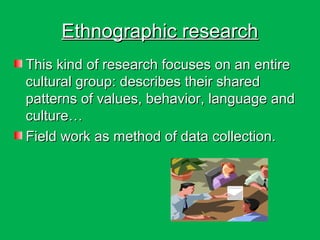
Ethnographic research
This kind of research focuses on an entire
cultural group: describes their shared
patterns of values, behavior, language and
culture…
Field work as method of data collection.
Case study research
This kind of research involves the study of
an issue explored through one or two cases
within a setting or context.
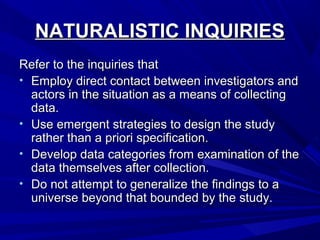
NATURALISTIC INQUIRIES
Refer to the inquiries that
• Employ direct contact between investigators and
  actors in the situation as a means of collecting
  data.
• Use emergent strategies to design the study
  rather than a priori specification.
• Develop data categories from examination of the
  data themselves after collection.
• Do not attempt to generalize the findings to a
  universe beyond that bounded by the study.
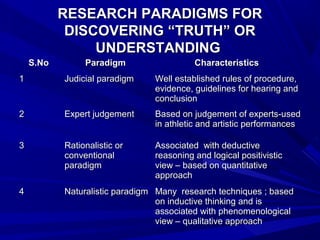
RESEARCH PARADIGMS FOR
            DISCOVERING “TRUTH” OR
                UNDERSTANDING
    S.No        Paradigm                  Characteristics
1          Judicial paradigm    Well established rules of procedure,
                                evidence, guidelines for hearing and
                                conclusion
2          Expert judgement     Based on judgement of experts-used
                                in athletic and artistic performances

3          Rationalistic or     Associated with deductive
           conventional         reasoning and logical positivistic
           paradigm             view – based on quantitative
                                approach
4          Naturalistic paradigm Many research techniques ; based
                                 on inductive thinking and is
                                 associated with phenomenological
                                 view – qualitative approach
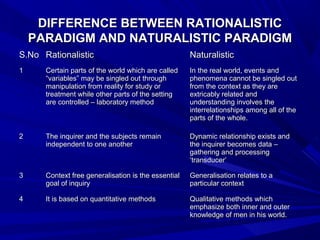
DIFFERENCE BETWEEN RATIONALISTIC
    PARADIGM AND NATURALISTIC PARADIGM
S.No Rationalistic                                   Naturalistic
1     Certain parts of the world which are called    In the real world, events and
      “variables” may be singled out through         phenomena cannot be singled out
      manipulation from reality for study or         from the context as they are
      treatment while other parts of the setting     extricably related and
      are controlled – laboratory method             understanding involves the
                                                     interrelationships among all of the
                                                     parts of the whole.

2     The inquirer and the subjects remain           Dynamic relationship exists and
      independent to one another                     the inquirer becomes data –
                                                     gathering and processing
                                                     ‘transducer’

3     Context free generalisation is the essential   Generalisation relates to a
      goal of inquiry                                particular context

4     It is based on quantitative methods            Qualitative methods which
                                                     emphasize both inner and outer
                                                     knowledge of men in his world.
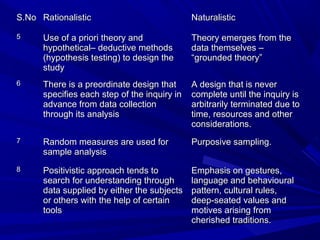
S.No Rationalistic                            Naturalistic

5     Use of a priori theory and              Theory emerges from the
      hypothetical– deductive methods         data themselves –
      (hypothesis testing) to design the      “grounded theory”
      study
6     There is a preordinate design that      A design that is never
      specifies each step of the inquiry in   complete until the inquiry is
      advance from data collection            arbitrarily terminated due to
      through its analysis                    time, resources and other
                                              considerations.
7     Random measures are used for            Purposive sampling.
      sample analysis
8     Positivistic approach tends to          Emphasis on gestures,
      search for understanding through        language and behavioural
      data supplied by either the subjects    pattern, cultural rules,
      or others with the help of certain      deep-seated values and
      tools                                   motives arising from
                                              cherished traditions.
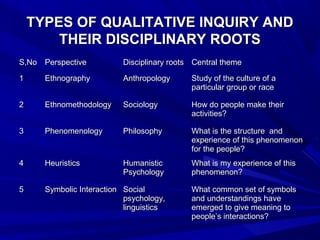
TYPES OF QUALITATIVE INQUIRY AND
        THEIR DISCIPLINARY ROOTS
S,No Perspective          Disciplinary roots Central theme

1     Ethnography         Anthropology      Study of the culture of a
                                            particular group or race

2     Ethnomethodology    Sociology         How do people make their
                                            activities?

3     Phenomenology       Philosophy        What is the structure and
                                            experience of this phenomenon
                                            for the people?
4     Heuristics          Humanistic        What is my experience of this
                          Psychology        phenomenon?

5     Symbolic Interaction Social           What common set of symbols
                           psychology,      and understandings have
                           linguistics      emerged to give meaning to
                                            people’s interactions?
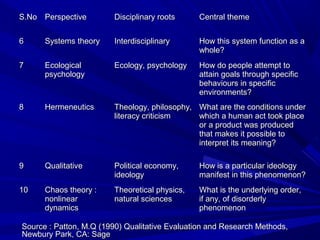
S.No Perspective         Disciplinary roots     Central theme


6     Systems theory     Interdisciplinary      How this system function as a
                                                whole?
7     Ecological         Ecology, psychology    How do people attempt to
      psychology                                attain goals through specific
                                                behaviours in specific
                                                environments?
8     Hermeneutics       Theology, philosophy, What are the conditions under
                         literacy criticism    which a human act took place
                                               or a product was produced
                                               that makes it possible to
                                               interpret its meaning?

9     Qualitative        Political economy,     How is a particular ideology
                         ideology               manifest in this phenomenon?
10    Chaos theory :     Theoretical physics,   What is the underlying order,
      nonlinear          natural sciences       if any, of disorderly
      dynamics                                  phenomenon

Source : Patton, M.Q (1990) Qualitative Evaluation and Research Methods,
Newbury Park, CA: Sage
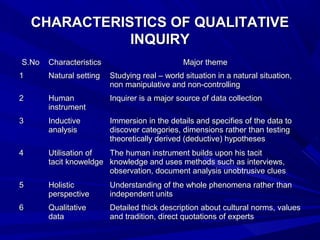
CHARACTERISTICS OF QUALITATIVE
               INQUIRY
S.No   Characteristics                         Major theme
1      Natural setting   Studying real – world situation in a natural situation,
                         non manipulative and non-controlling
2      Human             Inquirer is a major source of data collection
       instrument
3      Inductive         Immersion in the details and specifies of the data to
       analysis          discover categories, dimensions rather than testing
                         theoretically derived (deductive) hypotheses
4      Utilisation of  The human instrument builds upon his tacit
       tacit knoweldge knowledge and uses methods such as interviews,
                       observation, document analysis unobtrusive clues
5      Holistic          Understanding of the whole phenomena rather than
       perspective       independent units
6      Qualitative       Detailed thick description about cultural norms, values
       data              and tradition, direct quotations of experts
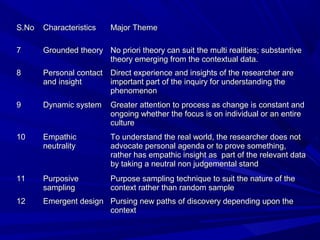
S.No   Characteristics    Major Theme

7      Grounded theory No priori theory can suit the multi realities; substantive
                       theory emerging from the contextual data.
8      Personal contact Direct experience and insights of the researcher are
       and insight      important part of the inquiry for understanding the
                        phenomenon
9      Dynamic system     Greater attention to process as change is constant and
                          ongoing whether the focus is on individual or an entire
                          culture
10     Empathic           To understand the real world, the researcher does not
       neutrality         advocate personal agenda or to prove something,
                          rather has empathic insight as part of the relevant data
                          by taking a neutral non judgemental stand
11     Purposive          Purpose sampling technique to suit the nature of the
       sampling           context rather than random sample
12     Emergent design Pursing new paths of discovery depending upon the
                       context
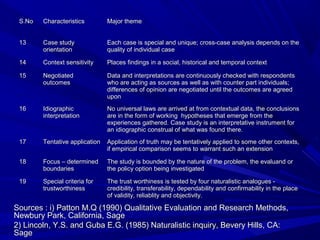
S.No   Characteristics         Major theme


 13     Case study              Each case is special and unique; cross-case analysis depends on the
        orientation             quality of individual case

 14     Context sensitivity     Places findings in a social, historical and temporal context

 15     Negotiated              Data and interpretations are continuously checked with respondents
        outcomes                who are acting as sources as well as with counter part individuals;
                                differences of opinion are negotiated until the outcomes are agreed
                                upon
 16     Idiographic             No universal laws are arrived at from contextual data, the conclusions
        interpretation          are in the form of working hypotheses that emerge from the
                                experiences gathered. Case study is an interpretative instrument for
                                an idiographic construal of what was found there.
 17     Tentative application   Application of truth may be tentatively applied to some other contexts,
                                if empirical comparison seems to warrant such an extension

 18     Focus – determined      The study is bounded by the nature of the problem, the evaluand or
        boundaries              the policy option being investigated

 19     Special criteria for    The trust worthiness is tested by four naturalistic analogues -
        trustworthiness         credibility, transferability, dependability and confirmability in the place
                                of validity, reliablity and objectivity.

Sources : i) Patton M.Q (1990) Qualitative Evaluation and Research Methods,
Newbury Park, California, Sage
2) Lincoln, Y.S. and Guba E.G. (1985) Naturalistic inquiry, Bevery Hills, CA:
Sage
THE AUDIT
 It is designed to judge the rigour and authenticity
  of the study. The raw material for the audit is the
  investigator’s paper trial which documents the
  data (raw field notes of observation, interviews
  and documents).
 Through the examination of the audit trial, the
  credibility (persistent observation, triangulation
  and member check), transferability (purposive
  sampling and thick design), dependability
  (emergent design) and confirmability (cross –
  validation) are established.
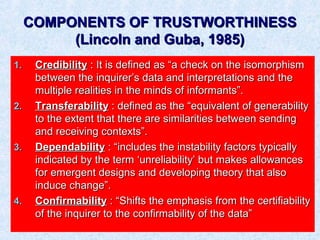
COMPONENTS OF TRUSTWORTHINESS
          (Lincoln and Guba, 1985)
1.    Credibility : It is defined as “a check on the isomorphism
      between the inquirer’s data and interpretations and the
      multiple realities in the minds of informants”.
2.    Transferability : defined as the “equivalent of generability
      to the extent that there are similarities between sending
      and receiving contexts”.
3.    Dependability : “includes the instability factors typically
      indicated by the term ‘unreliability’ but makes allowances
      for emergent designs and developing theory that also
      induce change”.
4.    Confirmability : “Shifts the emphasis from the certifiability
      of the inquirer to the confirmability of the data”
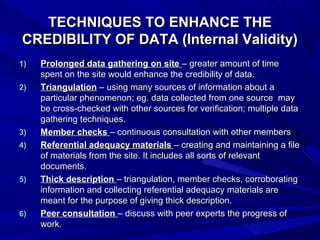
TECHNIQUES TO ENHANCE THE
CREDIBILITY OF DATA (Internal Validity)
1)   Prolonged data gathering on site – greater amount of time
     spent on the site would enhance the credibility of data.
2)   Triangulation – using many sources of information about a
     particular phenomenon; eg. data collected from one source may
     be cross-checked with other sources for verification; multiple data
     gathering techniques.
3)   Member checks – continuous consultation with other members
4)   Referential adequacy materials – creating and maintaining a file
     of materials from the site. It includes all sorts of relevant
     documents.
5)   Thick description – triangulation, member checks, corroborating
     information and collecting referential adequacy materials are
     meant for the purpose of giving thick description.
6)   Peer consultation – discuss with peer experts the progress of
     work.
Designing naturalistic inquiries
Naturalistic designs must emerge and unfold as
 the study progresses.
Not all of the elements can be specified ahead
 of time, but some can.
Determining where and from whom data will be
 collected.
Identifying initial sample and making provisions for
 orderly evolution
Phases of inquiry:
Orientation and overview
Focused exploration
Member checking
Determining instrumentation: teams and
 training
Designing naturalistic inquiries
Planning data collection and recording:
– Interview/participant observation..
– Recording: advantages of field notes over
  recording

Planning data analysis procedures: must
begin early and be ongoing.

Planning for trustworthiness
Participant observation
           (Spradley 1980)
Dual purposes of participant observation:
 To engage in activities
 To observe activities
Explicit awareness: becoming aware of things that
 you normally block out.
Wide angle lens: wider circle of awareness
Insider/outsider experiences.
Introspection
Record keeping
Awareness of what is not there
Kinds of participation
Non participation (study of TV programs)
Passive participation (courtroom spectator)
Moderate participation (“watching” video
 games)
Active participation (learning to do what
 others are doing)
Complete participation
Qualities of good interviews
Begin with small talk
Listening:
– Follow up on of course statements
– Listen for key words
– Probing questions
– Use of why questions (Don’t ask for meaning,
  ask for use)
– Self disclosure
Taking notes (Lincoln and Guba, 1985).
Disadvantages:
– One cannot record everything.
– Rapid handwriting is sometimes
  undecipherable.
– Respondent may slow down to accommodate
  the interviewer and lose train of thought.
Advantages:
– Forces careful attention
– Can interpolate questions or comments on to
  the notes without knowledge of interviewee.
– Notes can easily be flagged for follow ups
– Member checking is easier.
When to use qualitative research
   “Quality” versus “quantity”.
   For problems that need exploration
   For problems that need a complex detailed
    understanding.
   To empower individual and collective
    voices.
   To write in styles that push the limits of
    formal academic narratives
   To understand contexts
   The question of “fit”
Thank you

Naturalistic qualitative inquiry.

  • 1.
    NATURALISTIC QUALITATIVE INQUIRY DR.R.KRISHNARAJ PROFESSOR OF EDUCATION AND HEAD, DEPARTMENT OF LIFELONG LEARNING ALAGAPPA UNIVERSITY, KARAIKUDI.
  • 2.
    NATURALISTIC QUALITATIVE INQUIRY •It express one view as to the nature of “reality”. It is the view that the real world is a dynamic system all of whose parts are so interrelated that one part inevitably influences the other parts. •To understand to real world, the parts cannot be separated bit by bit, but the parts must be examined in the context of the whole. •It is essentially a phenomenological view – as differentiated from a logical – positivistic view – of the reality of the world.
  • 3.
    Phenomenological research Describes themeaning for several individuals of their lived experience of a certain phenomena. Can center around basic broad questions: “what have you experienced in terms of the phenomena” and “what contexts have influenced your experience of the phenomena”
  • 4.
    Grounded theory research Employedin situations where it is perceived as necessary to go beyond description and generate theory. Use of the constant comparative method Can lead to follow up quantitative research
  • 5.
    Ethnographic research This kindof research focuses on an entire cultural group: describes their shared patterns of values, behavior, language and culture… Field work as method of data collection.
  • 6.
    Case study research Thiskind of research involves the study of an issue explored through one or two cases within a setting or context.
  • 7.
    NATURALISTIC INQUIRIES Refer tothe inquiries that • Employ direct contact between investigators and actors in the situation as a means of collecting data. • Use emergent strategies to design the study rather than a priori specification. • Develop data categories from examination of the data themselves after collection. • Do not attempt to generalize the findings to a universe beyond that bounded by the study.
  • 8.
    RESEARCH PARADIGMS FOR DISCOVERING “TRUTH” OR UNDERSTANDING S.No Paradigm Characteristics 1 Judicial paradigm Well established rules of procedure, evidence, guidelines for hearing and conclusion 2 Expert judgement Based on judgement of experts-used in athletic and artistic performances 3 Rationalistic or Associated with deductive conventional reasoning and logical positivistic paradigm view – based on quantitative approach 4 Naturalistic paradigm Many research techniques ; based on inductive thinking and is associated with phenomenological view – qualitative approach
  • 9.
    DIFFERENCE BETWEEN RATIONALISTIC PARADIGM AND NATURALISTIC PARADIGM S.No Rationalistic Naturalistic 1 Certain parts of the world which are called In the real world, events and “variables” may be singled out through phenomena cannot be singled out manipulation from reality for study or from the context as they are treatment while other parts of the setting extricably related and are controlled – laboratory method understanding involves the interrelationships among all of the parts of the whole. 2 The inquirer and the subjects remain Dynamic relationship exists and independent to one another the inquirer becomes data – gathering and processing ‘transducer’ 3 Context free generalisation is the essential Generalisation relates to a goal of inquiry particular context 4 It is based on quantitative methods Qualitative methods which emphasize both inner and outer knowledge of men in his world.
  • 10.
    S.No Rationalistic Naturalistic 5 Use of a priori theory and Theory emerges from the hypothetical– deductive methods data themselves – (hypothesis testing) to design the “grounded theory” study 6 There is a preordinate design that A design that is never specifies each step of the inquiry in complete until the inquiry is advance from data collection arbitrarily terminated due to through its analysis time, resources and other considerations. 7 Random measures are used for Purposive sampling. sample analysis 8 Positivistic approach tends to Emphasis on gestures, search for understanding through language and behavioural data supplied by either the subjects pattern, cultural rules, or others with the help of certain deep-seated values and tools motives arising from cherished traditions.
  • 11.
    TYPES OF QUALITATIVEINQUIRY AND THEIR DISCIPLINARY ROOTS S,No Perspective Disciplinary roots Central theme 1 Ethnography Anthropology Study of the culture of a particular group or race 2 Ethnomethodology Sociology How do people make their activities? 3 Phenomenology Philosophy What is the structure and experience of this phenomenon for the people? 4 Heuristics Humanistic What is my experience of this Psychology phenomenon? 5 Symbolic Interaction Social What common set of symbols psychology, and understandings have linguistics emerged to give meaning to people’s interactions?
  • 12.
    S.No Perspective Disciplinary roots Central theme 6 Systems theory Interdisciplinary How this system function as a whole? 7 Ecological Ecology, psychology How do people attempt to psychology attain goals through specific behaviours in specific environments? 8 Hermeneutics Theology, philosophy, What are the conditions under literacy criticism which a human act took place or a product was produced that makes it possible to interpret its meaning? 9 Qualitative Political economy, How is a particular ideology ideology manifest in this phenomenon? 10 Chaos theory : Theoretical physics, What is the underlying order, nonlinear natural sciences if any, of disorderly dynamics phenomenon Source : Patton, M.Q (1990) Qualitative Evaluation and Research Methods, Newbury Park, CA: Sage
  • 13.
    CHARACTERISTICS OF QUALITATIVE INQUIRY S.No Characteristics Major theme 1 Natural setting Studying real – world situation in a natural situation, non manipulative and non-controlling 2 Human Inquirer is a major source of data collection instrument 3 Inductive Immersion in the details and specifies of the data to analysis discover categories, dimensions rather than testing theoretically derived (deductive) hypotheses 4 Utilisation of The human instrument builds upon his tacit tacit knoweldge knowledge and uses methods such as interviews, observation, document analysis unobtrusive clues 5 Holistic Understanding of the whole phenomena rather than perspective independent units 6 Qualitative Detailed thick description about cultural norms, values data and tradition, direct quotations of experts
  • 14.
    S.No Characteristics Major Theme 7 Grounded theory No priori theory can suit the multi realities; substantive theory emerging from the contextual data. 8 Personal contact Direct experience and insights of the researcher are and insight important part of the inquiry for understanding the phenomenon 9 Dynamic system Greater attention to process as change is constant and ongoing whether the focus is on individual or an entire culture 10 Empathic To understand the real world, the researcher does not neutrality advocate personal agenda or to prove something, rather has empathic insight as part of the relevant data by taking a neutral non judgemental stand 11 Purposive Purpose sampling technique to suit the nature of the sampling context rather than random sample 12 Emergent design Pursing new paths of discovery depending upon the context
  • 15.
    S.No Characteristics Major theme 13 Case study Each case is special and unique; cross-case analysis depends on the orientation quality of individual case 14 Context sensitivity Places findings in a social, historical and temporal context 15 Negotiated Data and interpretations are continuously checked with respondents outcomes who are acting as sources as well as with counter part individuals; differences of opinion are negotiated until the outcomes are agreed upon 16 Idiographic No universal laws are arrived at from contextual data, the conclusions interpretation are in the form of working hypotheses that emerge from the experiences gathered. Case study is an interpretative instrument for an idiographic construal of what was found there. 17 Tentative application Application of truth may be tentatively applied to some other contexts, if empirical comparison seems to warrant such an extension 18 Focus – determined The study is bounded by the nature of the problem, the evaluand or boundaries the policy option being investigated 19 Special criteria for The trust worthiness is tested by four naturalistic analogues - trustworthiness credibility, transferability, dependability and confirmability in the place of validity, reliablity and objectivity. Sources : i) Patton M.Q (1990) Qualitative Evaluation and Research Methods, Newbury Park, California, Sage 2) Lincoln, Y.S. and Guba E.G. (1985) Naturalistic inquiry, Bevery Hills, CA: Sage
  • 16.
    THE AUDIT  Itis designed to judge the rigour and authenticity of the study. The raw material for the audit is the investigator’s paper trial which documents the data (raw field notes of observation, interviews and documents).  Through the examination of the audit trial, the credibility (persistent observation, triangulation and member check), transferability (purposive sampling and thick design), dependability (emergent design) and confirmability (cross – validation) are established.
  • 17.
    COMPONENTS OF TRUSTWORTHINESS (Lincoln and Guba, 1985) 1. Credibility : It is defined as “a check on the isomorphism between the inquirer’s data and interpretations and the multiple realities in the minds of informants”. 2. Transferability : defined as the “equivalent of generability to the extent that there are similarities between sending and receiving contexts”. 3. Dependability : “includes the instability factors typically indicated by the term ‘unreliability’ but makes allowances for emergent designs and developing theory that also induce change”. 4. Confirmability : “Shifts the emphasis from the certifiability of the inquirer to the confirmability of the data”
  • 18.
    TECHNIQUES TO ENHANCETHE CREDIBILITY OF DATA (Internal Validity) 1) Prolonged data gathering on site – greater amount of time spent on the site would enhance the credibility of data. 2) Triangulation – using many sources of information about a particular phenomenon; eg. data collected from one source may be cross-checked with other sources for verification; multiple data gathering techniques. 3) Member checks – continuous consultation with other members 4) Referential adequacy materials – creating and maintaining a file of materials from the site. It includes all sorts of relevant documents. 5) Thick description – triangulation, member checks, corroborating information and collecting referential adequacy materials are meant for the purpose of giving thick description. 6) Peer consultation – discuss with peer experts the progress of work.
  • 19.
    Designing naturalistic inquiries Naturalisticdesigns must emerge and unfold as the study progresses. Not all of the elements can be specified ahead of time, but some can. Determining where and from whom data will be collected. Identifying initial sample and making provisions for orderly evolution Phases of inquiry: Orientation and overview Focused exploration Member checking Determining instrumentation: teams and training
  • 20.
    Designing naturalistic inquiries Planningdata collection and recording: – Interview/participant observation.. – Recording: advantages of field notes over recording Planning data analysis procedures: must begin early and be ongoing. Planning for trustworthiness
  • 21.
    Participant observation (Spradley 1980) Dual purposes of participant observation: To engage in activities To observe activities Explicit awareness: becoming aware of things that you normally block out. Wide angle lens: wider circle of awareness Insider/outsider experiences. Introspection Record keeping Awareness of what is not there
  • 22.
    Kinds of participation Nonparticipation (study of TV programs) Passive participation (courtroom spectator) Moderate participation (“watching” video games) Active participation (learning to do what others are doing) Complete participation
  • 23.
    Qualities of goodinterviews Begin with small talk Listening: – Follow up on of course statements – Listen for key words – Probing questions – Use of why questions (Don’t ask for meaning, ask for use) – Self disclosure
  • 24.
    Taking notes (Lincolnand Guba, 1985). Disadvantages: – One cannot record everything. – Rapid handwriting is sometimes undecipherable. – Respondent may slow down to accommodate the interviewer and lose train of thought. Advantages: – Forces careful attention – Can interpolate questions or comments on to the notes without knowledge of interviewee. – Notes can easily be flagged for follow ups – Member checking is easier.
  • 25.
    When to usequalitative research  “Quality” versus “quantity”.  For problems that need exploration  For problems that need a complex detailed understanding.  To empower individual and collective voices.  To write in styles that push the limits of formal academic narratives  To understand contexts  The question of “fit”
  • 26.