



In the name of Allah Kareem,
Most Beneficent, Most Gracious,
the Most Merciful !
Referencing
 Referencing means systematically
showing what information or ideas you are
quoting or paraphrasing, and where they
come from.
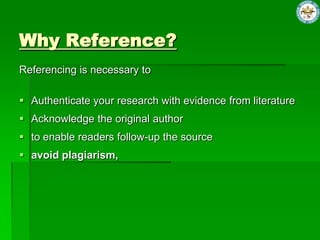
Why Reference?
Referencing is necessary to
 Authenticate your research with evidence from literature
 Acknowledge the original author
 to enable readers follow-up the source
 avoid plagiarism,
WHAT MUST I REFERENCE?
 All work done by other researchers
 Other writers' words
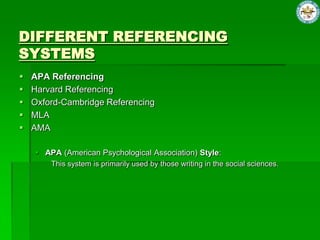
DIFFERENT REFERENCING
SYSTEMS
 APA Referencing
 Harvard Referencing
 Oxford-Cambridge Referencing
 MLA
 AMA
 APA (American Psychological Association) Style:
This system is primarily used by those writing in the social sciences.
Basic components of
Referencing
1) In text referencing (citation)
2) End list Referencing
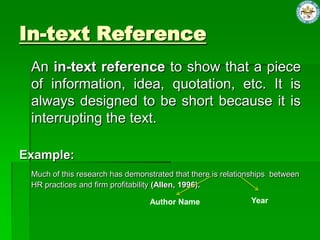
In-text Reference
An in-text reference to show that a piece
of information, idea, quotation, etc. It is
always designed to be short because it is
interrupting the text.
Example:
Much of this research has demonstrated that there is relationships between
HR practices and firm profitability (Allen, 1996).
Author Name Year
End list Referencing
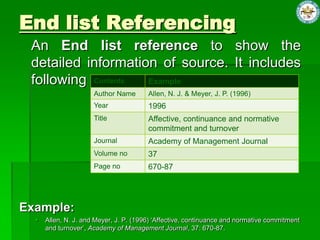
An End list reference to show the
detailed information of source. It includes
following contents
Example:
 Allen, N. J. and Meyer, J. P. (1996) ‘Affective, continuance and normative commitment
and turnover’, Academy of Management Journal, 37: 670-87.
Contents Example
Author Name Allen, N. J. & Meyer, J. P. (1996)
Year 1996
Title Affective, continuance and normative
commitment and turnover
Journal Academy of Management Journal
Volume no 37
Page no 670-87
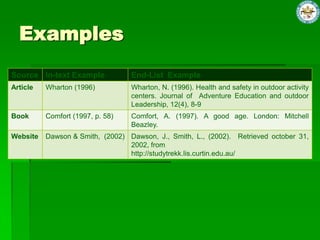
Examples
Source In-text Example End-List Example
Article Wharton (1996) Wharton, N. (1996). Health and safety in outdoor activity
centers. Journal of Adventure Education and outdoor
Leadership, 12(4), 8-9
Book Comfort (1997, p. 58) Comfort, A. (1997). A good age. London: Mitchell
Beazley.
Website Dawson & Smith, (2002) Dawson, J., Smith, L., (2002). Retrieved october 31,
2002, from
http://studytrekk.lis.curtin.edu.au/
14

REFRENCING

  • 1.
    In the nameof Allah Kareem, Most Beneficent, Most Gracious, the Most Merciful !
  • 5.
    Referencing  Referencing meanssystematically showing what information or ideas you are quoting or paraphrasing, and where they come from.
  • 6.
    Why Reference? Referencing isnecessary to  Authenticate your research with evidence from literature  Acknowledge the original author  to enable readers follow-up the source  avoid plagiarism,
  • 7.
    WHAT MUST IREFERENCE?  All work done by other researchers  Other writers' words
  • 8.
    DIFFERENT REFERENCING SYSTEMS  APAReferencing  Harvard Referencing  Oxford-Cambridge Referencing  MLA  AMA  APA (American Psychological Association) Style: This system is primarily used by those writing in the social sciences.
  • 9.
    Basic components of Referencing 1)In text referencing (citation) 2) End list Referencing
  • 10.
    In-text Reference An in-textreference to show that a piece of information, idea, quotation, etc. It is always designed to be short because it is interrupting the text. Example: Much of this research has demonstrated that there is relationships between HR practices and firm profitability (Allen, 1996). Author Name Year
  • 11.
    End list Referencing AnEnd list reference to show the detailed information of source. It includes following contents Example:  Allen, N. J. and Meyer, J. P. (1996) ‘Affective, continuance and normative commitment and turnover’, Academy of Management Journal, 37: 670-87. Contents Example Author Name Allen, N. J. & Meyer, J. P. (1996) Year 1996 Title Affective, continuance and normative commitment and turnover Journal Academy of Management Journal Volume no 37 Page no 670-87
  • 12.
    Examples Source In-text ExampleEnd-List Example Article Wharton (1996) Wharton, N. (1996). Health and safety in outdoor activity centers. Journal of Adventure Education and outdoor Leadership, 12(4), 8-9 Book Comfort (1997, p. 58) Comfort, A. (1997). A good age. London: Mitchell Beazley. Website Dawson & Smith, (2002) Dawson, J., Smith, L., (2002). Retrieved october 31, 2002, from http://studytrekk.lis.curtin.edu.au/
  • 14.