Presented By:
Nadia Naseem
17061716-004
Longitudinal
Research
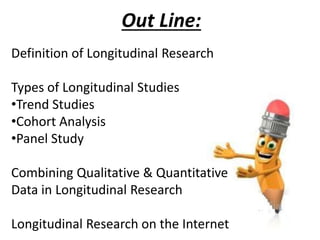
Out Line:
Definition of Longitudinal Research
Types of Longitudinal Studies
•Trend Studies
•Cohort Analysis
•Panel Study
Combining Qualitative & Quantitative
Data in Longitudinal Research
Longitudinal Research on the Internet
What is
Longitudinal
Research?
Types of Longitudinal
Studies
•Trend Studies
•Cohort Analysis
•Panel Study
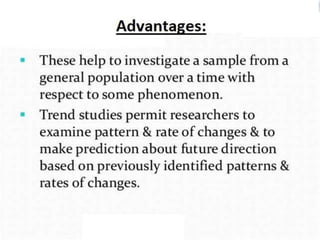
Trend Studies:
•A most common type of Longitudinal Study in
mass media Research.
•Trend Study samples different groups of
people at different times from the same
population.
•Trend Studies are common around
presidential election time.
Cohort Analysis:
• A cohort is any group of individuals who are
linked in some way or who have experienced the
same significant life event within a given period.
• Any study in which some characteristic of one
or more cohorts is measured at two or more
points in time is a Cohort Analysis.
Panel Studies:
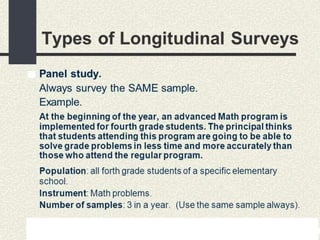
• Panel Studies measure the same sample of respondents
at different points in time.
• Unlike Trend Studies, panel studies can reveal
information about both net change and gross change in
the dependent Variable.
Combining Qualitative &
Quantitative Data in
Longitudinal Research
Advantages:
• The qualitative data can aid in the interpretation of
the quantitative data and provide insights that might
have been missed.
• Qualitative data might suggest new hypotheses that
could be examined in subsequent waves of data
collection.
Longitudinal Research on the
Internet:
An internet survey panel consists of individuals who have been
prerecruited to participate in a number of surveys over time.
Advantages: A large number of individuals can be recruited to
serve as potential panel members. This makes it easier for
researchers to target and collect data from low-incidence groups.
Disadvantages: Internet panels may not be representative of the
entire population. Not everyone is skilled at completing online
surveys.
Longitudinal research

Longitudinal research

  • 1.
  • 2.
  • 3.
    Out Line: Definition ofLongitudinal Research Types of Longitudinal Studies •Trend Studies •Cohort Analysis •Panel Study Combining Qualitative & Quantitative Data in Longitudinal Research Longitudinal Research on the Internet
  • 4.
  • 9.
    Types of Longitudinal Studies •TrendStudies •Cohort Analysis •Panel Study
  • 10.
    Trend Studies: •A mostcommon type of Longitudinal Study in mass media Research. •Trend Study samples different groups of people at different times from the same population. •Trend Studies are common around presidential election time.
  • 13.
    Cohort Analysis: • Acohort is any group of individuals who are linked in some way or who have experienced the same significant life event within a given period. • Any study in which some characteristic of one or more cohorts is measured at two or more points in time is a Cohort Analysis.
  • 16.
    Panel Studies: • PanelStudies measure the same sample of respondents at different points in time. • Unlike Trend Studies, panel studies can reveal information about both net change and gross change in the dependent Variable.
  • 19.
    Combining Qualitative & QuantitativeData in Longitudinal Research
  • 20.
    Advantages: • The qualitativedata can aid in the interpretation of the quantitative data and provide insights that might have been missed. • Qualitative data might suggest new hypotheses that could be examined in subsequent waves of data collection.
  • 21.
    Longitudinal Research onthe Internet: An internet survey panel consists of individuals who have been prerecruited to participate in a number of surveys over time. Advantages: A large number of individuals can be recruited to serve as potential panel members. This makes it easier for researchers to target and collect data from low-incidence groups. Disadvantages: Internet panels may not be representative of the entire population. Not everyone is skilled at completing online surveys.