By
Sabeena P.S
Research Scholar
Sri Ramakrishna Mission Vidyalaya College of
Education
Coimbatore
Paradigm is a model or pattern for something
that may be copied
Webster
Paradigm is a standard, perspective, or set of
ideas. It is a way of looking at something.
Vocabulary
Sabeena P.S, Ph.D. Scholar, Sri Ramakrishna Mission Vidyalaya College of Education,Coimbatore
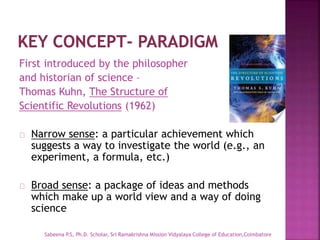
First introduced by the philosopher
and historian of science –
Thomas Kuhn, The Structure of
Scientific Revolutions (1962)
Narrow sense: a particular achievement which
suggests a way to investigate the world (e.g., an
experiment, a formula, etc.)
Broad sense: a package of ideas and methods
which make up a world view and a way of doing
science
Sabeena P.S, Ph.D. Scholar, Sri Ramakrishna Mission Vidyalaya College of Education,Coimbatore
An intellectual window through which the
researcher views the world
Through paradigms, the researcher sees the
social world objectively
Two researchers studying the same phenomenon
by adopting different paradigms may give rise to
different findings
The paradigms help the researcher in deciding
what questions to study and/or hypotheses to
test, appropriate method to use and how to
interpret the results
Sabeena P.S, Ph.D. Scholar, Sri Ramakrishna Mission Vidyalaya College of Education,Coimbatore
Theory – A set of interrelated constructs (variables),
definitions and propositions that present a
systematic view of phenomena by specifying
relations among variables, with the purpose of
explaining phenomena.
Paradigm – World views or overall arching ideas or
beliefs that a group of people may have to
understand the theories.
Sabeena P.S, Ph.D. Scholar, Sri Ramakrishna Mission Vidyalaya College of Education,Coimbatore
Explicitly stated laws and theoretical assumptions
Standard ways of applying the fundamental laws to a
variety of situations
Instrumentation and instrumental techniques that bring
the laws of the paradigm to bear on the real world
General metaphysical principles that guide work within
the paradigm
General methodological prescriptions about how to
conduct work within the paradigm
Sabeena P.S, Ph.D. Scholar, Sri Ramakrishna Mission Vidyalaya College of Education,Coimbatore
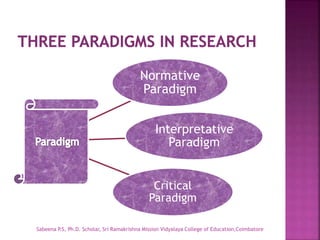
Normative
Paradigm
Interpretative
Paradigm
Critical
Paradigm
Sabeena P.S, Ph.D. Scholar, Sri Ramakrishna Mission Vidyalaya College of Education,Coimbatore
They seek an understanding of phenomenon
that is helpful and useful
All share the assumption that the knowledge
is valuable
They share the assumption of materialism
which suggests a real world exists outside of
our perceptions of it
They rely on the basic assumptions of
empiricism which relies on sensory experience
as a men of knowing the world (evidence)
Sabeena P.S, Ph.D. Scholar, Sri Ramakrishna Mission Vidyalaya College of Education,Coimbatore
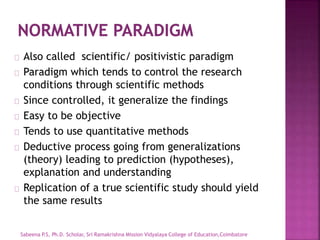
Also called scientific/ positivistic paradigm
Paradigm which tends to control the research
conditions through scientific methods
Since controlled, it generalize the findings
Easy to be objective
Tends to use quantitative methods
Deductive process going from generalizations
(theory) leading to prediction (hypotheses),
explanation and understanding
Replication of a true scientific study should yield
the same results
Sabeena P.S, Ph.D. Scholar, Sri Ramakrishna Mission Vidyalaya College of Education,Coimbatore
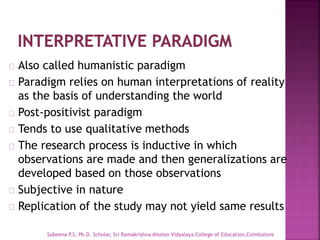
Also called humanistic paradigm
Paradigm relies on human interpretations of reality
as the basis of understanding the world
Post-positivist paradigm
Tends to use qualitative methods
The research process is inductive in which
observations are made and then generalizations are
developed based on those observations
Subjective in nature
Replication of the study may not yield same results
Sabeena P.S, Ph.D. Scholar, Sri Ramakrishna Mission Vidyalaya College of Education,Coimbatore
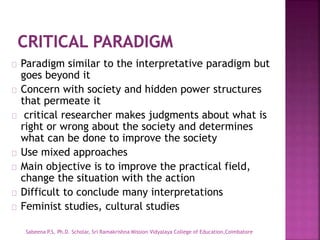
Paradigm similar to the interpretative paradigm but
goes beyond it
Concern with society and hidden power structures
that permeate it
critical researcher makes judgments about what is
right or wrong about the society and determines
what can be done to improve the society
Use mixed approaches
Main objective is to improve the practical field,
change the situation with the action
Difficult to conclude many interpretations
Feminist studies, cultural studies
Sabeena P.S, Ph.D. Scholar, Sri Ramakrishna Mission Vidyalaya College of Education,Coimbatore
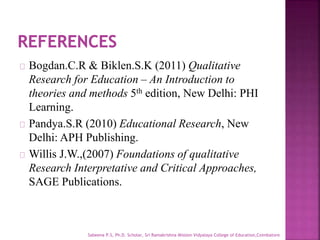
Bogdan.C.R & Biklen.S.K (2011) Qualitative
Research for Education – An Introduction to
theories and methods 5th edition, New Delhi: PHI
Learning.
Pandya.S.R (2010) Educational Research, New
Delhi: APH Publishing.
Willis J.W.,(2007) Foundations of qualitative
Research Interpretative and Critical Approaches,
SAGE Publications.
Sabeena P.S, Ph.D. Scholar, Sri Ramakrishna Mission Vidyalaya College of Education,Coimbatore

Paradigms of research

  • 1.
    By Sabeena P.S Research Scholar SriRamakrishna Mission Vidyalaya College of Education Coimbatore
  • 2.
    Paradigm is amodel or pattern for something that may be copied Webster Paradigm is a standard, perspective, or set of ideas. It is a way of looking at something. Vocabulary Sabeena P.S, Ph.D. Scholar, Sri Ramakrishna Mission Vidyalaya College of Education,Coimbatore
  • 3.
    First introduced bythe philosopher and historian of science – Thomas Kuhn, The Structure of Scientific Revolutions (1962) Narrow sense: a particular achievement which suggests a way to investigate the world (e.g., an experiment, a formula, etc.) Broad sense: a package of ideas and methods which make up a world view and a way of doing science Sabeena P.S, Ph.D. Scholar, Sri Ramakrishna Mission Vidyalaya College of Education,Coimbatore
  • 4.
    An intellectual windowthrough which the researcher views the world Through paradigms, the researcher sees the social world objectively Two researchers studying the same phenomenon by adopting different paradigms may give rise to different findings The paradigms help the researcher in deciding what questions to study and/or hypotheses to test, appropriate method to use and how to interpret the results Sabeena P.S, Ph.D. Scholar, Sri Ramakrishna Mission Vidyalaya College of Education,Coimbatore
  • 5.
    Theory – Aset of interrelated constructs (variables), definitions and propositions that present a systematic view of phenomena by specifying relations among variables, with the purpose of explaining phenomena. Paradigm – World views or overall arching ideas or beliefs that a group of people may have to understand the theories. Sabeena P.S, Ph.D. Scholar, Sri Ramakrishna Mission Vidyalaya College of Education,Coimbatore
  • 6.
    Explicitly stated lawsand theoretical assumptions Standard ways of applying the fundamental laws to a variety of situations Instrumentation and instrumental techniques that bring the laws of the paradigm to bear on the real world General metaphysical principles that guide work within the paradigm General methodological prescriptions about how to conduct work within the paradigm Sabeena P.S, Ph.D. Scholar, Sri Ramakrishna Mission Vidyalaya College of Education,Coimbatore
  • 7.
    Normative Paradigm Interpretative Paradigm Critical Paradigm Sabeena P.S, Ph.D.Scholar, Sri Ramakrishna Mission Vidyalaya College of Education,Coimbatore
  • 8.
    They seek anunderstanding of phenomenon that is helpful and useful All share the assumption that the knowledge is valuable They share the assumption of materialism which suggests a real world exists outside of our perceptions of it They rely on the basic assumptions of empiricism which relies on sensory experience as a men of knowing the world (evidence) Sabeena P.S, Ph.D. Scholar, Sri Ramakrishna Mission Vidyalaya College of Education,Coimbatore
  • 9.
    Also called scientific/positivistic paradigm Paradigm which tends to control the research conditions through scientific methods Since controlled, it generalize the findings Easy to be objective Tends to use quantitative methods Deductive process going from generalizations (theory) leading to prediction (hypotheses), explanation and understanding Replication of a true scientific study should yield the same results Sabeena P.S, Ph.D. Scholar, Sri Ramakrishna Mission Vidyalaya College of Education,Coimbatore
  • 10.
    Also called humanisticparadigm Paradigm relies on human interpretations of reality as the basis of understanding the world Post-positivist paradigm Tends to use qualitative methods The research process is inductive in which observations are made and then generalizations are developed based on those observations Subjective in nature Replication of the study may not yield same results Sabeena P.S, Ph.D. Scholar, Sri Ramakrishna Mission Vidyalaya College of Education,Coimbatore
  • 11.
    Paradigm similar tothe interpretative paradigm but goes beyond it Concern with society and hidden power structures that permeate it critical researcher makes judgments about what is right or wrong about the society and determines what can be done to improve the society Use mixed approaches Main objective is to improve the practical field, change the situation with the action Difficult to conclude many interpretations Feminist studies, cultural studies Sabeena P.S, Ph.D. Scholar, Sri Ramakrishna Mission Vidyalaya College of Education,Coimbatore
  • 12.
    Bogdan.C.R & Biklen.S.K(2011) Qualitative Research for Education – An Introduction to theories and methods 5th edition, New Delhi: PHI Learning. Pandya.S.R (2010) Educational Research, New Delhi: APH Publishing. Willis J.W.,(2007) Foundations of qualitative Research Interpretative and Critical Approaches, SAGE Publications. Sabeena P.S, Ph.D. Scholar, Sri Ramakrishna Mission Vidyalaya College of Education,Coimbatore
  • 13.
    Sabeena P.S, Ph.D.Scholar, Sri Ramakrishna Mission Vidyalaya College of Education,Coimbatore