Research
The term ‘Research’ consists of two words:
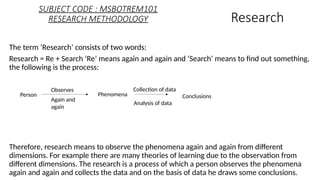
Research = Re + Search ‘Re’ means again and again and ‘Search’ means to find out something,
the following is the process:
Therefore, research means to observe the phenomena again and again from different
dimensions. For example there are many theories of learning due to the observation from
different dimensions. The research is a process of which a person observes the phenomena
again and again and collects the data and on the basis of data he draws some conclusions.
Observes
Again and
again
Person Phenomena
Collection of data
Analysis of data
Conclusions
SUBJECT CODE : MSBOTREM101
RESEARCH METHODOLOGY
• Definitions
The following are the important definitions of research: “Research is an endeavor / attempt to discover, develop
and verify knowledge. It is an intellectual process that has developed over hundreds of years ever changing in
purpose and form and always researching to truth.” J. Francis Rummel
“Research is an honest, exhaustive, intelligent searching for facts and their meanings or implications with
reference to a given problem. The product or findings of a given piece of research should be an authentic,
verifiable contribution to knowledge in the field studied.” P.M. Cook
“Research may be defined as a method of studying problems whose solutions are to be derived partly or wholly
from facts.” W.S. Monroes
“Research is considered to be the more formal, systematic intensive process of carrying on the scientific method
of analysis. It involves a more systematic structure of investigation, usually resulting in some sort of formal
record of procedures and a report of results or conclusion.” John W. Best
The following characteristics may be gathered from the definitions of ‘Research’
1. It gathers new knowledge or data from primary or first-hand sources.
2. It places emphasis upon the discovery of general principles.
3. It is an exact systematic and accurate investigation.
4. It uses certain valid data gathering devices.
5. It is logical and objective.
6. The researcher resists the temptation to seek only the data that support his hypotheses.
7. The researcher eliminates personal feelings and preferences.
8. It endeavours to organise data in quantitative terms.
9. Research is patient and unhurried activity.
10. The researcher is willing to follow his procedures to the conclusions that may be unpopular and bring socia
disapproval.
11. Research is carefully recorded and reported.
12. Conclusions and generalisations are arrived at carefully and cautiously.
Types
• Qualitative
Qualitative research gathers participants' experiences, perceptions,
and behavior.
It answers the hows and whys instead of how many or how much.
It could be structured as a standalone study, purely relying on
qualitative data, or part of mixed-methods research that combines
qualitative and quantitative data.
The most frequently used qualitative analysis methods are one-on-
one interviews, focus groups, ethnographic research, case study
research, record keeping, and qualitative observation.
• Qualitative Research Approaches
1. Ethnography
Ethnography as a research design originates in social and cultural anthropology and involves the
researcher being directly immersed in the participant’s environment. Through this immersion, the
ethnographer can use a variety of data collection techniques to produce a comprehensive account
of the social phenomena that occurred during the research period. That is to say, the researcher’s
aim with ethnography is to immerse themselves into the research population and come out of it
with accounts of actions, behaviors, events, etc, through the eyes of someone involved in the
population. Direct involvement of the researcher with the target population is one benefit of
ethnographic research because it can then be possible to find data that is otherwise very difficult to
extract and record.
2. Grounded theory
Grounded Theory is the "generation of a theoretical model through the experience of observing a
study population and developing a comparative analysis of their speech and behavior.“ Unlike
quantitative research, which is deductive and tests or verifies an existing theory, grounded theory
research is inductive and, therefore, lends itself to research aimed at social interactions or
experiences. In essence, Grounded Theory’s goal is to explain how and why an event occurs or how
and why people might behave a certain way. Through observing the population, a researcher using
the Grounded Theory approach can then develop a theory to explain the phenomena of interest.
3. Phenomenology
Phenomenology is the "study of the meaning of phenomena or the study of the particular.” At first
glance, it might seem that Grounded Theory and Phenomenology are pretty similar, but the differences
can be seen upon careful examination. At its core, phenomenology looks to investigate experiences
from the individual's perspective. Phenomenology is essentially looking into the "lived experiences" of
the participants and aims to examine how and why participants behaved a certain way from their
perspective. Herein lies one of the main differences between Grounded Theory and Phenomenology.
Grounded Theory aims to develop a theory for social phenomena through an examination of various
data sources. In contrast, Phenomenology focuses on describing and explaining an event or
phenomenon from the perspective of those who have experienced it.
4. Narrative research
One of qualitative research’s strengths lies in its ability to tell a story, often from the perspective of
those directly involved in it. Reporting on qualitative research involves including details and
descriptions of the setting involved and quotes from participants. This detail is called a "thick" or "rich"
description and is a strength of qualitative research. Narrative research is rife with the possibilities of
"thick" description as this approach weaves together a sequence of events, usually from just one or two
individuals, hoping to create a cohesive story or narrative. While it might seem like a waste of time to
focus on such a specific, individual level, understanding one or two people’s narratives for an event or
phenomenon can help to inform researchers about the influences that helped shape that narrative. The
tension or conflict of differing narratives can be "opportunities for innovation."
• Data Sampling
The better the sample represents the intended study population, the more likely the
researcher is to encompass the varying factors. The following are examples of
participant sampling and selection:
1. Purposive sampling- selection based on the researcher’s rationale for being the most
informative.
2. Criterion sampling selection based on pre-identified factors.
3. Convenience sampling- selection based on availability.
4. Snowball sampling- the selection is by referral from other participants or people who
know potential participants.
5. Extreme case sampling- targeted selection of rare cases.
6. Typical case sampling selection based on regular or average participants.
• Applications
1. Many times, a research question will start with qualitative research. The
qualitative research will help generate the research hypothesis, which can be
tested with quantitative methods.
2. After the data is collected and analyzed with quantitative methods, a set of
qualitative methods can be used to dive deeper into the data to better
understand what the numbers truly mean and their implications.
3. The qualitative techniques can then help clarify the quantitative data and
also help refine the hypothesis for future research.
4. Furthermore, with qualitative research, researchers can explore poorly
studied subjects with quantitative methods. These include opinions,
individual actions, and social science research.
Quantitative research is a systematic investigation of phenomena by gathering
quantifiable data and performing statistical, mathematical, or computational
techniques. Quantitative research collects statistically significant information from
existing and potential customers using sampling methods and sending out online
surveys, online polls, and questionnaires, for example.
An example of a quantitative research study is the survey conducted to
understand how long a doctor takes to tend to a patient when the patient walks
into the hospital. A patient satisfaction survey can be administered to ask
questions like how long a doctor takes to see a patient, how often a patient walks
into a hospital, and other such questions, which are dependent variables in the
research. This kind of research method is often employed in the social sciences,
and it involves using mathematical frameworks and theories to effectively present
data, ensuring that the results are logical, statistically sound, and unbiased.
Data collection in quantitative research uses a structured method and is typically
conducted on larger samples representing the entire population. Researchers use
quantitative methods to collect numerical data, which is then subjected to
statistical analysis to determine statistically significant findings. This approach is
valuable in both experimental research and social research, as it helps in making
• Quantitative Research Characteristics
1. Structured tools: Quantitative research relies on structured tools such as surveys, polls, or
questionnaires to gather quantitative data. Using such structured methods helps collect in-depth and
actionable numerical data from the survey respondents, making it easier to perform data analysis.
2. Sample size: Quantitative research is conducted on a significant sample size representing the target
market. Appropriate Survey Sampling methods, a fundamental aspect of quantitative research methods,
must be employed when deriving the sample to fortify the research objective and ensure the reliability of
the results.
3. Close-ended questions: Closed-ended questions, specifically designed to align with the research
objectives, are a cornerstone of quantitative research. These questions facilitate the collection of
quantitative data and are extensively used in data collection processes.
4. Prior studies: Before collecting feedback from respondents, researchers often delve into previous studies
related to the research topic. This preliminary research helps frame the study effectively and ensures the
data collection process is well-informed.
5. Quantitative data: Typically, quantitative data is represented using tables, charts, graphs, or other
numerical forms. This visual representation aids in understanding the collected data and is essential for
rigorous data analysis, a key component of quantitative research methods.
6. Generalization of results: One of the strengths of quantitative research is its ability to generalize results
to the entire population. It means that the findings derived from a sample can be extrapolated to make
informed decisions and take appropriate actions for improvement based on numerical data analysis.
• Common Approaches to Quantitative Research
1. Surveys
2. Custom surveys
3. Mail/e-mail/Internet surveys
4. Telephone surveys
5. Self-administered questionnaire surveys
6. Omnibus surveys
7. Correlational research
8. Trend analysis
9. Exploratory research
10. Descriptive research
11. Experimental research
• Descriptive research is a type of research that describes a population, situation, or phenomenon that
is being studied. It focuses on answering the how, what, when, and where questions If a research
problem, rather than the why. This is mainly because it is important to have a proper understanding
of what a research problem is about before investigating why it exists in the first place.
• Examples:
• Survey Studies: A researcher surveys a group of people to gather information about their opinions on
a new technology. The results might include data on how many people use the technology, their
satisfaction levels, and demographic information.
• Case Studies: An in-depth examination of a single individual or group. For example, a case study on a
patient with a rare disease to document their symptoms, treatment responses, and overall
experience.
• Observational Studies: A study where researchers observe and record behaviors or phenomena in a
natural setting without interfering. For instance, observing and documenting how children interact
during free play in a schoolyard.
• Content Analysis: Analyzing the content of media, such as newspapers or social media, to describe
trends and patterns. For example, examining how often certain themes or topics appear in news
articles over a specific period.
• Cross-Sectional Studies: Analyzing data from a population at a single point in time to describe
characteristics or conditions. For instance, measuring the prevalence of a specific health condition in
different age groups within a community.
• Conceptual research is defined as a methodology wherein research is conducted by observing and
analyzing already present information on a given topic. Conceptual research doesn’t involve conducting
any practical experiments. It is related to abstract concepts or ideas. Philosophers have long used
conceptual research to develop new theories or interpret existing theories in a different light.
• Conceptual research focuses on developing new theories or refining existing ones. Here are a few
examples:
• Theory Development: Creating a new framework for understanding complex phenomena. For instance, a
researcher might develop a new model to explain human motivation that integrates insights from
psychology, sociology, and neuroscience.
• Conceptual Analysis: Examining and clarifying the meaning and implications of key concepts. An example
is analyzing the concept of "justice" and how it varies across different cultural and philosophical
traditions.
• Philosophical Inquiry: Exploring fundamental questions about the nature of reality, knowledge, or ethics.
For example, a philosopher might investigate the nature of free will and its implications for moral
responsibility.
• Comparative Studies: Comparing different theoretical perspectives on a particular issue. For example,
comparing various theories of learning to identify their strengths and weaknesses.
• Model Refinement: Refining existing models to improve their explanatory power. For instance, updating
economic models to better account for recent behavioral research findings.
• Analytical research is a specific type of research that involves critical thinking skills and the
evaluation of facts and information relative to the research being conducted. A variety of people
including students, doctors and psychologists use analytical research during studies to find the most
relevant information.
• Analytical research involves examining and interpreting data to understand patterns, relationships,
and insights. Here are some examples:
1. Statistical Analysis: Analyzing survey data to identify trends and correlations. For instance, using
regression analysis to understand how different factors like income and education level impact
health outcomes.
2. Content Analysis: Examining text or media content to identify patterns or themes. For example,
analyzing news articles to determine how often and in what context certain topics are discussed.
3. Comparative Analysis: Comparing different case studies or datasets to draw conclusions. For
instance, comparing the economic growth rates of different countries to identify factors that
contribute to higher growth.
4. Financial Analysis: Analyzing financial statements to assess a company's performance. For example,
using ratios like return on equity or current ratio to evaluate a company's financial health.
5. Policy Analysis: Evaluating the impact of a policy or program. For instance, analyzing the effects of
a new education policy on student achievement and educational equity.
6. Trend Analysis: Examining historical data to identify patterns and predict future trends. For
• Fundamental research is driven by a scientist's curiosity or interest in a scientific question. The main motivation
is to expand man's knowledge, not to create or invent something. There is no obvious commercial value to the
discoveries that result from basic research. For example, basic science investigations probe for answers to
questions such as: • How did the universe begin? • What are protons, neutrons, and electrons composed of? •
How do slime molds reproduce? • What is the specific genetic code of the fruit fly?
• Fundamental research, also known as basic or pure research, aims to expand knowledge by investigating
fundamental principles and theories without immediate practical application. Here are some examples:
1. Quantum Mechanics: Research into the fundamental nature of particles and forces at the quantum level, such
as the behavior of subatomic particles and quantum entanglement.
2. Theory of Relativity: Studies by Albert Einstein on the nature of space and time, leading to the development of
the Special and General Theories of Relativity.
3. Genetics: Investigating the structure and function of genes and DNA, including the basic mechanisms of
inheritance and genetic variation.
4. Mathematical Theories: Developing and exploring new mathematical theories or proofs, such as the study of
prime numbers or the development of new branches of mathematics like topology.
5. Neuroscience: Basic research into the workings of the brain and nervous system, including understanding how
neurons communicate and how cognitive processes are mapped in the brain.
6. Astronomy: Studying the fundamental properties and origins of celestial objects and phenomena, such as the
formation of galaxies or the nature of dark matter.
7. Evolutionary Biology: Investigating the fundamental processes of evolution, such as natural selection, genetic
drift, and the origin of species.
• Applied research refers to scientific study and research that seeks to solve practical problems. Applied research is
used to find solutions to everyday problems, cure illness, and develop innovative technologies, rather than to
acquire knowledge for knowledge's sake.
• For example, applied researchers may investigate ways to: • Improve agricultural crop production • Treat or cure a
specific disease • Improve the energy efficiency of homes, offices, or modes of transportation
• Applied research focuses on solving practical problems and improving real-world practices by applying scientific
knowledge. Here are some examples:
1. Medical Research: Developing new treatments or drugs for diseases. For example, research into new cancer
therapies or vaccines to combat infectious diseases.
2. Engineering Innovations: Designing and improving technology for specific applications, such as developing more
efficient renewable energy sources like solar panels or wind turbines.
3. Educational Practices: Implementing and testing new teaching methods to enhance student learning outcomes.
For instance, applying findings from cognitive psychology to develop better educational tools and strategies.
4. Environmental Solutions: Creating strategies to address environmental issues, such as developing methods to
reduce pollution, manage waste, or protect endangered species.
5. Business Strategies: Applying market research to develop effective marketing strategies or improve customer
service practices. For example, using data analytics to optimize supply chain management.
6. Public Health Interventions: Designing and evaluating programs to improve public health, such as initiatives to
increase vaccination rates or reduce smoking.
7. Urban Planning: Using research to design and implement better urban infrastructure, such as creating more
efficient public transportation systems or improving urban green spaces.
• Empirical research is a type of research methodology that makes use of verifiable evidence in order to arrive at research
outcomes. In other words, this type of research relies solely on evidence obtained through observation or scientific data
collection methods. Empirical research can be carried out using qualitative or quantitative observation methods, depending on
the data sample, that is, quantifiable data or non-numerical data. Unlike theoretical research that depends on preconceived
notions about the research variables, empirical research carries a scientific investigation to measure the experimental
probability of the research variables
• Empirical research involves collecting and analyzing data through observation or experimentation to answer specific questions
or test hypotheses. Here are some examples:
1. Clinical Trials: Testing the effectiveness of new drugs or medical treatments through controlled experiments with human
participants. For example, evaluating a new cancer drug's efficacy compared to existing treatments.
2. Psychological Experiments: Conducting experiments to study human behavior and mental processes. For instance, testing the
effects of sleep deprivation on cognitive performance.
3. Field Surveys: Gathering data from large groups of people through questionnaires or interviews to understand social
phenomena, such as public opinion on policy issues.
4. Longitudinal Studies: Tracking the same subjects over time to observe changes and developments. For example, studying how
childhood experiences influence adult mental health over several decades.
5. Behavioral Observations: Observing and recording behaviors in natural settings to understand patterns and factors influencing
behavior. For instance, studying how different environmental conditions affect animal behavior.
6. Experimental Economics: Conducting laboratory or field experiments to test economic theories and behaviors, such as
examining how different incentives impact consumer decision-making.
7. Environmental Studies: Measuring and analyzing environmental variables, such as tracking pollution levels in different regions
to assess their impact on public health.
Literature survey
• A literature survey, also known as a literature review, in science involves systematically reviewing and summarizing
existing research on a particular topic. It aims to provide an overview of the current state of knowledge, identify gaps in
the literature, and establish a foundation for new research. Here’s how a literature survey is typically conducted in
science:
1. Define the Scope: Clearly define the topic or research question to focus the literature search. This could involve
narrowing down a broad topic to a specific aspect or research area.
2. Conduct a Comprehensive Search: Use academic databases (e.g., PubMed, Google Scholar, Web of Science) to find
relevant articles, books, and other scholarly sources. Search terms and keywords should be carefully chosen to capture
relevant literature.
3. Screen and Select Studies: Review the search results to select studies that are directly relevant to the research question.
This involves reading abstracts and sometimes full texts to determine relevance and quality.
4. Organize the Literature: Group the selected studies into categories based on themes, methodologies, or findings. This
helps in identifying patterns, trends, and key debates in the literature.
5. Analyze and Synthesize: Summarize the findings of each study, noting methodologies, results, and conclusions. Analyze
how these studies contribute to the understanding of the topic and how they relate to one another.
6. Identify Gaps and Trends: Highlight areas where research is lacking or where further investigation is needed. Discuss
emerging trends, controversies, or consensus in the field.
7. Write the Review: Prepare a structured review that includes an introduction to the topic, a detailed summary of the
literature, a discussion of key findings, and an identification of gaps or future research directions.
8. Cite Sources: Properly cite all sources to give credit to original authors and provide evidence for the review.
1. Books and Text books Material : The most useful list of books published in the English language is the Cumulative Book Index and
Book Review Index, Books Review Digest, Subject Guide to Books indicates that books are in print or press or forthcoming books.
2. Periodicals : A periodical is defined as a publication issued in successive parts, usually at regular intervals, and as a rule, intended
to be continued indefinitely. These include Yearbook, Documents, Almanacs, The Cumulative Book Index, International Abstracts,
Journals, Newspapers, Magazines, International Index to Periodicals.
3. Abstracts : Another type of reference guide is the abstract, review, or digest. In addition to provide a systematized list of reference
sources, it includes a summary of the contents. Usually the brief summaries of research studies are given in the form of abstract.
4. Encyclopaedias : Encyclopaedias provide concise information on a number of subjects written by specialists. They provide a
convenient source of information, and often include illustrations and bibliographies. Only specialized encyclopaedias deal with
restricted areas of knowledge. Encyclopaedia of Educational Research, New York. It is published, every ten years. It refers to
important work on educational problems.
5. Almanacs, Handbooks, Yearbooks and Guides : This general category of references includes those publications that present rather
detailed up-to-date information on a variety of subjects, organized around a given theme. They are the types of references that
one consults to find specific information, often of a statistical nature.
6. Dissertations and Theses : The theses and dissertations which embody the bulk of presenting educational research, are usually
housed by the institutions and universities that award the authors their advanced degrees. Sometimes these studies are published
in whole or in part in educational journals. The related dissertations and theses are the main sources of review of literature. the
entry ‘dissertations and theses’ issue of the bibliographic index in the most comprehensive listing of sources to these research in
progress.
7. Newspaper : The current newspapers provide upto-data information and speeches, reports. conferences. new developments in
field of education. The current events and educational news are also reported in newspapers. It is also one of the important
sources of review of literature.
• Library research
• Library research involves using various resources available in libraries to gather information for academic, professional, or personal
purposes. Here’s a step-by-step guide on how to conduct effective library research:
1. Identify the Research Topic: Clearly define what you are researching. This could be a specific question, problem, or area of interest.
2. Develop a Research Strategy: Plan how you will search for information. This includes selecting appropriate keywords, deciding which
types of sources to use (e.g., books, journals, databases), and determining which library resources to access.
3. Access Library Resources: Use the library’s catalog to find books, e-books, and other materials. Most libraries offer online catalogs where
you can search for resources by title, author, subject, or keyword.
4. Search Databases: Utilize academic databases and electronic journals available through the library. Databases such as JSTOR, ProQuest,
and ScienceDirect provide access to peer-reviewed articles, research papers, and other scholarly materials.
5. Use Reference Materials: Consult reference materials such as encyclopedias, dictionaries, and handbooks to get background information
and context for your topic.
6. Evaluate Sources: Assess the credibility, relevance, and quality of the sources you find. Check for peer-reviewed articles, reputable
publishers, and up-to-date information.
7. Take Notes and Organize Information: As you gather information, take detailed notes and keep track of your sources. Organize your
notes by themes or categories relevant to your research question.
8. Access Archives and Special Collections: If your library has special collections or archives, explore these resources for unique or primary
source materials that might not be available elsewhere.
9. Consult with Librarians: Librarians are experts in finding and managing information. Don’t hesitate to ask for assistance or
recommendations on sources and research strategies.
10.Compile and Synthesize: Combine the information you have gathered to address your research question. Synthesize the findings and
organize them logically.
11.Cite Sources Properly: Ensure that you cite all sources correctly according to the required citation style (e.g., APA, MLA, Chicago).
• Library research is a valuable skill that involves using various tools and resources to gather and analyze information effectively. It helps in
building a strong foundation for academic or professional projects.
• Field research
• Field research involves collecting data and gathering information directly from the natural environment or
real-world settings. This method is often used to study phenomena in their natural context rather than in a
controlled or artificial setting. Here’s a breakdown of how field research is typically conducted:
1.Define Research Objectives: Clearly outline what you aim to study and why. This includes formulating
research questions or hypotheses based on what you want to learn.
2.Design the Study: Develop a research plan detailing how you will collect data. This includes selecting the
field site, deciding on methods (e.g., surveys, interviews, observations), and planning logistics.
3.Obtain Permissions: If necessary, secure permissions or approvals from relevant authorities, organizations,
or individuals to conduct research in specific locations or with particular groups.
4.Collect Data:
• Observation: Observe and record behaviors, events, or conditions in their natural setting. For example, studying animal behavior in the wild or observing social
interactions in a community.
• Interviews: Conduct interviews with individuals or groups to gather qualitative data. This might involve structured, semi-structured, or unstructured interviews.
• Surveys: Distribute questionnaires to collect data from a larger population. This can be done in person, online, or via phone.
• Experiments: Conduct experiments or trials in real-world settings to test hypotheses or observe outcomes.
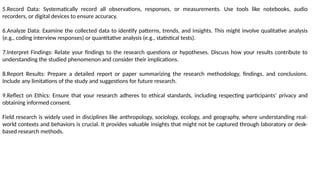
5.Record Data: Systematically record all observations, responses, or measurements. Use tools like notebooks, audio
recorders, or digital devices to ensure accuracy.
6.Analyze Data: Examine the collected data to identify patterns, trends, and insights. This might involve qualitative analysis
(e.g., coding interview responses) or quantitative analysis (e.g., statistical tests).
7.Interpret Findings: Relate your findings to the research questions or hypotheses. Discuss how your results contribute to
understanding the studied phenomenon and consider their implications.
8.Report Results: Prepare a detailed report or paper summarizing the research methodology, findings, and conclusions.
Include any limitations of the study and suggestions for future research.
9.Reflect on Ethics: Ensure that your research adheres to ethical standards, including respecting participants’ privacy and
obtaining informed consent.
Field research is widely used in disciplines like anthropology, sociology, ecology, and geography, where understanding real-
world contexts and behaviors is crucial. It provides valuable insights that might not be captured through laboratory or desk-
based research methods.
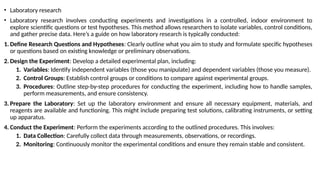
• Laboratory research
• Laboratory research involves conducting experiments and investigations in a controlled, indoor environment to
explore scientific questions or test hypotheses. This method allows researchers to isolate variables, control conditions,
and gather precise data. Here’s a guide on how laboratory research is typically conducted:
1. Define Research Questions and Hypotheses: Clearly outline what you aim to study and formulate specific hypotheses
or questions based on existing knowledge or preliminary observations.
2. Design the Experiment: Develop a detailed experimental plan, including:
1. Variables: Identify independent variables (those you manipulate) and dependent variables (those you measure).
2. Control Groups: Establish control groups or conditions to compare against experimental groups.
3. Procedures: Outline step-by-step procedures for conducting the experiment, including how to handle samples,
perform measurements, and ensure consistency.
3. Prepare the Laboratory: Set up the laboratory environment and ensure all necessary equipment, materials, and
reagents are available and functioning. This might include preparing test solutions, calibrating instruments, or setting
up apparatus.
4. Conduct the Experiment: Perform the experiments according to the outlined procedures. This involves:
1. Data Collection: Carefully collect data through measurements, observations, or recordings.
2. Monitoring: Continuously monitor the experimental conditions and ensure they remain stable and consistent.
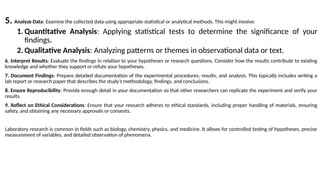
5. Analyze Data: Examine the collected data using appropriate statistical or analytical methods. This might involve:
1. Quantitative Analysis: Applying statistical tests to determine the significance of your
findings.
2. Qualitative Analysis: Analyzing patterns or themes in observational data or text.
6. Interpret Results: Evaluate the findings in relation to your hypotheses or research questions. Consider how the results contribute to existing
knowledge and whether they support or refute your hypotheses.
7. Document Findings: Prepare detailed documentation of the experimental procedures, results, and analysis. This typically includes writing a
lab report or research paper that describes the study’s methodology, findings, and conclusions.
8. Ensure Reproducibility: Provide enough detail in your documentation so that other researchers can replicate the experiment and verify your
results.
9. Reflect on Ethical Considerations: Ensure that your research adheres to ethical standards, including proper handling of materials, ensuring
safety, and obtaining any necessary approvals or consents.
Laboratory research is common in fields such as biology, chemistry, physics, and medicine. It allows for controlled testing of hypotheses, precise
measurement of variables, and detailed observation of phenomena.
Experimental designing
• Problem assigning
• Setting hypothesis
• Review of literature
• Research methodology
• Result and discussion writing

RESEARCH METHODOLOGY......................

  • 1.
    Research The term ‘Research’consists of two words: Research = Re + Search ‘Re’ means again and again and ‘Search’ means to find out something, the following is the process: Therefore, research means to observe the phenomena again and again from different dimensions. For example there are many theories of learning due to the observation from different dimensions. The research is a process of which a person observes the phenomena again and again and collects the data and on the basis of data he draws some conclusions. Observes Again and again Person Phenomena Collection of data Analysis of data Conclusions SUBJECT CODE : MSBOTREM101 RESEARCH METHODOLOGY
  • 2.
    • Definitions The followingare the important definitions of research: “Research is an endeavor / attempt to discover, develop and verify knowledge. It is an intellectual process that has developed over hundreds of years ever changing in purpose and form and always researching to truth.” J. Francis Rummel “Research is an honest, exhaustive, intelligent searching for facts and their meanings or implications with reference to a given problem. The product or findings of a given piece of research should be an authentic, verifiable contribution to knowledge in the field studied.” P.M. Cook “Research may be defined as a method of studying problems whose solutions are to be derived partly or wholly from facts.” W.S. Monroes “Research is considered to be the more formal, systematic intensive process of carrying on the scientific method of analysis. It involves a more systematic structure of investigation, usually resulting in some sort of formal record of procedures and a report of results or conclusion.” John W. Best
  • 3.
    The following characteristicsmay be gathered from the definitions of ‘Research’ 1. It gathers new knowledge or data from primary or first-hand sources. 2. It places emphasis upon the discovery of general principles. 3. It is an exact systematic and accurate investigation. 4. It uses certain valid data gathering devices. 5. It is logical and objective. 6. The researcher resists the temptation to seek only the data that support his hypotheses. 7. The researcher eliminates personal feelings and preferences. 8. It endeavours to organise data in quantitative terms. 9. Research is patient and unhurried activity. 10. The researcher is willing to follow his procedures to the conclusions that may be unpopular and bring socia disapproval. 11. Research is carefully recorded and reported. 12. Conclusions and generalisations are arrived at carefully and cautiously.
  • 4.
    Types • Qualitative Qualitative researchgathers participants' experiences, perceptions, and behavior. It answers the hows and whys instead of how many or how much. It could be structured as a standalone study, purely relying on qualitative data, or part of mixed-methods research that combines qualitative and quantitative data. The most frequently used qualitative analysis methods are one-on- one interviews, focus groups, ethnographic research, case study research, record keeping, and qualitative observation.
  • 5.
    • Qualitative ResearchApproaches 1. Ethnography Ethnography as a research design originates in social and cultural anthropology and involves the researcher being directly immersed in the participant’s environment. Through this immersion, the ethnographer can use a variety of data collection techniques to produce a comprehensive account of the social phenomena that occurred during the research period. That is to say, the researcher’s aim with ethnography is to immerse themselves into the research population and come out of it with accounts of actions, behaviors, events, etc, through the eyes of someone involved in the population. Direct involvement of the researcher with the target population is one benefit of ethnographic research because it can then be possible to find data that is otherwise very difficult to extract and record. 2. Grounded theory Grounded Theory is the "generation of a theoretical model through the experience of observing a study population and developing a comparative analysis of their speech and behavior.“ Unlike quantitative research, which is deductive and tests or verifies an existing theory, grounded theory research is inductive and, therefore, lends itself to research aimed at social interactions or experiences. In essence, Grounded Theory’s goal is to explain how and why an event occurs or how and why people might behave a certain way. Through observing the population, a researcher using the Grounded Theory approach can then develop a theory to explain the phenomena of interest.
  • 6.
    3. Phenomenology Phenomenology isthe "study of the meaning of phenomena or the study of the particular.” At first glance, it might seem that Grounded Theory and Phenomenology are pretty similar, but the differences can be seen upon careful examination. At its core, phenomenology looks to investigate experiences from the individual's perspective. Phenomenology is essentially looking into the "lived experiences" of the participants and aims to examine how and why participants behaved a certain way from their perspective. Herein lies one of the main differences between Grounded Theory and Phenomenology. Grounded Theory aims to develop a theory for social phenomena through an examination of various data sources. In contrast, Phenomenology focuses on describing and explaining an event or phenomenon from the perspective of those who have experienced it. 4. Narrative research One of qualitative research’s strengths lies in its ability to tell a story, often from the perspective of those directly involved in it. Reporting on qualitative research involves including details and descriptions of the setting involved and quotes from participants. This detail is called a "thick" or "rich" description and is a strength of qualitative research. Narrative research is rife with the possibilities of "thick" description as this approach weaves together a sequence of events, usually from just one or two individuals, hoping to create a cohesive story or narrative. While it might seem like a waste of time to focus on such a specific, individual level, understanding one or two people’s narratives for an event or phenomenon can help to inform researchers about the influences that helped shape that narrative. The tension or conflict of differing narratives can be "opportunities for innovation."
  • 7.
    • Data Sampling Thebetter the sample represents the intended study population, the more likely the researcher is to encompass the varying factors. The following are examples of participant sampling and selection: 1. Purposive sampling- selection based on the researcher’s rationale for being the most informative. 2. Criterion sampling selection based on pre-identified factors. 3. Convenience sampling- selection based on availability. 4. Snowball sampling- the selection is by referral from other participants or people who know potential participants. 5. Extreme case sampling- targeted selection of rare cases. 6. Typical case sampling selection based on regular or average participants.
  • 8.
    • Applications 1. Manytimes, a research question will start with qualitative research. The qualitative research will help generate the research hypothesis, which can be tested with quantitative methods. 2. After the data is collected and analyzed with quantitative methods, a set of qualitative methods can be used to dive deeper into the data to better understand what the numbers truly mean and their implications. 3. The qualitative techniques can then help clarify the quantitative data and also help refine the hypothesis for future research. 4. Furthermore, with qualitative research, researchers can explore poorly studied subjects with quantitative methods. These include opinions, individual actions, and social science research.
  • 9.
    Quantitative research isa systematic investigation of phenomena by gathering quantifiable data and performing statistical, mathematical, or computational techniques. Quantitative research collects statistically significant information from existing and potential customers using sampling methods and sending out online surveys, online polls, and questionnaires, for example. An example of a quantitative research study is the survey conducted to understand how long a doctor takes to tend to a patient when the patient walks into the hospital. A patient satisfaction survey can be administered to ask questions like how long a doctor takes to see a patient, how often a patient walks into a hospital, and other such questions, which are dependent variables in the research. This kind of research method is often employed in the social sciences, and it involves using mathematical frameworks and theories to effectively present data, ensuring that the results are logical, statistically sound, and unbiased. Data collection in quantitative research uses a structured method and is typically conducted on larger samples representing the entire population. Researchers use quantitative methods to collect numerical data, which is then subjected to statistical analysis to determine statistically significant findings. This approach is valuable in both experimental research and social research, as it helps in making
  • 10.
    • Quantitative ResearchCharacteristics 1. Structured tools: Quantitative research relies on structured tools such as surveys, polls, or questionnaires to gather quantitative data. Using such structured methods helps collect in-depth and actionable numerical data from the survey respondents, making it easier to perform data analysis. 2. Sample size: Quantitative research is conducted on a significant sample size representing the target market. Appropriate Survey Sampling methods, a fundamental aspect of quantitative research methods, must be employed when deriving the sample to fortify the research objective and ensure the reliability of the results. 3. Close-ended questions: Closed-ended questions, specifically designed to align with the research objectives, are a cornerstone of quantitative research. These questions facilitate the collection of quantitative data and are extensively used in data collection processes. 4. Prior studies: Before collecting feedback from respondents, researchers often delve into previous studies related to the research topic. This preliminary research helps frame the study effectively and ensures the data collection process is well-informed. 5. Quantitative data: Typically, quantitative data is represented using tables, charts, graphs, or other numerical forms. This visual representation aids in understanding the collected data and is essential for rigorous data analysis, a key component of quantitative research methods. 6. Generalization of results: One of the strengths of quantitative research is its ability to generalize results to the entire population. It means that the findings derived from a sample can be extrapolated to make informed decisions and take appropriate actions for improvement based on numerical data analysis.
  • 11.
    • Common Approachesto Quantitative Research 1. Surveys 2. Custom surveys 3. Mail/e-mail/Internet surveys 4. Telephone surveys 5. Self-administered questionnaire surveys 6. Omnibus surveys 7. Correlational research 8. Trend analysis 9. Exploratory research 10. Descriptive research 11. Experimental research
  • 12.
    • Descriptive researchis a type of research that describes a population, situation, or phenomenon that is being studied. It focuses on answering the how, what, when, and where questions If a research problem, rather than the why. This is mainly because it is important to have a proper understanding of what a research problem is about before investigating why it exists in the first place. • Examples: • Survey Studies: A researcher surveys a group of people to gather information about their opinions on a new technology. The results might include data on how many people use the technology, their satisfaction levels, and demographic information. • Case Studies: An in-depth examination of a single individual or group. For example, a case study on a patient with a rare disease to document their symptoms, treatment responses, and overall experience. • Observational Studies: A study where researchers observe and record behaviors or phenomena in a natural setting without interfering. For instance, observing and documenting how children interact during free play in a schoolyard. • Content Analysis: Analyzing the content of media, such as newspapers or social media, to describe trends and patterns. For example, examining how often certain themes or topics appear in news articles over a specific period. • Cross-Sectional Studies: Analyzing data from a population at a single point in time to describe characteristics or conditions. For instance, measuring the prevalence of a specific health condition in different age groups within a community.
  • 13.
    • Conceptual researchis defined as a methodology wherein research is conducted by observing and analyzing already present information on a given topic. Conceptual research doesn’t involve conducting any practical experiments. It is related to abstract concepts or ideas. Philosophers have long used conceptual research to develop new theories or interpret existing theories in a different light. • Conceptual research focuses on developing new theories or refining existing ones. Here are a few examples: • Theory Development: Creating a new framework for understanding complex phenomena. For instance, a researcher might develop a new model to explain human motivation that integrates insights from psychology, sociology, and neuroscience. • Conceptual Analysis: Examining and clarifying the meaning and implications of key concepts. An example is analyzing the concept of "justice" and how it varies across different cultural and philosophical traditions. • Philosophical Inquiry: Exploring fundamental questions about the nature of reality, knowledge, or ethics. For example, a philosopher might investigate the nature of free will and its implications for moral responsibility. • Comparative Studies: Comparing different theoretical perspectives on a particular issue. For example, comparing various theories of learning to identify their strengths and weaknesses. • Model Refinement: Refining existing models to improve their explanatory power. For instance, updating economic models to better account for recent behavioral research findings.
  • 14.
    • Analytical researchis a specific type of research that involves critical thinking skills and the evaluation of facts and information relative to the research being conducted. A variety of people including students, doctors and psychologists use analytical research during studies to find the most relevant information. • Analytical research involves examining and interpreting data to understand patterns, relationships, and insights. Here are some examples: 1. Statistical Analysis: Analyzing survey data to identify trends and correlations. For instance, using regression analysis to understand how different factors like income and education level impact health outcomes. 2. Content Analysis: Examining text or media content to identify patterns or themes. For example, analyzing news articles to determine how often and in what context certain topics are discussed. 3. Comparative Analysis: Comparing different case studies or datasets to draw conclusions. For instance, comparing the economic growth rates of different countries to identify factors that contribute to higher growth. 4. Financial Analysis: Analyzing financial statements to assess a company's performance. For example, using ratios like return on equity or current ratio to evaluate a company's financial health. 5. Policy Analysis: Evaluating the impact of a policy or program. For instance, analyzing the effects of a new education policy on student achievement and educational equity. 6. Trend Analysis: Examining historical data to identify patterns and predict future trends. For
  • 15.
    • Fundamental researchis driven by a scientist's curiosity or interest in a scientific question. The main motivation is to expand man's knowledge, not to create or invent something. There is no obvious commercial value to the discoveries that result from basic research. For example, basic science investigations probe for answers to questions such as: • How did the universe begin? • What are protons, neutrons, and electrons composed of? • How do slime molds reproduce? • What is the specific genetic code of the fruit fly? • Fundamental research, also known as basic or pure research, aims to expand knowledge by investigating fundamental principles and theories without immediate practical application. Here are some examples: 1. Quantum Mechanics: Research into the fundamental nature of particles and forces at the quantum level, such as the behavior of subatomic particles and quantum entanglement. 2. Theory of Relativity: Studies by Albert Einstein on the nature of space and time, leading to the development of the Special and General Theories of Relativity. 3. Genetics: Investigating the structure and function of genes and DNA, including the basic mechanisms of inheritance and genetic variation. 4. Mathematical Theories: Developing and exploring new mathematical theories or proofs, such as the study of prime numbers or the development of new branches of mathematics like topology. 5. Neuroscience: Basic research into the workings of the brain and nervous system, including understanding how neurons communicate and how cognitive processes are mapped in the brain. 6. Astronomy: Studying the fundamental properties and origins of celestial objects and phenomena, such as the formation of galaxies or the nature of dark matter. 7. Evolutionary Biology: Investigating the fundamental processes of evolution, such as natural selection, genetic drift, and the origin of species.
  • 16.
    • Applied researchrefers to scientific study and research that seeks to solve practical problems. Applied research is used to find solutions to everyday problems, cure illness, and develop innovative technologies, rather than to acquire knowledge for knowledge's sake. • For example, applied researchers may investigate ways to: • Improve agricultural crop production • Treat or cure a specific disease • Improve the energy efficiency of homes, offices, or modes of transportation • Applied research focuses on solving practical problems and improving real-world practices by applying scientific knowledge. Here are some examples: 1. Medical Research: Developing new treatments or drugs for diseases. For example, research into new cancer therapies or vaccines to combat infectious diseases. 2. Engineering Innovations: Designing and improving technology for specific applications, such as developing more efficient renewable energy sources like solar panels or wind turbines. 3. Educational Practices: Implementing and testing new teaching methods to enhance student learning outcomes. For instance, applying findings from cognitive psychology to develop better educational tools and strategies. 4. Environmental Solutions: Creating strategies to address environmental issues, such as developing methods to reduce pollution, manage waste, or protect endangered species. 5. Business Strategies: Applying market research to develop effective marketing strategies or improve customer service practices. For example, using data analytics to optimize supply chain management. 6. Public Health Interventions: Designing and evaluating programs to improve public health, such as initiatives to increase vaccination rates or reduce smoking. 7. Urban Planning: Using research to design and implement better urban infrastructure, such as creating more efficient public transportation systems or improving urban green spaces.
  • 17.
    • Empirical researchis a type of research methodology that makes use of verifiable evidence in order to arrive at research outcomes. In other words, this type of research relies solely on evidence obtained through observation or scientific data collection methods. Empirical research can be carried out using qualitative or quantitative observation methods, depending on the data sample, that is, quantifiable data or non-numerical data. Unlike theoretical research that depends on preconceived notions about the research variables, empirical research carries a scientific investigation to measure the experimental probability of the research variables • Empirical research involves collecting and analyzing data through observation or experimentation to answer specific questions or test hypotheses. Here are some examples: 1. Clinical Trials: Testing the effectiveness of new drugs or medical treatments through controlled experiments with human participants. For example, evaluating a new cancer drug's efficacy compared to existing treatments. 2. Psychological Experiments: Conducting experiments to study human behavior and mental processes. For instance, testing the effects of sleep deprivation on cognitive performance. 3. Field Surveys: Gathering data from large groups of people through questionnaires or interviews to understand social phenomena, such as public opinion on policy issues. 4. Longitudinal Studies: Tracking the same subjects over time to observe changes and developments. For example, studying how childhood experiences influence adult mental health over several decades. 5. Behavioral Observations: Observing and recording behaviors in natural settings to understand patterns and factors influencing behavior. For instance, studying how different environmental conditions affect animal behavior. 6. Experimental Economics: Conducting laboratory or field experiments to test economic theories and behaviors, such as examining how different incentives impact consumer decision-making. 7. Environmental Studies: Measuring and analyzing environmental variables, such as tracking pollution levels in different regions to assess their impact on public health.
  • 18.
    Literature survey • Aliterature survey, also known as a literature review, in science involves systematically reviewing and summarizing existing research on a particular topic. It aims to provide an overview of the current state of knowledge, identify gaps in the literature, and establish a foundation for new research. Here’s how a literature survey is typically conducted in science: 1. Define the Scope: Clearly define the topic or research question to focus the literature search. This could involve narrowing down a broad topic to a specific aspect or research area. 2. Conduct a Comprehensive Search: Use academic databases (e.g., PubMed, Google Scholar, Web of Science) to find relevant articles, books, and other scholarly sources. Search terms and keywords should be carefully chosen to capture relevant literature. 3. Screen and Select Studies: Review the search results to select studies that are directly relevant to the research question. This involves reading abstracts and sometimes full texts to determine relevance and quality. 4. Organize the Literature: Group the selected studies into categories based on themes, methodologies, or findings. This helps in identifying patterns, trends, and key debates in the literature. 5. Analyze and Synthesize: Summarize the findings of each study, noting methodologies, results, and conclusions. Analyze how these studies contribute to the understanding of the topic and how they relate to one another. 6. Identify Gaps and Trends: Highlight areas where research is lacking or where further investigation is needed. Discuss emerging trends, controversies, or consensus in the field. 7. Write the Review: Prepare a structured review that includes an introduction to the topic, a detailed summary of the literature, a discussion of key findings, and an identification of gaps or future research directions. 8. Cite Sources: Properly cite all sources to give credit to original authors and provide evidence for the review.
  • 19.
    1. Books andText books Material : The most useful list of books published in the English language is the Cumulative Book Index and Book Review Index, Books Review Digest, Subject Guide to Books indicates that books are in print or press or forthcoming books. 2. Periodicals : A periodical is defined as a publication issued in successive parts, usually at regular intervals, and as a rule, intended to be continued indefinitely. These include Yearbook, Documents, Almanacs, The Cumulative Book Index, International Abstracts, Journals, Newspapers, Magazines, International Index to Periodicals. 3. Abstracts : Another type of reference guide is the abstract, review, or digest. In addition to provide a systematized list of reference sources, it includes a summary of the contents. Usually the brief summaries of research studies are given in the form of abstract. 4. Encyclopaedias : Encyclopaedias provide concise information on a number of subjects written by specialists. They provide a convenient source of information, and often include illustrations and bibliographies. Only specialized encyclopaedias deal with restricted areas of knowledge. Encyclopaedia of Educational Research, New York. It is published, every ten years. It refers to important work on educational problems. 5. Almanacs, Handbooks, Yearbooks and Guides : This general category of references includes those publications that present rather detailed up-to-date information on a variety of subjects, organized around a given theme. They are the types of references that one consults to find specific information, often of a statistical nature. 6. Dissertations and Theses : The theses and dissertations which embody the bulk of presenting educational research, are usually housed by the institutions and universities that award the authors their advanced degrees. Sometimes these studies are published in whole or in part in educational journals. The related dissertations and theses are the main sources of review of literature. the entry ‘dissertations and theses’ issue of the bibliographic index in the most comprehensive listing of sources to these research in progress. 7. Newspaper : The current newspapers provide upto-data information and speeches, reports. conferences. new developments in field of education. The current events and educational news are also reported in newspapers. It is also one of the important sources of review of literature.
  • 20.
    • Library research •Library research involves using various resources available in libraries to gather information for academic, professional, or personal purposes. Here’s a step-by-step guide on how to conduct effective library research: 1. Identify the Research Topic: Clearly define what you are researching. This could be a specific question, problem, or area of interest. 2. Develop a Research Strategy: Plan how you will search for information. This includes selecting appropriate keywords, deciding which types of sources to use (e.g., books, journals, databases), and determining which library resources to access. 3. Access Library Resources: Use the library’s catalog to find books, e-books, and other materials. Most libraries offer online catalogs where you can search for resources by title, author, subject, or keyword. 4. Search Databases: Utilize academic databases and electronic journals available through the library. Databases such as JSTOR, ProQuest, and ScienceDirect provide access to peer-reviewed articles, research papers, and other scholarly materials. 5. Use Reference Materials: Consult reference materials such as encyclopedias, dictionaries, and handbooks to get background information and context for your topic. 6. Evaluate Sources: Assess the credibility, relevance, and quality of the sources you find. Check for peer-reviewed articles, reputable publishers, and up-to-date information. 7. Take Notes and Organize Information: As you gather information, take detailed notes and keep track of your sources. Organize your notes by themes or categories relevant to your research question. 8. Access Archives and Special Collections: If your library has special collections or archives, explore these resources for unique or primary source materials that might not be available elsewhere. 9. Consult with Librarians: Librarians are experts in finding and managing information. Don’t hesitate to ask for assistance or recommendations on sources and research strategies. 10.Compile and Synthesize: Combine the information you have gathered to address your research question. Synthesize the findings and organize them logically. 11.Cite Sources Properly: Ensure that you cite all sources correctly according to the required citation style (e.g., APA, MLA, Chicago). • Library research is a valuable skill that involves using various tools and resources to gather and analyze information effectively. It helps in building a strong foundation for academic or professional projects.
  • 21.
    • Field research •Field research involves collecting data and gathering information directly from the natural environment or real-world settings. This method is often used to study phenomena in their natural context rather than in a controlled or artificial setting. Here’s a breakdown of how field research is typically conducted: 1.Define Research Objectives: Clearly outline what you aim to study and why. This includes formulating research questions or hypotheses based on what you want to learn. 2.Design the Study: Develop a research plan detailing how you will collect data. This includes selecting the field site, deciding on methods (e.g., surveys, interviews, observations), and planning logistics. 3.Obtain Permissions: If necessary, secure permissions or approvals from relevant authorities, organizations, or individuals to conduct research in specific locations or with particular groups. 4.Collect Data: • Observation: Observe and record behaviors, events, or conditions in their natural setting. For example, studying animal behavior in the wild or observing social interactions in a community. • Interviews: Conduct interviews with individuals or groups to gather qualitative data. This might involve structured, semi-structured, or unstructured interviews. • Surveys: Distribute questionnaires to collect data from a larger population. This can be done in person, online, or via phone. • Experiments: Conduct experiments or trials in real-world settings to test hypotheses or observe outcomes.
  • 22.
    5.Record Data: Systematicallyrecord all observations, responses, or measurements. Use tools like notebooks, audio recorders, or digital devices to ensure accuracy. 6.Analyze Data: Examine the collected data to identify patterns, trends, and insights. This might involve qualitative analysis (e.g., coding interview responses) or quantitative analysis (e.g., statistical tests). 7.Interpret Findings: Relate your findings to the research questions or hypotheses. Discuss how your results contribute to understanding the studied phenomenon and consider their implications. 8.Report Results: Prepare a detailed report or paper summarizing the research methodology, findings, and conclusions. Include any limitations of the study and suggestions for future research. 9.Reflect on Ethics: Ensure that your research adheres to ethical standards, including respecting participants’ privacy and obtaining informed consent. Field research is widely used in disciplines like anthropology, sociology, ecology, and geography, where understanding real- world contexts and behaviors is crucial. It provides valuable insights that might not be captured through laboratory or desk- based research methods.
  • 23.
    • Laboratory research •Laboratory research involves conducting experiments and investigations in a controlled, indoor environment to explore scientific questions or test hypotheses. This method allows researchers to isolate variables, control conditions, and gather precise data. Here’s a guide on how laboratory research is typically conducted: 1. Define Research Questions and Hypotheses: Clearly outline what you aim to study and formulate specific hypotheses or questions based on existing knowledge or preliminary observations. 2. Design the Experiment: Develop a detailed experimental plan, including: 1. Variables: Identify independent variables (those you manipulate) and dependent variables (those you measure). 2. Control Groups: Establish control groups or conditions to compare against experimental groups. 3. Procedures: Outline step-by-step procedures for conducting the experiment, including how to handle samples, perform measurements, and ensure consistency. 3. Prepare the Laboratory: Set up the laboratory environment and ensure all necessary equipment, materials, and reagents are available and functioning. This might include preparing test solutions, calibrating instruments, or setting up apparatus. 4. Conduct the Experiment: Perform the experiments according to the outlined procedures. This involves: 1. Data Collection: Carefully collect data through measurements, observations, or recordings. 2. Monitoring: Continuously monitor the experimental conditions and ensure they remain stable and consistent.
  • 24.
    5. Analyze Data:Examine the collected data using appropriate statistical or analytical methods. This might involve: 1. Quantitative Analysis: Applying statistical tests to determine the significance of your findings. 2. Qualitative Analysis: Analyzing patterns or themes in observational data or text. 6. Interpret Results: Evaluate the findings in relation to your hypotheses or research questions. Consider how the results contribute to existing knowledge and whether they support or refute your hypotheses. 7. Document Findings: Prepare detailed documentation of the experimental procedures, results, and analysis. This typically includes writing a lab report or research paper that describes the study’s methodology, findings, and conclusions. 8. Ensure Reproducibility: Provide enough detail in your documentation so that other researchers can replicate the experiment and verify your results. 9. Reflect on Ethical Considerations: Ensure that your research adheres to ethical standards, including proper handling of materials, ensuring safety, and obtaining any necessary approvals or consents. Laboratory research is common in fields such as biology, chemistry, physics, and medicine. It allows for controlled testing of hypotheses, precise measurement of variables, and detailed observation of phenomena.
  • 25.
  • 26.
  • 27.
    • Review ofliterature
  • 28.
  • 29.
    • Result anddiscussion writing