PARADIGMS OF
SOCIAL RESEARCH	
  
     Honors RMD
       24 March 2012
Lesson intentions
By this end of this class, you should:
 Know the three dominant research paradigms
 Differentiate between Positivism and Interpretivism
 Differentiate between Inductive and Deductive
  Reasoning
 Know the difference between
   Research Paradigm
   Research Methodology
   Research Methods
   Research Design
Success Criteria
You will know whether you have attained the
lesson intentions when you able to:
 Name the three dominant paradigms
 List the key characteristics of positivism and
  interpretivism
 Be able to apply deductive and inductive
  reasoning principles to any topic
 List different methods and methodologies
 Developed the research design for a (your)
  project
Research paradigms
Broadly speaking the are two dominant views or
paradigms over the nature of knowledge and how it is
developed (Epistemology).

•  Positivism (scientific method) and
•  Interpretivism.

Note: They are often in warring camps.
Some see these oppositions as false and detrimental
to research.
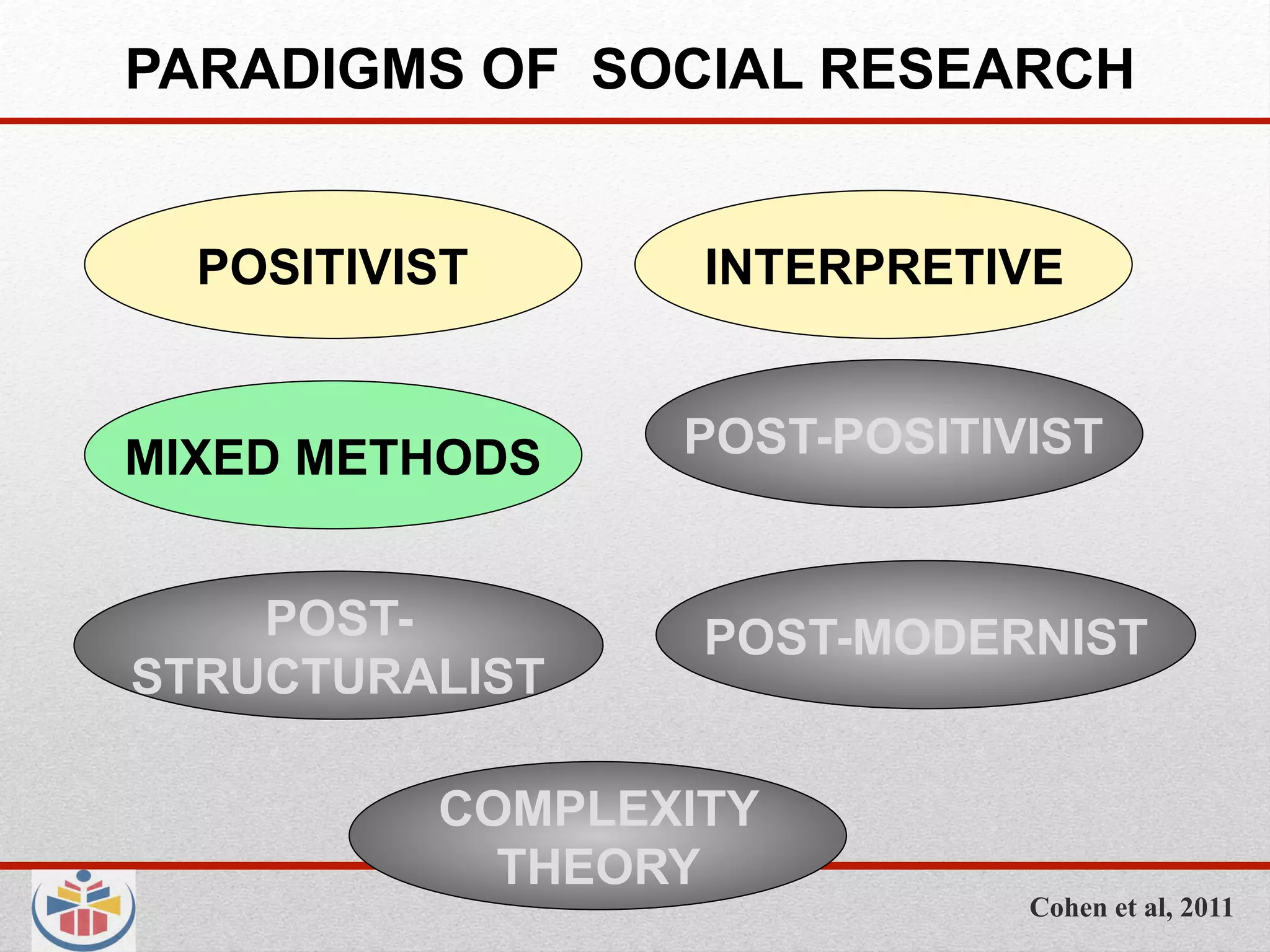
PARADIGMS OF SOCIAL RESEARCH


  POSITIVIST      INTERPRETIVE


MIXED METHODS    POST-POSITIVIST


    POST-         POST-MODERNIST
STRUCTURALIST

          COMPLEXITY
            THEORY
                             Cohen et al, 2011
Positivism

 Positivism is a philosophy states that the
  only authentic knowledge is scientific
  knowledge, and that such knowledge can
  only come from positive affirmation of
  theories through strict scientific method.
POSITIVISM
  Positivism refers to the school of thought that the only
    true or valid form of knowledge is that which is
    scientific .
  The principles and methods of the natural sciences (such as
   chemistry or physics) are used to study human behaviour,
   which in itself is objective and tangible in nature.
  The researcher can observe human behaviour and measure
    facts , and laws or theories of behaviour can be
   developed.
  Concepts such as feelings, emotions, beliefs and so on have
   no place in research as they cannot be directly observed or
   measured, they are unreliable and they are not constant over
   time.
POSITIVISM- cont
  Positivists attempt to mirror the methods of the natural
   and physical scientists.
  Through observing reality you can produce laws of the
   social world which can be generalised from one context to
   another
  Your role is to be an objective analyst, collecting data and
   interpreting it in a value free way.
  You are detached, neither affect nor are affected by the
   subject of your research.
  Emphasise the quantifiable, the observable, and
   replication (the ability to repeat research)
Interpretivism
 Interpretivism, is a way to gain insights
  through discovering meanings by
  improving our comprehension of the
  whole. Qualitative research explores the
  richness, depth, and complexity of
  phenomena.
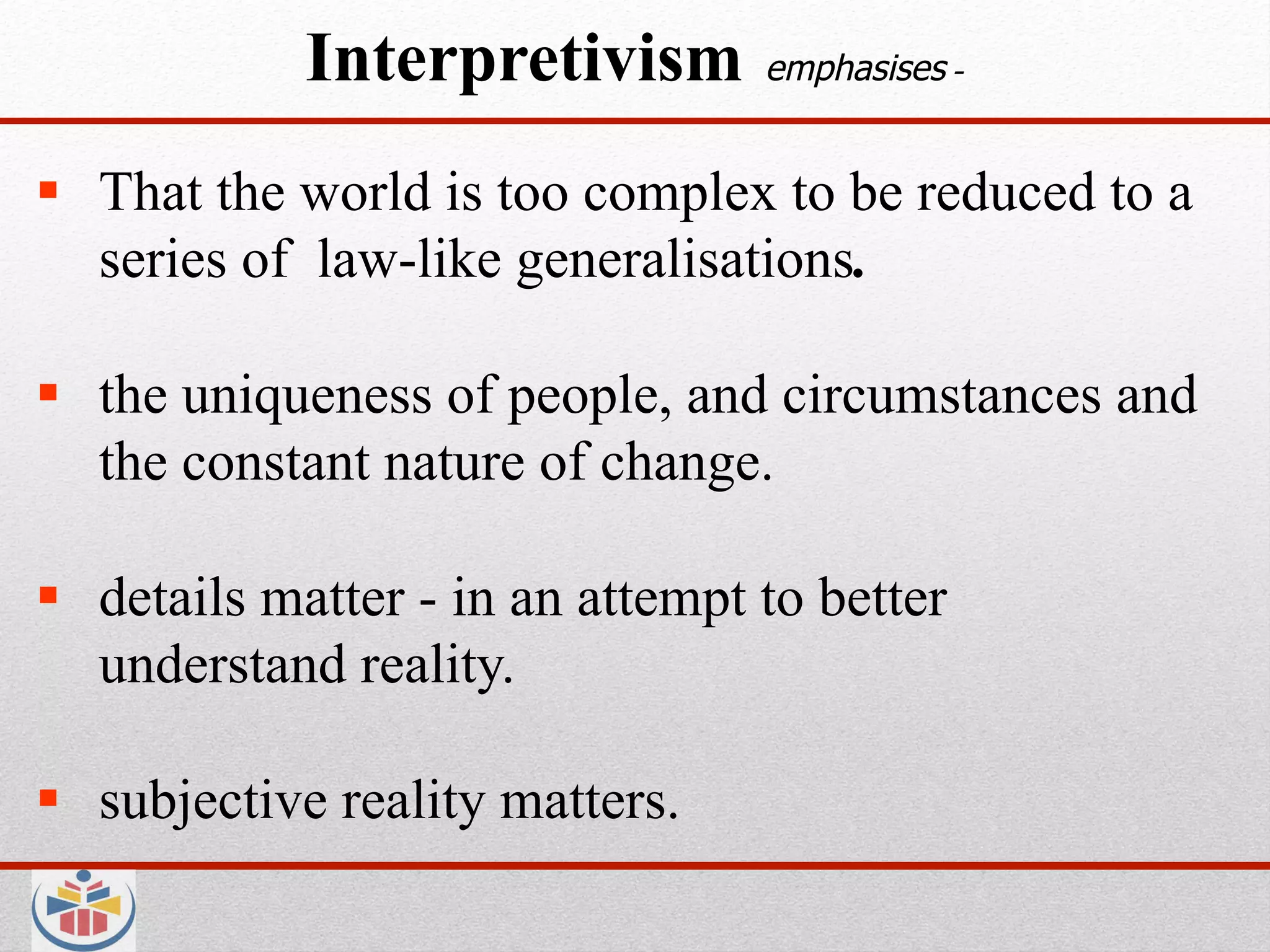
Interpretivism        emphasises -


  That the world is too complex to be reduced to a
   series of law-like generalisations.

  the uniqueness of people, and circumstances and
   the constant nature of change.

  details matter - in an attempt to better
   understand reality.

  subjective reality matters.
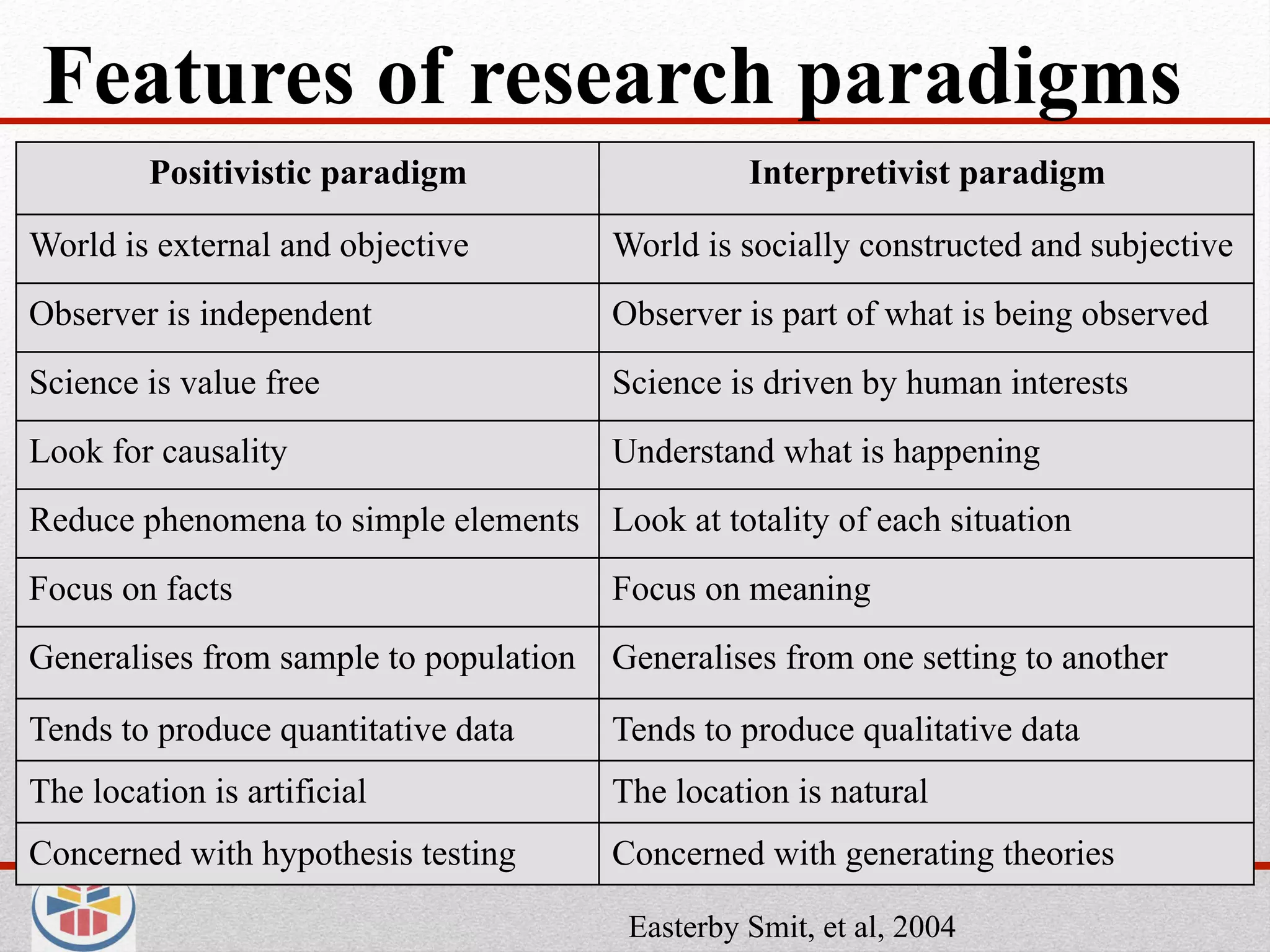
Features of research paradigms
         Positivistic paradigm                    Interpretivist paradigm

World is external and objective         World is socially constructed and subjective
Observer is independent                 Observer is part of what is being observed
Science is value free                   Science is driven by human interests
Look for causality                      Understand what is happening
Reduce phenomena to simple elements Look at totality of each situation
Focus on facts                          Focus on meaning
Generalises from sample to population   Generalises from one setting to another

Tends to produce quantitative data      Tends to produce qualitative data
The location is artificial              The location is natural
Concerned with hypothesis testing       Concerned with generating theories

                                         Easterby Smit, et al, 2004
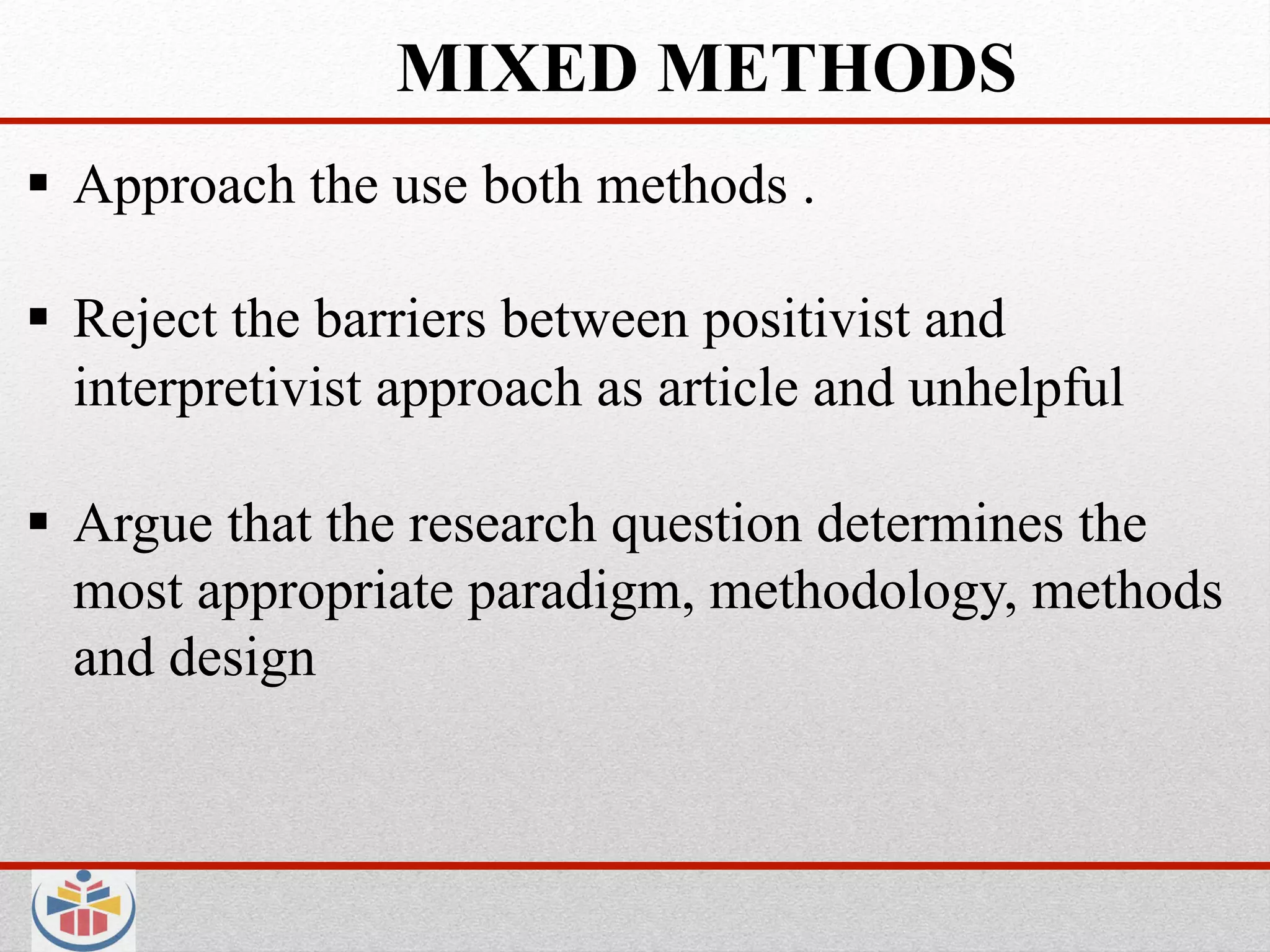
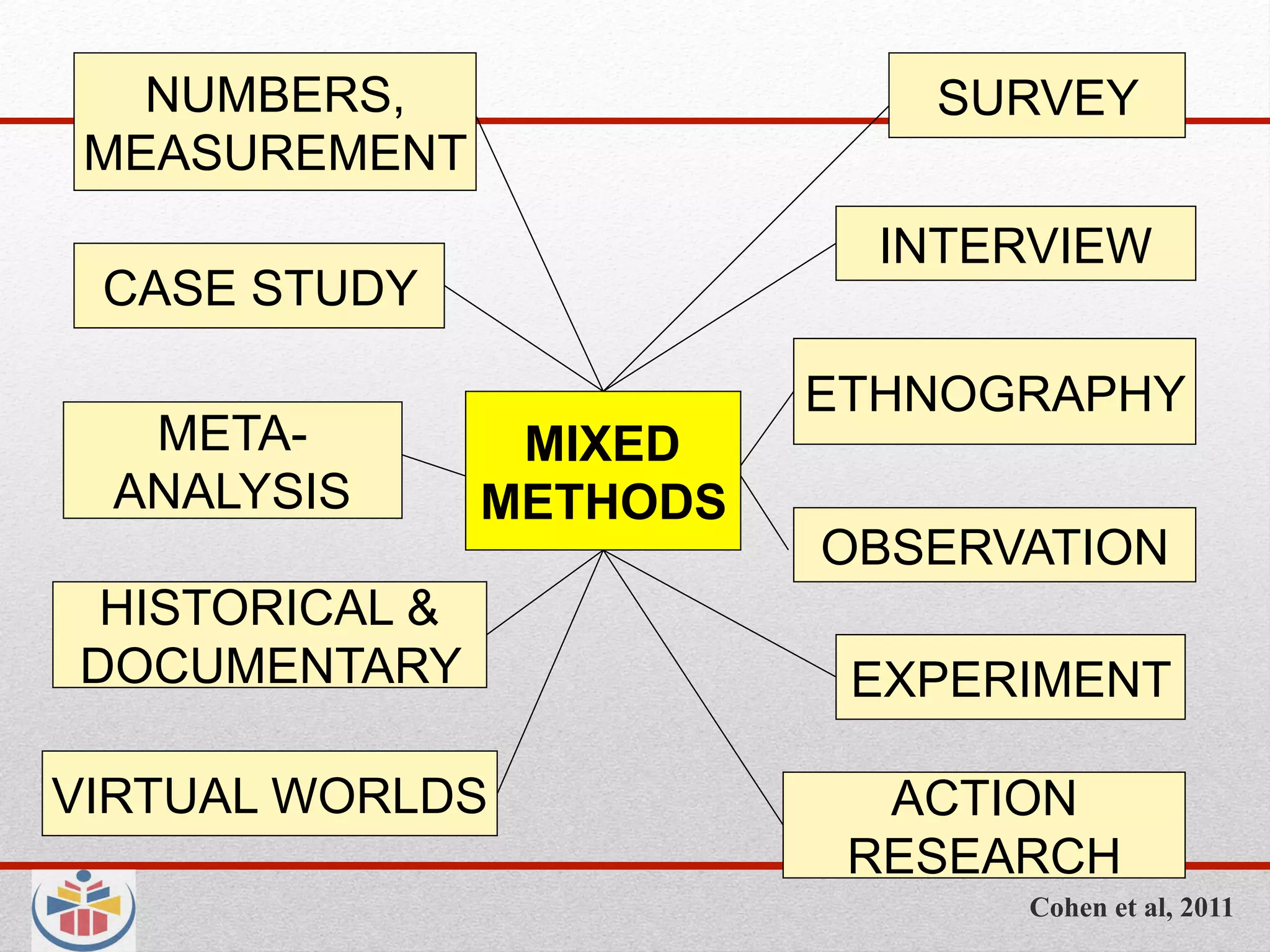
MIXED METHODS
  Approach the use both methods .

  Reject the barriers between positivist and
   interpretivist approach as article and unhelpful

  Argue that the research question determines the
   most appropriate paradigm, methodology, methods
   and design
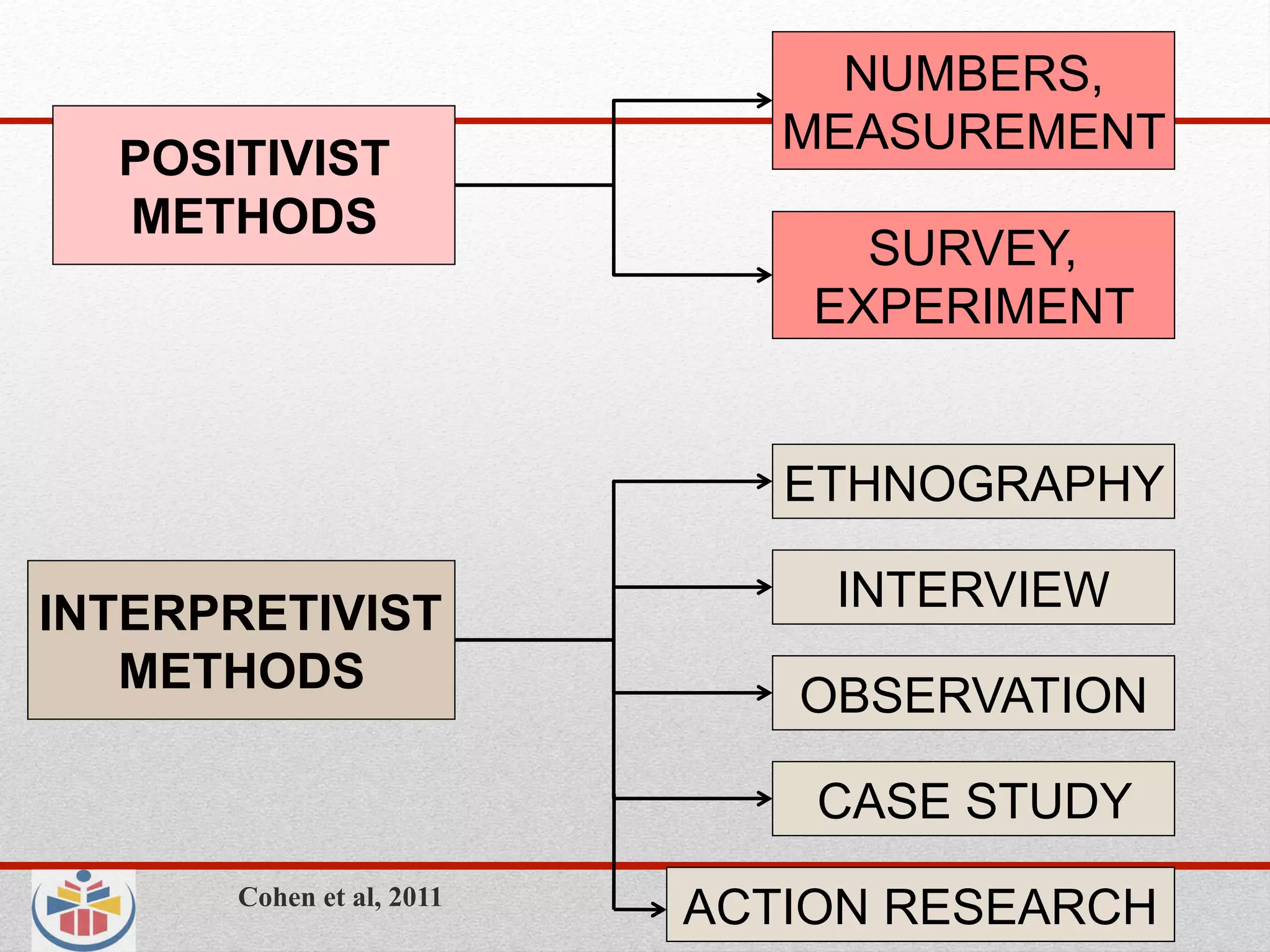
NUMBERS,
                             MEASUREMENT
  POSITIVIST
  METHODS
                                SURVEY,
                              EXPERIMENT


                             ETHNOGRAPHY

INTERPRETIVIST                INTERVIEW
   METHODS                   OBSERVATION

                              CASE STUDY
      Cohen et al, 2011
                          ACTION RESEARCH
NUMBERS,                  SURVEY
 MEASUREMENT
                            INTERVIEW
 CASE STUDY

                          ETHNOGRAPHY
  META-          MIXED
 ANALYSIS       METHODS
                          OBSERVATION
 HISTORICAL &
DOCUMENTARY                EXPERIMENT

VIRTUAL WORLDS              ACTION
                           RESEARCH
                                Cohen et al, 2011
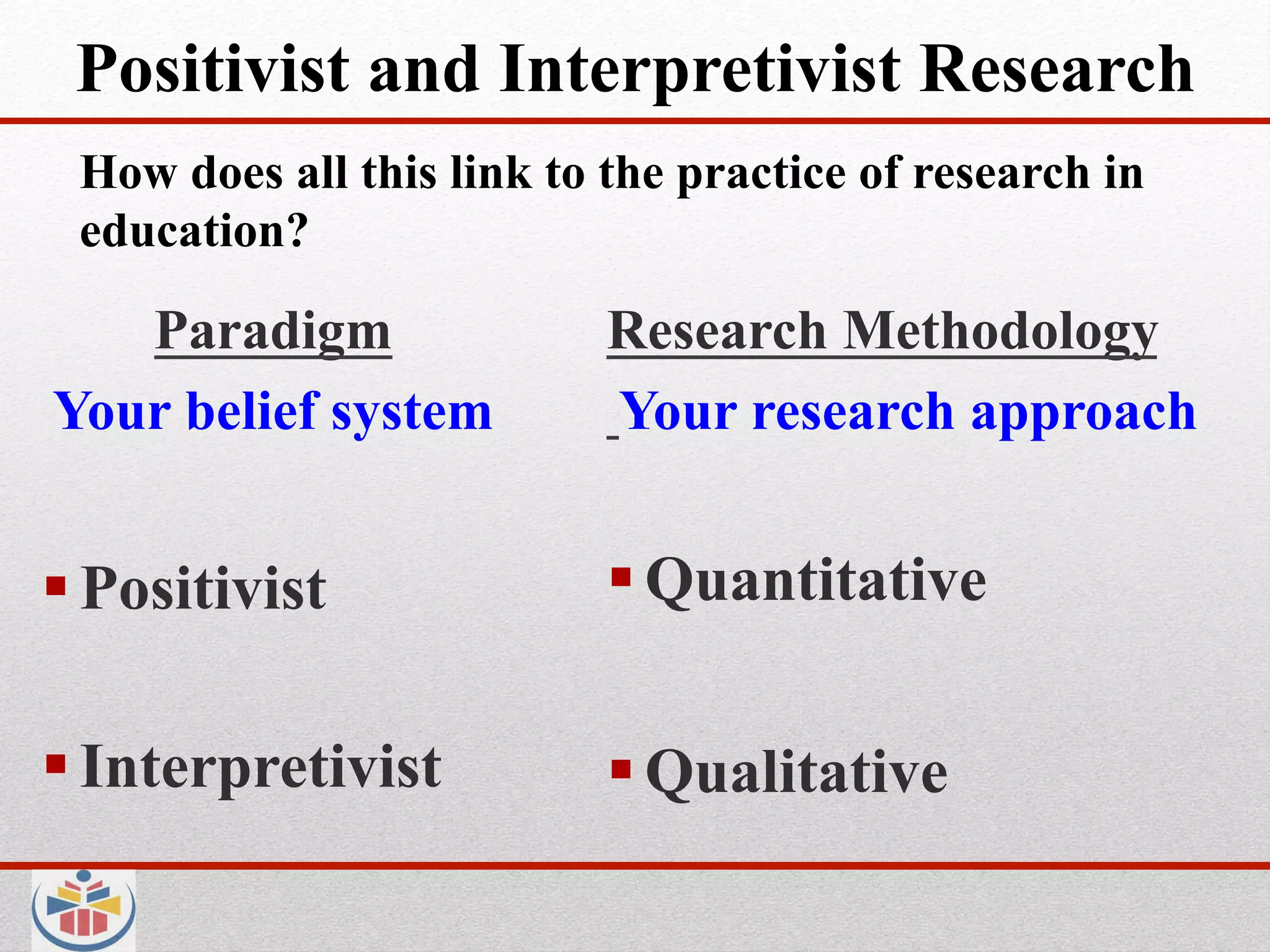
Positivist and Interpretivist Research
 How does all this link to the practice of research in
 education?

   Paradigm                Research Methodology
Your belief system         Your research approach


 Positivist                Quantitative

 Interpretivist            Qualitative
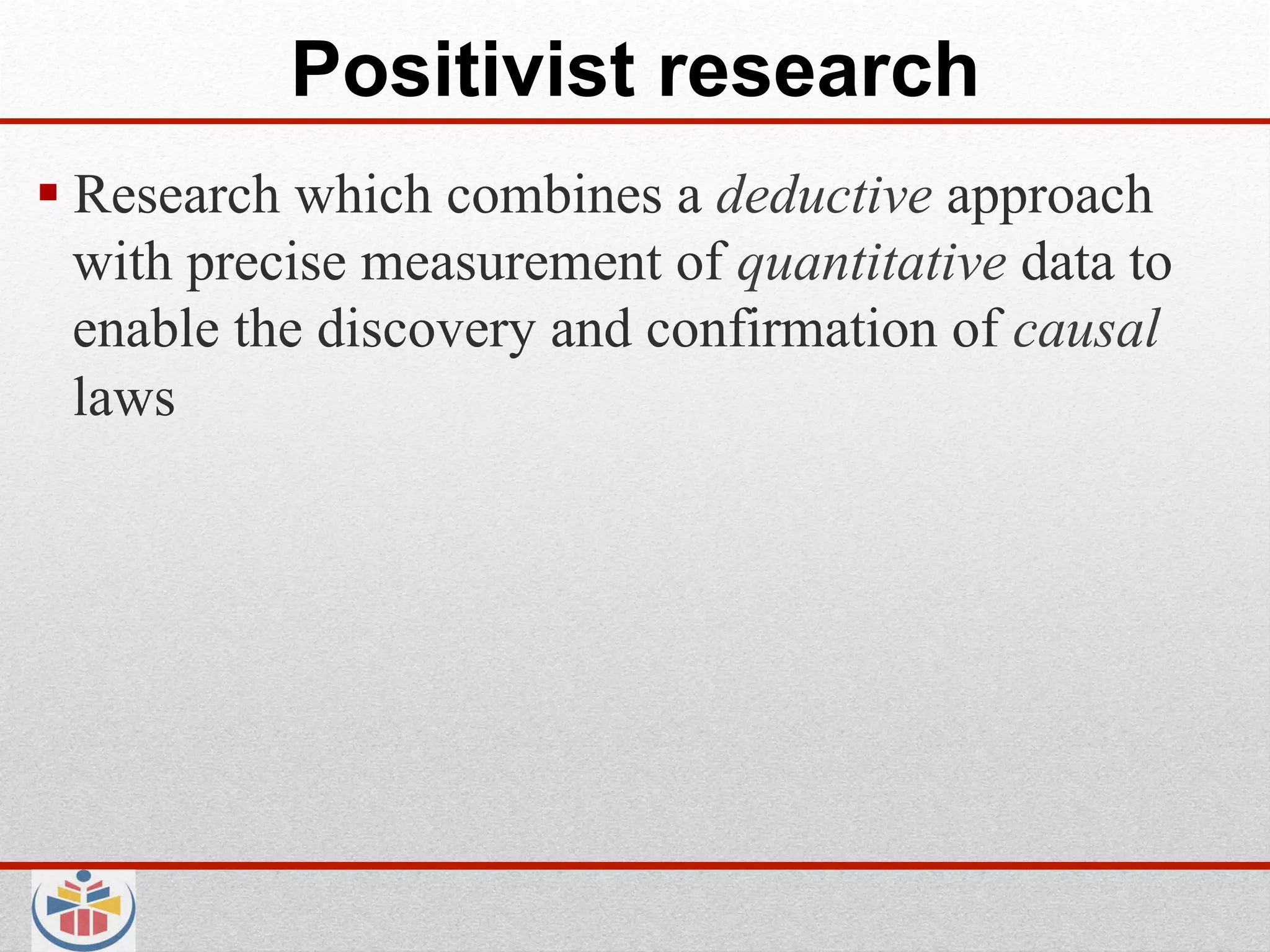
Positivist research
 Research which combines a deductive approach
  with precise measurement of quantitative data to
  enable the discovery and confirmation of causal
  laws
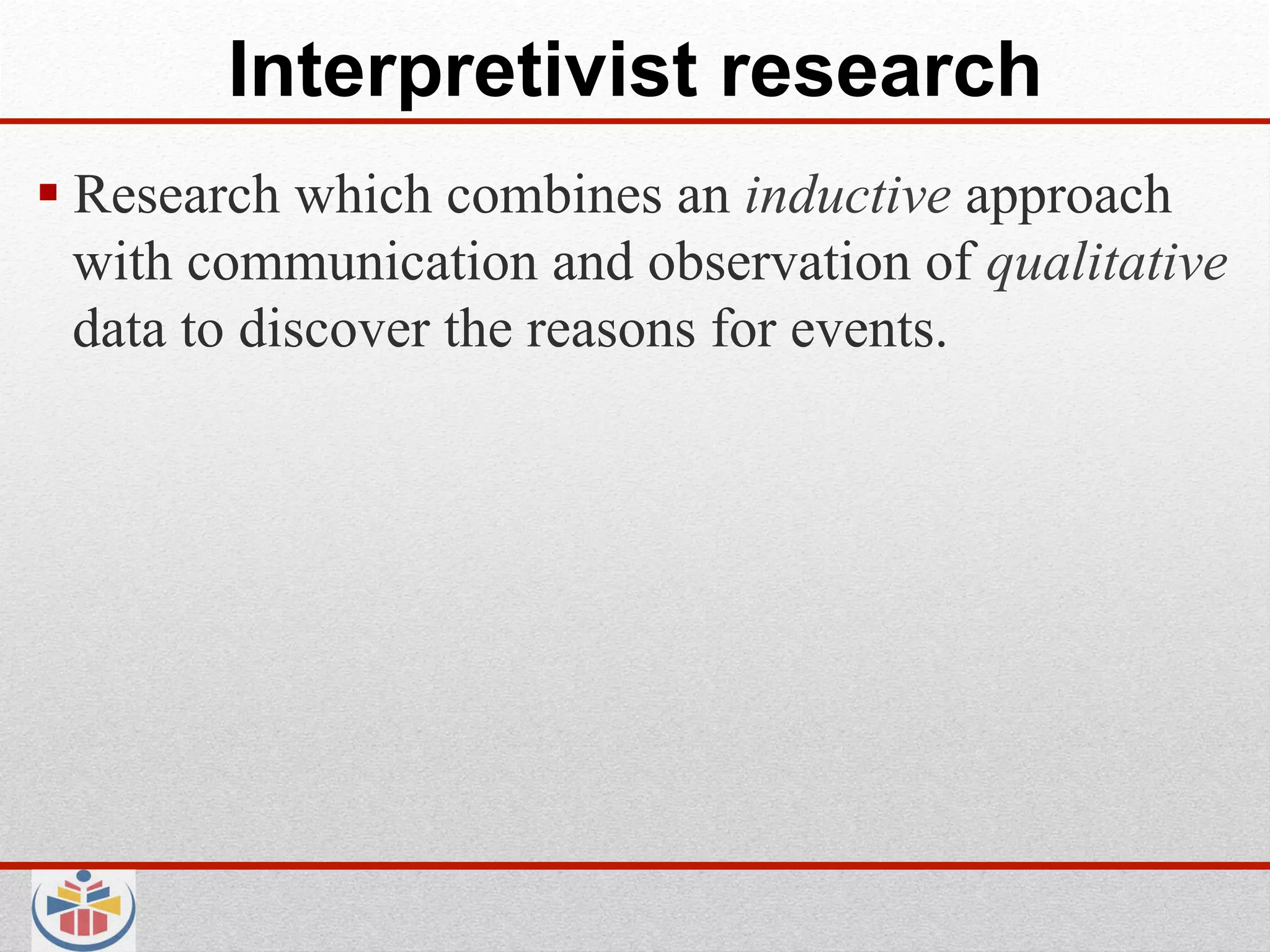
Interpretivist research
 Research which combines an inductive approach
  with communication and observation of qualitative
  data to discover the reasons for events.
Few more concepts
before a short break
Deductive vs Inductive
 Deductive - begins with an abstract idea and
 principle and works toward the concrete details
 to test these ideas.
   Theory Testing


 Inductive - begins with concrete details and
 then works toward abstract ideas or general
 principles or laws.
   Theory Building
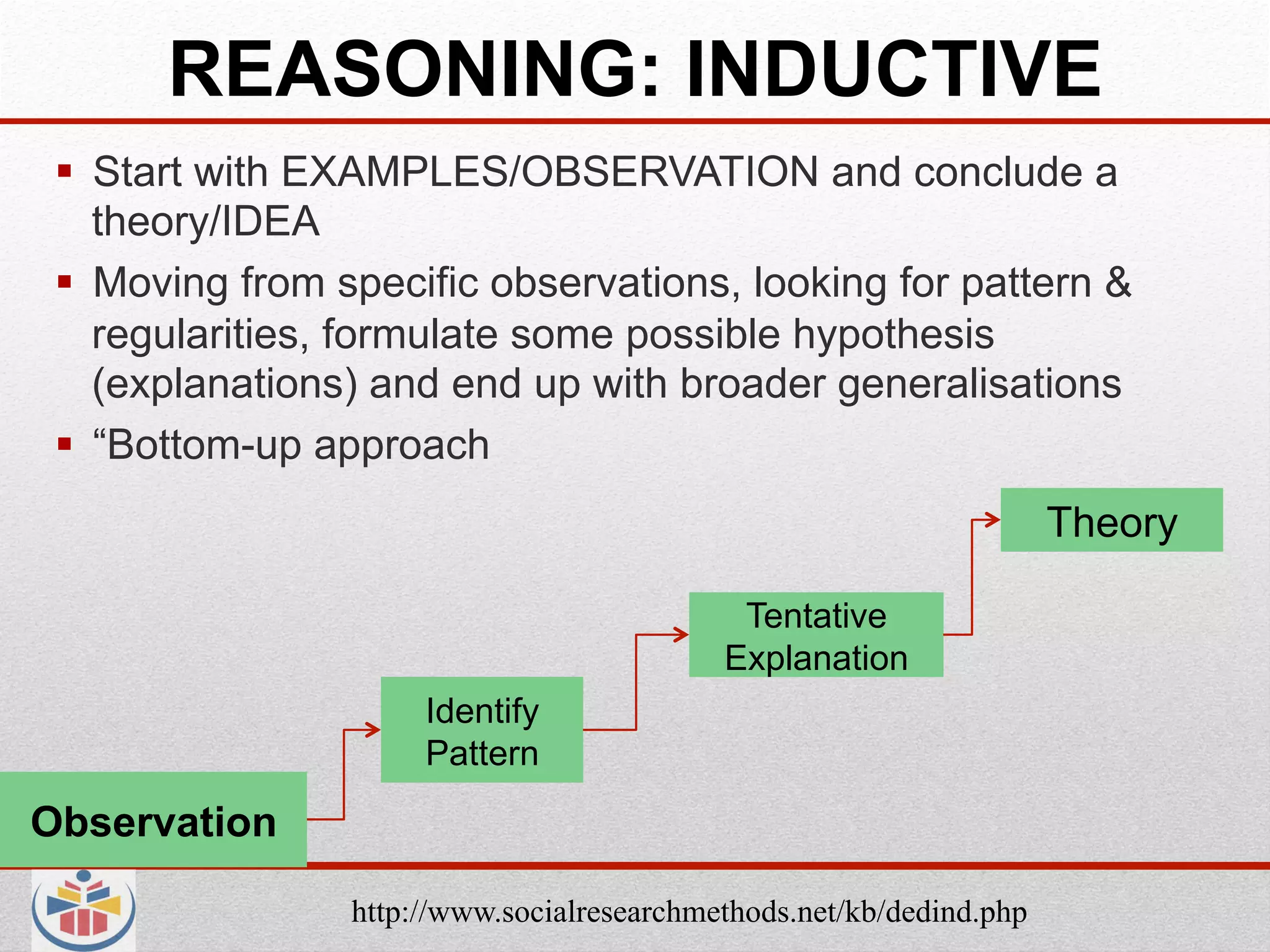
REASONING: INDUCTIVE
   Start with EXAMPLES/OBSERVATION and conclude a
    theory/IDEA
   Moving from specific observations, looking for pattern &
    regularities, formulate some possible hypothesis
    (explanations) and end up with broader generalisations
   “Bottom-up approach
                                                                      Theory

                                             Tentative
                                            Explanation
                      Identify
                      Pattern

Observation

                 http://www.socialresearchmethods.net/kb/dedind.php
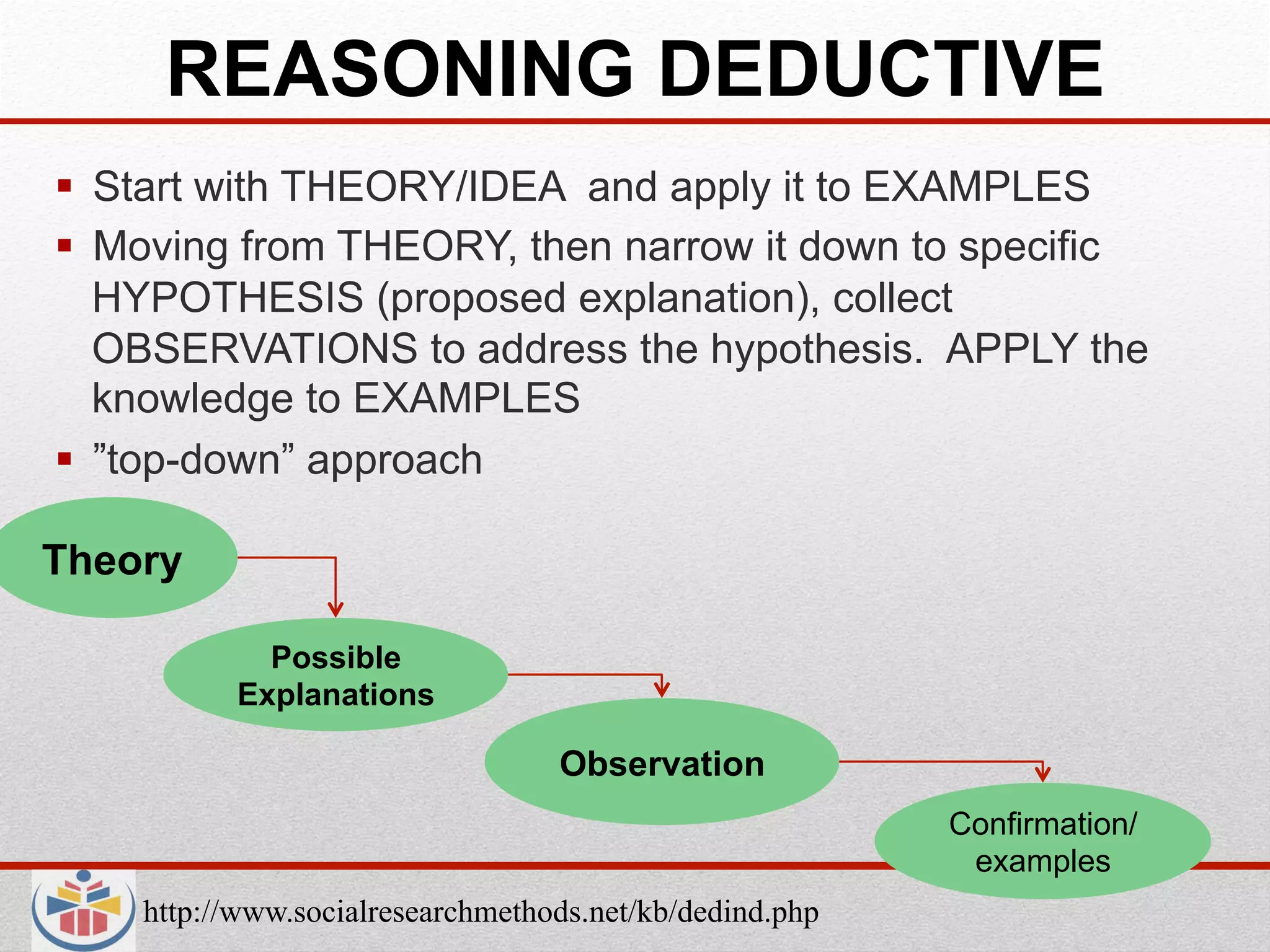
REASONING DEDUCTIVE
  Start with THEORY/IDEA and apply it to EXAMPLES
  Moving from THEORY, then narrow it down to specific
   HYPOTHESIS (proposed explanation), collect
   OBSERVATIONS to address the hypothesis. APPLY the
   knowledge to EXAMPLES
  ”top-down” approach

Theory

            Possible
          Explanations

                                  Observation
                                                         Confirmation/
                                                          examples
    http://www.socialresearchmethods.net/kb/dedind.php
Why does the approach matter?
  Whether you take a scientific (positivistic) or
  phenomenological approach will influence:


  What research questions you ask
  What methods you use to collect your data
  What type of data you collect
  What techniques you use to analyse your data
Methods

 Refers to techniques used in research
  Survey questionnaires
  Interviews
  Observations
  Document reviews
  Experiments
Methodology

 refers to more than a simple set of methods
 refers to the rationale and the philosophical
  assumptions that underlie a particular study.


 Examples
   Quantitative
   Qualitative
   Mixed methods
Research Design
 refers to the blue print that you prepare to conduct
  your research
    It lists the steps that you need to take.
 tells what is to be done at what time.
 tells how the goals of a research project can be
  accomplished.
 Key features of any research design include the
  methodology and methods sampling, data
  collection and analysis, procedures and
  instruments etc.
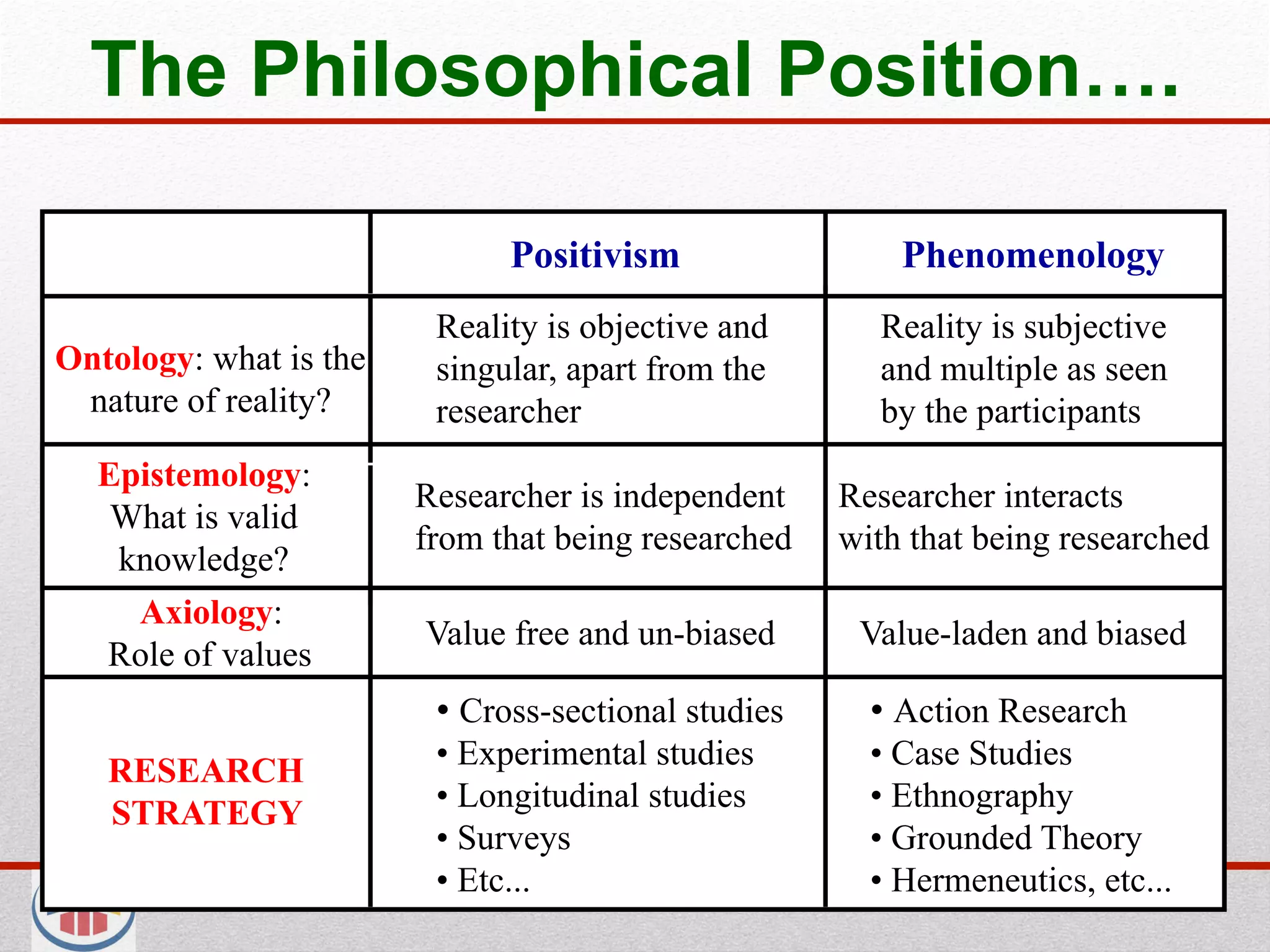
The Philosophical Position….

                              Positivism                  Phenomenology
                         Reality is objective and       Reality is subjective
Ontology: what is the    singular, apart from the       and multiple as seen
 nature of reality?      researcher                     by the participants
  Epistemology:
                        Researcher is independent     Researcher interacts
   What is valid
                        from that being researched    with that being researched
   knowledge?
    Axiology:
                        Value free and un-biased       Value-laden and biased
  Role of values
                         •  Cross-sectional studies     •  Action Research
                         •  Experimental studies        •  Case Studies
   RESEARCH
                         •  Longitudinal studies        •  Ethnography
   STRATEGY
                         •  Surveys                     •  Grounded Theory
                         •  Etc...                      •  Hermeneutics, etc...
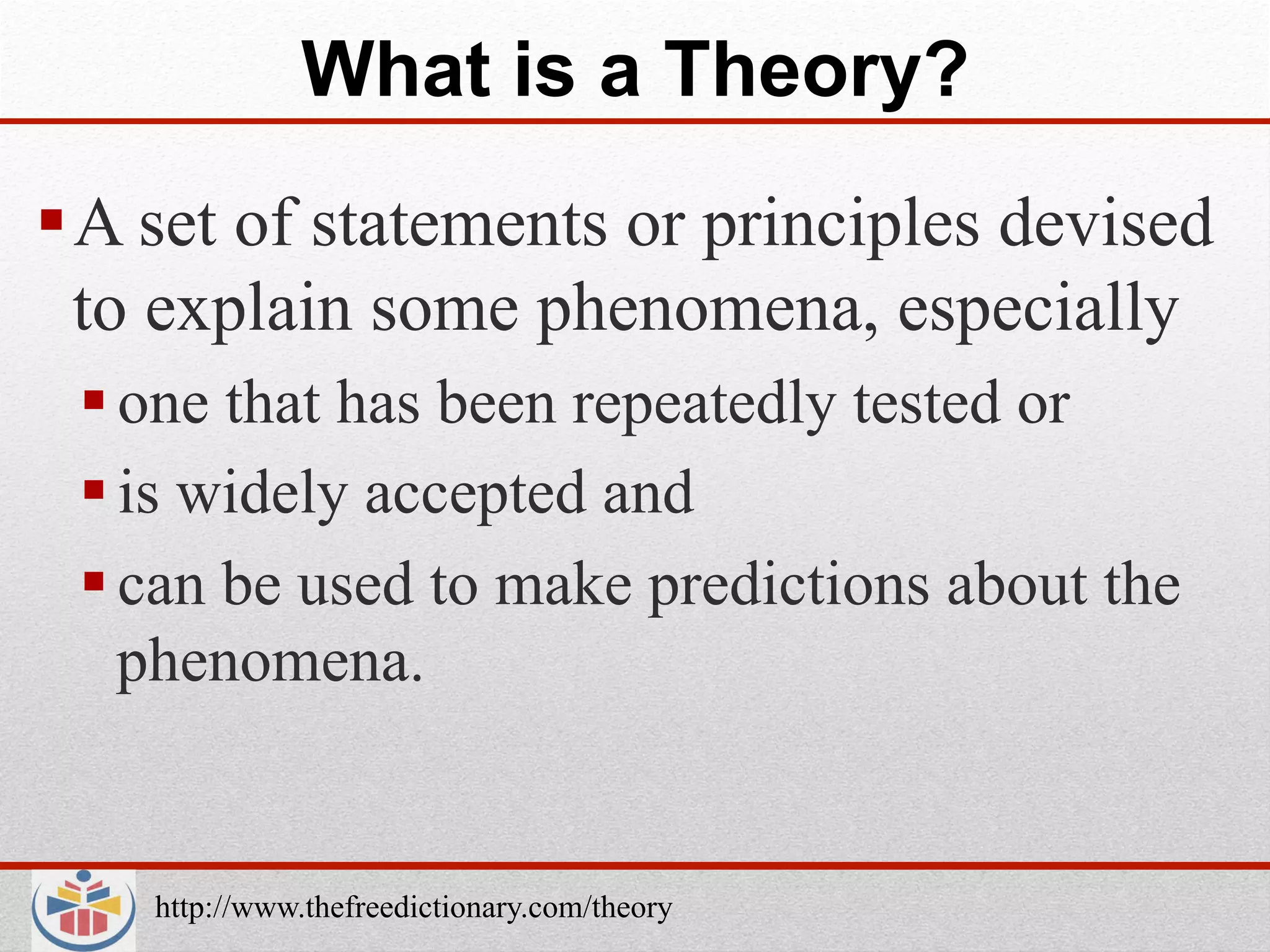
What is a Theory?
 A set of statements or principles devised
  to explain some phenomena, especially
  one that has been repeatedly tested or
  is widely accepted and
  can be used to make predictions about the
   phenomena.


    http://www.thefreedictionary.com/theory

RMD100Q Chapter1 Cohen AK revised

  • 1.
    PARADIGMS OF SOCIAL RESEARCH   Honors RMD 24 March 2012
  • 2.
    Lesson intentions By thisend of this class, you should:  Know the three dominant research paradigms  Differentiate between Positivism and Interpretivism  Differentiate between Inductive and Deductive Reasoning  Know the difference between   Research Paradigm   Research Methodology   Research Methods   Research Design
  • 3.
    Success Criteria You willknow whether you have attained the lesson intentions when you able to:  Name the three dominant paradigms  List the key characteristics of positivism and interpretivism  Be able to apply deductive and inductive reasoning principles to any topic  List different methods and methodologies  Developed the research design for a (your) project
  • 4.
    Research paradigms Broadly speakingthe are two dominant views or paradigms over the nature of knowledge and how it is developed (Epistemology). •  Positivism (scientific method) and •  Interpretivism. Note: They are often in warring camps. Some see these oppositions as false and detrimental to research.
  • 5.
    PARADIGMS OF SOCIALRESEARCH POSITIVIST INTERPRETIVE MIXED METHODS POST-POSITIVIST POST- POST-MODERNIST STRUCTURALIST COMPLEXITY THEORY Cohen et al, 2011
  • 6.
    Positivism  Positivism is aphilosophy states that the only authentic knowledge is scientific knowledge, and that such knowledge can only come from positive affirmation of theories through strict scientific method.
  • 7.
    POSITIVISM   Positivism refersto the school of thought that the only true or valid form of knowledge is that which is scientific .   The principles and methods of the natural sciences (such as chemistry or physics) are used to study human behaviour, which in itself is objective and tangible in nature.   The researcher can observe human behaviour and measure facts , and laws or theories of behaviour can be developed.   Concepts such as feelings, emotions, beliefs and so on have no place in research as they cannot be directly observed or measured, they are unreliable and they are not constant over time.
  • 8.
    POSITIVISM- cont   Positivistsattempt to mirror the methods of the natural and physical scientists.   Through observing reality you can produce laws of the social world which can be generalised from one context to another   Your role is to be an objective analyst, collecting data and interpreting it in a value free way.   You are detached, neither affect nor are affected by the subject of your research.   Emphasise the quantifiable, the observable, and replication (the ability to repeat research)
  • 9.
    Interpretivism  Interpretivism, is away to gain insights through discovering meanings by improving our comprehension of the whole. Qualitative research explores the richness, depth, and complexity of phenomena.
  • 10.
    Interpretivism emphasises -   That the world is too complex to be reduced to a series of law-like generalisations.   the uniqueness of people, and circumstances and the constant nature of change.   details matter - in an attempt to better understand reality.   subjective reality matters.
  • 11.
    Features of researchparadigms Positivistic paradigm Interpretivist paradigm World is external and objective World is socially constructed and subjective Observer is independent Observer is part of what is being observed Science is value free Science is driven by human interests Look for causality Understand what is happening Reduce phenomena to simple elements Look at totality of each situation Focus on facts Focus on meaning Generalises from sample to population Generalises from one setting to another Tends to produce quantitative data Tends to produce qualitative data The location is artificial The location is natural Concerned with hypothesis testing Concerned with generating theories Easterby Smit, et al, 2004
  • 12.
    MIXED METHODS   Approachthe use both methods .   Reject the barriers between positivist and interpretivist approach as article and unhelpful   Argue that the research question determines the most appropriate paradigm, methodology, methods and design
  • 13.
    NUMBERS, MEASUREMENT POSITIVIST METHODS SURVEY, EXPERIMENT ETHNOGRAPHY INTERPRETIVIST INTERVIEW METHODS OBSERVATION CASE STUDY Cohen et al, 2011 ACTION RESEARCH
  • 14.
    NUMBERS, SURVEY MEASUREMENT INTERVIEW CASE STUDY ETHNOGRAPHY META- MIXED ANALYSIS METHODS OBSERVATION HISTORICAL & DOCUMENTARY EXPERIMENT VIRTUAL WORLDS ACTION RESEARCH Cohen et al, 2011
  • 15.
    Positivist and InterpretivistResearch How does all this link to the practice of research in education? Paradigm Research Methodology Your belief system Your research approach  Positivist  Quantitative  Interpretivist  Qualitative
  • 16.
    Positivist research  Research whichcombines a deductive approach with precise measurement of quantitative data to enable the discovery and confirmation of causal laws
  • 17.
    Interpretivist research  Research whichcombines an inductive approach with communication and observation of qualitative data to discover the reasons for events.
  • 18.
  • 19.
    Deductive vs Inductive  Deductive- begins with an abstract idea and principle and works toward the concrete details to test these ideas.   Theory Testing  Inductive - begins with concrete details and then works toward abstract ideas or general principles or laws.   Theory Building
  • 20.
    REASONING: INDUCTIVE  Start with EXAMPLES/OBSERVATION and conclude a theory/IDEA   Moving from specific observations, looking for pattern & regularities, formulate some possible hypothesis (explanations) and end up with broader generalisations   “Bottom-up approach Theory Tentative Explanation Identify Pattern Observation http://www.socialresearchmethods.net/kb/dedind.php
  • 21.
    REASONING DEDUCTIVE   Startwith THEORY/IDEA and apply it to EXAMPLES   Moving from THEORY, then narrow it down to specific HYPOTHESIS (proposed explanation), collect OBSERVATIONS to address the hypothesis. APPLY the knowledge to EXAMPLES   ”top-down” approach Theory Possible Explanations Observation Confirmation/ examples http://www.socialresearchmethods.net/kb/dedind.php
  • 22.
    Why does theapproach matter? Whether you take a scientific (positivistic) or phenomenological approach will influence:   What research questions you ask   What methods you use to collect your data   What type of data you collect   What techniques you use to analyse your data
  • 23.
    Methods  Refers to techniquesused in research  Survey questionnaires  Interviews  Observations  Document reviews  Experiments
  • 24.
    Methodology  refers to morethan a simple set of methods  refers to the rationale and the philosophical assumptions that underlie a particular study.  Examples  Quantitative  Qualitative  Mixed methods
  • 25.
    Research Design  refers tothe blue print that you prepare to conduct your research   It lists the steps that you need to take.  tells what is to be done at what time.  tells how the goals of a research project can be accomplished.  Key features of any research design include the methodology and methods sampling, data collection and analysis, procedures and instruments etc.
  • 26.
    The Philosophical Position…. Positivism Phenomenology Reality is objective and Reality is subjective Ontology: what is the singular, apart from the and multiple as seen nature of reality? researcher by the participants Epistemology: Researcher is independent Researcher interacts What is valid from that being researched with that being researched knowledge? Axiology: Value free and un-biased Value-laden and biased Role of values •  Cross-sectional studies •  Action Research •  Experimental studies •  Case Studies RESEARCH •  Longitudinal studies •  Ethnography STRATEGY •  Surveys •  Grounded Theory •  Etc... •  Hermeneutics, etc...
  • 27.
    What is aTheory?  A set of statements or principles devised to explain some phenomena, especially  one that has been repeatedly tested or  is widely accepted and  can be used to make predictions about the phenomena. http://www.thefreedictionary.com/theory