


Presented By โ€“ ULFAT AMIN
M.Sc.(N) 1st YEAR
๏‚–
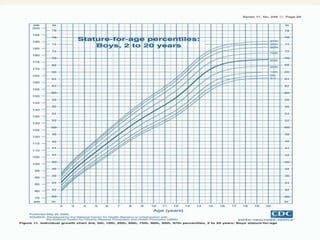
๏‚™ Failure to thrive (FTT) is a chronic, potentially life threatening disorder of
infants and children who fail to gain and may even lose weight. Children
are considered as failing to thrive when their rate of growth does not meet
the expected growth rate for a child of their age. More specifically, the
term characterized those whose weight is below the 3rd percentile on an
appropriate growth chart.
Introduction
๏‚–
๏‚–
๏‚™ The deviation from a normal growth channel is actually more descriptive
of what is happening to an individual than a decrease in the actual
amount of weight. Any infant or child at the fifth percentile should alert
the caregiver that a problem exists. If the condition progresses, the
undernourished child may become irritable and/or apathetic and may not
reach typical developmental markers such as sitting up, walking, and
talking at the usual ages.
๏‚–
๏‚™ FTT is a term used to describe inadequate growth or the
inability to maintain growth in childhood.
๏‚™ Attained growth
โ€ข Weight<3rd percentile on standard growth chart.
โ€ข Weight for height<5th percentile on standard growth chart.
โ€ข Weight 20% or more below ideal weight for height.
๏‚™ Rate of growth
โ€ข Less than 20g/day from birth to 3 months of age.
โ€ข Less than 15g/day from 3 months to 6 months of age.
โ€ข Fall off from previously established growth curve.
โ€ข Downward crossing of >2 major percentiles.
Definition
๏‚–
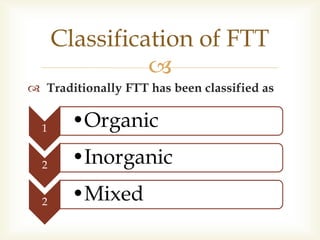
๏‚™ Traditionally FTT has been classified as
Classification of FTT
1 โ€ขOrganic
2 โ€ขInorganic
2 โ€ขMixed
๏‚–
Occurs when there is underlying medical cause
like:
๏‚™ Premature birth.
๏‚™ Maternal smoking, alcohol use or illicit drugs during
pregnancy.
๏‚™ Mechanical problems present.
๏‚™ Unexplained poor appetites that are unrelated to mechanical
problems.
๏‚™ Inadequate intake also can result from metabolic
abnormalities.
๏‚™ Poor absorption of food, inability of the body to use
absorbed nutrients or increased loss of nutrients.
Organic
๏‚–
Due to causes other than medical cause.
๏‚™ Poor feeding skills on the part of the parent
๏‚™ Dysfunctional family interactions
๏‚™ Difficult parent-child interactions
๏‚™ Lack of social support
๏‚™ Lack of parenting preparation
๏‚™ Family dysfunction, such as abuse or divorce
๏‚™ Child neglect
๏‚™ Emotional deprivation
Inorganic
๏‚–
๏‚™Has both organic and inorganic causes
and canโ€™t be described alone.
Mixed
๏‚–
1 โ€ขInadequate caloric intake
2 โ€ขInadequate absorption
3 โ€ขIncreased caloric requirement
4 โ€ขExcessive loss of calories
5
โ€ขAltered growth potential or regulation.
CAUSES OF FTT
๏‚–๏‚™ Incorrect formula preparation
๏‚™ Neglect
๏‚™ Excessive juice consumption
๏‚™ Poverty
๏‚™ Behavioral problem affecting eating
๏‚™ Non-availability of food
๏‚™ Misperceptions about diet and feeding practices
๏‚™ Errors in formula reconstitution
1.Inadequate caloric intake
๏‚–
๏‚™ Dysfunctional parent-child interaction, child abuse
and neglect
๏‚™ Behavioral feeding problem
๏‚™ Mechanical problems with sucking, swallowing
and feeding
๏‚™ Primary neurological diseases
๏‚™ Chronic systemic disease resulting in anorexia, food
refusal and neurological problems
Continueโ€ฆ
๏‚–
๏‚™Cystic fibrosis
๏‚™Celiac disease
๏‚™Vitamin deficiencies
๏‚™Hepatic diseases.
2. Inadequate absorption
๏‚–
๏‚™ Hyperthyroidism
๏‚™ Congenital heart disease
๏‚™ Chronic immunodeficiency
๏‚™ Chronic respiratory disease
๏‚™ Neoplasm
๏‚™ Chronic or recurrent infection
3.Increased caloric requirement
๏‚–
๏‚™ Persistent vomiting
๏‚™ Gastro esophageal reflux disease
๏‚™ Gastrointestinal obstruction
๏‚™ Increased intracranial pressure
๏‚™ Renal lossesโ€”renal tubular acidosis
๏‚™ Diabetes mellitus
๏‚™ Inborn errors of metabolism
4. Excessive loss of calories
๏‚–
๏‚™ Chromosomal abnormalities
๏‚™ Endocrinopathies
5.Altered growth potential or
regulation
๏‚–
๏‚™ Height, weight, and head circumference do not match
standard growth charts
๏‚™ Weight is lower than 3rd percentile
๏‚™ Growth may have slowed or stopped after a previously
established growth curve
๏‚™ Physical skills such as rolling over, sitting, standing and
walking decreased
๏‚™ Mental and social skills decreased
๏‚™ Secondary sexual characteristics delayed in adolescents.
CLINICAL FEATURES
Cont.โ€ฆ.
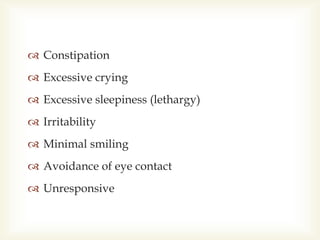
๏‚™ Constipation
๏‚™ Excessive crying
๏‚™ Excessive sleepiness (lethargy)
๏‚™ Irritability
๏‚™ Minimal smiling
๏‚™ Avoidance of eye contact
๏‚™ Unresponsive
๏‚–
History taking
Examination and Tests
DIAGNOSTIC EVALUATION
๏‚–
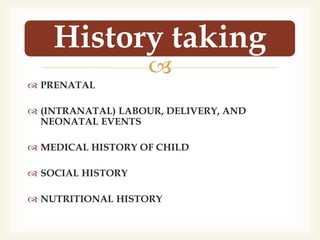
๏‚™ PRENATAL
๏‚™ (INTRANATAL) LABOUR, DELIVERY, AND
NEONATAL EVENTS
๏‚™ MEDICAL HISTORY OF CHILD
๏‚™ SOCIAL HISTORY
๏‚™ NUTRITIONAL HISTORY
History taking
๏‚–
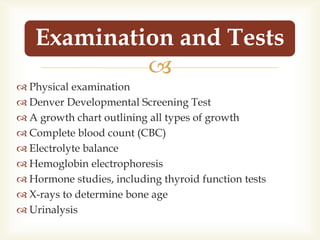
๏‚™ Physical examination
๏‚™ Denver Developmental Screening Test
๏‚™ A growth chart outlining all types of growth
๏‚™ Complete blood count (CBC)
๏‚™ Electrolyte balance
๏‚™ Hemoglobin electrophoresis
๏‚™ Hormone studies, including thyroid function tests
๏‚™ X-rays to determine bone age
๏‚™ Urinalysis
Examination and Tests
๏‚–
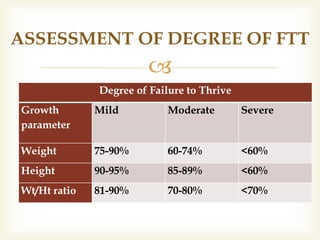
Degree of Failure to Thrive
Growth
parameter
Mild Moderate Severe
Weight 75-90% 60-74% <60%
Height 90-95% 85-89% <60%
Wt/Ht ratio 81-90% 70-80% <70%
ASSESSMENT OF DEGREE OF FTT
๏‚–
๏‚™ Children with FTT require 50% of Recommended Dietary
Allowance (RDA) of calories for catch up growth.
๏‚™ Correction of any underlying disease
๏‚™ Improvement in care-giver skills.
๏‚™ Regular and effective follow up
๏‚™ Treatment may also involve improving the family relationships
and living conditions.
MANAGEMENT
Cont.โ€ฆ.
๏‚™ Feeding interval should not be greater than 4 hours & a
maximum time allowed for sucking should be 20 minutes.
๏‚™ Eliminating distractive events
๏‚™ Avoiding excessive fruit juices
๏‚™ For older & young children meals should be last for 30
minutes, solid foods should be offered before liquid,
environmental distraction should be minimized.
๏‚–
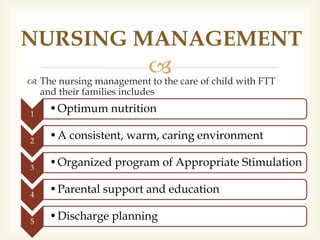
NURSING MANAGEMENT
๏‚™ The nursing management to the care of child with FTT
and their families includes
1
โ€ขOptimum nutrition
2
โ€ขA consistent, warm, caring environment
3
โ€ขOrganized program of Appropriate Stimulation
4
โ€ขParental support and education
5
โ€ขDischarge planning
๏‚–
๏‚™ Normal growth and development may be affected
if a child fails to thrive for a long time. Normal
growth and development may continue if the child
has failed to thrive for a short time and the cause is
determined and treated.
PROGNOSIS
๏‚–
Permanent mental
Emotional
Physical delays can occur.
POSSIBLE COMPLICATIONS
๏‚–๏‚™ Initial failure to thrive caused by physical defects
cannot be prevented but can often be corrected
before they become a danger to the child.
Maternal education, emotional and economic
support systems all help to prevent FTT in those
cases where there is no physical deformity.
PREVENTION
๏‚–
๏‚™ Failure to thrive is a descriptive term, not a specific
diagnosis. FTT is result of inadequate usable calories
necessary for a childโ€™s metabolic and growth demands.
Simplified approach to FTT by detailed history, thorough
Physical Examination with primary care giver, initial
investigation includes CBC, ESR, urinalysis, urine culture,
stool for ova and cyst of parasites. Trail of nutritional therapy
with calorie-dense diet.
CONCLUSION
๏‚–๏‚™ Dorothy R. Marlow, Textbook of Pediatric nursing, Saunders
publisher, 6th edition, page no. 677-684
๏‚™ Marilyn J Hockenberry, Essential of pediatric nursing, Mosby
publisher, 8th edition, page no.396-400
๏‚™ IAP Textbook of pediatrics, 5th addition, page no.113
๏‚™ http://www.healthofchildren.com/E-F/Failure-to-Thrive.html
๏‚™ http://www.modernmedicalguide.com/failure-to-thrive/
๏‚™ http://www.slideshare.net/Singaram_Paed/approach-to-a-child-
with-failure-to-thrive
BIBLIOGRAPHY
Failure to thrive
Failure to thrive

Failure to thrive

  • 1.
    Presented By โ€“ULFAT AMIN M.Sc.(N) 1st YEAR
  • 2.
    ๏‚– ๏‚™ Failure tothrive (FTT) is a chronic, potentially life threatening disorder of infants and children who fail to gain and may even lose weight. Children are considered as failing to thrive when their rate of growth does not meet the expected growth rate for a child of their age. More specifically, the term characterized those whose weight is below the 3rd percentile on an appropriate growth chart. Introduction
  • 3.
  • 4.
    ๏‚– ๏‚™ The deviationfrom a normal growth channel is actually more descriptive of what is happening to an individual than a decrease in the actual amount of weight. Any infant or child at the fifth percentile should alert the caregiver that a problem exists. If the condition progresses, the undernourished child may become irritable and/or apathetic and may not reach typical developmental markers such as sitting up, walking, and talking at the usual ages.
  • 5.
    ๏‚– ๏‚™ FTT isa term used to describe inadequate growth or the inability to maintain growth in childhood. ๏‚™ Attained growth โ€ข Weight<3rd percentile on standard growth chart. โ€ข Weight for height<5th percentile on standard growth chart. โ€ข Weight 20% or more below ideal weight for height. ๏‚™ Rate of growth โ€ข Less than 20g/day from birth to 3 months of age. โ€ข Less than 15g/day from 3 months to 6 months of age. โ€ข Fall off from previously established growth curve. โ€ข Downward crossing of >2 major percentiles. Definition
  • 6.
    ๏‚– ๏‚™ Traditionally FTThas been classified as Classification of FTT 1 โ€ขOrganic 2 โ€ขInorganic 2 โ€ขMixed
  • 7.
    ๏‚– Occurs when thereis underlying medical cause like: ๏‚™ Premature birth. ๏‚™ Maternal smoking, alcohol use or illicit drugs during pregnancy. ๏‚™ Mechanical problems present. ๏‚™ Unexplained poor appetites that are unrelated to mechanical problems. ๏‚™ Inadequate intake also can result from metabolic abnormalities. ๏‚™ Poor absorption of food, inability of the body to use absorbed nutrients or increased loss of nutrients. Organic
  • 8.
    ๏‚– Due to causesother than medical cause. ๏‚™ Poor feeding skills on the part of the parent ๏‚™ Dysfunctional family interactions ๏‚™ Difficult parent-child interactions ๏‚™ Lack of social support ๏‚™ Lack of parenting preparation ๏‚™ Family dysfunction, such as abuse or divorce ๏‚™ Child neglect ๏‚™ Emotional deprivation Inorganic
  • 9.
    ๏‚– ๏‚™Has both organicand inorganic causes and canโ€™t be described alone. Mixed
  • 10.
    ๏‚– 1 โ€ขInadequate caloricintake 2 โ€ขInadequate absorption 3 โ€ขIncreased caloric requirement 4 โ€ขExcessive loss of calories 5 โ€ขAltered growth potential or regulation. CAUSES OF FTT
  • 11.
    ๏‚–๏‚™ Incorrect formulapreparation ๏‚™ Neglect ๏‚™ Excessive juice consumption ๏‚™ Poverty ๏‚™ Behavioral problem affecting eating ๏‚™ Non-availability of food ๏‚™ Misperceptions about diet and feeding practices ๏‚™ Errors in formula reconstitution 1.Inadequate caloric intake
  • 12.
    ๏‚– ๏‚™ Dysfunctional parent-childinteraction, child abuse and neglect ๏‚™ Behavioral feeding problem ๏‚™ Mechanical problems with sucking, swallowing and feeding ๏‚™ Primary neurological diseases ๏‚™ Chronic systemic disease resulting in anorexia, food refusal and neurological problems Continueโ€ฆ
  • 13.
    ๏‚– ๏‚™Cystic fibrosis ๏‚™Celiac disease ๏‚™Vitamindeficiencies ๏‚™Hepatic diseases. 2. Inadequate absorption
  • 14.
    ๏‚– ๏‚™ Hyperthyroidism ๏‚™ Congenitalheart disease ๏‚™ Chronic immunodeficiency ๏‚™ Chronic respiratory disease ๏‚™ Neoplasm ๏‚™ Chronic or recurrent infection 3.Increased caloric requirement
  • 15.
    ๏‚– ๏‚™ Persistent vomiting ๏‚™Gastro esophageal reflux disease ๏‚™ Gastrointestinal obstruction ๏‚™ Increased intracranial pressure ๏‚™ Renal lossesโ€”renal tubular acidosis ๏‚™ Diabetes mellitus ๏‚™ Inborn errors of metabolism 4. Excessive loss of calories
  • 16.
    ๏‚– ๏‚™ Chromosomal abnormalities ๏‚™Endocrinopathies 5.Altered growth potential or regulation
  • 17.
    ๏‚– ๏‚™ Height, weight,and head circumference do not match standard growth charts ๏‚™ Weight is lower than 3rd percentile ๏‚™ Growth may have slowed or stopped after a previously established growth curve ๏‚™ Physical skills such as rolling over, sitting, standing and walking decreased ๏‚™ Mental and social skills decreased ๏‚™ Secondary sexual characteristics delayed in adolescents. CLINICAL FEATURES Cont.โ€ฆ.
  • 18.
    ๏‚™ Constipation ๏‚™ Excessivecrying ๏‚™ Excessive sleepiness (lethargy) ๏‚™ Irritability ๏‚™ Minimal smiling ๏‚™ Avoidance of eye contact ๏‚™ Unresponsive
  • 19.
    ๏‚– History taking Examination andTests DIAGNOSTIC EVALUATION
  • 20.
    ๏‚– ๏‚™ PRENATAL ๏‚™ (INTRANATAL)LABOUR, DELIVERY, AND NEONATAL EVENTS ๏‚™ MEDICAL HISTORY OF CHILD ๏‚™ SOCIAL HISTORY ๏‚™ NUTRITIONAL HISTORY History taking
  • 21.
    ๏‚– ๏‚™ Physical examination ๏‚™Denver Developmental Screening Test ๏‚™ A growth chart outlining all types of growth ๏‚™ Complete blood count (CBC) ๏‚™ Electrolyte balance ๏‚™ Hemoglobin electrophoresis ๏‚™ Hormone studies, including thyroid function tests ๏‚™ X-rays to determine bone age ๏‚™ Urinalysis Examination and Tests
  • 22.
    ๏‚– Degree of Failureto Thrive Growth parameter Mild Moderate Severe Weight 75-90% 60-74% <60% Height 90-95% 85-89% <60% Wt/Ht ratio 81-90% 70-80% <70% ASSESSMENT OF DEGREE OF FTT
  • 23.
    ๏‚– ๏‚™ Children withFTT require 50% of Recommended Dietary Allowance (RDA) of calories for catch up growth. ๏‚™ Correction of any underlying disease ๏‚™ Improvement in care-giver skills. ๏‚™ Regular and effective follow up ๏‚™ Treatment may also involve improving the family relationships and living conditions. MANAGEMENT Cont.โ€ฆ.
  • 24.
    ๏‚™ Feeding intervalshould not be greater than 4 hours & a maximum time allowed for sucking should be 20 minutes. ๏‚™ Eliminating distractive events ๏‚™ Avoiding excessive fruit juices ๏‚™ For older & young children meals should be last for 30 minutes, solid foods should be offered before liquid, environmental distraction should be minimized.
  • 25.
    ๏‚– NURSING MANAGEMENT ๏‚™ Thenursing management to the care of child with FTT and their families includes 1 โ€ขOptimum nutrition 2 โ€ขA consistent, warm, caring environment 3 โ€ขOrganized program of Appropriate Stimulation 4 โ€ขParental support and education 5 โ€ขDischarge planning
  • 26.
    ๏‚– ๏‚™ Normal growthand development may be affected if a child fails to thrive for a long time. Normal growth and development may continue if the child has failed to thrive for a short time and the cause is determined and treated. PROGNOSIS
  • 27.
    ๏‚– Permanent mental Emotional Physical delayscan occur. POSSIBLE COMPLICATIONS
  • 28.
    ๏‚–๏‚™ Initial failureto thrive caused by physical defects cannot be prevented but can often be corrected before they become a danger to the child. Maternal education, emotional and economic support systems all help to prevent FTT in those cases where there is no physical deformity. PREVENTION
  • 29.
    ๏‚– ๏‚™ Failure tothrive is a descriptive term, not a specific diagnosis. FTT is result of inadequate usable calories necessary for a childโ€™s metabolic and growth demands. Simplified approach to FTT by detailed history, thorough Physical Examination with primary care giver, initial investigation includes CBC, ESR, urinalysis, urine culture, stool for ova and cyst of parasites. Trail of nutritional therapy with calorie-dense diet. CONCLUSION
  • 30.
    ๏‚–๏‚™ Dorothy R.Marlow, Textbook of Pediatric nursing, Saunders publisher, 6th edition, page no. 677-684 ๏‚™ Marilyn J Hockenberry, Essential of pediatric nursing, Mosby publisher, 8th edition, page no.396-400 ๏‚™ IAP Textbook of pediatrics, 5th addition, page no.113 ๏‚™ http://www.healthofchildren.com/E-F/Failure-to-Thrive.html ๏‚™ http://www.modernmedicalguide.com/failure-to-thrive/ ๏‚™ http://www.slideshare.net/Singaram_Paed/approach-to-a-child- with-failure-to-thrive BIBLIOGRAPHY