HYDROCEPHALUS
INTRODUCTION
Hydrocephalus, also known years ago as “water
on the brain”, is a condition where the circulation
system of the body’s cerebrospinal fluid (CSF) is
not functioning properly. The CSF accumulates in
the brain and causes intracranial pressure. A shunt
is usually placed to equalize the flow of CSF, which
requires surgery. The diagnosis and surgery can
be very frightening for the parents as well as the
child
DEFINITION
Hydrocephalus is a condition characterized by an
excess of cerebrospinal fluid (CSF) within the
ventricular and subarachnoid spaces of the cranial
cavity.
INCIDENCE
It is found in 1-3 of every 1000 born children in
world wide
Classification
1. Non communicating. In the non communicating
type of congenital hydrocephalus, an obstruction
occurs in the free circulation of CSF.
2. Communicating. In the communicating type of
hydrocephalus, no obstruction of the free flow of
the CSF exists between the ventricles and the
spinal theca; rather, the condition is caused by
defective absorption of CSF, thus causing increased
pressure on the brain or spinal cord.
CAUSES
Obstruction. The most common problem is a partial
obstruction of the normal flow of CSF, either from one
ventricle to another or from the ventricles to other
spaces around the brain.
Poor absorption. Less common is a problem with the
mechanisms that enable the blood vessels to absorb
CSF; this is often related to inflammation of brain tissues
from disease or injury.
Overproduction. Rarely, the mechanisms for producing
CSF create more than normal and more quickly than it
can be absorbed.
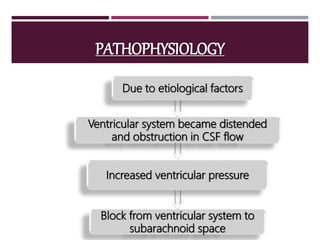
PATHOPHYSIOLOGY
Due to etiological factors
Ventricular system became distended
and obstruction in CSF flow
Increased ventricular pressure
Block from ventricular system to
subarachnoid space
CONTI…
CSF absorption will not occur
Excess Collection of CSF
Hydrocephalus
CLINICAL MANIFESTATION
Poor feeding. The infant with hydrocephalus has trouble in
feeding due to the difficulty of his condition.
Large head. An excessively large head at birth is suggestive of
hydrocephalus.
Bulging of the anterior fontanelles. The anterior fontanelle
becomes tense and bulging, the skull enlarges in all diameters,
and the scalp becomes shiny and its veins dilate.
Setting sun sign. If pressure continues to increase without
intervention, the eyes appear to be pushed downward slightly
with the sclera visible above the iris- the so-called setting sun
sign.
CONTI…
High-pitched cry. The intracranial pressure may increase
and the infant’s cry could become high-pitched.
Irritability. Irritability is also caused by an increase in the
intracranial pressure.
Projectile vomiting. An increase in the intracranial
pressure can cause projectile vomiting
ASSESSMENT AND DIAGNOSTIC FINDINGS
Computed tomography (CT) scanning. CT scan is used to
assess the size of ventricles and other structures.
Magnetic resonance imaging (MRI). MRI is used to assess for
Chiari malformation or cerebellar or periaqueductal tumors.
Ultrasonography through anterior fontanelle in infants. This
study assesses for subependymal and intraventricular
hemorrhage; to follow infants for possible progressive
hydrocephalus.
Skull radiography. To detect erosion of sella turcica, or “beaten
copper cranium” (or “beaten silver cranium”)—the latter can
also be seen in craniosynostosis; (after shunt insertion) to
confirm correct positioning of installed hardware.
CONTI…
MRI cine. To measure CSF stroke volume (SV) in the cerebral
aqueduct; however, such measurements don’t appear to be
useful in predicting response to shunting.
Diffusion tensor imaging (DTI). To detect differences in
fractional anisotropy and mean diffusivity of the brain
parenchyma surrounding the ventricles; allows recognition of
microstructural changes in periventricular white matter region
that may be too subtle on conventional MRI.
Radionuclide cisternography (in NPH). To assess the prognosis
with regard to possible shunting—however, due to its poor
sensitivity in predicting shunt response when the ventricular to
total intracranial activity (V/T) ratio is less than 32%, this test is
no longer commonly used
MANAGEMENT
GOAL
 The goal of treatment in clients with hydrocephalus is to
reduce or prevent brain damage by improving the flow
of CSF which may include surgery to provide shunting
for drainage of the excess fluid from the ventricles to an
extracranial space such as the peritoneum or
right atrium (in older children) or management with
medications to reduce ICP if progression is slow or
surgery is contraindicated.
PHARMACOLOGICAL MANAGEMENT
 Diuretics. Acetazolamide (ACZ) and furosemide (FUR)
treat posthemorrhagic hydrocephalus in neonates; both
are diuretics that also appear to decrease secretion of
CSF at the level of the choroid plexus.
 Anticonvulsants Helps to interfere impulse transmission
of cerebral cortex and prevent seizures.
 Antibiotics Culture and sensitivity dependent for shunt
infections such as septicemia, ventriculitis, meningitis, or
given as a prophylactic treatment.
NON PHARMACOLOGICAL MANAGEMENT
1. Provide calm and quite environment
2. Prevent the child from nosocomial infection
3. Position the body with neck adequately supporter
4. Keep the infant clean and dry
SURGICAL MANAGEMENT
 Surgery. Surgical treatment is the preferred therapeutic option in patients
with hydrocephalus.
 Ventriculoperitoneal (VP) shunt. A ventriculoperitoneal (VP) shunt is a
medical device that relieves pressure on the brain caused by fluid
accumulation.
 Ventriculoatrial (VA) shunt. Ventriculoatrial shunt placement enables
cerebrospinal fluid (CSF) to flow from the cerebral ventricular system to the
atrium of the heart.
 Lumboperitoneal shunt. Only used for communicating hydrocephalus, CSF
fistula, or pseudotumor cerebri).
 Torkildsen shunt (rarely). Effective only in acquired obstructive hydrocephalus.
 Ventriculopleural shunt (second-line therapy). Used if other shunt types
contraindicated.
NURSING MANAGEMENT
Nursing Assessment
o Accurate information is essential in the assessment of the child with
hydrocephalus.
o Head circumference. Measurement of the newborn‘s head is essential.
o Neurologic and vital signs. Obtaining accurate vital and neurologic signs is
necessary before and after surgery.
o Check the fontanelles. If the fontanelles are not closed, carefully observe
them for any signs of bulging.
o Monitor increase in intracranial pressure. Observe, report, and document all
signs of IICP.
o History taking. If the child has returned for revision of an existing shunt,
obtain a complete history before surgery from the family caregiver to
provide a baseline of the child’s behavior.
Nursing Diagnoses
1. Risk for Injury related to increased ICP.
2. Risk for Impaired Skin Integrity related to pressure from
physical immobility.
3. Risk for Infection related to the presence of a shunt.
4. Risk for Delayed Growth and Development related to
impaired ability to achieve developmental tasks.
5. Anxiety related to the family caregiver’s fear of the surgical
outcome.
6. Deficient Knowledge related to the family’s understanding of
the child’s condition and home care
Nursing Interventions
Nursing interventions for the newborn with hydrocephalus include:
 Preventing injury. At least every 2 to 4 hours, monitor the newborn’s level of
consciousness; check the pupils for equality and reaction; monitor the
neurologic status, and observe for a shrill cry, lethargy, or irritability;
measure and record the head circumference daily, and keep suction and
oxygen equipment convenient at the bedside.
 Promoting skin integrity. After a shunting procedure, keep the newborn’s
head turned away from the operative site until the physician allows a
change in position; reposition the newborn at least every 2 hours, as
permitted; inspect the dressings over the shunt site immediately after the
surgery, every hour for the first 3 to 4 hours, and then at least every 4
hours.
 Preventing infection. Closely observe for and promptly report any signs of
infection; perform wound care thoroughly as ordered, and administer
antibiotics as prescribed.
 Promoting growth and development. The newborn needs social interaction
and needs to be talked to, played with, and given the opportunity for
activity; and provide toys appropriate for his mental and physical capacity.
 Reducing family anxiety. Explain to the family the condition and the
anatomy of the surgical procedure in terms they can understand; encourage
them to express their anxieties and ask questions; and give accurate,
nontechnical answers that are easy to understand.
 Providing family teaching. Demonstrate care of the shunt to the family
caregivers and have them perform a return demonstration; provide them
with a list of signs and symptoms that should be reported, and discuss
appropriate growth and development expectations for the child, and stress
realistic goals.
Evaluation
Goals met are evidenced by:
Prevention of injury.
Maintenance of skin integrity.
Prevention of infection.
Maintenance of growth and development.
Reduction of family anxiety
DOCUMENTATION GUIDELINES
Documentation for a patient with hydrocephalus includes:
Individual risk factors including recent or current antibiotic
therapy.
Insertion sites, character of drainage.
Signs and symptoms of infectious process.
Plan of care.
Teaching plan.
Responses to interventions, teaching, and actions performed.
Attainment or progress towards desired outcomes.
Modifications to plan of care.
Discharge needs
COMPLICATION
o Seizures
o Herniation of brain
o Persistent increased Intracranial pressure
o Infection
o Neurological deficit
o Visual problem
o Aggressive behaviour
o Developmental delay
CONCLUSION
Hydrocephalus occurs with such condition either like
trauma, infection, congenital malformations and
haemorrhage
Hydrocephalus

Hydrocephalus

  • 1.
  • 2.
    INTRODUCTION Hydrocephalus, also knownyears ago as “water on the brain”, is a condition where the circulation system of the body’s cerebrospinal fluid (CSF) is not functioning properly. The CSF accumulates in the brain and causes intracranial pressure. A shunt is usually placed to equalize the flow of CSF, which requires surgery. The diagnosis and surgery can be very frightening for the parents as well as the child
  • 3.
    DEFINITION Hydrocephalus is acondition characterized by an excess of cerebrospinal fluid (CSF) within the ventricular and subarachnoid spaces of the cranial cavity.
  • 4.
    INCIDENCE It is foundin 1-3 of every 1000 born children in world wide
  • 5.
  • 6.
    1. Non communicating.In the non communicating type of congenital hydrocephalus, an obstruction occurs in the free circulation of CSF. 2. Communicating. In the communicating type of hydrocephalus, no obstruction of the free flow of the CSF exists between the ventricles and the spinal theca; rather, the condition is caused by defective absorption of CSF, thus causing increased pressure on the brain or spinal cord.
  • 7.
    CAUSES Obstruction. The mostcommon problem is a partial obstruction of the normal flow of CSF, either from one ventricle to another or from the ventricles to other spaces around the brain. Poor absorption. Less common is a problem with the mechanisms that enable the blood vessels to absorb CSF; this is often related to inflammation of brain tissues from disease or injury. Overproduction. Rarely, the mechanisms for producing CSF create more than normal and more quickly than it can be absorbed.
  • 8.
    PATHOPHYSIOLOGY Due to etiologicalfactors Ventricular system became distended and obstruction in CSF flow Increased ventricular pressure Block from ventricular system to subarachnoid space
  • 9.
    CONTI… CSF absorption willnot occur Excess Collection of CSF Hydrocephalus
  • 10.
    CLINICAL MANIFESTATION Poor feeding.The infant with hydrocephalus has trouble in feeding due to the difficulty of his condition. Large head. An excessively large head at birth is suggestive of hydrocephalus. Bulging of the anterior fontanelles. The anterior fontanelle becomes tense and bulging, the skull enlarges in all diameters, and the scalp becomes shiny and its veins dilate. Setting sun sign. If pressure continues to increase without intervention, the eyes appear to be pushed downward slightly with the sclera visible above the iris- the so-called setting sun sign.
  • 11.
    CONTI… High-pitched cry. Theintracranial pressure may increase and the infant’s cry could become high-pitched. Irritability. Irritability is also caused by an increase in the intracranial pressure. Projectile vomiting. An increase in the intracranial pressure can cause projectile vomiting
  • 12.
    ASSESSMENT AND DIAGNOSTICFINDINGS Computed tomography (CT) scanning. CT scan is used to assess the size of ventricles and other structures. Magnetic resonance imaging (MRI). MRI is used to assess for Chiari malformation or cerebellar or periaqueductal tumors. Ultrasonography through anterior fontanelle in infants. This study assesses for subependymal and intraventricular hemorrhage; to follow infants for possible progressive hydrocephalus. Skull radiography. To detect erosion of sella turcica, or “beaten copper cranium” (or “beaten silver cranium”)—the latter can also be seen in craniosynostosis; (after shunt insertion) to confirm correct positioning of installed hardware.
  • 13.
    CONTI… MRI cine. Tomeasure CSF stroke volume (SV) in the cerebral aqueduct; however, such measurements don’t appear to be useful in predicting response to shunting. Diffusion tensor imaging (DTI). To detect differences in fractional anisotropy and mean diffusivity of the brain parenchyma surrounding the ventricles; allows recognition of microstructural changes in periventricular white matter region that may be too subtle on conventional MRI. Radionuclide cisternography (in NPH). To assess the prognosis with regard to possible shunting—however, due to its poor sensitivity in predicting shunt response when the ventricular to total intracranial activity (V/T) ratio is less than 32%, this test is no longer commonly used
  • 14.
  • 15.
    GOAL  The goalof treatment in clients with hydrocephalus is to reduce or prevent brain damage by improving the flow of CSF which may include surgery to provide shunting for drainage of the excess fluid from the ventricles to an extracranial space such as the peritoneum or right atrium (in older children) or management with medications to reduce ICP if progression is slow or surgery is contraindicated.
  • 16.
    PHARMACOLOGICAL MANAGEMENT  Diuretics.Acetazolamide (ACZ) and furosemide (FUR) treat posthemorrhagic hydrocephalus in neonates; both are diuretics that also appear to decrease secretion of CSF at the level of the choroid plexus.  Anticonvulsants Helps to interfere impulse transmission of cerebral cortex and prevent seizures.  Antibiotics Culture and sensitivity dependent for shunt infections such as septicemia, ventriculitis, meningitis, or given as a prophylactic treatment.
  • 17.
    NON PHARMACOLOGICAL MANAGEMENT 1.Provide calm and quite environment 2. Prevent the child from nosocomial infection 3. Position the body with neck adequately supporter 4. Keep the infant clean and dry
  • 18.
    SURGICAL MANAGEMENT  Surgery.Surgical treatment is the preferred therapeutic option in patients with hydrocephalus.  Ventriculoperitoneal (VP) shunt. A ventriculoperitoneal (VP) shunt is a medical device that relieves pressure on the brain caused by fluid accumulation.  Ventriculoatrial (VA) shunt. Ventriculoatrial shunt placement enables cerebrospinal fluid (CSF) to flow from the cerebral ventricular system to the atrium of the heart.  Lumboperitoneal shunt. Only used for communicating hydrocephalus, CSF fistula, or pseudotumor cerebri).  Torkildsen shunt (rarely). Effective only in acquired obstructive hydrocephalus.  Ventriculopleural shunt (second-line therapy). Used if other shunt types contraindicated.
  • 19.
    NURSING MANAGEMENT Nursing Assessment oAccurate information is essential in the assessment of the child with hydrocephalus. o Head circumference. Measurement of the newborn‘s head is essential. o Neurologic and vital signs. Obtaining accurate vital and neurologic signs is necessary before and after surgery. o Check the fontanelles. If the fontanelles are not closed, carefully observe them for any signs of bulging. o Monitor increase in intracranial pressure. Observe, report, and document all signs of IICP. o History taking. If the child has returned for revision of an existing shunt, obtain a complete history before surgery from the family caregiver to provide a baseline of the child’s behavior.
  • 20.
    Nursing Diagnoses 1. Riskfor Injury related to increased ICP. 2. Risk for Impaired Skin Integrity related to pressure from physical immobility. 3. Risk for Infection related to the presence of a shunt. 4. Risk for Delayed Growth and Development related to impaired ability to achieve developmental tasks. 5. Anxiety related to the family caregiver’s fear of the surgical outcome. 6. Deficient Knowledge related to the family’s understanding of the child’s condition and home care
  • 21.
    Nursing Interventions Nursing interventionsfor the newborn with hydrocephalus include:  Preventing injury. At least every 2 to 4 hours, monitor the newborn’s level of consciousness; check the pupils for equality and reaction; monitor the neurologic status, and observe for a shrill cry, lethargy, or irritability; measure and record the head circumference daily, and keep suction and oxygen equipment convenient at the bedside.  Promoting skin integrity. After a shunting procedure, keep the newborn’s head turned away from the operative site until the physician allows a change in position; reposition the newborn at least every 2 hours, as permitted; inspect the dressings over the shunt site immediately after the surgery, every hour for the first 3 to 4 hours, and then at least every 4 hours.
  • 22.
     Preventing infection.Closely observe for and promptly report any signs of infection; perform wound care thoroughly as ordered, and administer antibiotics as prescribed.  Promoting growth and development. The newborn needs social interaction and needs to be talked to, played with, and given the opportunity for activity; and provide toys appropriate for his mental and physical capacity.  Reducing family anxiety. Explain to the family the condition and the anatomy of the surgical procedure in terms they can understand; encourage them to express their anxieties and ask questions; and give accurate, nontechnical answers that are easy to understand.  Providing family teaching. Demonstrate care of the shunt to the family caregivers and have them perform a return demonstration; provide them with a list of signs and symptoms that should be reported, and discuss appropriate growth and development expectations for the child, and stress realistic goals.
  • 23.
    Evaluation Goals met areevidenced by: Prevention of injury. Maintenance of skin integrity. Prevention of infection. Maintenance of growth and development. Reduction of family anxiety
  • 24.
    DOCUMENTATION GUIDELINES Documentation fora patient with hydrocephalus includes: Individual risk factors including recent or current antibiotic therapy. Insertion sites, character of drainage. Signs and symptoms of infectious process. Plan of care. Teaching plan. Responses to interventions, teaching, and actions performed. Attainment or progress towards desired outcomes. Modifications to plan of care. Discharge needs
  • 25.
    COMPLICATION o Seizures o Herniationof brain o Persistent increased Intracranial pressure o Infection o Neurological deficit o Visual problem o Aggressive behaviour o Developmental delay
  • 26.
    CONCLUSION Hydrocephalus occurs withsuch condition either like trauma, infection, congenital malformations and haemorrhage