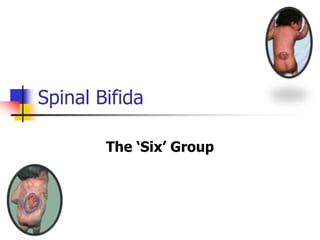
Spinal Bifida
The ‘Six’ Group
Group Members
Precious S. Kataika
Misheri Nkhani
Nelson Munthali
Benjamin Mpalabwazi
Ruth K. Nyalubanga
Broad Objective
 By the end of this presentation,
students should acquire knowledge on
spinal bifida
By the end of the presentation, students should
be able to:
 Define Spina Bifida?
 Outline the etiology of spina bifida.
 Describe the types of spina bifida.
 Explain the pathophysiology of spina bifida.
 Explain the clinical manifestations.
 List the diagnostic tests.
 Explain the medical management.
 Explain the nursing management.
 List the complications.
 A condition that
refers to a
developmental defect
of the spinal column
in which the arches of
one or more of the
spinal vertebrae fail
to fuse.
 It may involve the
entire length of the
neural tube or
restricted to one area.
ETIOLOGY
The cause is not known but has predisposing
factors and some of them are:
 Nutritional deficiency (Folic Acid) which helps in
neural tube development. In absence of this in
the first trimester of pregnancy, the child may
born with spinal bifida.
 Genetic factors; family history, if a woman bears
a child with spinal bifida, there is a chance that
of another child having spinal bifida. This is most
common in females than in males.
Cont’..
 CSF pressure. Blockage in the
circulation of CSF can cause pressure in
the spine of unborn baby which can
lead to spinal bifida.
 Medications such as anticonvulsants
 Conditions such as diabetes, obesity
and fever also increases the chances of
delivering of a baby with a spina bifida
1. Spinal Bifida Occulta
 an abnormality is confined to the vertebrae
only and is due to an unclosed posterior
vertebral arch.
 This has no visible defect to the external (no
protrusion). It occurs most at the lumbasacral
area.
 There is a dimple, hairy patch, dark spot or
swelling over affected area
 spinal cords and nerves usually normal
Cont’…
 It is the mildest
type of spina
bifida
 It has no
symptoms
 There is gap in
one or more of
the vertebra of
the spine
 no treatment
needed
2. Spinal bifida Cystica
 A more severe type of spinal bifida
 This refers to the visible defect with the
external saclike protrusion
 It has two major forms;
1. Meningocele
2. Myelomeningocele
1. Meningocele
 Is a rarest form of which
a cyst or fluid-filled sac
pokes through an open
part of the spine.
 The sac contains
membranes that protect
spinal cord but not
spinal nerves i.e. there
is no neural elements
but only CSF and
meninges.
2. Myelomeningocele
 Most severe form
of spinal bifida
cystica
 The cyst holds
both membranes
and nerve roots of
spinal cord and
often the cord
itself
 Almost 96%
Pathophysiology
 Under normal circumstances, the
closure of the neural tube occurs
around 23rd and 27th day
after fertilization.
 However, if something interferes e.g.
Medications such as some
anticonvulsants, diabetes, having a
relative with spina bifida, obesity, and
an increased body temperature
from fever.
Cont’…
 The neural tube fails to close properly
as a result a neural tube defect occurs.
 The most common location of this
malformations is the lumbar and sacral
areas
Clinical Manifestations
Signs and symptoms vary according
to degree of spinal defect.
 Readily apparent on inspection!
 Loss of sensation below lesion
 Poor urinary and bladder control. There
is an Overflow incontinence with
constant dripling in urine due to nerve
dysfunction that supplies the bladder.
Clinical Manifestations
 Joint deformities in lower extremities
due to demolition to the muscles of the
lower extremities.
 Orthopedic abnormalities (i.e. club
foot, hip dislocation, scoliosis)
 Hydrocephalus
 Swelling
 Brain damage
Assessment
 History taking
 Subjective data
 Family history of the condition and if it is the
first pregnancy.
 Ask the nutritional history of the mother during
pregnancy to ensure folic acid deficiency.
 Urine and faecal incontinence.
 Ask for paralysis especially in the lower
extremities.
 Objective data
 Weigh the child.
 Conduct a neurological assessment.
 Prick response.
 Assess cystic
 Physical examination
Diagnostic Tests
Prenatal Tests
• AFP screening
• Ultrasound
• Testing of Amniotic fluid
Imaging Studies
• X-ray of the spine to rule out occulta spinal
bifida
• Ultrasound of pregnancy between 6th and 8th
weak
• CT scan to rule out hydrocephalus
• MRI
Medical Management
 There is no cure for spina bifida.
Damaged nerve tissues can not be
repaired nor its function be restored.
 Treatment depend on how severe the
defect is. Most children with spina bifida
have a mild defect and may not need
treatment i.e. spina bifida occulta
 But a child with severe defect may need
surgery.
 The surgery involves putting the meninges
back in place and closing the opening in
the vertebrae.
 The surgery is done within 24 – 48 hours
after birth. There is also a surgery to treat
hydrocephalus by placing a shunt
 Fetal surgery is also done to promote early
surgical closure of the spina bifida
Cont’…
 Assistive technology e.g.
electric wheel chair, braces
or crutches to help the
child get around.
 Medication involves
treating the complications
and signs of spina bifida.
 Physiotherapy to improve
day to day life and boost
independence.
Nursing Management
Pre-Op
 Position the child in prone with legs
abducted. This reduces tension and risk
of sac trauma.
 Put the child in an incubator or warmer
area without clothes. This maintains
normal body temperature, and reduces
trauma from the clothes.
 Apply dressing (moist, no adhesions), to
avoid drying of the area due to heat in
the incubator.
 Strictly use the sterile gauze so as to
prevent re-infection.
 Change dressing two-four hourly, to
avoid drying.
 Use normal saline or silver nitrate in
dressing.
 Gentle handling of the child to avoid
any risk of trauma.
 Change the child’s position every two
hours, to promote circulation and
prevent development of decubitus sore.
 Check vital signs and signs of increased
intracranial pressure.
 Assess for signs of hydrocephalus.
 Cover the sacrum with sterile surgical
drape, but not latex tape.
 Measure the head circumference
 Prepare the mother psychologically.
 Apply gentle pressure to suprapubic
area to facilitate urine emptying.
 Gently do a range of motion of the
extremities to the child.
Post-Op
 Position the child in prone to avoid
pressure on suture, or side lying
position alternatively.
 Monitor the child`s vital signs every 30
minutes until stable.
 Use all measures to avoid any infection
e. g. hand washing.
 Monitor input and output.
 Encourage the mother to continue
breastfeeding if the child is being
breastfed.
 Resume the feeding after the effects of
anaesthesia.
 Remove the dressings after 48hrs to
check any signs of bleeding or bulging
 Psychologically, care the mother.
 Observe for leakage.
 Maintain passive range of motion of the
extremities to promote circulation.
 Give high fibre diet to the child (if
above 6 months), to avoid constipation,
 To alley anxiety, counsel the mother on
the condition of the child.
 Teach the parents to observe for signs
of complications e. g. convulsions.
 Teach on the care of the child.
Complications
 Meningitis due to infections
 Hydrocephalus due to Increased
Intracranial Pressure
 Physical and neurological problems e.g.
lack of normal bowel and bladder
control, Paralysis of the legs
 Latex allergy
Summary
 Spina bifida birth defect is the most common
defect of the central nervous system with a
worldwide incidence of about 1 in every 1000
births
 This disease is clinically referred to as
Myelomeningocele.
 Regular checkups and intake of folic acid diet
before conception and during the first few
weeks of pregnancy can help to prevent spina
bifida.
References
 Hockenberry, M. J., & Winkelstein, W.
(2005). Wong's essential of pediatric
nursing (7th Ed).philadephia, USA:
Elsevier Mosby .
 www.mayoclinic.org/diseases-
conditions/spina-bifida
 www.ninds.nih.gov/disorders/spina-
bifida

Spinal Bifida

  • 1.
  • 2.
    Group Members Precious S.Kataika Misheri Nkhani Nelson Munthali Benjamin Mpalabwazi Ruth K. Nyalubanga
  • 3.
    Broad Objective  Bythe end of this presentation, students should acquire knowledge on spinal bifida
  • 4.
    By the endof the presentation, students should be able to:  Define Spina Bifida?  Outline the etiology of spina bifida.  Describe the types of spina bifida.  Explain the pathophysiology of spina bifida.  Explain the clinical manifestations.  List the diagnostic tests.  Explain the medical management.  Explain the nursing management.  List the complications.
  • 5.
     A conditionthat refers to a developmental defect of the spinal column in which the arches of one or more of the spinal vertebrae fail to fuse.  It may involve the entire length of the neural tube or restricted to one area.
  • 6.
    ETIOLOGY The cause isnot known but has predisposing factors and some of them are:  Nutritional deficiency (Folic Acid) which helps in neural tube development. In absence of this in the first trimester of pregnancy, the child may born with spinal bifida.  Genetic factors; family history, if a woman bears a child with spinal bifida, there is a chance that of another child having spinal bifida. This is most common in females than in males.
  • 7.
    Cont’..  CSF pressure.Blockage in the circulation of CSF can cause pressure in the spine of unborn baby which can lead to spinal bifida.  Medications such as anticonvulsants  Conditions such as diabetes, obesity and fever also increases the chances of delivering of a baby with a spina bifida
  • 8.
    1. Spinal BifidaOcculta  an abnormality is confined to the vertebrae only and is due to an unclosed posterior vertebral arch.  This has no visible defect to the external (no protrusion). It occurs most at the lumbasacral area.  There is a dimple, hairy patch, dark spot or swelling over affected area  spinal cords and nerves usually normal
  • 9.
    Cont’…  It isthe mildest type of spina bifida  It has no symptoms  There is gap in one or more of the vertebra of the spine  no treatment needed
  • 10.
    2. Spinal bifidaCystica  A more severe type of spinal bifida  This refers to the visible defect with the external saclike protrusion  It has two major forms; 1. Meningocele 2. Myelomeningocele
  • 11.
    1. Meningocele  Isa rarest form of which a cyst or fluid-filled sac pokes through an open part of the spine.  The sac contains membranes that protect spinal cord but not spinal nerves i.e. there is no neural elements but only CSF and meninges.
  • 12.
    2. Myelomeningocele  Mostsevere form of spinal bifida cystica  The cyst holds both membranes and nerve roots of spinal cord and often the cord itself  Almost 96%
  • 13.
    Pathophysiology  Under normalcircumstances, the closure of the neural tube occurs around 23rd and 27th day after fertilization.  However, if something interferes e.g. Medications such as some anticonvulsants, diabetes, having a relative with spina bifida, obesity, and an increased body temperature from fever.
  • 14.
    Cont’…  The neuraltube fails to close properly as a result a neural tube defect occurs.  The most common location of this malformations is the lumbar and sacral areas
  • 15.
    Clinical Manifestations Signs andsymptoms vary according to degree of spinal defect.  Readily apparent on inspection!  Loss of sensation below lesion  Poor urinary and bladder control. There is an Overflow incontinence with constant dripling in urine due to nerve dysfunction that supplies the bladder.
  • 16.
    Clinical Manifestations  Jointdeformities in lower extremities due to demolition to the muscles of the lower extremities.  Orthopedic abnormalities (i.e. club foot, hip dislocation, scoliosis)  Hydrocephalus  Swelling  Brain damage
  • 17.
    Assessment  History taking Subjective data  Family history of the condition and if it is the first pregnancy.  Ask the nutritional history of the mother during pregnancy to ensure folic acid deficiency.  Urine and faecal incontinence.  Ask for paralysis especially in the lower extremities.
  • 18.
     Objective data Weigh the child.  Conduct a neurological assessment.  Prick response.  Assess cystic  Physical examination
  • 19.
    Diagnostic Tests Prenatal Tests •AFP screening • Ultrasound • Testing of Amniotic fluid Imaging Studies • X-ray of the spine to rule out occulta spinal bifida • Ultrasound of pregnancy between 6th and 8th weak • CT scan to rule out hydrocephalus • MRI
  • 20.
    Medical Management  Thereis no cure for spina bifida. Damaged nerve tissues can not be repaired nor its function be restored.  Treatment depend on how severe the defect is. Most children with spina bifida have a mild defect and may not need treatment i.e. spina bifida occulta  But a child with severe defect may need surgery.
  • 21.
     The surgeryinvolves putting the meninges back in place and closing the opening in the vertebrae.  The surgery is done within 24 – 48 hours after birth. There is also a surgery to treat hydrocephalus by placing a shunt  Fetal surgery is also done to promote early surgical closure of the spina bifida
  • 22.
    Cont’…  Assistive technologye.g. electric wheel chair, braces or crutches to help the child get around.  Medication involves treating the complications and signs of spina bifida.  Physiotherapy to improve day to day life and boost independence.
  • 23.
    Nursing Management Pre-Op  Positionthe child in prone with legs abducted. This reduces tension and risk of sac trauma.  Put the child in an incubator or warmer area without clothes. This maintains normal body temperature, and reduces trauma from the clothes.
  • 24.
     Apply dressing(moist, no adhesions), to avoid drying of the area due to heat in the incubator.  Strictly use the sterile gauze so as to prevent re-infection.  Change dressing two-four hourly, to avoid drying.
  • 25.
     Use normalsaline or silver nitrate in dressing.  Gentle handling of the child to avoid any risk of trauma.  Change the child’s position every two hours, to promote circulation and prevent development of decubitus sore.
  • 26.
     Check vitalsigns and signs of increased intracranial pressure.  Assess for signs of hydrocephalus.  Cover the sacrum with sterile surgical drape, but not latex tape.  Measure the head circumference
  • 27.
     Prepare themother psychologically.  Apply gentle pressure to suprapubic area to facilitate urine emptying.  Gently do a range of motion of the extremities to the child.
  • 28.
    Post-Op  Position thechild in prone to avoid pressure on suture, or side lying position alternatively.  Monitor the child`s vital signs every 30 minutes until stable.  Use all measures to avoid any infection e. g. hand washing.
  • 29.
     Monitor inputand output.  Encourage the mother to continue breastfeeding if the child is being breastfed.  Resume the feeding after the effects of anaesthesia.  Remove the dressings after 48hrs to check any signs of bleeding or bulging
  • 30.
     Psychologically, carethe mother.  Observe for leakage.  Maintain passive range of motion of the extremities to promote circulation.  Give high fibre diet to the child (if above 6 months), to avoid constipation,
  • 31.
     To alleyanxiety, counsel the mother on the condition of the child.  Teach the parents to observe for signs of complications e. g. convulsions.  Teach on the care of the child.
  • 32.
    Complications  Meningitis dueto infections  Hydrocephalus due to Increased Intracranial Pressure  Physical and neurological problems e.g. lack of normal bowel and bladder control, Paralysis of the legs  Latex allergy
  • 33.
    Summary  Spina bifidabirth defect is the most common defect of the central nervous system with a worldwide incidence of about 1 in every 1000 births  This disease is clinically referred to as Myelomeningocele.  Regular checkups and intake of folic acid diet before conception and during the first few weeks of pregnancy can help to prevent spina bifida.
  • 34.
    References  Hockenberry, M.J., & Winkelstein, W. (2005). Wong's essential of pediatric nursing (7th Ed).philadephia, USA: Elsevier Mosby .  www.mayoclinic.org/diseases- conditions/spina-bifida  www.ninds.nih.gov/disorders/spina- bifida