


Receivable Management
OR
Accounts Receivable Management
Prepared By:
Mohammed Jasir PV
Asst. Professor
MIIMS Puthanangadi
Contact No: 9605 69 32 66
Receivables
• Receivables represent amounts owed to the firm as a result of sale of
goods or services in the ordinary course of business
• Receivables are also known as accounts receivables, trade receivables,
customer receivables or book debts
• The purpose of maintaining or investing in receivable is to meet
competition, and to increase the sales and profits
Cost of maintaining receivables
• Cost of financing receivables
• Administrative cost
• Opportunity cost
• Cost of collection
• Bad debts / Default Cost
• 1. Cost of Financing, Receivables. When goods and services are provided on credit
then concern's capital is allowed to be used by the customers. The receivables are
financed from the funds supplied by shareholders for long term financing and
through retained earnings. The concern incurs some cost for collecting funds which
finance receivables.
• 2. Cost of Collection. A proper collection of receivables is essential for receivables
management. The customers who do not pay the money during a stipulated credit
period are sent reminders for early payments. Some persons may have to be sent
for collecting these amounts. In some cases legal recourse may have to be taken for
collecting receivables. All these costs are known as collection costs which a concern
is generally required to incur.
Factors influencing the size of receivables
• Size of credit sales
• Credit policies
• Terms of trade
• Expansion plans
• Relation with profit
• Credit collection efforts
• Habits of customers
Receivables Management
• Receivables Management is the process of making decisions
relating to investment in trade debtors
• The objective of receivables management is to take a sound
decision as regards investment in debtors
Receivable Management
• Accounts receivable management incorporates is all about ensuring that
customers pay their invoices
• Good receivables management helps prevent overdue payment or non-
payment
• It is therefore a quick and effective way to strengthen the company’s
financial or liquidity position
A Good Receivables Management
• Determining the customer’s credit rating in advance
• Frequently scanning and monitoring customers for credit risks
• Maintaining customer relations
• Detecting late payments in due time
• Detecting complaints in due time
• Reducing the total balance outstanding
• Preventing any bad debt in receivables outstanding
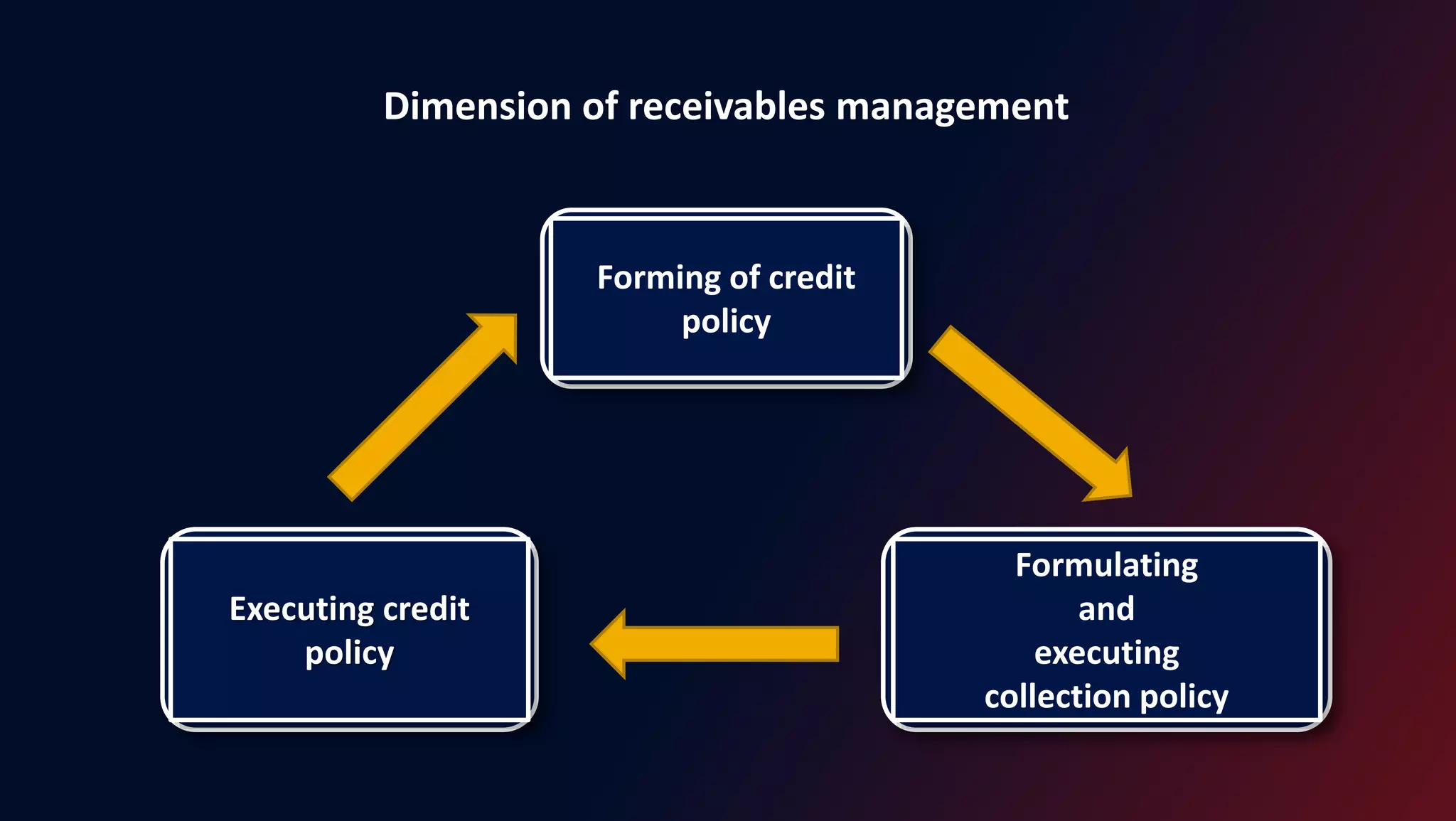
Dimension of receivables management
Forming of credit
policy
Formulating
and
executing
collection policy
Executing credit
policy
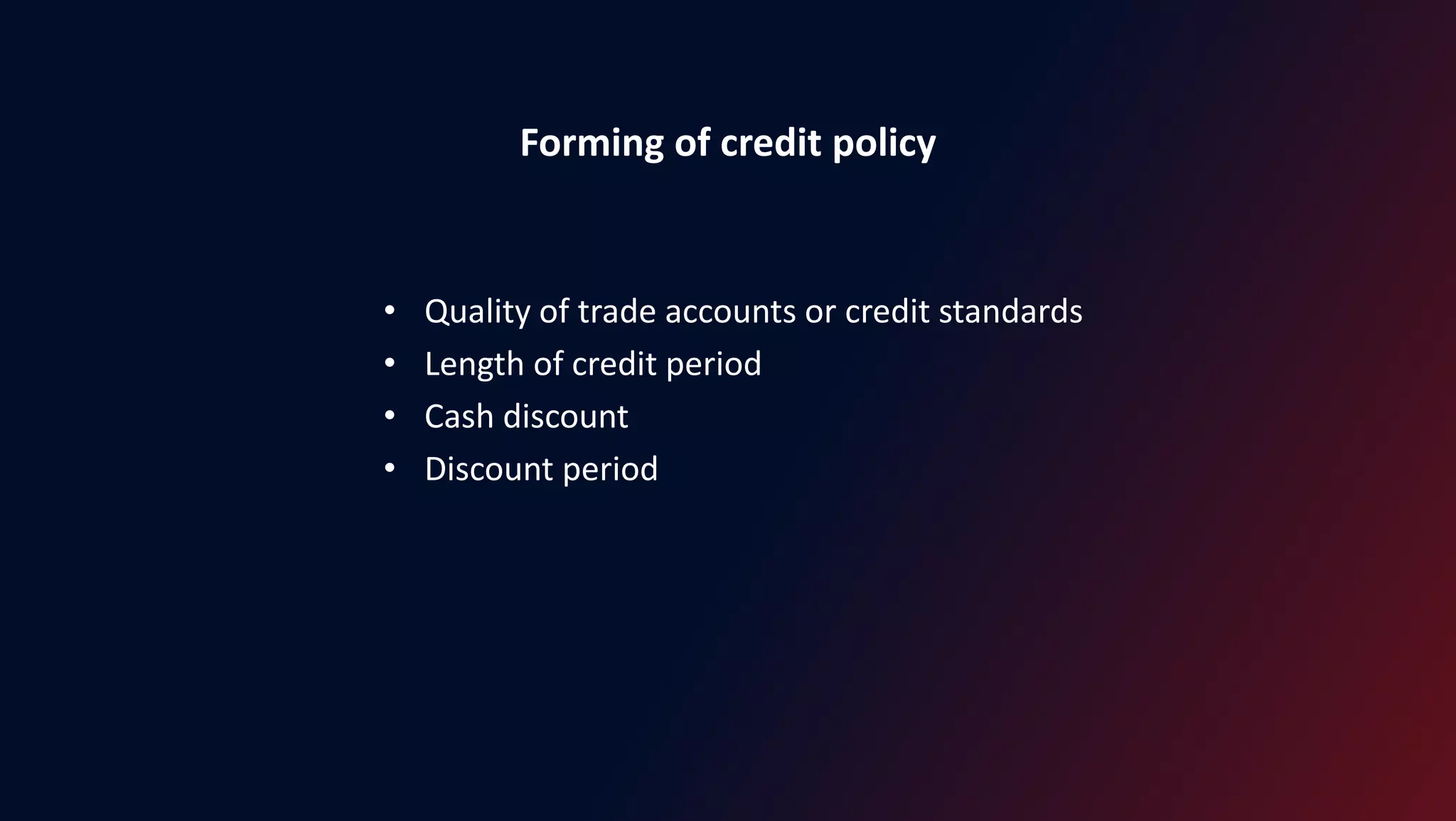
Forming of credit policy
• Quality of trade accounts or credit standards
• Length of credit period
• Cash discount
• Discount period
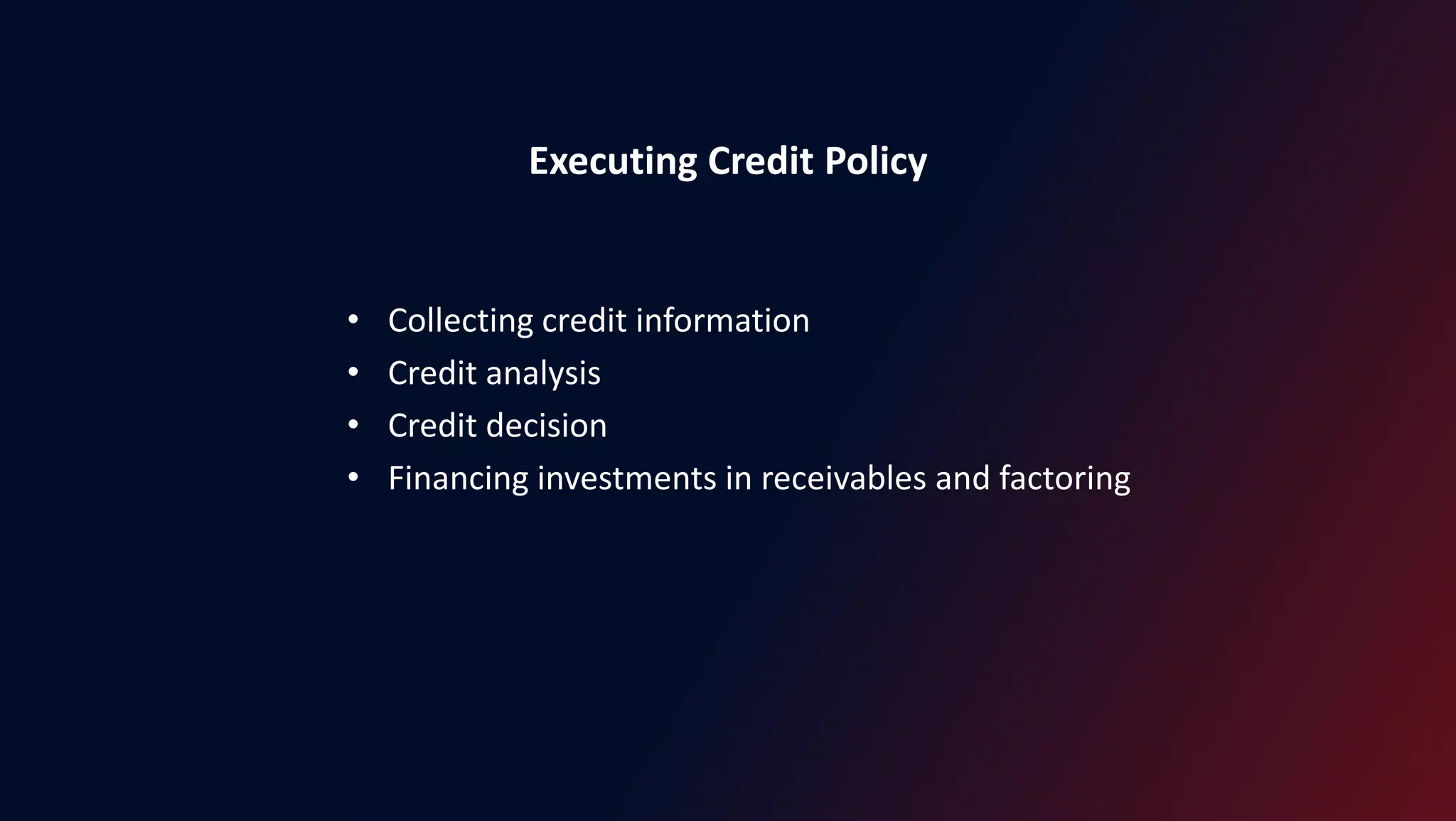
Executing Credit Policy
• Collecting credit information
• Credit analysis
• Credit decision
• Financing investments in receivables and factoring
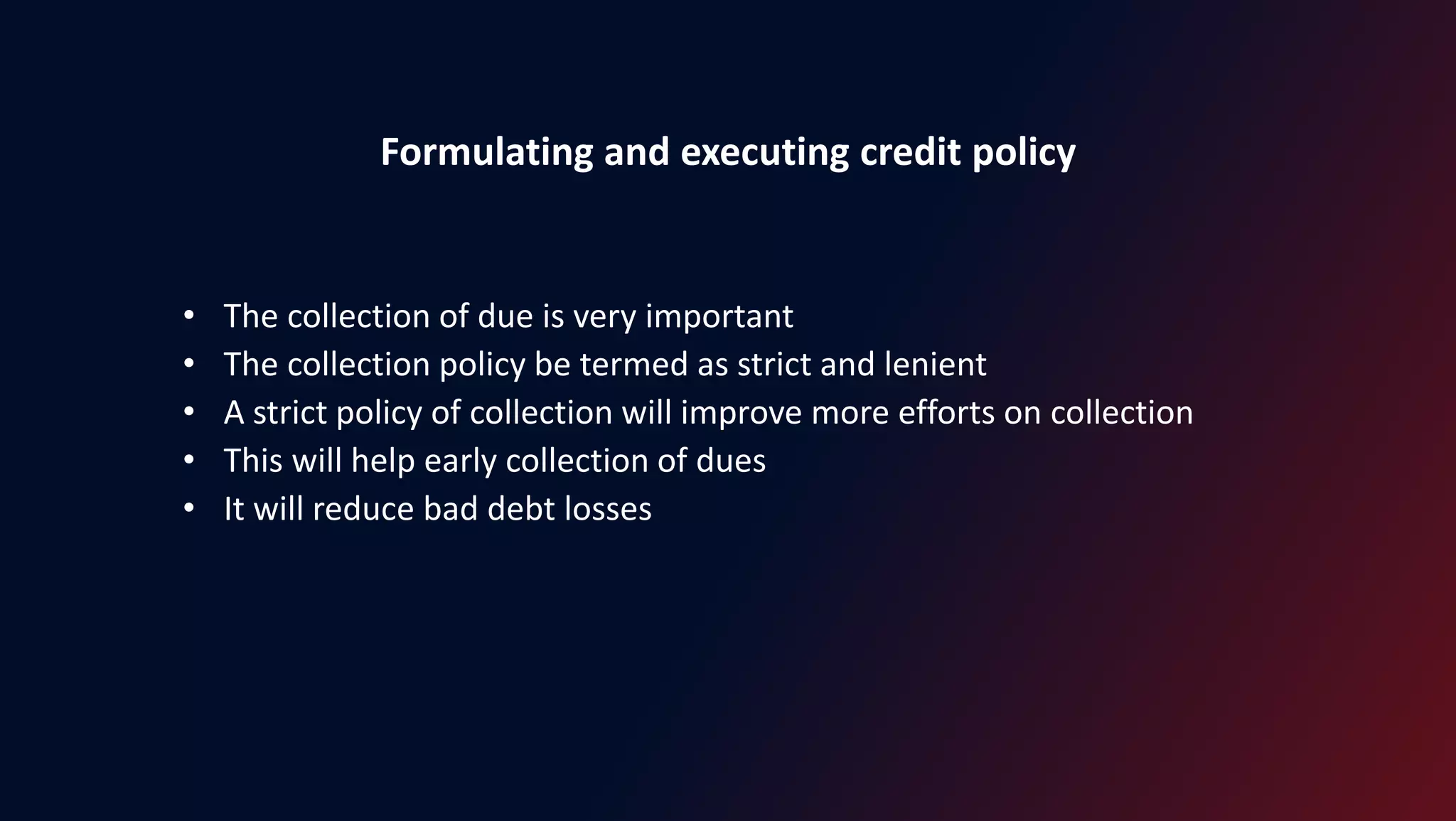
Formulating and executing credit policy
• The collection of due is very important
• The collection policy be termed as strict and lenient
• A strict policy of collection will improve more efforts on collection
• This will help early collection of dues
• It will reduce bad debt losses
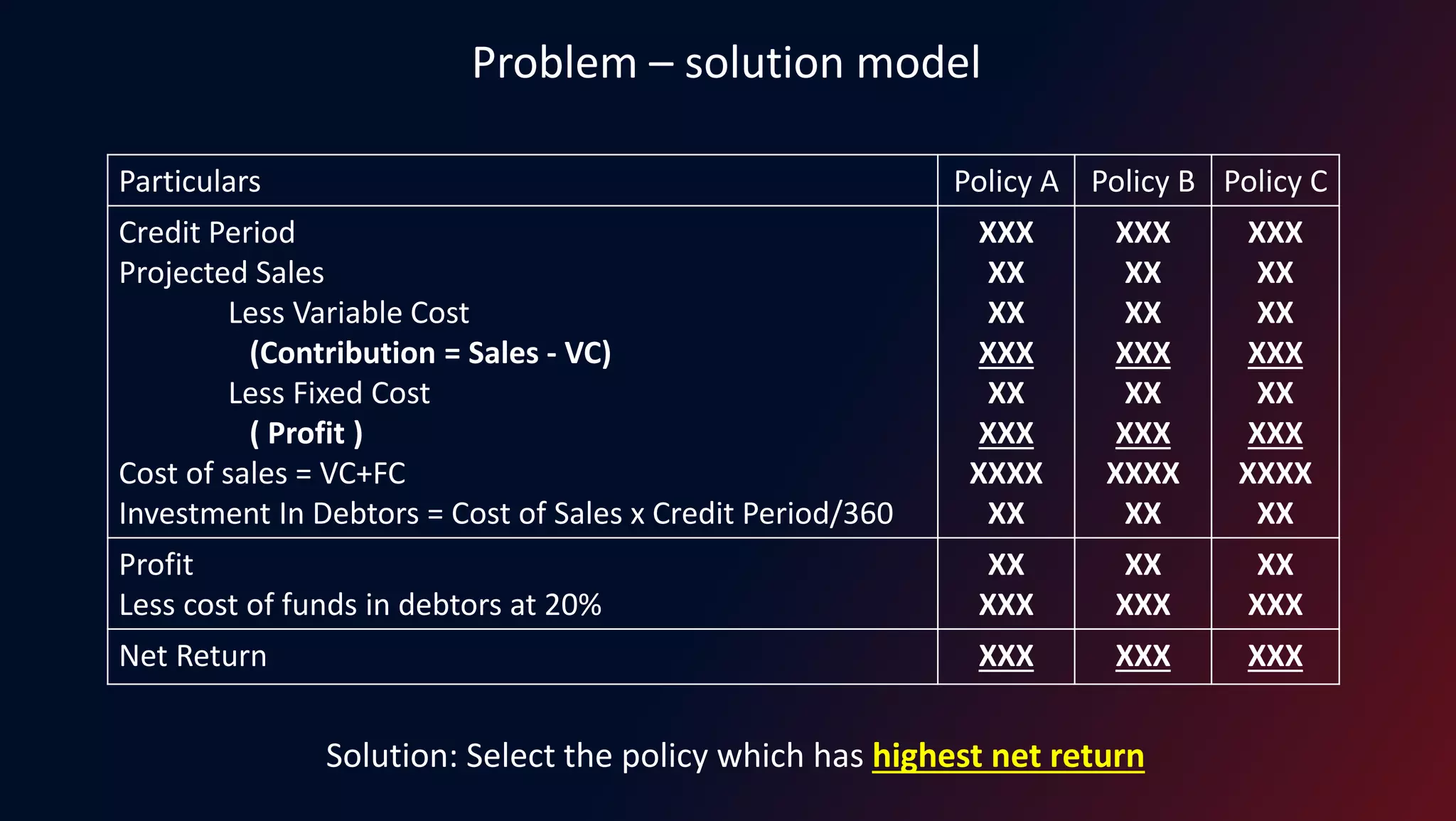
Problem – solution model
Particulars Policy A Policy B Policy C
Credit Period
Projected Sales
Less Variable Cost
(Contribution = Sales - VC)
Less Fixed Cost
( Profit )
Cost of sales = VC+FC
Investment In Debtors = Cost of Sales x Credit Period/360
XXX
XX
XX
XXX
XX
XXX
XXXX
XX
XXX
XX
XX
XXX
XX
XXX
XXXX
XX
XXX
XX
XX
XXX
XX
XXX
XXXX
XX
Profit
Less cost of funds in debtors at 20%
XX
XXX
XX
XXX
XX
XXX
Net Return XXX XXX XXX
Solution: Select the policy which has highest net return
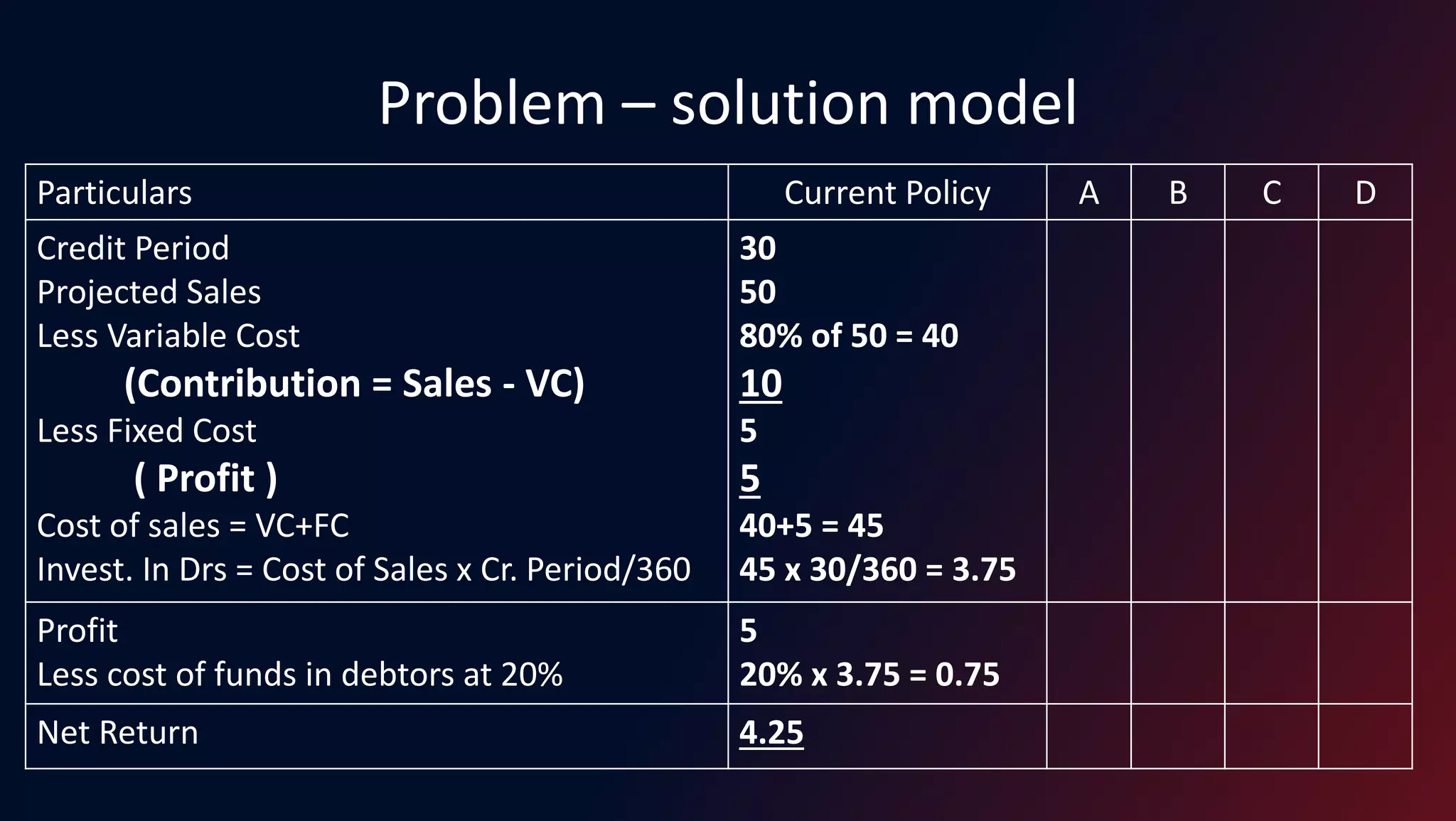
Problem – solution model
Particulars Current Policy A B C D
Credit Period
Projected Sales
Less Variable Cost
(Contribution = Sales - VC)
Less Fixed Cost
( Profit )
Cost of sales = VC+FC
Invest. In Drs = Cost of Sales x Cr. Period/360
30
50
80% of 50 = 40
10
5
5
40+5 = 45
45 x 30/360 = 3.75
Profit
Less cost of funds in debtors at 20%
5
20% x 3.75 = 0.75
Net Return 4.25
Cash and Marketable
Securities Management
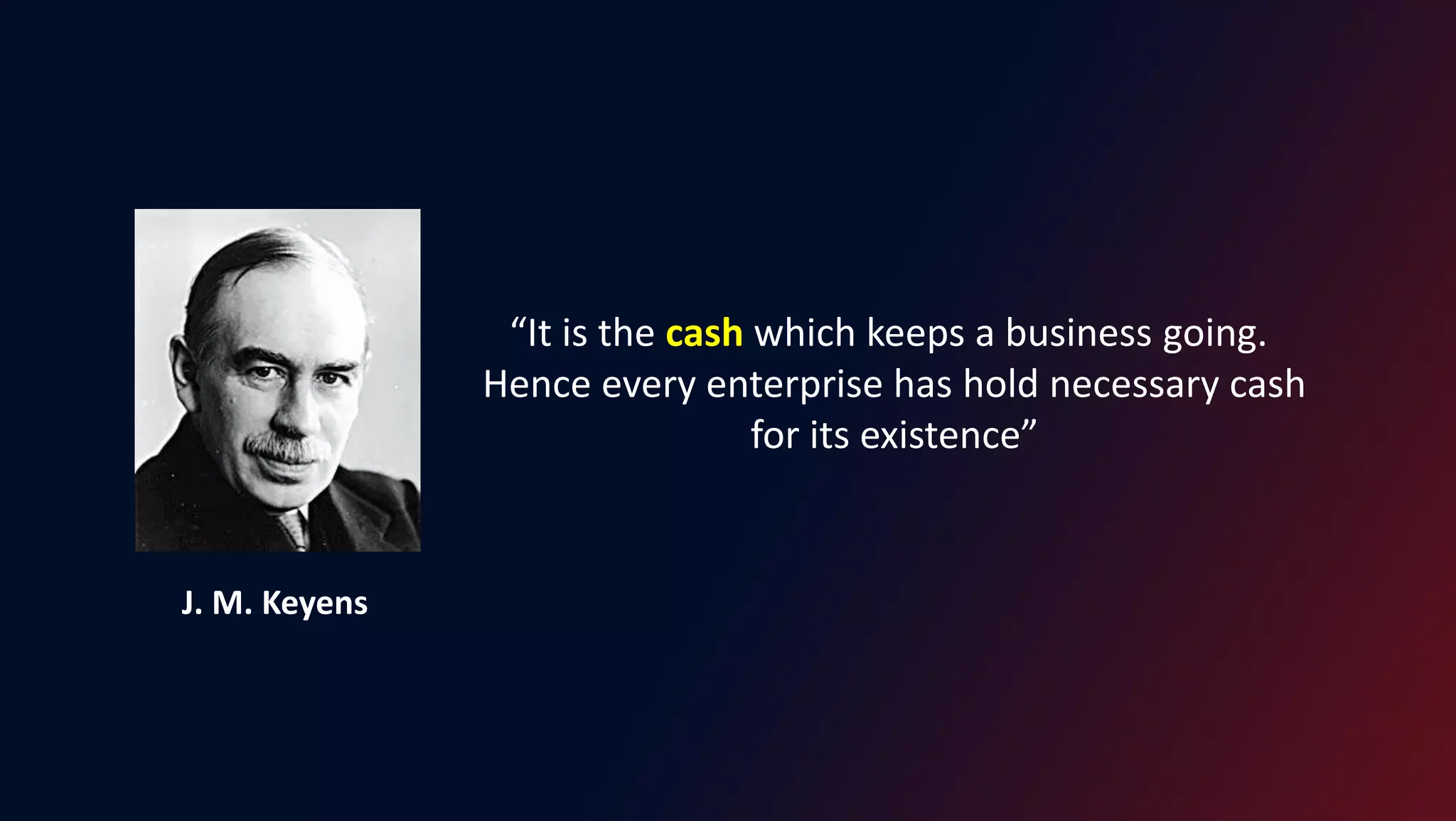
“It is the cash which keeps a business going.
Hence every enterprise has hold necessary cash
for its existence”
J. M. Keyens
Cash
• Cash is an important component of current assets
• Cash is most essential for business operations
• Cash is the basic input to run the business continuously
• It is also the ultimate output by selling the service and product
manufactured by the firm
Motives for holding cash
The Transaction Motives
The Precautionary Motive
The Speculative Motive
The Compensating Motive
Why ?
1. Transaction motive
– It is a motive for holding cash or near cash to meet routine cash
requirements to finance transaction in the normal course of business.
Cash is needed to make purchases of raw materials, pay expenses,
taxes, dividends etc.
2. Precautionary motive
– It is the motive for holding cash or near cash as a cushion to meet
unexpected contingencies. Cash is needed to meet the unexpected
situation like, floods strikes etc.
3. Speculative motive
– It is the motive for holding cash to quickly take advantage of
opportunities typically outside the normal course of business. Certain
amount of cash is needed to meet an opportunity to purchase raw
materials at a reduced price or make purchase at favorable prices.
4. Compensating motive
– It is a motive for holding cash to compensate banks for providing certain
services or loans. Banks provide variety of services to the business
concern, such as clearance of cheque, transfer of funds etc.
Thank You

Receivable management or accounts receivable management

  • 1.
    Receivable Management OR Accounts ReceivableManagement Prepared By: Mohammed Jasir PV Asst. Professor MIIMS Puthanangadi Contact No: 9605 69 32 66
  • 2.
    Receivables • Receivables representamounts owed to the firm as a result of sale of goods or services in the ordinary course of business • Receivables are also known as accounts receivables, trade receivables, customer receivables or book debts • The purpose of maintaining or investing in receivable is to meet competition, and to increase the sales and profits
  • 3.
    Cost of maintainingreceivables • Cost of financing receivables • Administrative cost • Opportunity cost • Cost of collection • Bad debts / Default Cost
  • 4.
    • 1. Costof Financing, Receivables. When goods and services are provided on credit then concern's capital is allowed to be used by the customers. The receivables are financed from the funds supplied by shareholders for long term financing and through retained earnings. The concern incurs some cost for collecting funds which finance receivables. • 2. Cost of Collection. A proper collection of receivables is essential for receivables management. The customers who do not pay the money during a stipulated credit period are sent reminders for early payments. Some persons may have to be sent for collecting these amounts. In some cases legal recourse may have to be taken for collecting receivables. All these costs are known as collection costs which a concern is generally required to incur.
  • 5.
    Factors influencing thesize of receivables • Size of credit sales • Credit policies • Terms of trade • Expansion plans • Relation with profit • Credit collection efforts • Habits of customers
  • 6.
    Receivables Management • ReceivablesManagement is the process of making decisions relating to investment in trade debtors • The objective of receivables management is to take a sound decision as regards investment in debtors
  • 7.
    Receivable Management • Accountsreceivable management incorporates is all about ensuring that customers pay their invoices • Good receivables management helps prevent overdue payment or non- payment • It is therefore a quick and effective way to strengthen the company’s financial or liquidity position
  • 8.
    A Good ReceivablesManagement • Determining the customer’s credit rating in advance • Frequently scanning and monitoring customers for credit risks • Maintaining customer relations • Detecting late payments in due time • Detecting complaints in due time • Reducing the total balance outstanding • Preventing any bad debt in receivables outstanding
  • 9.
    Dimension of receivablesmanagement Forming of credit policy Formulating and executing collection policy Executing credit policy
  • 10.
    Forming of creditpolicy • Quality of trade accounts or credit standards • Length of credit period • Cash discount • Discount period
  • 11.
    Executing Credit Policy •Collecting credit information • Credit analysis • Credit decision • Financing investments in receivables and factoring
  • 12.
    Formulating and executingcredit policy • The collection of due is very important • The collection policy be termed as strict and lenient • A strict policy of collection will improve more efforts on collection • This will help early collection of dues • It will reduce bad debt losses
  • 13.
    Problem – solutionmodel Particulars Policy A Policy B Policy C Credit Period Projected Sales Less Variable Cost (Contribution = Sales - VC) Less Fixed Cost ( Profit ) Cost of sales = VC+FC Investment In Debtors = Cost of Sales x Credit Period/360 XXX XX XX XXX XX XXX XXXX XX XXX XX XX XXX XX XXX XXXX XX XXX XX XX XXX XX XXX XXXX XX Profit Less cost of funds in debtors at 20% XX XXX XX XXX XX XXX Net Return XXX XXX XXX Solution: Select the policy which has highest net return
  • 14.
    Problem – solutionmodel Particulars Current Policy A B C D Credit Period Projected Sales Less Variable Cost (Contribution = Sales - VC) Less Fixed Cost ( Profit ) Cost of sales = VC+FC Invest. In Drs = Cost of Sales x Cr. Period/360 30 50 80% of 50 = 40 10 5 5 40+5 = 45 45 x 30/360 = 3.75 Profit Less cost of funds in debtors at 20% 5 20% x 3.75 = 0.75 Net Return 4.25
  • 15.
  • 16.
    “It is thecash which keeps a business going. Hence every enterprise has hold necessary cash for its existence” J. M. Keyens
  • 17.
    Cash • Cash isan important component of current assets • Cash is most essential for business operations • Cash is the basic input to run the business continuously • It is also the ultimate output by selling the service and product manufactured by the firm
  • 18.
    Motives for holdingcash The Transaction Motives The Precautionary Motive The Speculative Motive The Compensating Motive Why ?
  • 19.
    1. Transaction motive –It is a motive for holding cash or near cash to meet routine cash requirements to finance transaction in the normal course of business. Cash is needed to make purchases of raw materials, pay expenses, taxes, dividends etc. 2. Precautionary motive – It is the motive for holding cash or near cash as a cushion to meet unexpected contingencies. Cash is needed to meet the unexpected situation like, floods strikes etc.
  • 20.
    3. Speculative motive –It is the motive for holding cash to quickly take advantage of opportunities typically outside the normal course of business. Certain amount of cash is needed to meet an opportunity to purchase raw materials at a reduced price or make purchase at favorable prices. 4. Compensating motive – It is a motive for holding cash to compensate banks for providing certain services or loans. Banks provide variety of services to the business concern, such as clearance of cheque, transfer of funds etc.
  • 21.