B Y ,
V I V E K G K R I S H N A N
INTERNATIONAL RECEIVABLES
AND INVENTORY
MANAGEMENT
RECEIVABLES MANAGEMENT
 Receivables represent the amount owed to the firm as a
result of sale of goods or services in the ordinary course
of business.
 Receivables constitute a significant portion of current
assets of a firm.
 Receivables – accounts receivables or trade
receivables, or customer receivables, or book debts.
COST OF MAINTAINING RECEIVABLES
 The allowing of credit to customers means giving funds for
the customer’s use. A concern incur the following costs on
maintaining receivables:
1. Cost of collection:
Sending reminders for the customers who don’t make
payment during a stipulated credit period. Sometimes,
persons may have to be sent for collecting these amounts.
All these costs are known as collection costs.
2. Bad Debts:
The amounts which the customers fail to pay are known
as bad debts. Though a concern may be able to reduced bad
debts through efficient collection machinery but one cannot
altogether rule out this cost.
Contd.
3. Capital costs:
cost of arranging additional funds to support
credit sales.
RECEIVABLES MANAGEMENT
 Receivables management is defined as “the process of
making decisions relating to investment in the trade
debtors”.
 Investment in receivables is necessary to boost up the
sales and profits, but it involves certain cost
considerations such as bad debts etc.
OBJECTIVES OF RECEIVABLES
MANAGEMENT
To reach sales potential.
To survive competition.
Maintaining up-to-date records.
Initiate collection procedures on overdue accounts.
DIMENSIONS OF RECEIVABLES
MANAGEMENT
FORMING OF CREDIT POLICY
For efficient management of receivables, a concern must
adopt a credit policy.
Dimensions of credit policy – related to decisions such as
Credit standards, length of credit period, cash discount,
discount period etc.
1. Credit standards.
 Credit standards leads to quality of trade accounts. By
liberalizing the credit policy, sales volume can be
increased thereby leading to increase in profits.
 But enhanced sales results in enhanced costs and risks of
bad debts and delayed receipts.
 There may be more bad debt losses due to extension of
credit to less credit worthy customers.
FORMING OF CREDIT POLICY
 On the other hand, extending credit to only credit worthy
customers can reduce bad debt losses, collection costs etc, but
such restriction certainly reduces sales volume.
 A finance manager has to match the increased revenue with
additional costs.
 The credit should be liberalized only to the level where
incremental revenue matches the additional cost.
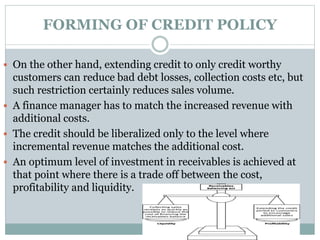
 An optimum level of investment in receivables is achieved at
that point where there is a trade off between the cost,
profitability and liquidity.
FORMING OF CREDIT POLICY
2. Length of credit period
 It is the period allowed to customers for making the
payment. The customers making prompt payment should
be given cash discounts.
 The length of credit period and the quantum of discount
allowed determine the magnitude of investment in
receivables.
 A liberal credit policy can increase the sales, but working
capital will be blocked and chances of bad debt losses are
more.
 A finance manager should determine the period where
additional revenue equates the additional costs and
should not extend credit period beyond this period as
increase in cost will be more than increase in revenue.
FORMING OF CREDIT POLICY
3. Cash discount.
 This is the rate of discount offered to customer in
which the overdue amount will be reduced by this
amount.
 The finance manager should compare the earnings
resulting from released fund and the cost of discount.
The discount may be allowed if cost is less than the
earnings from released fund.
FORMING OF CREDIT POLICY
4. Discount period.
 It affects the firm’s collection period and profit.
 An increase in it will have a positive effect on profit
because many customers who didn’t take advantage
of discount in past may avail it now. It reduces the
average collection period.
 At the same time, the extending of discount period
will result in late collection of funds because those
who were getting discounts and making payments as
per earlier schedule will delay the payments.
EXECUTING CREDIT POLICY
After formulation, execution of the credit policies are very
important.
1. Collecting Credit Information.
o Collecting credit information about the customer to
analyse about the financial position of the customer.
o The information may be available from the financial
statements, credit rating agencies, reports from banks,
firm’s records etc.
2. Credit analysis.
o The finance manager should analyse the collected
information to find out credit worthiness of the potential
customers.
o The credit analysis determine the degree of risk
associated, the capacity of the customer to make
payments.
EXECUTING CREDIT POLICY
3. Credit decision.
o Based on the credit analysis, the financial manager
should take a decision whether the credit is to be
extended to the customer, and up to what level.
4. Financing investments in receivables and
factoring.
o Receivables block a part of the working capital and
efforts should be made that funds are not tied up in
receivables for a longer period.
o The finance manager should take efforts to get
receivables financed so that working capital needs are
met in time.
FORMULATING AND EXECUTING
COLLECTION POLICY Collection policies are the last step involved in the accounts
receivable management. This refers to the procedures
followed to collect accounts receivable when they become
due.
 The objective here is to speed up the collection.
 The following are the degree of effort to collect the over dues:
1. Tight:
The bad debt expenses would decline and average
collection period will be reduced. There fore the profit of the
firm will increase. There may be decline in sales volume
because some consumer may not like the pressure and switch
to another one.
FORMULATING AND EXECUTING
COLLECTION POLICY
2. Lenient:
A lenient collection effort also affect the cost benefits
trade off. The effect of lenient policy will be just the
opposite of the tight policy.
The collection policy should also devise steps to be followed
in collecting over due amounts. The objective is to collect
the dues and not to annoy the customer. The steps should
be like:
(a)Letter to expedite payment.
(b) reminding through telephones.
(c) Personal visits.
(d) Help from collection agencies.
(e) Legal action.
INTERNATIONAL
INVENTORY
MANAGEMENT
INVENTORY MANAGEMENT
 Inventory means stock of goods.
 In accounting language, inventory means stock of finished
goods.
 In a manufacturing concern, inventory includes stock of
raw material, work in progress and finished goods.
(a) Raw material – they are required to carry out
production activities uninterruptedly.
(b) Work in progress – stage of stocks which are in
between raw materials and finished goods. They are
yet to attain a full shape of finished goods.
(c) Consumables – they are catalysts to the entire
production activity. These materials do not directly
enter the production activity. E.g.: Fuel oil.
Contd.
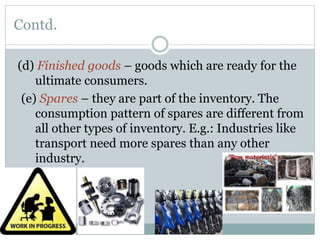
(d) Finished goods – goods which are ready for the
ultimate consumers.
(e) Spares – they are part of the inventory. The
consumption pattern of spares are different from
all other types of inventory. E.g.: Industries like
transport need more spares than any other
industry.
PURPOSE OF HOLDING INVENTORY
 Every business enterprise has to maintain a certain level of
inventories to facilitate uninterrupted production and
smooth running of business.
 Generally, there are 3 main purposes or motives of holding
inventory:
(i) The transaction motive:- which facilitates
continuous production and timely execution of sales
order.
(ii) The precautionary motive:- which necessitates the
holding of the inventory for meeting unpredictable
changes in demand and supply of materials.
(iii) The Speculative motive:- to take advantage of
price fluctuations, savings in re-ordering costs and
quantity discounts etc.
RISKS AND COSTS OF HOLDING
INVENTORY
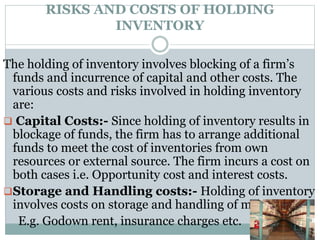
The holding of inventory involves blocking of a firm’s
funds and incurrence of capital and other costs. The
various costs and risks involved in holding inventory
are:
 Capital Costs:- Since holding of inventory results in
blockage of funds, the firm has to arrange additional
funds to meet the cost of inventories from own
resources or external source. The firm incurs a cost on
both cases i.e. Opportunity cost and interest costs.
Storage and Handling costs:- Holding of inventory
involves costs on storage and handling of materials.
E.g. Godown rent, insurance charges etc.
RISKS AND COSTS OF HOLDING
INVENTORY
Risk of price decline:- There is always a risk of
reduction in the prices of inventories. It may be due to
increased market supplies, competition or general
depression in the market.
Risk of obsolescence:- The inventories may
obsolete due to improved technology, changes in
customer taste etc.
Risk deterioration in quality:- Materials can
deteriorate when kept in stores for a long period.
OBJECTIVES OF INVENTORY
MANAGEMENT
Contd.
o To ensure continuous supply of materials, spares,
finished goods etc, so that the production should not
suffer at any time.
o To avoid both over-stocking and under-stocking.
o To maintain investment in inventory at the optimum
level as required.
o To minimise losses through deterioration, pilferage,
wastage and damages.
o To ensure perpetual inventory control so that the
materials shown in the stock ledger should be actually
lying in the stores.
o To ensure right quality goods at reasonable prices.
Contd.
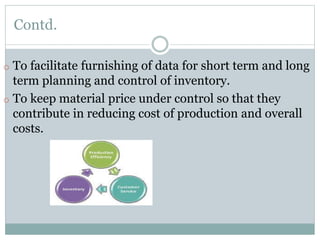
o To facilitate furnishing of data for short term and long
term planning and control of inventory.
o To keep material price under control so that they
contribute in reducing cost of production and overall
costs.
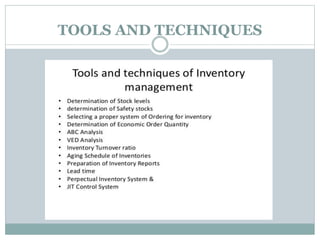
TOOLS AND TECHNIQUES
Contd.
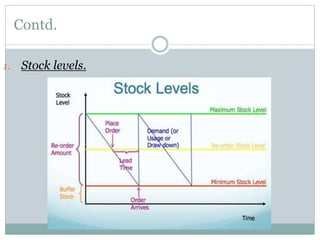
1. Stock levels.
Contd.
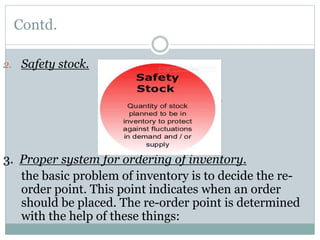
2. Safety stock.
3. Proper system for ordering of inventory.
the basic problem of inventory is to decide the re-
order point. This point indicates when an order
should be placed. The re-order point is determined
with the help of these things:
Contd.
(a) Average consumption rate.
(b) Duration of lead time.
(c) Economic order quantity.
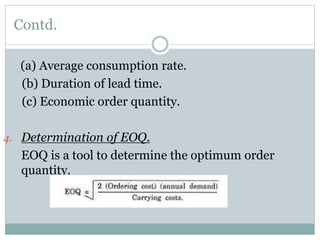
4. Determination of EOQ.
EOQ is a tool to determine the optimum order
quantity.
Contd.
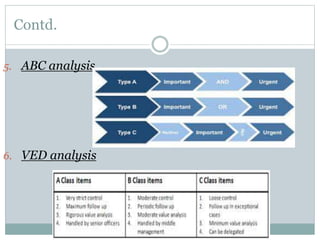
5. ABC analysis
6. VED analysis
Contd.
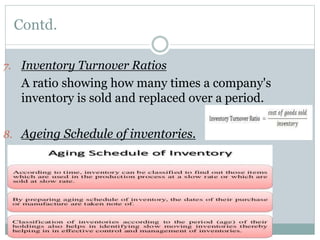
7. Inventory Turnover Ratios
A ratio showing how many times a company's
inventory is sold and replaced over a period.
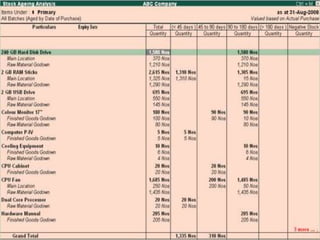
8. Ageing Schedule of inventories.
Contd.
9. Preparation of inventory reports.
An inventory report is a summary of items held by a
business, usually with the goal of providing a
comprehensive assessment of a party's holdings.
10. Perpetual Inventory system.
It refers to inventory records i.e. Bin cards and stock
ledger, that are maintained on a up to date basis at all
points of time.
11. Just in Time Control System.
An approach that seeks to eliminate all sources of
wastes in production activities by providing the right
part at the right place and at the right time.
Receivables and inventory mgt

Receivables and inventory mgt

  • 1.
    B Y , VI V E K G K R I S H N A N INTERNATIONAL RECEIVABLES AND INVENTORY MANAGEMENT
  • 2.
    RECEIVABLES MANAGEMENT  Receivablesrepresent the amount owed to the firm as a result of sale of goods or services in the ordinary course of business.  Receivables constitute a significant portion of current assets of a firm.  Receivables – accounts receivables or trade receivables, or customer receivables, or book debts.
  • 3.
    COST OF MAINTAININGRECEIVABLES  The allowing of credit to customers means giving funds for the customer’s use. A concern incur the following costs on maintaining receivables: 1. Cost of collection: Sending reminders for the customers who don’t make payment during a stipulated credit period. Sometimes, persons may have to be sent for collecting these amounts. All these costs are known as collection costs. 2. Bad Debts: The amounts which the customers fail to pay are known as bad debts. Though a concern may be able to reduced bad debts through efficient collection machinery but one cannot altogether rule out this cost.
  • 4.
    Contd. 3. Capital costs: costof arranging additional funds to support credit sales.
  • 5.
    RECEIVABLES MANAGEMENT  Receivablesmanagement is defined as “the process of making decisions relating to investment in the trade debtors”.  Investment in receivables is necessary to boost up the sales and profits, but it involves certain cost considerations such as bad debts etc.
  • 6.
    OBJECTIVES OF RECEIVABLES MANAGEMENT Toreach sales potential. To survive competition. Maintaining up-to-date records. Initiate collection procedures on overdue accounts.
  • 7.
  • 8.
    FORMING OF CREDITPOLICY For efficient management of receivables, a concern must adopt a credit policy. Dimensions of credit policy – related to decisions such as Credit standards, length of credit period, cash discount, discount period etc. 1. Credit standards.  Credit standards leads to quality of trade accounts. By liberalizing the credit policy, sales volume can be increased thereby leading to increase in profits.  But enhanced sales results in enhanced costs and risks of bad debts and delayed receipts.  There may be more bad debt losses due to extension of credit to less credit worthy customers.
  • 9.
    FORMING OF CREDITPOLICY  On the other hand, extending credit to only credit worthy customers can reduce bad debt losses, collection costs etc, but such restriction certainly reduces sales volume.  A finance manager has to match the increased revenue with additional costs.  The credit should be liberalized only to the level where incremental revenue matches the additional cost.  An optimum level of investment in receivables is achieved at that point where there is a trade off between the cost, profitability and liquidity.
  • 10.
    FORMING OF CREDITPOLICY 2. Length of credit period  It is the period allowed to customers for making the payment. The customers making prompt payment should be given cash discounts.  The length of credit period and the quantum of discount allowed determine the magnitude of investment in receivables.  A liberal credit policy can increase the sales, but working capital will be blocked and chances of bad debt losses are more.  A finance manager should determine the period where additional revenue equates the additional costs and should not extend credit period beyond this period as increase in cost will be more than increase in revenue.
  • 11.
    FORMING OF CREDITPOLICY 3. Cash discount.  This is the rate of discount offered to customer in which the overdue amount will be reduced by this amount.  The finance manager should compare the earnings resulting from released fund and the cost of discount. The discount may be allowed if cost is less than the earnings from released fund.
  • 12.
    FORMING OF CREDITPOLICY 4. Discount period.  It affects the firm’s collection period and profit.  An increase in it will have a positive effect on profit because many customers who didn’t take advantage of discount in past may avail it now. It reduces the average collection period.  At the same time, the extending of discount period will result in late collection of funds because those who were getting discounts and making payments as per earlier schedule will delay the payments.
  • 13.
    EXECUTING CREDIT POLICY Afterformulation, execution of the credit policies are very important. 1. Collecting Credit Information. o Collecting credit information about the customer to analyse about the financial position of the customer. o The information may be available from the financial statements, credit rating agencies, reports from banks, firm’s records etc. 2. Credit analysis. o The finance manager should analyse the collected information to find out credit worthiness of the potential customers. o The credit analysis determine the degree of risk associated, the capacity of the customer to make payments.
  • 14.
    EXECUTING CREDIT POLICY 3.Credit decision. o Based on the credit analysis, the financial manager should take a decision whether the credit is to be extended to the customer, and up to what level. 4. Financing investments in receivables and factoring. o Receivables block a part of the working capital and efforts should be made that funds are not tied up in receivables for a longer period. o The finance manager should take efforts to get receivables financed so that working capital needs are met in time.
  • 15.
    FORMULATING AND EXECUTING COLLECTIONPOLICY Collection policies are the last step involved in the accounts receivable management. This refers to the procedures followed to collect accounts receivable when they become due.  The objective here is to speed up the collection.  The following are the degree of effort to collect the over dues: 1. Tight: The bad debt expenses would decline and average collection period will be reduced. There fore the profit of the firm will increase. There may be decline in sales volume because some consumer may not like the pressure and switch to another one.
  • 16.
    FORMULATING AND EXECUTING COLLECTIONPOLICY 2. Lenient: A lenient collection effort also affect the cost benefits trade off. The effect of lenient policy will be just the opposite of the tight policy. The collection policy should also devise steps to be followed in collecting over due amounts. The objective is to collect the dues and not to annoy the customer. The steps should be like: (a)Letter to expedite payment. (b) reminding through telephones. (c) Personal visits. (d) Help from collection agencies. (e) Legal action.
  • 17.
  • 18.
    INVENTORY MANAGEMENT  Inventorymeans stock of goods.  In accounting language, inventory means stock of finished goods.  In a manufacturing concern, inventory includes stock of raw material, work in progress and finished goods. (a) Raw material – they are required to carry out production activities uninterruptedly. (b) Work in progress – stage of stocks which are in between raw materials and finished goods. They are yet to attain a full shape of finished goods. (c) Consumables – they are catalysts to the entire production activity. These materials do not directly enter the production activity. E.g.: Fuel oil.
  • 19.
    Contd. (d) Finished goods– goods which are ready for the ultimate consumers. (e) Spares – they are part of the inventory. The consumption pattern of spares are different from all other types of inventory. E.g.: Industries like transport need more spares than any other industry.
  • 20.
    PURPOSE OF HOLDINGINVENTORY  Every business enterprise has to maintain a certain level of inventories to facilitate uninterrupted production and smooth running of business.  Generally, there are 3 main purposes or motives of holding inventory: (i) The transaction motive:- which facilitates continuous production and timely execution of sales order. (ii) The precautionary motive:- which necessitates the holding of the inventory for meeting unpredictable changes in demand and supply of materials. (iii) The Speculative motive:- to take advantage of price fluctuations, savings in re-ordering costs and quantity discounts etc.
  • 21.
    RISKS AND COSTSOF HOLDING INVENTORY The holding of inventory involves blocking of a firm’s funds and incurrence of capital and other costs. The various costs and risks involved in holding inventory are:  Capital Costs:- Since holding of inventory results in blockage of funds, the firm has to arrange additional funds to meet the cost of inventories from own resources or external source. The firm incurs a cost on both cases i.e. Opportunity cost and interest costs. Storage and Handling costs:- Holding of inventory involves costs on storage and handling of materials. E.g. Godown rent, insurance charges etc.
  • 22.
    RISKS AND COSTSOF HOLDING INVENTORY Risk of price decline:- There is always a risk of reduction in the prices of inventories. It may be due to increased market supplies, competition or general depression in the market. Risk of obsolescence:- The inventories may obsolete due to improved technology, changes in customer taste etc. Risk deterioration in quality:- Materials can deteriorate when kept in stores for a long period.
  • 23.
  • 24.
    Contd. o To ensurecontinuous supply of materials, spares, finished goods etc, so that the production should not suffer at any time. o To avoid both over-stocking and under-stocking. o To maintain investment in inventory at the optimum level as required. o To minimise losses through deterioration, pilferage, wastage and damages. o To ensure perpetual inventory control so that the materials shown in the stock ledger should be actually lying in the stores. o To ensure right quality goods at reasonable prices.
  • 25.
    Contd. o To facilitatefurnishing of data for short term and long term planning and control of inventory. o To keep material price under control so that they contribute in reducing cost of production and overall costs.
  • 26.
  • 27.
  • 28.
    Contd. 2. Safety stock. 3.Proper system for ordering of inventory. the basic problem of inventory is to decide the re- order point. This point indicates when an order should be placed. The re-order point is determined with the help of these things:
  • 29.
    Contd. (a) Average consumptionrate. (b) Duration of lead time. (c) Economic order quantity. 4. Determination of EOQ. EOQ is a tool to determine the optimum order quantity.
  • 30.
  • 31.
    Contd. 7. Inventory TurnoverRatios A ratio showing how many times a company's inventory is sold and replaced over a period. 8. Ageing Schedule of inventories.
  • 33.
    Contd. 9. Preparation ofinventory reports. An inventory report is a summary of items held by a business, usually with the goal of providing a comprehensive assessment of a party's holdings. 10. Perpetual Inventory system. It refers to inventory records i.e. Bin cards and stock ledger, that are maintained on a up to date basis at all points of time. 11. Just in Time Control System. An approach that seeks to eliminate all sources of wastes in production activities by providing the right part at the right place and at the right time.