RECEIVABLES MANAGEMENT “ Any fool can lend money, but it takes a lot of skill to get it back ”
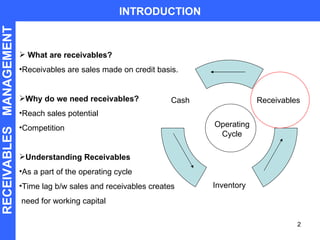
What are receivables?  Receivables are sales made on credit basis. Why do we need receivables? Reach sales potential Competition Understanding Receivables As a part of the operating cycle Time lag b/w sales and receivables creates  need for working capital INTRODUCTION RECEIVABLES  MANAGEMENT Receivables Inventory Cash Operating Cycle
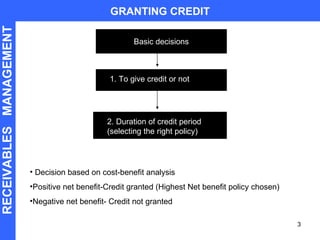
Decision based on cost-benefit analysis Positive net benefit-Credit granted (Highest Net benefit policy chosen) Negative net benefit- Credit not granted GRANTING CREDIT RECEIVABLES  MANAGEMENT Basic decisions 1. To give credit or not  2. Duration of credit period (selecting the right policy)
COLLECTION COST :   Administrative costs incurred in collecting the accounts receivable. CAPITAL COST : Cost incurred for arranging additional funds to support credit sales. DELINQUENCY COST :  Cost which arises if customers fail to meet their obligations. DEFAULT COST :  Amounts which have to written off as bad debts. DIFFERENT TYPES OF COSTS ASSOCIATED RECEIVABLES  MANAGEMENT
Creating, presenting and collecting accounting receivables Establish and communicate the credit policies Evaluation of customers and setting credit limits Ensure prompt and accurate billing Maintaining up-to-date records Initiate collection procedures on overdue accounts OBJECTIVES RECEIVABLES  MANAGEMENT
Customer Evaluation- The 5 C’s C haracter - Reputation, Track Record C apacity - Ability to repay( earning capacity) C apital - Financial Position of the co. C ollateral -  The type and kind of assets pledged C onditions - Economic conditions & competitive factors that may affect the profitability of the customer STEPS IN CREDIT ANALYSIS   “ Investigating the customer” RECEIVABLES  MANAGEMENT
Financial statements :  long term, short term solvency etc can be judged Bank references :  information about the customer from another bank Trade references :  information about customer obtained from firms based on their experiences Credit bureaus :  to check the financial viability of the business Third party guarantees Field visit :  to get information of the existence and general condition of the customer’s business STEPS IN CREDIT ANALYSIS RECEIVABLES  MANAGEMENT
Helps improve customer satisfaction :   enhance service level and increase retention with customized information. Takes control of sales processes :   manage your sales process more effectively by measuring trends and analyzing performance. Enhance your productivity :  help reduce administrative costs and enhance office productivity  Streamline revenue allocation :  managed calculations to fit your business needs Providing access to vital information BENEFITS RECEIVABLES  MANAGEMENT
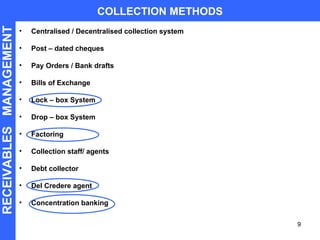
Centralised / Decentralised collection system Post – dated cheques Pay Orders / Bank drafts Bills of Exchange Lock – box System Drop – box System Factoring Collection staff/ agents Debt collector Del Credere agent Concentration banking COLLECTION METHODS RECEIVABLES  MANAGEMENT
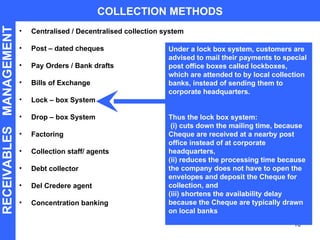
Centralised / Decentralised collection system Post – dated cheques Pay Orders / Bank drafts Bills of Exchange Lock – box System Drop – box System Factoring Collection staff/ agents Debt collector Del Credere agent Concentration banking COLLECTION METHODS RECEIVABLES  MANAGEMENT Under a lock box system, customers are advised to mail their payments to special post office boxes called lockboxes, which are attended to by local collection banks, instead of sending them to corporate headquarters. Thus the lock box system: (i) cuts down the mailing time, because Cheque are received at a nearby post office instead of at corporate headquarters,  (ii) reduces the processing time because the company does not have to open the envelopes and deposit the Cheque for collection, and  (iii) shortens the availability delay because the Cheque are typically drawn on local banks
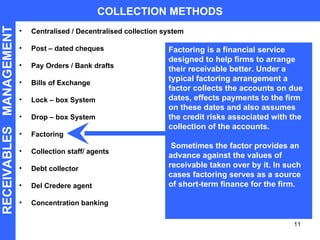
Centralised / Decentralised collection system Post – dated cheques Pay Orders / Bank drafts Bills of Exchange Lock – box System Drop – box System Factoring Collection staff/ agents Debt collector Del Credere agent Concentration banking COLLECTION METHODS RECEIVABLES  MANAGEMENT Factoring is a financial service designed to help firms to arrange their receivable better. Under a typical factoring arrangement a factor collects the accounts on due dates, effects payments to the firm on these dates and also assumes the credit risks associated with the collection of the accounts.   Sometimes the factor provides an advance against the values of receivable taken over by it. In such cases factoring serves as a source of short-term finance for the firm.
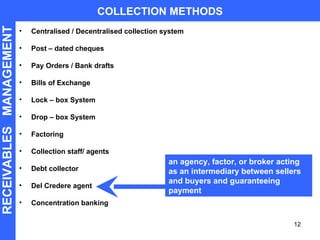
Centralised / Decentralised collection system Post – dated cheques Pay Orders / Bank drafts Bills of Exchange Lock – box System Drop – box System Factoring Collection staff/ agents Debt collector Del Credere agent Concentration banking COLLECTION METHODS RECEIVABLES  MANAGEMENT an agency, factor, or broker acting as an intermediary between sellers and buyers and guaranteeing payment
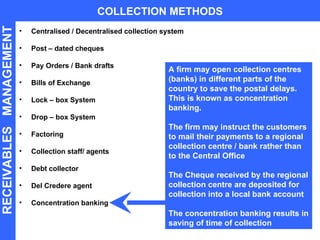
Centralised / Decentralised collection system Post – dated cheques Pay Orders / Bank drafts Bills of Exchange Lock – box System Drop – box System Factoring Collection staff/ agents Debt collector Del Credere agent Concentration banking COLLECTION METHODS RECEIVABLES  MANAGEMENT A firm may open collection centres (banks) in different parts of the country to save the postal delays. This is known as concentration banking.   The firm may instruct the customers to mail their payments to a regional collection centre / bank rather than to the Central Office  The Cheque received by the regional collection centre are deposited for collection into a local bank account   The concentration banking results in saving of time of collection
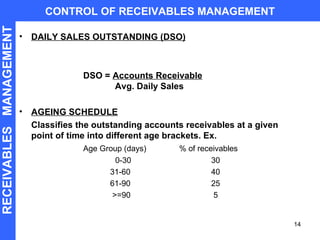
DAILY SALES OUTSTANDING (DSO) DSO =  Accounts Receivable     Avg. Daily Sales AGEING SCHEDULE Classifies the outstanding accounts receivables at a given point of time into different age brackets. Ex. Age Group (days) % of receivables 0-30 30   31-60 40   61-90 25   >=90  5 CONTROL OF RECEIVABLES MANAGEMENT RECEIVABLES  MANAGEMENT
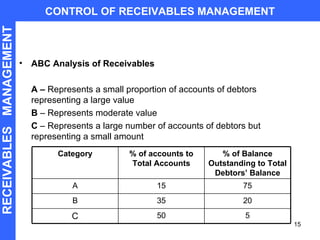
ABC Analysis of Receivables A –  Represents a small proportion of accounts of debtors representing a large value B  – Represents moderate value C  – Represents a large number of accounts of debtors but representing a small amount CONTROL OF RECEIVABLES MANAGEMENT RECEIVABLES  MANAGEMENT Category % of accounts to Total Accounts % of Balance Outstanding to Total Debtors’ Balance A 15 75 B 35 20 C 50 5
PROFORMA RECEIVABLES  MANAGEMENT Type A- If Fixed Costs is given Credit Policy  Present Policy Option 1 Option 2 Option 3 Credit Period (days/ weeks/months) xx xx xx xx Particulars Rs. Rs. Rs. Rs. Sales xxxx xxxx xxxx xxxx Less: Variable Cost xx xx xx xx Contribution xxx xxx xxx xxx Less: Fixed Cost xx xx xx xx Profit [Benefits (A)] xxx xxx xxx xxx Total Cost= Variable Cost +Fixed Cost Average Investment in Receivables  (Based on Total Costs) xxx xxx xxx xxx Costs of Extending Credit: 1) ____ % Opportunity Cost of Capital (Calculated on Avg. Invst. in Receivables) xx xx xx xx 2) Bad debts as % of Sales xx xx xx xx 3) Credit Collection and Admin costs xx xx xx xx Total Costs [B] xxxx xxxx xxxx xxxx Net Benefits [A-B] xxx xxx xxx xxx Incremental Net Benefits --- xx xx xx
Type B: If Fixed costs is NOT given. PROFORMA RECEIVABLES  MANAGEMENT Credit Policy  Present Policy Option 1 Option 2 Option 3 Credit Period (days/ weeks/months) xx xx xx xx Particulars Rs. Rs. Rs. Rs. Sales xxxx xxxx xxxx xxxx Less:  Variable Cost xx xx xx xx Contribution [Benefits (A)] xxx xxx xxx xxx Average Investment in Receivables  (Based on Sales) xxx xxx xxx xxx Costs of Extending Credit: 1) ____ % Opportunity Cost of Capital (Calculated on Avg. Invst. in Receivables) xx xx xx xx 2) Bad debts as % of Sales xx xx xx xx 3) Credit Collection and Admin costs xx xx xx xx Total Costs [B] xxxx xxxx xxxx xxxx Net Benefits [A-B] xxx xxx xxx xxx Incremental Net Benefits --- xx xx xx

Receivables Management

  • 1.
    RECEIVABLES MANAGEMENT “Any fool can lend money, but it takes a lot of skill to get it back ”
  • 2.
    What are receivables? Receivables are sales made on credit basis. Why do we need receivables? Reach sales potential Competition Understanding Receivables As a part of the operating cycle Time lag b/w sales and receivables creates need for working capital INTRODUCTION RECEIVABLES MANAGEMENT Receivables Inventory Cash Operating Cycle
  • 3.
    Decision based oncost-benefit analysis Positive net benefit-Credit granted (Highest Net benefit policy chosen) Negative net benefit- Credit not granted GRANTING CREDIT RECEIVABLES MANAGEMENT Basic decisions 1. To give credit or not 2. Duration of credit period (selecting the right policy)
  • 4.
    COLLECTION COST : Administrative costs incurred in collecting the accounts receivable. CAPITAL COST : Cost incurred for arranging additional funds to support credit sales. DELINQUENCY COST : Cost which arises if customers fail to meet their obligations. DEFAULT COST : Amounts which have to written off as bad debts. DIFFERENT TYPES OF COSTS ASSOCIATED RECEIVABLES MANAGEMENT
  • 5.
    Creating, presenting andcollecting accounting receivables Establish and communicate the credit policies Evaluation of customers and setting credit limits Ensure prompt and accurate billing Maintaining up-to-date records Initiate collection procedures on overdue accounts OBJECTIVES RECEIVABLES MANAGEMENT
  • 6.
    Customer Evaluation- The5 C’s C haracter - Reputation, Track Record C apacity - Ability to repay( earning capacity) C apital - Financial Position of the co. C ollateral - The type and kind of assets pledged C onditions - Economic conditions & competitive factors that may affect the profitability of the customer STEPS IN CREDIT ANALYSIS “ Investigating the customer” RECEIVABLES MANAGEMENT
  • 7.
    Financial statements : long term, short term solvency etc can be judged Bank references : information about the customer from another bank Trade references : information about customer obtained from firms based on their experiences Credit bureaus : to check the financial viability of the business Third party guarantees Field visit : to get information of the existence and general condition of the customer’s business STEPS IN CREDIT ANALYSIS RECEIVABLES MANAGEMENT
  • 8.
    Helps improve customersatisfaction : enhance service level and increase retention with customized information. Takes control of sales processes : manage your sales process more effectively by measuring trends and analyzing performance. Enhance your productivity : help reduce administrative costs and enhance office productivity Streamline revenue allocation : managed calculations to fit your business needs Providing access to vital information BENEFITS RECEIVABLES MANAGEMENT
  • 9.
    Centralised / Decentralisedcollection system Post – dated cheques Pay Orders / Bank drafts Bills of Exchange Lock – box System Drop – box System Factoring Collection staff/ agents Debt collector Del Credere agent Concentration banking COLLECTION METHODS RECEIVABLES MANAGEMENT
  • 10.
    Centralised / Decentralisedcollection system Post – dated cheques Pay Orders / Bank drafts Bills of Exchange Lock – box System Drop – box System Factoring Collection staff/ agents Debt collector Del Credere agent Concentration banking COLLECTION METHODS RECEIVABLES MANAGEMENT Under a lock box system, customers are advised to mail their payments to special post office boxes called lockboxes, which are attended to by local collection banks, instead of sending them to corporate headquarters. Thus the lock box system: (i) cuts down the mailing time, because Cheque are received at a nearby post office instead of at corporate headquarters, (ii) reduces the processing time because the company does not have to open the envelopes and deposit the Cheque for collection, and (iii) shortens the availability delay because the Cheque are typically drawn on local banks
  • 11.
    Centralised / Decentralisedcollection system Post – dated cheques Pay Orders / Bank drafts Bills of Exchange Lock – box System Drop – box System Factoring Collection staff/ agents Debt collector Del Credere agent Concentration banking COLLECTION METHODS RECEIVABLES MANAGEMENT Factoring is a financial service designed to help firms to arrange their receivable better. Under a typical factoring arrangement a factor collects the accounts on due dates, effects payments to the firm on these dates and also assumes the credit risks associated with the collection of the accounts.   Sometimes the factor provides an advance against the values of receivable taken over by it. In such cases factoring serves as a source of short-term finance for the firm.
  • 12.
    Centralised / Decentralisedcollection system Post – dated cheques Pay Orders / Bank drafts Bills of Exchange Lock – box System Drop – box System Factoring Collection staff/ agents Debt collector Del Credere agent Concentration banking COLLECTION METHODS RECEIVABLES MANAGEMENT an agency, factor, or broker acting as an intermediary between sellers and buyers and guaranteeing payment
  • 13.
    Centralised / Decentralisedcollection system Post – dated cheques Pay Orders / Bank drafts Bills of Exchange Lock – box System Drop – box System Factoring Collection staff/ agents Debt collector Del Credere agent Concentration banking COLLECTION METHODS RECEIVABLES MANAGEMENT A firm may open collection centres (banks) in different parts of the country to save the postal delays. This is known as concentration banking. The firm may instruct the customers to mail their payments to a regional collection centre / bank rather than to the Central Office The Cheque received by the regional collection centre are deposited for collection into a local bank account The concentration banking results in saving of time of collection
  • 14.
    DAILY SALES OUTSTANDING(DSO) DSO = Accounts Receivable Avg. Daily Sales AGEING SCHEDULE Classifies the outstanding accounts receivables at a given point of time into different age brackets. Ex. Age Group (days) % of receivables 0-30 30 31-60 40 61-90 25 >=90 5 CONTROL OF RECEIVABLES MANAGEMENT RECEIVABLES MANAGEMENT
  • 15.
    ABC Analysis ofReceivables A – Represents a small proportion of accounts of debtors representing a large value B – Represents moderate value C – Represents a large number of accounts of debtors but representing a small amount CONTROL OF RECEIVABLES MANAGEMENT RECEIVABLES MANAGEMENT Category % of accounts to Total Accounts % of Balance Outstanding to Total Debtors’ Balance A 15 75 B 35 20 C 50 5
  • 16.
    PROFORMA RECEIVABLES MANAGEMENT Type A- If Fixed Costs is given Credit Policy Present Policy Option 1 Option 2 Option 3 Credit Period (days/ weeks/months) xx xx xx xx Particulars Rs. Rs. Rs. Rs. Sales xxxx xxxx xxxx xxxx Less: Variable Cost xx xx xx xx Contribution xxx xxx xxx xxx Less: Fixed Cost xx xx xx xx Profit [Benefits (A)] xxx xxx xxx xxx Total Cost= Variable Cost +Fixed Cost Average Investment in Receivables (Based on Total Costs) xxx xxx xxx xxx Costs of Extending Credit: 1) ____ % Opportunity Cost of Capital (Calculated on Avg. Invst. in Receivables) xx xx xx xx 2) Bad debts as % of Sales xx xx xx xx 3) Credit Collection and Admin costs xx xx xx xx Total Costs [B] xxxx xxxx xxxx xxxx Net Benefits [A-B] xxx xxx xxx xxx Incremental Net Benefits --- xx xx xx
  • 17.
    Type B: IfFixed costs is NOT given. PROFORMA RECEIVABLES MANAGEMENT Credit Policy Present Policy Option 1 Option 2 Option 3 Credit Period (days/ weeks/months) xx xx xx xx Particulars Rs. Rs. Rs. Rs. Sales xxxx xxxx xxxx xxxx Less: Variable Cost xx xx xx xx Contribution [Benefits (A)] xxx xxx xxx xxx Average Investment in Receivables (Based on Sales) xxx xxx xxx xxx Costs of Extending Credit: 1) ____ % Opportunity Cost of Capital (Calculated on Avg. Invst. in Receivables) xx xx xx xx 2) Bad debts as % of Sales xx xx xx xx 3) Credit Collection and Admin costs xx xx xx xx Total Costs [B] xxxx xxxx xxxx xxxx Net Benefits [A-B] xxx xxx xxx xxx Incremental Net Benefits --- xx xx xx