FACTORING
GAYATRI IYER
FACTORING
The word “Factor” has been derived from the
Latin word “Facere” which means “to make or to
do or to get things done”. Factoring may broadly
be defined as the relationship, created by an
agreement, between the seller of goods/services
and a financial institution called the factor,
whereby the latter purchases the receivables of
the former and also controls and administers
the receivables of the former.
Who is a factor?
A factor is a financial institution that
specializes in purchasing receivables from
business firms. Factor assumes the risk of
collection of receivables and on the event of
non payment by debtors/customers bears the
risk of bad debt and losses.
PARTIES INVOLVED IN
FACTORING
The parties involved in the factoring
transaction are:-
a) Supplier or Seller (Client)
b) Buyer or Debtor (Customer)
c) Financial Intermediary (Factor)
CHARACTERISTICS OF
FACTORING
 Usually the period for factoring is 90 to 150
days. Some factoring companies allow even
more than 150 days.
 Factoring receivables is an ideal financial
solution for new and emerging firms without
strong financials. This is because credit
worthiness is evaluated based on the financial
strength of the customer (debtor).
 Factoring is considered to be a costly
source of finance compared to other sources
of short term borrowings.
 Bad debts will not be considered for
factoring. Credit rating is not mandatory. But
the factoring companies usually carry out
credit risk analysis before entering into the
agreement.
 Follow-up and collection of Receivables
from Clients.
 Purchase of Receivables with or without
recourse.
 Help in getting information and credit line
on customers (credit protection)
 Sorting out disputes, if any, due to his
relationship with Buyer & Seller.
SERVICES OFFERED BY
FACTORING
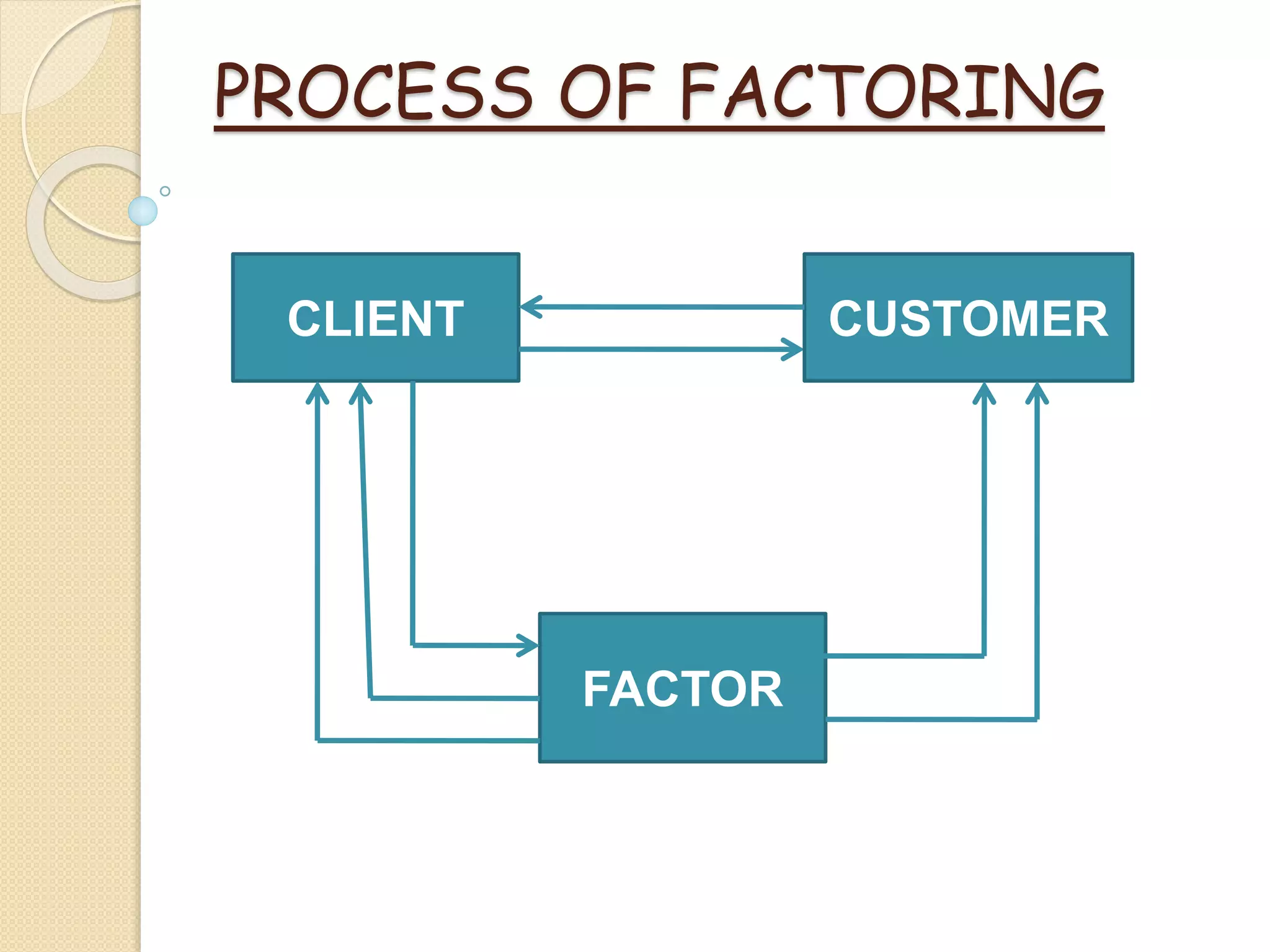
PROCESS OF FACTORING
CLIENT CUSTOMER
FACTOR
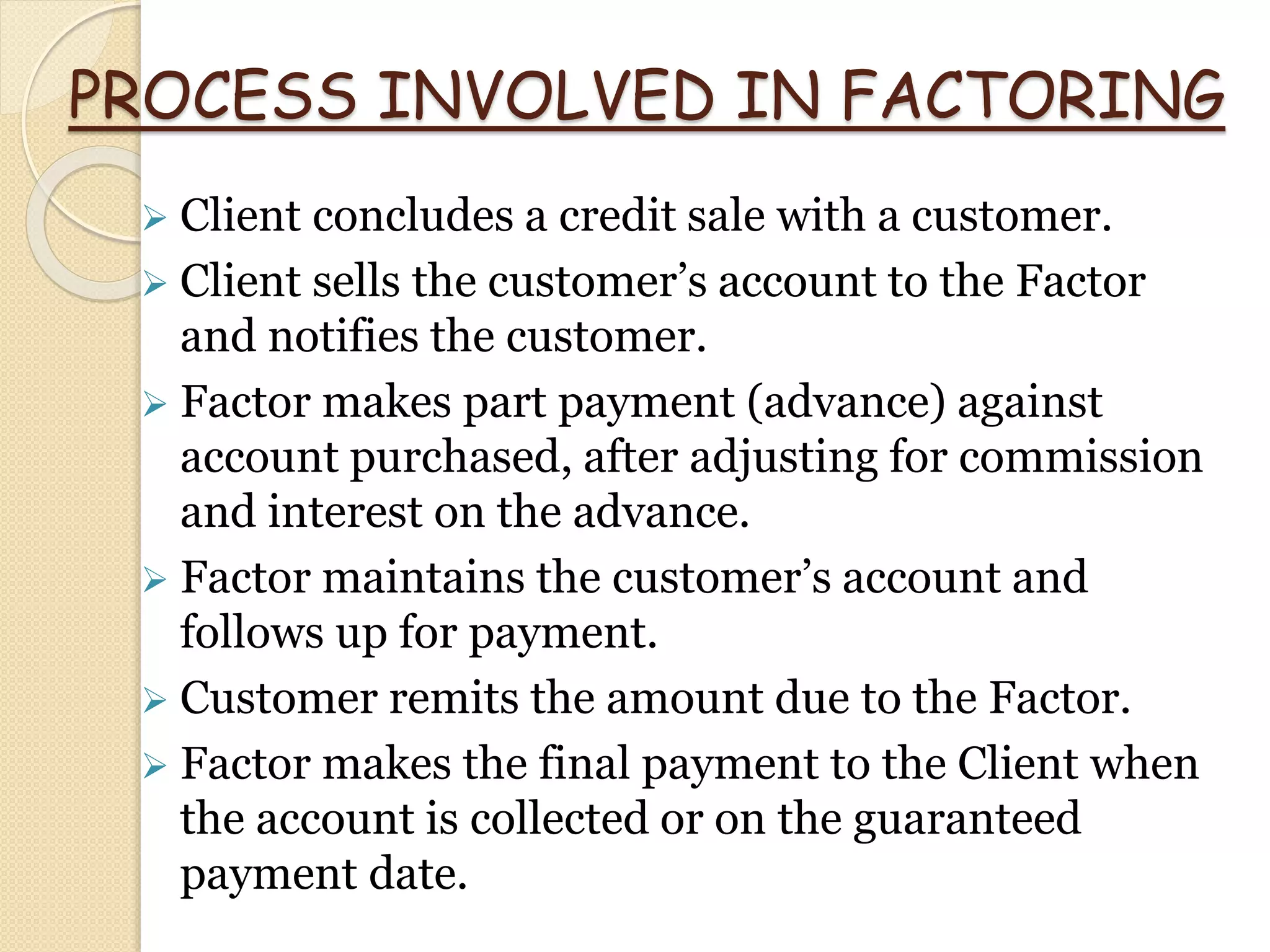
PROCESS INVOLVED IN FACTORING
 Client concludes a credit sale with a customer.
 Client sells the customer’s account to the Factor
and notifies the customer.
 Factor makes part payment (advance) against
account purchased, after adjusting for commission
and interest on the advance.
 Factor maintains the customer’s account and
follows up for payment.
 Customer remits the amount due to the Factor.
 Factor makes the final payment to the Client when
the account is collected or on the guaranteed
payment date.
MECHANISM OF FACTORING
a) An agreement is entered into between the
selling firm and the firm. The agreement
provides the basis and the scope understanding
reached between the two for rendering factor
service.
b) The sales documents should contain the
instructions to make payment directly to the
factor who is assigned the job of collection of
receivables.
c) When the payment is received by the factor,
the account of the firm is credited by the
factor after deducting its fees, charges,
interest etc. as agreed.
d) The factor may provide advance finance to
the selling firm conditions of the agreement
so require.
TYPES OF FACTORING
 Recourse Factoring
 Non-recourse factoring
 Maturity factoring
 Cross border factoring
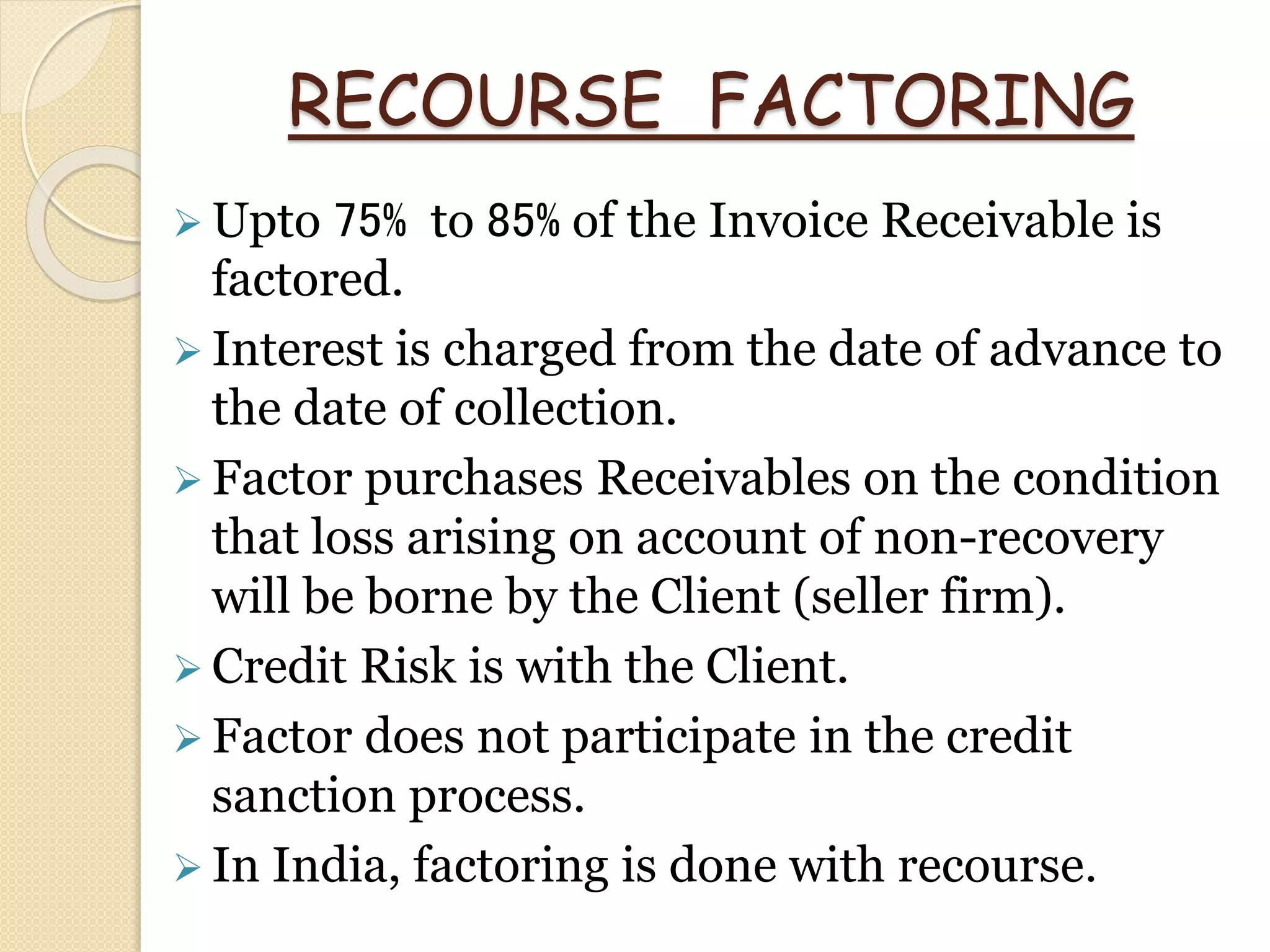
RECOURSE FACTORING
 Upto 75% to 85% of the Invoice Receivable is
factored.
 Interest is charged from the date of advance to
the date of collection.
 Factor purchases Receivables on the condition
that loss arising on account of non-recovery
will be borne by the Client (seller firm).
 Credit Risk is with the Client.
 Factor does not participate in the credit
sanction process.
 In India, factoring is done with recourse.
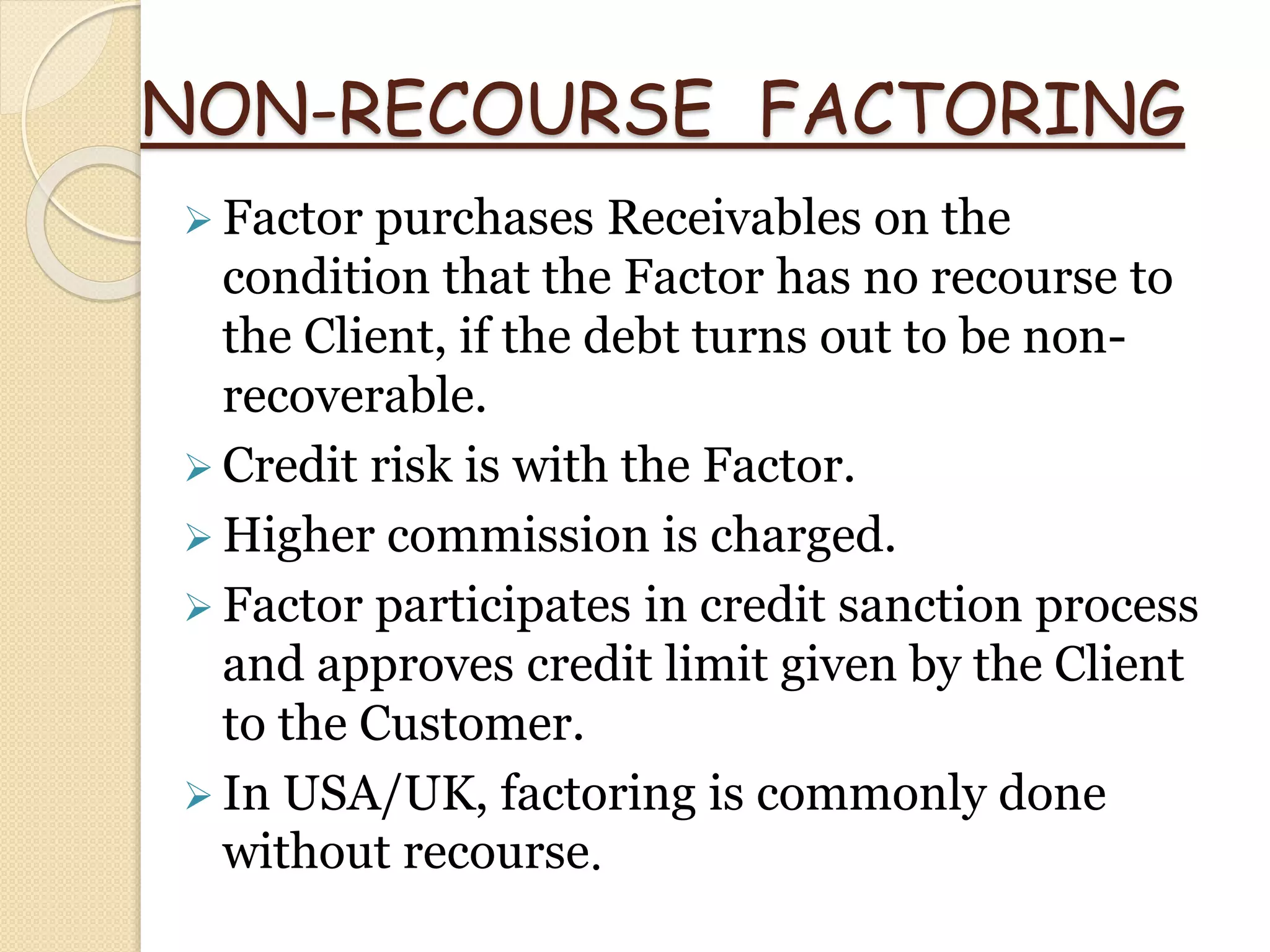
NON-RECOURSE FACTORING
 Factor purchases Receivables on the
condition that the Factor has no recourse to
the Client, if the debt turns out to be non-
recoverable.
 Credit risk is with the Factor.
 Higher commission is charged.
 Factor participates in credit sanction process
and approves credit limit given by the Client
to the Customer.
 In USA/UK, factoring is commonly done
without recourse.
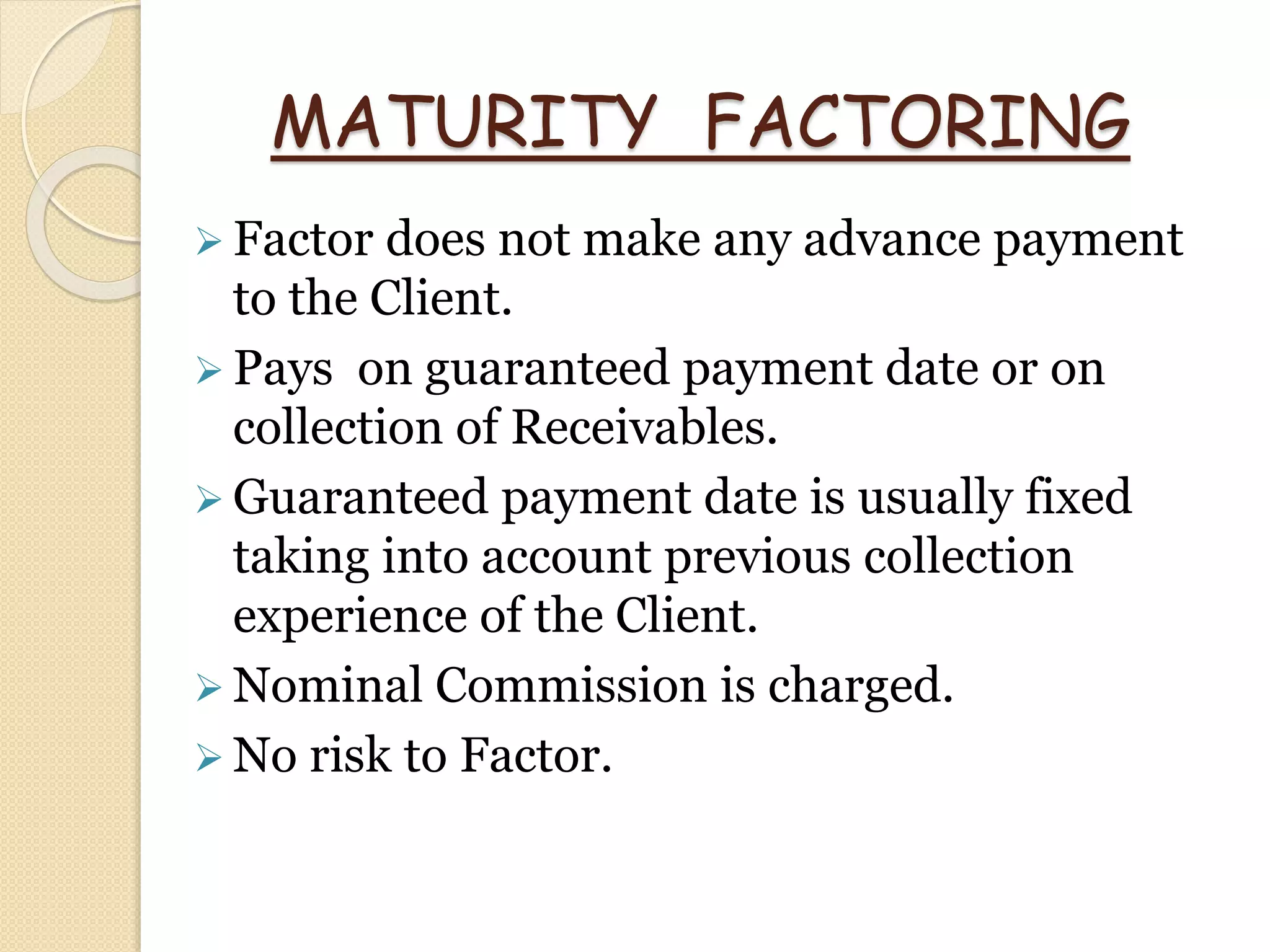
MATURITY FACTORING
 Factor does not make any advance payment
to the Client.
 Pays on guaranteed payment date or on
collection of Receivables.
 Guaranteed payment date is usually fixed
taking into account previous collection
experience of the Client.
 Nominal Commission is charged.
 No risk to Factor.
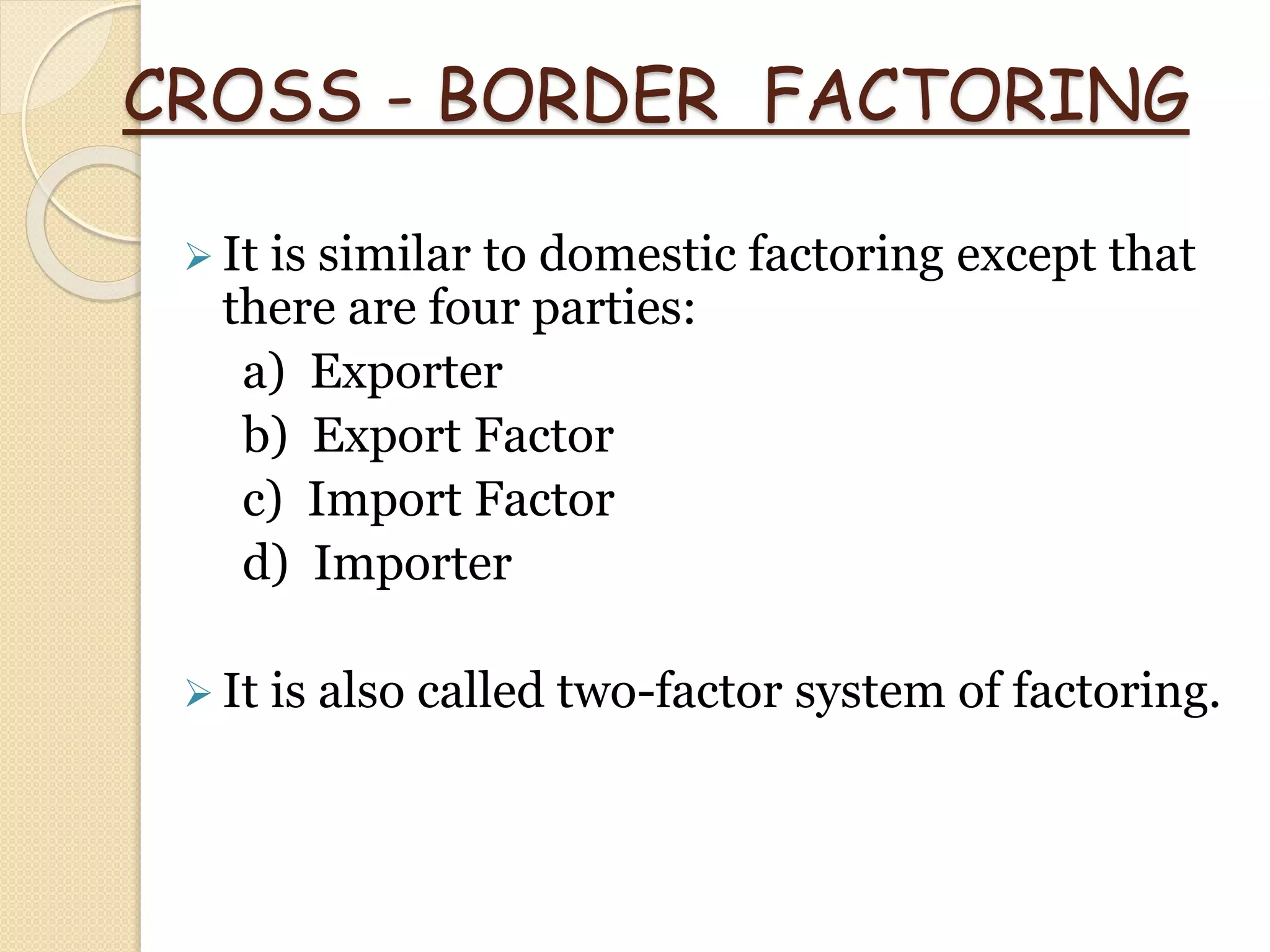
CROSS - BORDER FACTORING
 It is similar to domestic factoring except that
there are four parties:
a) Exporter
b) Export Factor
c) Import Factor
d) Importer
 It is also called two-factor system of factoring.
 Exporter (Client) enters into factoring
arrangement with Export Factor in his country
and assigns to him export receivables.
 Export Factor enters into arrangement with
Import Factor and has arrangement for credit
evaluation & collection of payment for an
agreed fee.
 Notation is made on the invoice that
importer has to make payment to the Import
Factor.
 Import Factor collects payment and remits
to Export Factor who passes on the proceeds to
the Exporter after adjusting his advance, if
any.
 Where foreign currency is involved, Factor
covers exchange risk also.
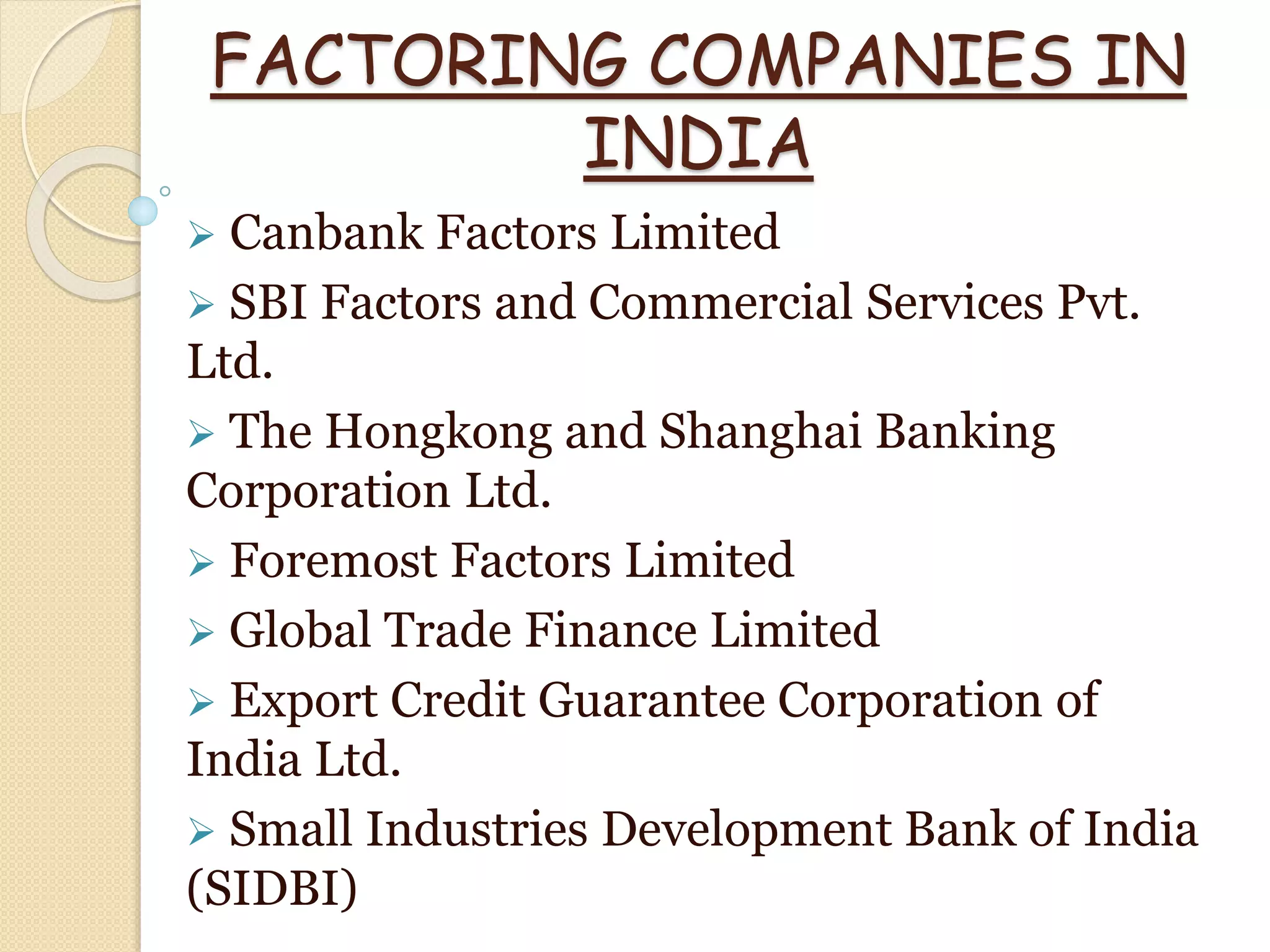
FACTORING COMPANIES IN
INDIA
 Canbank Factors Limited
 SBI Factors and Commercial Services Pvt.
Ltd.
 The Hongkong and Shanghai Banking
Corporation Ltd.
 Foremost Factors Limited
 Global Trade Finance Limited
 Export Credit Guarantee Corporation of
India Ltd.
 Small Industries Development Bank of India
(SIDBI)
STATUTES APPLICABLE TO
FACTORING
Factoring transactions in India are governed by
the following Acts:-
 Indian Contract Act
 Sale of Goods Act
 Transfer of Property Act
 Banking Regulation Act.
 Foreign Exchange Regulation Act.
THANK YOU

Factoring

  • 1.
  • 2.
    FACTORING The word “Factor”has been derived from the Latin word “Facere” which means “to make or to do or to get things done”. Factoring may broadly be defined as the relationship, created by an agreement, between the seller of goods/services and a financial institution called the factor, whereby the latter purchases the receivables of the former and also controls and administers the receivables of the former.
  • 3.
    Who is afactor? A factor is a financial institution that specializes in purchasing receivables from business firms. Factor assumes the risk of collection of receivables and on the event of non payment by debtors/customers bears the risk of bad debt and losses.
  • 4.
    PARTIES INVOLVED IN FACTORING Theparties involved in the factoring transaction are:- a) Supplier or Seller (Client) b) Buyer or Debtor (Customer) c) Financial Intermediary (Factor)
  • 5.
    CHARACTERISTICS OF FACTORING  Usuallythe period for factoring is 90 to 150 days. Some factoring companies allow even more than 150 days.  Factoring receivables is an ideal financial solution for new and emerging firms without strong financials. This is because credit worthiness is evaluated based on the financial strength of the customer (debtor).
  • 6.
     Factoring isconsidered to be a costly source of finance compared to other sources of short term borrowings.  Bad debts will not be considered for factoring. Credit rating is not mandatory. But the factoring companies usually carry out credit risk analysis before entering into the agreement.
  • 7.
     Follow-up andcollection of Receivables from Clients.  Purchase of Receivables with or without recourse.  Help in getting information and credit line on customers (credit protection)  Sorting out disputes, if any, due to his relationship with Buyer & Seller. SERVICES OFFERED BY FACTORING
  • 8.
  • 9.
    PROCESS INVOLVED INFACTORING  Client concludes a credit sale with a customer.  Client sells the customer’s account to the Factor and notifies the customer.  Factor makes part payment (advance) against account purchased, after adjusting for commission and interest on the advance.  Factor maintains the customer’s account and follows up for payment.  Customer remits the amount due to the Factor.  Factor makes the final payment to the Client when the account is collected or on the guaranteed payment date.
  • 10.
    MECHANISM OF FACTORING a)An agreement is entered into between the selling firm and the firm. The agreement provides the basis and the scope understanding reached between the two for rendering factor service. b) The sales documents should contain the instructions to make payment directly to the factor who is assigned the job of collection of receivables.
  • 11.
    c) When thepayment is received by the factor, the account of the firm is credited by the factor after deducting its fees, charges, interest etc. as agreed. d) The factor may provide advance finance to the selling firm conditions of the agreement so require.
  • 12.
    TYPES OF FACTORING Recourse Factoring  Non-recourse factoring  Maturity factoring  Cross border factoring
  • 13.
    RECOURSE FACTORING  Upto75% to 85% of the Invoice Receivable is factored.  Interest is charged from the date of advance to the date of collection.  Factor purchases Receivables on the condition that loss arising on account of non-recovery will be borne by the Client (seller firm).  Credit Risk is with the Client.  Factor does not participate in the credit sanction process.  In India, factoring is done with recourse.
  • 14.
    NON-RECOURSE FACTORING  Factorpurchases Receivables on the condition that the Factor has no recourse to the Client, if the debt turns out to be non- recoverable.  Credit risk is with the Factor.  Higher commission is charged.  Factor participates in credit sanction process and approves credit limit given by the Client to the Customer.  In USA/UK, factoring is commonly done without recourse.
  • 15.
    MATURITY FACTORING  Factordoes not make any advance payment to the Client.  Pays on guaranteed payment date or on collection of Receivables.  Guaranteed payment date is usually fixed taking into account previous collection experience of the Client.  Nominal Commission is charged.  No risk to Factor.
  • 16.
    CROSS - BORDERFACTORING  It is similar to domestic factoring except that there are four parties: a) Exporter b) Export Factor c) Import Factor d) Importer  It is also called two-factor system of factoring.
  • 17.
     Exporter (Client)enters into factoring arrangement with Export Factor in his country and assigns to him export receivables.  Export Factor enters into arrangement with Import Factor and has arrangement for credit evaluation & collection of payment for an agreed fee.  Notation is made on the invoice that importer has to make payment to the Import Factor.  Import Factor collects payment and remits to Export Factor who passes on the proceeds to the Exporter after adjusting his advance, if any.  Where foreign currency is involved, Factor covers exchange risk also.
  • 18.
    FACTORING COMPANIES IN INDIA Canbank Factors Limited  SBI Factors and Commercial Services Pvt. Ltd.  The Hongkong and Shanghai Banking Corporation Ltd.  Foremost Factors Limited  Global Trade Finance Limited  Export Credit Guarantee Corporation of India Ltd.  Small Industries Development Bank of India (SIDBI)
  • 19.
    STATUTES APPLICABLE TO FACTORING Factoringtransactions in India are governed by the following Acts:-  Indian Contract Act  Sale of Goods Act  Transfer of Property Act  Banking Regulation Act.  Foreign Exchange Regulation Act.
  • 20.