

RECEIVABLES MANAGEMENT
Presented by,
Shruthi.R.Nair
2nd sem
“ANY FOOL CAN LEND MONEY, BUT IT
TAKES A LOT OF SKILL TO GET IT BACK”
INDEX
 MEANING OF RECEIVABLES.
 UNDERSTANDING RECEIVABLES.
 WHY DO WE NEED RECEIVABLES & CHARACTERISTICS.
 FACTORS AFFECTING THE SIZE OF RECEIVABLES.
 MEANING OF RECEIVABLES MANAGEMENT.
 GRANTING CREDIT IN RECEIVABLES MANAGEMENT.
 DIFFERENT TYPE OF COSTS ASSOCIATED IN RECEIVABLE
MANAGEMENT.
 OBJECTIVES OF RECEIVABLES MANAGEMENT.
 BENEFITS OF RECEIVABLES MANAGEMENT.
 COLLECTION METHOD USED IN RECEIVABLES MANAGEMENT.
 SCOPE OF RECEIVABLES MANAGEMENT
 DIMENSIONS OF RECEIVABLES MANAGEMENT
MEANING OF RECEIVABLES
 “Receivables are sales made on credit basis”
 According to Hampton, “Receivables are asset accounts
representing amount owned to the firm as a result of the
sale of goods or services in the ordinary course of
business”. Thus receivables are an asset and represent
claims of the firms against its customers.
 According to Robert N. Anthony, “Account receivables are
amounts owned to the business enterprise, usually by its
customers. Sometimes it is broken down into trade
accounts receivables; in the former refers of amount
owned by employees and others”.
UNDERSTANDING RECEIVABLES
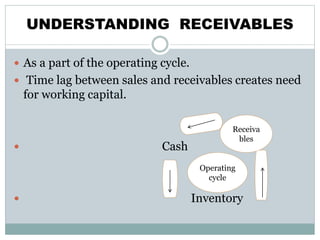
 As a part of the operating cycle.
 Time lag between sales and receivables creates need
for working capital.
 Cash
 Inventory
Operating
cycle
Receiva
bles
WHY DO WE NEED RECEIVABLES &
CHARACTERISTICS
 Reach Sales potential.
 competition.
CHARACTERISTICS
 It involves Risk.
Based on present economic value.
 It implies Futurity: The buyer makes the cash
payment for goods or services received by him
in future period.
FACTORS AFFECTING THE SIZE OF RECEIVABLES
 Level of sales.
 Nature & condition of Business.
 Credit policy of the firm: Credit policy means the policy
adopted to extend credit sales.
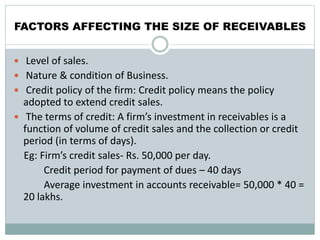
 The terms of credit: A firm’s investment in receivables is a
function of volume of credit sales and the collection or credit
period (in terms of days).
Eg: Firm’s credit sales- Rs. 50,000 per day.
Credit period for payment of dues – 40 days
Average investment in accounts receivable= 50,000 * 40 =
20 lakhs.
MEANING OF RECEIVABLES MANAGEMENT
 ‘Credit is the soul of business.’
 Receivable management is the process of making decisions
relating to investment in trade debtors. Certain investment in
receivables is necessary to increase the sales and the profits of
the firm. But at the same time investment in this asset involves
cost consideration also.
 Receivable management may be defined as collection of steps
and procedure required to properly weigh the costs and benefits
attached with the credit policies. The receivables management
consists of matching the cost of increasing sales (particularly
credit sales ) with the benefits arising out of increased sales with
the objective of maximising the return on investment of the firm.
GRANTING CREDIT IN RECEIVABLES
MANAGEMENT
 BASIC DECISIONS
1. To give credit or not.
2. Duration of credit period (selecting the right
policy)
 Decisions based on cost-benefit analysis.
 Positive net benefit-credit granted (highest net
benefit policy chosen)
 Negative net benefit-credit not granted.
DIFFERENT TYPE OF COSTS ASSOCIATED IN
RECEIVABLES MANAGEMENT
 CARRYING COSTS/CAPITAL COST: Cost incurred for
arranging additional funds to support credit.
 ADMINISTRATIVE COSTS: A firm is also required to
incur various costs in order to maintain the record and
collection from customers. These cost includes:-
# Salary to the staff kept for keeping the records of
credit sales and collection of payments.
# Cost of collecting cheques.
# Cost of ph calls, reminders and follow up.
# Use of office space, processing equipments etc...
# Accounting, recording and processing costs of
debtors balances.
 DELIQUENCY COSTS: These are the costs which are to be
incurred by a firm in order to collect the amount due from
customers on account of credit sales. Sometimes, additional
steps may have to be taken to recover the amount due from
defaulting customers. The costs of such extra steps e.g.
Reminders, legal charges etc... Are known as deliquency costs.
 DEFAULTING COSTS: Sometimes, the firm may not
collect the overdue from the customers since they are unable to
pay. These debts are treated as bad debts and are to be written
of accordingly since the amounts will not be realised in future.
OBJECTIVES OF RECEIVABLES MANAGEMENT
 Maximise the return on investment in receivables.
 Maximise the sales to the extent the risk involved
remains within the acceptable limit.
 Maintaining up-to-date record.
 Accurate billing.
 Establish the credit policies.
BENEFITS OF RECEIVABLES MANAGEMENT
 Growth in sales.
 Increase in Profits.
 Capability to Face competition.
 Helps to increase customer satisfaction.
 Takes control of sales processes.
COLLECTION METHODS USED IN RECEIVABLES
MANAGEMENT
 Post-dated cheques.
 Bank drafts.
 Debt Collector.
 Bills of exchange.
 Pay orders.
 Collection through staffs or agents.
 Lock-box system.
 Factoring.
 Concentration banking.
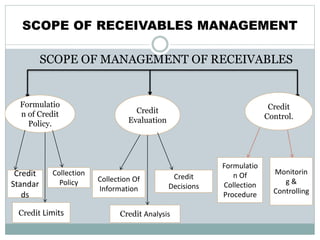
SCOPE OF RECEIVABLES MANAGEMENT
SCOPE OF MANAGEMENT OF RECEIVABLES
Formulatio
n of Credit
Policy.
Credit
Evaluation
Credit
Control.
Credit Limits
Credit
Standar
ds
Collection
Policy Collection Of
Information
Credit Analysis
Credit
Decisions
Formulatio
n Of
Collection
Procedure
Monitorin
g &
Controlling
DIMENSIONS OF RECEIVABLES MANAGEMENT
(1) CREDIT POLICIES:- Credit policy refers to the
application of those factors which influence the amount of
trade credit, i.e. Investment in receivables. TWO TYPES:-
(a) Liberal or lenient credit policy.
(b) Stringent or light credit policy.
(a) Where in credit sales are made liberally to those customers
whose credit –worthiness is either doubtful or even is not
known at all.
(b) Wherein credit sales are made only to those customers
whose credit-worthiness has been tested and is proved
good.
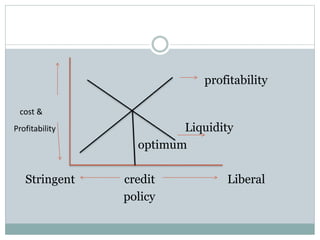
profitability
cost &
Profitability Liquidity
optimum
Stringent credit Liberal
policy
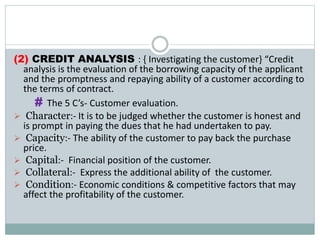
(2) CREDIT ANALYSIS : { Investigating the customer} “Credit
analysis is the evaluation of the borrowing capacity of the applicant
and the promptness and repaying ability of a customer according to
the terms of contract.
# The 5 C’s- Customer evaluation.
 Character:- It is to be judged whether the customer is honest and
is prompt in paying the dues that he had undertaken to pay.
 Capacity:- The ability of the customer to pay back the purchase
price.
 Capital:- Financial position of the customer.
 Collateral:- Express the additional ability of the customer.
 Condition:- Economic conditions & competitive factors that may
affect the profitability of the customer.
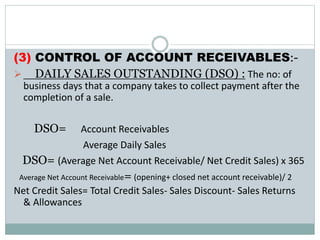
(3) CONTROL OF ACCOUNT RECEIVABLES:-
 DAILY SALES OUTSTANDING (DSO) : The no: of
business days that a company takes to collect payment after the
completion of a sale.
DSO= Account Receivables
Average Daily Sales
DSO= (Average Net Account Receivable/ Net Credit Sales) x 365
Average Net Account Receivable= (opening+ closed net account receivable)/ 2
Net Credit Sales= Total Credit Sales- Sales Discount- Sales Returns
& Allowances
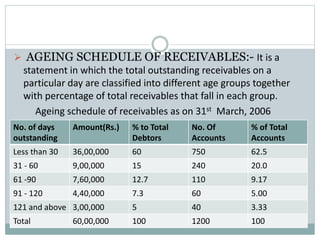
 AGEING SCHEDULE OF RECEIVABLES:- It is a
statement in which the total outstanding receivables on a
particular day are classified into different age groups together
with percentage of total receivables that fall in each group.
Ageing schedule of receivables as on 31st March, 2006
No. of days
outstanding
Amount(Rs.) % to Total
Debtors
No. Of
Accounts
% of Total
Accounts
Less than 30 36,00,000 60 750 62.5
31 - 60 9,00,000 15 240 20.0
61 -90 7,60,000 12.7 110 9.17
91 - 120 4,40,000 7.3 60 5.00
121 and above 3,00,000 5 40 3.33
Total 60,00,000 100 1200 100
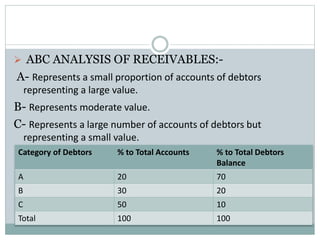
 ABC ANALYSIS OF RECEIVABLES:-
A- Represents a small proportion of accounts of debtors
representing a large value.
B- Represents moderate value.
C- Represents a large number of accounts of debtors but
representing a small value.
Category of Debtors % to Total Accounts % to Total Debtors
Balance
A 20 70
B 30 20
C 50 10
Total 100 100
IMPORTANCE OF RECEIVABLES MANAGEMENT
 Credit policy helps to meet the competition.
 Credit sales help to attract not only existing customers but also the new
customers but also the new customers.
 It helps to minimize bad debts.
 Liberalised credit policy helps to increase the growth of sales.
 Helps to increase the operating profits because of more credit sales.
 It ensures higher investment in trade debtors, which will produce
larger sales.
 It gives guidance to the management for effective financial planning
and control.
 It helps to make effective coordination between finance, production,
sales, profit and cost.
Receivable management presentation1

Receivable management presentation1

  • 1.
  • 2.
    “ANY FOOL CANLEND MONEY, BUT IT TAKES A LOT OF SKILL TO GET IT BACK”
  • 3.
    INDEX  MEANING OFRECEIVABLES.  UNDERSTANDING RECEIVABLES.  WHY DO WE NEED RECEIVABLES & CHARACTERISTICS.  FACTORS AFFECTING THE SIZE OF RECEIVABLES.  MEANING OF RECEIVABLES MANAGEMENT.  GRANTING CREDIT IN RECEIVABLES MANAGEMENT.  DIFFERENT TYPE OF COSTS ASSOCIATED IN RECEIVABLE MANAGEMENT.  OBJECTIVES OF RECEIVABLES MANAGEMENT.  BENEFITS OF RECEIVABLES MANAGEMENT.  COLLECTION METHOD USED IN RECEIVABLES MANAGEMENT.  SCOPE OF RECEIVABLES MANAGEMENT  DIMENSIONS OF RECEIVABLES MANAGEMENT
  • 4.
    MEANING OF RECEIVABLES “Receivables are sales made on credit basis”  According to Hampton, “Receivables are asset accounts representing amount owned to the firm as a result of the sale of goods or services in the ordinary course of business”. Thus receivables are an asset and represent claims of the firms against its customers.  According to Robert N. Anthony, “Account receivables are amounts owned to the business enterprise, usually by its customers. Sometimes it is broken down into trade accounts receivables; in the former refers of amount owned by employees and others”.
  • 5.
    UNDERSTANDING RECEIVABLES  Asa part of the operating cycle.  Time lag between sales and receivables creates need for working capital.  Cash  Inventory Operating cycle Receiva bles
  • 6.
    WHY DO WENEED RECEIVABLES & CHARACTERISTICS  Reach Sales potential.  competition. CHARACTERISTICS  It involves Risk. Based on present economic value.  It implies Futurity: The buyer makes the cash payment for goods or services received by him in future period.
  • 7.
    FACTORS AFFECTING THESIZE OF RECEIVABLES  Level of sales.  Nature & condition of Business.  Credit policy of the firm: Credit policy means the policy adopted to extend credit sales.  The terms of credit: A firm’s investment in receivables is a function of volume of credit sales and the collection or credit period (in terms of days). Eg: Firm’s credit sales- Rs. 50,000 per day. Credit period for payment of dues – 40 days Average investment in accounts receivable= 50,000 * 40 = 20 lakhs.
  • 8.
    MEANING OF RECEIVABLESMANAGEMENT  ‘Credit is the soul of business.’  Receivable management is the process of making decisions relating to investment in trade debtors. Certain investment in receivables is necessary to increase the sales and the profits of the firm. But at the same time investment in this asset involves cost consideration also.  Receivable management may be defined as collection of steps and procedure required to properly weigh the costs and benefits attached with the credit policies. The receivables management consists of matching the cost of increasing sales (particularly credit sales ) with the benefits arising out of increased sales with the objective of maximising the return on investment of the firm.
  • 9.
    GRANTING CREDIT INRECEIVABLES MANAGEMENT  BASIC DECISIONS 1. To give credit or not. 2. Duration of credit period (selecting the right policy)  Decisions based on cost-benefit analysis.  Positive net benefit-credit granted (highest net benefit policy chosen)  Negative net benefit-credit not granted.
  • 10.
    DIFFERENT TYPE OFCOSTS ASSOCIATED IN RECEIVABLES MANAGEMENT  CARRYING COSTS/CAPITAL COST: Cost incurred for arranging additional funds to support credit.  ADMINISTRATIVE COSTS: A firm is also required to incur various costs in order to maintain the record and collection from customers. These cost includes:- # Salary to the staff kept for keeping the records of credit sales and collection of payments. # Cost of collecting cheques. # Cost of ph calls, reminders and follow up. # Use of office space, processing equipments etc... # Accounting, recording and processing costs of debtors balances.
  • 11.
     DELIQUENCY COSTS:These are the costs which are to be incurred by a firm in order to collect the amount due from customers on account of credit sales. Sometimes, additional steps may have to be taken to recover the amount due from defaulting customers. The costs of such extra steps e.g. Reminders, legal charges etc... Are known as deliquency costs.  DEFAULTING COSTS: Sometimes, the firm may not collect the overdue from the customers since they are unable to pay. These debts are treated as bad debts and are to be written of accordingly since the amounts will not be realised in future.
  • 12.
    OBJECTIVES OF RECEIVABLESMANAGEMENT  Maximise the return on investment in receivables.  Maximise the sales to the extent the risk involved remains within the acceptable limit.  Maintaining up-to-date record.  Accurate billing.  Establish the credit policies.
  • 13.
    BENEFITS OF RECEIVABLESMANAGEMENT  Growth in sales.  Increase in Profits.  Capability to Face competition.  Helps to increase customer satisfaction.  Takes control of sales processes.
  • 14.
    COLLECTION METHODS USEDIN RECEIVABLES MANAGEMENT  Post-dated cheques.  Bank drafts.  Debt Collector.  Bills of exchange.  Pay orders.  Collection through staffs or agents.  Lock-box system.  Factoring.  Concentration banking.
  • 15.
    SCOPE OF RECEIVABLESMANAGEMENT SCOPE OF MANAGEMENT OF RECEIVABLES Formulatio n of Credit Policy. Credit Evaluation Credit Control. Credit Limits Credit Standar ds Collection Policy Collection Of Information Credit Analysis Credit Decisions Formulatio n Of Collection Procedure Monitorin g & Controlling
  • 16.
    DIMENSIONS OF RECEIVABLESMANAGEMENT (1) CREDIT POLICIES:- Credit policy refers to the application of those factors which influence the amount of trade credit, i.e. Investment in receivables. TWO TYPES:- (a) Liberal or lenient credit policy. (b) Stringent or light credit policy. (a) Where in credit sales are made liberally to those customers whose credit –worthiness is either doubtful or even is not known at all. (b) Wherein credit sales are made only to those customers whose credit-worthiness has been tested and is proved good.
  • 17.
  • 18.
    (2) CREDIT ANALYSIS: { Investigating the customer} “Credit analysis is the evaluation of the borrowing capacity of the applicant and the promptness and repaying ability of a customer according to the terms of contract. # The 5 C’s- Customer evaluation.  Character:- It is to be judged whether the customer is honest and is prompt in paying the dues that he had undertaken to pay.  Capacity:- The ability of the customer to pay back the purchase price.  Capital:- Financial position of the customer.  Collateral:- Express the additional ability of the customer.  Condition:- Economic conditions & competitive factors that may affect the profitability of the customer.
  • 19.
    (3) CONTROL OFACCOUNT RECEIVABLES:-  DAILY SALES OUTSTANDING (DSO) : The no: of business days that a company takes to collect payment after the completion of a sale. DSO= Account Receivables Average Daily Sales DSO= (Average Net Account Receivable/ Net Credit Sales) x 365 Average Net Account Receivable= (opening+ closed net account receivable)/ 2 Net Credit Sales= Total Credit Sales- Sales Discount- Sales Returns & Allowances
  • 20.
     AGEING SCHEDULEOF RECEIVABLES:- It is a statement in which the total outstanding receivables on a particular day are classified into different age groups together with percentage of total receivables that fall in each group. Ageing schedule of receivables as on 31st March, 2006 No. of days outstanding Amount(Rs.) % to Total Debtors No. Of Accounts % of Total Accounts Less than 30 36,00,000 60 750 62.5 31 - 60 9,00,000 15 240 20.0 61 -90 7,60,000 12.7 110 9.17 91 - 120 4,40,000 7.3 60 5.00 121 and above 3,00,000 5 40 3.33 Total 60,00,000 100 1200 100
  • 21.
     ABC ANALYSISOF RECEIVABLES:- A- Represents a small proportion of accounts of debtors representing a large value. B- Represents moderate value. C- Represents a large number of accounts of debtors but representing a small value. Category of Debtors % to Total Accounts % to Total Debtors Balance A 20 70 B 30 20 C 50 10 Total 100 100
  • 22.
    IMPORTANCE OF RECEIVABLESMANAGEMENT  Credit policy helps to meet the competition.  Credit sales help to attract not only existing customers but also the new customers but also the new customers.  It helps to minimize bad debts.  Liberalised credit policy helps to increase the growth of sales.  Helps to increase the operating profits because of more credit sales.  It ensures higher investment in trade debtors, which will produce larger sales.  It gives guidance to the management for effective financial planning and control.  It helps to make effective coordination between finance, production, sales, profit and cost.